
Let's get one thing straight right away: No, Ahrefs Domain Rating (DR) is not the same as Moz Domain Authority (DA). It's a common point of confusion, and for good reason. Both tools grade a website's "authority" on a 0-100 scale, but that’s where the similarities end. They’re built on completely different philosophies and measure different things.
Think of it this way: one isn’t better, they’re just different tools for different jobs. An experienced SEO knows when to pull out the right one.
Understanding Ahrefs DR vs. Moz DA
So, what’s the actual difference? At its core, Ahrefs DR is a straightforward, almost pure measure of a website's backlink profile. It looks at the quantity and, more importantly, the quality of websites linking to you. That’s pretty much it.
Moz DA, on the other hand, is trying to predict the future. It uses a complex machine learning model that chews on over 40 different factors to guess how well a site might rank in Google’s search results.
DR is a measure of link equity. DA is a prediction of ranking potential.
Once you grasp that fundamental distinction, you can start using these scores strategically. A high DR tells you a site has a powerful link profile, while a high DA suggests it has many of the ingredients that correlate with strong rankings.
Core Methodological Differences
The reason you’ll often see wildly different scores for the same website comes down to how each metric is calculated.
Ahrefs keeps things simple. DR focuses almost entirely on the backlink profile, answering a very specific question: "How strong is this website's backlink profile compared to every other site in our database?" This makes it a transparent and focused metric, perfect for link-building analysis.
Moz DA throws a much wider net. Its algorithm considers link data but also looks at many other signals to answer a broader question: "Based on all the factors we track, what is this site's general ability to rank in search results?" Because it’s a predictive model, it's less direct but aims for a more holistic picture of a site’s SEO health.
To make things a bit clearer, here’s a quick summary of how they stack up.
Ahrefs DR vs Moz DA At a Glance
This table breaks down the essential differences between the two metrics at a high level.
| Metric | Primary Focus | Scale | Primary Use Case |
|---|---|---|---|
| Ahrefs DR | The strength of a site's backlink profile | Logarithmic, 0-100 | Link building and competitor backlink analysis |
| Moz DA | Predictive ability to rank in search results | Logarithmic, 0-100 | High-level authority benchmarking and reporting |
Ultimately, worrying about whether Ahrefs DR is the same as Moz DA is the wrong way to think about it. The real skill is knowing how to read both scores, understand what they’re telling you, and use that insight to make smarter SEO decisions.
How Each SEO Metric Gets Calculated
To really get why a website’s Domain Rating and Domain Authority scores can look so different, you have to peek under the hood at how they’re built. The two platforms use fundamentally different engines to measure a site’s authority. This is why asking “is Ahrefs DR the same as Moz DA?” kind of misses the point. They aren’t even trying to measure the same thing in the same way.
Ahrefs’ Domain Rating (DR) is a pure reflection of a website's backlink profile strength. The calculation is pretty direct and transparent, focusing on two main things: how many unique websites (referring domains) link to a site, and the DR score of those linking domains.
It’s all based on the old-school concept of "link juice." A link from a high-DR website passes more authority than a link from a low-DR site. Simple as that. This makes DR a straightforward measure of link equity.
Ahrefs DR Calculation Factors
Ahrefs’ method is all about the raw power of your links. The core pieces of its calculation are:
- Quantity of Referring Domains: More unique sites linking to you generally means a higher DR.
- DR of Linking Domains: A single link from a DR 80 site carries way more weight than dozens of links from DR 10 sites.
- Link Distribution: The system also looks at how many other unique sites a domain links out to. If a site links to thousands of others, its "link juice" gets diluted, and each outbound link passes less authority.
This focused approach makes DR super sensitive to your link-building efforts. When you dig into how these SEO metrics are calculated, you can't ignore the role of quality backlinks in shaping a domain's strength.
Moz DA Calculation Factors
On the other hand, Moz’s Domain Authority (DA) uses a much more complex, predictive model. Instead of just counting link inputs, DA tries to correlate its massive link index against actual Google search engine rankings. It’s not a direct measure of your links but a comparative one.
This is done with a machine-learning algorithm that crunches over 40 different signals. While Moz keeps the exact formula under wraps, they’ve confirmed it includes a whole mix of factors to create a more holistic score.
The broader range of signals means DA can be less volatile than DR. It’s built to give you a more stable, big-picture view of a site’s potential to compete in the SERPs, not just its raw link power. This is a huge reason why the two scores for the same website rarely, if ever, match up.
Interpreting Differences in Real-World Scenarios
Knowing the formulas is one thing, but seeing how Domain Rating and Domain Authority behave out in the wild is where you get the real story. Their different calculation methods often tell conflicting tales about a website's authority, and learning to read between the lines is a crucial SEO skill.
For instance, imagine a brand-new website launches an aggressive link-building campaign, focusing on getting as many links as possible, fast. They might be guest posting on dozens of low-to-mid-tier blogs or even dabbling in shadier tactics to pump up their numbers.
Because Ahrefs’ DR is super sensitive to the raw count of referring domains, this kind of strategy can make a site's DR shoot up. A site could jump from DR 10 to DR 35 in just a few months, giving the illusion that its authority is exploding.
The Slow Burn of Moz DA
But Moz's DA would probably paint a very different picture. Its algorithm is built to predict ranking potential, factoring in signals like link trust and spam scores. It’s far less impressed by a flood of mediocre links.
While the DR is climbing, the DA might barely budge, maybe inching up just a few points. This gap between the two scores is a massive red flag. It suggests the link-building strategy is building hollow authority—the kind that Google’s much more sophisticated algorithms are unlikely to reward.
A rapidly increasing DR paired with a stagnant DA often points to a low-quality, high-volume link acquisition strategy that may carry long-term risks.
This scenario is exactly why you can't rely on a single metric. DR shows you the raw link volume being built, while DA offers a more cautious, holistic take on its actual ranking value.
A Tale of Two Strategies
Let's look at two hypothetical websites to see how this plays out.
Website A: Aggressive Guest Posting
- Strategy: Publishes 50 guest posts in three months on various blogs with DR scores ranging from 20 to 50.
- Result: DR jumps from 15 to 40. DA moves from 12 to 18.
- Interpretation: The DR spike reflects the sheer volume of new domains. The tiny DA increase, however, hints that these links lack the trust and quality signals Moz prioritizes, meaning they probably won't move the needle much in search rankings.
Website B: Strategic Link Acquisition
- Strategy: Secures three powerful backlinks from a university website (.edu), a major industry news outlet, and a government resource (.gov).
- Result: DR moves from 15 to 25. DA jumps from 12 to 28.
- Interpretation: DR only sees a modest bump because there are just a few new domains. But DA recognizes the immense trust and authority of these sources, predicting a much stronger impact on the site's ability to rank.
Digging into these different outcomes is a fundamental part of a solid SEO workflow. It's especially useful when you're figuring out how to conduct competitor analysis, as it uncovers the real story behind their link-building efforts. A competitor with a high DR but a low DA might look strong at first glance, but their backlink profile could be a house of cards.
Why Your Domain Scores Constantly Flactuate
It’s a feeling every SEO knows well. You log in to check your site's authority scores, and the number has dipped. A small knot of panic forms. Did you lose a high-value backlink? Is this a penalty from Google? More often than not, the real reason is far less dramatic.
To get a handle on this, you have to shift your thinking. Ahrefs DR and Moz DA aren’t absolute measures of your site’s value, like a grade on a test. They're relative rankings. Think of them as a competitive leaderboard, placing your website against every other site in their massive databases.
Your score is just a reflection of your position in an ecosystem that's always in flux. When a giant like Wikipedia or Facebook gains millions of new links, it doesn't just boost its own score—it recalibrates the entire 0-100 scale. The bar for what's considered a "high" score gets raised for everybody.
Index Updates and the Link Discovery Game
Another big reason for these swings is the constant churn of web crawling and index updates. SEO tool providers are always discovering new links and re-evaluating old ones across the entire web.
Picture it as a global census of backlinks that never stops. One day, Ahrefs or Moz might discover a fresh batch of authoritative links pointing to your competitors. Even if your own backlink profile is rock solid and hasn't changed at all, their newfound link equity can nudge your relative score down a point or two. It doesn’t mean your site got weaker; it just means the competition got a little stronger.
The key takeaway here is that your DR or DA can change even when your own backlink profile is completely stable. What happens elsewhere on the web directly impacts your score.
It's also worth remembering that both Moz DA and Ahrefs DR are built on their own private databases. They are not direct Google ranking factors, though they certainly correlate with a site's potential to rank. Both also use logarithmic scales, which makes it much harder to jump from a DA of 50 to 60 than it is to go from 10 to 20. You can find some more great insights on these competitive authority metrics on thehoth.com.
The Logarithmic Scale Effect
Finally, the logarithmic nature of both scales means that progress isn't a straight line. Gaining your first handful of backlinks might shoot your score from 1 to 10 pretty quickly. But climbing from DR 60 to DR 70? That requires a monumental amount of high-quality link equity—far more than what it took to get to 60 in the first place.
This design makes small fluctuations, especially at the higher end of the scale, completely normal. So instead of reacting to every one or two-point drop, focus on the long-term trend. A consistent strategy of building quality links will always win out, no matter what the score says on any given day.
Choosing the Right Metric for Your SEO Strategy
So, which metric should you trust: Ahrefs DR or Moz DA? The truth is, it’s not about which one is “better.” It’s about which one is right for the job you’re doing right now. Asking "is ahrefs dr same as mox da" misses the point entirely. The real question is, "which metric helps me hit my current goal?"
Each score gives you a unique lens to look through. Choosing the right one means matching its strengths to your immediate objective. They aren't interchangeable, and trying to use them that way can lead to some seriously flawed analysis and wasted hours. Think of it as a situational choice, not a permanent one.
When to Use Ahrefs Domain Rating
If your work revolves around backlinks, Ahrefs DR is your tool. It’s a pure, direct measure of link equity, making it the clear winner for any granular, link-focused task.
You should be reaching for DR when you’re doing things like:
- Deep Competitor Backlink Analysis: DR is perfect for evaluating the raw power of a competitor’s link profile. It helps you zero in on their most authoritative referring domains.
- Link Prospecting and Acquisition: When you're on the hunt for guest post opportunities or new link targets, DR gives you a reliable signal of how much link juice a site can actually pass.
- Tracking Link-Building Campaigns: Want to see the direct impact of your outreach? Watch how new, high-quality links move your DR score over time. It’s a clear and responsive indicator.
Because Ahrefs packs in so many other tools—like traffic estimates and paid search data—it paints a much richer picture of a site's complete online footprint. This is why many SEO pros live in Ahrefs. For a deeper dive on how DR stacks up against other metrics, check out our guide on Ahrefs vs KWFinder.
When to Use Moz Domain Authority
Moz DA is your go-to for a quick, high-level benchmark of a site's ranking potential. Its predictive model pulls from over 40 different factors, giving you a much broader, more holistic view than DR’s singular focus on links.
Lean on DA when you need to:
- Perform High-Level Health Checks: It’s a great way to quickly gauge a site's general authority before you dive into a full-blown SEO audit.
- Report to Stakeholders: DA is easy to understand. That makes it the perfect metric for monthly reports to clients or executives who don't need (or want) to get lost in the SEO weeds.
- Conduct Broad Competitive Benchmarking: Use DA to get a quick snapshot of where you stand against your main competitors in terms of overall SEO strength.
Situational Guidance: Here’s a simple rule of thumb: Use DR for precision in your link-building efforts. Use DA for a quick, comprehensive health check. Following this helps you pick the right tool for the job, every time.
The decision tree below does a great job of visualizing why a domain score might suddenly drop—it could be a big index update or just a competitor stepping up their game.
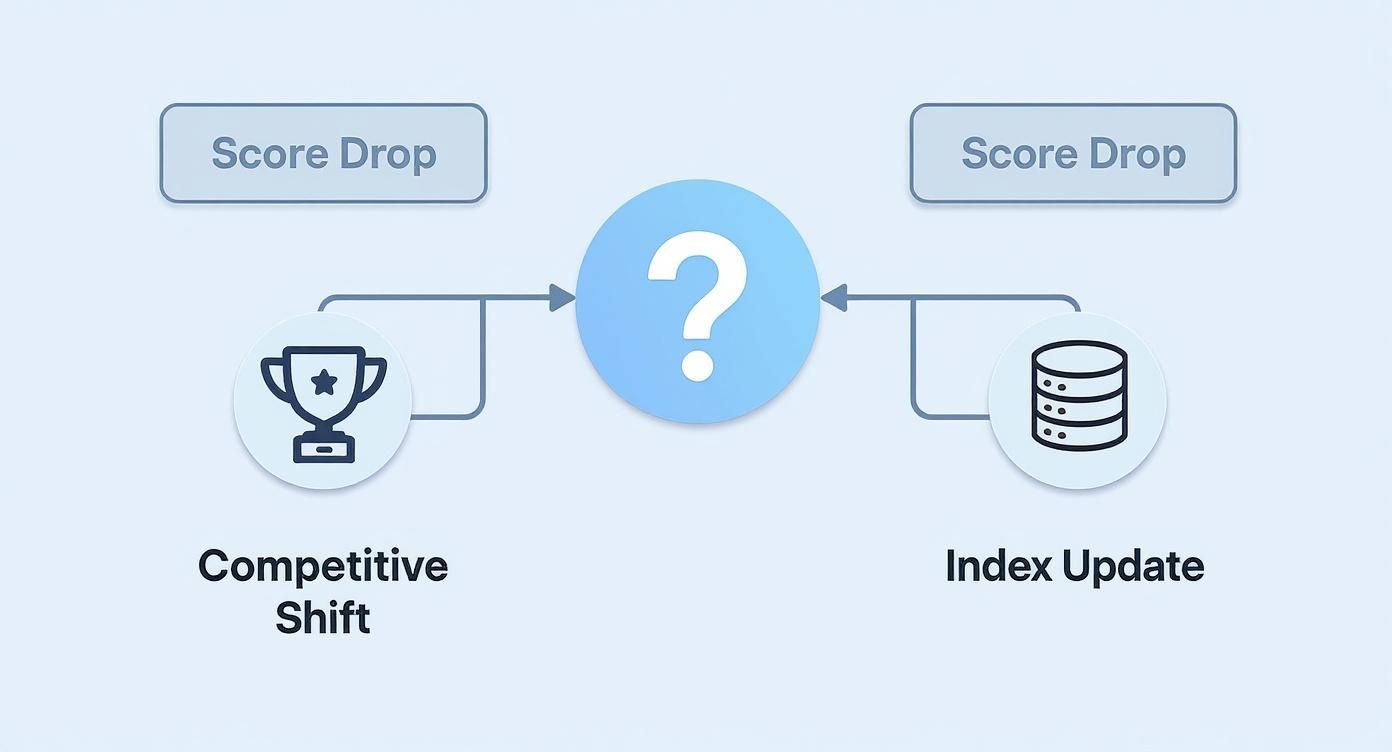
This is a great reminder that score fluctuations are often caused by external factors in the wider SEO ecosystem, not necessarily something you did or didn't do.
How to Strategically Improve Your Authority Scores

Trying to improve your authority scores isn't just about chasing a number on a dashboard. It’s about building a fundamentally stronger, more trustworthy website. That said, you can definitely tailor your efforts to influence either Domain Rating or Domain Authority more directly, depending on what you need to accomplish right now.
When it comes to boosting your Ahrefs DR, the strategy is refreshingly direct: get high-quality backlinks from a diverse set of websites. DR is extremely sensitive to both the quantity and strength of unique referring domains.
This means you should pour your energy into tactics that generate links at scale.
- Guest Posting: Zero in on websites with a strong DR themselves. This ensures the link equity passed back to your site is actually significant.
- Broken Link Building: Hunt for dead links on authoritative sites in your niche and slide in with your content as the perfect replacement.
- Digital PR: Launch campaigns that are genuinely interesting enough to earn natural mentions and links from news outlets and top industry blogs.
Building a Holistic Authority Profile
Improving your Moz DA requires all those same link-building tactics, but you’ll need to add a layer of finesse and a much broader focus. DA’s algorithm is designed to reward trust and a healthy overall SEO profile, not just raw link volume.
While DR is heavily focused on the quantity and quality of referring domains, DA also weighs the trustworthiness of those domains and your site's overall on-page health.
To really move the needle on your DA, you have to weave link acquisition into your other core SEO practices. This means prioritizing links from highly trusted sources—think .edu and .gov domains—which Moz’s algorithm really values. You also need to consistently clean up your link profile by disavowing toxic or spammy links that could be dragging you down. Our guide on how to improve SEO covers this well-rounded approach in more detail.
Ultimately, the smartest path forward is creating a comprehensive link building strategy that builds a sustainable, white-hat foundation for your site. An approach like this naturally raises both scores while driving what actually matters: more organic traffic and better rankings.
Frequently Asked Questions About DR and DA
When you’re digging into SEO metrics, it’s easy to end up with more questions than answers. When it comes to Domain Rating and Domain Authority, a few questions pop up again and again. Getting a straight answer helps you use these tools a lot more effectively in your day-to-day work.
Let's clear up some of the most common points of confusion so you can make smarter, more confident SEO decisions.
Which Metric Is More Accurate DR or DA
Honestly, neither metric is "accurate" in the way you might think—they aren't perfect mirrors of Google's algorithm. Their value really depends on what you're trying to accomplish. Ahrefs' DR gives you a much more direct and precise measure of a website's backlink profile strength. It’s the go-to for any deep, link-centric analysis.
On the other hand, Moz's DA is built to be more of a predictive indicator of a site's overall ability to rank in search results. If you’re doing a heavy-duty link-building analysis, you'll probably lean on DR. For a quick, holistic SEO health check, DA works just fine as a benchmark.
Why Are My DR and DA Scores So Different
This is completely normal, so don't sweat it. The scores are often wildly different because they’re calculated using unique methods, separate link indexes, and updated on different schedules. The real question isn't which one is right, but what each one is telling you.
Ahrefs DR is super sensitive to the raw number of referring domains, so you’ll see it jump around more during high-volume link building campaigns. Moz DA puts more weight on factors like link trust and spam signals, making it a slower, more stable metric.
Just treat them as two distinct data points. When you look at them together, you get a much more complete picture of your site's authority.
Should I Focus on Increasing My DA or DR Score
Your main focus should always be on building a strong, sustainable SEO strategy—not just chasing a higher score. Put your energy into creating genuinely valuable content and earning high-quality, relevant backlinks from authoritative sites.
When you nail those fundamentals, both your DR and DA scores will naturally climb over time. Use these metrics as diagnostic tools to guide your strategy and see how you stack up against competitors. But always, always measure your success with data that actually impacts your business, like organic traffic, leads, and revenue.
Ready to build real authority that drives measurable results? Up North Media offers data-driven SEO strategies that go beyond the scores to boost your organic traffic and revenue. Schedule your free consultation today!