
At its core, increasing your average order value (AOV) is all about encouraging customers to spend a little more on each purchase. It’s the art of getting them to add just one more item—or a slightly better item—to their cart before they hit that final checkout button.
This usually happens through smart tactics like offering product bundles, suggesting complementary items at the right moment, or setting a free shipping threshold that makes a larger purchase feel like a no-brainer.
What Is Average Order Value and Why It Matters
Average Order Value, or AOV, is a deceptively simple metric that tells you a whole lot about your business. It’s the average amount of money a customer spends every single time they place an order on your site.
Calculating it is straightforward: just divide your total revenue by the total number of orders over a certain period. So, if your store pulled in $10,000 from 200 orders in a month, your AOV would be $50. Simple, right?
But the real magic isn't in the calculation; it's in what you do with that number. Focusing on how to increase average order value is one of the most cost-effective ways to boost your revenue. Instead of throwing more money at ads to find new customers, you're making more from the traffic you already have. This has a direct, positive impact on your profitability and return on ad spend (ROAS).
The Strategic Importance of AOV
A higher AOV almost always leads to a higher customer lifetime value (CLV), which is one of the truest signs of a healthy, sustainable business. When people consistently spend more with you, their long-term worth to your brand skyrockets. We dive deeper into this connection in our guide on increasing customer lifetime value.
Keeping a close eye on your AOV also helps you understand your customers' buying habits. Is it trending up? That could mean your new product bundles are a hit. Is it dipping? You might have a pricing issue or friction in the checkout process.
Key Takeaway: AOV is more than just a sales metric; it's a diagnostic tool. It gives you a clear snapshot of purchasing behavior, helping you make smarter decisions about pricing, promotions, and product placement to drive profitable growth.
AOV in the Global Market
Even with economic headwinds, the global e-commerce AOV climbed to $144.57 as of last November. According to this Opensend report, that’s an 8.7% increase year-over-year.
This trend tells us that shoppers are willing to spend more per transaction. That’s a massive opportunity for any business that’s paying attention.
Ultimately, even a small lift in your store’s AOV can create a significant boost in overall revenue—all without spending another dime on customer acquisition.
AOV Growth Levers at a Glance
To give you a quick overview of the strategies we'll be covering, here's a breakdown of the core levers you can pull to increase your store's AOV. Each one targets a slightly different customer behavior but works toward the same goal: a healthier bottom line.
| Strategy | Primary Goal | Example Implementation |
|---|---|---|
| Upselling | Encourage purchase of a higher-end, more expensive version of an item. | Offer a "pro" version of a gadget with more features on the product page. |
| Cross-selling | Suggest relevant, complementary products to the main purchase. | Show batteries or a protective case when a customer adds a camera to their cart. |
| Product Bundling | Package multiple items together for a single, often discounted, price. | Sell a "Skincare Starter Kit" with a cleanser, moisturizer, and serum. |
| Free Shipping Threshold | Motivate customers to add more items to qualify for free shipping. | Display a message: "You're only $15 away from free shipping!" |
| Volume Discounts | Offer tiered pricing that rewards customers for buying in larger quantities. | "Buy 2 get 10% off, Buy 3 get 15% off" on t-shirts or consumables. |
| Loyalty Programs | Reward repeat customers with points or perks that encourage larger purchases. | Offer double points on all orders over $100. |
These are the foundational tactics that successful e-commerce brands use every day. As we go through this guide, we'll unpack how to implement each one effectively to see a real impact on your AOV.
Master Upselling and Cross-Selling Without Being Pushy
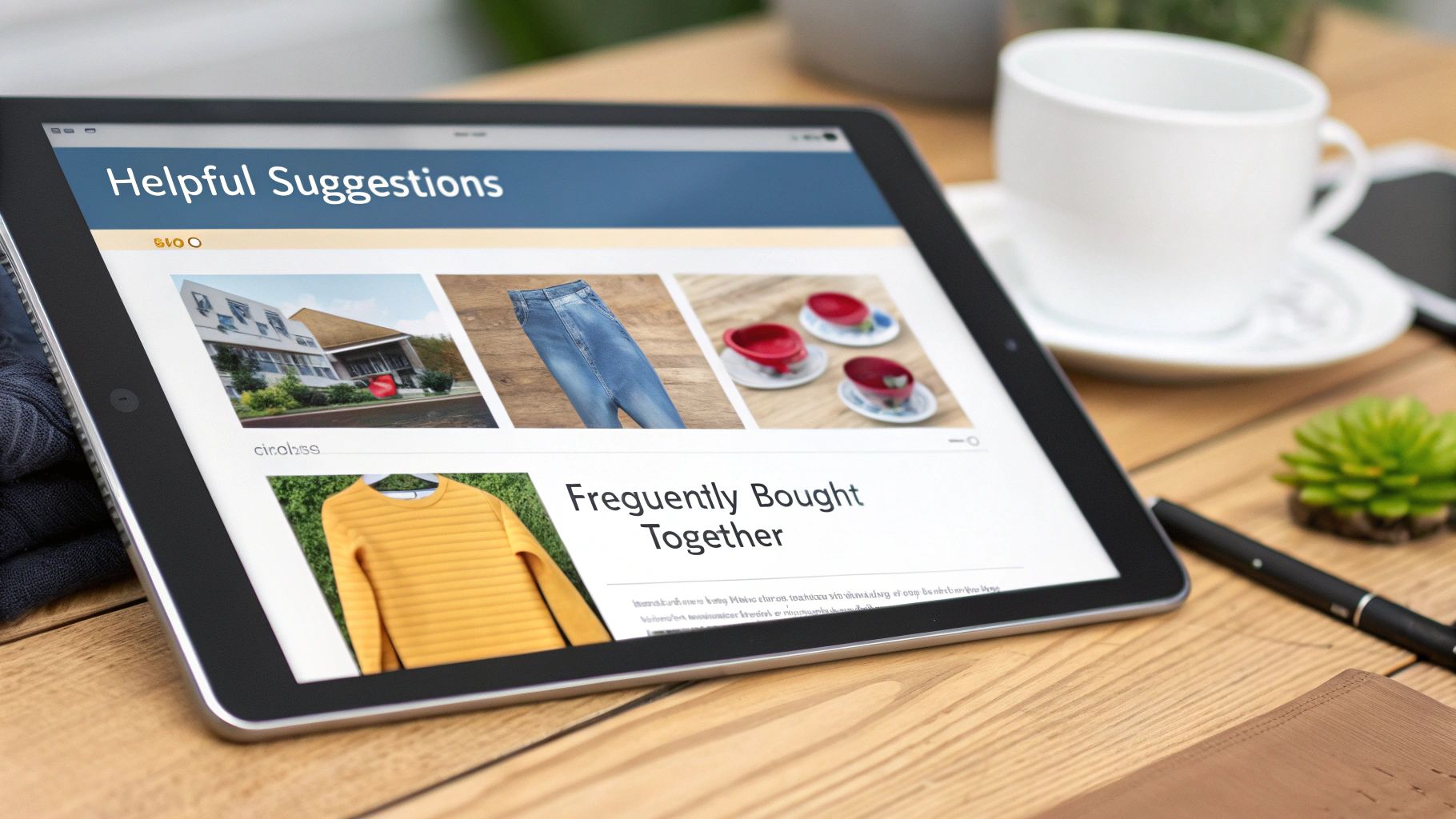 You’ve seen Amazon's "Frequently Bought Together" section, right? That's cross-selling 101, and it's a ridiculously effective way to lift your average order value. People often lump upselling and cross-selling together, but they’re two distinct tools in your e-commerce toolkit.
Upselling is all about encouraging a customer to buy a slightly better, more expensive version of what they're already looking at. Think of it as upgrading from a standard hotel room to a suite with a killer view.
Cross-selling, on the other hand, is about suggesting related items that make the original purchase even better. When someone adds a new phone to their cart, suggesting a case and screen protector is a classic cross-sell. The secret to making both work isn't pushiness—it's genuine, helpful advice.
The Art of the Relevant Suggestion
The golden rule here is relevance. Always. Offering a premium camera lens to someone buying a camera body is a smart upsell. Suggesting they buy a lawnmower with it? Not so much. Irrelevant offers just create friction and can make a customer question your brand's credibility.
To get this right, you have to really understand your products and what your customers actually need. Dig into your sales data and see what people are already buying together. This data-driven approach takes the guesswork out and makes sure your recommendations are based on real-world behavior.
For example, if you sell coffee beans, a natural cross-sell is a pack of filters or a quality grinder. An upsell might be a limited-edition single-origin bean that costs a few extra bucks but delivers a way better morning brew.
Key Insight: The best upsells and cross-sells don't just pump up the order total. They solve a customer's problem more completely, making them feel like they just made an even smarter purchase.
Strategic Placement for Maximum Impact
Where you place your offers is just as important as what you offer. You want to slide that suggestion in at the exact moment a customer is most likely to say yes.
Here’s where to focus your efforts:
- On Product Pages: This is prime real estate. A "compare models" table is perfect for upselling, while a "complete the look" or "customers also bought" section is a home run for cross-selling.
- In the Shopping Cart: Once an item is in the cart, the customer has already committed. This is a great time for small, relevant add-ons. A pop-up suggesting batteries for that electronic toy is a no-brainer.
- During Checkout: This is a delicate spot because you don't want to interrupt the final step. But a small, low-cost "impulse buy"—like a travel-size version of a popular product—can work wonders.
- Post-Purchase: Don't sleep on the "thank you" page and your follow-up emails. Offering a discount on a related product after the sale is a great way to bring customers back. Getting these emails opened is key; our guide on how to improve email open rates has some great tips.
Common Mistakes to Avoid
Upselling and cross-selling are powerful, but they can definitely backfire if you get too aggressive. Pushy or irrelevant offers are a one-way ticket to cart abandonment.
Here’s what to steer clear of:
- Offering Too Many Choices: Don't paralyze your customer with a dozen options. Stick to a few, highly relevant suggestions to avoid decision fatigue.
- Suggesting Items That Are Too Expensive: A good rule of thumb for a cross-sell is to keep its price significantly lower than the main product. An upsell should feel like a reasonable step up, not a massive leap in cost.
- Making the Offer Intrusive: Nobody likes a full-screen pop-up that blocks their path. Weave your recommendations seamlessly into the page design so they feel helpful, not annoying.
The fashion e-commerce world has this down to a science. Globally, the average order value for fashion has hit $102.30, a number driven by smart tactics like personalized styling suggestions and virtual try-ons that encourage shoppers to buy a complete outfit.
To stay ahead, it's worth exploring emerging trends like V-Commerce as a boost to up-sell goods, which can add a whole new dimension to your sales strategy. By mastering these helpful, non-pushy techniques, you can seriously increase your average order value and build much stronger relationships with your customers.
Create Product Bundles That Actually Sell
Product bundles are so much more than a simple discount. When you get them right, they completely change the conversation from individual price tags to the total value of a complete solution. It's a foundational strategy for anyone learning how to increase average order value because it makes the buying decision easier and solves a customer's entire problem in one click.
Instead of crossing your fingers and hoping a shopper finds everything they need, you hand them a perfectly curated package. Think about it: you could sell a camera, or you could sell a "Vlogger Starter Kit" with the camera, tripod, microphone, and memory card. One is a product. The other is an instant career.
The trick is to create bundles that feel like a natural, thoughtful solution. You want the customer thinking, "Wow, they thought of everything."
Uncover Natural Product Pairings in Your Data
The absolute best bundle ideas are already hiding in your sales data. Before you start guessing what products go together, you need to dig into your order history and see what your customers are already buying together. This isn't about guesswork; it's about following proven customer behavior.
Look for the patterns. Do people who buy your best-selling coffee beans also tend to grab a specific type of filter? That's your first bundle right there. These organic pairings are low-hanging fruit because you already have proof of demand.
Most e-commerce platforms like Shopify have built-in analytics, but third-party apps can also help you visualize these connections, making it dead simple to spot your most powerful product pairings.
By bundling products, you’re increasing the perceived value of a customer’s purchase. The package feels like a special offer designed to provide a comprehensive experience, making the higher price point an easy decision for the shopper.
Design Bundles That Solve a Specific Problem
Once you've spotted some potential pairings, the real magic is in how you frame them. A generic name like "Bundle #3" has zero appeal. But a "Complete Morning Routine" skincare set or a "New Puppy Welcome Kit"? Those tell a story and scream value.
Think about the different types of problems you can solve for your customers:
- Starter Kits: Perfect for newbies. Group the essentials someone needs to get started with your brand. A home-brewing company could offer a kit with the fermenter, ingredients, and sanitizer—everything for that first batch.
- Curated Collections: These are all about selling a full experience. A fashion brand could sell a "Complete Summer Outfit" that includes the dress, sandals, and sunglasses. You're no longer selling items; you're selling a look.
- Bulk or Refill Bundles: A no-brainer for consumables. Offer a nice discount for buying a three-month supply of protein powder or a six-pack of your most popular hot sauce.
And here’s the non-negotiable part: every bundle needs a clear financial incentive. The total price must be less than buying each item separately. This reinforces the value and makes the customer feel smart for choosing the bundle.
Make Your Bundles Impossible to Miss
Creating a killer bundle is only half the job. You have to get it in front of people. Don't just bury your bundles on some forgotten category page; feature them prominently where high-intent shoppers are guaranteed to see them.
Here’s where to place them for maximum impact:
- On Product Pages: When a customer is looking at a single item that's part of a bundle, show them the full bundle as an upgrade. Make it obvious they can get more value by choosing the complete package.
- In Pop-Ups: Use cart-triggered pop-ups to make a timely suggestion. If someone adds a single bottle of shampoo, a pop-up can offer the "Hair Care Trio" with conditioner and a treatment mask at the special bundle price.
- Dedicated Landing Pages: For your best-sellers, create a dedicated landing page for the bundle itself. Then, drive traffic there from your email campaigns and social media ads.
If you're selling on Amazon, you can use platform-specific features like Amazon Virtual Bundles to build and promote your bundles directly. The end goal is to weave your bundles so seamlessly into the shopping journey that they become the most obvious, appealing choice, lifting your AOV without you even trying.
Turn Free Shipping Into a Powerful Sales Tool
Let's be honest, "free shipping" is one of the most powerful phrases in e-commerce. It’s more than just saving a few bucks; for a lot of shoppers, seeing that shipping fee pop up at checkout is a major turn-off. It’s a point of friction that can kill a sale instantly. But you can flip this expectation on its head and turn it into one of your best tools for boosting your average order value.
The strategy is simple but incredibly effective: offer free shipping, but only once a customer's cart hits a certain dollar amount. This little nudge encourages shoppers who are almost there to add one more item. The urge to "unlock" free shipping often feels more valuable than the cost of that extra product, pushing your AOV higher in the process.
Finding Your Free Shipping Sweet Spot
Figuring out the right threshold is a bit of an art. Set it too high, and you'll just annoy people and watch your cart abandonment rate climb. Set it too low, and you’re just giving away free shipping without actually encouraging anyone to spend more, which eats right into your profits.
A great place to start is setting your threshold about 15-20% higher than your current average order value. So, if your AOV is currently $50, a $60 threshold is the perfect target. For a customer who was already planning to spend $50, adding another small $10 or $15 item to save on shipping feels like a smart, justifiable move.
Pro Tip: Don't just look at your AOV. Dig into your modal order value—the single most common order total. If you see that tons of orders are hovering right around $40, setting a $50 threshold can be a super effective way to get those specific customers to spend just a little bit more.
Before you roll this out, take a hard look at your shipping costs and product margins. You need to be sure that the bump in order value will more than cover the cost of shipping. Once you have a number, test it out and keep a close eye on your metrics to make sure it's working as planned. If you want to dive deeper, our guide on how to reduce cart abandonment has some great tips for keeping customers on track.
Make the Offer Impossible to Ignore
Once you've landed on your magic number, you have to make sure every single shopper sees it. Don't bury it on some policy page no one reads. You want to weave it into the shopping experience itself, almost like a mini-game.
Here are the best ways to get it in front of them:
- A Dynamic Announcement Bar: Stick a banner right at the top of every page that says something like, "Free shipping on all orders over $60!" It sets the expectation from the moment they land on your site.
- A Cart Progress Indicator: This is a total game-changer. As someone adds items to their cart, a little bar or text updates to show them how close they are. Phrases like, "You're only $12.50 away from free shipping!" create a natural sense of urgency and make it a no-brainer to add another item.
- Showcase It on Product Pages: A little note right by the "Add to Cart" button plants the seed early. It gets shoppers thinking about what else they could grab while they’re already browsing.
By making your free shipping offer a core part of the experience, you change it from a passive perk into an active sales driver. You're not just giving something away for free; you're creating a compelling reason for customers to spend more time on your site, discover more of your products, and ultimately, spend more with every order.
Build Loyalty Programs That Encourage Higher Spending
Boosting your average order value isn't just about squeezing more out of a single transaction. It’s about building long-term habits that get customers to consistently spend more with you. This is where a smart loyalty program becomes one of your most valuable tools. You're shifting the relationship from a one-off purchase to a long-term partnership where customers get real, tangible rewards for sticking around.
A good loyalty program changes the customer's internal monologue from "What's the cheapest option?" to "How do I get the most rewards out of this?" It gives them a compelling reason to consolidate their shopping with your brand instead of browsing your competitors. Over time, this strategy is a direct pipeline to a higher AOV.
Just look at how a simple incentive, like a free shipping threshold, can nudge a customer to add one more thing to their cart, significantly lifting the final order value.
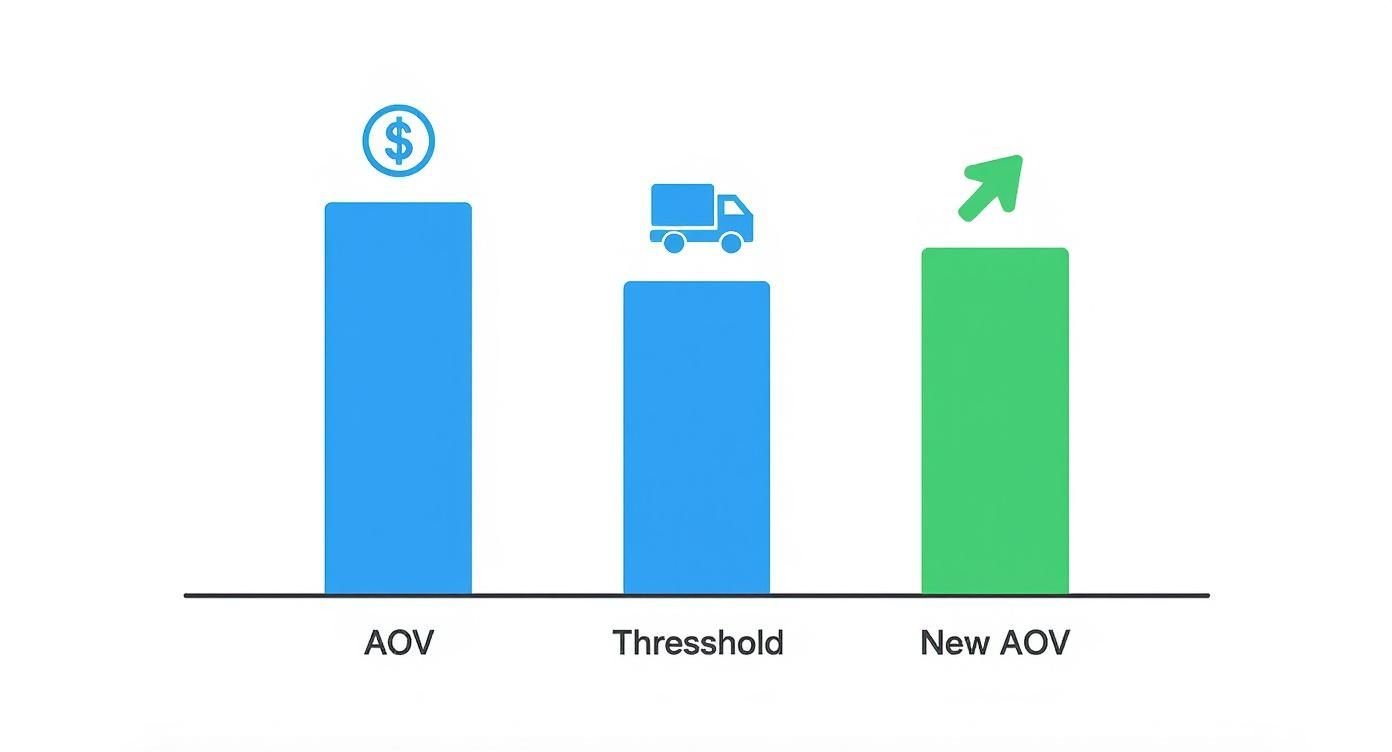
The visual makes it obvious: by encouraging customers to bridge that small gap to reach a goal, you can easily push their total spend well past your typical AOV.
Designing a Program That Drives Spending
The most successful loyalty programs tap into our natural desire for progression and exclusivity. They make shoppers feel like they're working toward something, unlocking better perks and status as they go.
Think about these proven models:
- Tiered Rewards: This is the gold standard for encouraging bigger spends. Customers unlock new levels of benefits—like better discounts, early access to new products, or exclusive sales—as their lifetime spending increases. Sephora's Beauty Insider program is a masterclass in this, with its VIB and Rouge tiers creating a powerful incentive to keep shopping.
- Points-Based Systems: A straightforward classic where customers earn points for every dollar spent. The real magic happens when you gamify it by offering double or triple points on orders over a certain amount. A simple banner saying, "Earn 2x points on all orders over $75!" can be incredibly effective.
- Exclusive Member Benefits: Sometimes the best perks aren't about money, but access. Offering members-only content, a private community forum, or priority customer service can build a powerful sense of belonging that translates directly into loyalty and higher spending.
Key Takeaway: A loyalty program's main purpose is to make your best customers feel seen and valued. When shoppers feel appreciated and have a clear path to better rewards, they are far more likely to increase their cart size just to hit that next milestone.
Linking Loyalty to Real-World Results
Structuring your loyalty program the right way can have a massive impact on your bottom line. For Shopify stores, the global AOV typically falls between $85–$92, but the top performers blow past that. The top 10% of stores consistently achieve an AOV over $120 by leaning into tactics just like these. In fact, you can find more insights about e-commerce benchmarks and see how well-executed strategies can lift AOV by 50% or more.
To make it all work, you need to weave the program right into the shopping experience. Use on-site pop-ups and banners to remind customers how many points they'll earn or how close they are to the next tier. This constant reinforcement keeps the program top-of-mind and provides that final nudge to add one more item to their cart.
AOV Strategy Effectiveness Comparison
Not all AOV-boosting tactics are created equal. Some are quick wins, while others require more technical setup or a deeper understanding of your customer. This table breaks down the effort versus the potential reward for several popular strategies.
| Strategy | Potential AOV Lift | Implementation Effort | Customer Experience Impact |
|---|---|---|---|
| Tiered Loyalty Program | High (15-30%) | Medium-High | Very Positive (Rewards loyalty) |
| Order Minimum for Free Shipping | Medium (10-20%) | Low | Positive (Clear incentive) |
| Product Bundling | Medium (10-25%) | Medium | Positive (Offers value/discovery) |
| One-Click Upsells (Post-Purchase) | Low-Medium (5-15%) | Medium | Neutral (Can feel pushy if irrelevant) |
| Volume Discounts | Medium (10-20%) | Low | Positive (Encourages bulk buying) |
| Cross-Sells on Product/Cart Page | Low-Medium (5-15%) | Low-Medium | Mostly Positive (Helpful if relevant) |
Ultimately, a tiered loyalty program often delivers the highest long-term lift, though it requires more initial setup. Simpler tactics like free shipping thresholds are fantastic starting points. By turning shopping into a rewarding game, you can systematically increase your average order value and build a loyal community that keeps coming back.
Use Personalization to Drive Smarter Recommendations
Generic product recommendations are a dead end. Seriously. In today’s e-commerce world, the biggest jumps in average order value come from making each customer feel like you’re their personal shopper. That means getting way past just showing "top sellers" to everyone who lands on your site.
This is where hyper-personalization comes in. It’s all about using customer data—like past purchases, items they’ve clicked on, and even products left in their cart—to offer suggestions that are genuinely useful. When your site knows a customer just bought running shoes, suggesting the right socks and anti-chafe balm feels like a helpful service, not a hard sales pitch. It's a fundamental shift in how you think about selling.
Using Data for Smarter Suggestions
The goal is to transform your website from a static catalog into a dynamic, responsive shopping assistant. You can't do this manually; modern AI and machine learning tools are pretty much essential here. They crunch customer behavior in real time to predict what shoppers will want next, sometimes before the shoppers even know it themselves.
And it works. Companies that nail personalization consistently outperform their competitors. Some studies show they can generate up to 30% more revenue, which proves that a tailored experience isn't just a nice feature—it's a massive profit driver.
When every recommendation feels like a thoughtful suggestion from a trusted expert, the whole dynamic shifts. You're no longer just pushing products; you're helping customers find better solutions, which naturally leads them to fill up their carts.
Where to Put Personalized Recommendations
To really get the most out of this, you need to place these tailored suggestions at key moments throughout the customer's journey. Don't just stick a single "You Might Also Like" carousel at the bottom of a page and call it a day.
Instead, think strategically about where they'll make the biggest impact:
- On the Homepage: When a customer returns, greet them with a dynamic section showing products related to what they last bought or looked at. It immediately shows you remember them.
- On Product Pages: This is prime real estate. Show complementary items that complete a look or enhance the main product. Someone looking at a leather bag? Show them the matching wallet and belt.
- In the Shopping Cart: Right before checkout is your last, best chance. Suggest small, relevant add-ons. Think of it as the digital version of the candy and magazine aisle at the grocery store.
- In Email Campaigns: After a purchase, send a follow-up email showcasing other items that pair perfectly with what they just bought. It keeps the conversation going.
By making every interaction feel unique, you build trust and show that you offer value beyond just the products. This turns upselling and cross-selling from a sales tactic into a welcome service, encouraging customers to stick around, explore more, and ultimately boost both your AOV and their long-term loyalty.
Your Top AOV Questions, Answered
Once you start digging into raising your average order value, a few common questions always seem to surface. We hear them all the time from store owners, so let's clear them up right now.
What’s a Good Average Order Value to Aim For?
Honestly, there’s no magic number. A “good” AOV is completely relative to your industry and what you sell. A luxury watch store will have a wildly different AOV than a shop selling stickers. Chasing some universal benchmark is a waste of time.
Instead, your best benchmark is yourself. Look at your own historical data. A realistic—and seriously impactful—goal is to shoot for a steady 10-20% lift quarter-over-quarter. If you need a ballpark, the global e-commerce AOV sits around $144, while the fashion industry is closer to $102. Use those as a loose guide, but always focus on beating your own last record.
Will Raising My Free Shipping Threshold Scare Away Customers?
This is a totally valid fear, but you can get around it by being smart. The trick is to set your free shipping threshold just a little bit above your current AOV. We've found the sweet spot is typically 15-20% higher. This nudges customers who are already close to the finish line to add one more small thing, rather than making the goal feel impossible.
Don't just set it and forget it, though. Test everything. Once you roll out a new threshold, keep a close eye on your cart abandonment rate. If it jumps up, you’ve probably aimed too high.
Pro Tip: Make it a game. Use a dynamic progress bar in the cart with a message like, "You're only $8 away from free shipping!" It feels less like a sales tactic and more like a smart move for the customer.
How Do I Create Product Bundles That Actually Sell?
The best bundles aren't just a random collection of products. They solve a real problem for the customer or offer a complete, no-brainer experience. Your best friend here is your own sales data. Dive into your order history and see what people are already buying together.
Once you spot those patterns, you can build offers that people actually want:
- Create "starter kits" for new customers just getting into your products.
- Design "pro bundles" for your loyal fans or enthusiasts.
- Offer bulk discounts on items people buy over and over again.
Most importantly, the bundle has to scream value. The total price needs to be clearly less than buying each item on its own. And give it a name that sells the outcome, like "The Ultimate Morning Coffee Kit" instead of a boring "Bundle #3." Framing it this way helps customers see the benefit, not just the discount.
Ready to elevate your digital strategy and drive real revenue growth? The experts at Up North Media specialize in data-driven SEO and custom web solutions that boost key metrics like AOV. Learn more about our services.