
AI solutions for businesses aren't about sci-fi robots taking over. Forget the hype. Think of AI as a practical tool—your most capable employee, really—one that helps you and your team work smarter, not harder.
Putting AI to Work in Your Business
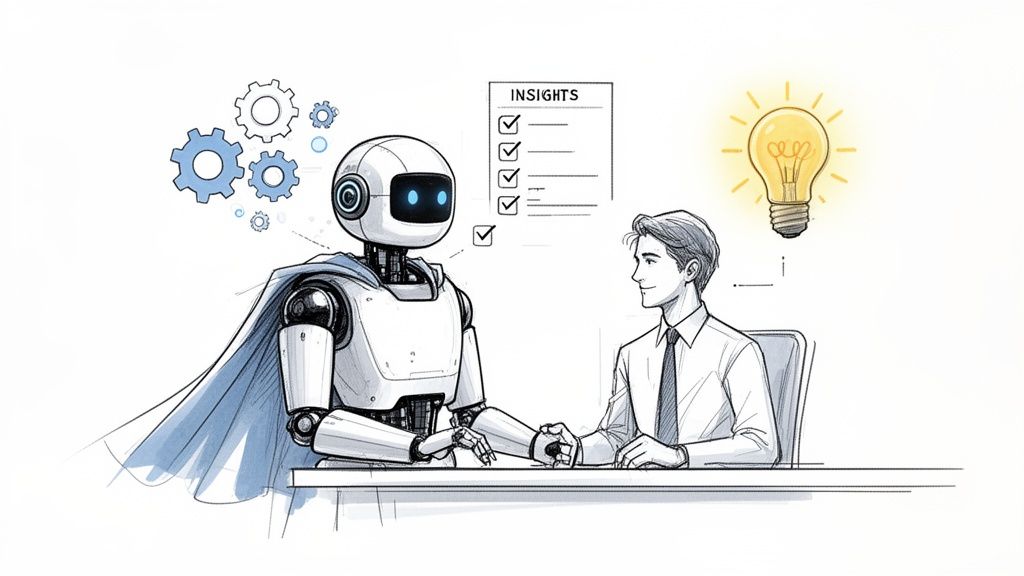
Artificial intelligence isn't just for tech giants and research labs anymore. For small and mid-sized companies, it's become an accessible and surprisingly powerful way to hit specific business goals. At its heart, AI is a superpower that amplifies what your team can do, letting them ditch the repetitive grunt work and focus on what really matters.
This move from an experimental toy to a core business driver is happening fast. Between 2020 and 2024, AI went from a nice-to-have add-on to a central piece of the growth puzzle, especially in marketing, sales, and operations. By 2024, global surveys found that 78% of organizations were using AI in at least one part of their business—a huge jump from just 55% the year before. Some leading companies even expect 60% higher revenue growth by 2027 because of it.
What This Means for You
The real value of AI today is in its practical applications. We're past the point of abstract theories; businesses are seeing real results that directly pad their bottom line. It’s all about solving everyday problems more efficiently.
Think about these immediate benefits:
- Boosted Revenue: Smart marketing tools can personalize customer outreach on a massive scale, bumping up conversion rates.
- Reduced Costs: AI-driven automation can take over tasks like data entry and routine customer support, freeing up your team’s time for bigger things.
- Smarter Decisions: AI can sift through market data to spot trends you might have missed, giving you a genuine competitive edge.
To get a better sense of this, just look at how harnessing AI in ecommerce is creating new engines for growth. The key takeaway here is that you don't need a massive budget or a team of data scientists to get started.
The most successful AI projects I've seen all start with a simple question: "What's our single biggest operational bottleneck?" Once you identify a clear, high-impact problem, you can aim a targeted AI solution right at it. That delivers immediate value and proves the concept for whatever you want to tackle next.
Getting these technologies up and running can feel like a lot, but a structured approach makes all the difference. That's where specialized AI consulting services can lay out a clear roadmap, helping you find the right tools and strategies for your specific goals. By starting small and focusing on tangible wins, any company can start putting AI to work.
The Tangible Business Impact of AI
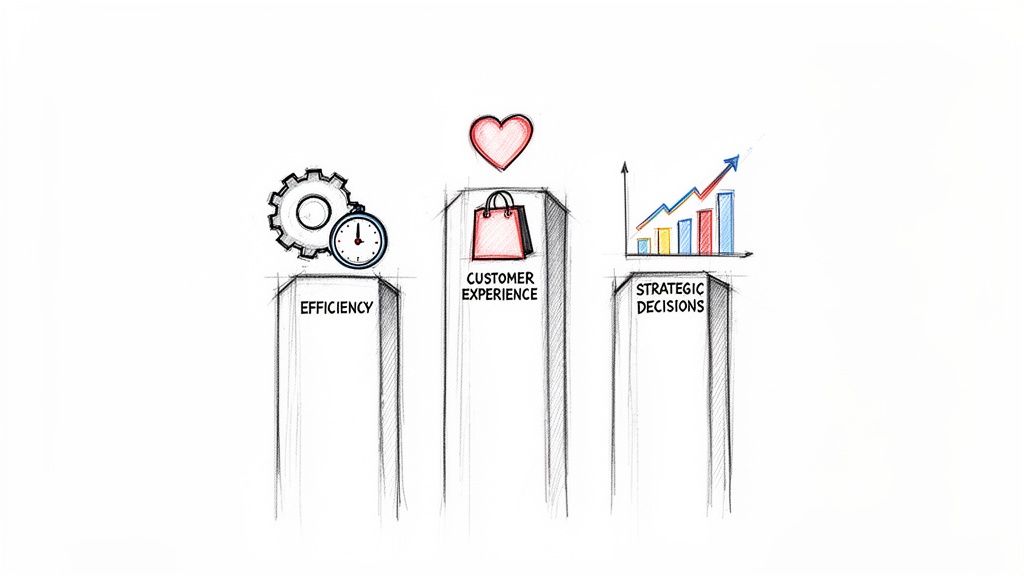
Let’s cut through the noise. Beyond the impressive technology, what do ai solutions for businesses actually do for your bottom line? The real value isn't in buzzwords—it’s in concrete results. The business impact of AI really boils down to three core pillars every leader cares about: boosting operational efficiency, elevating the customer experience, and driving smarter strategic decisions.
Think of it this way: AI is a force multiplier for your existing team. It’s not about replacing people; it’s about augmenting their skills so they can achieve more.
Enhance Operational Efficiency
One of the quickest wins with AI comes from automation. So many businesses get bogged down by repetitive, manual tasks that eat up valuable time and are prone to human error. AI excels at handling this kind of work with precision and speed, 24/7.
For instance, AI can automate:
- Data Entry: Pulling information from invoices or forms and plugging it straight into your CRM or accounting software.
- Inventory Management: Predicting demand to fine-tune stock levels and prevent costly overstocking or running out of popular items.
- Internal Support: Using AI-powered helpdesks to answer common employee questions about HR policies or IT issues, instantly.
This frees your team from the mundane stuff. It lets them focus on the high-value, creative, and strategic work that actually pushes the business forward. The result is a more productive and engaged team.
Elevate Customer Experiences
In today's market, a generic customer experience is an invisible one. AI makes hyper-personalization at scale a reality, creating interactions that make customers feel seen and understood. This goes way beyond just sticking a first name in an email.
AI analyzes customer behavior—like browsing history and past purchases—to deliver recommendations and messages that feel genuinely helpful. A perfect example is an e-commerce store's recommendation engine. By suggesting products a specific shopper is likely to love, businesses can seriously increase their average order value and build real loyalty.
"Your job will not be taken by AI. It will be taken by a person who knows how to use AI. So, it is very important for marketers to know how to use AI."
On top of that, AI-powered chatbots provide instant, round-the-clock support. They can answer common questions and resolve issues without making customers wait, improving satisfaction and freeing up human agents to tackle the more complex conversations.
Drive Smarter Strategic Decisions
Gut feelings have their place, but data-driven decisions are what build sustainable growth. AI turns massive, complicated datasets into clear insights that a human could never uncover alone. This is where predictive analytics really shines.
AI models can analyze market trends, competitor moves, and customer feedback to forecast future outcomes with surprising accuracy. This lets you get ahead of the curve instead of just reacting to it.
Imagine if you could:
- Forecast Sales Demand: Accurately predict which products will be hot next quarter, guiding your purchasing and marketing spend.
- Identify At-Risk Customers: Proactively spot customers who are likely to churn and step in with targeted offers to keep them.
- Optimize Pricing Strategies: Analyze market dynamics in real-time to set prices that maximize profitability without scaring customers away.
By turning raw data into foresight, AI empowers leaders to make confident choices that minimize risk and jump on emerging opportunities.
This table gives a clearer picture of the quantifiable benefits you can expect.
Key Business Outcomes from AI Adoption
This table quantifies the primary benefits businesses can expect from implementing AI solutions across different operational areas, highlighting measurable improvements and strategic advantages.
| Business Area | AI-Driven Improvement | Potential ROI Metric |
|---|---|---|
| Operations | Automated data entry and scheduling | -30% reduction in time spent on administrative tasks |
| Customer Service | 24/7 chatbot support for common queries | -25% decrease in customer support ticket volume |
| Marketing | Personalized product recommendations | +15% increase in average order value |
| Strategy | Predictive demand forecasting | -20% reduction in inventory holding costs |
As you can see, the impact isn't just theoretical. These are real numbers that directly affect efficiency, customer satisfaction, and profitability.
Finding the Right AI Solution for Each Department
Artificial intelligence isn't some magic wand you wave over your entire business. A better way to think about it is like a specialized toolkit, with different instruments perfectly designed for specific jobs in each department. When you frame AI solutions for businesses this way, the whole concept becomes more concrete, and you can start spotting immediate opportunities right inside your own company.
Forget about a massive, company-wide overhaul. The smarter move is to zero in on specific pain points within individual teams. Where are the real bottlenecks? What mind-numbing, repetitive tasks are eating up everyone's time? Match a targeted AI tool to a clear departmental need, and you'll get some quick wins on the board and build momentum for bigger projects down the road.
Let’s break down how this actually works, department by department.
Give Your Marketing and Sales Engine a Major Boost
For marketing and sales teams, it all comes down to attracting the right people and turning them into customers. AI slides right in as a powerful assistant, replacing guesswork with data-driven precision.
- Marketing Content Creation: Need SEO-friendly blog posts, social media updates, or ad copy? AI tools can generate solid first drafts in minutes. This frees up your marketers to focus on big-picture strategy and creativity instead of getting buried in production work.
- Ad Spend Optimization: Instead of a human manually tweaking campaigns, AI algorithms can chew through performance data in real time. They automatically shift your budget toward the best-performing ads and audiences, making sure you squeeze every drop of value from your ad spend.
- Intelligent CRM for Sales: Modern CRM systems packed with AI can analyze a lead's behavior to predict who is most likely to buy. This lets your sales team focus their energy on the warmest leads, which can seriously improve their close rates and overall efficiency.
The impact here is real. AI isn't just making old tasks faster; it's redesigning how the work gets done to deliver measurable results. In fact, McKinsey data shows that by 2024, 71% of organizations were already using generative AI in at least one business function, with marketing content being a huge area of focus. You can dig into the specifics by checking out the full state of AI report.
By using AI to analyze customer feedback at scale, we can uncover hidden pain points and opportunities that would take a human team months to find. It's like having a thousand conversations at once and instantly knowing what matters most to your market.
This shift toward intelligent automation is changing how companies connect with customers and close deals.
Reinvent Your Customer Service and Support
Great customer service can make or break a business, and AI gives you the tools to deliver fast, personalized support around the clock. The idea isn't to replace your human agents but to empower them. Let AI handle the routine questions so your team can focus on the complex, high-stakes conversations where they really shine.
AI-powered chatbots are the classic example. You can plug one into your website to provide instant answers to frequently asked questions 24/7. This one simple tool can slash customer wait times and free up a surprising amount of your support team’s bandwidth.
Beyond that, AI can sift through customer feedback from emails, support tickets, and online reviews. Using Natural Language Processing (NLP), these systems can detect sentiment, spot recurring issues, and flag urgent problems before they blow up. It’s like having a real-time pulse on customer satisfaction.
Streamline Your Operations and Logistics
On the operational side of a business, efficiency is the name of the game. AI solutions are fantastic at optimizing complex processes, whether that's managing inventory or forecasting demand.
Here are a few ways it's being used:
- Smarter Inventory Management: AI digs into historical sales data, seasonality, and market trends to predict future demand with startling accuracy. This helps you avoid wasting money on overstocking or frustrating customers with stockouts.
- Supply Chain Optimization: AI can figure out the most efficient shipping routes, predict potential delays, and even automate communications with your suppliers. The result is a more resilient and cost-effective supply chain.
- Process Automation: With Robotic Process Automation (RPA), businesses can automate all those rule-based, click-heavy tasks like processing invoices, generating reports, or updating records across different software systems.
Each of these examples solves a specific, practical problem. When you look at your business department by department, it’s much easier to see where an AI solution could deliver the most immediate and significant value, giving you a clear place to start.
Your Step-by-Step AI Implementation Roadmap
Jumping into artificial intelligence can feel like a massive undertaking, but it doesn’t have to be. The most successful AI solutions for businesses don't start with some giant technological leap. Instead, they begin with a clear, step-by-step plan that focuses on solving one specific problem at a time.
Think of it less like building a skyscraper and more like assembling a piece of IKEA furniture. You just need to follow the instructions, one stage at a time. This roadmap breaks the entire process down into five manageable steps, turning your interest in AI into a concrete action plan.
This visual shows how AI can create a smooth, connected workflow across your most critical business functions—from marketing and sales right through to customer service.
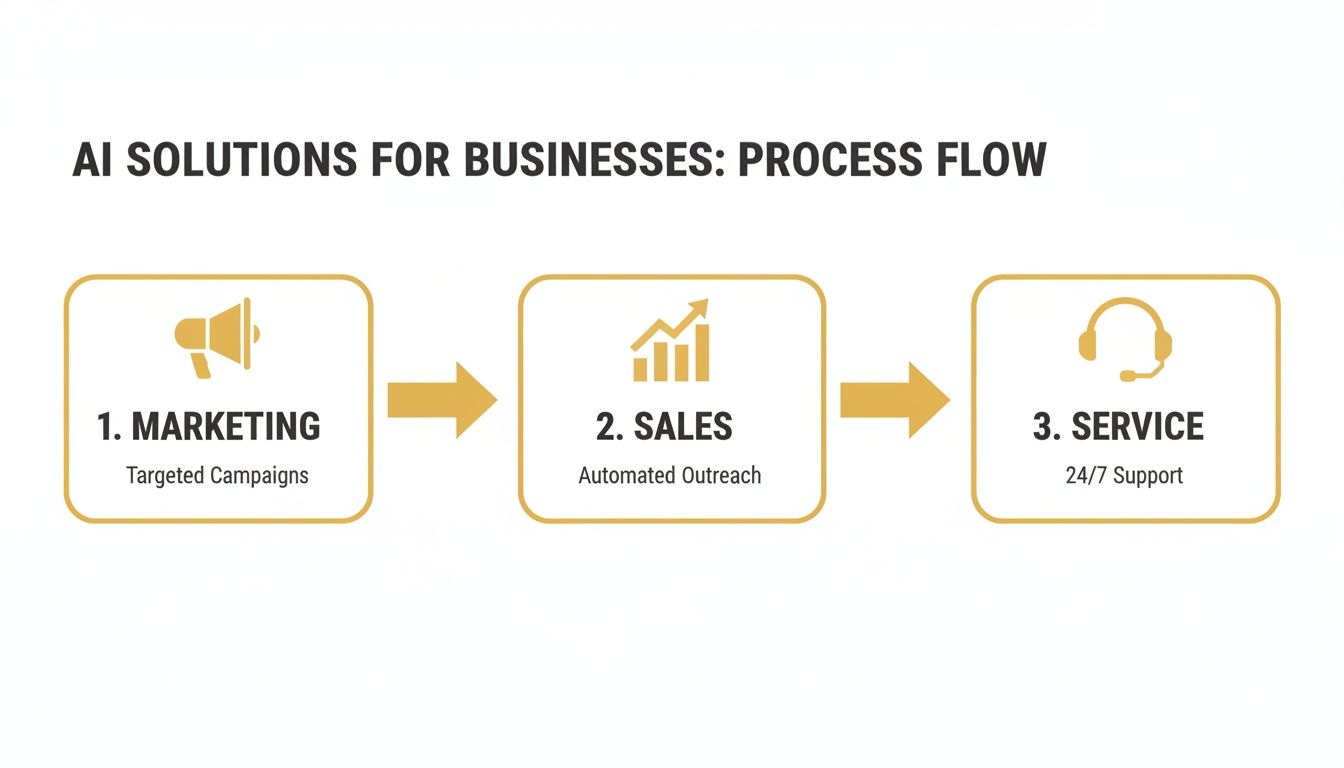
The flow from hyper-targeted marketing to automated sales outreach and always-on support highlights how AI builds a much more efficient customer journey.
Step 1: Identify Your Core Problem
Before you even think about technology, start with a real business challenge. The goal here isn't to "do AI" for the sake of it; it's to solve a problem that's costing you time, money, or customers. A great starting point is to find a high-impact, low-complexity bottleneck in your operations.
Not sure where to look? Start here:
- Repetitive Tasks: What are your teams doing over and over again, every single day? This could be manual data entry, answering the same five customer questions, or pulling weekly reports. These are prime candidates for automation.
- Lost Opportunities: Are you struggling to follow up with every lead? Are you missing chances to upsell or cross-sell to existing customers because you just don't have the right insights at the right time?
- Customer Friction: Where do your customers get stuck or frustrated? Long wait times for support or an impersonal website experience are common examples that can be fixed with AI.
By zeroing in on a single, well-defined problem, you give your AI project a clear purpose and a measurable goal. Honestly, this focus is the single most important factor for a successful first implementation.
Step 2: Assess Your Data Readiness
Data is the fuel that powers any AI engine. Without clean, accessible data, even the most advanced algorithm is completely useless. This step is all about checking your "fuel tank" before you start the engine.
You don't need perfect data, but you do need a solid foundation. Ask yourself these questions:
- Do we collect the right data? For a sales AI, you'll need data on leads, customer interactions, and deal outcomes. For a customer service bot, you'll need a history of past support tickets.
- Is the data accessible? Is your data locked away in separate, disconnected systems (like a dozen different spreadsheets or software tools)? Getting it into one place is a critical first hurdle.
- Is the data clean? Are there a lot of errors, duplicates, or missing fields? Some data cleanup will almost certainly be necessary.
This assessment helps you understand the groundwork required. If you find major gaps, your first project might just be focused on improving data collection before you even touch an AI tool.
"Your job will not be taken by AI. It will be taken by a person who knows how to use AI. So, it is very important for marketers to know how to use AI."
This really highlights that readiness isn't just about technology; it's also about preparing your team to work alongside these new, data-driven systems.
Step 3: Launch a Pilot Project
Now it’s time for action—but on a small scale. A pilot project is a limited test run designed to prove that an AI solution can solve your chosen problem and deliver a real return. This approach minimizes risk and helps you build momentum internally.
For example, instead of rolling out a new chatbot to your entire customer base, deploy it to handle just one specific type of query on one page of your website. Or, if you're testing a sales prediction tool, have just one or two salespeople use it for a month and track their results.
The goal of the pilot is to gather data and answer a few key questions:
- Does it actually work as expected?
- Is it improving the target metric (e.g., reducing support response time, increasing lead conversion rates)?
- What feedback does the team have? Is it easy to use?
A successful pilot provides a powerful, undeniable case study to get buy-in for a wider rollout. For a deeper dive, our guide on how to implement AI in your business offers more detailed strategies for getting that first project off the ground.
Step 4: Integrate and Deploy
Once your pilot has proven successful, the next step is to fully integrate the solution into your daily operations. This is all about making the AI tool a seamless part of your team's existing workflow, not some awkward add-on they have to remember to use.
Effective integration involves both technical and human elements. Technically, this might mean connecting the AI tool directly to your CRM or other core software so data flows automatically. On the human side, it means providing clear training and documentation so everyone on the team understands how, when, and why to use the new system.
Step 5: Measure and Optimize
AI implementation is never a "set it and forget it" activity. The final step is a continuous cycle of monitoring performance, gathering feedback, and making improvements. Go back and track the key metrics you identified in step one. Are you hitting your goals?
Use this data to refine the system. For instance, you might adjust a chatbot’s script based on common questions it couldn't answer, or you might update a predictive sales model with new data to improve its accuracy. This ongoing optimization ensures your AI solution continues to deliver value and adapts as your business evolves.
Choosing Your Path: Build vs. Buy
Once you’re sold on bringing AI into your business, you hit a fork in the road. It’s a classic question that shapes everything that comes next: do you build a custom AI solution from scratch, or do you buy a ready-made tool off the shelf?
There’s no universally “right” answer here. The best choice depends entirely on your budget, your timeline, and how much of a competitive edge you’re trying to create.
Think of it like getting a new vehicle. Building a custom AI is like commissioning a Formula 1 race car. It’s a masterpiece of engineering, designed from the ground up to fit your exact specifications and give you a killer advantage on a very specific track. This route gives you total control and can become a powerful, proprietary asset. But make no mistake—it requires a team of specialists, a serious budget, and a whole lot more time.
Buying an off-the-shelf AI solution is more like driving a brand-new Porsche 911 off the lot. It’s built on proven, world-class technology, delivers incredible performance from day one, and is far more approachable financially. These tools are fantastic at solving common business problems, getting you where you need to go with impressive speed and reliability.
Understanding the Build Approach
Going the custom-build route is a major commitment. It’s the right call when you’re dealing with a business process so unique that no existing software can touch it—and if you get it right, that process could completely change your standing in the market.
To pull it off, you’ll need a team of data scientists and AI engineers, plus a rock-solid project management framework to keep things on track.
The main upsides of building are pretty clear:
- Perfect Fit: The solution is molded precisely to your existing workflows.
- Proprietary Edge: You own the intellectual property, turning your AI into a unique company asset.
- Total Control: You call the shots on every feature and can adapt the tool as your business grows.
But the hurdles are just as real. Building demands a huge upfront investment, a much longer wait before you see any value, and ongoing costs for maintenance and the specialized talent needed to keep it running. If this sounds like your path, a practical early step for some projects might be choosing the right chatbot development framework to get started.
Evaluating the Buy Option
For the vast majority of businesses, buying an AI solution is the smarter, more efficient way to go. The market for AI solutions for businesses has exploded, offering incredibly powerful tools for nearly every function imaginable, from marketing automation to financial modeling.
The numbers tell a clear story.
Menlo Ventures found that while the split was nearly 50/50 in 2024—with 47% of companies building vs. 53% buying—the trend is shifting dramatically. By 2025, they predict a whopping 76% of AI use cases will be handled by purchased solutions. On top of that, the success rate is higher: 47% of purchased AI deals actually make it into production, almost double the rate of traditional software.
Choosing a pre-built solution slashes your risk and gets you to a positive ROI much faster. You get a proven product that the vendor constantly updates and supports, freeing you up to focus on using the tool, not building it. For a deeper dive, check out our guide on custom software vs. off-the-shelf solutions.
The main trade-off? You might have to tweak some of your internal processes to match the software’s capabilities, as customization options can be limited.
AI Implementation Build vs Buy Decision Framework
So, how do you make the final call? This table breaks down the key factors to weigh when you're standing at that build-or-buy crossroads. It’s a straightforward comparison to help you map your resources and goals to the right strategy.
| Factor | Building In-House | Buying a Solution |
|---|---|---|
| Cost | High upfront investment (talent, infrastructure) and ongoing maintenance costs. | Lower initial cost (subscriptions, licenses) with predictable expenses. |
| Speed to Value | Slow. Months or even years before a usable product is ready and delivering ROI. | Fast. Implementation can take days or weeks, delivering value almost immediately. |
| Customization | Total. Built perfectly to match your unique workflows and business needs. | Limited. You adapt to the tool’s features, with some configuration options. |
| Competitive Edge | High Potential. Creates a proprietary asset that competitors can't replicate. | Low. You're using the same tools as everyone else; the edge comes from how you use them. |
| Resource Needs | Intensive. Requires a dedicated team of AI engineers, data scientists, and project managers. | Minimal. Your existing team can learn to use it, with support from the vendor. |
| Risk | High. Projects can fail due to technical hurdles, budget overruns, or talent gaps. | Low. You’re buying a proven, tested product with a track record and vendor support. |
Ultimately, the decision comes down to one core question: is your challenge so unique that only a custom-built solution will do, or can a best-in-class commercial tool get you 80% of the way there in 20% of the time? For most businesses looking to move quickly and efficiently, the answer is increasingly pointing toward "buy."
Frequently Asked Questions About Business AI
When businesses start looking into artificial intelligence, a few practical questions always pop up. How much does this stuff actually cost? Do I need to hire a team of PhDs? And where on earth do I even begin? This section cuts through the noise and gives you straight answers to the most common questions we hear.
Think of this as your cheat sheet for getting past the initial hurdles. The goal is to show you that AI is a lot more accessible than you might think.
How Much Does It Cost to Implement AI?
The cost of AI can swing wildly, but it’s more affordable now than ever. You can get started with an off-the-shelf tool—like an AI-powered CRM or a marketing platform—for as little as $50 to $100 per month. These tools are built to solve common problems without needing a massive upfront investment.
If you have a more specific need, a custom AI project might run anywhere from a few thousand to tens of thousands of dollars. The smartest way to approach it is to define a single business problem and set a budget first. Many companies kick things off with a small pilot project to prove the ROI before they commit to a bigger spend.
Do I Need a Team of Data Scientists?
Not anymore. While building an AI model from scratch absolutely requires specialists, most modern business AI tools are designed for regular folks to use. A huge number of them are "no-code" or "low-code," meaning they plug right into the software your team is already using.
A common saying holds true here: "Your job will not be taken by AI. It will be taken by a person who knows how to use AI." This really gets to the heart of it—the shift is toward user-friendly tools that make your existing team better, not replace them.
For bigger, more strategic projects, you can always partner with an AI consultant or an agency. This gives you access to expert guidance without the long-term cost and headache of hiring a full-time data science team.
What Is the Easiest Way to Start with AI?
Honestly, the simplest and most effective way to start is to pick one single task that's repetitive and eats up a ton of time. Look for a clear pain point where automation can give you a quick, measurable win. This approach builds confidence and shows everyone the value of AI firsthand.
A couple of great starting points:
- Customer Questions: Is your team answering the same five questions all day long? An AI chatbot can handle those 24/7, freeing up your support staff to tackle the more complex issues.
- Marketing Personalization: Struggling to send the right emails to the right people? An AI-powered marketing tool can automate that segmentation, boosting your engagement and sales almost immediately.
By focusing on one clear problem, you'll see benefits fast, get a feel for how the technology works, and build momentum for more ambitious projects down the line.
Ready to identify the perfect AI starting point for your business? The team at Up North Media offers expert AI consulting to help you create a clear roadmap, choose the right tools, and start driving real results. Book your free consultation today!