

Jumping into AI can feel like you're trying to boil the ocean. It's easy to get overwhelmed. But the truth is, a successful AI rollout isn't about some massive, single leap of faith. It's a strategic journey, broken down into five core phases.
Think of it this way: you first Assess where you are, then Identify the right problem to solve. From there, you run a small Pilot to prove it works, Integrate it into your daily grind, and finally, Scale what you’ve learned across the company. This methodical approach keeps every AI project grounded in real business goals from the start.
Your Strategic AI Implementation Roadmap
Let's cut through the noise. Forget chasing the latest shiny AI trend. The goal here is to build a practical, repeatable framework that actually delivers results. We're moving past the abstract theories and focusing on the concrete steps that take an idea and turn it into a tool that generates real value for your business.
This entire process is about making smart, informed decisions one step at a time. To really get a handle on this shift, it helps to see the bigger picture of the AI revolution in business and understand the forces driving it.
The visual below breaks down the five essential stages of any solid AI implementation.
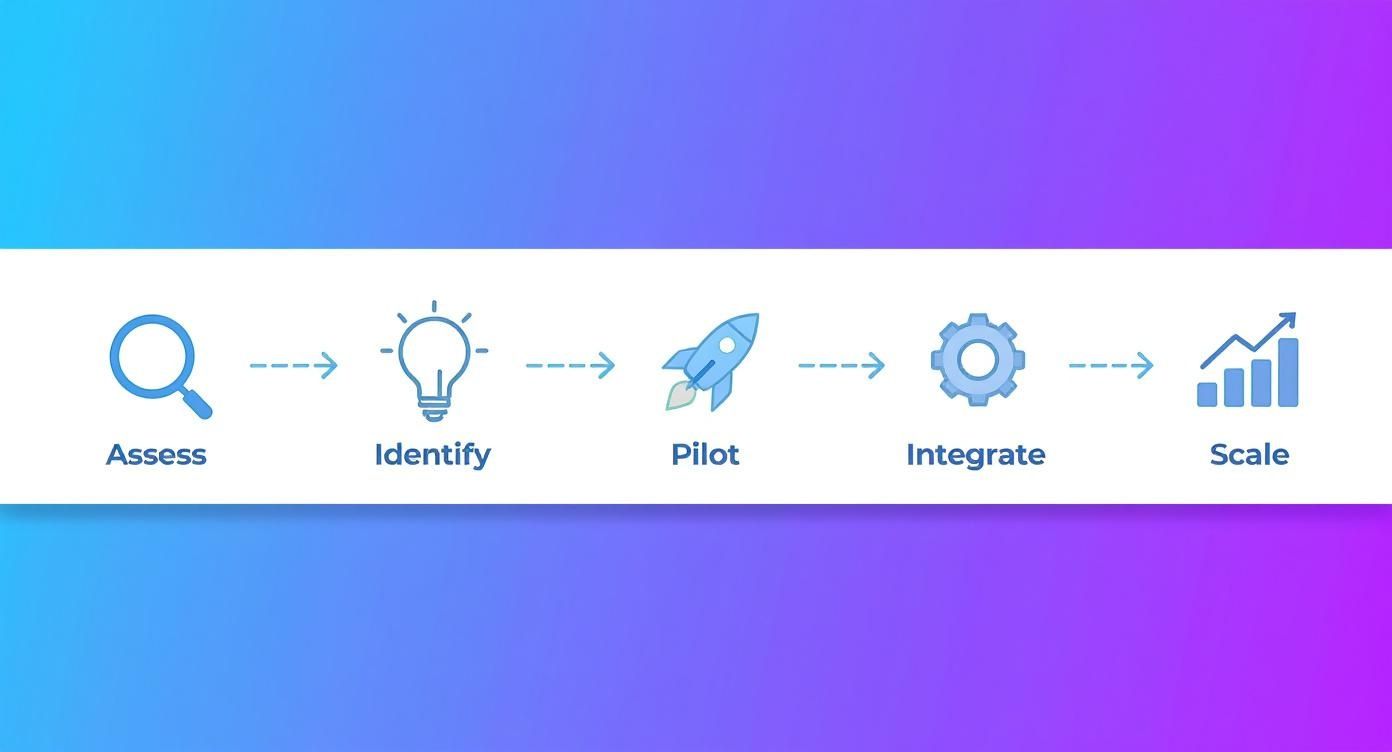
As you can see, it’s a cycle. You start by looking inward, and you end with a solution that creates widespread, scalable impact. Then you do it again.
The 5 Core Phases of AI Implementation
To bring this roadmap to life, let's break down what each phase actually involves. Think of this table as your high-level cheat sheet for the entire journey.
| Phase | Objective | Key Activities |
|---|---|---|
| Assess | Evaluate current capabilities and establish a baseline. | Audit existing data, tech stack, and team skills. Define business goals and high-level AI vision. |
| Identify | Pinpoint specific, high-impact business problems AI can solve. | Brainstorm use cases with department heads. Prioritize based on ROI, feasibility, and strategic alignment. |
| Pilot | Build and validate a small-scale proof-of-concept. | Develop a minimum viable product (MVP). Test with a small user group and gather performance data. |
| Integrate | Weave the validated AI solution into existing workflows. | Connect the pilot with core business systems (CRM, ERP). Develop training materials and manage change. |
| Scale | Expand the successful AI solution across the organization. | Create a rollout plan for other departments. Monitor performance, iterate, and identify new opportunities. |
Each phase builds on the last, preventing costly missteps and ensuring that your investment in AI is sound from day one.
Mapping Your Path Forward
Rushing through those first two phases—Assess and Identify—is one of the most common mistakes I see. It’s tempting to jump straight to building something cool, but that’s how you end up with a pilot project that goes nowhere. Nail the foundation, and the rest of the process becomes infinitely smoother.
The pace of change really underscores the need for a clear plan. By 2025, an estimated 78% of global companies were actively using AI in their operations. That’s a huge jump from just 55% the year before, and it shows that having an AI strategy is no longer optional.
A successful AI implementation isn’t about having the most advanced technology; it’s about applying the right technology to the right business problem at the right time.
This disciplined approach is what separates the companies getting real ROI from AI from those who are just spinning their wheels. If you're looking to navigate these stages efficiently and make sure your first project is a home run, bringing in an experienced partner can make all the difference. Professional guidance from AI consulting provides the expertise to avoid common pitfalls and accelerate your journey.
Throughout the rest of this guide, we’ll dive deep into each of these five phases, giving you the playbook to confidently lead your business into its next chapter of growth.
Finding Your First High-Impact AI Project
Before you write a single line of code or sign up for a new SaaS tool, the most important work in any AI project happens right inside your own business. It's easy to get distracted by the tech, but real success starts with a brutally honest look at whether you're actually ready. This is the step that separates the successful projects from the expensive failures.
It all boils down to an audit of three critical areas: your data, your tech, and your team. This isn't just about ticking boxes; it's a strategic gut-check. Without this clarity, you're just gambling on a project your business can't realistically support.
Are You Truly AI-Ready?
First, let's talk about data, because AI is nothing without it. The quality of what you put in directly dictates the quality of what you get out. So, you have to ask the tough questions. Is your customer data clean and organized in one accessible place? Or is it a chaotic mess spread across a dozen old spreadsheets and legacy systems that don't talk to each other?
Next up is your tech stack. Can your current servers or cloud setup actually handle the number-crunching an AI model requires? Do your most important business tools, like your CRM or ERP, have APIs? An API is just a way for different software to connect, and if you don't have them, you're setting yourself up for a major technical headache down the road.
Finally, take a hard look at your team. Do you have people who know their way around data analysis? Does your IT team have any experience with integrations? Figuring out your skill gaps now lets you plan for training or decide when it’s time to call in an expert for a little help.
Brainstorming Real Business Problems
Once you have a clear picture of what you're working with, you can start hunting for opportunities. The trick is to stop chasing shiny objects and start focusing on solving a real, nagging business problem. Think about the friction in your day-to-day operations. Where are the bottlenecks? What repetitive, soul-crushing tasks are eating up your team's time?
A great way to get started is to pull your department heads or team leads into a room for a brainstorming session. But here's the key: frame the conversation around their biggest headaches, not around AI.
- Customer Service: Is your team drowning in the same 20 questions over and over? An AI-powered chatbot could probably handle 80% of those routine inquiries, freeing up your agents to tackle the truly tricky stuff.
- Marketing: Does your team spend hours staring at a blank page trying to write the first draft of social posts or email campaigns? Generative AI can spit out a dozen versions in seconds, letting your team focus on strategy and polishing the final product.
- Operations: Are your logistics folks still manually plotting delivery routes every single morning? An AI model could analyze traffic data and schedules to find the most efficient path in a fraction of the time.
The best first AI projects aren't the most glamorous. They're the ones that solve a well-defined, persistent business pain point and deliver a clear, measurable win.
Prioritizing Your First Project
After brainstorming, you’ll probably have a laundry list of potential projects. Now comes the hard part: prioritizing. Don't just pick the one that sounds coolest. Instead, run each idea through a simple framework to find the "quick win"—a project that delivers a big business impact without being a nightmare to implement.
Here’s a practical way to score your ideas:
| Evaluation Criteria | Scoring (1-5) | Why It Matters |
|---|---|---|
| Business Impact | 1 (Low) - 5 (High) | How much will this project actually move the needle on revenue, costs, or customer happiness? |
| Data Availability | 1 (Poor) - 5 (Excellent) | Do we have the clean, ready-to-use data for this project right now? |
| Technical Feasibility | 1 (Very Hard) - 5 (Easy) | Can our current systems and team realistically pull this off? |
| Measurability | 1 (Vague) - 5 (Clear) | Can we easily track KPIs to prove this worked (e.g., hours saved, response time cut in half)? |
The project with the highest score is your winner. It gives you the best shot at a tangible victory that builds momentum and gets everyone else in the company excited for what's next. Starting small and proving the value is the smartest way to get AI off the ground.
Building Your Data Foundation and Picking the Right Tools

Here's a hard truth: AI runs on data. It’s not just a catchy phrase; it's the bedrock of any serious AI project. Without a solid data foundation, the most sophisticated algorithm is like a supercar with an empty gas tank—it looks impressive but goes nowhere.
This is the part of the process that's often the least glamorous but, frankly, the most important when you implement AI in business. Getting your data house in order before you start dreaming about specific tools will save you from a world of headaches and failed projects down the road. It all starts with a clear rulebook for how you handle your information.
Establishing Strong Data Governance
Data governance is your company’s rulebook for managing data. It spells out who can do what, with what data, in what situations, using what methods. Think of it as the quality control system that ensures your data is accurate, consistent, and secure from day one.
Good governance is what prevents the classic "garbage in, garbage out" problem. It really boils down to a few core practices:
- Data Quality: Putting checks in place to hunt down and fix errors, duplicates, and outdated info.
- Data Security: Setting up crystal-clear permissions to control who gets to see sensitive customer or company data.
- Data Accessibility: Making sure the right people can get the data they need without jumping through endless hoops, all while keeping it locked down.
This initial work might feel a bit tedious, but it builds the trustworthy foundation your entire AI strategy will stand on.
A well-governed data set is the single greatest accelerator for AI implementation. It slashes the time spent on cleaning and prep, letting you focus on building models that actually drive business value.
For instance, a retail company wants to use AI for personalized product recommendations. First, they have to make sure their customer purchase history is clean and unified. Without solid governance, they could be dealing with duplicate customer profiles or inaccurate transaction logs, which would lead to flawed and totally ineffective AI suggestions.
The Big Three of Tooling Decisions
With your data strategy starting to firm up, the next question is how you’ll actually bring your AI vision to life. The tooling decision usually comes down to three paths, each with its own pros and cons. The right choice depends entirely on your specific situation.
This is a strategic decision, and you need to base it on your team's skills, your budget, and how quickly you need to see a return.
1. Build a Custom Solution This is the path where you create a proprietary AI model from the ground up, designed specifically for your unique business challenges.
- Pros: Total control, a perfect fit for your needs, and a potential competitive advantage.
- Cons: Extremely expensive, time-consuming, and requires highly specialized in-house talent.
2. Buy an Off-the-Shelf Product This means subscribing to an existing AI-powered SaaS tool, like an AI-enhanced CRM or a marketing automation platform.
- Pros: Quick to get started, relatively low upfront cost, and no need for in-house AI experts.
- Cons: Limited customization, you don't own the core technology, and your data might get stuck in a silo.
3. Partner with a Vendor This is the hybrid approach. You work with an AI consultancy or agency to develop a semi-custom solution using their platforms and expertise.
- Pros: Balances customization with speed, gives you access to expert guidance, and is less risky than building from scratch.
- Cons: Can be pricier than off-the-shelf options and creates some dependency on the vendor.
Making this choice is a lot like figuring out how to choose a tech stack for any other part of your business—it involves the same principles of balancing cost, scalability, and internal resources.
This kind of strategic thinking is becoming more common every day. In fact, business adoption of Generative AI has doubled in the past year, now reaching 65% usage. A huge reason for this is its impact on customer service, where 59% of companies report positive results from using it to improve customer interactions. You can dig into more insights on this trend and other generative AI statistics from Amplifai.com. This rapid adoption just goes to show how accessible tools are making it easier than ever to implement AI in business.
Running an AI Pilot That Actually Teaches You Something
Your AI pilot project is where all the careful planning finally meets the messy reality of your business. This is your chance to test your assumptions, prove a use case is valuable, and gather real-world data—all without betting the farm on an unproven idea.
This stage is all about controlled experimentation. Forget about building a perfect, polished product. The goal here is to build something small and focused that answers one fundamental question: Does this actually solve the business problem we think it does?

A successful pilot hinges on a tight scope. You have to resist the urge to add "just one more feature." A good pilot has a single, laser-focused objective and a handful of clear metrics that will tell you—without any ambiguity—whether it worked or not.
Designing a Pilot with a Purpose
To get started, you need a clear blueprint. An effective pilot isn't just a tech demo; it’s a business experiment. It needs a clear hypothesis, a method for testing it, and a way to measure what happens.
Think of it like this: if you’re piloting an AI chatbot to cut down the customer service workload, your success metrics can't just be "Did the chatbot work?" They have to be specific and quantifiable.
- Primary Metric: Reduce agent response time for common queries by 40%.
- Secondary Metric: Achieve a customer satisfaction score of 8/10 or higher on chatbot interactions.
- Guardrail Metric: Ensure escalation rates to a human agent do not exceed 15%.
These numbers give you a clear, objective way to judge the pilot. Without them, you’re just guessing. You can find more practical applications in these real-world robotic process automation examples, which share a lot of the same goal-setting DNA as a good AI pilot.
Building Your Pilot Dream Team and MVP
You can’t run a pilot in a silo. You need a small, cross-functional team that brings different perspectives to the table. This isn't about pulling in entire departments; it’s about assembling a nimble squad.
Ideally, your team should include:
- A Business Lead who deeply understands the problem you're solving.
- A Technical Expert who can manage the AI tool or build the model.
- An End User who will actually interact with the solution and give you direct feedback.
This team's first job is to build a Minimum Viable Product (MVP). The MVP is the most basic version of your AI solution that can still achieve the core objective. For a sales forecasting tool, the MVP might just predict next month's sales for one product line, not your entire catalog. This approach gets you feedback, fast.
The primary goal of an AI pilot isn't perfection; it’s learning. Every setback, every piece of user feedback, and every unexpected outcome is a valuable piece of data that will inform your next move.
This learning-focused approach is critical. A shocking number of AI projects stumble right here. In fact, a 2025 MIT report revealed that a staggering 95% of generative AI pilot projects in enterprises fail to deliver meaningful business results. The report notes this is often due to poor integration with company workflows and a significant "learning gap"—exactly what a well-designed pilot is meant to close. You can discover more about these findings from Fortune.
Extracting Insights and Making the Call
Once your pilot is done, it's time to dig into the results. Gather your team and compare the data against the success metrics you defined at the very beginning. Did you hit your targets? More importantly, why or why not?
The outcome of this analysis should lead you to one of three clear decisions:
- Scale: The pilot was a clear success. It proved its business value and is ready for a wider rollout.
- Pivot: The pilot showed promise but missed the mark in key areas. You need to tweak the approach and maybe run another, revised pilot.
- Shelve: The pilot demonstrated that this AI solution isn't the right fit for the problem, or the ROI just isn't there.
Remember, a pilot that tells you to stop is not a failure. It’s a success because it just saved you from investing heavily in the wrong solution. This disciplined process of testing, learning, and deciding is the heart of implementing AI in your business the right way.
From Pilot Success to Seamless Business Integration
Getting a pilot project across the finish line feels great, but it’s really just the halfway point. The real challenge—and where you find the lasting value—is stitching that successful pilot into the fabric of your daily business. This is where you go from a cool experiment to a core business process.
Integration is a two-sided coin. On one side, you have the technical puzzle of getting your new AI to play nice with your existing systems. On the other, you have the human element, which is often a lot trickier. You have to nail both if you want this to stick.

Connecting the Technical Dots
First things first, you have to get your AI tool talking to the software your business already runs on. Your CRM, ERP, and other core platforms are the company's central nervous system. An AI solution that lives on an island, completely disconnected, will never deliver on its promise.
This is where Application Programming Interfaces (APIs) come into play. Think of an API as a universal translator that lets different software programs communicate and share data safely.
Let’s say you’ve piloted an AI model that predicts customer churn. You’ll need to use its API to hook it into your CRM. That connection lets the AI automatically flag at-risk customers right where your sales team is already working, making the insight immediately useful.
Your technical plan should map out a few key things:
- API Development: Making sure both your AI tool and existing software have the right APIs to connect.
- Data Flow Mapping: Defining exactly how information will move between systems, hopefully in real-time.
- System Performance: Keeping an eye on things to ensure the new AI workload doesn’t grind your core operations to a halt.
Winning Hearts and Minds with Change Management
Honestly, the tech is the easy part. If your team doesn't get it, trust it, or actually use the new AI tool, the whole project is dead on arrival. This is why a solid change management strategy isn’t just a "nice-to-have"—it's absolutely critical.
Don't be surprised by fear and skepticism. An employee hears "AI" and immediately thinks "my job is next." It’s on you to get ahead of that narrative by showing them how the AI will help their roles, not replace them. Frame it as a way to automate the boring, repetitive tasks so they can focus on the more strategic and creative work.
True AI integration isn't a technical task; it's a cultural shift. You're not just installing software. You're changing how your team works, thinks, and solves problems.
To get this cultural shift right, you need to own the process. Here’s a simple breakdown:
| Change Management Pillar | Actionable Strategy |
|---|---|
| Communication | Be radically transparent about why you're doing this. Host town halls and open Q&A sessions to tackle concerns head-on. |
| Training | Ditch the generic one-pagers. Create hands-on, role-specific training that shows people how the tool makes their specific job easier. |
| Feedback Loops | Set up a simple way for users to report bugs and suggest improvements. When they feel like part of the process, they take ownership. |
For example, when you roll out an AI-powered inventory forecasting tool, don't just send a memo. Run workshops where your supply chain managers can play with the tool using real data. Show them how it helps them dodge stockouts and cut carrying costs.
When they see the direct benefit for themselves, you'll create internal champions who drive adoption way more effectively than any top-down mandate ever could. This careful, human-first approach is the playbook for turning a promising pilot into a business asset that actually gets used.
Scaling AI Responsibly Across Your Organization
Getting that first AI pilot across the finish line feels great. It's a win. But turning that single success into a real competitive advantage means thinking bigger. Moving from one-off projects to a company-wide AI program requires a whole new level of structure and oversight. This is where you build the operational muscle to make AI a core part of how your business runs.
The first step is to stop treating AI as a series of isolated experiments. You need a central hub to guide your efforts so that every department isn't stuck reinventing the wheel.
Establishing an AI Center of Excellence
Think of an AI Center of Excellence (CoE) as the central nervous system for your entire AI strategy. It's a dedicated team tasked with setting best practices, vetting new projects, and making sure knowledge gets shared across the company.
This group doesn't build every AI project themselves. Instead, their job is to empower other teams by providing a few key things:
- Standardized Toolkits: They recommend and support a core set of AI platforms and technologies, so you're not dealing with a chaotic mix of random tools.
- Expert Guidance: They act as internal consultants, helping business units figure out where AI could make the biggest impact.
- Knowledge Sharing: They document what worked (and what didn't) in past projects, which helps future initiatives get off the ground much faster.
By centralizing this expertise, you make sure every new AI project benefits from the collective wisdom you've already paid to acquire. It drives both efficiency and better ideas.
AI Governance and Ethical Guardrails
As you scale, the stakes get much higher. A biased algorithm or a data privacy slip-up can do serious damage to your reputation. That's why strong AI governance isn't just a "nice-to-have"—it's non-negotiable. You need clear, enforceable policies that tackle the tough ethical questions before they blow up into a crisis.
Scaling AI responsibly isn't just about managing technology; it's about managing risk. A proactive governance framework is your best defense against unintended consequences.
Your governance plan needs to lay down some firm ground rules in a few critical areas. These guardrails ensure your AI systems are fair, transparent, and secure as their influence grows.
- Data Privacy: You need strict protocols for how personal data is collected, used, and protected in your models. This should line up with regulations like GDPR and CCPA.
- Model Transparency: Teams must be able to explain, at least in high-level terms, how their AI models arrive at a decision. This is especially critical for anything customer-facing.
- Algorithmic Bias: You have to implement regular audits of your models to spot and fix biases related to gender, race, or other protected characteristics.
These policies aren't there to slow you down. They're there to build trust with your customers and your own employees.
Finally, managing one AI model is one thing; managing dozens is another beast entirely. This is where MLOps (Machine Learning Operations) comes in. It’s a set of practices that brings software development and IT operations together to manage the complete lifecycle of your AI models—from training and deployment all the way to ongoing monitoring and maintenance. Adopting MLOps is what ensures your AI solutions stay effective, reliable, and secure as you scale.
As you move from a single pilot to a full-scale program, keeping track of all the moving parts is essential. A simple checklist can help you and your team stay aligned on the critical steps.
AI Implementation Checklist
This checklist provides a practical guide to navigate the key actions and considerations at each stage of your AI implementation journey. Use it to track your progress and ensure no critical steps are missed.
| Phase | Key Action Items | Status (To-Do/In-Progress/Complete) |
|---|---|---|
| 1. Readiness Assessment | - Define business goals for AI. - Assess current data infrastructure. - Evaluate team skills and identify gaps. | |
| 2. Use Case Identification | - Brainstorm potential AI applications. - Prioritize use cases based on impact vs. effort. - Select a high-impact, low-risk pilot project. | |
| 3. Data Strategy & Tooling | - Identify and consolidate necessary data sources. - Establish data governance and quality standards. - Select and procure AI development tools/platforms. | |
| 4. Pilot Project | - Build and train the initial AI model. - Validate the model's performance and accuracy. - Document learnings and pilot outcomes. | |
| 5. Integration | - Plan integration with existing business systems. - Develop APIs and data pipelines. - Conduct end-to-end testing in a staging environment. | |
| 6. Change Management | - Communicate the project's value to stakeholders. - Develop and deliver training for end-users. - Create support channels for questions and feedback. | |
| 7. Measurement & KPIs | - Define success metrics and KPIs. - Implement monitoring and reporting dashboards. - Regularly review performance against goals. | |
| 8. Compliance & Security | - Establish an AI governance framework. - Conduct a security and data privacy review. - Implement bias detection and mitigation processes. | |
| 9. Scaling | - Establish an AI Center of Excellence (CoE). - Implement MLOps practices for model management. - Create a roadmap for future AI initiatives. |
This checklist isn't just a to-do list; it's a roadmap. By methodically working through each phase, you build a solid foundation that allows you to scale your AI efforts responsibly and effectively.
A Few Common Questions About Getting Started with AI
Diving into AI implementation always brings up a handful of make-or-break questions. Leaders want to know about the real costs, the right starting point, and what it takes to get an early win. Getting clear, straightforward answers is the first step to setting realistic expectations and launching a project that actually delivers.
We hear the same questions from businesses just starting their AI journey, so let's tackle them head-on with some practical insights.
What’s a Realistic Budget for a First AI Project?
The cost can swing wildly depending on the path you take. On one end, you have off-the-shelf AI software, like an intelligent CRM or a marketing automation tool. That could run you anywhere from a few hundred to several thousand dollars a month. The big advantage here is speed and simplicity.
On the other hand, if you're building a custom pilot project with a vendor or your own team, you're looking at a much bigger investment. A typical range is $50,000 to over $300,000. That price tag is shaped by the project's complexity, how much data wrangling is needed, and the talent you bring in. The trick is to anchor your budget to a specific use case with a clear, measurable ROI.
How Can a Small Business Start with AI on a Tight Budget?
If you're a small business, forget about building a custom AI model from the ground up. That’s not the game you need to play. The smart move is to focus on accessible, low-cost AI tools that solve one specific problem really well.
Look for areas where you can get an immediate impact:
- Marketing Automation: Plenty of tools use AI to generate social media copy or draft email campaigns.
- Customer Service: A simple chatbot can be a game-changer for handling common customer questions, freeing up your team for more complex issues.
- Content Creation: You can use generative AI to get a first draft of a blog post or come up with product descriptions in a fraction of the time.
The best approach is to start with a free trial or a low-cost subscription. Prove the tool's value to yourself and your team before you even think about a bigger investment. This way, you minimize risk while showing everyone the tangible benefits.
For a small business, the goal isn't to engineer a complex AI system. It's about strategically adopting existing tools that fix a narrow, high-impact problem without breaking the bank.
By zeroing in on a well-defined pain point first, even the smallest companies can start using AI effectively. You don't need a massive budget or a team of data scientists to get in the game.
Ready to move from questions to action? The experts at Up North Media specialize in AI consulting and integration, helping businesses like yours build a practical roadmap for success. Schedule your free consultation today!