
Cutting operational costs isn't just about slashing budgets. It's about getting smarter with how you spend your money. I've found the most effective strategies always boil down to focusing on four key areas: your people, your processes, your technology, and your vendors. The trick is to start with a quick, honest audit to see where the leaks are, then prioritize the changes that give you the biggest bang for your buck with the least amount of chaos.
Your Starting Point for Smarter Cost Management

So, you're ready to trim the fat from your operational expenses. Good. This is your practical playbook for doing just that, written specifically for growing SMBs and e-commerce shops. We'll skip the corporate jargon and dive straight into actionable steps that can turn hidden costs into fuel for growth.
Think of it this way: most businesses have small, hidden financial leaks. A subscription here, an inefficient process there. Individually, they don't seem like much, but they add up. Plugging them isn't just about saving cash—it's about building a more resilient, efficient, and profitable operation.
The Four Pillars of Operational Costs
To really get a grip on your spending, you need to look at your business through four different lenses. Each one holds unique opportunities for savings.
- People: This is more than just payroll. It’s about productivity, team structure, benefits, and training. Optimizing how your team works can lead to huge savings without hurting morale. As you get started, it's worth exploring if HR outsourcing is the answer to reducing operational expenses to handle some of the heavy lifting.
- Processes: Clunky workflows, redundant tasks, and bottlenecks are silent profit killers. I've seen businesses waste thousands of hours a year on processes that could be simplified. Mapping out how work actually gets done is the first step to fixing it.
- Technology: That software you pay for but never use? The outdated hardware slowing everyone down? Your tech stack can be a goldmine of unnecessary spending. A quick audit often reveals some easy wins.
- Vendors: Your relationships with suppliers and service providers are always ripe for a second look. Renegotiating contracts, consolidating services, or just shopping around can unlock immediate savings.
Creating Your Cost-Reduction Roadmap
Throughout this guide, we’ll give you a framework to help figure out what to tackle first. The key is to find the changes that deliver a big impact without turning your business upside down. Some fixes are quick, like canceling unused software. Others, like overhauling a core workflow, take more planning but can deliver massive long-term returns.
The best cost-cutting strategies aren't about making painful sacrifices. They’re about creating a culture of financial awareness where everyone on the team is empowered to spot and eliminate waste. That’s what builds sustainable financial health.
By running a simple operational audit, you can stop guessing where the money is going and start making data-backed decisions. This turns a vague goal—"cut costs"—into a clear, actionable plan.
Operational Cost Reduction Quick Wins Checklist
Before we dive deep, here are some immediate, low-effort actions you can take to start seeing results right away. This checklist is designed to give you some quick momentum as you begin your cost-reduction journey.
| Area of Focus | Actionable Quick Win | Potential Impact |
|---|---|---|
| Technology | Audit all software subscriptions and cancel unused or redundant tools. | 5-15% reduction in monthly software spend. |
| Vendors | Review your top 5 vendor contracts; ask for a discount or better terms. | 10-20% savings on specific contracts. |
| Processes | Identify one repetitive manual task and find a simple automation for it. | Frees up 2-5 hours of employee time per week. |
| People | Encourage remote work for a few days a week to reduce office utility costs. | 5-10% reduction in utility bills. |
| Technology | Switch to energy-efficient lighting and set computers to sleep mode. | Lowers electricity costs and extends hardware life. |
Tackling even one or two items from this list can build confidence and free up resources for bigger, more impactful changes down the road. It’s all about starting small and building from there.
Pinpointing Your Operational Inefficiencies
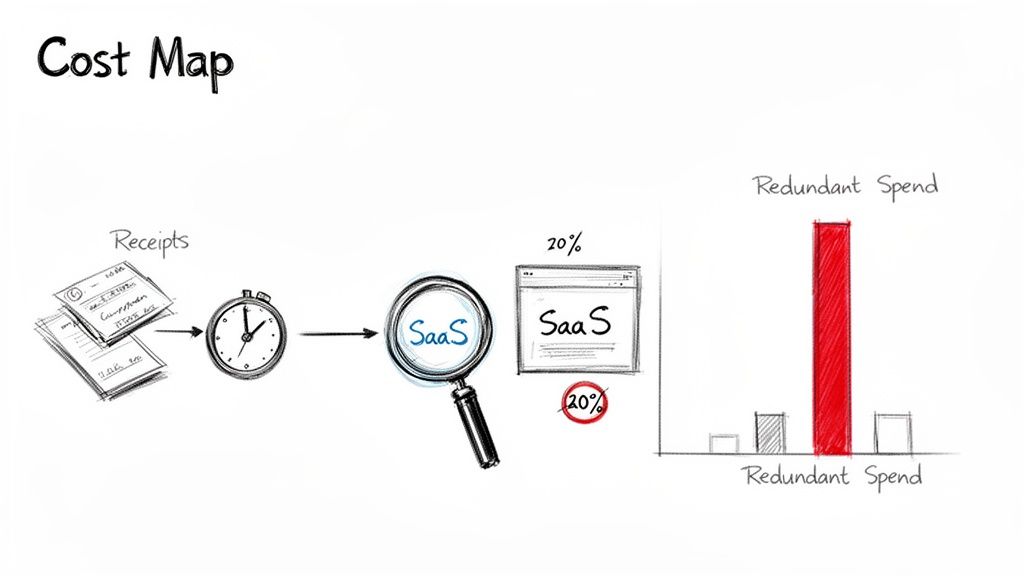
Before you can cut a single dollar from your budget, you have to play detective. The first step is figuring out where your money is actually going, not just where your budget says it should be. This calls for a full diagnostic—what I call a Cost Audit—to uncover all the hidden leaks that are quietly draining your bank account.
This isn't about nitpicking the cost of office coffee. It’s a strategic deep-dive into the four pillars of your business: People, Processes, Technology, and Vendors. By systematically pulling back the curtain on each one, you can stop guessing and start making data-backed decisions. The end goal is to create a clear Cost Map that lights up the path forward.
Conducting Your Four-Pillar Cost Audit
Time to roll up your sleeves and gather some data. This means digging into everything from expense reports and payroll records to software invoices and vendor contracts. You’re trying to build a complete, unfiltered picture of your finances to spot patterns and red flags that signal savings opportunities.
Think of it as a financial health checkup for your business. You're looking for symptoms of waste—redundant tasks, underused software, or dusty old contracts with unfavorable terms.
Here’s how to tackle each pillar:
-
People: Look past the salary numbers. Use time-tracking software to see where the hours are actually going. Are your best people stuck doing low-value admin work? Spikes in overtime could point to a bottleneck in your workflow or a sign that you're understaffed in a crucial area.
-
Processes: Sketch out your core workflows, from the first customer touchpoint to the final delivery. You're hunting for redundancies, manual data entry, and any little steps that cause frequent delays. Small frictions in a daily process add up to massive labor costs over time.
-
Technology: This is a goldmine, especially for e-commerce shops and SMBs. Make a list of every single SaaS subscription you pay for. I guarantee you’ll find overlap. Do you really need three different project management tools? It’s shocking how many businesses are paying for premium features they never touch or, worse, for licenses still assigned to employees who left months ago.
-
Vendors: Pull up every contract you have with third-party providers—your marketing agency, your shipping carrier, your web host. When did you last renegotiate those terms? Are you still paying for services that don't even align with your current business goals?
Turning Data Into a Clear Cost Map
Don't let all this information just rot in a spreadsheet. You need to visualize it. Create a simple Cost Map that sorts every major expense into one of the four pillars. This visual breakdown makes it immediately obvious where your cash is concentrated and where your biggest wins are hiding.
I once worked with an e-commerce retailer who did this exact audit. Their Cost Map showed that a staggering 20% of their monthly tech spend was on redundant or completely unused software. Turns out, they’d switched to a new marketing tool six months earlier, but nobody ever canceled the old subscription.
A thorough Cost Audit isn't an accusation of past mistakes. It's an empowering tool that gives you the clarity needed to build a more resilient and profitable business for the future.
That one find led them to consolidate their software, saving them over $12,000 a year with just a few emails. That leak would have kept dripping forever without a structured audit.
From Diagnosis to Action
Once your Cost Map is done, you've got the foundation for your entire cost-reduction strategy. You now have a prioritized list of inefficiencies, all backed by cold, hard data. You can see which problems are small leaks you can patch in an afternoon and which are gushing pipes that demand a more serious fix.
The next move is to turn this diagnostic report into an action plan. You’ll decide which initiatives to tackle first based on their potential impact and how much effort they’ll take. This methodical approach ensures you put your energy where it’ll deliver the biggest results, fast.
Using Technology and AI to Automate and Save
Smart technology isn't a luxury reserved for big corporations anymore. For small and mid-sized businesses, it's a fundamental tool for survival and growth. Putting automation and Artificial Intelligence (AI) to work strategically is one of the most effective ways to slash operational costs without sacrificing quality. It’s all about working smarter, not just harder.
The key is to cut through the buzzwords and find practical uses. This means hunting down the high-volume, repetitive tasks that eat up your team's valuable time and letting technology take over. The goal isn't to replace your talented people, but to free them from the monotonous work so they can focus on what actually grows the business—strategy, customer relationships, and innovation.
Identifying Prime Candidates for Automation
First things first, you need to pinpoint which parts of your operation are ripe for automation. Think about the daily or weekly jobs that are essential but don't need complex human judgment. These are your low-hanging fruit.
A few common areas to look at:
- Customer Service: Using AI-powered chatbots to handle frequently asked questions instantly, 24/7. This frees up your support team to tackle the more complex, high-touch inquiries.
- Marketing and SEO: Automating weekly SEO performance reports or using AI to analyze ad spend and suggest budget reallocations for better ROI.
- Administrative Tasks: Automating invoice processing, data entry between different software, or scheduling out your social media posts.
- E-commerce Operations: Automating inventory updates across multiple sales channels or sending out abandoned cart reminders.
The real power of automation is in its ability to give you back time. Every hour saved on a repetitive task is an hour your team can reinvest into activities that directly grow the business.
Recent data really drives this point home. The 2025 Agency Growth Benchmark from Predictable Profits found that 89% of agencies are now using AI tools, leading to productivity boosts of up to 49%. On top of that, a PwC survey noted that 62% of operations leaders find AI highly effective for managing costs. Businesses that get serious about using AI for high-volume tasks can potentially cut operational costs by 30-50%.
Choosing the Right Tools for the Job
Once you know what to automate, the next puzzle is picking the right tools. The market is flooded with AI and automation software, and it’s easy to get overwhelmed. The trick is to focus on solutions that offer a clear, measurable return and play nicely with the systems you already use.
For instance, a tool like Zapier is incredibly popular because it connects different apps to automate workflows without needing to know a lick of code.
Tools like these are designed to be accessible, letting you build simple "if this happens, then do that" automations. They can handle things like adding a new lead from a form to your CRM and sending them a welcome email at the same time.
When you're looking at a new tool, ask yourself a few honest questions:
- Does it fix a specific, recurring headache? Avoid those "solutions in search of a problem."
- Can it integrate with our existing software? A tool that doesn’t talk to your other systems just creates another frustrating silo.
- Is the ROI obvious and measurable? Do the math. Figure out the time saved or errors reduced to make sure the subscription cost is worth it.
- Is it user-friendly for my team? A complicated tool that requires tons of training can defeat the whole purpose of saving time.
For a deeper look into this process, our guide on how to implement AI in your business offers a practical framework for picking and integrating the right solutions.
A Practical Example of Automation in Action
Let's look at an e-commerce business. Before automation, their process for a new order might involve manually updating inventory in a spreadsheet, adding the customer's email to their marketing list, and then creating a shipping label. That could easily take 5-10 minutes for every single order.
With a simple automation workflow, the moment an order is placed in Shopify:
- Inventory is automatically updated in their management system.
- The customer is added to a "New Customer" segment in Mailchimp.
- A shipping label is automatically generated in ShipStation.
What once took hours each day now happens instantly, with zero human intervention. This is a perfect example of reducing operational costs in a meaningful way. It frees up staff, cuts down on errors, and creates a scalable process that actually supports business growth instead of holding it back.
Optimizing Processes and People for Peak Efficiency
It’s easy to get caught up in shiny new tech, but at the end of the day, technology doesn't run your business—your people do. The workflows they follow day-in and day-out are your greatest assets, but they can also be your biggest source of hidden costs. Nailing your internal processes and empowering your team is a surefire way to trim waste and see a real jump in productivity.
Inefficient processes are like sludge in your operational engine. They cause delays, frustrate your best employees, and quietly drive up costs. The first step is to get everything out in the open. That's where workflow mapping comes in.
It's simpler than it sounds. Just sketch out a process from start to finish. If you run an e-commerce store, map the entire journey of an order from the moment a customer clicks "buy" to when the box lands on their doorstep. You’ll be amazed at what you find. Bottlenecks like a manual data entry step causing errors or a communication breakdown leaving orders sitting idle will become painfully obvious.
Fostering a Culture of Continuous Improvement
Once you’ve spotted the friction points, the real work begins. This isn’t about a one-time fix. The goal is to build a culture where every single person on your team is encouraged to find and suggest better ways of doing things. Your frontline employees are the true experts; they know exactly where the holdups are because they live them every day.
Don’t just fix the process; empower the people. When your team feels ownership over their workflows, they become your most valuable source of innovation for reducing operational costs.
For example, a customer service rep might notice they answer the same three questions a dozen times a day. If you empower them to help create a new FAQ page or an automated email response, you not only save their time but also improve the customer experience. This mindset is crucial. For a deeper dive, check out our guide on how to streamline business processes for more strategies.
Building a More Agile and Resilient Workforce
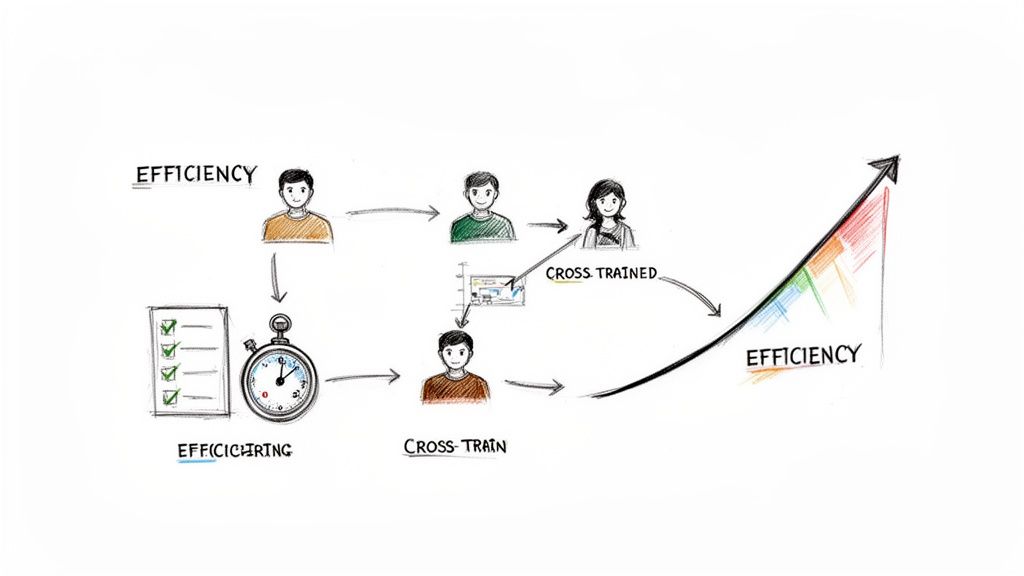
Beyond just fixing workflows, take a hard look at how your team is structured. Relying too heavily on a few specialists creates serious vulnerabilities. If that one key person is out sick, does everything grind to a halt? This is where cross-training becomes a strategic game-changer.
By training employees in adjacent roles, you build a much more flexible and resilient team.
- A marketing assistant trained in basic graphic design can whip up simple social media assets without needing to outsource.
- A warehouse team member who also knows how to manage customer returns can eliminate the need for temp staff during your busy season.
This approach does more than just cut your dependence on pricey specialists or temp agencies. It boosts employee engagement by offering new skills and pathways for growth. It’s a classic win-win that directly lowers your operational costs in the long run.
Data-Driven Budgeting for Smarter Spending
This optimization mindset also applies to how you allocate your budget, especially for something like marketing. Stop guessing and start using data to make every dollar count. Track your key metrics like Cost Per Acquisition (CPA) and Return on Ad Spend (ROAS) across social media, SEO, and PPC campaigns.
When you know your numbers, you can confidently shift money away from channels that aren't performing and double down on what works. For instance, in 2025, top brands are allocating their social media budgets with precision: 60% to ad media spend, 20% to creative, 15% to management, and 5% to analytics. This focus helps them hit an average ROAS of 3x-5x. One B2B SaaS company even saw a 30% reduction in their cost-per-lead on LinkedIn just by refining their ad targeting. You can find more insights on social media marketing costs on quimbydigital.com.
By applying this same analytical rigor to all your team's functions and workflows, you turn small, incremental improvements into significant, compounding gains. This is how you transform your operations from a cost center into a lean, efficient engine for growth.
Mastering Vendor Management and Negotiation
Your third-party vendors—from software providers to marketing agencies—can easily eat up a huge slice of your operational budget. Getting this spend under control isn’t about nickel-and-diming your partners. It's about strategically managing those relationships to get the best possible value. The process kicks off with a full audit to get a crystal-clear picture of who you're paying, for what, and if you're actually getting your money's worth.
This audit is your secret weapon. It gives you the leverage to spot chances for consolidation, renegotiation, or sometimes, cutting a service loose entirely. The goal is to make sure every dollar you spend on a vendor is an investment that delivers a real, measurable return.
Conducting a Thorough Vendor Contract Audit
First things first: you need to round up every single active vendor contract and invoice. You're hunting for key details that often get buried in the day-to-day chaos.
- Service Redundancy: Are you paying two different companies for basically the same thing? This happens all the time with software subscriptions, where features overlap between platforms.
- Contract Terms: When do your contracts auto-renew? Countless businesses get locked into another year of a bad deal simply because they missed the cancellation window.
- Performance vs. Cost: Is the vendor actually meeting the service level agreements (SLAs) in the contract? If they aren't, you've got immediate grounds for a chat.
Once you have all this data laid out, you can start making smart decisions. For instance, consolidating services with a single, high-performing vendor can often unlock volume discounts. Our guide on custom software vs. off-the-shelf solutions is a great resource for figuring out if building or buying makes more sense for your tech stack, a key piece of this analysis.
Powerful Tactics for Successful Negotiation
With your audit findings in hand, it's time to talk. Remember, this is a business conversation, not a confrontation. The goal is a win-win: you get better terms, and your vendor keeps a client they value.
Walk into that meeting prepared. State your position clearly, backing it up with market rates, competitor pricing, or the performance gaps you uncovered.
Your best negotiation tool is knowledge. When you can demonstrate that you understand the market and your own usage data, you shift the conversation from asking for a discount to building a smarter partnership.
And don't just fixate on the price tag. You can also negotiate for:
- Better Payment Terms: Shifting from monthly to annual payments can sometimes land you a 10-20% discount. On the flip side, asking for longer payment cycles (like Net 60 instead of Net 30) can give your cash flow some breathing room.
- Added Value: If a vendor won't move on price, ask what else they can throw in. This could be extra user licenses, premium support, or early access to new features at no cost.
- Performance-Based Models: Tie part of the vendor's fee to specific, measurable results. This works especially well with marketing or sales agencies.
Shifting from Retainers to Project-Based Work
For services like web development, SEO, or content creation, the old-school monthly retainer model isn't always the sharpest tool in the shed. It can lead to paying for unused hours or a fuzzy focus on deliverables. A smarter way to trim operational costs is to move toward project-based pricing.
This model puts you back in control of your budget. You define a specific scope of work, agree on a fixed price, and pay when clear milestones are hit. It forces clarity from the get-go and ensures you're only paying for tangible outcomes.
Research is backing this up. Promethean Research's 2025 Digital Agency Industry Report found that niche agencies often have higher margins (40-75%) simply because their operations are so dialed in. What’s really telling is that the fastest-growing agencies are now handling 24% more projects on 16% fewer retainers—a clear signal of where the market is headed. With only 2% of agencies using pure value-based pricing, there's a huge opportunity for clients to negotiate performance-driven contracts. You can dig into the specifics in the 2025 Digital Agency Industry Report on prometheanresearch.com. This data makes a strong case for seeking out specialized partners and tying your contracts directly to business results, not just hours logged.
Building Your Cost Reduction Action Plan
All the analysis in the world won't save you a dime if you don't act on it. Once you’ve pinpointed where the money is going, it’s time to build a real plan to turn those insights into savings. This isn't about a one-off budget slash; it's about embedding a cost-conscious mindset into your company's DNA for the long haul.
A solid action plan takes your audit findings and turns them into specific, measurable goals with a deadline. Forget vague ideas like "cut software spend." A much better goal is, "consolidate our three project management tools into one by the end of Q3, saving $4,800 a year." That kind of clarity is what keeps everyone accountable and makes progress easy to track.
Assigning Ownership and Setting KPIs
Here's a hard truth: if an initiative doesn't have a clear owner, it's probably not going to happen. Every single cost-saving project needs one person who is responsible for pushing it forward, reporting on its progress, and knocking down any barriers that pop up. Without that, even the most brilliant ideas just fizzle out.
Once you’ve got owners, you need a way to keep score. That's where Key Performance Indicators (KPIs) come in. They're your scoreboard for what's actually working.
- Cost Per Acquisition (CPA): Is your marketing spend getting more or less efficient? This tells you.
- Software ROI: This forces you to ask if a tool is actually generating more value than it costs.
- Employee Productivity Rate: A great way to see if your process improvements are actually helping people get more done.
These metrics transform your efforts from hopeful guesses into a data-driven strategy.
Your action plan is the bridge between analysis and results. It ensures your cost-reduction strategy is a living document that drives real financial improvement, not just a report that gathers dust.
For example, when tackling vendor spending—which is often a huge chunk of operational costs—a simple, repeatable framework makes all the difference.
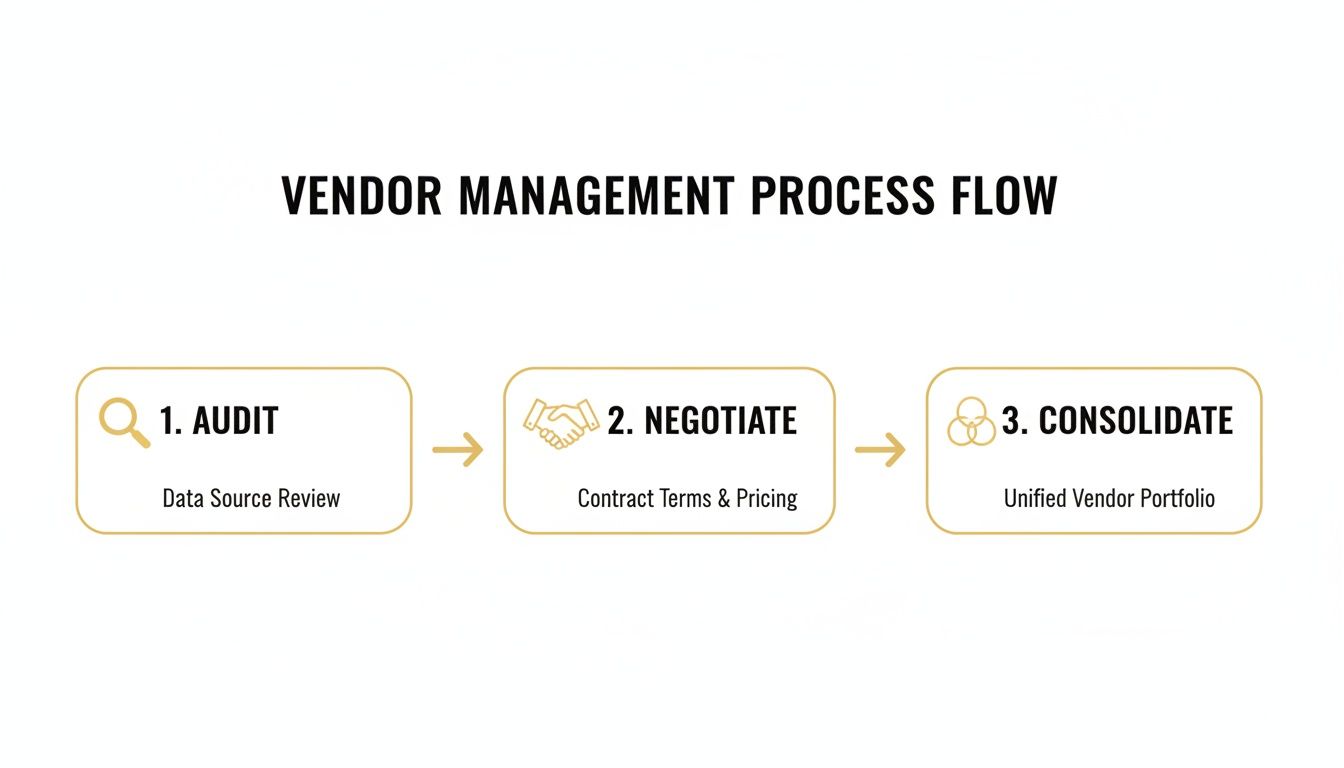
This process isn't a one-time thing. It’s a continuous cycle of auditing what you have, negotiating better terms, and consolidating where it makes sense.
Communicating Changes to Your Team
Never, ever forget the human side of this. Rolling out big operational changes without proper communication is a recipe for anxiety, confusion, and resistance. You have to be transparent about why these changes are happening.
Frame these initiatives for what they are: a collective effort to build a stronger, more stable business that ultimately benefits everyone.
When your team understands the big picture and sees how their work contributes to it, they shift from being passive observers to active participants. That buy-in is what turns cost management from a top-down mandate into a shared responsibility—and that’s how you build sustainable, long-term profitability.
Answering Your Questions
Still have a few things on your mind about cutting operational costs the right way? Let's tackle some of the most common questions business owners ask.
Where’s the Best Place to Start Looking for Savings?
Start with your "Big Three": payroll, software subscriptions, and vendor contracts. Honestly, these are almost always the areas where you'll find the biggest wins without turning the whole business upside down.
Kick things off with a deep dive into your software stack. You'd be surprised how often you find redundant tools or premium features you're paying for but never actually use. Next, pull out those vendor contracts. If any are coming up for renewal, that's your golden opportunity to renegotiate.
As for payroll, the goal isn't just to cut heads. It's about boosting efficiency and productivity—that's where the real long-term value is.
How Do I Cut Costs Without Tanking Quality or Morale?
This is the big one, right? The trick is to focus on eliminating waste, not slashing valuable resources or asking people to do more with less. You want to make your operations smarter, not cheaper. When you get that right, morale actually goes up.
- Automate the boring stuff: Free up your team from repetitive tasks so they can focus on work that actually matters and requires their brainpower.
- Play hardball with vendors: You can often get the same—or even better—service for less money just by asking for better terms or shopping around.
- Fix your broken processes: Getting rid of operational bottlenecks makes everyone's job less frustrating and way more productive.
When you talk about these changes with your team, frame it as a strategy for growth. Explaining how becoming more efficient makes the company stronger and their jobs more secure is key to getting everyone on board.
How Often Should I Be Reviewing My Costs?
You should do a full, top-to-bottom operational cost audit at least once a year. This gives you the 30,000-foot view you need to set your annual budget and plan strategically.
But don't just set it and forget it for 12 months. Keep a closer eye on the big-ticket items quarterly or even monthly. This means tracking things like software usage, spending with your top vendors, and key marketing metrics like your Cost Per Acquisition (CPA). Catching a rising cost early is a lot easier than fixing a massive budget blowout later.
Ready to make operational efficiency your secret weapon? The team at Up North Media lives and breathes this stuff. We build custom web apps and AI solutions that automate your tedious processes and seriously drive down costs.