
Let's be honest, AI consulting isn't about chasing some futuristic tech trend. It’s about solving the very real, often frustrating, operational problems you face today. For a small business, this means bringing in an expert who can pinpoint specific AI tools to save you time, cut costs, and actually drive revenue. It's about turning complex technology into a real competitive advantage.
Is Your Small Business Truly Ready for AI?
Forget the hype for a second. Artificial intelligence isn't just a buzzword for Silicon Valley giants; it's a practical tool that helps small businesses right here in places like Omaha compete and win. The whole point of AI consulting is to get an expert guide who can map your specific business headaches to tangible, affordable AI solutions. This isn't about ripping out everything and starting over.
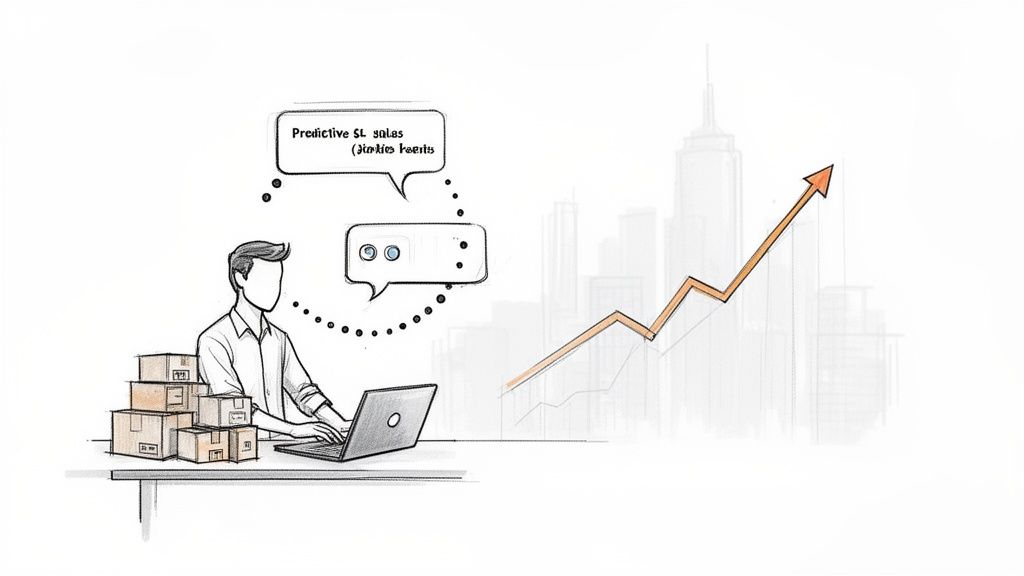
Instead, it’s about making targeted improvements that deliver results you can actually see. Imagine you run an e-commerce shop and you're drowning in customer service emails while constantly guessing at inventory levels. An AI consultant’s job is to zero in on those exact problems and introduce a smart chatbot for 24/7 support and predictive sales analytics to stop stockouts before they happen.
That’s how you turn daily operational chaos into genuine growth opportunities.
From Problem to Profit with AI
The journey is pretty straightforward: identify a bottleneck, apply a targeted AI solution, and measure the positive impact. This is how AI consulting transforms business challenges into real growth.
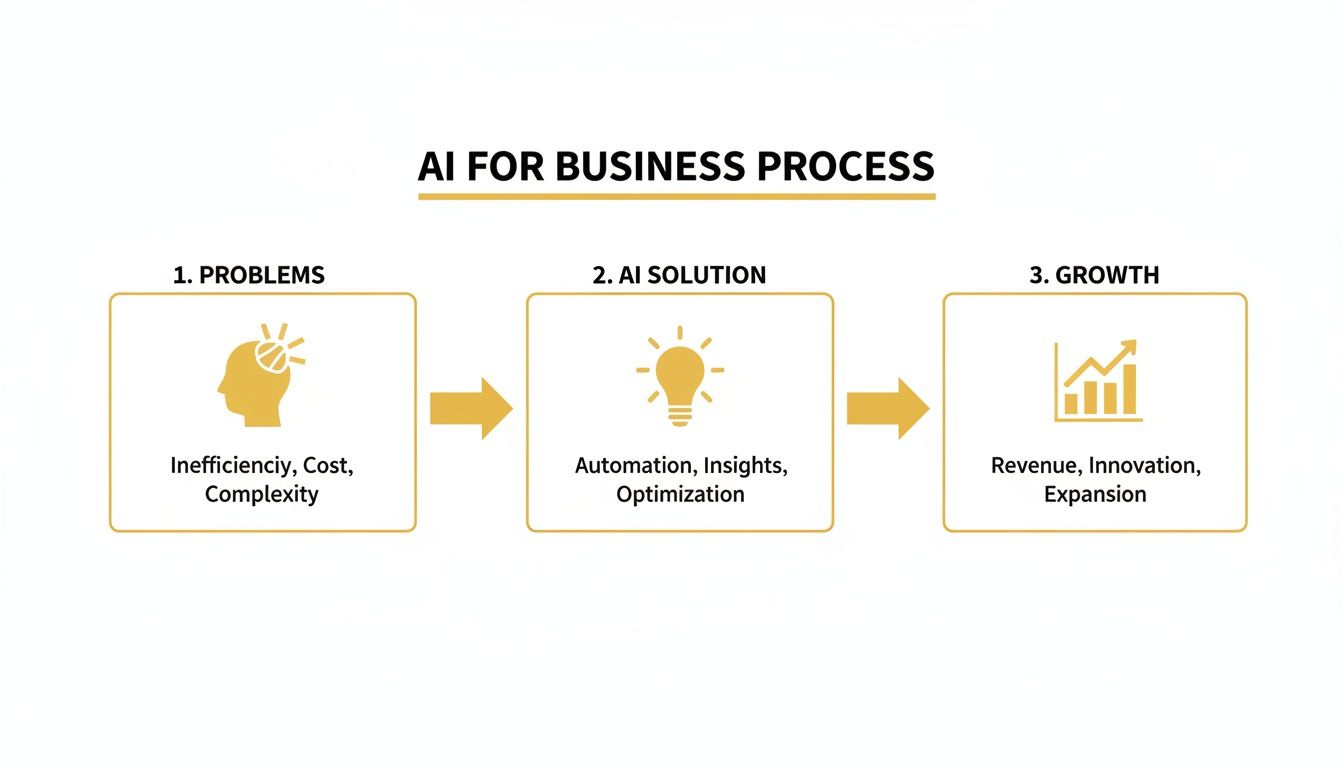
The key takeaway here? AI should be a direct response to a problem you already have, not a solution looking for one.
This strategic approach is why AI adoption is blowing up among smaller companies. Recent surveys show that 75% of small and mid-sized businesses (SMBs) are now experimenting with AI. Even more impressive, an incredible 91% of those using it report direct boosts in revenue.
For e-commerce retailers and digital publishers, this translates to tangible wins like automated customer service, accurate inventory forecasting, and super-efficient content creation. It's about making your limited resources go further.
The goal isn't just to use AI; it's to solve a specific business problem more effectively than you could before. Whether it's freeing up your team from repetitive tasks or gaining insights from your data, the focus is always on the outcome.
Before diving in, it helps to take a quick, honest look at where your business stands. Answering a few key questions can tell you if you're truly prepared to get the most out of an AI investment.
Quick AI Readiness Checklist for Your Business
| Readiness Area | Key Question to Ask | Why It Matters for AI Success |
|---|---|---|
| Clear Business Problem | "What specific, repetitive, or data-heavy task is costing us the most time or money?" | AI thrives on solving well-defined problems. Vague goals lead to wasted effort and poor results. |
| Data Availability | "Do we have organized digital data related to this problem (e.g., customer emails, sales numbers, inventory records)?" | AI models need data to learn. No data, no AI. It's that simple. Even basic spreadsheets can be a starting point. |
| Basic Digital Tools | "Are we already using standard business software like a CRM, accounting software, or an e-commerce platform?" | AI tools need to connect to your existing systems. Having a digital foundation makes implementation smoother and cheaper. |
| Team Buy-In | "Is my team open to trying new tools that could change how they work, or is there resistance to change?" | Your team will be using the AI. If they're not on board, even the best tool will fail. |
| Realistic Budget | "Have we set aside a budget for not just the tool, but for potential consulting and training costs?" | Thinking beyond the software subscription is crucial. Proper setup and training are what deliver the real ROI. |
Taking a moment to run through this checklist gives you a solid gut check. If you find yourself answering "yes" to most of these, you're likely in a great position to see a real return from AI.
For any small business thinking about this leap, a good understanding of AI automation for small business is a must. Think of this roadmap as your guide from initial curiosity to successful implementation—all designed for the practical needs of a business owner looking for real results, not just new tech.
Finding High-Impact AI Opportunities in Your Business
Before you even think about talking to an AI consultant, the best thing you can do is look at your own business. Forget the hype and the futuristic stuff for a minute. Where are the bottlenecks? What tasks are eating up your team's time?
A quick, practical audit of your own operations will immediately highlight the spots ripe for an upgrade. This isn't about finding some wildly complex AI application. It's about spotting the daily grind—the repetitive data entry, the customer questions you answer over and over, the sales data you aren't really using.
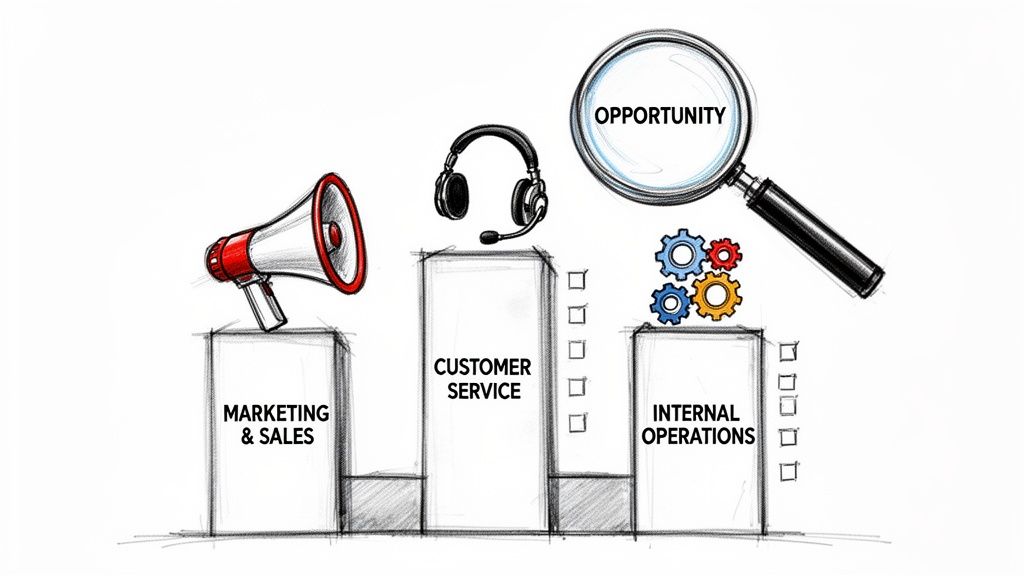
Breaking your business down into a few core areas makes it much easier to find these quick wins. This is how you turn a vague interest in AI into a productive first conversation with a consultant.
Auditing Your Marketing and Sales Engine
Let's be honest, marketing and sales are usually the most data-rich parts of any small business. You're already sitting on a goldmine of information about customer behavior, where leads come from, and which campaigns are working. The real question is, are you using that data to its full potential?
An experienced AI consultant will almost always start here. They're looking for ways to move beyond just analyzing what happened last month and start predicting what will happen next. This is where AI stops being a simple tool and becomes a real strategic advantage.
Think about these common scenarios:
- Lead Scoring: Imagine if your sales team knew, with a high degree of certainty, which leads were actually ready to buy. AI can sift through your historical data to automatically score new leads, so your team stops wasting time on tire-kickers and focuses on closing deals.
- Smarter Content Strategy: For a business that relies on content, AI can analyze what your competitors are doing and what people are searching for to find lucrative content gaps. You get to create articles you know people are looking for before you even write a word.
- Personalized Email Campaigns: Ditch the one-size-fits-all newsletter. AI can segment your audience based on what they've bought or looked at, tailoring the message to what they actually care about. The impact on open and click-through rates can be massive.
This is where the money is—using data to make smarter, faster decisions that show up on your bottom line.
Enhancing Your Customer Service and Support
Great customer service is a huge differentiator for small businesses, but it's also incredibly time-consuming. This is where AI can be a game-changer, handling all the routine stuff so your team can focus on the tricky problems that need a human brain.
The goal isn't to replace your people; it's to make them better at their jobs. So many businesses struggle to offer support outside of the classic 9-to-5, leading to frustrated customers and lost sales. AI-powered tools can fill that gap without you having to hire a night-shift crew.
The most effective AI implementations don't replace the human element; they augment it. By automating the predictable, you free up your team's creativity and problem-solving skills for where they matter most.
For any business looking to improve customer interactions, it's worth exploring specific tools like AI customer support software to see what's possible. Picture a chatbot on your website that can instantly answer 80% of common customer questions, 24/7. This isn't just about making customers happier; it's about freeing up dozens of hours for your team each week.
For an e-commerce store, this might mean automatically handling "where's my order?" questions. For a service business, it could be an AI that handles appointment bookings seamlessly.
Streamlining Internal Operations and Admin Tasks
Finally, take a hard look at the internal tasks that suck up time but don't directly make you money. Every business has them—the paperwork, the scheduling, the mind-numbing data entry. These administrative burdens are often the easiest and fastest wins for AI, delivering an immediate efficiency boost.
These are the silent productivity killers that AI is perfectly built to handle. The ROI here is measured in hours saved, which you can pour right back into growing the business.
Here are a few operational areas to look at first:
- Invoice Processing: AI tools can literally read an invoice, pull out the important info, and pop it straight into your accounting software. No more manual entry, and far fewer errors.
- Inventory Management: For retailers, AI can analyze past sales and seasonal trends to predict demand, helping you avoid running out of popular items or getting stuck with stuff that won't sell.
- Document Management: Imagine an AI that could automatically organize, tag, and file all your digital documents. Finding that one specific contract from two years ago would take seconds, not hours.
By starting with these focused audits, you’ll walk into your first AI consultation with a solid list of potential projects. You can find many of the top AI solutions for small business to boost growth that tackle these exact problems. Doing this homework first changes the entire conversation from a vague "what can AI do?" to a strategic discussion about solving your most pressing business challenges.
How to Choose the Right AI Consulting Partner
Once you have a few potential AI projects in mind, you’ll face what is easily the most important decision in this whole process: picking the right consulting partner. This isn’t just about hiring a vendor with a flashy portfolio. It’s about finding a true partner who will get in the trenches with you, understand your business, and guide you to real, tangible results.
Make the wrong choice, and you’ll end up with wasted money and a soured view of what AI can actually do. But the right partner acts as a genuine extension of your team. They bring the technical chops, sure, but more importantly, they bring business sense. That distinction makes all the difference between a successful AI initiative and a frustrating, expensive experiment.
Look Beyond the Technical Checklist
It’s easy to get mesmerized by a consultant's technical skills, but for a small business, the "softer" skills are often what really count. Can they explain complex AI concepts in plain English? Do they ask more questions about your business goals than they do about their own algorithms?
Think about this common scenario. You meet with two different consultants.
- Consultant A immediately dives into their proprietary machine learning models and shows you impressive—but totally irrelevant—case studies from giant corporations.
- Consultant B spends the first thirty minutes asking about your customer churn rate, your most time-consuming admin tasks, and where you want your revenue to be in a year.
You want Consultant B. Every time. They're starting with your problems, not their solutions. A great AI consulting partner for small businesses prioritizes your business context above everything else. They get that the coolest technology is useless if it doesn't solve an actual business problem.
Your AI consultant should feel like an extension of your team, not just another vendor. Their first priority should be to deeply understand your specific business challenges before ever mentioning a single piece of technology.
Prioritize Industry and Local Expertise
A consultant who already gets your industry—whether it’s e-commerce, digital publishing, or local services—is worth their weight in gold. They already know the common pain points, the competitive landscape, and the metrics that matter. This shared language saves a massive amount of time and ensures the solutions they propose are genuinely relevant.
For Omaha-based businesses, finding a local partner can be a game-changer. A consultant who understands the regional market can offer insights that a remote, faceless firm simply can’t. They're invested in the local business community and are far more accessible for hands-on work.
Here are the critical, non-technical things to look for:
- Business Acumen: Do they talk about ROI, efficiency gains, and customer lifetime value?
- Clear Communication: Can they explain their plan without hiding behind confusing jargon?
- Proven SMB Experience: Have they actually worked with businesses of your size and budget before?
- Customized Approach: Are they proposing a solution built for you, or are they just pushing a one-size-fits-all package?
The process feels a lot like hiring a key employee. Many of the same principles of partnership and alignment apply, which you can read more about in our guide on how to choose a software development company.
Create a Vetting Scorecard
To make your decision-making more objective, put together a simple scorecard. This little tool helps you move beyond a "gut feeling" and focus on what truly matters for a successful partnership. It forces you to compare everyone on the same important factors.
Here’s a practical template to get you started. Just score each consultant on a scale of 1 to 5 for each criterion.
AI Consultant Vetting Scorecard
| Evaluation Criterion | Consultant A Score (1-5) | Consultant B Score (1-5) | Notes/Comments |
|---|---|---|---|
| Understands My Business Goals | Did they ask about revenue/cost savings? | ||
| Relevant Industry Experience | Have they solved this problem before? | ||
| Clear Communication Style | Could I explain their plan to my team? | ||
| Focus on Practical ROI | Did they talk about measurable results? | ||
| Transparent Pricing Model | Are there any hidden fees or costs? | ||
| Cultural Fit & Partnership | Do they feel like a true partner? |
Choosing your AI partner is a foundational step. By focusing on business alignment, clear communication, and a true partnership mentality, you set your first AI project up for success from day one.
Launching Your First AI Pilot Project
Big ambitions need to start with small, smart steps. The idea of a full-scale AI overhaul is enough to paralyze anyone, which is why you don’t do it. Instead, you start with a tightly focused pilot project. Think of it as a controlled experiment designed to minimize risk, maximize learning, and deliver a quick, measurable win. This is how you build momentum and prove AI's value to your team and your bottom line.
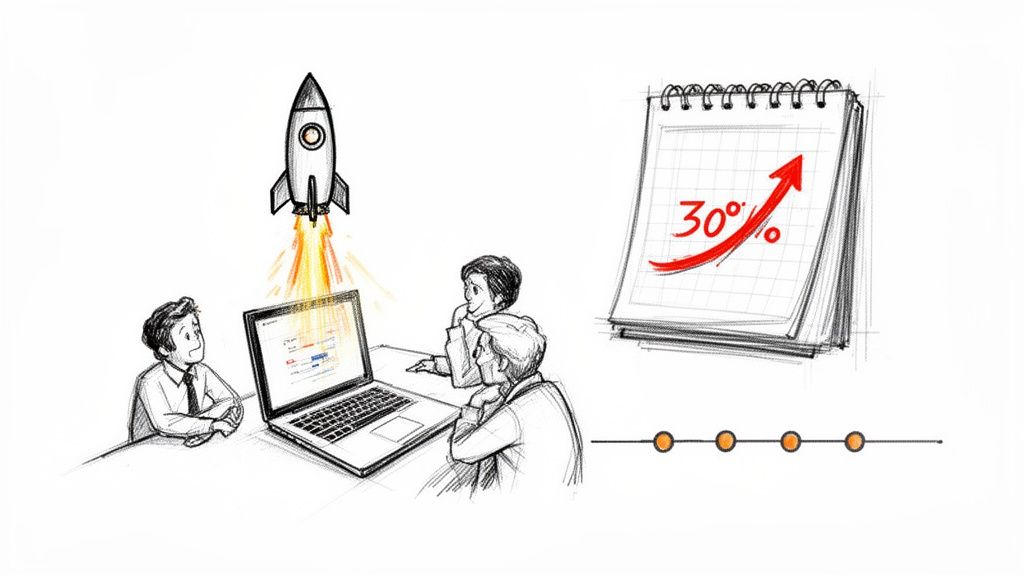
Forget trying to boil the ocean with a vague goal like "improve customer service." A successful pilot needs a narrow, achievable scope with a crystal-clear metric for success. Instead of that fuzzy idea, you aim for something specific: "reduce customer email response time by 30% within 60 days." See the difference? That transforms a wish into a concrete objective you can actually build a project around.
Defining Your Pilot Project Scope
The key here is to pick one specific, nagging problem and solve it. Don't try to tackle marketing, operations, and sales all at once. An effective pilot has a clear start, a clear end, and a single, undeniable success metric. It’s a test, not a company-wide revolution.
Let's imagine an Omaha-based home services business that's constantly bogged down by appointment scheduling. The owner spends hours every week playing phone tag with clients, trying to find a time that works for everyone. This is a perfect candidate for an AI pilot project.
The project isn't "implement AI." It's "deploy an AI-powered scheduling assistant to automate booking for one specific service."
Here’s how you’d break that down:
- The Problem: Too much time is wasted on manual appointment scheduling, leading to lost revenue and administrative headaches.
- The AI Solution: An AI chatbot integrated into the website and business phone line that can access calendars and book appointments automatically.
- The Scope: The pilot will only handle bookings for "Annual HVAC Tune-Ups," the company's most standardized offering.
- The Success Metric: Reduce the owner's time spent on scheduling by 10 hours per week and achieve a 90% successful booking rate through the AI assistant.
This hyper-focused approach makes the project manageable and the results dead simple to track. It's a low-risk way to test the waters and see what really works for your business.
From Small Wins to Big Momentum
Starting small does something incredibly important: it builds internal confidence. When your team sees a small, well-defined AI project knock it out of the park, their skepticism starts to turn into excitement. That first win becomes the proof you need to justify a bigger investment down the road. It gets everyone on board and curious about what’s next.
A pilot project isn't just a technical test; it's a cultural one. It's your chance to show that AI is a helpful tool that makes everyone's job easier, not some threat that's here to replace them.
Your AI consulting for small business partner should be an expert at designing these kinds of pilots. They’ll help you spot the low-hanging fruit and structure the experiment for a win. They make sure you’re not just testing a piece of technology, but actually validating a solid business case. For a deeper dive into the steps, our guide on how to implement AI in business walks through the entire process in more detail.
Your Pilot Project Action Plan
Once you've locked in the scope, execution becomes a clear, step-by-step process. A good plan ensures nothing falls through the cracks and keeps everyone on the same page.
Here’s a practical checklist to guide your first pilot:
- Finalize the Scope & Metrics: Get your consultant and key team members to formally sign off on the project’s specific goals. What does success look like in hard numbers?
- Set a Realistic Timeline: A good pilot should take weeks, not months. Aim for a 30- to 90-day window from kickoff to results. This keeps the project agile and focused.
- Identify the Project Lead: Designate one person internally who "owns" the pilot. This person is the point of contact and ensures clear communication and accountability.
- Prepare Your Data: The AI tool needs clean data to work its magic. For our scheduling example, this means making sure service calendars and customer contact lists are organized and up-to-date.
- Communicate with Your Team: Explain what the pilot is, why you're doing it, and how it will help them. Transparency is everything when it comes to getting buy-in.
- Plan for a "Go/No-Go" Decision: At the end of the pilot, you'll analyze the results against your initial metrics. This is your clear, data-backed decision point on whether to expand the solution, tweak it, or try something else.
This framework takes the guesswork and fear out of your first AI project. By starting with a small, strategic pilot, you’re not just adopting new tech—you’re building a foundation for smarter, more efficient growth.
Estimating Costs and Calculating Your AI Return
Alright, let's get right to it—what’s this going to cost, and is it actually worth the investment? These are the first questions any sharp business owner asks. Getting a clear picture of the financials is how you build a real business case for AI, not just a wishlist.
The price tag for ai consulting for small business isn't just one number. It’s a mix of a few different things, and knowing what they are helps you budget without any nasty surprises down the road.
You've got the upfront consulting and strategy fees, which cover the expert’s time digging into your business, finding the best opportunities, and drawing up a practical roadmap. Then there are the software and licensing costs for the AI tools themselves—usually a monthly or yearly subscription. And don't forget about the implementation and training fees to get everything set up and make sure your team actually knows how to use it.
Breaking Down the Investment
To make this feel a bit more real, let's talk about the common ways these costs are structured. Every project is different, but the expenses usually fall into a few predictable buckets.
- Consulting Fees: This could be a one-time project fee for a specific pilot or an hourly rate for ongoing advice. A small business pilot project can run anywhere from a few thousand dollars on up, depending on how complex it is.
- Software Subscriptions: A lot of powerful AI tools are surprisingly affordable. You’ll see monthly plans starting from $50 to $500 a month, with the price scaling based on how much you use it and the features you need.
- Implementation Costs: This is the one-off expense to get the AI tool talking to your existing software, like your CRM or accounting platform. It's a critical step that you can't skip if you want things to run smoothly.
Any consultant worth their salt will give you a clear, itemized proposal. That kind of transparency is the sign of a true partner who's focused on delivering value, not just selling you a product.
Calculating Your Potential Return on Investment
Now for the fun part: figuring out the return. ROI isn't some fluffy metric; it's a hard number that proves the investment was worth it. We can look at this in two main ways: cost savings and revenue growth.
Cost savings are often the easiest to nail down. Let's take a classic example of automating repetitive admin tasks.
Example 1: Automating Admin Work Say you have a team member who spends 10 hours a week on manual data entry, scheduling, and chasing down invoices. If their loaded hourly rate (salary plus benefits) is $35/hour, you’re spending $350 a week—or about $1,400 a month—on that work.
If you bring in an AI tool for $200/month that automates 80% of those tasks, your net monthly savings are $920.
(Hours Saved x Hourly Rate) - AI Tool Cost = Monthly Savings (8 hours/week x 4 weeks x $35) - $200 = $920 per month
That’s a clear win. You haven't just cut costs; you've freed up that employee to focus on work that actually grows the business.
Next up is revenue growth. This takes a little more forecasting, but the payoff can be massive.
Example 2: Boosting Lead Conversion Imagine you roll out an AI-powered marketing tool to personalize your email campaigns. Your consultant helps you aim for a 15% increase in your lead-to-customer conversion rate. If you currently close 10 new customers a month and your average customer lifetime value (LTV) is $2,000, that 15% bump means an extra 1-2 customers each month.
That’s an additional $2,000 to $4,000 in monthly revenue, easily covering the cost of the tool and the consulting work.
Globally, the AI market is expected to explode to $1.68 trillion by 2031, and it’s being driven by exactly this kind of tangible ROI. For local Omaha e-tailers, publishers, and startups, this means putting AI to work on data-driven SEO, personalized web apps, and serious cost-cutting through automation. You can find more insights on how AI consulting delivers measurable ROI for small businesses.
By focusing on these clear financial calculations, you turn AI from a "nice-to-have" expense into a strategic investment proven to fuel growth.
Common Questions About AI for Small Businesses
Jumping into artificial intelligence can feel like a big step, and it's completely normal to have questions. A lot of business owners feel the same way—they hear about the potential but worry about the price tag, the complexity, and whether their data will be safe.
Let's tackle those concerns head-on. The goal here is to give you clear, straightforward answers so you can see how AI becomes a powerful tool for growth, not a source of fear.
Is AI Too Expensive for a Small Business Budget?
This is easily the number one question on every owner's mind, and the answer is almost always a pleasant surprise. The idea that AI is only for massive corporations with bottomless budgets is a thing of the past. The landscape has changed, big time.
Many powerful AI tools are now available as affordable monthly subscriptions. You can find highly effective solutions for marketing, customer support, and admin tasks for just a few hundred dollars a month, with plans that let you start small and scale up.
The most important thing to remember is that AI is not an expense; it's an investment. The right implementation should pay for itself through cost savings or increased revenue, often much faster than you’d expect.
A good ai consulting for small business engagement is all about finding projects with a clear and quick return. A consultant's job is to pinpoint the "quick wins" that generate immediate value, which can then fund more ambitious projects down the road. The focus is always on solutions that fit your budget and deliver real results.
Will My Customer Data Be Secure?
Data privacy is non-negotiable. It’s a huge and valid concern for any business trusting its information to a new system. The good news is that reputable AI providers and consultants take security extremely seriously. Protecting your data is the cornerstone of their service.
When you're looking at any AI solution, a consultant will help you vet its security features. Here are the key things to look for:
- Data Encryption: This ensures your data is unreadable, both when it's stored and when it's being sent.
- Access Controls: Strong systems that limit who can see or use your data, both on your team and at the provider's end.
- Compliance Certifications: Look for adherence to established standards like SOC 2 or GDPR, which shows a real commitment to best practices.
A crucial part of the process is setting up solid data protection from day one. This isn’t just about choosing secure tools, but also training your team on security best practices to prevent human error—still a leading cause of data breaches.
Do I Need a Tech Expert on My Team to Use AI?
Absolutely not. This is a common myth that holds a lot of businesses back. The idea that you need an in-house data scientist to benefit from AI is just plain wrong for most small business uses.
Modern AI tools are designed with non-technical users in mind. They come with intuitive dashboards, simple setup guides, and require little to no coding. The whole point of these platforms is to make sophisticated tech accessible to everyone.
This is exactly where an AI consultant adds massive value. They act as your on-demand tech expert, handling the setup, integrating the tool with your other systems, and most importantly, training you and your team. They bridge the gap so everyone feels comfortable using the new tools. Your team doesn't need to know how the AI works, just how to use it to make their jobs easier.
Will AI Replace My Employees?
The fear of AI taking jobs is everywhere, but for small businesses, the reality is usually the exact opposite. AI is most effective when it’s used to make your existing team better, not replace them. It's about empowering your people to be more productive and focus on work that actually matters.
Think of it this way: AI is great at the repetitive, predictable, and time-consuming tasks that people honestly hate doing.
- An AI chatbot can handle the same 20 questions your customers ask every day. This frees up your support staff to deal with the complex, emotional, or high-stakes issues that demand a human touch.
- An AI tool can process hundreds of invoices in minutes, wiping out hours of manual data entry and letting your admin team focus on financial analysis and strategy.
By automating the boring stuff, you give your team back their most valuable resource: time. This lets them zero in on creativity, strategy, building customer relationships, and other uniquely human skills that drive real growth. AI is a tool to help your team, not a threat.
Ready to see how a strategic AI plan can solve your biggest business challenges? The team at Up North Media specializes in creating practical, results-driven AI solutions for small businesses just like yours. Book a free consultation today and let's build your roadmap to smarter growth.