
You’re probably feeling this already. Leads come in from your website, social posts go out when someone remembers, ad reports live in three different dashboards, and follow-up depends on whoever has the fewest fires to put out that day.
That’s not a work ethic problem. It’s a systems problem.
A lot of Omaha business owners are running marketing with a patchwork of tools, spreadsheets, and reminders. One person checks form fills. Another exports ad performance. Someone else tries to write follow-up emails between meetings. The result is familiar. Slow response times, inconsistent nurturing, wasted ad spend, and a constant sense that marketing is busy but not compounding.
An automation marketing agency changes that by building the missing operating system. Instead of treating email, ads, CRM data, reporting, and sales handoff as separate tasks, the agency connects them into one coordinated process. When it’s done well, the business doesn’t just save time. It gets faster, cleaner, and much easier to scale.
The End of Marketing Overload
A typical small business setup looks manageable on paper. A website form sends an email notification. Meta ads generate some leads. A CRM holds contact records. Mailchimp or HubSpot sends newsletters. Google Analytics tracks traffic. None of those tools are broken.
The problem is that they often don’t work together in a meaningful way.
A prospect fills out a quote form on Tuesday afternoon. Nobody calls until Thursday. By then, they’ve already talked to two competitors. Another lead clicks an ad, reads three service pages, and leaves. No one notices. A customer buys once, then never hears from the business again unless someone remembers to send a campaign.
That’s how growth stalls. Not from lack of activity, but from too much manual coordination.
What overload actually looks like
Most owners don’t describe it as “marketing operations fragmentation.” They say things like:
- We’re always reacting: Campaigns get attention only after performance drops.
- We don’t know what’s working: Reports take too long to build, so decisions get made on instinct.
- Leads slip through the cracks: Follow-up depends on people remembering the next step.
- Our team is maxed out: More marketing usually means more administrative work.
An automation marketing agency steps into that mess and designs a system that runs consistently. Form submissions trigger the right response. Leads get routed based on intent. Campaign data feeds reporting automatically. Sales sees which prospects are engaged. Owners stop chasing updates across five tabs and three inboxes.
Marketing feels chaotic when every task has to be remembered by a person instead of triggered by a system.
That’s the shift. Automation isn’t just software. It’s a way to remove friction from the path between attention and revenue.
For local businesses, that matters because the gap between “interested” and “ready to buy” can be short. If your processes are slow, manual, or disconnected, you don’t just lose efficiency. You lose deals.
What an Automation Marketing Agency Actually Does
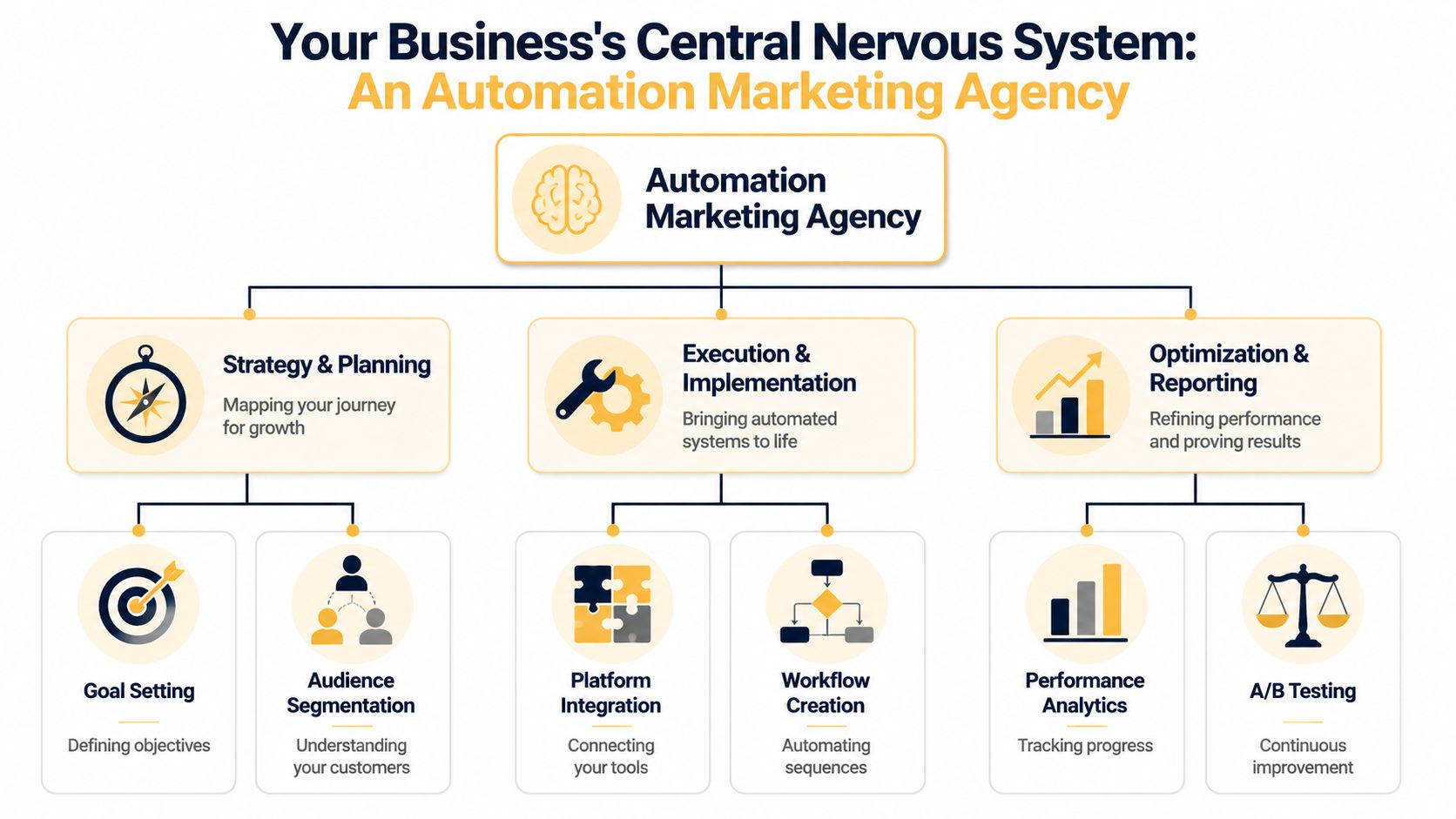
Think of an automation marketing agency as the central nervous system for your marketing. It connects signals from your website, ad platforms, CRM, email tool, and analytics stack, then turns those signals into actions.
A visitor downloads a guide. The CRM records the contact. The email platform starts a nurture sequence. The sales team gets notified only if that lead shows real buying intent. Reporting updates without anyone exporting a spreadsheet. That’s what coordination looks like when the system is designed properly.
The agency isn’t the software
Many businesses get tripped up. They buy a platform and assume it will solve the problem by itself. It usually won’t.
The hard part is the design work. Someone has to map your funnel, define the triggers, clean the data, connect the tools, write the logic, test the workflows, and keep improving the system after launch. That’s the Capability-Expertise Gap. The challenge isn’t access to tools. It’s having the technical and strategic skill to make those tools produce reliable business outcomes. That gap is one reason many companies need a partner who can bridge powerful automation capabilities with practical implementation, as discussed in this analysis of AI and automation in channel marketing.
What the work usually includes
An automation marketing agency typically handles three layers of work:
| Function | What it means in practice |
|---|---|
| Strategy | Defining customer journeys, segmentation rules, lead stages, and success metrics |
| Implementation | Connecting CRM, forms, ads, email, analytics, and internal workflows |
| Optimization | Reviewing performance, fixing logic gaps, refining messaging, and improving conversion paths |
The second layer is where many projects fail. Integrations sound simple until one tool passes incomplete data, another uses the wrong field format, and your “automated” workflow starts routing bad leads to sales.
Practical rule: If your automation depends on clean handoffs between tools, the system is only as strong as its weakest integration.
For owners trying to understand what modern workflow design can look like, it helps to discover workflow automation use cases in adjacent business functions. The patterns are similar. Trigger, decision, action, handoff, measurement.
A capable partner also knows when not to automate. Not every client touchpoint should be handed to software. High-value proposals, sensitive service issues, and major account conversations still need human judgment.
For a closer look at business processes that often benefit from this kind of setup, see intelligent automation use cases in real operations. The common thread is simple. Good automation removes repetitive work so people can spend more time on timing, messaging, and decisions that move revenue.
A Look Inside the Automation Toolkit
A lot of Omaha business owners hit the same point. Leads are coming in, the team is busy, and nothing feels organized. One prospect gets three follow-ups. Another sits untouched for two days. Sales blames marketing for weak leads, and marketing has no clean way to show what happened after the form fill.
That is usually not a tool problem alone. It is a capability-expertise gap. The software can send emails, score leads, sync records, and build dashboards. But those features only help if someone knows how to configure the rules, connect the data, and shape the workflow around how the business sells.
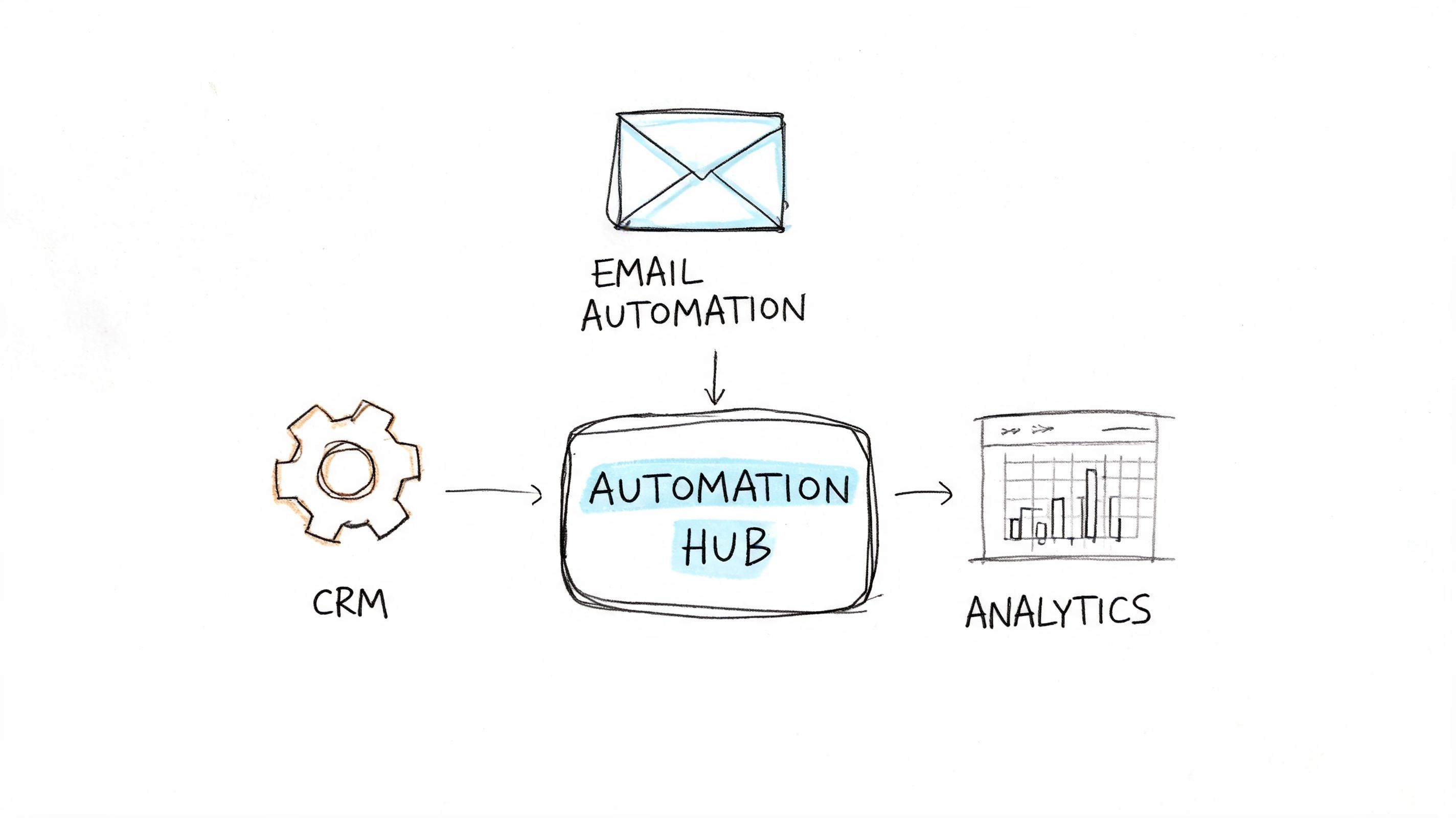
Most automation marketing agency stacks center on four working parts. Email sequences keep follow-up active. CRM integrations keep records clean. Lead scoring helps sales spend time on the right contacts. Reporting shows whether the system is creating revenue opportunities or just extra noise.
Email and drip automation
Email automation is often the first part of the stack that brings relief. Instead of relying on a salesperson to remember every follow-up, the system sends the next message based on what the lead did.
A new website inquiry can receive a welcome series. A customer can move into onboarding. An inactive contact can enter a re-engagement sequence. The benefit is not just speed. It is coverage. Leads do not disappear because someone had a packed week.
Good email automation also reflects intent. A person who requested an estimate should get a different message path than someone who downloaded a checklist or watched a service video.
CRM integration and management
The CRM is where automation either holds together or breaks down.
If forms map to the wrong fields, source data gets lost. If lifecycle stages are vague, sales cannot tell who needs attention. If ad, site, and email activity do not flow into one contact record, every team works from a partial picture.
Platforms like HubSpot and ActiveCampaign can support this well, but setup quality matters more than brand recognition. Up North Media’s AI automation tools show what that service layer looks like in practice. The work is not just buying software. It is connecting systems into workflows a business can use every day.
Lead scoring and nurturing
Lead scoring turns a contact list into an operating system for sales.
The model can assign points for actions like repeat page visits, email clicks, estimate requests, or returning to a pricing page. Sales gets a clearer signal on who is researching, who is comparing options, and who is ready for a call. Marketing gets a better view of which campaigns are attracting real buying intent instead of low-value traffic.
Industry guidance from Salesforce on lead management automation notes that automation can cut the time spent qualifying leads. For a small or mid-sized business, that usually means fewer manual check-ins, faster response to high-intent prospects, and less time wasted on names that were never a fit.
Not every company needs predictive scoring on day one. A local home services business may only need a few simple rules tied to form type, geography, and urgency. A longer B2B sales cycle often needs more nuance, including lead stage logic and handoff rules between marketing and sales.
Campaign optimization and reporting
Campaign reporting should help someone make a decision by the end of the day.
Automation can pull performance data from ad platforms, analytics tools, call tracking, and the CRM into one reporting view. That matters because channel metrics alone can be misleading. A campaign can look strong in Google Ads and still produce weak sales conversations if the wrong leads are filling out the form.
Some teams also use automation to manage creative testing and deployment at a faster pace. Agencies exploring that side of production often review creative automation for marketers to understand how asset versioning, testing, and output can be systemized without turning every campaign into generic ad clutter.
Here’s what the toolkit often controls day to day:
- Paid media optimization: Budgets shift toward audiences, keywords, and placements that are producing stronger lead quality.
- Creative deployment: New ad and email variations can go live faster, with cleaner naming and testing structure.
- Reporting automation: Dashboards combine ad, web, and CRM data without manual spreadsheet work.
- Alerts: Teams get notified when lead volume drops, conversion rates swing, or a campaign starts wasting spend.
The right toolkit does not replace judgment. It gives the business a cleaner system for applying it. That is the part many SMBs miss when they buy software first and strategy second.
Measuring the Real-World Business Impact
A common Omaha small business scenario goes like this. The owner is paying for ads, the phone rings inconsistently, sales says the leads are mixed, and Monday starts with someone piecing together numbers from three platforms and a spreadsheet. Automation helps only if it changes that operating reality.
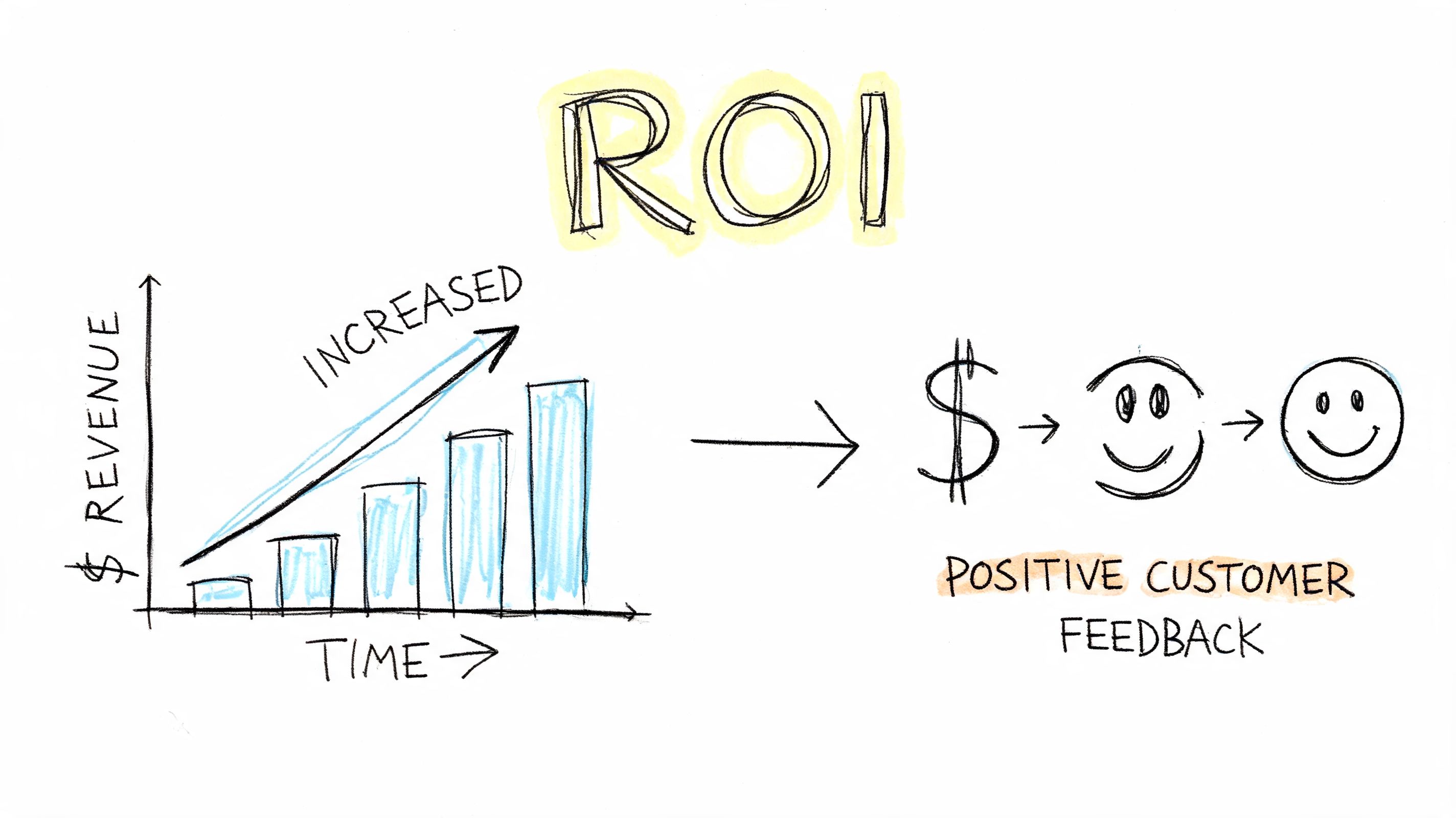
That is the standard to use when judging an automation marketing agency. Look for changes in lead quality, speed to follow-up, cost per qualified opportunity, close rate, and reporting clarity. Software can handle repetitive tasks. Getting business results from it takes strategy, configuration, and ongoing adjustment. That capability-expertise gap is where many SMBs get stuck. They buy tools with plenty of features, then discover nobody on the team knows how to map workflows to the way the business sells.
What the numbers say
Adoption keeps rising for a reason. According to this marketing automation statistics roundup, the global marketing automation market was valued at $6.65 billion in 2024 and is projected to reach $15.58 billion by 2030, with a 15.3% CAGR between 2025 and 2030. The same source reports that about 50% of companies use marketing automation, 28% plan to adopt it within two years, businesses have seen qualified leads increase by up to 451%, overall lead generation rise by 80%, and Nucleus Research found $5.44 in revenue for every $1 spent over three years.
Those numbers are useful, but they get misread all the time.
A local service business does not install software on Friday and wake up Monday with better margins. Results come from tighter intake rules, cleaner CRM stages, faster handoff to sales, and reporting that shows which channels produce jobs, not just clicks. The agency's job is not just to turn features on. It is to connect marketing activity to revenue in a way an owner can trust.
Where return shows up first
For smaller companies, the first gains are usually operational before they show up as a dramatic top-line jump.
- Lead response gets faster: New inquiries are routed to the right person right away, while intent is still high.
- Sales effort gets sharper: Reps spend less time chasing weak leads and more time on prospects showing clear buying signals.
- Reporting gets cleaner: Teams stop rebuilding updates by hand and start reviewing the same numbers in one place.
- Waste gets easier to spot: Campaigns that produce forms but not real opportunities are identified sooner.
For a clearer view of which KPIs matter after launch, this guide to measuring digital marketing performance is a useful reference.
This short video gives a useful high-level lens on how teams think about automation ROI in practice.
The return that owners feel before they quantify
Some of the payoff shows up before it appears neatly on a dashboard.
Owners make faster calls when they trust the numbers. Staff spend more time on sales conversations, client communication, and campaign improvement when repetitive admin work is reduced. Planning improves when everyone is working from the same source of truth instead of arguing over exports from different systems.
A strong automation system pays twice. First in efficiency, then in better decisions.
That second payoff is easy to miss during a software demo. In practice, it is often the difference between owning a tool and having a system that supports growth.
Beyond Technology It's a Strategic Partnership
The software conversation is only half the job.
The harder part comes after automation starts working. Who owns what now? Which tasks should the client’s team keep? Which work moves to the agency? What should sales handle differently once lead scoring is active? How should pricing or service delivery change when execution gets faster?
The Human-AI role clarity gap
Many automation projects lose momentum because teams install workflows but never redefine roles. People keep doing old tasks manually because nobody clarified the new process.
That problem has a name. The Human-AI Role Clarity Gap. As noted in this discussion of AI and marketing department change, most content about automation focuses on what AI can do, but not on how agencies and businesses should restructure teams and pricing when AI handles execution. For SMBs, that gap matters because they need practical guidance on retraining staff for more strategic roles.
What good partnership looks like
A real partner doesn’t just install workflows and disappear. They help answer questions like:
| Business question | Strategic partner response |
|---|---|
| Should we automate this task? | Only if the task is repetitive, rules-based, and low-risk |
| Who handles exceptions? | A person with context, usually on sales, service, or account management |
| What should our team focus on now? | Messaging, creative review, offer strategy, and customer insight |
| How do we explain this to clients or staff? | By framing automation as support for better execution, not a replacement for judgment |
The businesses that handle this transition best usually move people upward, not outward. Admin work shrinks. Strategic work expands.
What doesn’t work
Two patterns fail repeatedly.
The first is over-automation. A company tries to automate every message, every approval, every customer interaction. The system becomes brittle and impersonal. Customers feel it. Staff stop trusting it.
The second is under-managed automation. A workflow goes live, nobody reviews it, and months later the business discovers leads were routed incorrectly or key fields never synced.
Automation should absorb repetition. Humans should own nuance.
That’s why the strongest automation marketing agency relationships feel less like outsourcing and more like operational partnership. The agency handles architecture, logic, and optimization. The business keeps ownership of brand voice, customer relationships, and strategic judgment.
For Omaha companies, that partnership model matters even more. Many local teams are lean. They don’t need more dashboards. They need clarity on how to grow without turning their staff into full-time system admins.
How to Choose Your Automation Partner in Omaha
A typical Omaha owner sees the problem before they know what to call it. Leads come in from the website, someone exports a spreadsheet, sales follows up late, and nobody trusts the numbers in the CRM. Hiring an automation marketing agency means handing that chain of events to a partner who can redesign it without breaking what already works.

The first screen is technical competence. Ask how the agency handles CRM field mapping, API connections, attribution rules, and reporting structure. If the answers stay at the level of campaigns and content, keep asking. Automation projects fail in the gaps between systems, not in the ad copy.
Then test for operational judgment.
A strong partner can explain how they audit an existing process, document decision points, build fallback rules, and test edge cases before launch. That matters because SMBs usually have more software capability than in-house expertise. The tools are available to everyone. The difference is whether the agency can translate business reality into logic that your team can use.
Use this checklist in meetings:
- Integration capability: Can they connect forms, CRM, ad platforms, email tools, and analytics into one working system?
- Revenue process understanding: Do they understand qualification, routing, nurture timing, and the sales handoff?
- Measurement discipline: Can they explain how they track pipeline impact, not just clicks and opens?
- Exception planning: Can they show what happens when data is incomplete, duplicated, or wrong?
- Local business fit: Have they worked with Omaha companies that run lean and need practical systems, not enterprise overhead?
The best questions are specific.
- What would you automate first in our process, and why?
- Where do you usually find bad data or broken handoffs?
- Who owns workflow updates after launch?
- How do you test before a workflow touches real leads?
- What should stay manual in our sales or service process?
Lead scoring is a good example of the capability-expertise gap. The feature exists in many platforms, but the setup is where the value lives. If scores are based on weak signals, sales wastes time on the wrong accounts. If the model is too rigid, good prospects get buried because they did not fit the original rules. Ask how the agency sets scoring criteria, how often it reviews them, and how sales feedback changes the model over time.
Strong agencies answer with process. They talk about data hygiene, workflow logic, routing rules, QA steps, and ownership after go-live. They can also tell you where automation should stop. That answer usually separates a strategic partner from a software reseller.
For Omaha businesses, that distinction matters. Many local teams do not have a RevOps manager, a CRM admin, and a marketing ops specialist sitting in-house. They need one partner that can connect strategy, setup, and ongoing refinement without turning a straightforward growth problem into a six-month systems project.
If an agency cannot explain how a lead moves from first touch to sales action to reporting, they are not ready to build your automation system.
Choose the partner that makes the business easier to run, easier to measure, and easier to scale.
Start Automating Your Growth with Up North Media
Marketing automation works when the strategy is sound, the integrations are clean, and the business knows how people and systems should work together.
That’s why the right automation marketing agency does more than set up software. It connects your tools, defines the logic, improves handoffs, and keeps the machine aligned with revenue goals. For Omaha businesses, that can mean fewer dropped leads, better reporting, and a marketing function that scales without adding chaos.
The biggest mistake is assuming automation is turnkey. It isn’t. The tools are accessible. The expertise to implement them well is still the actual differentiator.
If your team is juggling manual follow-up, disconnected reporting, or a CRM that isn’t helping anyone make better decisions, this is usually the right time to audit the system. Small fixes can release a lot of capacity. Larger rebuilds can change how the business grows.
Up North Media is an Omaha-based agency that works across AI consulting, automation, SEO, and custom web systems. If you want help assessing where automation fits, what to prioritize first, and how to build a setup your team can use, a direct conversation is the practical next step.
Schedule a free, no-obligation consultation with Up North Media to review your current marketing workflow, identify automation opportunities, and map out a system built for sustainable growth.