
Your store probably isn’t failing. It’s stuck.
You have products people want. Your site looks decent. Paid ads brought traction for a while, then costs climbed and returns got harder to defend. Organic traffic feels flat. You’re getting enough data to know something is off, but not enough clarity to know what to fix first.
That’s the point where many owners start shopping for an ecommerce seo agency and run into the same problem. Most agencies sell activity. Audits, reports, keyword lists, content calendars. What growing stores need is a partner that can connect search visibility to revenue, merchandising, site performance, and margin.
Why Your Online Store Needs a Growth Partner
A good ecommerce seo agency doesn’t replace your team. It extends it.
That distinction matters because ecommerce SEO touches more than rankings. It affects how category pages are structured, how product pages convert, how your site performs on mobile, how quickly search engines can crawl inventory, and whether your best offers show up when buyers are ready to act. That’s operations, UX, content, and revenue strategy wrapped into one channel.
The market has caught up to that reality. The global SEO services market is projected to reach $127.3 billion by 2030, and ecommerce SEO delivers an average ROI of 320% with breakeven periods of 8 to 9 months, according to Anchor Group’s ecommerce SEO statistics. That’s why serious retailers treat SEO less like a campaign and more like infrastructure.
Why this matters for SMBs
Small and mid-sized stores can’t afford waste. Every channel has to pull its weight.
Paid media is useful, especially for launches and testing, but it rents attention. SEO builds an asset. When your product, collection, and buying-guide pages rank well, they keep bringing in qualified visitors without requiring a fresh payment every time someone clicks. If you’re trying to scale without living inside ad dashboards, that matters.
A practical way to consider this:
- Ads create bursts: Useful for immediate demand and promotion windows.
- SEO compounds: Useful for stable acquisition over time.
- The right agency connects both: It uses search data to improve pages, product targeting, and conversion paths across channels.
Practical rule: If an agency talks mostly about rankings and barely talks about margin, conversion paths, or inventory priorities, they’re selling SEO as a deliverable instead of treating it like a growth system.
That’s why hiring a partner is different from hiring a vendor. A vendor completes tasks. A partner helps you decide which tasks matter most, in what order, and what success should look like for your business. If you’re already trying to boost ecommerce sales, that difference shows up fast in both decision quality and speed.
Unpacking Core Ecommerce SEO Agency Services
Most store owners hear “full-service SEO” and get a vague list. The work is more concrete. A capable ecommerce seo agency usually operates across four pillars, and each one affects the others.
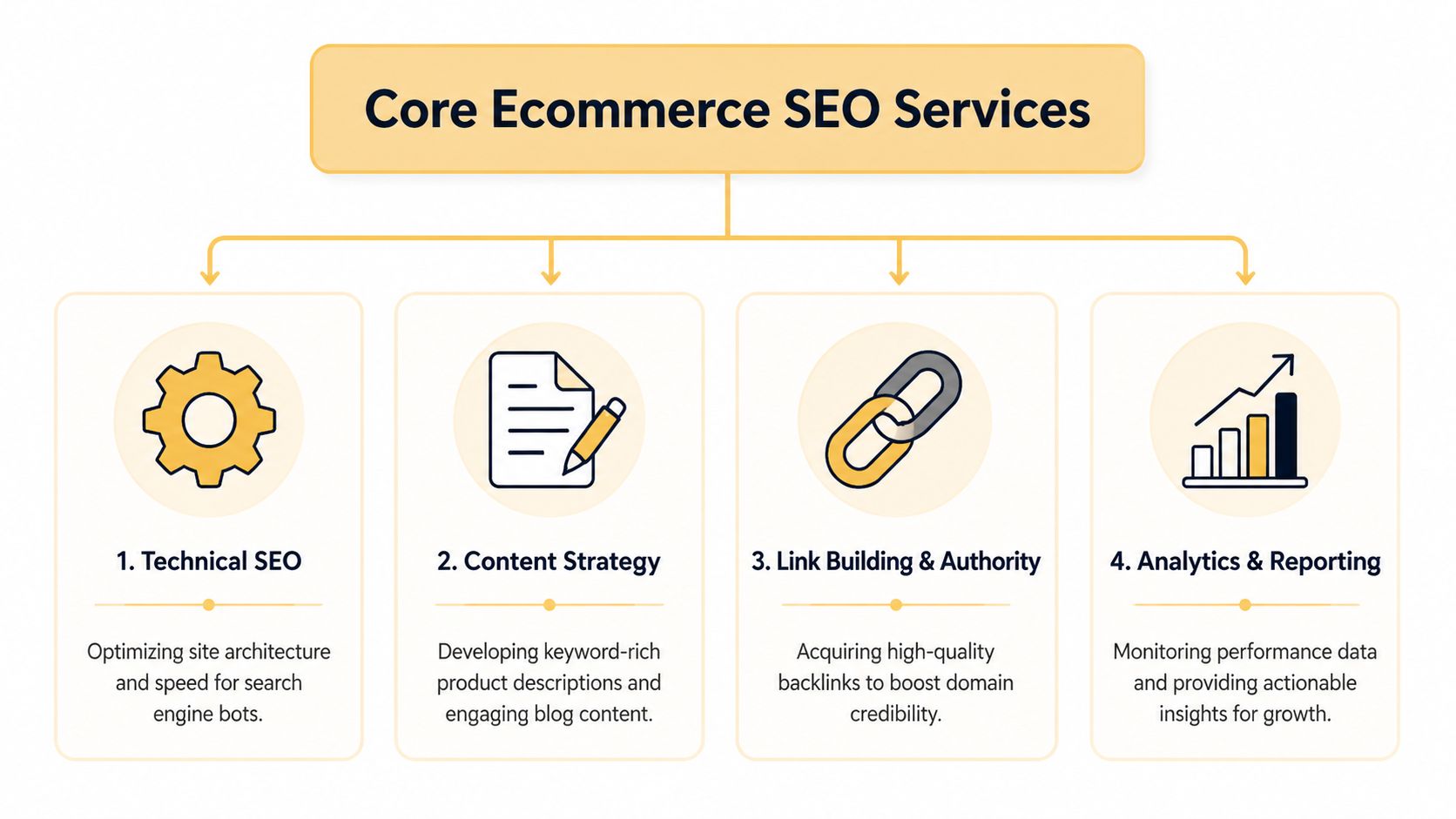
Technical SEO
Technical SEO is the foundation. If the site is slow, hard to crawl, or unstable on mobile, everything else underperforms.
For ecommerce, this often means fixing template-level issues rather than tweaking a few pages. Product grids load too much JavaScript. Filters create messy indexation. Image-heavy pages drag on mobile. Theme changes break internal links. Performance problems show up everywhere at once.
There’s a direct business case for fixing this work. Optimizing Core Web Vitals, including getting Largest Contentful Paint under 2.5 seconds, correlates with a 15% to 30% uplift in conversion rates, and over 70% of ecommerce sites need performance improvements, according to Victorious on technical SEO for ecommerce.
A strong agency will inspect things like:
- Template speed issues: Collection pages, PDPs, blog templates, and cart interactions.
- Crawl efficiency: Canonicals, duplicate paths, faceted navigation, and XML sitemap quality.
- Mobile rendering: Button spacing, image sizing, and layout stability across devices.
Content strategy
Content isn’t just blog writing. In ecommerce, content has to support buying intent.
That usually starts with category pages and collection pages. These are often the strongest revenue pages, yet many stores leave them thin, generic, or nearly identical. Product pages also need sharper copy, clearer differentiation, and structure that helps search engines understand what the page is about.
Then there’s support content. Buying guides, comparison pages, FAQ hubs, gift guides, and post-purchase education can pull in search demand earlier in the funnel and assist conversions later.
Good content strategy answers questions like:
| Content type | Best use | | | | | Category pages | Capture commercial demand and organize product discovery | | Product pages | Convert branded and high-intent searches | | Buying guides | Support comparison shoppers and answer objections | | FAQ content | Handle trust, shipping, fit, compatibility, and use-case questions |
Site architecture
Architecture is your store layout. If customers and search engines can’t move through it easily, rankings and conversion both suffer.
I’ve seen stores with great products bury key categories under awkward menus, duplicate collections, and filter combinations that create confusion. Search engines read that mess the same way a shopper does. Poor structure dilutes relevance.
A smart ecommerce seo agency simplifies the path. It maps keyword intent to categories, subcategories, and product groups. It makes internal linking deliberate instead of accidental. It also coordinates with developers when template logic or platform constraints get in the way.
For agencies building repeatable workflows around these deliverables, operational systems matter too. Teams that rely on better process and handoff management often benefit from solutions tailored for agencies, especially when they’re juggling content, technical fixes, and reporting across multiple clients.
Link building and authority
Links still matter, but cheap link packages usually create noise, not authority.
For ecommerce brands, useful authority work often looks like digital PR, partner mentions, product-led outreach, manufacturer relationships, media placements, and linkable assets that deserve citation. The key is relevance. A handful of contextually aligned mentions can be more valuable than a giant spreadsheet of weak placements.
A good agency doesn’t ask, “How many links can we build?” It asks, “What proof of trust does this store need to compete in its category?”
Measuring Success Beyond Traffic and Rankings
More traffic feels good. More orders pay the bills.
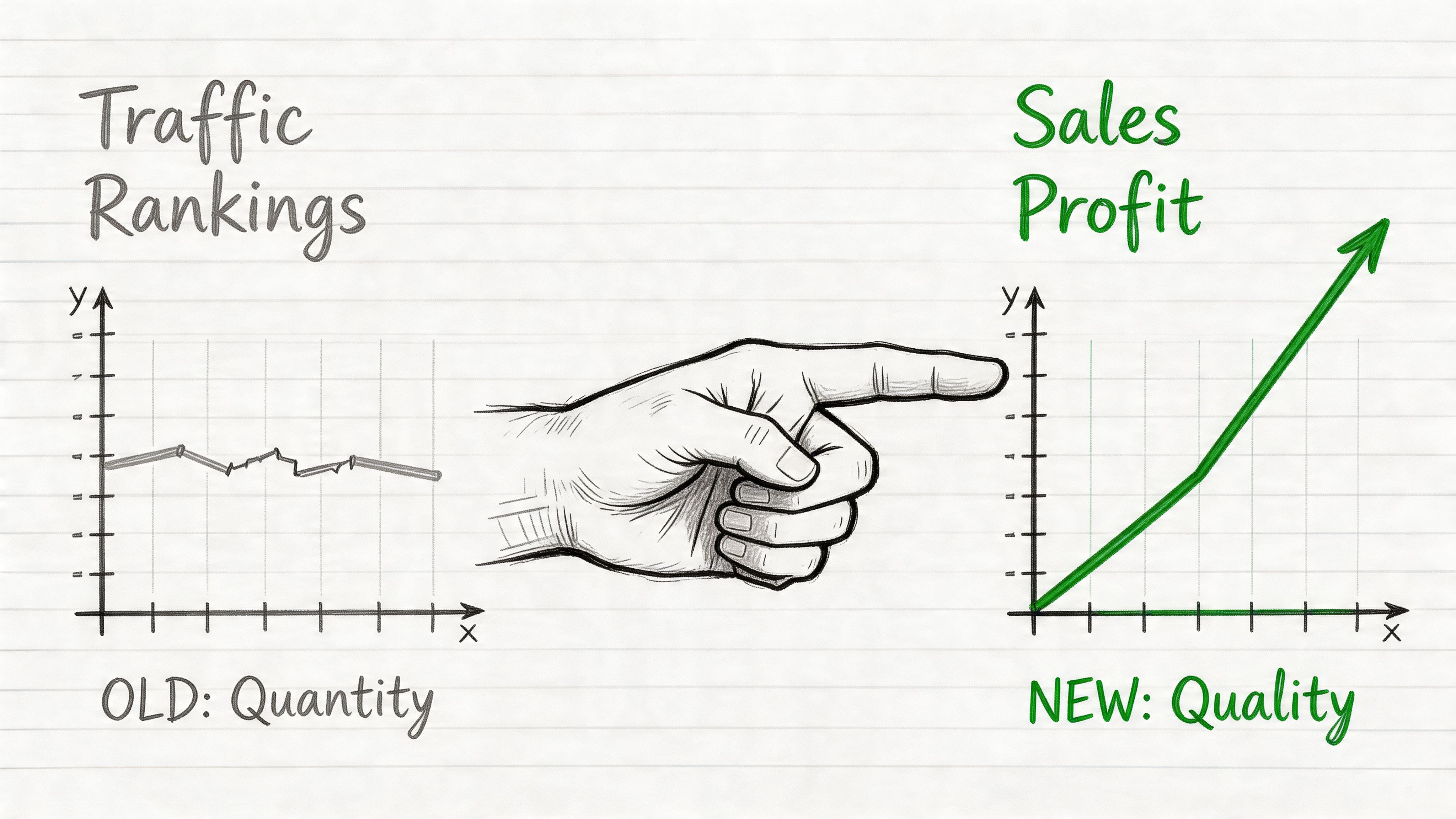
That sounds obvious, but many agencies still report SEO like it exists in a vacuum. They’ll show keyword movement, impression growth, and sessions by landing page. Those are useful signals, not the outcome. If traffic rises while conversion rate drops, merchandising weakens, or average order value slips, the business may not be healthier at all.
What a serious dashboard should include
When evaluating an ecommerce seo agency, look for reporting that connects organic search to commercial outcomes.
At minimum, your dashboard should help answer:
- Which landing pages generate revenue: Not just visits.
- Which categories convert best from organic: So strategy follows margin and demand.
- Where assisted conversions happen: Informational content often influences later purchases.
- How organic performs by device: Mobile issues can suppress revenue.
- What changed after implementation: So you can tie work to outcomes.
A useful benchmarking resource is this guide to 10 essential metrics for ecommerce, especially if you want a clearer way to distinguish vanity metrics from operating metrics.
Why rankings matter only when they lead to action
Rankings still matter because visibility shapes click behavior. The first Google position captures about 30% of clicks, and 75% of users never scroll past page one, according to OuterBox’s SEO statistics. That’s why “we moved from position 11 to position 8” can matter a lot more than it sounds. One move can take a page from invisible to commercially relevant.
But the conversation should go further. Ask what those clicks do after arrival.
Here’s the store analogy I use with clients. Traffic is footfall. Conversion rate is how many people buy. Average order value is how much they spend per basket. Customer lifetime value tells you whether those first purchases turn into a healthy customer base. ROI tells you whether the whole system deserves more investment.
If you want a framework for reviewing that with more discipline, this guide on measuring digital marketing performance is a helpful starting point.
A short walkthrough can help when you’re comparing agency reports:
Don’t let an agency hide behind “SEO takes time” if they can’t also show early indicators tied to revenue quality, page engagement, and conversion friction.
Understanding Agency Pricing and What to Expect
Pricing gets weird fast in SEO because stores don’t buy the same thing.
A 200-product Shopify store with clean templates is a different engagement from a large catalog with migration issues, duplicate category paths, weak content, and no reporting setup. That’s why the right question isn’t “What does ecommerce SEO cost?” It’s “What type of engagement matches our stage and constraints?”
Common pricing models
Here’s the practical trade-off between the most common models:
| Model | Best fit | Watch out for | | | | | | Monthly retainer | Ongoing growth, technical fixes, content, and reporting | Vague scope and padded deliverables | | Project-based | Migrations, audits, taxonomy cleanup, or one-time remediation | No follow-through after recommendations | | Performance-based | Businesses that want incentives aligned to outcomes | Narrow definitions of success and cherry-picked targets |
Retainers usually make the most sense when SEO is part of steady growth. They let the agency sequence work across technical cleanup, content improvements, internal linking, and measurement. That’s usually better than trying to solve everything in a single sprint.
Project work fits specific moments. Site redesigns, platform moves, and template overhauls are common examples. This model can work well if your internal team can execute after the project ends.
Performance-based pricing sounds attractive, and sometimes it can work, but it often needs careful scrutiny. If the target metric is too narrow, the agency may optimize for movement that looks good in a report but doesn’t improve the business much.
What smart buyers ask before signing
Before agreeing to any pricing model, ask:
- What work is included each month: Specific deliverables, not broad promises.
- Who does the work: Senior strategist, specialist, writer, developer, or account manager.
- What dependencies exist: Access, dev bandwidth, approvals, platform constraints.
- How priorities are set: Revenue opportunity, technical risk, and ease of implementation.
The best pricing conversation feels like capacity planning, not sales theater.
Your Vetting Checklist How to Choose the Right Partner
Hiring an ecommerce seo agency is part due diligence, part pattern recognition. The wrong partner usually reveals itself early if you know what to ask.
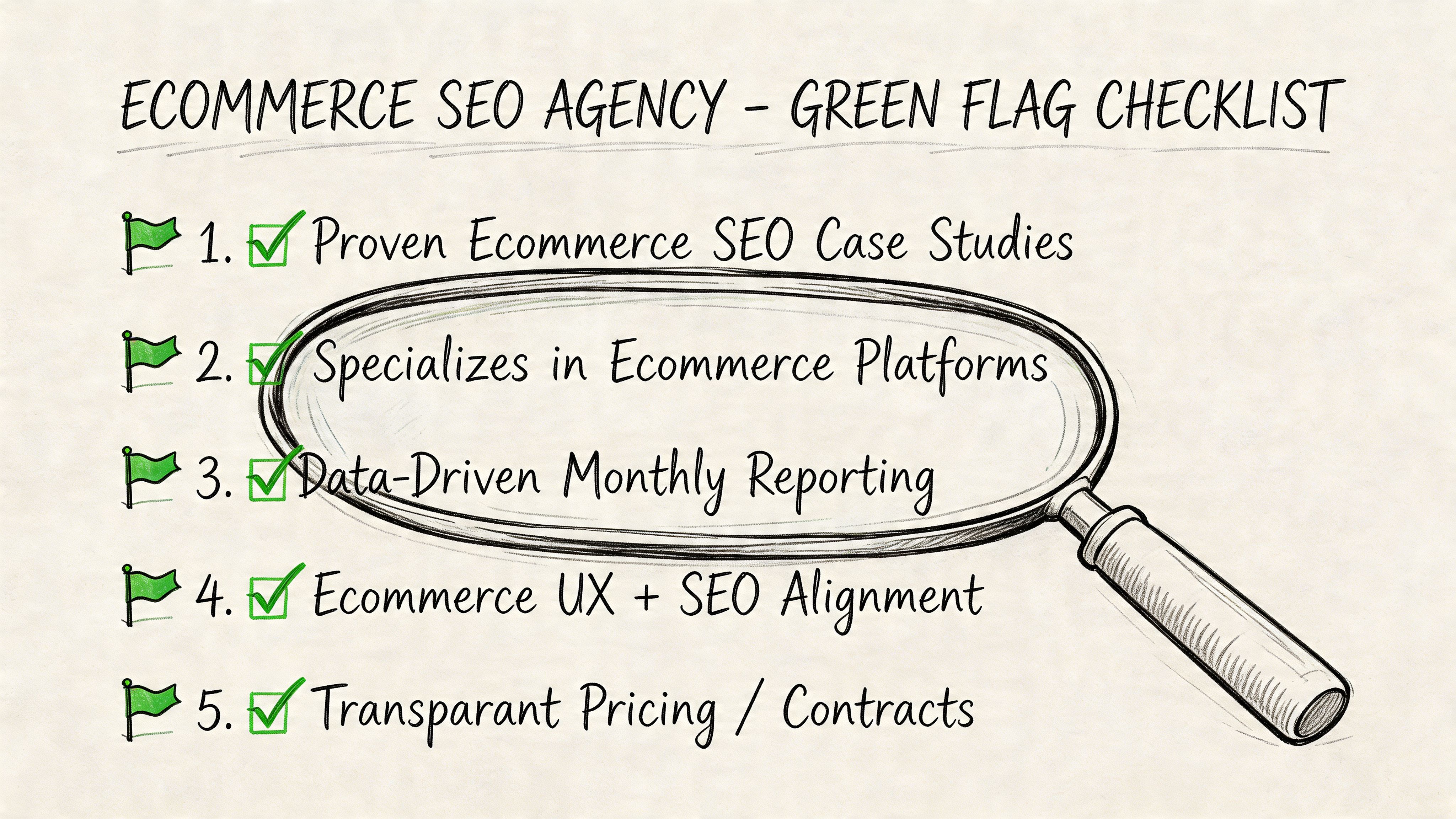
Green flags worth paying for
A strong agency usually does a few things consistently.
- They diagnose before prescribing: They ask about margins, product priorities, seasonality, and platform limitations before presenting a package.
- They show how they think: Not just what they sell. You should hear reasoning about crawl waste, collection-page intent, internal linking, and mobile UX.
- They’re comfortable with trade-offs: For example, they’ll explain when to prioritize technical fixes over new content, or when a category rewrite matters more than another blog post.
- They report in business language: Revenue, assisted conversions, page quality, and implementation status.
- They coordinate across functions: SEO for ecommerce usually needs alignment with dev, design, merchandising, and analytics.
Red flags that usually get expensive
These are the warning signs I’d take seriously:
- Guaranteed rankings: No credible agency can promise a #1 position.
- Secret methods: If they can’t explain the basics, they’re hiding weak process or risky tactics.
- Template proposals: If every store gets the same roadmap, the strategy isn’t a strategy.
- No implementation plan: Recommendations without execution support often die in a backlog.
- Overfocus on blog volume: Many stores don’t need more articles. They need stronger money pages.
Buyer check: Ask the agency to name the first three things they’d inspect on your store and why. Good teams answer with a sequence. Weak teams answer with a pitch.
Ask about AI, but ask the right way
Modern SEO work increasingly includes AI-assisted analysis and workflow support. That doesn’t mean replacing strategy with prompts. It means using AI where it improves speed and consistency without sacrificing judgment.
According to Modern Marketing Partners on advanced ecommerce SEO strategies, AI adoption for tasks like keyword analysis and predictive SEO surged by 40% in 2026, and it can reduce costs by 20% to 30% when used well.
Don’t ask, “Do you use AI?” Every agency will say yes.
Ask questions like:
- Where does AI help your workflow most
- What do humans still review manually
- How do you prevent thin or repetitive output
- How do you use AI for prioritization, not just production
That same logic applies when you evaluate technical partners more broadly. If you want a solid framework for how to choose the right partner, this API2Cart piece is useful because the principles carry over: integration fit, transparency, support model, and operational reliability matter more than polished sales language.
The Local Advantage Why Omaha Businesses Need a Local SEO Partner
For SMB ecommerce brands in Omaha, the biggest agency on the list usually isn’t the best fit.
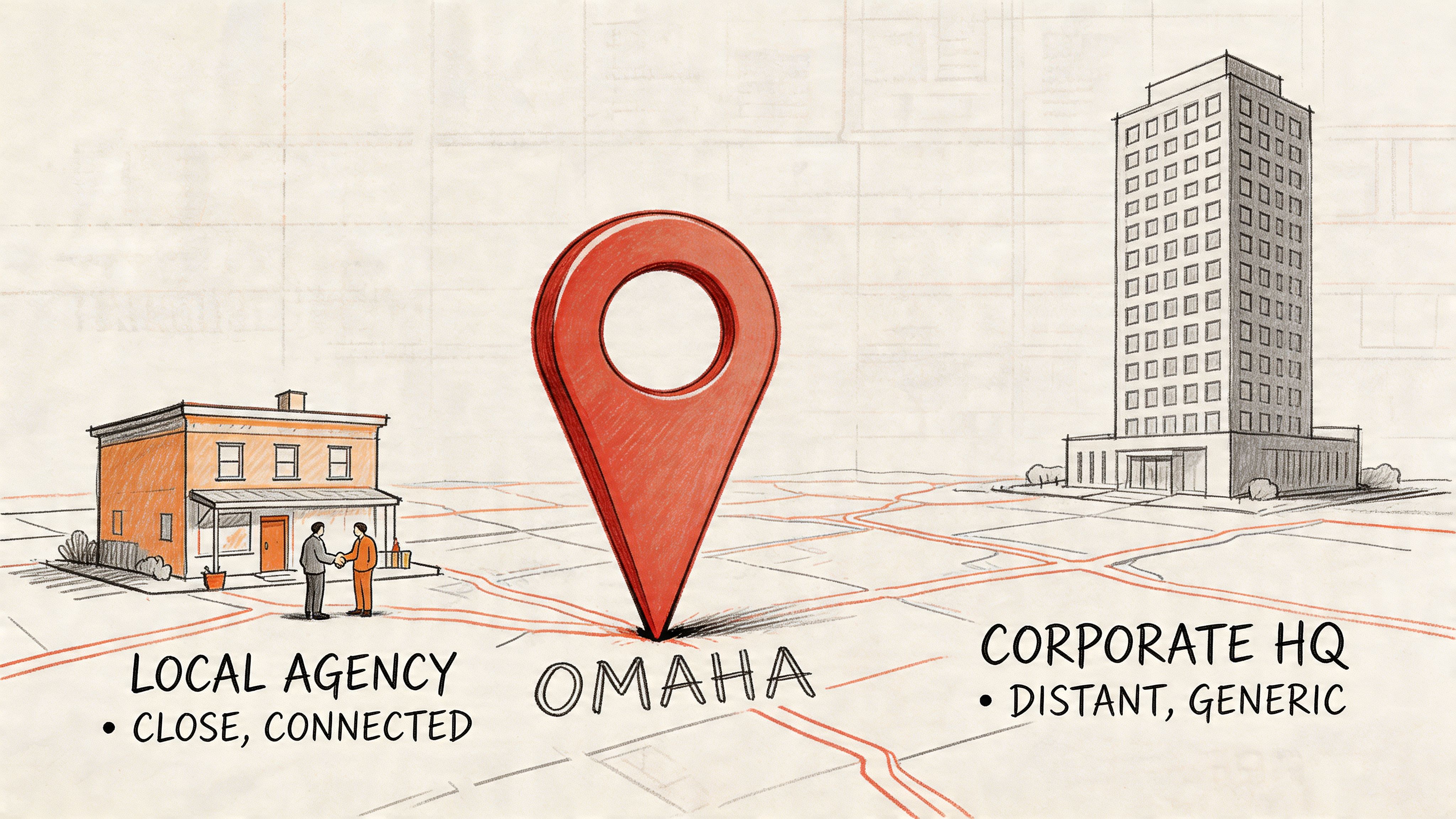
Most “top agency” roundups feature coastal firms built for enterprise accounts. Their process often assumes larger budgets, longer contracts, slower approval cycles, and teams with in-house developers, analysts, and content staff. That setup can be a poor match for a founder-led or lean marketing team that needs sharper prioritization and faster execution.
There’s a real market gap here. Only 10% of top-ranked agencies explicitly focus on the mid-market, leaving SMBs in places like Omaha underserved, according to Coalition Technologies’ ecommerce SEO page.
Why local fit matters
A local partner often works better because they understand the operating context, not just the SEO checklist.
That can mean better judgment around:
- Budget reality: You need sequencing, not a giant wish list.
- Communication style: Direct answers, fast feedback, fewer layers.
- Regional market nuance: How local service lines, fulfillment realities, or adjacent in-person demand affect search strategy.
- Access to stakeholders: It’s easier to get the right people in the room when the relationship feels closer and more accountable.
For Omaha businesses, there’s also overlap between ecommerce strategy and local visibility. Many companies here aren’t pure-play online brands. They might sell online while also serving a regional customer base, supporting wholesale relationships, or operating local service arms. That mix changes what good SEO looks like.
A national agency may treat all of that as edge-case complexity. A local partner is more likely to treat it as normal.
What SMBs usually need instead
Most mid-sized businesses don’t need a giant team throwing deliverables over the fence. They need a smaller group that can prioritize what moves revenue now, explain what can wait, and stay close enough to execution that strategy doesn’t disappear after the kickoff call.
That’s especially true when ecommerce, content, and local discovery overlap. If your business sits in that middle ground, it’s worth understanding how local SEO in Omaha can support broader digital growth instead of treating local and ecommerce as separate channels.
The best local agency advantage isn’t geography by itself. It’s accountability, context, and the ability to tailor the work to how your business actually runs.
Take the Next Step to Ecommerce Growth
Choosing an ecommerce seo agency isn’t about outsourcing a marketing chore. It’s about finding a team that can help you make better growth decisions.
The right partner will know when your problem is technical, when it’s structural, when it’s content-related, and when the issue isn’t SEO at all but conversion friction on key pages. They won’t flood you with jargon or distract you with vanity metrics. They’ll help you turn search into a dependable acquisition channel that supports revenue over time.
For SMBs, especially in secondary markets, that fit matters even more. You need practical strategy, clear priorities, realistic communication, and work that respects your budget and internal bandwidth.
If your store has hit a plateau, that doesn’t mean you’ve run out of demand. It usually means the next stage of growth needs a more disciplined system.
If you want a practical second opinion on your store’s SEO, Up North Media offers a free, no-obligation consultation for businesses that want a clearer path to sustainable ecommerce growth. Bring your goals, your current challenges, and your site. You’ll leave with a grounded view of what to fix first, what can wait, and what a real growth plan should look like.