
You’re selling a product people actively search for, but your brand still feels buried.
That’s the normal starting point for CBD companies. You launch a strong product line, invest in packaging, tighten fulfillment, and build a store that looks credible. Then traffic stalls. Paid ads get restricted, messaging gets flagged, and the agencies that promised “growth marketing” start recycling generic ecommerce SEO advice that doesn’t survive contact with a regulated category.
That’s where a real cbd seo agency earns its keep.
In CBD, SEO isn’t just a traffic channel. It’s the system that turns your website into a durable business asset. Done right, it helps you attract qualified visitors, educate them without creating compliance problems, and convert them on a site that feels fast, secure, and trustworthy. Done poorly, it creates thin content, risky claims, technical debt, and rankings that never stick.
The difference isn’t subtle. It shows up in how the site is built, how the content is framed, how local intent is captured, and how the agency handles risk.
The CBD Visibility Problem
A lot of CBD founders hit the same wall.
They assume the hard part is product development. It isn’t. The hard part is getting discovered consistently when your category lives under tighter scrutiny than standard wellness ecommerce. You can have a better tincture, cleaner ingredient sourcing, and stronger customer support than your competitors, and still lose because buyers never find you at the moment they’re searching.
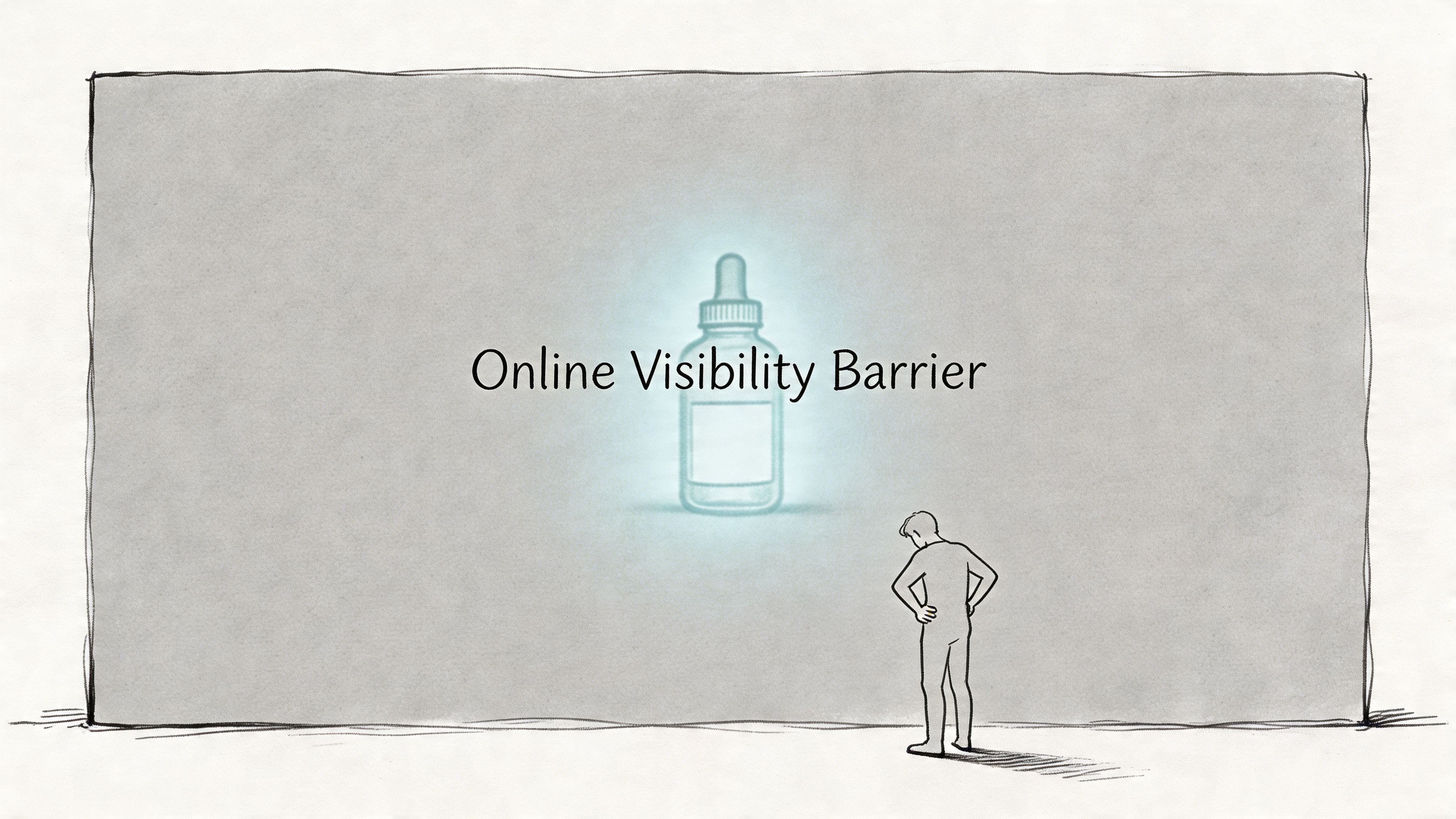
Most brands don’t need more noise. They need more search visibility. That’s why SEO becomes the center of the strategy, especially for companies operating in restricted categories. A specialized partner focused on CBD and hemp SEO services approaches the problem differently from a general ecommerce shop. The goal isn’t to stuff product pages with keywords and hope for the best. The goal is to build a site Google can trust and customers can buy from.
Why previous marketing efforts often fail
Generic campaigns usually break down in a few predictable ways:
- Wrong messaging: Teams write like a supplement brand in an unrestricted market and drift into claim language that creates risk.
- Weak site structure: Product pages, category pages, and educational content compete with each other instead of supporting each other.
- Thin authority signals: The site looks new, shallow, or inconsistent, so rankings don’t hold.
- Poor conversion experience: Even when traffic lands, the site feels slow or unclear, and visitors leave.
A CBD site can’t rely on aggressive ad tactics to paper over weak fundamentals. The website has to do the work.
That’s why SEO in this industry has to be treated as infrastructure, not a side tactic.
Why CBD SEO Is a Different Beast Entirely
CBD SEO gets lumped in with ordinary ecommerce SEO all the time. That’s a mistake.
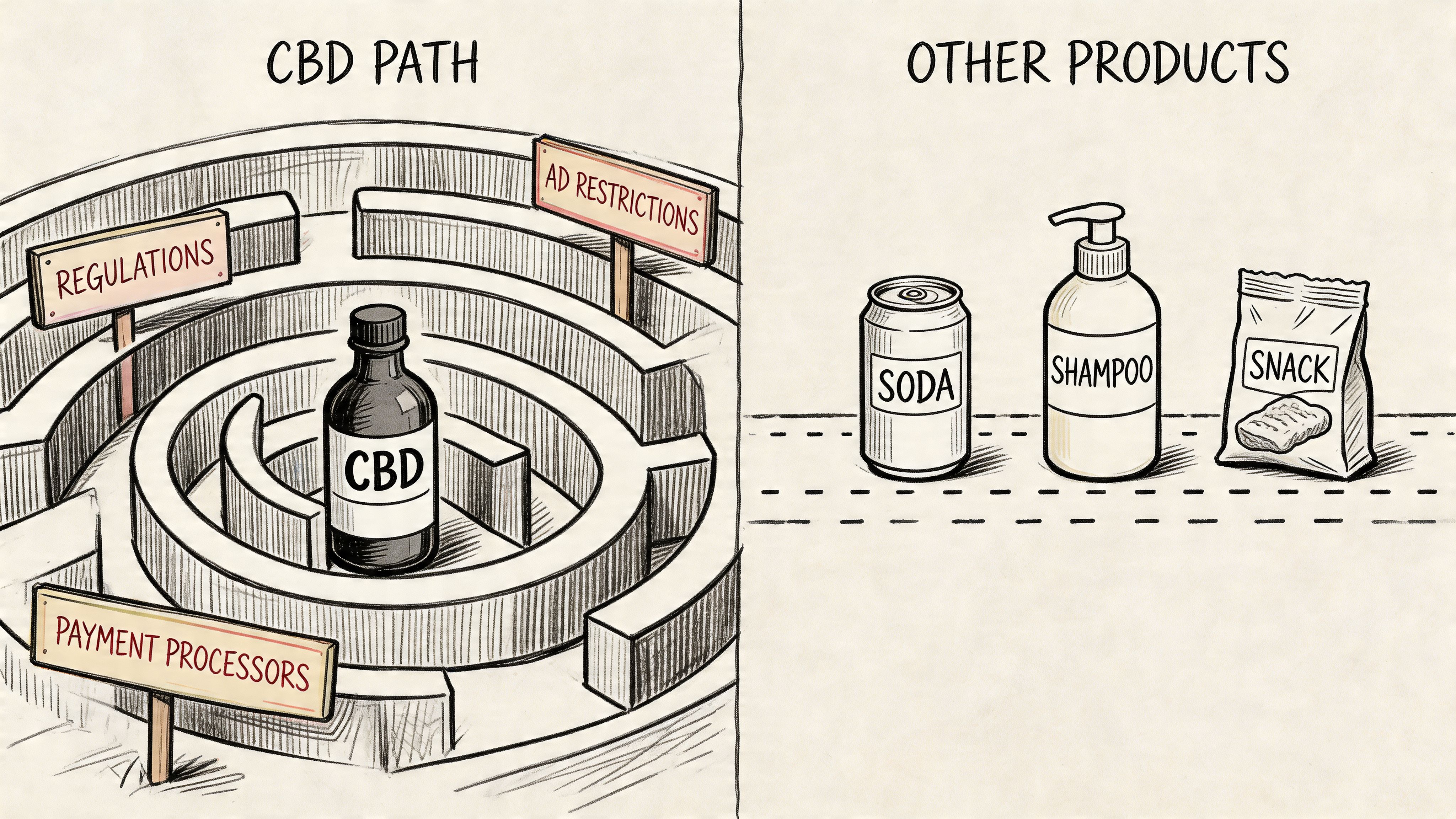
The category sits inside a legal and policy gray zone that changes how you write, how you optimize, and how you measure risk. A skincare brand can often push direct benefit language and broad paid acquisition. A CBD brand has to think harder about wording, local regulations, platform restrictions, and whether each page strengthens trust or invites scrutiny.
The market is growing, but so is the pressure
The opportunity is real. The global CBD market is projected to grow from USD 10.04 billion in 2025 to USD 21.34 billion by 2030, and specialized CBD SEO agencies in the United States typically charge $3,000 to $6,000 per month. In this context, 57% of CBD searches happen on mobile and often carry local intent, which raises the importance of local and mobile optimization (NisonCo).
That combination changes the work. You’re not competing in a sleepy niche. You’re competing in a category with rising demand, limited paid distribution, and a buyer journey that often starts on a phone.
A generic agency sees product pages and blog posts. A good cbd seo agency sees a compliance problem, a technical SEO problem, a local visibility problem, and a conversion problem tied together.
The real constraints are operational, not theoretical
Most CBD businesses already know they can’t be careless. What they underestimate is how many parts of the digital stack are affected at once.
A few examples:
- Content risk: You can’t write loose copy that sounds like a medical promise.
- State-by-state variation: Messaging and merchandising decisions can’t ignore geography.
- Processor and trust friction: Buyers already have questions. If the site looks slow, confusing, or improvised, conversion drops.
- Algorithm exposure: Thin content, copied descriptions, and manipulative link tactics are more dangerous in a category that already needs extra trust.
Discipline is critical. The agency has to know when not to chase a keyword, when not to publish a page, and when a short-term win creates a long-term liability.
Local search matters more than many brands think
CBD brands often obsess over national rankings and ignore local demand. That leaves money on the table.
If your business has a physical footprint, local delivery model, wholesale presence, or any geographic angle, local optimization is part of the core strategy, not a side task. A solid local SEO approach for service areas and storefront visibility can help you capture searches from buyers who want nearby options, not just general information.
Video is useful here because local search behavior is tied to mobile habits, map packs, and quick trust judgments.
What fails in CBD SEO
The patterns are familiar:
| Approach | What happens |
|---|---|
| Generic ecommerce SEO | Misses compliance nuance and local intent |
| Content written only for keywords | Sounds spammy, adds risk, converts poorly |
| Link building without relevance | Produces weak authority or avoidable penalties |
| Ignoring mobile UX | Loses buyers before they trust the brand |
Practical rule: If an agency can’t explain how it handles claims, location strategy, and technical trust signals together, it probably doesn’t understand CBD SEO.
The Four Pillars of a Winning CBD SEO Strategy
A strong CBD SEO program isn’t one tactic. It’s a stack.
The agencies that produce stable growth usually work from the same foundation. They may package it differently, but the system is consistent: technical stability first, compliant content second, local capture where relevant, and authority building that doesn’t flirt with spam.
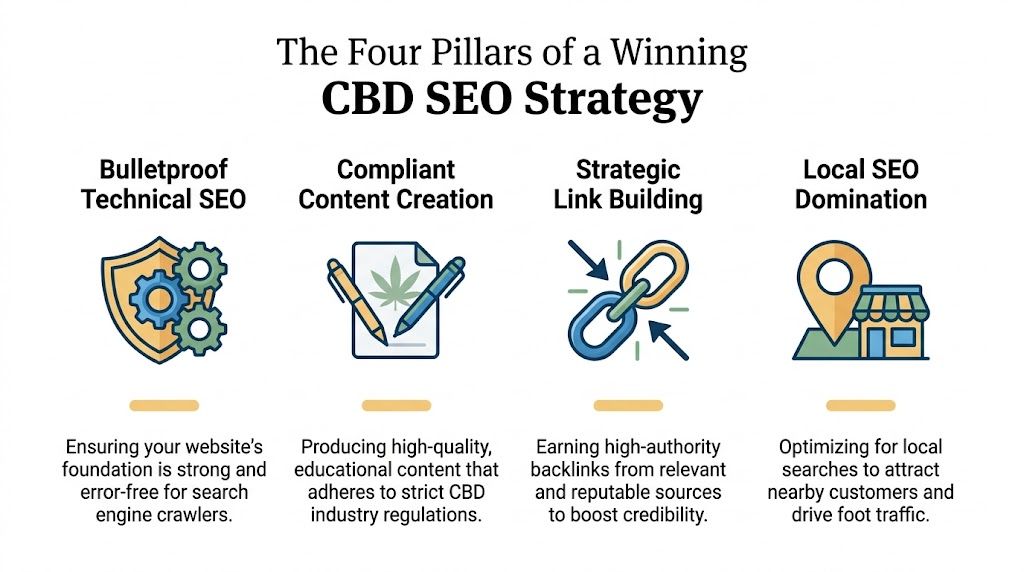
Bulletproof technical SEO
This is the part many brands underfund because it isn’t flashy.
But site speed, crawlability, mobile layout, internal linking, schema, and page stability all influence whether search traffic turns into revenue. CBD companies that prioritize technical SEO and achieve Green Core Web Vitals see a 15% higher conversion rate, and the same source notes that over 60% of CBD shoppers browse on mobile devices (CISIN).
That’s not a minor optimization. It means your site experience directly affects trust.
A capable agency should be doing work like this:
- Compress media: Product imagery has to look premium without slowing down mobile loads.
- Reduce code bloat: Bloated themes, unnecessary scripts, and plugin clutter hurt both rankings and conversion.
- Fix technical errors: Broken links, duplicate paths, indexing issues, and weak canonicals waste authority.
- Implement schema carefully: Product, Review, and Organization markup help search engines interpret the site correctly.
If you want a practical reference point for the broader mechanics behind sustainable organic growth, this guide to proven SEO and content strategies is worth reviewing alongside your agency conversations.
Compliance-first content creation
CBD content has to do two jobs at once. It has to rank, and it has to stay disciplined.
Weak agencies treat content like volume production. They churn out “what is CBD” articles, vague listicles, and over-optimized product copy. That creates a lot of pages and not much authority. Better agencies build content around actual search intent and frame it with educational, lifestyle, ingredient, sourcing, and product-use context that doesn’t drift into risky claims.
Good content planning usually includes:
- Educational pages: Clear answers for buyers who are still comparing formats, ingredients, and product categories.
- Commercial pages: Category and collection pages built for people close to purchase.
- Transactional pages: Product pages with clean structure, clear benefits, FAQs, and strong internal links.
- Support content: Shipping, testing, sourcing, and quality pages that reduce friction.
The writing should sound informed, not evasive. Buyers can tell when a brand is trying too hard to “SEO” them.
Hyper-local SEO
Not every CBD company is local-first, but many are local-dependent.
That includes retailers, clinics with CBD-adjacent education, regional brands, delivery operators, and any business trying to win in city or state-level searches. Local SEO means optimizing business information, service pages, location pages, internal location signals, and review acquisition processes so nearby buyers can find and trust you.
This pillar matters most when the business needs discovery close to the point of purchase.
High-authority link building
Link building in CBD is where weak operators show themselves quickly.
If the proposal is full of vague promises about “hundreds of backlinks,” walk away. In this category, quality and relevance matter far more than raw volume. The right links usually come from wellness publications, industry resources, niche business sites, local media, and credible partnerships.
The goal of link building isn’t to manufacture popularity. It’s to prove your site belongs in the conversation.
A good agency will explain where links come from, what kind of pages earn them, and why they fit your brand. It won’t hide behind jargon.
How to Evaluate and Hire the Right Agency
Hiring a cbd seo agency is less about listening for confidence and more about testing for competence.
A polished sales call doesn’t tell you much. The useful signals are operational. Can the agency explain how it handles claim-sensitive copy? Can it show how technical fixes support conversion? Can it describe reporting in terms of decisions, not vanity charts? Does it understand where AI helps and where manual review still matters?
Questions that expose real capability
The strongest interview questions are specific.
Ask how the agency uses AI in a regulated environment. In regulated industries, AI-powered SEO tools have been shown to increase organic traffic by 35% to 50%, and forward-looking agencies should be able to discuss AI for compliance checks and trend analysis, including the 28% spike in voice search queries for CBD products referenced in the source material (12A Agency).
That doesn’t mean you want an agency to hand your brand to automation. You want it to use AI where it improves monitoring, forecasting, content research, and workflow speed, while keeping human review on compliance-sensitive pages.
If you’re comparing agency tool stacks, this roundup of best SEO software for agencies helps you understand the platforms many firms rely on for audits, rank tracking, content workflows, and technical monitoring.
CBD SEO Agency Evaluation Checklist
| Area to Evaluate | Key Question to Ask | What a Good Answer Sounds Like |
|---|---|---|
| Compliance knowledge | How do you prevent risky claim language? | They describe a review process for product pages, blogs, metadata, and FAQs. They talk about education-first copy and legal sensitivity, not “aggressive positioning.” |
| Technical SEO | What do you audit first? | They mention crawl issues, Core Web Vitals, mobile UX, internal linking, schema, indexing, and duplicate content. |
| Content strategy | How do you choose what to publish? | They map content to intent. Informational, commercial, and transactional pages each have a job. |
| Local SEO | How do you handle geo-targeted demand? | They explain location pages, business profile optimization, citation consistency, and city or state-level keyword targeting where relevant. |
| Link building | Where do backlinks come from? | They talk about relevant sites, editorial standards, outreach quality, and why each link supports authority. |
| Reporting | What do monthly reports include? | They show rankings, traffic trends, conversions, technical progress, and next actions. Not just screenshots. |
| AI usage | Where does AI help without creating risk? | They use AI for research, monitoring, forecasting, and compliance support, with human review for final output. |
| Team structure | Who does the work? | They can name roles. Strategist, technical SEO, content lead, developer, and account manager. |
What to watch for in proposals
Bad proposals often look polished because they avoid detail.
Be cautious if you see:
- Template deliverables: The same package for every regulated brand.
- No mention of compliance review: That’s a major red flag in CBD.
- Ranking guarantees: Serious agencies don’t guarantee positions.
- Vague reporting language: If they can’t explain what gets measured, they probably won’t improve it.
- No discovery process: They should ask about your products, fulfillment model, target states, and operational constraints.
For a broader vetting framework, this guide on how to choose an SEO company gives a useful baseline for evaluating process and fit.
What Success Looks Like A CBD SEO Case Study
The cleanest way to judge SEO is to look at business outcomes, not marketing language.
One documented CBD SEO case study shows what happens when a strategy is built around technical repair, search intent, and conversion quality instead of random publishing. In that campaign, The CBD Supplier achieved a 557% increase in organic traffic, growing from 850 monthly visitors to over 5,500 monthly visitors within 18 months, while also improving conversion rate from 0.8% to 4.2% and producing 340% revenue growth (Koanthic case study).
Why the campaign worked
The outcome wasn’t driven by one lucky keyword.
The strategy combined several parts that reinforce each other:
- Deep keyword research: The campaign identified over 500 target keywords across informational, commercial, and transactional intent.
- Technical improvements: The site architecture was rebuilt, and the team implemented caching and image optimization.
- Conversion-minded execution: Traffic quality improved, but the site also converted that traffic more effectively.
- Competitive rankings: The client reached page one for over 150 CBD-related keywords, including terms such as “CBD oil UK,” “hemp products online,” and “third-party tested CBD.”
That’s what a serious cbd seo agency is supposed to build. Not traffic in isolation. A system where search demand, site architecture, content structure, and conversion design work together.
The most useful case studies don’t just show rankings. They show whether the business made more money from better traffic.
The practical takeaway
A lot of founders look at SEO and ask whether it can really move revenue in a restricted category.
Yes, it can. But only if the agency treats SEO like an operating system for the business. The moment strategy gets reduced to blog production or link volume, the upside disappears.
Frequently Asked Questions About CBD SEO
How long does it take to see results from CBD SEO
SEO in CBD usually takes patience because the category is competitive and trust has to be earned. Technical fixes can improve crawlability and user experience early, while content and authority building tend to compound over time.
The honest answer is that progress happens in layers. You may see early movement in indexing, visibility, and page quality before you see substantial commercial impact.
Can I handle CBD SEO in-house
You can, if your team has the right mix of skills.
What usually breaks in-house isn’t effort. It’s bandwidth and specialization. Someone can write content, but not audit schema. Someone can fix templates, but not build a keyword map around compliance-sensitive search intent. Someone can publish blogs, but not evaluate link quality.
A lot of brands do best with a hybrid model:
- Internal product expertise: Your team knows the customer and the product nuances.
- External SEO execution: A specialist agency handles technical, strategic, and authority work.
- Shared review process: Sensitive pages get checked before launch.
Does SEO help with the payment processor problem
Not directly in the sense of changing processor rules.
It does help indirectly by making your brand more credible. Better site architecture, clearer quality information, stronger educational content, cleaner trust signals, and improved UX all reduce buyer hesitation. When people feel uncertain about checkout, they often back out. A well-built site lowers that friction.
SEO also brings in visitors who are already searching for your category. That traffic often has better intent than colder traffic sources.
What should a cbd seo agency actually deliver each month
You should expect work, not just reports.
That usually includes technical fixes, content planning and production, on-page optimization, internal linking updates, authority work, reporting, and strategic recommendations tied to what the data shows. If the agency sends a monthly PDF but can’t point to concrete changes made on the site, that’s a problem.
Should my strategy focus on product pages or blog content
Both, but not equally at every stage.
If your product pages are weak, slow, or poorly structured, publishing more blogs won’t solve the core issue. If your site has decent commercial pages but lacks topical depth and internal authority, content development can help. The mix should follow the bottleneck.
Where does AI fit into CBD SEO
AI is useful when it supports analysts and writers, not when it replaces judgment.
The best use cases are research support, compliance monitoring, trend analysis, content outlining, and spotting gaps across large sites. The final decisions still need human review, especially on product language and regulated topics. One practical example is Up North Media, which offers SEO and AI consulting services that can be relevant for businesses needing both search strategy and automation support.
What’s the biggest mistake CBD brands make with SEO
They hire for activity instead of strategy.
More pages, more keywords, and more backlinks don’t mean more growth if the site is technically weak, the copy creates risk, or the authority signals don’t line up with the business model. CBD SEO rewards precision. The brands that win are usually the ones that treat search as a long-term asset and choose partners who do the same.
If your CBD brand needs a search strategy built around technical performance, compliant content, and smart use of AI, Up North Media is one option to consider. They work across SEO, web development, and AI consulting, which is useful when growth depends on more than rankings alone.