
You're comparing music schools late at night, moving between audition requirements, tuition pages, faculty biographies, and videos of students performing. The phrase conservatory of musical arts sounds impressive, but it doesn't answer the question that matters most: would this kind of education help you become the musician, teacher, producer, scholar, or arts professional you want to be?
A conservatory is a specialized environment for serious musical study. You'll spend more time in private instruction, rehearsals, performance preparation, theory, and musicianship training than you might in a general university program. That focus can be energizing, but it also brings demanding schedules, public evaluation, and a need to choose your teachers and program structure carefully.
This guide is for high school students, parents, adult learners, and career-changers. It explains where the model came from, how degree and non-degree options differ, what the curriculum feels like, how auditions work, how to think about financial aid, and what musicians can do after graduation. If you're preparing application materials or looking for examples of clear student-focused writing, these blog entry examples for students may also help you organize your questions and goals.
What a Conservatory of Musical Arts Is and Who This Guide Is For
A conservatory of musical arts is a school built around concentrated musical training. Instead of treating music as one subject among many, it makes music the center of your academic and professional life. Depending on the institution, you might study classical performance, jazz, composition, conducting, vocal arts, music technology, pedagogy, or related fields.
The easiest way to understand the model is to compare it with a broad university music department. A university may let you combine music with sciences, languages, business, or other majors within a larger campus. A conservatory usually gives you denser contact with studios, ensembles, practice facilities, recitals, masterclasses, and faculty members who work professionally in music.
That difference doesn't make one path automatically better. It changes the kind of student who's likely to thrive.
Start with your purpose
Ask yourself what you want your education to do:
- Prepare you for performance: You'll need regular individual feedback, demanding repertoire, ensemble experience, and frequent opportunities to perform.
- Build a wider academic identity: A double-degree or university-affiliated model may suit you better if you want music alongside another field.
- Develop a flexible career: Look for coursework and mentoring in teaching, production, arts administration, composition, or technology.
- Maintain music alongside work or family: A certificate, private-study program, or adult education option may be more realistic than a full-time degree.
A nervous applicant often asks, “Am I good enough for a conservatory?” A more useful first question is, “Does this school's training model match the work I'm prepared to do every day?” Conservatory education rewards consistency, openness to critique, and a willingness to perform before you feel completely comfortable.
You also don't need to decide your entire career before applying. You do need to identify the kind of training you want, the level of intensity you can sustain, and the financial conditions that would make enrollment responsible.
The Origins of the Conservatory Model
The modern conservatory model grew from a sequence of institutional reforms rather than one single founding event. Paris became a foundational reference point because it connected professional training, public access, and systematic instruction in performance and theory.
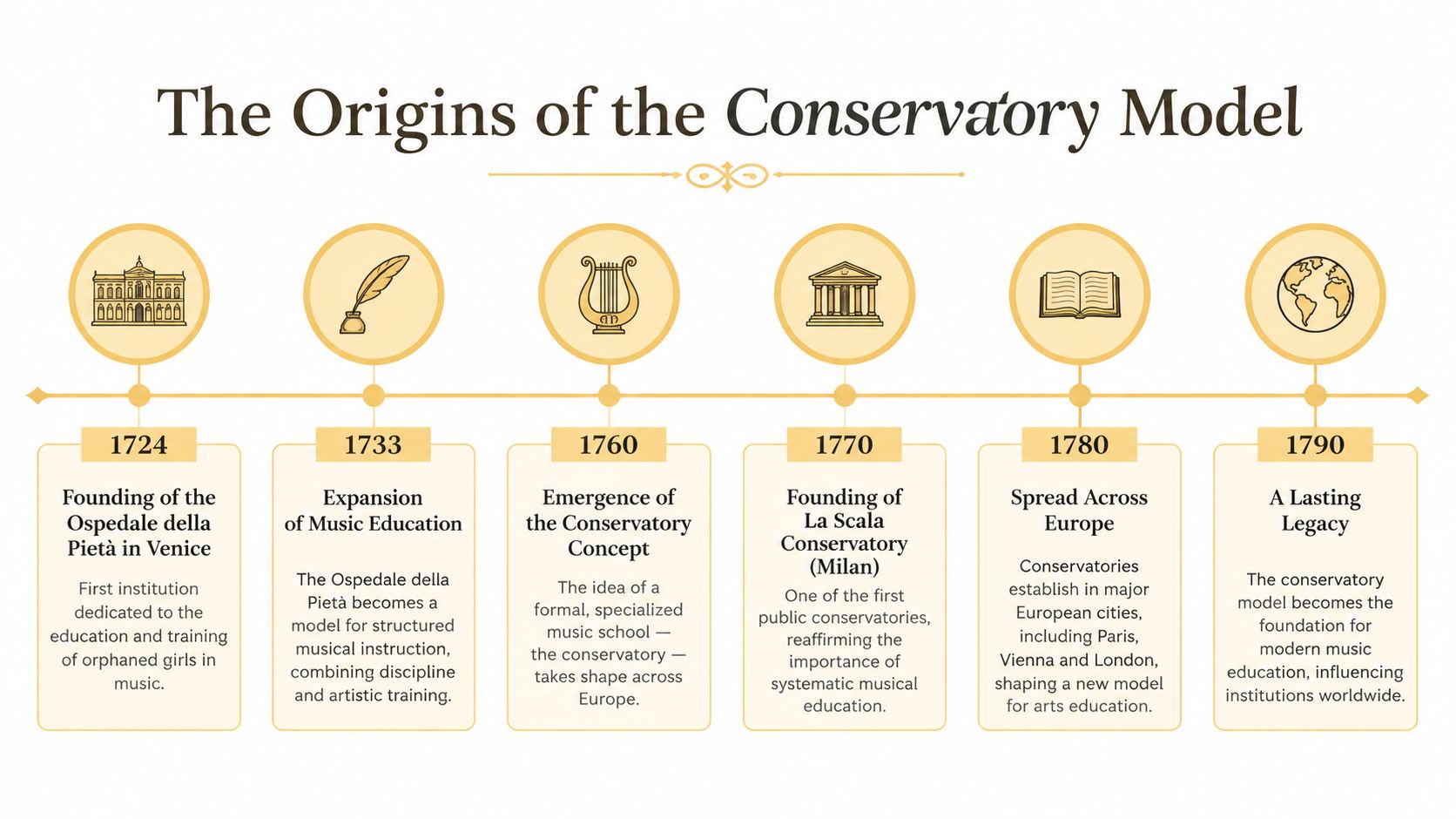
Britannica identifies 1784 as the year the first secular school of music for students at large was founded in Paris. The institution was reorganized in 1795 as the Conservatoire National de Musique et d'Art Dramatique, a development that helped establish Paris as a central reference for organized conservatory education. Britannica's history of the musical conservatory describes this broader development within the European tradition.
The Paris institution's own historical record shows why the timeline matters. The Royal School of Singing and Declamation was founded on January 3, 1783. The Municipal School of Music was formalized on November 8, 1793, and the Conservatoire de Musique was established on August 3, 1795. These milestones reveal a gradual process of state-backed restructuring across more than a decade.
From specialist school to national institution
The same basic pattern appeared in the United States. Specialist schools often began with small faculties and modest student populations, then expanded into institutions with broader academic and cultural responsibilities.
The American Conservatory of Music in Chicago reports that it began with fewer than 100 students and only a handful of teachers. Later, it grew to more than 135 artist instructors and annual enrollment above 3,700 students. The American Conservatory of Music's institutional history presents this growth as part of the wider development of American music education.
Other institutions illustrate the same national expansion. The University of Cincinnati College-Conservatory of Music traces its origins to Clara Baur and identifies itself as one of the first music conservatories in the United States. The Peabody Institute states that it was founded in 1857 with a $1.4 million gift and was the first conservatory in the United States.
The important lesson is practical. Conservatories weren't created only to celebrate gifted performers. They were designed to make musical training systematic, repeatable, and connected to public cultural life. That legacy still shapes the studio lesson, theory class, ensemble rehearsal, recital, and jury you'll encounter today.
Degree and Non-Degree Programs You Can Choose
The right program depends on your current training, your available time, and the credential you need. Start by separating degree programs from non-degree study, then compare the actual experience each option provides.
A bachelor's program is designed for students who want a sustained undergraduate education in music. Performance majors typically combine private lessons with ensembles, theory, ear training, history, chamber music, and recital requirements. Composition, conducting, jazz, and vocal tracks may organize those requirements differently, so read the curriculum rather than relying on the program title.
Graduate study is more specialized. A master's degree, artist diploma, or similar advanced track may focus tightly on repertoire, performance, conducting, vocal arts, or a professional concentration. Doctoral study usually adds advanced scholarship, pedagogy, research, and a substantial performance component.
A broader route for interdisciplinary students
Bard College Conservatory of Music uses a distinctive five-year double-degree model. Its students must complete a bachelor's degree in a field other than music while pursuing specialized music study, and the conservatory offers graduate tracks in vocal arts, conducting, performance, and Chinese music and culture. Bard's academic program information explains this structure.
That model may appeal to a student who wants intensive musical development without giving up another academic discipline. It also demands more planning, because you're managing a broader academic load alongside conservatory requirements.
Non-degree options
Non-degree study can be the smarter choice when you want targeted development rather than a full credential.
- Pre-college programs help younger musicians build technique, musicianship, and audition readiness before undergraduate applications.
- Adult studies provide lessons, classes, and ensemble opportunities for learners balancing music with work or family responsibilities.
- Summer programs and festivals offer concentrated repertoire work, coaching, performances, and exposure to new teachers.
- Certificates and short courses can support composition, recording, pedagogy, music technology, or another focused skill.
The key question is not whether a program sounds prestigious. Ask what it requires each week, who teaches it, how performance is assessed, and what credential or portfolio you'll leave with. A working musician may gain more from a focused certificate than from taking on a full-time degree without a clear reason.
What a Conservatory Curriculum Actually Feels Like
A conservatory curriculum feels less like a sequence of unrelated classes and more like a repeating performance cycle. You learn repertoire in private lessons, test ideas in studio or chamber settings, refine technique through practice, and eventually perform for faculty or a public audience.
Your week may include individual instruction, ensemble rehearsal, theory, ear training, sight-reading, chamber music coaching, and practice blocks. The private lesson identifies problems. The rehearsal shows whether you can respond to other musicians. Theory and ear training help you understand what you're playing, hear structure, and communicate with greater control.
The performance cycle
Most programs build toward recurring evaluations such as juries, departmental recitals, studio performances, and capstone concerts. A jury may ask you to perform prepared repertoire before a faculty panel. That setting tests more than memory. Faculty may listen for tone, rhythm, stylistic understanding, technique, expression, and your ability to recover when something goes wrong.
Graduate study makes the workload especially visible. The University of Cincinnati College-Conservatory of Music describes Doctor of Musical Arts performance programs that commonly include 47 to 48 total credits, a three-year completion target, and performance expectations centered on technique, tone, expression, rhythm, historically informed interpretation, and pedagogical communication. The University of Cincinnati program catalog provides those program details.
You can use that structure as a reality check. Advanced conservatory training doesn't treat performance as a final decoration added after coursework. Performance is one of the main ways the school evaluates your development.
The work outside the spotlight
A serious schedule also includes less visible preparation:
- Marking scores and planning practice goals
- Listening to contrasting interpretations
- Studying language and diction for vocal repertoire
- Preparing chamber music independently before rehearsal
- Writing program notes or research papers
- Practising teaching explanations for pedagogy requirements
- Building a recital program that reflects your artistic direction
A curriculum-planning resource such as this course curriculum creator can help you turn a long catalog into a simple comparison sheet. List required courses, performance milestones, electives, practice expectations, and final assessments. You'll see quickly whether a program gives you room to explore or keeps you on a tightly prescribed track.
Faculty, Mentors, and Who Actually Teaches You
At many conservatories, your primary teacher shapes your experience more than the institution's general reputation. You may attend the same school as another student but have a very different education because your studio culture, lesson style, repertoire priorities, and feedback process differ.
Artist-faculty members often lead private studios, coach chamber groups, teach classes, perform concerts, and conduct masterclasses. Graduate assistants may support lessons, accompanying, rehearsals, or introductory courses. Visiting artists can add a short-term perspective, especially when they bring a different performance tradition or professional specialty.
Research the teacher, not only the school
Before you apply, investigate the prospective teacher's background and teaching approach. Review faculty biographies, recital programs, recordings, interviews, and current students' performances where available. Don't assume that a celebrated performer automatically offers the kind of instruction you need.
Look for evidence that the teacher works with students at your level and understands your goals. A singer may need help with diction and stagecraft, while a composer may prioritize orchestration feedback and workshop access. A jazz student may care about improvisation, ensemble leadership, and professional collaboration.
Practical rule: Choose the studio where you can imagine receiving difficult feedback without losing your motivation.
Ask specific questions during a campus visit or online meeting:
- How often do students receive individual lessons?
- How does the teacher assign repertoire?
- What happens when a student's interests change?
- How are practice problems diagnosed?
- Do students perform regularly in studio settings?
- What support exists if the teacher is away for professional work?
You can also review the institution's staff and faculty information through the school staff resource, then follow each teacher's professional work through official profiles and performance pages. The best choice is usually the mentor whose teaching priorities align with your growth, not the person with the most recognizable name.
Admissions and Audition Steps From Start to Decision
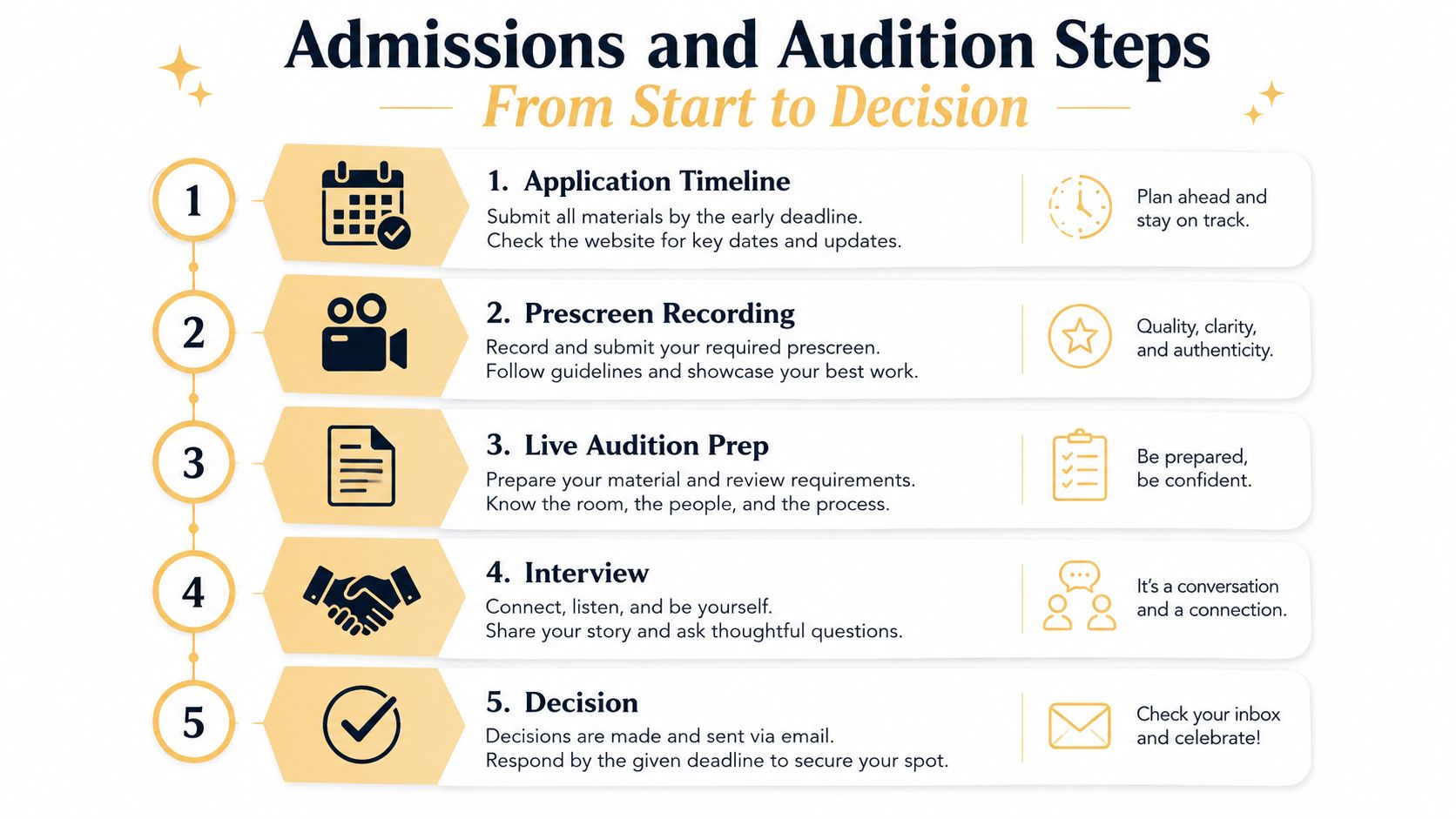
Conservatory admissions becomes manageable when you treat it as a sequence of deliverables. Requirements vary, so always use the current application page for each school, but the process commonly moves from paperwork to prescreening, then to live evaluation and a final decision.
Build your application calendar
Record every deadline for the application, transcripts, recommendations, prescreen videos, financial aid forms, and audition registration. Don't assume that submitting the general application completes the music application. Some schools require separate repertoire lists, resumes, essays, or departmental materials.
Your prescreen recording should show control, musical judgment, and preparation. Choose repertoire that represents your strengths without taking on pieces you can't perform consistently. If the school's suggested list doesn't include the work that best represents you, contact the department before recording and ask whether substitutions are accepted.
Prepare for the audition room
A live audition may include prepared pieces, scales, sight-reading, interviews, theory, dictation, or ear-training placement. Practise entering the room, introducing your repertoire, adjusting to an unfamiliar instrument or space, and continuing after a mistake. Faculty aren't only listening for perfection. They're also observing how you interpret, communicate, and respond under pressure.
Recent admissions information shows why planning matters. Peabody reported an 18% increase in applications after expanding financial aid and making DMA tuition-free. Its undergraduate admit rate moved from 48% to 37% and then 27% for fall 2025, according to the published admissions trend information. Those figures relate to the reported admissions data, not to every conservatory, but they show how quickly selectivity can change.
Keep decision day practical
If audition dates conflict, ask whether another date, virtual option, or recorded submission is available. Bring printed repertoire lists, identification, water, quiet clothing, and any required accompaniment materials. Afterward, compare offers using teacher fit, net cost, curriculum, performance access, location, and the support available for your intended career.
Tuition, Scholarships, and What Life After Graduation Looks Like
The financial question deserves more than a promise of “generous aid.” Start with the school's full cost of attendance, then separate merit scholarships, need-based assistance, assistantships, outside awards, travel costs, instrument maintenance, housing, and lost income if you're leaving work.
A tuition-free doctoral announcement can change the calculation for one student while doing nothing for another. Undergraduate applicants should compare the complete aid package rather than focusing on a single scholarship headline. Ask whether awards renew automatically, what academic or performance conditions apply, and whether the package covers only tuition or also living expenses.
Compare the institution's tradeoffs
Independent conservatories may offer concentrated performance culture, specialized facilities, and a strong artistic identity. University-affiliated programs may provide wider course selection, access to another major, and potentially more manageable costs. The better option depends on your goals and the actual offer in front of you.
Global enrollment also needs careful interpretation. Italy's conservatoires had 96,292 total students in 2025/26, an increase of 1% year over year and 5.6% over two years, while state music conservatoires showed a slight decline from the prior academic year. The reported Italian enrollment figures suggest that interest in conservatory systems can rise even while traditional pathways remain narrow.
Plan for a portfolio career
Graduates may combine several roles instead of relying on one job title:
- Performance: Solo work, chamber music, orchestral work, opera, musical theatre, or freelance engagements
- Teaching: Private studios, schools, community programs, colleges, or online instruction
- Creation: Composition, arranging, songwriting, orchestration, or multimedia work
- Production: Recording, editing, concert production, artist support, or music technology
- Administration: Presenting organizations, festivals, education departments, fundraising, or artist management
The return on investment is personal and practical. If you want only one narrow outcome, conservatory training may feel financially risky. If you're prepared to combine performance with teaching, production, administration, or creative work, a program with broad electives and strong mentoring may provide more useful long-term value than prestige alone.
Performance Life, Community Outreach, and Your Next Steps
Conservatory life extends beyond scheduled classes. Students may perform in studio events, department recitals, chamber concerts, masterclasses, public series, and partner venues. They also learn how to arrive prepared, communicate with collaborators, respond to feedback, and support an audience that may not already know the repertoire.
Community outreach adds another dimension. Conservatory musicians can work with local schools, hospitals, libraries, community centers, and cultural organizations. These activities develop communication and teaching skills while showing students that a musical career includes service, explanation, and relationship-building, not only stage performance.
Plan a useful campus visit
A visit should answer practical questions, not just confirm that you like the building.
- Attend a lesson or rehearsal if permitted. Notice how teachers give feedback and how students respond.
- Walk through practice and performance spaces. Ask how students reserve rooms and prepare for recitals.
- Speak with current students. Ask about workload, studio culture, financial pressure, and access to performances.
- Meet the admissions and financial aid teams. Request written answers about deadlines, renewal rules, and additional fees.
- Contact the department directly. Faculty coordinators can clarify repertoire, prescreen rules, accompanist policies, and theory requirements.
If you're interested in the community side of music, resources about arts grants for small nonprofits can help you understand how local arts organizations fund education, outreach, and performance partnerships.
Questions applicants ask before committing
Do I need to be certain about my career?
No. You should know what kind of training you want, but your interests can develop through lessons, ensembles, electives, and performances.
Is a conservatory only for classical musicians?
No. Programs vary widely. Some focus on classical performance, while others include jazz, composition, conducting, vocal arts, music technology, or culturally specific traditions.
What if I'm not ready for a full degree?
Explore pre-college, adult, certificate, summer, or private-study options. A smaller commitment can help you test the environment and identify your next level of preparation.
How should I compare two offers?
Start with the primary teacher and net cost. Then compare curriculum flexibility, performance opportunities, student support, location, and the career pathways graduates can realistically pursue.
Your next step should be concrete. Make a shortlist, download each current audition requirement, contact the relevant teacher or department, and create a calendar for recordings, applications, financial aid, and travel. The right conservatory of musical arts won't impress you. It will give you a sustainable structure for becoming a stronger musician and a more adaptable professional.
Up North Media helps organizations turn complex ideas into clear, effective digital experiences through custom web development, data-driven SEO, and AI consulting. If your arts organization, school, or nonprofit needs a stronger online strategy, visit Up North Media to explore support and request a consultation.