

Your store probably isn't failing. It's just outgrown the setup that got you started.
That's a common place for Omaha business owners to land. The site launched fast on a theme, revenue started coming in, and everyone felt good about momentum. Then substantial friction showed up. Merchandising feels boxed in. Promotions require hacks. Mobile checkout doesn't feel smooth. SEO improvements keep getting limited by the platform or theme structure. Your team starts spending more time working around the website than growing the business.
That's usually the point where custom e-commerce website design stops being a design conversation and becomes a business conversation. You're not buying prettier pages. You're deciding whether your storefront should support your next stage of growth or keep slowing it down.
Is Your E-commerce Site Holding You Back
A familiar scenario looks like this. A retailer launches on a prebuilt template because it's fast and affordable. At first, that's the right move. The catalog is manageable, the brand story is simple, and the priority is getting online.
Then the business changes.
Now there are more SKUs, more promotions, more customer questions, and more channels feeding traffic into the store. The original site still works, but it doesn't work well. Category pages get messy. Product pages all look the same even when products sell differently. Checkout asks customers to adapt to the theme instead of the other way around.
That's where revenue leaks start.
A template usually breaks down in the same places:
- Brand expression gets limited: the site starts looking like a slightly edited version of other stores in the category.
- Marketing flexibility shrinks: landing pages, bundles, seasonal campaigns, and content-led SEO become harder to execute cleanly.
- Operations get clunky: inventory tools, CRM workflows, shipping logic, or reporting often rely on patchwork integrations.
- Conversion friction rises: small UX issues stack up and customers feel them before your team can quantify them.
Most owners don't decide on custom e-commerce website design because they want more design freedom. They decide because the current site has become a constraint.
The broader market reflects that shift. The global e-commerce website design market was valued at $11.2 billion in 2025 and is projected to reach $24.1 billion by 2034, with custom design leading that growth, according to USDA Analytics on the e-commerce website design market. That matters because it signals how businesses are thinking now. Bespoke storefronts aren't a luxury layer anymore. They're a practical response to growth, competition, and higher customer expectations.
If your site feels harder to manage each quarter, that isn't a sign you made the wrong early decision. It's a sign the business is ready for a more capable platform.
Beyond the Template Why Custom Design Delivers Real ROI
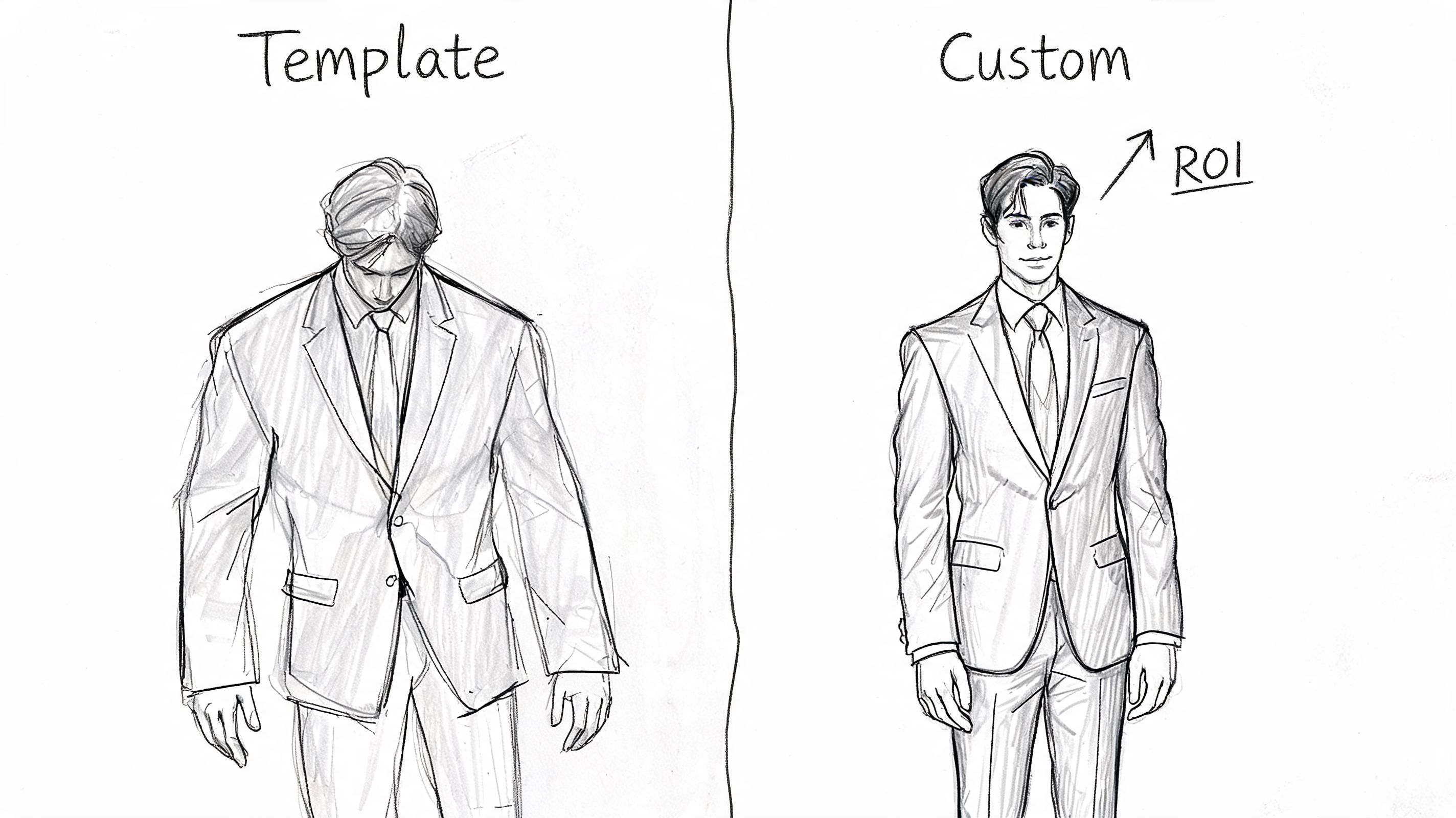
A template is like an off-the-rack suit. It can look fine from a distance, and it may be good enough for a while. A custom build is designed for how your business operates, how your customers buy, and where your marketing strategy needs flexibility.
That distinction matters because performance doesn't come from appearance alone. It comes from fit.
What templates do well
Templates are useful when speed and simplicity matter more than differentiation. They're often enough for:
- Early-stage validation: proving demand before investing in deeper customization
- Small catalogs: where merchandising needs are straightforward
- Low-complexity operations: with minimal integrations and simple fulfillment rules
The issue isn't that templates are bad. The issue is that they're designed to serve many businesses moderately well, not one business precisely.
Where custom starts paying for itself
Custom e-commerce website design earns its keep when the store needs to do something specific and profitable.
That could mean building category pages around how people shop your products. It could mean restructuring product detail pages for a long-consideration purchase. It could mean creating a better mobile checkout, connecting inventory systems cleanly, or supporting SEO landing pages without fighting a rigid theme architecture.
The business case gets stronger when you look at the conversion side. Websites with a strong focus on user experience can achieve up to 400% higher conversion rates, and 75% of consumers judge a company's credibility based on website design, according to Hostinger's web design statistics roundup.
For an owner, that translates into three practical outcomes:
- More visitors buy
- More first-time shoppers trust the brand
- Marketing dollars work harder because the site converts more efficiently
ROI comes from alignment, not decoration
A custom build works when every major element aligns with the business model:
- Navigation matches buyer intent
- Product pages answer real objections
- Checkout removes avoidable friction
- Content structure supports organic search
- Integrations reduce manual work for staff
If you're thinking about broader brand strategy at the same time, this guide on growing your DTC brand presence is useful because it connects storefront decisions to the larger job of building a recognizable digital brand.
Practical rule: If your site can't support the way you sell, market, and fulfill today, every campaign becomes more expensive than it should be.
That's the essential difference between custom and template. One gives you pages. The other gives you an asset built to drive revenue.
The Custom E-commerce Build Process From Blueprint to Launch
A typical Omaha owner reaches out after the same pattern repeats. Paid traffic is expensive, orders are coming in, but the site creates drag at every step. Search is weak, product pages do not answer buying questions, inventory data is unreliable, and the team is patching together manual workarounds after every promotion. A custom build fixes those operational and conversion problems in a planned sequence.
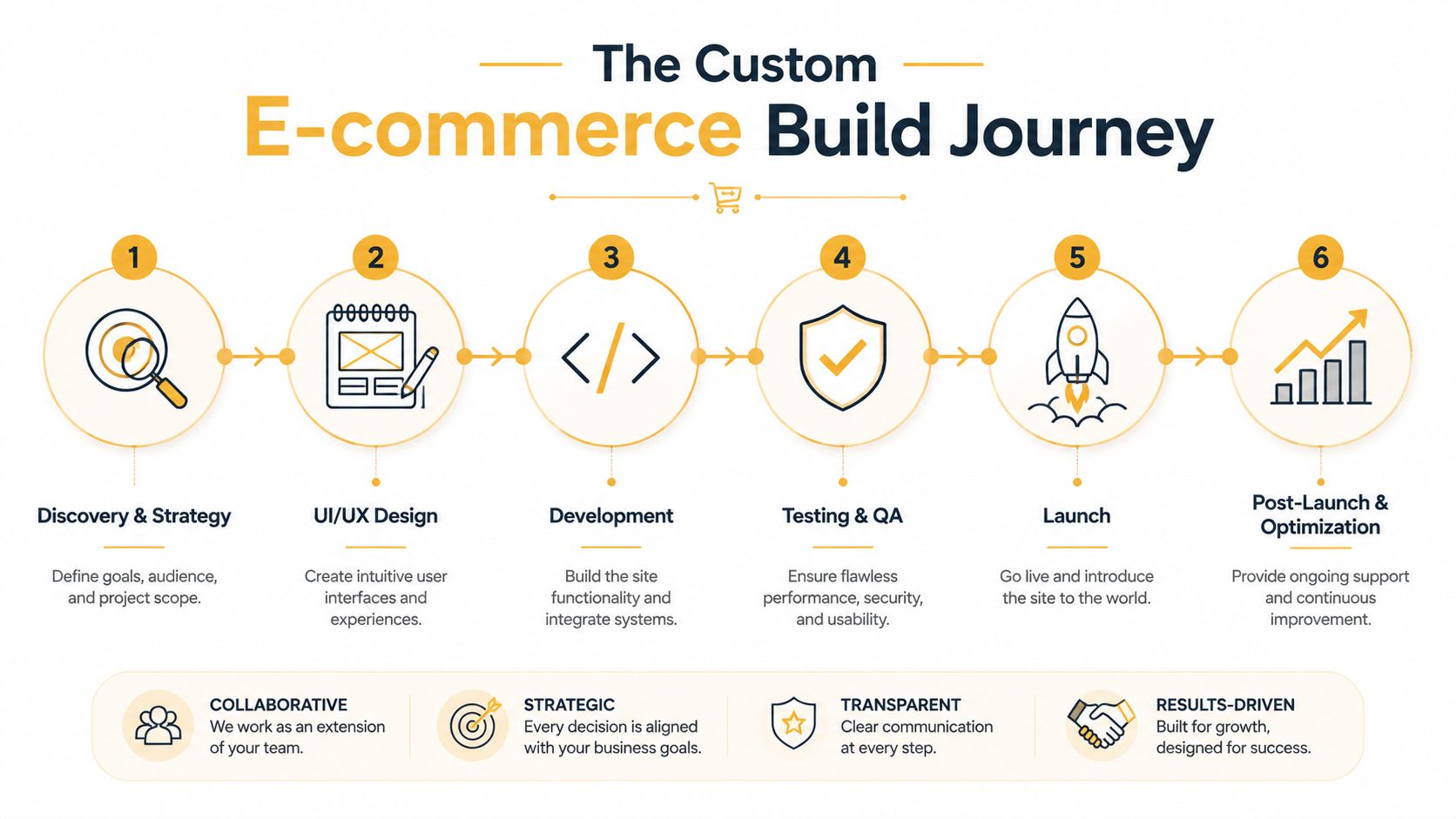
Discovery and strategy
Projects succeed or fail before design starts.
The first job is defining what the new store has to improve in business terms. That usually means revenue targets, conversion rate goals, average order value, repeat purchase behavior, staff time saved through automation, and the systems that cannot break during launch. For Omaha businesses, local requirements often shape the build early. Store pickup rules, territory-based delivery, B2B account pricing, sales rep ordering, and multi-location inventory all affect architecture before anyone approves a homepage mockup.
A good discovery phase answers a few hard questions:
- Which customer journeys produce the most revenue today
- Where do users hesitate, abandon, or call the team for help
- Which integrations have to work on day one
- Which pages need to rank, convert, and support paid campaigns at the same time
- What should the site automate so staff can stop doing it by hand
That work also determines whether a platform-led build is enough or whether the business needs a more flexible architecture. For owners weighing those paths, this guide to compare top ecommerce platforms is a useful starting point, and our own ecommerce platform comparison guide helps connect that decision to long-term operating costs and growth plans.
UX and UI design
Design starts with buying behavior.
The team maps how customers move from search or ad click to category page, product evaluation, cart, and checkout. The structure changes based on what you sell. A manufacturer with technical specs, quantity breaks, and quote requests needs a different interface than a lifestyle brand selling giftable products or a replenishment business trying to increase repeat orders.
This phase often includes:
- Wireframes for high-value templates
- Navigation, filtering, and on-site search planning
- Mobile-first layout decisions
- Content hierarchy for category, product, and landing pages
- Design system rules that keep new pages consistent
Good UI work also protects conversion. If shipping details are hard to find, filters are weak, or mobile add-to-cart is clumsy, ad spend gets less efficient and support requests go up.
Development and integrations
This is the point where strategy either becomes a working sales system or breaks down into technical debt.
Development covers the storefront, CMS configuration, data models, app setup, integration logic, analytics, and the details that affect day-to-day operations after launch. On one project, the hard part might be syncing inventory across locations. On another, it is building account-specific pricing, bundling logic, or a content model that gives the marketing team control without developer help every week.
Performance work belongs here. According to Mol-tech's guide to high-performing custom e-commerce websites, optimizing Core Web Vitals such as LCP, INP, and CLS can increase conversion rates by 20-30%, and techniques like server-side rendering can cut load times by over 30%. Teams that take performance seriously address rendering, image delivery, caching, script weight, and layout stability during development, because fixing those issues after launch usually costs more and delivers slower results.
In practical terms, this phase includes four jobs:
- Storefront build: converting approved designs into responsive page templates and reusable components.
- Commerce logic: configuring products, collections, search behavior, cart rules, and checkout flows.
- System connections: syncing the storefront with ERPs, CRMs, email platforms, shipping tools, payment gateways, and reporting.
- SEO and AI readiness: building crawlable site architecture, structured content control, metadata management, and clean data foundations that support stronger search visibility and better AI-assisted merchandising and content workflows.
Testing and QA
Launch problems usually start in QA, not on launch day.
A serious QA process checks the full buying experience across devices, browsers, and edge cases. That includes product variants, promo codes, account creation, cart persistence, shipping scenarios, tax handling, transactional emails, analytics events, low-inventory behavior, and permission settings across integrated systems.
The business impact is straightforward. Catching those issues before launch protects revenue, reduces support tickets, and keeps the team from spending the first month in cleanup mode.
Launch and post-launch optimization
Launch is the start of measurement.
The best teams go live with dashboards, benchmarks, and a short list of improvements they expect to test first. They watch category engagement, product-page exits, checkout completion, site search usage, organic landing performance, and the revenue contribution of key channels. That is where custom design starts proving its value in numbers, not opinions.
Post-launch work often produces the biggest return. One store may need better merchandising rules. Another may need stronger collection content for SEO. Another may need AI-assisted search tuning, improved product recommendations, or a cleaner checkout flow to reduce abandonment. The point is not to keep redesigning. The point is to keep improving the parts of the funnel that move revenue and lower operating costs.
Choosing Your Technology Stack Explained Simply
Most owners don't need a lecture on frameworks. They need to know what they're buying, what it will let them do later, and what trade-offs come with the decision.
The right stack for custom e-commerce website design depends on three things: how complex your operation is, how much flexibility your storefront needs, and how much internal overhead you want to manage.
The simple way to think about it
There are three common paths.
The first is a platform-led build. That usually means using a commerce platform such as Shopify or BigCommerce and customizing within its structure. This is often the fastest way to get a solid store online while keeping the back office manageable.
The second is headless commerce. In that setup, the commerce engine handles products, checkout, and order data, while a separate front end handles the customer experience. That's useful when brand, speed, content flexibility, or SEO requirements push beyond what a standard theme can comfortably do.
The third is a fully custom application. That gives you the most control, but it also demands the most planning, technical rigor, and ongoing ownership.
For owners comparing options, this overview to compare top ecommerce platforms can help frame the early platform conversation before you get into implementation details.
E-commerce Technology Stack Comparison
| Approach | Best For | Key Advantage | Key Consideration |
|---|---|---|---|
| Platform-led build | Businesses that need reliable commerce features without heavy custom engineering | Faster setup and easier day-to-day admin | You may hit flexibility limits as catalog, content, or integrations become more complex |
| Headless commerce | Brands that need stronger front-end control, content freedom, and performance tuning | Better design flexibility and cleaner separation between storefront and commerce engine | Requires a more capable development partner and a clearer content workflow |
| Fully custom application | Businesses with unusual workflows, pricing models, or operational requirements | Maximum control over customer experience and business logic | Higher complexity, broader maintenance responsibility, and longer implementation cycles |
What matters more than the stack itself
Owners sometimes fixate on trendy tools when the bigger question is operational fit.
Ask the agency or dev partner:
- Who will manage products and content after launch?
- How hard is it to add landing pages or campaigns?
- What happens when integrations change?
- Can the storefront scale without a rebuild?
- Will SEO teams have real control over templates and content structure?
A good partner should be able to answer those questions in business language, not just developer language. If you want a deeper side-by-side breakdown before making that call, this e-commerce platform comparison guide is a practical starting point.
Choose the stack that supports the business you're becoming, not just the business you are today.
Budgeting for Success Costs Timelines and Value
The wrong way to budget a redesign is to ask only, “What does it cost?”
The better question is, “What value should this project create, and how will we measure it?”
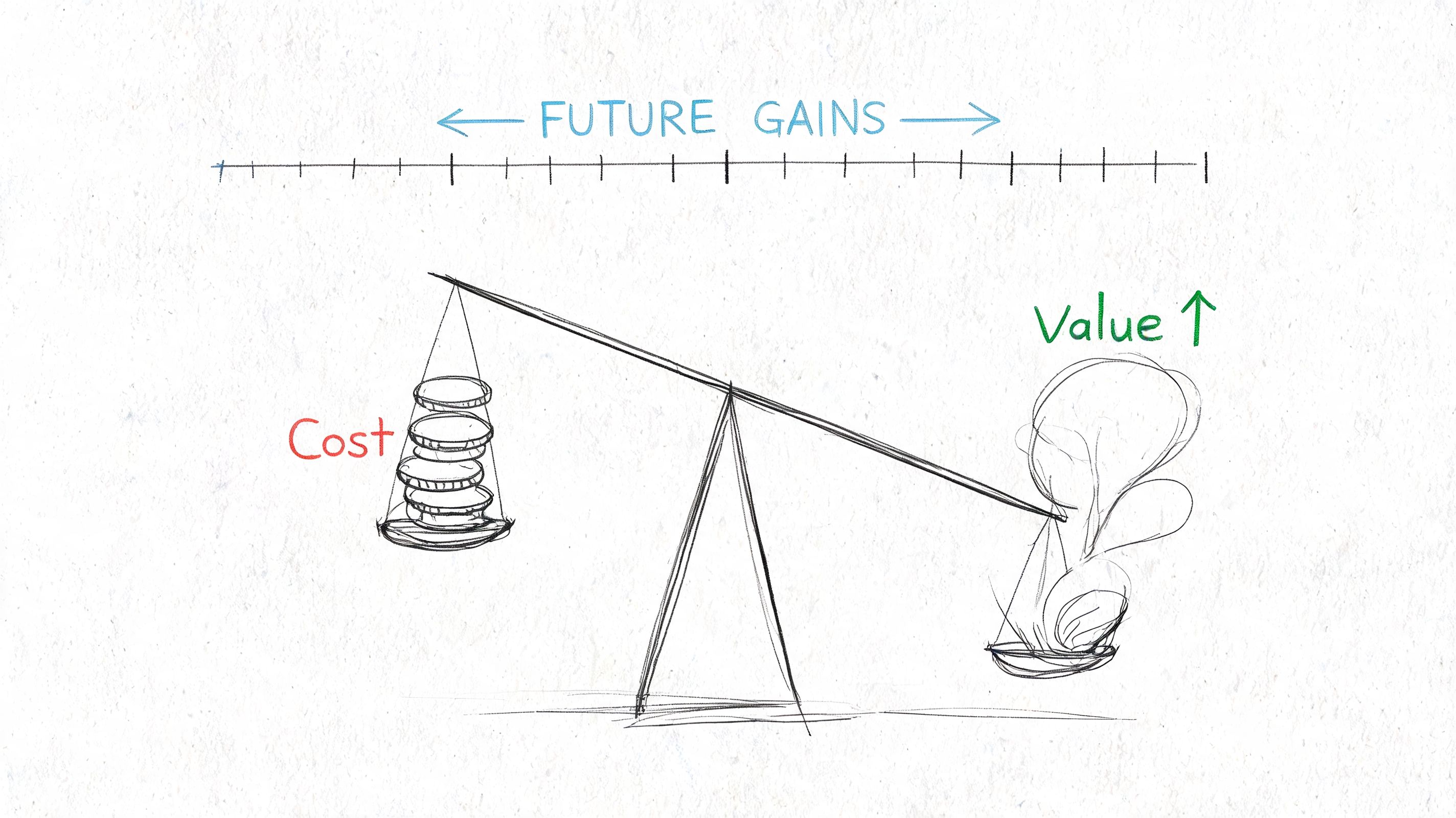
A custom e-commerce project can range from a focused storefront redesign to a full platform rebuild with integrations, migration, and advanced merchandising logic. The spread in pricing exists for a reason. Two stores can both sell online and still require very different levels of design, engineering, and operational complexity.
What drives budget up or down
Several decisions shape cost more than owners expect:
- Design depth: a lightly customized interface costs less than a system with unique templates for home, category, product, landing, cart, and account experiences.
- Integration complexity: ERPs, CRMs, inventory systems, shipping software, and subscription tools can add meaningful scope.
- Content and migration needs: moving products, customer data, order history, and SEO-critical URLs requires planning.
- Custom features: account portals, product configurators, regional merchandising, and specialized checkout behavior all increase complexity.
- Post-launch support: training, QA depth, analytics setup, and optimization retainer work affect total investment.
One of the biggest budget mistakes is approving a project before agreeing on success metrics. According to AmericanEagle's custom e-commerce redesign insights, 40% of redesigns fail because objectives weren't clearly defined. The same source notes that AI-driven personalization has lifted conversions by 22% in some cases, which is a useful reminder that ROI usually comes from targeted features, not from “a redesign” as a vague concept.
Timelines should follow complexity
A straightforward custom implementation can move far faster than a multi-system rebuild. The timeline depends on decision speed, content readiness, integration requirements, and how many stakeholders need to approve strategy, design, and functionality.
That's why realistic project planning matters more than arbitrary deadlines. A rushed launch with poor QA often costs more in lost sales, rework, and customer frustration than a disciplined launch done properly.
Here's a helpful overview if you're trying to anchor the discussion around e-commerce website development cost.
How to evaluate value instead of price alone
The strongest budgets tie line items to outcomes. If the proposal includes personalization, better collection architecture, faster templates, cleaner analytics, and improved mobile flows, ask what each piece is expected to improve.
Look for value in areas like:
- Higher conversion efficiency
- Lower reliance on manual work
- Cleaner campaign execution
- Stronger SEO publishing flexibility
- Better customer retention through smoother UX
This short video offers another useful perspective on investment and planning before a build moves forward.
A cheap site that slows down growth is expensive. A well-scoped custom build that improves margins, conversion, and operating efficiency is an asset.
How to Choose the Right Web Design Agency in Omaha
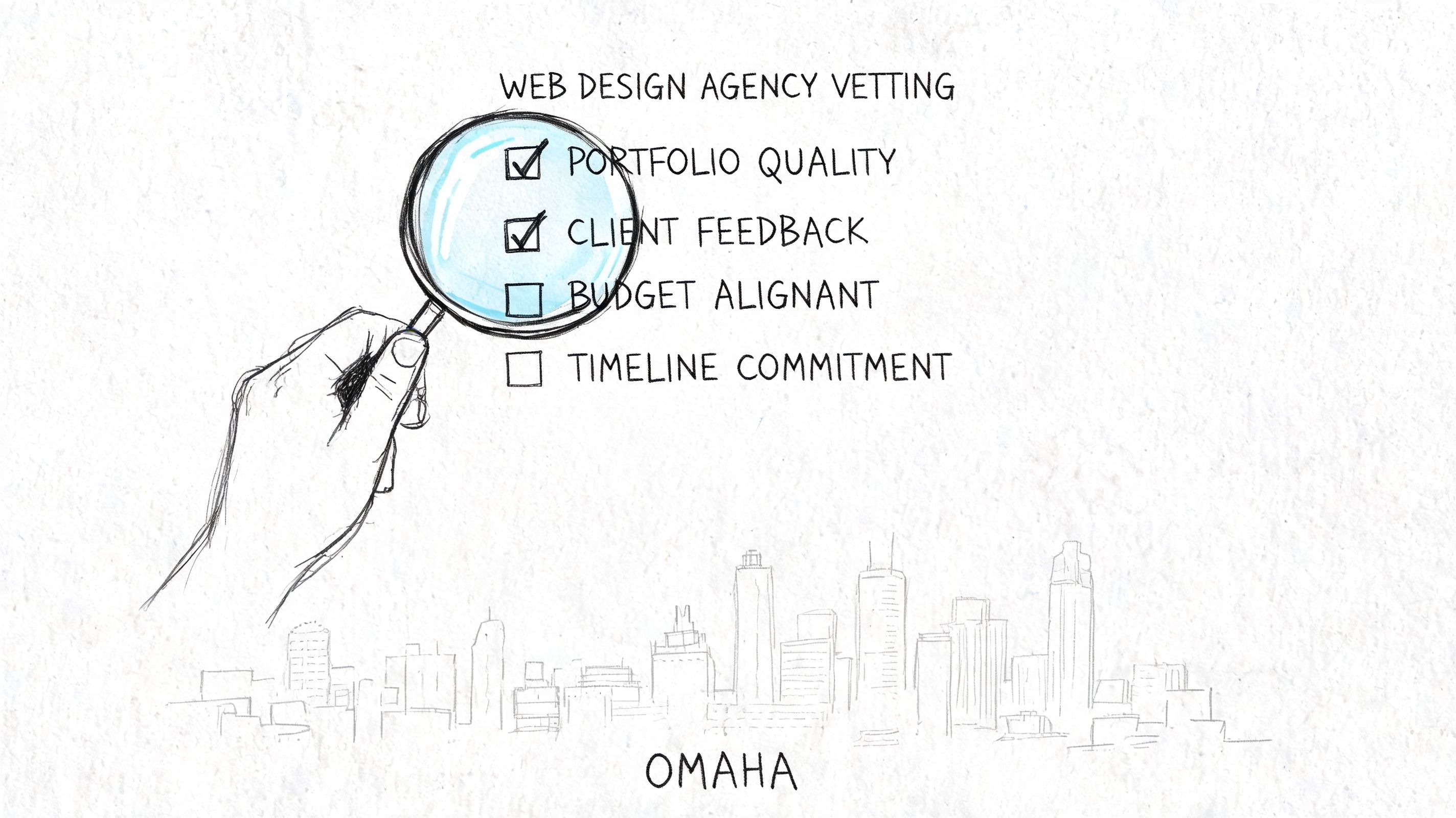
The agency you hire will shape more than the final design. They'll influence scope, technology choices, launch quality, reporting, and how confidently your team can run the store afterward.
That's why the selection process should feel more like hiring a strategic partner than buying a creative service.
What to ask before signing
A polished portfolio isn't enough. Ask direct questions that reveal how the team works:
- Can you show relevant complexity: not just attractive stores, but projects with similar integrations, catalog structures, or user flows?
- How do you handle discovery: do they start with goals, customer behavior, and systems, or jump straight into visuals?
- How do you define success: are they talking about revenue impact, funnel metrics, and operational efficiency, or only aesthetics?
- What happens after launch: will they help analyze user behavior, fix friction points, and support iteration?
- Who is doing the work: is the strategy and engineering handled in-house or passed between layers of subcontractors?
What a good local fit looks like
For Omaha businesses, local context helps. A nearby team can understand your market, your pace of decision-making, and the fact that many SMBs need a site that works as both a sales engine and a marketing engine.
That doesn't mean “local” should outweigh capability. It means the ideal partner combines technical depth with practical business judgment.
A credible agency should be comfortable discussing:
- SEO structure alongside design
- AI or automation where it reduces manual work
- Platform trade-offs without pushing one default solution
- Training and ownership after launch
If you're reviewing local options, look closely at agencies that handle e-commerce web development services as part of a broader digital strategy rather than treating the store as an isolated design project.
The right agency doesn't just ask what pages you need. They ask what the business needs the site to accomplish.
Start Your E-commerce Growth Story Today
If your current store feels rigid, hard to market, or harder to scale each quarter, the issue probably isn't effort. It's architecture.
A custom e-commerce website design gives you control over the pieces that affect growth: customer flow, brand credibility, search visibility, performance, integrations, and conversion efficiency. That's why serious businesses eventually outgrow the “good enough” phase of template-based selling.
For Omaha companies, this decision is often less about chasing something flashy and more about removing friction. You want a site your team can manage, a storefront your customers trust, and a platform that can support the next stage of the business without another patchwork rebuild.
The best next step isn't guessing. It's a focused conversation about where your current site is leaking opportunity and what a better system should do.
If you're evaluating a redesign or a rebuild, talk through the business side first. Clarify the goals, map the constraints, and decide whether a custom approach makes financial sense for your catalog, operations, and growth plan. That's the point where smart e-commerce projects start.
Frequently Asked Questions About Custom E-commerce
What's the difference between a custom design and a premium theme
A premium theme gives you a prebuilt structure with some flexibility around layout, styling, and content blocks. A custom design starts with your business goals, customer journey, and operational requirements, then builds the experience around those needs.
The gap becomes obvious when you need unusual category logic, deeper integrations, custom landing pages, or a different purchase flow for certain products.
Will I still be able to manage the site myself
Yes, if the project is built correctly.
A good custom implementation should make day-to-day work easier, not harder. Your team should be able to update products, publish content, run promotions, and manage merchandising without opening a development ticket for every small change. That's partly a platform decision and partly a CMS setup decision.
How hard is it to migrate products and customer data
Migration takes planning, but it's manageable when handled early in the project.
The main work is mapping data fields, cleaning inconsistencies, preserving critical URLs, and testing the imported content before launch. The more custom your current setup is, the more attention this phase needs. It's not just a technical transfer. It's also a quality-control process.
What does ongoing maintenance usually include
Most stores need a mix of technical upkeep and growth work.
That often includes platform updates, app or integration monitoring, bug fixes, QA after changes, analytics review, and iterative UX improvements. For stores investing in SEO or campaign landing pages, maintenance also includes keeping content workflows clean and templates flexible.
Can a custom site support regional or international growth
Yes, and this is one of the more overlooked advantages.
Using modular frameworks, teams can build geo-targeted landing pages much more efficiently, reducing development time by as much as 10x as cross-border e-commerce sales grow over 25% year-over-year, according to Splitbase's e-commerce redesign analysis. For a business expanding beyond Omaha or Nebraska, that matters because region-specific pages can support localized messaging, currencies, product availability, and compliance needs without forcing a bloated one-size-fits-all storefront.
How much say will I have during the project
You should have a lot of say on goals, priorities, brand direction, and business rules.
You shouldn't have to guess your way through technical decisions alone. A strong agency guides the process, explains trade-offs clearly, and gives you structured approval points so the project keeps moving without losing alignment.
If you're ready to talk through what a custom e-commerce website design could look like for your business, schedule a conversation with Up North Media. A no-pressure review can help you clarify the opportunity, the trade-offs, and the smartest next step for growth.