
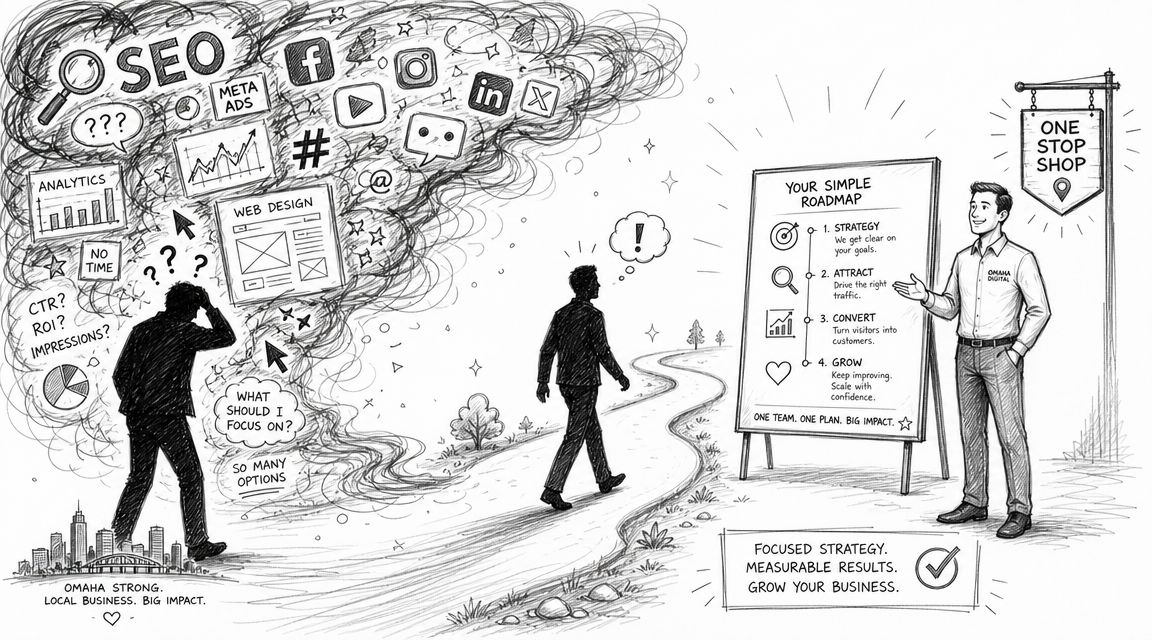
If you're running an Omaha business right now, this probably feels familiar. Your website looks dated, your Google visibility is inconsistent, your branding doesn't match from one channel to the next, and every vendor you talk to seems to solve only one slice of the problem.
That's where many SMB owners get stuck. You don't need five separate specialists who all speak different languages. You need one team that can understand the business, map the customer journey, build the right assets, and keep everything moving without constant handoffs.
The One-Stop Shop for Your Digital Growth
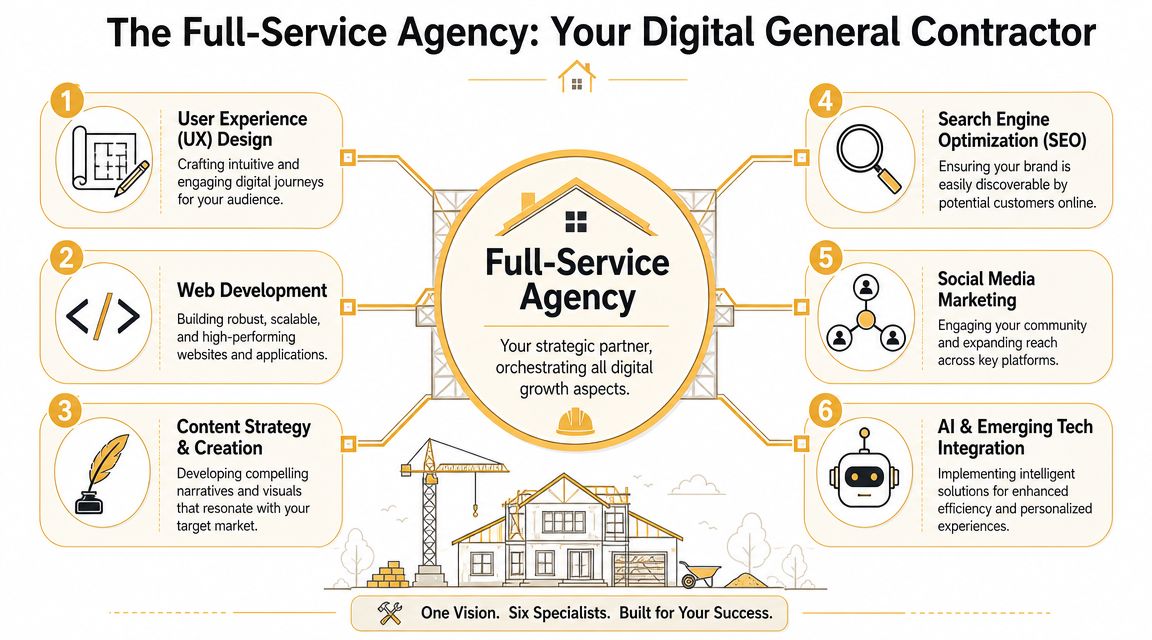
A full service design agency is the digital version of a general contractor. Instead of hiring one person for branding, another for UX, a developer for the site, and someone else for SEO, you hire a team that coordinates the whole job.
For Omaha SMBs, that matters more than people think. Most businesses here don't have time to manage a fragmented marketing stack. They need a practical plan, a realistic budget, and a partner who can connect strategy to execution.
Why this model keeps growing
This isn't a niche category anymore. The global design agency market is projected to grow from USD 3.2 billion in 2026 to USD 5.1 billion by 2035 according to Research Nester's design agency market forecast. That projection points to something buyers already feel in practice. Businesses increasingly want one partner that can handle strategy, branding, digital design, and delivery under one roof.
That growth also reflects a basic business reality. Customers don't experience your company in departments. They experience one brand, one buying process, one website, one support flow.
What Omaha owners usually need first
Most local businesses don't start by asking for “service design” or “digital transformation.” They start with more grounded problems:
- Leads are inconsistent. The site gets traffic, but not enough calls, form fills, or booked appointments.
- The brand feels uneven. Your trucks, storefront, social pages, proposals, and website don't look like they belong to the same company.
- Technology is slowing staff down. Internal tools, forms, or customer workflows create extra admin work.
- Growth decisions feel reactive. You're making one-off fixes instead of working from a roadmap.
Practical rule: If you're solving one digital problem every quarter with a different vendor, you probably don't have a vendor problem. You have a coordination problem.
A good full service agency fixes that by tying together the moving parts. The right partner doesn't just make things look better. They help you decide what to build, what to ignore, and what has to happen first so your budget does useful work.
Decoding the Service Menu from UX to AI
A lot of agency websites make their services sound abstract. For a business owner, the better way to think about it is this: a full service agency builds your digital house. Strategy is the plan. UX is the floorplan. Development is the framing. Branding is the curb appeal. SEO brings people to the front door. Analytics tells you where visitors get stuck. AI can automate the repetitive work inside.
The value comes from having one crew manage the whole project instead of passing it between disconnected trades.
The core services that matter most
A full-service agency's workflow often combines user research, interaction design, visual design, site mapping, and user testing in one process, which reduces the friction that shows up when work gets handed between separate teams, as explained in Eleken's overview of how full-service design agencies operate.
Here's what that means in plain English.
| Service | What it is | Why you need it |
|---|---|---|
| UX design | The structure of how people move through your website, app, or tool | It reduces confusion and helps more people complete the action you want |
| UI and visual design | The look and feel of the interface | It builds trust and makes the experience easier to use |
| Web development | The code and technical build behind the site or app | It turns strategy into something stable, fast, and usable |
| Branding | Your visual identity, voice, and positioning | It helps customers recognize you and remember why you're different |
| SEO | The work that improves your visibility in search | It helps qualified buyers find you when they're already looking |
| Content strategy | The messaging, page structure, and information users need | It prevents weak copy from undermining strong design |
| Analytics | Measurement across site behavior, leads, and funnel performance | It shows what's working and what's leaking |
| AI integration | Automation, assistants, and workflow support | It removes manual steps and can improve response speed |
What each service solves in the real world
A local roofing company may think it needs “a new website.” Sometimes it needs clearer service pages, stronger calls to action, better local search visibility, and a simpler quote request flow.
A clinic may ask for “better branding.” The larger issue might be inconsistent patient touchpoints, confusing navigation, and intake friction.
A manufacturer might want “AI.” In practice, that can mean automating repetitive inquiry handling, improving internal search, or cleaning up lead routing so sales staff stop wasting time.
For many Omaha businesses, the right answer isn't one service. It's the combination.
UX and research are where good work starts
Many owners still think UX means making things pretty. It doesn't. UX is about reducing hesitation, dead ends, and unnecessary effort. If you want a clearer baseline, this primer on what user experience design means in practice gives the concept a straightforward business lens.
A strong agency will ask questions like:
- Who is the primary buyer?
- What action matters most on each page?
- Where do users drop off right now?
- What objections stop them from converting?
- What has to be fast, simple, or self-serve?
Good design work starts with behavior, not color palettes.
Where AI fits and where it doesn't
AI belongs in the service menu, but it shouldn't be treated like a shortcut button. It works well when a business already understands its workflow and wants to automate repetitive steps, support internal teams, or personalize parts of the customer experience.
It does not replace research, positioning, or clear systems. If the agency can't explain the business problem first, “AI integration” is just decorative packaging.
Why a Single Partner Beats Juggling Freelancers
Hiring separate freelancers can work for narrow tasks. A logo refresh, a landing page build, a one-time dev sprint. But once the project touches brand, messaging, customer journey, technology, and marketing performance at the same time, fragmentation gets expensive fast.
The issue isn't talent. Plenty of freelancers are excellent. The issue is coordination.
The hidden cost of handoffs
Every handoff creates risk. The strategist writes a brief. The designer interprets it. The developer rebuilds it. The SEO consultant joins later and asks for structural changes. The copywriter rewrites headlines after layouts are approved. You spend time paying people to wait on each other, revise each other's work, and solve problems that started upstream.
That's why integrated teams tend to make better decisions earlier. They're solving the same business problem from different angles at the same time.
A single partner also gives you one operating rhythm. One roadmap. One shared set of priorities. One group that can say, “No, don't spend money there yet. Fix this first.”
Design maturity affects business performance
This isn't just a workflow preference. McKinsey found that companies in the top quartile of its Design Maturity Index achieved 32 percentage points higher revenue growth over a five-year period than industry peers, as reported in McKinsey's research on the business value of design.
That finding matters for SMBs because it points to the larger pattern. Companies that treat design as an integrated business discipline tend to outperform companies that treat it as surface-level production work.
When design, research, and execution live in separate silos, the client usually becomes the project manager. That's rarely a good use of an owner's time.
Where integrated work matters most
The biggest gains often show up in businesses with more operational complexity. In sectors like healthcare, finance, business services, and the public sector, the highest-value work is often end-to-end orchestration of customer and employee touchpoints, with front-stage experience aligned to back-stage operations, as described by Highland's service design practice.
You don't have to run a hospital or bank to feel this. A local home services company has front-of-house and back-of-house issues too. The website promises fast scheduling, but dispatch is manual. The intake form collects weak information, so staff have to call back. The CRM tags are messy, so follow-up slips.
A full service agency can see those dependencies. A disconnected set of specialists usually won't.
When a subscription model makes sense
There is a fair counterpoint. If your company already has strategy, brand direction, and core systems in place, a subscription or outsourced design model can be efficient for ongoing production. It can be a good fit for recurring ad creatives, routine landing pages, sales collateral, or design throughput.
But that model is usually weaker when you need deep discovery, structural redesign, internal alignment, or business model-level decision support. If the challenge is execution volume, subscription can work. If the challenge is figuring out what to build and why, a full-service partner is usually the safer choice.
Understanding Agency Pricing and Project Timelines
Most SMB owners ask two questions early. What will this cost, and how long will it take? Fair questions. The honest answer is that both depend on scope clarity, internal responsiveness, and how much discovery is needed before production starts.
What matters more than a cheap quote is whether the pricing model matches the job.
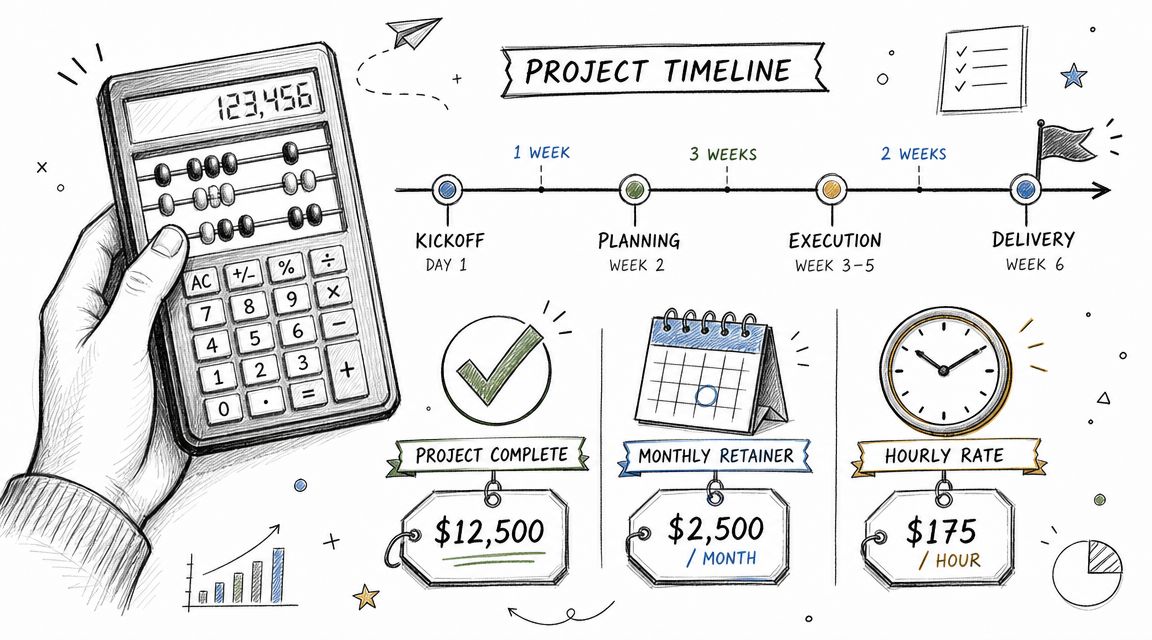
The three pricing models you'll see most
| Model | Best for | What to watch |
|---|---|---|
| Project-based | Defined website builds, brand packages, audits, app features | Scope creep can trigger change orders if goals shift |
| Monthly retainer | Ongoing SEO, design support, CRO, content, fractional strategy | Weak retainers become task buckets with no strategic priorities |
| Value-based | High-impact work where business upside is clear | Requires trust, strong discovery, and a mature buyer on both sides |
Project pricing works when the deliverables are clear. If you need a new site, a brand system, or a defined redesign, it can keep budgeting simple.
Retainers work when you need momentum over time. SEO, conversion improvements, content, and iterative product work usually perform better when they're not boxed into a one-time engagement.
Value-based pricing is less common with SMBs, but it can make sense when the agency is solving a costly business bottleneck and both sides agree on what success looks like.
Typical timelines for common SMB work
Without inventing fake precision, these are realistic planning ranges most businesses should expect:
- Basic brochure-style website. Often measured in weeks, not days.
- Custom website with deeper messaging, SEO structure, and content support. Usually takes longer because approvals, content gathering, and revisions matter.
- E-commerce build. Typically longer than a standard site because products, collections, checkout flows, integrations, and QA add complexity.
- Local SEO campaign. Usually needs a few months before patterns become clear.
- Brand identity plus website. Often runs longer than owners expect because positioning decisions slow things down more than design production does.
- Custom web app or internal workflow tool. Usually requires staged delivery, not one giant launch.
Budget warning: The cheapest timeline in a proposal often assumes you'll approve quickly, deliver content on time, and avoid changing direction midway.
What slows projects down
The agency isn't always the bottleneck. In SMB work, delays often come from inside the client team.
Common timeline killers include:
- Unclear decision ownership. Too many stakeholders, no final approver.
- Late content delivery. Missing service descriptions, bios, photos, pricing, or FAQs.
- Mid-project strategy changes. Rewriting the offer after design starts.
- Tool sprawl. New platforms introduced halfway through the build.
- Approval drift. Feedback arrives in fragments instead of one clear round.
A good agency will help control that by setting milestones, owner responsibilities, and revision windows early.
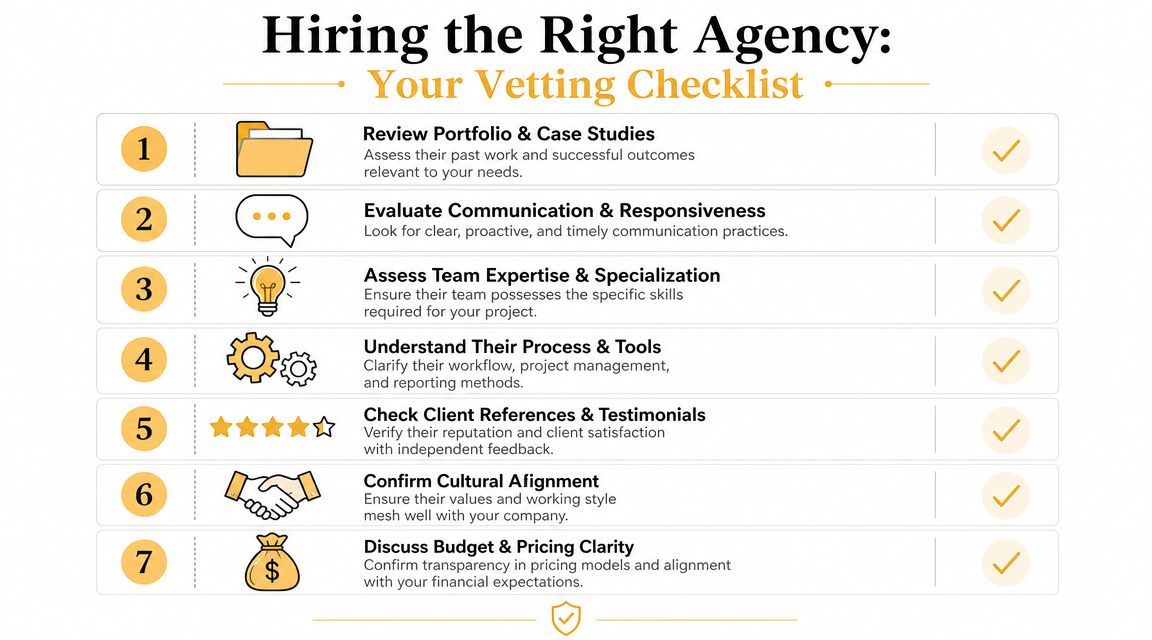
Your Vetting Checklist for Hiring the Right Agency
A polished portfolio can fool a lot of buyers. Good visuals matter, but they don't tell you whether the agency can diagnose the right problem, manage a project well, or work like a partner instead of an order-taker.
Use a checklist. It keeps you from buying on charm.
Questions that separate strong agencies from slick sales teams
Start with the process, not the pitch.
-
How do you approach research before design starts?
This is a big one. McKinsey found that about 50% of surveyed companies did not conduct user research before creating their first design ideas or specifications. In practice, that's a warning sign. If an agency jumps straight into mockups without asking how customers behave, what staff struggles with, or where conversion friction lives, you should be cautious. -
Who will do the work? Ask whether senior people stay involved after the sale. Some firms pitch with strategists and execute with junior generalists. That's not always bad, but you should know the delivery model.
-
How do you define success?
Listen for business language. Good agencies talk about lead quality, conversion paths, user behavior, sales enablement, workflow efficiency, and content clarity. Weak ones talk mostly about aesthetics.
Here's a useful companion piece on how to choose a digital marketing agency if you want a broader screening framework beyond design alone.
What to look for in a portfolio
A serious portfolio should answer more than “Does this look good?”
Look for these signals:
- Relevant complexity. Have they solved problems like yours, or only shown polished visuals for unrelated brands?
- Decision logic. Do case studies explain why choices were made?
- Before-and-after thinking. Can they identify the original business problem clearly?
- Cross-functional depth. Branding, UX, content, dev, and SEO should connect if they claim full-service capability.
Don't hire an agency because they made a restaurant website look stylish if you need a lead-generation engine for a service business.
Communication standards matter
A bad communication model can ruin a good strategy. Ask direct questions.
- How often will we meet?
- Where do tasks, files, and approvals live?
- Who owns project management?
- How do you handle feedback rounds?
- What happens if priorities change?
You should leave the conversation knowing whether they use a clear system, whether they can lead a meeting, and whether they can translate technical work into business language.
The video below gives another useful lens for evaluating agency fit and expectations.
A short hiring scorecard
| Area | Green flag | Red flag |
|---|---|---|
| Research | Asks about users, buyers, and workflows before proposing design | Starts with mockups and trends |
| Process | Clear phases, owners, deliverables, and approvals | Vague “we'll handle it” language |
| Team | You meet the people doing the work | Delivery team appears late or stays unclear |
| Communication | Defined cadence and tools | Email chaos and ad hoc updates |
| Strategy | Connects design to revenue, operations, or growth | Talks only about visuals |
If an agency can't explain how they think, they probably can't guide a complex project.
Success Stories What Agency Partnerships Deliver
Real agency work usually looks less dramatic than marketing copy and more practical than people expect. A business has a blockage. The blockage touches more than one department. The agency's value comes from solving the system, not just the surface.
Three common SMB scenarios
A local clinic has a trust problem online.
Patients can't quickly find services, insurance information is buried, and the intake process creates extra calls for staff. A full-service partner redesigns the navigation, rewrites key service pages, streamlines forms, and aligns the front-end experience with the operational realities behind scheduling and intake. In a healthcare setting, that end-to-end orchestration is often where the biggest gains happen.
A B2B service firm looks established offline but weak online.
The company has referrals and a solid reputation, but the website undersells the team and confuses first-time visitors. The agency sharpens positioning, rebuilds the site architecture, improves visual credibility, and creates a content structure that supports search visibility and sales conversations. The result is usually better lead quality, not just more traffic.
An e-commerce brand keeps patching instead of building.
Product pages, email creative, offers, and paid landing pages all evolved separately. Conversion issues show up everywhere, but no one owns the full journey. An integrated team can step back, clean up the brand system, improve product discovery, tighten page messaging, and coordinate design with technical fixes so the experience feels coherent again.
Why the combined model matters
These stories share one pattern. The problem wasn't isolated.
It's easy to hire someone to redesign a page. It's harder to connect that page to operations, sales, support, and customer expectations. That's why full service design agencies tend to deliver the most value in businesses with layered touchpoints, especially when the customer experience on the surface has to match the operational process behind it.
The strongest agency outcomes usually come from alignment. The site promises one thing, staff can deliver it, and the systems underneath support it.
That's what clients are really buying. Not just design files. A more coordinated business experience.
Finding Your Agency Partner in Omaha
Working with a local partner changes the relationship. You're not just buying production hours. You're working with a team that understands the market, can meet face to face, and has context for how Omaha businesses grow.
That local context matters more than people admit. An Omaha HVAC company, law firm, dental group, or regional retailer doesn't need the same strategy as a venture-backed tech brand in a major coastal market. The buying cycle, trust signals, competition, and budget expectations are different.
What a local agency should understand
A good Omaha partner should understand:
- Local search intent and how people look for services nearby
- Regional competition that may be strong offline but weak digitally
- SMB operating realities, including lean teams and limited owner time
- The value of direct collaboration, especially when projects affect sales and operations
If you're comparing options, this overview of an Omaha digital marketing agency gives a local frame for what to expect from a nearby partner.
For businesses that need one team across web development, SEO, and AI consulting, Up North Media is one Omaha-based option in this category. The firm focuses on custom web applications, data-driven SEO marketing, and AI consulting for businesses that need digital execution tied to practical growth goals.
The right fit still comes down to your situation. If you need ongoing design throughput, a subscription model might be enough. If you need strategy, UX, development, SEO, and operational thinking to work together, a full-service partner is usually the better call.
If you're sorting through website issues, SEO gaps, branding inconsistencies, or AI opportunities and want a practical outside view, Up North Media offers a free consultation to talk through your goals, constraints, and next steps.