
Before you even think about a website or a social media post, you need a plan. Building an online presence that actually works starts with three core questions: What are my goals? Who am I talking to? And what is the competition doing?
Getting this foundation right from the start means every action you take is strategic. It’s the difference between throwing money at random tactics and making intentional moves that drive real business results.
Your Digital Foundation: Auditing Your Starting Point
Jumping straight into building a website without a blueprint is a recipe for disaster. Your efforts will be scattered, and you'll end up with a digital presence that feels disconnected and ineffective.
Think of this initial audit like drawing the architectural plans for a house. It dictates the structure, purpose, and ultimate success of everything you build on top of it. This process starts with getting really clear on what you’re trying to achieve. Vague goals like "get more customers" just don't cut it. You need sharp, measurable objectives.
Define Your Business Goals
You have to turn those fuzzy ambitions into a concrete roadmap with specific, quantifiable goals. Are you trying to boost online sales by 20% this quarter? Or is the goal to generate 50 qualified leads a month through your website? Maybe you just want to become the go-to expert in your local market.
A well-defined goal is the compass for your entire digital strategy. It tells you which platforms to use, what kind of content to create, and how to measure success. This ensures every dollar and hour you invest is pushing you in the right direction.
The trick is to tie your goals directly to business outcomes, not just vanity metrics like followers or likes.
Pinpoint Your Ideal Audience
Once you know what you want, you need to know who you're talking to. Before you do anything else online, you have to nail down the importance of defining your target audience. You need to go deeper than just basic demographics like age and location. What are their real pain points? What actually motivates them to buy something? Where do they hang out online?
Creating detailed buyer personas is how you step into your customers' shoes. Our guide gives you a complete walkthrough on how to create buyer personas that feel like real people. This deep understanding is what allows you to craft messages and content that genuinely connect.
This flow chart breaks down the core steps for getting your digital foundation right.
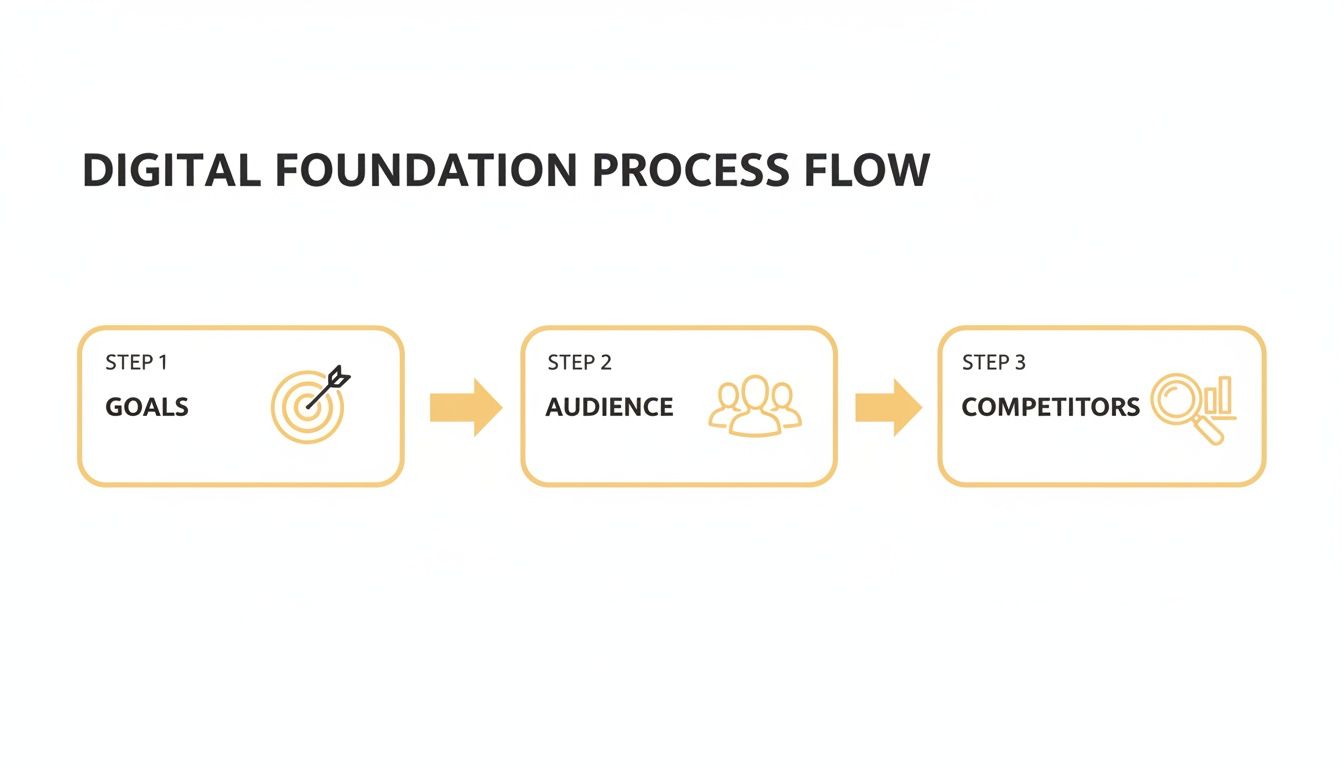
As you can see, it's a logical progression: start with your goals, figure out your audience, and then see what the competition is up to.
Analyze Your Competitors
Finally, it’s time to size up the competition. Take a hard look at what they’re doing online. What are they absolutely nailing? More importantly, where are they dropping the ball?
A solid competitive analysis can uncover some serious opportunities—from keywords they’re completely ignoring to content gaps you can swoop in and fill. This isn't about copying them. It's about learning from their wins and losses to carve out your own unique space in the market.
With clear goals, a deep audience understanding, and solid competitive insights, you’re ready to start building with purpose.
Building Your Website: The Hub of Your Digital World
Every single interaction you have online—whether it's on social media, in an email, or through a local directory—should point back to one central spot: your website. Think of it as your digital headquarters. It’s the one piece of online real estate you completely own and control, free from the whims of changing social media algorithms.
If you think a website is optional, think again. A shocking 56% of consumers won't even consider a business that doesn't have one. Your site isn't just an online business card; it's a powerful machine for building credibility, capturing leads, and driving sales. It’s where your audience goes to really understand who you are and what you offer. Getting this foundation right is non-negotiable.
Choosing the Right Website Platform
The first big decision you'll make is picking the platform to build your website on. This choice ripples through everything from your site's flexibility and cost to how much time you'll spend managing it. You're not just picking software; you're choosing the engine that will power your entire digital world.
There’s a platform out there for every skill level and business need:
- WordPress: The undisputed heavyweight, powering over 43% of all websites. Its superpower is its immense flexibility. With thousands of themes and plugins, you can build practically anything from a simple blog to a complex e-commerce or membership site.
- Shopify: If your main game is selling products online, Shopify is the gold standard. It’s an all-in-one e-commerce solution that handles everything from product pages and payment processing to inventory management. It’s incredibly powerful for retailers.
- Squarespace & Wix: These platforms are famous for their user-friendly, drag-and-drop builders and beautiful templates. They are fantastic options for service-based businesses, portfolios, and anyone who values design simplicity and doesn't want to touch a line of code.
Making this call can feel overwhelming, I get it. To help you sort through the options, we put together a detailed comparison that breaks down the pros and cons of Wix vs Squarespace vs WordPress so you can pick the best fit for your specific goals.
Choosing a website platform is a critical first step. Each has its own strengths tailored to different business needs, from e-commerce powerhouses to user-friendly builders for service businesses.
Core Website Platform Comparison
| Platform | Best For | Ease of Use | SEO Capabilities | Cost |
|---|---|---|---|---|
| WordPress | Ultimate flexibility, blogs, complex sites | Moderate learning curve | Excellent, highly customizable | Varies (hosting + plugins) |
| Shopify | E-commerce businesses of all sizes | Very user-friendly | Good, built-in tools | Monthly subscription + fees |
| Squarespace | Portfolios, service businesses, designers | Very user-friendly | Good, but less control | Monthly subscription |
| Wix | Small businesses, beginners, visual design | Easiest to use | Good, improving steadily | Freemium, paid plans |
Ultimately, the best platform is the one that aligns with your technical comfort, budget, and long-term business ambitions.
Designing for a Seamless User Experience
Have you ever landed on a website that was confusing, slow, or just plain frustrating to use? You probably left within seconds. That's your future customer if you get this wrong. Research shows that 75% of people judge a business's credibility based purely on its website design.
A poor user experience (UX) doesn't just annoy visitors; it actively drives them away and tells them you don't care about their time.
Your website design should be an invisible guide, effortlessly leading visitors from their first click to their final conversion. The best UX feels so natural that the user doesn't even notice the design—they just accomplish their goal.
Focus on creating an intuitive journey. This means a crystal-clear navigation menu, easy-to-read fonts, and strategically placed call-to-action (CTA) buttons that tell visitors exactly what to do next. "Buy Now," "Learn More," "Get a Quote"—make it obvious.
And it absolutely must be responsive. That means it looks and works perfectly on desktops, tablets, and mobile phones, since that's where most of your traffic will come from.
Optimizing for On-Page SEO
A beautiful website is useless if no one can find it. This is where on-page Search Engine Optimization (SEO) comes in. It’s the practice of optimizing individual web pages to rank higher in search engines and pull in more of the right kind of traffic.
Here are the on-page SEO fundamentals you need to nail from day one:
- Keyword-Optimized Titles & Headings: Every single page needs a unique title tag and H1 heading that includes its primary target keyword. This is the first thing Google looks at to understand what your page is about.
- Compelling Copywriting: Your content has to do more than just stuff in keywords. It must be engaging, informative, and written for your actual human audience, answering their questions and solving their problems.
- Wicked-Fast Page Speed: Site speed is a massive ranking factor. A slow-loading site leads to a higher bounce rate and lower rankings. Use tools to compress images and streamline code to ensure your pages load in under three seconds. Seriously.
By focusing on these three pillars—the right platform, a user-centric design, and solid on-page SEO—you’re not just building a website. You’re creating a powerful hub that attracts visitors and, more importantly, converts them into loyal customers.
Gaining Visibility with SEO and Content Marketing
 Your website might be the heart of your online presence, but a brilliant headquarters is pretty useless if nobody has the address. This is where Search Engine Optimization (SEO) and content marketing come in. They work together to put you on the map, turning your site from a lonely outpost into a bustling hub of activity.
Without a clear game plan to bring people in, even the most beautifully designed website will just sit there, failing to deliver any real results.
Let's be honest: showing up in search results isn't just a "nice-to-have" anymore—it's how businesses get discovered. For most companies, search engines drive the lion's share of website traffic, making SEO a non-negotiable investment. Buyers depend on a company's digital footprint to make decisions; in fact, 97% of consumers check a company’s online presence before visiting. Poor visibility can hit your bottom line, hard. You can find more of these eye-opening digital marketing statistics on seo.com.
Uncovering What Your Audience Is Searching For
The whole process kicks off with understanding the exact words and phrases your ideal customers are typing into Google. We call this keyword research, and it’s really about getting inside your audience's head to meet them right where they are. You have to think beyond your own industry jargon and focus on the real-world problems your customers are trying to solve.
A plumber, for instance, might assume people search for "HVAC repair services." And sure, some do. But way more people are probably searching for things like "why is my AC making a loud noise" or "furnace not turning on in winter." These problem-focused, longer phrases are called long-tail keywords, and they are absolute gold. They signal much stronger intent and usually have less competition, making them easier to rank for.
Don't just guess what your audience wants to know. Use actual tools to find the real questions they're asking, the problems they need solved, and the exact language they use to describe them. This data-driven approach is the bedrock of a successful content strategy.
Building a Content Strategy That Delivers Value
Once you're armed with your keywords, it’s time to create content that genuinely helps your audience. Content marketing isn't about churning out generic blog posts just for the sake of it. It’s about establishing yourself as a trusted authority by consistently providing real value. That’s how you build an online presence that actually lasts.
Your content plan should be a healthy mix of formats designed to engage different people at various stages of their journey.
- Informative Blog Posts: These are your workhorses. Write articles that directly answer the long-tail keyword questions you found. A real estate agent, for example, could write a post titled "A First-Time Homebuyer's Checklist for Closing Day."
- In-Depth Guides: Think bigger. Longer, more comprehensive pieces like "The Ultimate Guide to Staging Your Home for a Quick Sale" can become cornerstone assets that attract links and establish some serious authority.
- Engaging Videos: Create short, helpful videos for social media or longer tutorials for YouTube. A local bakery could make a quick video showing "How to Perfectly Frost a Cupcake in Under 60 Seconds."
A well-defined content marketing plan is just as important as your SEO work. If you need some help getting started, here’s a great guide to develop a comprehensive content marketing strategy that aligns with your business goals.
Earning Authority with Backlinks
In the world of SEO, backlinks are basically votes of confidence from other websites. When a reputable site links to your content, it sends a strong signal to search engines that your page is a valuable and trustworthy resource. This can give your rankings a significant boost. Just remember, quality always trumps quantity here.
A single backlink from an authoritative industry publication is worth more than hundreds of links from low-quality, spammy sites. Proactively earning these high-quality links is a huge part of building your online presence.
Effective Link-Building Tactics
- Guest Blogging: Write a high-quality article for another website in your niche. In return, you'll typically get a link back to your own site in the author bio.
- Creating Linkable Assets: Develop original research, in-depth guides, or free tools that people will naturally want to reference and link to in their own content.
- Digital PR: Share your unique data, expert insights, or compelling stories with journalists and bloggers who cover your industry.
Of course, effective content creation goes way beyond just writing. For more actionable advice, check out our in-depth guide covering essential SEO content writing tips.
By combining deep keyword research with a commitment to creating genuinely helpful content and a proactive strategy for earning authoritative backlinks, you build a powerful engine for visibility. This approach doesn't just attract traffic; it attracts the right traffic and builds the trust you need to turn visitors into loyal customers.
Engaging Your Audience on Social Media

Think of social media as less of a digital billboard and more of a virtual town square. It’s where your brand’s personality can really shine, but only if you show up to have a real conversation. Just blasting out company updates won't move the needle.
To make any real impact, you have to shift your mindset from broadcasting to community building. The goal isn't just to rack up followers; it's to turn passive scrollers into genuine brand advocates.
Choose Your Platforms Wisely
One of the biggest mistakes I see businesses make is trying to be everywhere at once. It's a recipe for burnout and a weak, inconsistent presence. A much smarter move is to pick one or two channels where your ideal customers actually hang out and go all-in there.
Don't just guess where they are. Do the legwork.
- For B2B service providers, LinkedIn is almost always the answer. It’s the digital watering hole for professionals looking to connect and share industry knowledge.
- For consumer brands with strong visuals—think clothing, home goods, or food—you absolutely need to be on Instagram and Pinterest.
- If you’re targeting a younger crowd and can create content that feels authentic and fun, TikTok has insane organic reach.
It's always better to master a couple of key channels than to have a mediocre presence on five or six. Focus your energy where it counts.
Craft a Compelling Content Mix
Your social media feed can't just be an endless parade of sales pitches. A solid content strategy mixes things up to keep your audience hooked, provide real value, and gently nudge them toward your business. You want to entertain, educate, and inspire.
A balanced content calendar could look something like this:
- Valuable Insights (40%): Post tips, how-to guides, and industry news that solve a real problem for your audience. A financial advisor could share a quick video on "Three Common Budgeting Mistakes."
- Behind-the-Scenes (20%): People want to connect with other people, not a faceless logo. Show the human side of your brand with team intros or a peek at how your product is made.
- Interactive Posts (20%): Get the conversation started with questions, polls, and quizzes. This drives engagement and gives you instant feedback from your community.
- Promotional Content (20%): This is where you can finally talk about your offers. Since you've already built trust by providing value, these posts will land much more effectively.
This mix ensures you're consistently useful, which is the secret to keeping people coming back for more.
Embrace the Power of Short-Form Video
How people find and connect with brands has totally changed, and short-form video is at the center of it all. There are an estimated 5.42–5.66 billion social media users worldwide, and their habits are clear. Surveys show a whopping 78% of people would rather learn about new products from a short video.
And marketers are listening—93% plan to increase their investment in social marketing to keep up. If you want to dig into the numbers, check out these insightful social media statistics at sproutsocial.com.
Short-form video isn't a trend anymore; it's a core part of building a modern online presence. Platforms like Instagram Reels and TikTok are built to push this format, giving you a huge advantage for organic reach.
Don't overthink production. You don't need a Hollywood budget. Authenticity and value are what truly matter. Just grab your phone and record a quick tip, a product demo, or a customer testimonial. The goal is to be real.
Scaling Your Reach with Email and Paid Ads

Organic growth from SEO and social media is fantastic, but let's be honest—it’s a long game. When you’re ready to really hit the accelerator, pairing your organic efforts with paid channels and direct communication is how you truly scale.
This is the shift from waiting for people to find you to actively putting your message right in front of them. It's about making smart investments to amplify your reach, drive traffic now, and build relationships on your own turf.
Your Most Valuable Asset? An Email List
I'm going to say something that might sound old-school: your email list is arguably the single most important digital asset you can own. Think about it. Your social media following is rented land, completely at the mercy of algorithm changes. Your email list, on the other hand, is a direct line to your audience that you control completely.
The engagement numbers for email are just staggering. A social media post might get seen by a tiny fraction of your followers, but 99% of email users check their inbox every single day. That's a level of attention other channels can only dream of.
Your email list is your brand’s private club. It's where you nurture leads, build real relationships, and drive repeat business without paying for every single interaction. It’s the foundation of a resilient online presence.
You should be building this list from day one. The easiest way is to offer something valuable in exchange for an email address—a discount, a useful checklist, or an exclusive guide. Sprinkle these sign-up forms everywhere on your website: in the header, at the end of every blog post, and even as a pop-up.
Set Up an Email Nurture Sequence
Once someone subscribes, the real work begins. Don't just let them sit there collecting digital dust. Guide them with an automated series of emails, often called a nurture sequence, that welcomes them to your world and immediately provides value.
Here's a simple but incredibly effective three-part welcome sequence you can set up:
- The Welcome Email: This goes out immediately after they sign up. It delivers whatever you promised and gives them a warm welcome. Briefly introduce your brand's mission and let them know what kind of content to expect from you.
- The Value Email: A few days later, send an email that’s pure value with no sales pitch. This could be your most popular blog post, a helpful video tutorial, or a quick tip that solves a common problem for your audience. You're building trust here.
- The Soft-Sell Email: In the third email, you can gently introduce one of your core products or services. Frame it as the solution to the problems you've been discussing, and maybe even include a small introductory offer to sweeten the deal.
This automated sequence is your 24/7 salesperson, working in the background to turn new subscribers into engaged prospects.
Getting Started with Paid Ads
Paid advertising on platforms like Google Ads and Meta (Facebook and Instagram) is the fastest way to get your brand in front of a hyper-targeted audience. While SEO can take months to gain traction, a well-run ad campaign can start driving traffic to your site within hours.
The key is to start small and have a crystal-clear objective. Are you trying to generate leads? Sell a product? Or just get your name out there? Your goal dictates the entire campaign.
Choosing the Right Ad Platform
This is where a lot of people get tripped up, but it’s pretty straightforward.
- Google Ads: This is where you capture high-intent users—people who are actively searching for what you offer. If someone types "emergency plumbing service near me" into Google, you want your ad to be the very first thing they see. It's about being the answer when someone has a question.
- Meta Ads (Facebook & Instagram): These platforms are built for demand generation. You're not waiting for them to search; you're introducing your brand to people who fit your ideal customer profile but might not know you exist yet. You can target based on demographics, interests, and online behavior.
Setting a Realistic Budget and Actually Measuring ROI
You don't need a massive budget to get started. Honestly, even $10-$20 per day can give you a ton of valuable data on what messaging and targeting works. The most critical part isn't how much you spend, but how diligently you track your return on investment (ROI).
Before you launch anything, make sure your conversion tracking is set up correctly. You absolutely need to know how many leads or sales each ad generates. This lets you calculate your Customer Acquisition Cost (CAC) and ensure your campaigns are actually making you money, not just costing you.
By combining the direct, relationship-building power of email with the immediate, scalable reach of paid ads, you create a growth engine that’s tough to beat.
Common Questions About Building an Online Presence
When you start digging into how to build an online presence, it's easy to hit a few common roadblocks. Over the years, I've heard the same questions pop up from business owners time and time again. Let's get those out of the way so you can move forward with a clear plan.
How Long Does It Take To Build a Strong Online Presence?
Let's be real: building a meaningful online presence is a marathon, not a sprint. Sure, you can spin up some paid ads and see traffic tomorrow, but creating a sustainable, organic footprint through things like SEO and content is a long game.
You should plan on seeing significant, measurable results from your organic work within 6 to 12 months. The biggest factor here? Consistency.
A steady, dedicated effort—publishing valuable content, showing up on social media, and chipping away at your SEO—will compound over time. Think of it like investing; the early efforts build a foundation for much bigger returns down the road. Of course, your industry's competitiveness and the resources you put in will also speed up or slow down that timeline.
Do I Need To Be on Every Social Media Platform?
Absolutely not. In fact, trying to be everywhere at once is one of the fastest ways to burn out and get mediocre results across the board. The smarter play is to figure out the one to three platforms where your ideal customers actually spend their time and go all-in there.
Don't spread yourself thin across a dozen platforms with a weak presence. Instead, become a master of the few channels that truly matter to your audience. This focused approach delivers much stronger results and a better return on your time.
A B2B consultant will almost certainly find their best leads on LinkedIn, while a brand selling handmade jewelry is going to live and die on Instagram and Pinterest. It's always better to master a few key channels than to be a ghost on ten of them.
What Is the Most Important Metric To Track?
There’s no single magic number that works for every business. The right KPIs (Key Performance Indicators) are tied directly to your goals. The most important thing is to stop obsessing over "vanity metrics" like follower counts or page views. They feel good, but they don't pay the bills.
Instead, you need to track the metrics that connect directly to business outcomes. These are the numbers that prove your online presence is actually making you money.
- Lead Form Submissions: How many people are raising their hand and asking to talk to you?
- Email Sign-ups: Are you building your email list? It's one of the only marketing assets you truly own.
- Direct Sales or Revenue: Is your website turning visitors into paying customers?
- Conversion Rate: What percentage of people who visit your site actually do the thing you want them to do?
While things like brand awareness are important, hard numbers like Customer Acquisition Cost (CAC) and Return on Ad Spend (ROAS) give you a much clearer picture of what's really working.
Can I Build an Online Presence with a Small Budget?
Yes, you absolutely can. But what you save in money, you'll need to invest in time and effort. This "sweat equity" approach means focusing on organic tactics that build a strong foundation without a big ad budget.
Start a blog. It’s an incredible long-term asset that can attract search traffic for years to come. Learning the fundamentals of SEO costs nothing but your time and is the key to getting on the first page of Google.
You can also become an active, helpful voice in relevant online communities or build an authentic following on social media through genuine engagement, not just posting links. Guest posting on other relevant websites is another fantastic, budget-friendly way to earn powerful backlinks and get your name in front of a new audience. Paid channels can definitely speed things up, but a smart organic strategy can build a powerful and sustainable presence all on its own.
Ready to stop guessing and start building a digital presence that drives real revenue? The team at Up North Media specializes in data-driven SEO and custom web development designed to help businesses like yours dominate their market. Schedule your free consultation today!