
Before you can really start fine-tuning your marketing, you have to get a handle on two of the most fundamental pieces of your business: leads and conversions. It sounds basic, but you’d be surprised how many businesses mix them up. A lead is just someone who’s shown some interest in what you do. A conversion is when they actually take the next step you want them to, like buying something. Nailing the difference is the first real step to building a business that actually grows.
Your Business Growth Engine
Think of your business like a high-performance engine. Website traffic is the fuel, and you absolutely need it. But fuel alone doesn't create motion—you need the internal parts to turn that fuel into horsepower. In this picture, leads and conversions are the pistons and gears doing the heavy lifting.
I see a lot of Omaha businesses fall into the same trap. They get excited about a jump in website visitors or a bunch of new social media followers, but their sales numbers stay flat. This is the classic "leaky bucket" problem. You're pouring all this water (traffic) into a bucket riddled with holes (a weak conversion process) and then wondering why it never fills up. A smart strategy isn't about just one metric; it's about making sure the whole system works together.
The Tale of Two Metrics
Here’s a simple way to think about it: a lead is a potential customer raising their hand. Maybe they filled out a contact form on your site, downloaded a free guide you offered, or signed up for your email list. They’ve signaled that they're curious. A conversion is when that raised hand turns into a handshake—a signed deal, a product in their cart, or an appointment officially booked.
The goal isn’t just to collect a long list of names and email addresses. It's to walk interested people from that first flicker of curiosity all the way to a final decision, turning that potential into actual revenue.
If your business has thousands of leads but only a few dozen actual sales, you don’t have a visibility problem; you have an engagement problem. On the flip side, if your conversion rate is sky-high but you only get a trickle of new leads each month, you've got a traffic problem. Figuring out which part of your engine needs a tune-up is everything. For instance, are you even attracting the right people to begin with? A quick look at your organic search traffic might show you're ranking for keywords that pull in researchers, not ready-to-buy customers.
To build real, sustainable momentum, you need a system where every part feeds the next. It looks something like this:
- Attracting Qualified Traffic: Using smart SEO to bring in visitors who are actively looking for the exact solutions you offer.
- Capturing High-Quality Leads: Giving visitors something valuable—a great piece of content or a clear offer—that makes them want to identify themselves.
- Nurturing Potential Customers: Methodically building trust and showing your value to guide those leads closer to a decision.
- Optimizing for Conversion: Creating a smooth, trustworthy, and compelling experience on your website that makes it incredibly easy for people to say "yes."
Once you truly get this relationship between leads and conversions, you can stop throwing things at the wall to see what sticks and start building a deliberate, measurable path to growth.
Measuring What Matters for Leads and Conversions
It’s easy to get fixated on website traffic. We all love seeing those numbers climb. But traffic alone doesn’t pay the bills, does it? The real health of your marketing isn’t just about who shows up—it’s about who takes action. That’s where the money is made, and that’s why we need to talk about leads and conversions.
Think of your analytics dashboard as a doctor’s check-up for your business. It tells you what’s working, but more importantly, it flags exactly where you’re losing people. Pinpointing that friction is the first step to fixing it. When you focus on the right numbers, you stop guessing and start making strategic moves that actually grow your bottom line.
Key Metrics That Tell the Full Story
You don't need to track every single data point to understand what's going on. In fact, getting lost in a sea of data is a classic mistake. Instead, just zero in on a handful of key performance indicators (KPIs) that give you a clear, honest picture of your performance.
These metrics cut right to the chase, showing you how efficiently you're spending your marketing dollars and how well your customer journey is actually working.
- Conversion Rate (CR): This is the big one. It’s the percentage of visitors who do what you want them to do—buy a product, fill out a form, or make a call. It's the ultimate test of how effective your website and marketing messages really are.
- Cost Per Lead (CPL): This number tells you exactly how much you’re paying to get one new potential customer. Keeping a close eye on your CPL makes sure your marketing budget is an investment, not just an expense.
- Lead-to-Customer Rate: So, you've got a bunch of leads. Great! But what percentage of them actually become paying customers? This metric reveals any disconnects between your marketing promises and your sales reality.
Tracking these numbers is how you shift from assumptions to informed decisions. For a deeper look at building out your measurement framework, check out our complete guide on measuring digital marketing performance.
The image below breaks it down perfectly. Generating leads is the fuel, but converting them is the engine that actually drives your business forward.
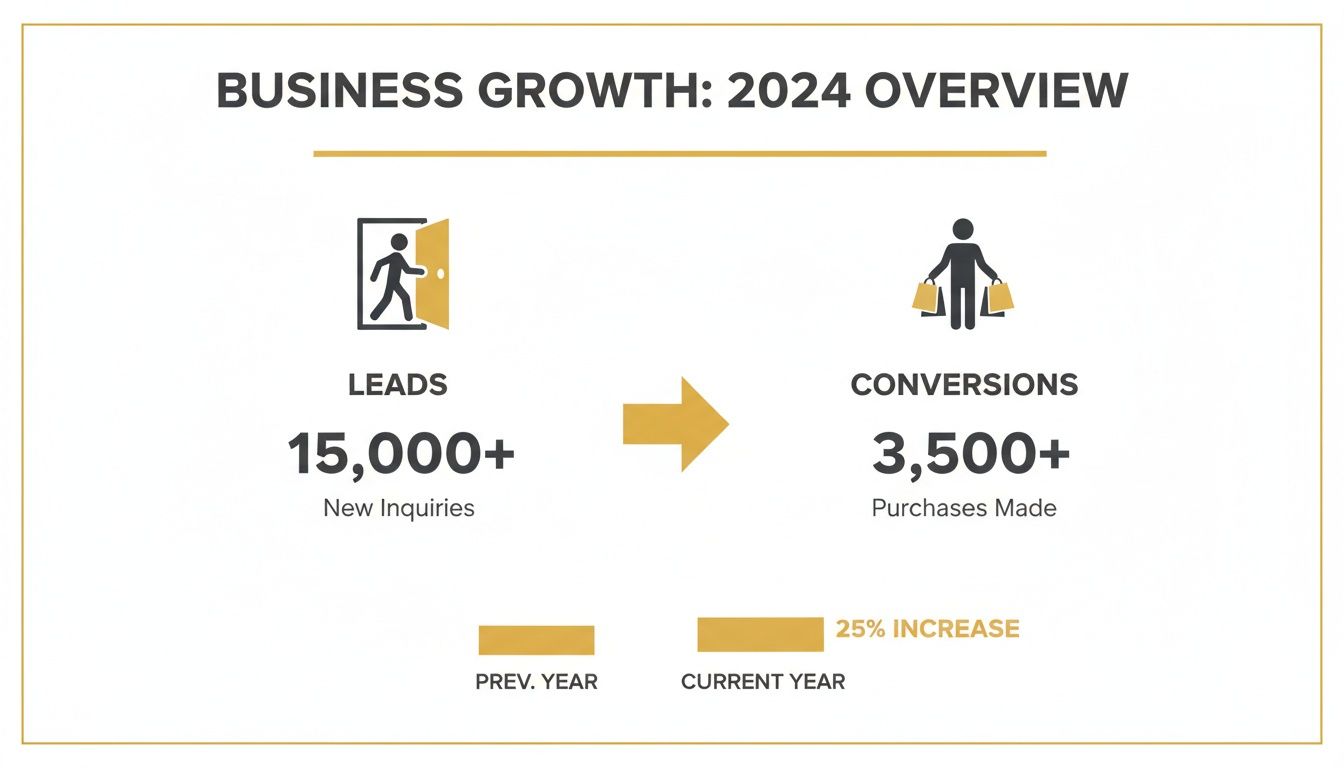
You need a steady stream of leads to keep the tank full, but without a solid conversion process, you're just spinning your wheels.
Essential Metrics for Leads and Conversions
To make this even more practical, here’s a quick rundown of the core metrics every Omaha SMB should be tracking. This isn't just about data; it's about understanding the story your numbers are telling you.
| Metric | What It Measures | Why It Matters for an Omaha SMB |
|---|---|---|
| Conversion Rate (CR) | The percentage of website visitors who complete a goal (e.g., make a purchase, fill out a form). | This shows how persuasive your website is. A higher CR means you're effectively turning local traffic into real business opportunities. |
| Cost Per Lead (CPL) | The average cost to acquire one new lead from a specific marketing campaign. | CPL helps you understand if your ad spend on platforms like Google or Facebook is actually profitable for your Omaha-based business. |
| Lead-to-Customer Rate | The percentage of leads that become paying customers. | This metric connects your marketing efforts to your sales results, showing if you're attracting the right kind of local customers. |
| Customer Acquisition Cost (CAC) | The total cost of sales and marketing to acquire a new customer over a specific period. | CAC gives you the big-picture cost. Is your growth sustainable, or are you spending too much to win each new customer? |
| Return on Ad Spend (ROAS) | The amount of revenue generated for every dollar spent on advertising. | This is the ultimate proof of whether your paid ad campaigns are working, telling you exactly how much you're getting back. |
Keeping an eye on these numbers helps you see beyond the surface and make decisions that lead to real, sustainable growth right here in Omaha.
How Do Your Numbers Stack Up?
Okay, so you're tracking your own metrics. That’s step one. But the next logical question is, "Are my numbers any good?" This is where industry benchmarks come in handy. They give you some context, but treat them as a reference point, not a strict rulebook.
Globally, the average e-commerce conversion rate is around 3.3%. But that’s just an average. The top-performing sites are hitting over 11%, while others struggle to break 2%. Even geography makes a difference—North America averages 3.4% while Europe is at 3.2%, which points to different online shopping habits.
Industry matters a ton, too. Food and beverage can see conversion rates as high as 6.3%, whereas complex B2B services might range from 1.5% to over 10% for a really high-intent landing page.
A "good" conversion rate is always relative. The only benchmark that truly matters is your own past performance. The goal isn't to beat some random industry average; it's to consistently do better than you did last month. That's how you turn your hard-won traffic into loyal customers and build a business that lasts.
Optimizing Your Digital Sales Funnel
Think of your website as your hardest-working salesperson—the one who never sleeps. To get the most out of it, you have to understand how a customer moves through your digital sales funnel. This funnel is just the path a potential customer takes, from first hearing about you to actually buying something. Nailing each step is the key to turning curious visitors into loyal customers.
Your funnel is like a guided tour of your business. Someone shows up at the entrance, interested but not yet sold. Your job is to lead them from one room to the next, building trust and showing them value until they're ready to pull out their wallet. If they get lost or bored at any point, that’s a lost opportunity.
This is exactly why lead quality beats lead quantity every single time. I'd rather have ten highly qualified leads who found me through a targeted blog post than one hundred random visitors who clicked a generic ad. The first group is already on the tour; the second just wandered in by mistake and will probably leave just as fast.
Mapping Content to Funnel Stages
You wouldn’t try to close a deal with someone who just walked in the door, right? The same logic applies online. Different stages of the customer journey need different types of content. A first-time visitor isn’t ready for a hard sell, and a long-time follower doesn't need a basic introduction.
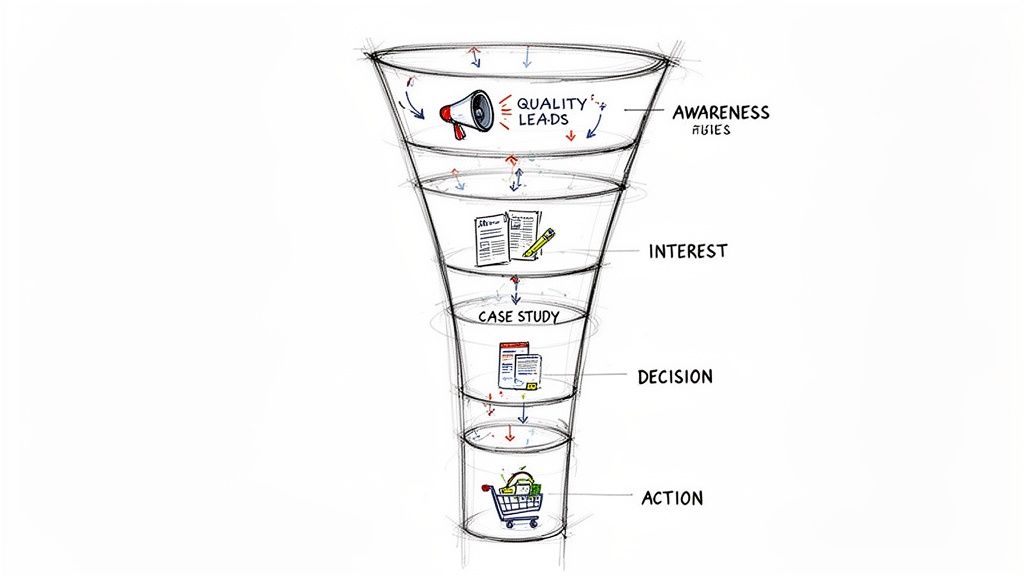
Here’s a simple breakdown of how your content should line up with the funnel:
- Awareness (Top of Funnel): At this point, people are just realizing they have a problem or a need. Your goal is to show up with helpful, educational content. Think insightful blog posts, how-to videos, or social media updates that speak to their pain points without being pushy.
- Interest & Consideration (Middle of Funnel): Now they’re actively looking for solutions. This is your chance to position your business as the expert. Offer more in-depth stuff like downloadable guides, webinars, or detailed service pages that prove you know your stuff and build trust.
- Decision & Action (Bottom of Funnel): The lead is on the verge of making a choice. Your content now needs to build confidence and make it easy for them to say "yes." This is the perfect spot for compelling case studies, client testimonials, free consultations, or product demos.
When you align your content this way, you create a smooth path that guides visitors from one stage to the next without them even realizing it.
A well-optimized funnel doesn't just capture leads; it qualifies and nurtures them. Each piece of content acts as a checkpoint, filtering out those who aren't a good fit and strengthening the relationship with those who are.
Creating a Frictionless Path to Conversion
Ultimately, your goal is to make the entire journey as easy as possible. Every extra click, confusing menu, or clunky form is a point of friction that can cause someone to give up. To really dial in your funnel and get more leads to convert, it's worth looking into effective sales funnel automation to streamline these steps.
This covers everything from your site's loading speed to how clear your calls-to-action are. For instance, when a high-intent visitor lands on a service page, they should instantly see how to request a quote or book a call. The design of your key pages is a huge part of this. For a deeper dive, check out these landing page design best practices to make sure your pages are built for action. Fine-tuning these final steps is often what separates a lead from a conversion.
Proven Strategies to Boost Your Performance
Alright, you've got a handle on the metrics and the customer journey. That's the foundational work. Now it's time to roll up our sleeves and put that knowledge into action with some powerful, data-backed strategies that will actually move the needle on your leads and conversions. Instead of just guessing what might work, this is about building a reliable system for growth.
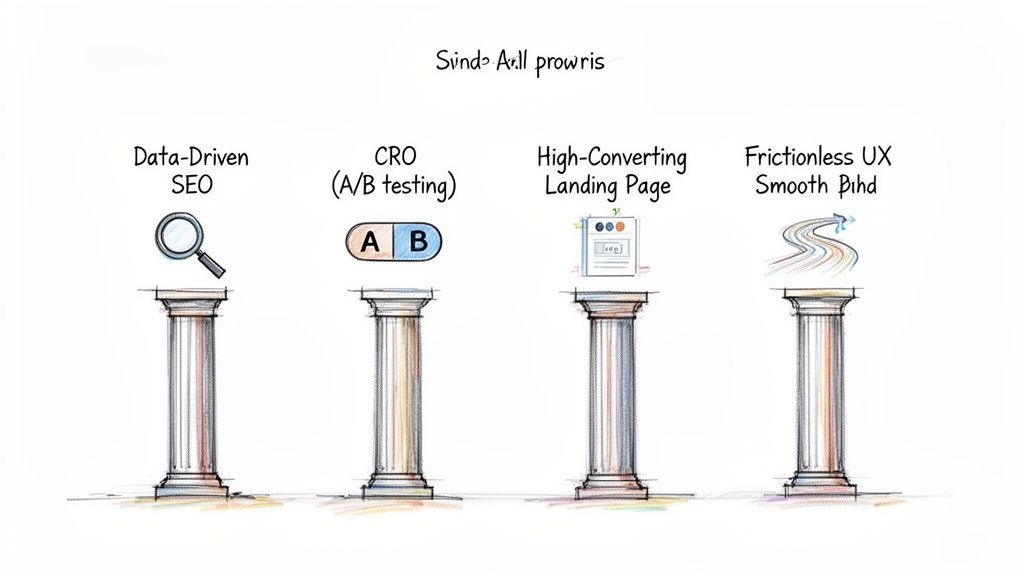
We’re going to focus on four critical pillars that work together to create a high-performing digital machine. Each one tackles a specific part of the customer journey, from the moment they find you to the final click. By shoring up each pillar, you create a seamless path that guides potential customers from just being interested to taking real action.
Attract High-Intent Traffic with Data-Driven SEO
Search Engine Optimization (SEO) isn't just about getting more traffic; it’s about getting the right traffic. It's the process of making your website more visible to people who are actively looking for the exact solutions you offer. Think of it as setting up your storefront on the busiest, most relevant street corner on the internet.
Good SEO for lead generation boils down to a few key things:
- Keyword Research: This means figuring out the specific phrases your ideal customers are typing into Google. For an Omaha plumber, this is the difference between targeting a broad term like "plumber" and a high-intent phrase like "emergency plumbing Omaha."
- On-Page Optimization: You need to make sure your website's content, titles, and descriptions clearly tell both users and search engines what you're all about. No ambiguity.
- Local SEO: This is huge for local businesses. It involves optimizing your Google Business Profile and website for local searches, ensuring you pop up the moment a potential customer nearby needs you.
When you nail your SEO, you attract visitors who already have a problem they need solved. They land on your site as highly qualified leads right from the get-go.
Fine-Tune Your Website with Conversion Rate Optimization
Once people are on your site, the next job is to turn them into customers. Conversion Rate Optimization (CRO) is the science and art of tweaking your website to increase the percentage of visitors who take the action you want them to. It’s all about making small, data-informed changes that can lead to surprisingly big wins.
At the heart of CRO is A/B testing, where you compare two versions of a webpage to see which one gets better results. You might test different headlines, button colors, images, or page layouts. The goal is to find and smooth out any friction points that are stopping users from converting.
Conversion Rate Optimization isn't about chasing some single, magical fix. It's a continuous loop of testing, learning, and refining your user experience to make it as easy and compelling as possible for visitors to say "yes."
Build Laser-Focused High-Converting Landing Pages
A landing page is a specialized webpage designed with one, and only one, objective in mind. Unlike your homepage, which might have links to your blog, about page, and services, a good landing page strips away all distractions. It's built to guide a visitor toward a single, specific action, like filling out a form or buying a product.
Here are the key ingredients for a landing page that converts:
- A Compelling Headline: It has to grab attention immediately and spell out the value.
- A Clear Call-to-Action (CTA): This is your big, obvious button with action-oriented text like "Get Your Free Quote" or "Download the Guide Now."
- Social Proof: Nothing builds trust like testimonials, reviews, or case studies from happy customers.
- Minimal Distractions: Seriously, remove the main navigation menu and any other links that could tempt a visitor to wander off.
A well-designed landing page is your digital closer. It presents a clear, persuasive case that encourages people to act now. And once you capture those leads, implementing smart email marketing tactics to generate leads is the perfect next step to nurture them.
Create a Frictionless User Experience
User Experience (UX) covers every single aspect of how a person interacts with your website. A great UX means your site is a breeze to navigate, loads in a snap, and just feels intuitive. A poor UX, on the other hand, creates frustration and sends potential customers running for the digital hills.
Think about how small improvements can have a massive impact. For instance, a one-second delay in page load time can absolutely crush your conversion rates. Simplifying a checkout process or a contact form by cutting out unnecessary fields can dramatically boost how many people complete it. The demand for these improvements is real; the global CRO software market is projected to grow from US$3.01 billion in 2019 to US$5.07 billion by 2025.
It's not just theory—simple changes like adding multi-step forms have been shown to boost conversions by as much as 200–300% in some cases. A frictionless experience respects your user's time and makes it easy for them to become a customer.
Lead Generation vs. Conversion Optimization Strategies
It's helpful to see how different marketing activities fit into these two buckets: are you trying to get more people in the door, or are you trying to do a better job with the people who are already there?
| Strategy | Primary Goal | Example Tactic for an Omaha Business |
|---|---|---|
| Local SEO | Lead Generation | Optimizing a Google Business Profile for "HVAC repair Omaha." |
| Paid Search Ads | Lead Generation | Running Google Ads targeting users searching for "best steakhouse in Omaha." |
| Content Marketing | Lead Generation | Writing a blog post on "Nebraska's Top 5 Weekend Getaways." |
| A/B Testing | Conversion Optimization | Testing two versions of a "Request a Quote" button color on a website. |
| Landing Page Design | Conversion Optimization | Creating a dedicated page for a seasonal offer with no navigation distractions. |
| Website Speed Optimization | Conversion Optimization | Compressing images and using a CDN to make a local boutique's site load faster. |
As you can see, some tactics are purely about attracting new eyes, while others are focused on making your existing digital property more effective. A truly strong strategy does both.
Giving Yourself an Edge with AI and Personalization
In a world drowning in generic marketing, personalization is what makes you memorable. It’s the difference between a mass email blast that gets ignored and a targeted message that feels like a one-on-one conversation. Getting this right is how you cut through the noise and seriously improve your leads and conversions.
Think of it like this: a great shopkeeper remembers what their regulars like. When a customer walks in, they don't show them every single item in the store. Instead, they point out a few things they know the customer will love based on past purchases. It's a helpful, efficient experience that builds loyalty.
Today, Artificial Intelligence (AI) and automation are the tools that let any business replicate that personal touch, but at a massive scale. AI can analyze user behavior, predict what someone might need next, and serve up dynamic content that actually resonates with each visitor. It makes your marketing sharper and your sales process a whole lot smoother.
Using AI to Create Smarter Marketing
AI isn't just some buzzword for giant corporations anymore; it’s a practical tool that small businesses can use to get a serious competitive advantage. It works behind the scenes, learning from your data, spotting patterns, and automating tasks that used to eat up hours of manual work. You can check out our guide for more details on how to implement AI in your business.
This technology fuels a few key marketing functions that have a direct impact on the quality of your leads and how many of them turn into customers.
- Dynamic Website Content: AI can swap out headlines, images, and offers on your website depending on who's visiting. A first-timer might see a general welcome discount, while a returning lead sees a message about the exact services they were looking at last time.
- Predictive Lead Scoring: Instead of treating every lead as equal, AI can analyze a lead's behavior—like which pages they visited or what guide they downloaded—and assign a score. This lets your sales team focus their energy on the people most likely to buy, which saves a ton of time and money.
- Automated Email Nurturing: AI-driven systems can send incredibly personalized follow-up emails. If a lead downloads a guide about SEO, the system can automatically send them a case study a few days later showing how you helped a similar business with your SEO services.
Practical Personalization That Actually Drives Conversions
Putting this stuff into practice doesn't have to be a huge, complicated project. The goal is just to make every interaction feel relevant and timely. Small, thoughtful adjustments can make a massive difference in how potential customers see your brand and how likely they are to take the next step.
For example, an Omaha e-commerce boutique could use AI to show a pop-up with a special discount on winter coats to a visitor who has been browsing parkas and boots. That simple, automated action is way more effective than a generic banner ad because it speaks directly to what that person wants right now.
By making your marketing smarter, you don’t just get more leads; you get better ones. Personalization filters out the noise, connecting you with customers who are genuinely interested in what you offer, which naturally leads to higher conversion rates.
This approach is also critical for keeping your marketing costs in check. The average cost per lead (CPL) hovers around $198–$200, but that number can go wild depending on the industry. Some sectors, like higher education and legal services, see CPLs balloon to over $600.
Investing in personalization helps improve the quality of leads you get from channels like SEO, which already boasts a much higher close rate (14.6%) compared to outbound methods (1.7%). With North America’s lead generation market expected to hit $3.62 billion by 2028, using AI to improve lead quality and speed up conversions isn't just a good idea—it's a necessary investment. You can find more insights in these powerful lead generation statistics on seoprofy.com.
Ultimately, a personalized journey respects the customer's time, builds trust, and makes the path from curious lead to happy customer feel natural and effortless.
Building Your Action Plan for Sustainable Growth
Alright, we’ve covered a lot of ground—from attracting visitors to capturing leads and finally, turning interest into action. Knowing this stuff is one thing, but putting it into practice is where the real growth happens. Think of this process as the engine for your business. Improving your leads and conversions isn't a one-and-done project; it’s a constant cycle of testing, learning, and tweaking.
I like to think of a marketing strategy like a garden. You can’t just throw some seeds in the ground and expect a prize-winning harvest. It needs constant attention—watering, pulling weeds, and adjusting as the seasons change. Your digital strategy is no different. It needs ongoing care to produce results that last.
Identifying Your Biggest Opportunity
To get started, you have to figure out where the real problem is. Most businesses I work with are struggling with one of two things: a traffic problem or a conversion problem. Answering this one question will tell you exactly where to start.
- Do you have a traffic problem? If your website is a ghost town with just a handful of visitors each month, your top priority is lead generation. You can't convert people who aren't even showing up. Your focus should be on filling the top of your funnel with the right kind of prospects.
- Do you have a conversion problem? If you have decent, steady traffic but your phone isn’t ringing and your inbox is empty, you have a conversion problem. Throwing more money at ads to bring people to a "leaky" website is like pouring water into a bucket full of holes. You’ve got to patch the leaks first to get a real return on your effort.
Your next move depends entirely on where your biggest bottleneck is right now. Don't try to fix everything at once. Find the single biggest thing holding you back from your growth goals, and pour your energy into that.
Your Simple Two-Step Framework
Once you know which problem you’re solving, the path forward gets a lot clearer. Use this simple framework to build an initial action plan and start seeing some real progress today.
-
If You Need More Leads (A Traffic Problem): Your immediate job is to get seen. Prioritize strategies that bring people who are actively looking for what you offer to your digital doorstep. A great first step is doing some keyword research to figure out what your ideal Omaha customers are actually typing into Google. Then, you can create helpful blog posts or tune up your service pages to match what they're looking for. Investing in Local SEO and making sure your Google Business Profile is completely filled out is another no-brainer for grabbing local customers.
-
If You Need More Conversions (A Conversion Problem): Your focus should be on getting more out of the traffic you already have. Start by taking a hard look at your most important landing pages. Is the call-to-action obvious and convincing? Does the page load quickly on a phone? Set up a simple A/B test on one key element, like a headline or button color, and see if a small change can make a difference. Also, check out your web forms—sometimes removing just one field you don't really need can dramatically increase how many people fill it out.
By focusing your energy on the right problem, you make sure your efforts actually move the needle for your business. This is how you get on the path to consistent, long-term success.
Common Questions We Hear
When you're trying to turn website visitors into real customers, a lot of questions pop up. It's totally normal. Here are some of the most common ones we tackle for business owners, broken down in a way that actually makes sense.
What’s a Good Conversion Rate for My Industry?
Everyone wants to know the magic number, but the truth is, a "good" conversion rate is all about context. Sure, the average e-commerce site might see a 2-4% conversion rate, but that number can swing wildly depending on what you sell.
A local restaurant's online ordering page might hit over 6% because people are ready to buy. On the other hand, a B2B company selling high-ticket services could be thrilled with a 5-7% conversion rate on a specific landing page, since their sales cycle is much longer.
The most important benchmark isn't some global average—it's your own history. The real goal is to beat your own numbers, month after month. That's how you build a business that lasts.
Should I Focus on Getting More Leads or Increasing Conversions?
This is the classic chicken-or-the-egg question in marketing. The answer depends on where your biggest problem is. Think of your website as a water pipe.
-
Low Traffic (Few Leads): If your site is a ghost town, you have a supply problem. Your first job is to get more water flowing into the pipe. That means focusing on lead generation tactics like SEO or paid ads. You can't convert people who never show up in the first place.
-
Steady Traffic (Few Conversions): If you have a steady stream of visitors but hardly anyone buys or fills out a form, you have a leak. Your top priority has to be Conversion Rate Optimization (CRO). It's way cheaper and more effective to patch the holes in your existing system than to keep paying for more traffic that just spills out.
Ultimately, a healthy strategy does both. But you have to start by fixing the biggest bottleneck.
How Long Does It Take to See Results from SEO and CRO?
This is a great question because the timelines for SEO and CRO are completely different. They play different roles on the team.
With Conversion Rate Optimization (CRO), you can see movement pretty quickly. You're working with the traffic you already have. An A/B test on a call-to-action button or a tweak to your checkout process can show a real, measurable lift in just a few weeks. It’s about making what you’ve got work harder for you, right now.
Search Engine Optimization (SEO) is the long game. Think of it like planting a tree. It takes time to build authority with Google and earn those top rankings. You can generally expect to see significant, needle-moving results in organic traffic within 4-6 months. The payoff, though, is huge: a reliable, compounding source of high-quality leads that keeps growing over time.
Ready to turn your website traffic into measurable revenue? The team at Up North Media specializes in data-driven SEO and conversion-focused web design that gets results for Omaha businesses. Schedule your free consultation today!