

Got a business idea that feels like a sure thing? Hold on. Let's talk about the single most important step you can take before pouring your life savings into that brilliant concept: validation.
Think of it this way: you wouldn't build a house without checking the foundation first. Validating your business idea is the same principle. It's about gathering real, hard evidence that people actually want what you're planning to sell before you spend a dime on development or inventory.
Why Most Startups Fail and How Yours Can Succeed
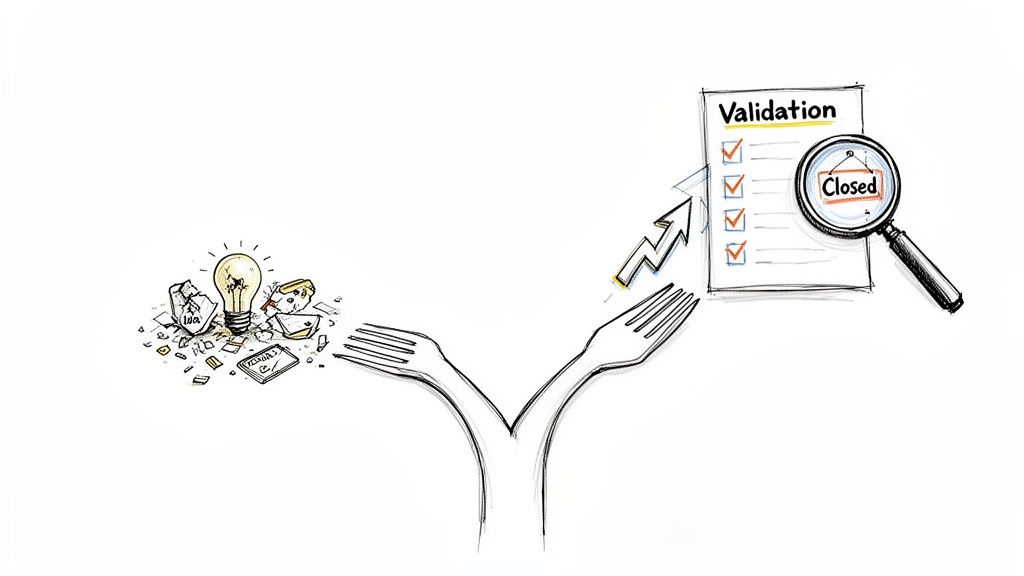
The road from a great idea to a profitable company is littered with failed startups. The hard truth is that most new businesses don't fail because the founders weren't passionate enough; they fail because they built something nobody was willing to pay for.
The statistics are sobering. A staggering 80% of startups don't make it, with some studies putting that number closer to 90%. The number one killer? A complete lack of market need, which accounts for 42% of all failures. They built a solution for a problem that didn't exist.
Idea validation is your most powerful risk-reduction strategy—an insurance policy against wasted time, money, and energy. It shifts your mindset from "I have a great idea" to "I have a hypothesis that needs to be tested."
This guide isn't about adding bureaucratic hurdles to your process. It’s about taking the smartest first step toward building a business that actually has a future.
Before we dive into the step-by-step playbook, let's get grounded in the core concepts. Think of these as the pillars holding up your entire validation strategy.
The Core Pillars of Business Idea Validation
A quick summary of the fundamental concepts you'll learn to master in this guide.
| Pillar | What It Means | Why It Matters |
|---|---|---|
| Assumption Mapping | Identifying every belief you hold about your idea, customer, and market. | Forces you to confront what you think you know versus what you can actually prove. |
| Customer Discovery | Getting out of the building and talking to real potential customers about their problems. | Ensures you're solving a real, painful problem, not just a minor inconvenience. |
| Lean Experimentation | Designing cheap, fast tests (like landing pages or ad tests) to gather real-world data. | Gathers objective proof of interest and willingness to pay without building the whole product. |
| Metric-Driven Decisions | Focusing on key numbers (conversions, CAC, etc.) to decide whether to proceed, pivot, or pull the plug. | Replaces gut feelings with cold, hard data, leading to much smarter business decisions. |
Mastering these four pillars is what separates the founders who succeed from those who run out of cash chasing a ghost.
The Scientific Approach to Business Ideas
Stop relying on gut feelings. Your friends and family mean well, but their encouragement isn't market data. True validation means treating every core belief you have about your business as a testable hypothesis.
Let's make this real.
- Your Assumption: "Small cafes will totally pay $50/month for my slick new coffee bean inventory app."
- A Testable Hypothesis: If I show a simple prototype to 20 local cafe owners, at least three of them will pre-order a subscription on the spot.
See the difference? This approach forces you to seek objective proof from the only people whose opinions actually matter: your future customers. It's how you figure out if you've got a real business on your hands or just an expensive hobby.
Understanding Your Market Landscape
Validation isn't just about looking inward at your idea; you have to look outward, too. Your business won't exist in a bubble. It'll be competing for customers' attention and dollars.
Getting a clear picture of your competitors—who they are, what they do well, and where their customers are frustrated—is non-negotiable. Knowing how to conduct competitor analysis gives you the context you need to find a gap in the market your idea can fill.
This isn't about copying what others are doing. It's about understanding the landscape so you can build something people will choose over the existing options. By combining sharp internal testing with keen external awareness, you start building a foundation strong enough to support real, sustainable growth.
Nailing Down Your Core Assumptions and Ideal Customer
Before you build, write a line of code, or spend a single dollar, you need to get brutally honest about what you're really betting on. Every business idea is just a collection of educated guesses—beliefs about a problem, a solution, and the people who will pay for it. The first step in validation is dragging those beliefs out into the light.
These aren't just minor details; they're your leap-of-faith assumptions. If even one of these core beliefs is wrong, the whole house of cards can come tumbling down. For instance, you might assume local restaurants will happily pay a monthly fee for an automated inventory system. That single idea is packed with risk: Do they even see inventory as a major headache? Is it painful enough to pay to fix? Is a subscription the right model for them?
Deconstructing Your Business Idea
Let's start by mapping out the DNA of your business. To succeed, you have to be right about three fundamental things, and this is where your riskiest assumptions are hiding.
- The Problem Assumption: Do people actually have the problem you think they do? Is it a genuine, "hair-on-fire" issue they're desperate to solve, or just a mild annoyance they can live with?
- The Solution Assumption: Does your idea actually solve that problem in a meaningful way? More importantly, is it a 10x better solution than what they're already doing (even if their current solution is just a messy spreadsheet or a series of sticky notes)?
- The Customer & Channel Assumption: Do you know exactly who this is for? And do you have a realistic, profitable way to get your solution in front of them?
Forcing yourself to answer these questions moves you from a fuzzy concept to a set of specific, testable hypotheses. It's the difference between saying "I have an idea" and "I have a plan to find out if my idea is any good."
Pinpointing Your Ideal Customer
You can't test an idea in a vacuum. You need to know who you're testing it with. One of the most common early-stage mistakes is casting the net too wide, hoping to appeal to everyone. That's a recipe for weak signals and wasted time. You need to get laser-focused on a specific Ideal Customer Profile (ICP).
An ICP isn't just about demographics like age and job title. It's a deep dive into the psychographics of your perfect user—the person who feels the pain most acutely, will get the most value from what you're offering, and will eventually become your biggest cheerleader. You should be able to describe this person in such detail that you feel like you could walk into a room and pick them out.
To build out a useful ICP, start by asking:
- What are their biggest pain points? Go beyond surface-level frustrations. What's the root cause of their struggle?
- What are their goals and motivations? What specific outcome are they trying to achieve? What does success look like for them?
- Where do they hang out and look for solutions? Think about the specific Google searches they're making, the Subreddits or Slack communities they're in, the industry blogs they read, or the influencers they follow.
- What does a "day in the life" look like for them? Understanding their daily routines gives you crucial context for how your product might fit into their world.
Getting specific about your ideal customer is non-negotiable. It ensures your validation experiments target the right people, so you get meaningful signals instead of false hope from an irrelevant audience.
This profile is a living document, by the way. It will change and get sharper as you start talking to real people. Creating these customer profiles, often called personas, is a foundational marketing activity. If you're new to this, our guide on how to create buyer personas is a great place to start.
Once you have a clear picture of your assumptions and your ideal customer, you're ready to start designing experiments to see if you're right. For an even more in-depth look at this process, check out this excellent tactical guide on how to define your target audience by Aakash Gupta. Nailing this combination of internal assumption mapping and external customer discovery sets the stage for everything that follows.
Designing Fast And Frugal Validation Experiments
You've mapped out your core assumptions and have a sharp picture of your ideal customer. Now it's time to get out of the spreadsheet and into the real world. Validating your business idea doesn't mean you need to burn through cash or spend months building something. The real goal here is to design quick, cheap experiments that give you hard data, fast.
This is where the rubber meets the road. You aren't trying to build a perfect, polished product yet. Instead, you're creating a series of small, targeted tests to answer one simple question for each of your assumptions: "Am I right?" The answers you get from the market will be infinitely more valuable than a thumbs-up from friends or family.
Uncovering Truths With Customer Interviews
Honestly, the single most effective way to start is by talking to people. Not selling to them—listening. Customer interviews are your chance to dig deep and understand the real problems, motivations, and habits of your ideal customer on a human level.
Your goal isn't to ask, "So, would you buy my product?" That question almost always gets a polite but totally useless "yes." You need to focus on their past and present behavior instead.
Try asking open-ended questions like:
- "Can you walk me through the last time you dealt with [the problem you solve]?"
- "What was the hardest part of that whole process?"
- "Have you tried to solve this before? What did you do?"
- "Did you pay for any of those solutions? If not, why not?"
The answers to these questions are pure gold. They tell you whether the problem is a genuine "hair-on-fire" issue or just a minor annoyance. If people haven't actively tried to solve it or spent money on a fix, your assumption that the problem is urgent is probably wrong.
The Power Of A Simple Landing Page Test
Once you’ve gathered some good qualitative feedback from interviews, it's time to get some numbers. A landing page test is a classic, powerful way to measure genuine interest before you write a single line of code. It’s just a simple, one-page website that clearly explains your value proposition and asks visitors for one thing: their email address in exchange for early access, a discount, or more info.
This is the ultimate test of your messaging. You’re asking a complete stranger to give you something valuable (their email) based only on the promise of your solution. The percentage of visitors who sign up—your conversion rate—is a direct signal of how much the market actually cares.
A landing page is more than just a marketing tool; it's a scientific instrument. It lets you test your value proposition, messaging, and customer interest with real data, all for less than the cost of a few pizzas.
This flowchart breaks down the assumptions you're testing at each stage.
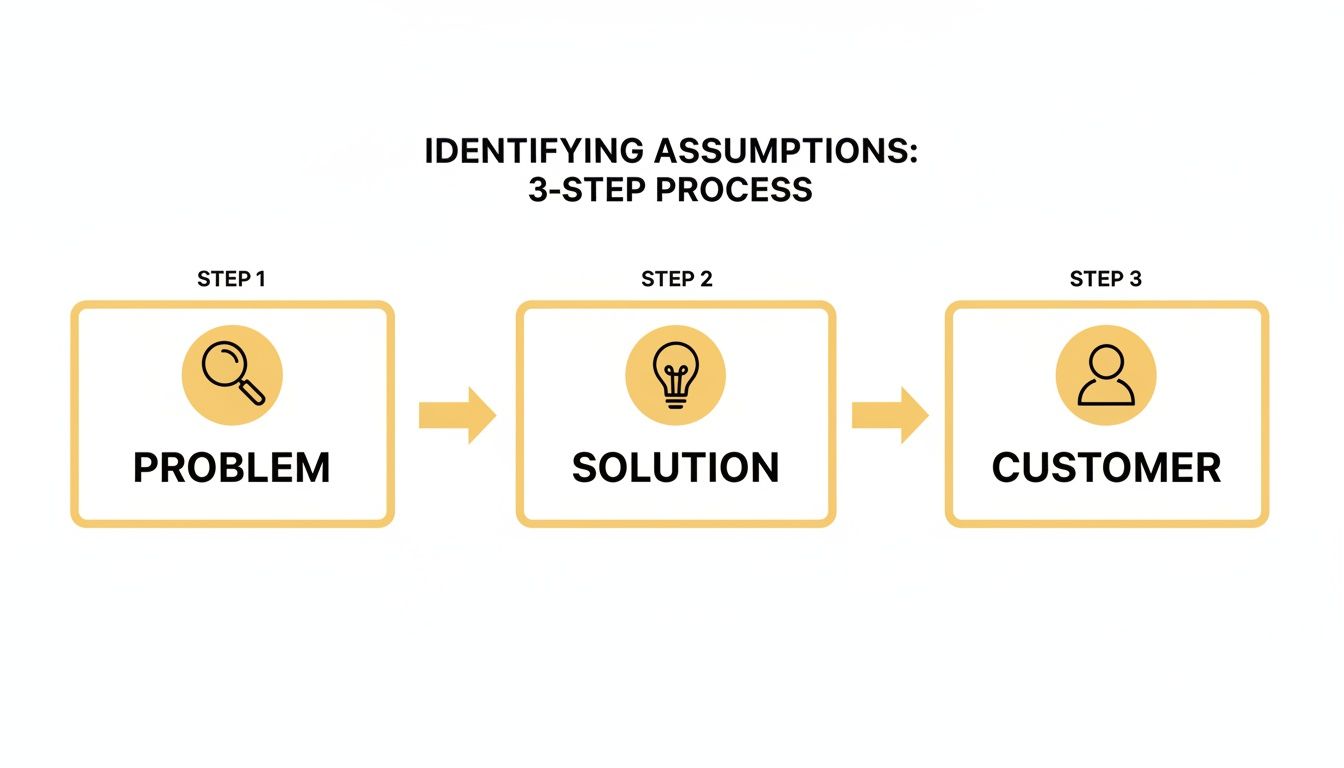
This flow highlights that critical journey from identifying a pain point to confirming who actually feels that pain—which is exactly what your landing page test is designed to measure.
The Smoke Test: Putting Real Intent On The Line
A Smoke Test takes the landing page idea one step further by gauging actual purchase intent. You basically create the illusion of a finished product to see if people will try to buy it. This is where you get definitive proof that someone is willing to pay.
The most common way to do this is to add a "Buy Now" or "Pre-Order" button to your landing page. When a user clicks it, instead of being sent to a payment processor, they see a message like, "Thanks for your interest! We're not quite ready yet, but you'll be the first to know when we launch."
This technique cuts through all the noise. It’s one thing for someone to give you their email, but clicking a button that implies a financial transaction is a much, much stronger signal of serious interest.
Turning Interest Into Revenue With Pre-Sales
If your Smoke Test shows strong purchase intent, a pre-sale campaign is the ultimate validation. This is where you actually ask for money before the product is even built. It’s a bold move, but it’s the most powerful proof you can possibly get that you've found a real market need.
You can offer an exclusive discount, lifetime access, or bonus features to entice early backers. This approach not only validates your idea with actual revenue but can also help fund your initial development. If people are willing to pay you for something that doesn't exist yet, you're not just validating an idea—you're starting a business.
Research from the Harvard Business Review found that pre-selling can increase a new product's success rate by up to 60%, since it confirms demand and builds a base of early adopters right from the start.
Using Ad Tests To Validate Your Audience
So how do you get people to your landing page or smoke test in the first place? Small, targeted ad campaigns on platforms like Facebook, Instagram, or LinkedIn are a perfect way to do it. For a tiny budget—often as little as $50 to $100—you can test your core assumptions about your audience and messaging.
Here’s a simple way to structure an ad test:
- Define Your Audience: Use the platform's targeting tools to build an audience that matches your Ideal Customer Profile.
- Test Your Messaging: Run 2-3 different ad variations, each with a slightly different headline or value proposition.
- Measure What Matters: Track your Click-Through Rate (CTR) to see which message resonates, and most importantly, the conversion rate on your landing page.
This isn’t about making sales directly from the ad. It’s about learning. You’ll quickly find out which value propositions get clicks and which audience segments are most responsive, giving you invaluable data before you even think about scaling your marketing spend.
Choosing Your Validation Experiment
Picking the right experiment depends on what you need to learn, how much you can spend, and how fast you need answers. Some tests are great for early-stage ideas, while others are better for confirming purchase intent.
| Experiment Type | Best For Validating | Typical Cost | Time to Results |
|---|---|---|---|
| Customer Interviews | Problem & Customer Pain | $0 (just your time) | Days |
| Landing Page Test | Solution Interest & Value Prop | $20 - $150 | 1-2 weeks |
| Ad Test | Audience & Messaging | $50 - $200 | Days to a week |
| Smoke Test | Purchase Intent | $50 - $200 | 1-2 weeks |
| Pre-Sales | Willingness to Pay (with cash) | $100 - $500+ | 2-4 weeks |
Each method builds on the last. You can start with free interviews to shape your message, then run a cheap landing page test with a small ad budget to see if the message sticks. If it does, you can move on to a smoke test or pre-sale with more confidence.
Measuring the Metrics That Truly Matter
Alright, you've launched your experiment. The landing page is live, ads are running, and traffic is hitting your site. It feels good, right? But here's where so many founders get it wrong. They fall in love with vanity metrics.
These are the numbers that stroke your ego but don't actually tell you if you have a business—things like total site visits, social media likes, or how many people opened your email. True validation comes from digging into the data that shows whether people actually want what you're building.
This is the moment you shift from being a hopeful entrepreneur to a data-informed founder. We're going to take the emotion and gut feelings out of the equation and focus on cold, hard numbers that give you a clear "go" or "no-go" signal.
Set Your Success Criteria Before You Launch
This is the single most important rule of running validation experiments. Before you spend a single dollar on ads or send one person to your landing page, you must define what success looks like.
Why? Because it stops you from moving the goalposts later. It’s way too easy to look at disappointing results and say, "Well, it's not that bad..." Don't fall into that trap. Set your targets beforehand, and stick to them.
Your criteria should be specific and tied directly to whatever assumption you're testing.
- For a landing page test: You might decide that a 10% email sign-up conversion rate from targeted traffic is your minimum viable threshold. Anything less, and the idea isn't compelling enough.
- For a pre-sale campaign: Your goal could be to get 20 paying customers at a discounted price within two weeks. This proves people will actually open their wallets for your solution.
- For an ad test: You might aim for a Click-Through Rate (CTR) above 2% and a Cost Per Acquisition (CAC) under $25 for each email lead.
Setting these benchmarks forces you to be objective. You either hit the numbers or you don't. Simple as that.
Core Metrics for Early-Stage Validation
While every business is different, there are a handful of key performance indicators (KPIs) that are universally critical for your first experiments. Let's break them down.
Conversion Rate
This is the big one. Conversion rate measures the percentage of people who take the specific action you want them to. For a landing page, it’s the percentage of visitors who sign up. For a pre-sale, it's the percentage who pull out a credit card and buy.
A strong conversion rate is the market screaming, "Yes, I want this!" It's direct proof that your value proposition is hitting the mark and solving a real problem.
A low conversion rate (think below 1-2%) is a massive red flag. It’s a clear signal that there’s a serious disconnect between your message and what your audience actually needs.
Cost Per Acquisition (CAC)
If you're using paid channels like Facebook or LinkedIn ads to get traffic, your CAC is everything. It's the total amount you spent on ads divided by the number of "acquisitions" you got (like an email sign-up or a pre-order). Basically, it’s what you pay to get one person to show real interest.
An unsustainable CAC can sink a business before it even launches. If it costs you $100 in ad spend to get one person to sign up for a product you plan to sell for $50, your business model is dead on arrival. Figuring this out early saves you a world of pain and money.
Click-Through Rate (CTR)
When you're running ad tests, CTR is your first indicator of success. It measures the percentage of people who saw your ad and were compelled enough to click on it.
A high CTR tells you that your ad creative, your copy, and your targeting are all working together effectively. Your hook is grabbing attention. A low CTR, on the other hand, means your message is getting lost in the noise. People are scrolling right past it, telling you that you need to go back and refine your value proposition.
By focusing on these core metrics, you get out of the guessing game. You’ll know with actual data whether you’ve found a real customer problem, if your solution resonates, and if you have a viable way to reach them. These are the pillars of any successful business.
Running a 72-Hour Validation Sprint
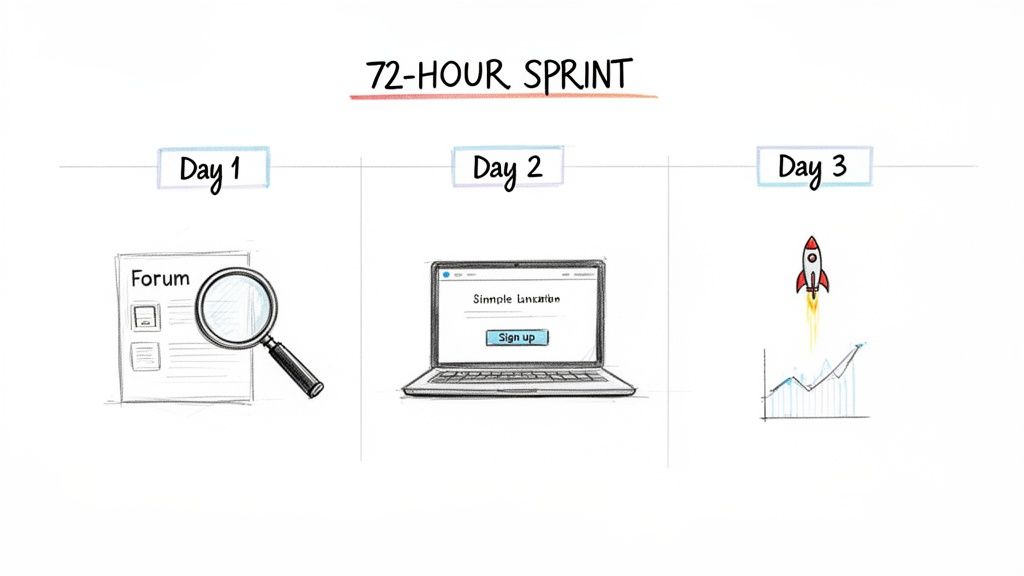
Theory is great, but execution is what separates a dream from an actual business. The good news? You don't need months to get a clear signal from the market. A focused, 72-hour sprint over a long weekend can give you the hard data you need to move forward with confidence—or to know when to walk away.
This tight timeline forces you to cut the fluff and focus on what truly matters. It’s the perfect way for busy entrepreneurs to test an idea without blowing up their day job.
This is the "fail fast, learn faster" mindset in action. You're trying to avoid the single biggest startup killer: building something nobody wants. One of my favorite examples of this comes from a company that used a no-cost, three-day framework to validate an idea, saving them six months and $50K in the process. It's a powerful reminder that the data 90% of failed startups ignore is often right there for the taking. You can dig into their full 72-hour idea validation process to see exactly how they did it.
Day 1: Foundation and Research
Your first 24 hours are all about getting crystal clear on what you're testing. This isn't about building anything yet. It's about sharpening your focus so your experiment is as clean and effective as possible.
Here are your action items for day one:
- Define Your Core Hypothesis: Get it down to a single, clear sentence. Something like, "Busy professionals in Omaha will pay $20/month for a curated newsletter of local networking events."
- Do Some Quick-and-Dirty Market Research: Fire up Google Trends to check search interest. More importantly, spend a couple of hours lurking in subreddits, Facebook groups, or online forums where your ideal customer hangs out. Pay attention to the exact language they use to describe their problems.
- Sketch Your Test Asset: Just an outline. What’s the core message for your landing page? What is the one big promise you're making?
This groundwork sets the stage for a targeted and meaningful test.
Day 2: Building Your Test Asset
Day two is all about speed. You're building your minimum viable test—the simplest possible thing you can create to get a real signal from real people. Perfection is the enemy here. You're building a data collection tool, not a finished product.
The point of a validation sprint isn't to build a business in a weekend. It's to find out if you should build a business at all.
For most ideas, a simple landing page is all you need. Use a tool like Carrd, Leadpages, or Mailchimp to throw together a single page. It should have a killer value proposition and a clear call-to-action, like an email sign-up form. If your idea is more complex, you might mock up a simple prototype. This is a critical first step, and our guide on MVP development for startups dives way deeper into this process.
Day 3: Execution and Analysis
With your test asset live, the final 24 hours are for driving a small amount of targeted traffic and seeing what happens. This is where your hypothesis meets reality.
Here’s your game plan:
- Drive Traffic: Run a small, highly targeted ad campaign on a platform like Facebook or LinkedIn. You don't need a huge budget; $50-$100 is plenty to get a signal. Point that traffic directly at your new landing page.
- Monitor Your Metrics: Keep a close eye on the numbers. How many people visited the page? And the most important metric of all: what was your conversion rate?
- Analyze and Decide: At the end of the day, compare your results to the success criteria you defined on Day 1. Did you hit your target?
This sprint packs an incredible amount of learning into a short time. Whether the results are a green light or a dead end, you've just gained invaluable market feedback in three days. Now you have real data to help you decide whether to pivot or persevere.
Interpreting Results: Time to Pivot or Persevere?
The experiments are done. The data is in. The initial adrenaline rush of launching your tests has probably worn off by now. This is the moment of truth—where you have to look at the results with cold, hard objectivity and decide what comes next.
This is where you figure out if you've struck gold and should keep pushing forward, or if the market is gently (or not so gently) telling you it's time for a change. Your validation efforts will point you toward one of three outcomes: Validation, Invalidation, or something frustratingly in between.
Let's be clear: this isn't about gut feelings anymore. It’s about taking the metrics you just collected and holding them up against the success criteria you defined before you started.
Making the Call: Validation, Invalidation, or Ambiguity
So, what did the numbers tell you?
If you hit or, even better, flew past your success metrics—say, you were aiming for a 10% conversion rate and you hit 15%—you've got a clear signal of Validation. This is your green light. It means a core assumption was right, and you have tangible proof you're onto something. Now’s the time to persevere, maybe by running a slightly larger experiment or starting to build out a more robust MVP.
On the flip side, what if your results fell flat? A 1% conversion rate and a sky-high cost per acquisition is a strong signal of Invalidation. This isn't failure; it's incredibly valuable, money-saving information. The market is telling you, loud and clear, that this specific approach isn't the one. This is a sign to either pivot or shelve the idea.
Then there’s the gray area: Ambiguous Results. Maybe you hit your conversion goal, but your ad costs were unsustainable. Or maybe your customer interviews were full of praise, but not a single person would actually commit to a pre-order. This murky outcome means you just haven't learned enough to make a confident call. The best move here is to tweak your experiment—adjust the messaging, target a different audience segment—and test again to get a clearer signal.
The Art of the Pivot
Invalidation doesn't mean you pack it all in. It just means one of your foundational assumptions was wrong, and now it’s time to pivot. A pivot isn't giving up; it's a strategic course correction based on what you just learned. The data from your "failed" test is actually a map showing you where not to go.
A pivot is a change in strategy without a change in vision. You're still trying to solve the big problem, but you're changing a fundamental hypothesis about how to do it.
Take a hard look at which of your core assumptions the data just blew up. Was it the problem itself, your solution, or the customer you were targeting?
- Customer Pivot: Your experiment got a response, just not from the people you expected. The solution might be perfect, but you were talking to the wrong crowd. Time to find the right audience.
- Problem Pivot: Customers didn't really care about the problem you thought they had. But during your interviews, they brought up a different, much more painful problem. You keep your target customer but adjust the solution to solve this new, validated need.
- Solution Pivot: Your audience agrees they have the problem, but your solution (like a mobile app) isn't how they want it solved. Maybe they'd prefer a simple web tool, a browser extension, or even a human-powered service.
This ability to listen to the market and adapt is what separates successful founders from everyone else. Ultimately, all your validation work is about getting to this critical decision point. To dig deeper into the end goal here, exploring what is product market fit can provide essential context for your next steps.
Ready to turn your validated business idea into a powerful web application or a revenue-generating digital strategy? At Up North Media, we specialize in custom web development and data-driven SEO to help businesses like yours launch, grow, and succeed. Schedule your free consultation today at https://upnorthmedia.co and let's build something great together.