

Your phone still isn’t ringing the way it should. You’ve probably got a few agency emails sitting in your inbox right now promising page-one rankings, more traffic, and a “proven system.” The problem is that most of those pitches sound identical, and that’s usually the first warning sign.
If you run an HVAC business in Omaha, hiring an SEO partner isn’t about buying vague visibility. It’s about choosing a company that understands emergency intent, neighborhood-level competition, service-area pages, review velocity, and what happens when a homeowner searches for furnace repair on a freezing night. A real hvac seo company should think like an operator, not a slideshow.
Why Your Next Hire Should Be an HVAC SEO Specialist
It is 8:15 p.m. in Omaha, the temperature is dropping, and a homeowner searches “emergency furnace repair near me.” If your site ranks with a clear service page, strong local signals, and a phone number that is easy to tap, that search can become a booked job in minutes. If your SEO is built by a general agency chasing broad traffic, that lead often goes somewhere else.
That gap is why the next hire should be a specialist.
HVAC search behavior is tied to urgency, geography, and service economics. Someone reading about filter changes is useful top-of-funnel traffic, but it does not carry the same value as someone searching for AC repair in West Omaha or furnace replacement in Papillion. A specialist builds around the jobs that keep trucks full, not just the keywords that look good in a report.
HVAC search behavior is tied to revenue
A specialist starts with how HVAC companies make money. Repair pages, replacement pages, maintenance plans, financing content, and location pages all serve different intents. They also produce different margins.
That affects strategy right away:
- High-intent services get priority. Repair, installation, replacement, and tune-up pages should be built before a long list of general blog posts.
- Service areas need real coverage. One city page rarely carries an Omaha HVAC company. You need useful pages for the towns and neighborhoods where profitable work comes from.
- Seasonal demand changes the publishing calendar. Cooling content and landing pages need to be ready before summer demand rises. Heating pages need attention before the first cold snap, not after it.
A general SEO firm may understand rankings. A skilled HVAC specialist understands dispatch patterns, shoulder seasons, and how quickly buying intent changes when a system fails.
Specialists track business outcomes, not vanity metrics
Traffic alone is a weak scorecard for HVAC SEO. The better question is which visits turn into calls, booked estimates, maintenance agreements, and replacement jobs.
That is why a hiring conversation should get specific fast. According to Up North Media’s HVAC marketing services, HVAC-focused SEO is built around qualified lead generation for heating and cooling businesses, not generic site traffic. That is the right lens.
I usually use a simple rule here. If an agency spends more time talking about impressions than call quality, they are probably not built for home services.
Specialists also tend to set up measurement better. They ask how calls are tracked, whether after-hours leads are answered, which service lines produce the best close rates, and whether your CSR team tags lead sources correctly. Some also use workflow and reporting systems similar to the AI tools for marketing agencies now use to speed up lead routing and surface missed opportunities. The tool matters less than the discipline behind it.
What a specialist asks that a generalist often misses
The difference usually shows up in discovery.
| Focus area | Generalist question | Specialist question |
|---|---|---|
| Service mix | “What services do you offer?” | “Which services produce the best margins, and which ones do you want more of?” |
| Geography | “What city are you in?” | “Which suburbs, ZIP codes, and towns turn into profitable jobs?” |
| Lead quality | “How many leads do you want?” | “Which calls become dispatches, estimates, memberships, or replacements?” |
| Operations | “Do you have a contact form?” | “Who answers the phones, what happens after hours, and how are missed calls handled?” |
Those questions lead to a better campaign because they reflect how HVAC businesses operate in practice.
An HVAC SEO specialist is not just trying to get your site seen. They are trying to help you win the searches that matter most, in the places you serve, during the months that drive revenue. For an Omaha contractor, that focus usually means fewer wasted leads, stronger local visibility, and less guesswork during the busiest parts of the year.
What a Great HVAC SEO Strategy Includes
A good HVAC SEO strategy should match how your company wins work.
If your Omaha shop makes better money on replacements than tune-ups, the campaign should reflect that. If emergency AC repair drives calls in July but maintenance memberships build margin the rest of the year, your SEO plan should support both. A good hvac seo company builds around service lines, seasonality, dispatch range, and call handling. They do not hand you the same monthly checklist they use for a plumber or roofer.
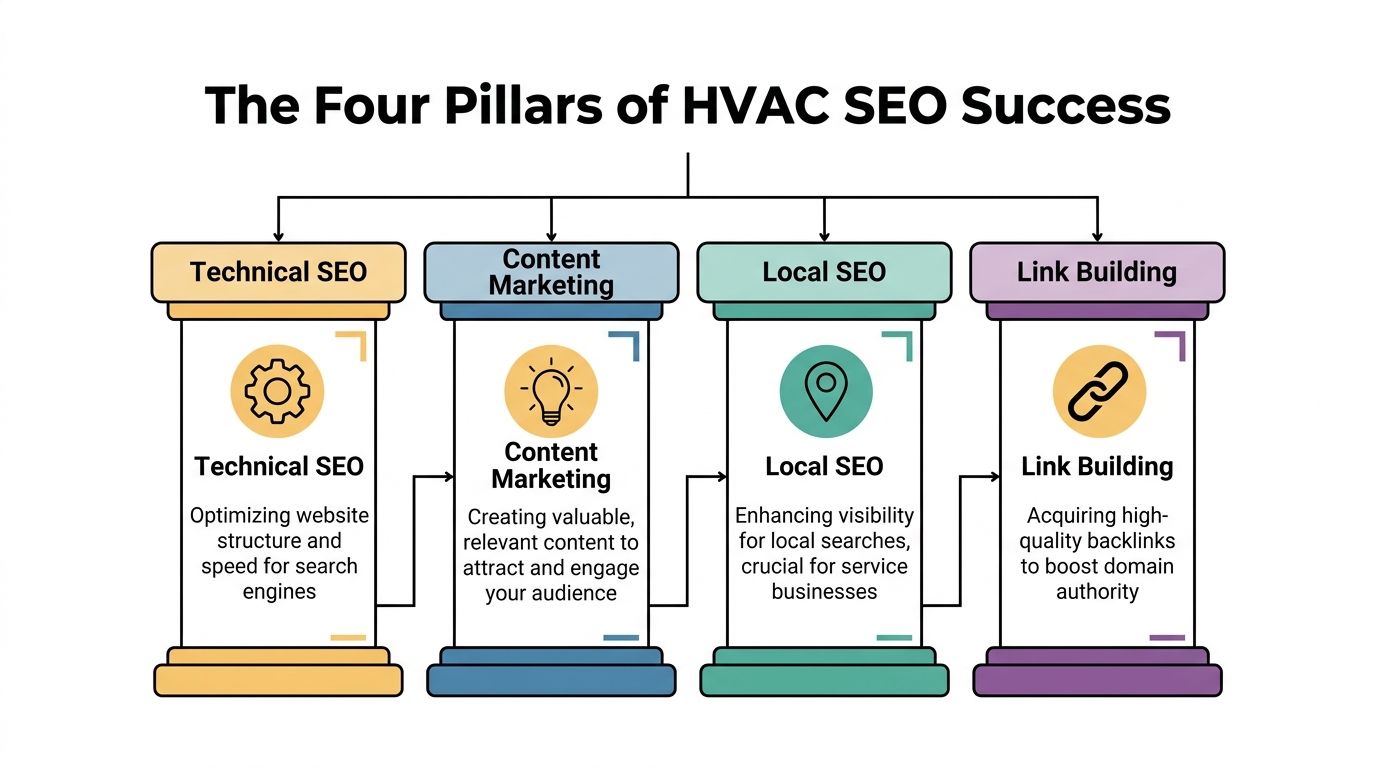
A full-funnel approach combining technical SEO, keyword-driven content, and local signal amplification delivers a median ROI of 27.46x for home service companies, with organic search driving 44% of paying customers. That is why strong SEO work is built as an operating system, not a bundle of disconnected tasks.
Local SEO built around service areas and buying intent
Local SEO carries a lot of the load for HVAC because homeowners usually search with urgency and location in mind. They want “AC repair Omaha,” “furnace replacement near me,” or “heat pump installer in Elkhorn,” not a generic blog post.
A solid agency should tighten your Google Business Profile, match categories to real services, keep your name, address, and phone data consistent, and build location pages for the places you dispatch to. If you want a practical framework for comparing providers, this guide on how to choose an SEO company for your business is a useful starting point.
What good local execution usually includes:
- Service-specific GBP optimization tied to real revenue categories
- Accurate service-area targeting based on the towns and ZIP codes you want more of
- Review workflows that help both rankings and conversion rates
- Location pages with real local detail instead of lightly rewritten copies
Technical SEO that helps calls happen
Technical SEO matters because HVAC traffic is often mobile, urgent, and ready to act. A homeowner with no AC is not going to fight a slow site, tiny text, or a broken click-to-call button.
The basics are simple, but they need to be done well:
- Faster page load times through image compression, caching, and cleaner code
- Mobile-first page layouts that make calls, forms, and financing options easy to find
- Structured data markup for business, service, and review information
- Internal links that connect service pages, location pages, and supporting content logically
This work often gets ignored because it is less visible than rankings. It still affects revenue. Many HVAC websites do not lose leads because they rank poorly. They lose leads because the site creates friction after the click.
Content that follows the jobs you want more of
Content should support the sales mix you are trying to build. That means service pages for high-value work, city pages for target markets, and support content that answers the questions homeowners ask before they call.
For HVAC companies, that usually includes:
- Primary service pages for AC repair, furnace repair, replacement, installation, and maintenance
- Repair-versus-replace pages for homeowners comparing options
- Financing, warranty, and brand pages that reduce hesitation
- Seasonal content tied to weather-driven demand
- FAQ pages that answer pricing, timing, and equipment concerns
There is room for AI in the workflow, but the quality bar is higher than it was a year ago. If an agency talks a lot about automation, ask how they keep pages accurate, local, and useful. A firm calling itself an AI SEO company still needs human review, trade knowledge, and editorial standards, especially for service businesses where bad advice can cost leads.
Authority signals that support competitive rankings
Authority building is still part of the job. HVAC companies in competitive metros usually need more than on-page edits and a cleaned-up Google Business Profile.
A sound plan includes local citations, relevant business listings, links from community organizations or industry sources, and pages worth referencing. It should also avoid junk directory blasts, paid link bundles, and vague promises about “building authority” with no explanation of where links come from.
One practical note. Up North Media offers SEO, local SEO, and web design services for HVAC contractors. That kind of integrated setup can be useful when site performance, local visibility, and conversion issues are tied together.
How to Vet Agencies and Spot Common Red Flags
Most HVAC owners don’t lose money because they hired no agency. They lose money because they hired the wrong one for too long.
The fastest way to improve your odds is to stop listening for confidence and start listening for process.
Start with evidence that matches your business
A case study only helps if it resembles your situation.
If you’re a small or mid-sized Omaha HVAC company, an agency bragging about national home-services growth isn’t enough. Ask whether they’ve ranked businesses in city-level service markets, whether they can explain what changed on the site, and whether they tracked calls and lead quality rather than just rankings.
Use this comparison filter:
| What to review | What to look for | What should worry you |
|---|---|---|
| Case studies | HVAC or close home-service examples | Ecommerce or generic B2B examples only |
| Market fit | Local service area work | National campaigns with no local detail |
| Reporting | Calls, forms, booked jobs, revenue logic | Rankings only |
| Retention | Ongoing relationship signs | Short snapshots with no duration |
| Strategy detail | Specific pages, technical work, GBP actions | “We optimized everything” language |
If you need a general framework for narrowing options, this article on how to choose SEO company is a useful companion to your interview process.
Ask questions that expose how they think
A strong hvac seo company should be able to explain priorities clearly. They shouldn’t hide behind jargon.
Here’s a practical set of questions to use.
| Question Category | Specific Question to Ask |
|---|---|
| HVAC experience | Which HVAC or home-service campaigns have you worked on that resemble my business size and market? |
| Local SEO | How will you improve my Google Business Profile and service-area visibility? |
| Content strategy | Which service pages and location pages would you build or rewrite first? |
| Technical SEO | What would you audit on my site before touching content? |
| Conversion tracking | How will you track calls, forms, and lead quality from organic search? |
| Reporting | What will I see each month besides rankings? |
| Sales alignment | How do you account for missed calls, after-hours leads, and follow-up gaps? |
| Link building | What kind of backlinks do you build for HVAC companies? |
| Contracts | What are the exit terms, and who owns the assets if we part ways? |
| AI readiness | Where do you use AI in research or optimization, and where do you keep human oversight? |
If you want to pressure-test how modern firms talk about AI-led optimization, reviewing a piece like this on the idea of an AI SEO company can help you separate thoughtful adoption from buzzword padding.
Hiring test: Ask the agency what they’d do in the first 90 days. Weak firms talk in slogans. Good firms talk in tasks, priorities, and dependencies.
Red flags that usually show up early
Some warning signs are obvious. Others sound polished until you know what to listen for.
The big ones:
- Guaranteed rankings. No credible agency can guarantee exact positions in Google.
- No discussion of follow-up. SEO and your sales process have to work together.
- Vague reporting. If they can’t show how work connects to leads, accountability will be weak.
- Template strategy. Omaha isn’t Dallas, and residential repair isn’t commercial install.
One detail many owners miss is the contract conversation. Thrive notes that a major gap in vetting agencies is failing to discuss exit clauses and performance guarantees, and that 80% of HVAC sales require 5+ follow-ups, while 90% of agency content ignores the need to align SEO with sales funnels. That matters because even strong SEO can underperform if your phones go unanswered or estimates aren’t chased.
What a good interview feels like
You should leave the meeting with more clarity, not more fog.
A competent agency will tell you where your current site is weak, where your local visibility is thin, what content likely needs work, and what they can’t responsibly predict yet. That kind of restraint is usually a good sign.
Decoding SEO Pricing and Contract Fine Print
An Omaha HVAC owner gets a proposal for $1,500 a month from one agency and $4,500 from another. Both call it "SEO." One includes service page builds, technical fixes, Google Business Profile work, call tracking, and monthly reporting. The other includes a few title tag edits and one short check-in call. The price gap is not the primary issue. Scope is.
A better buying question is simple: what work will happen each month, who is doing it, and how will you confirm it was done?
What HVAC SEO usually costs
Monthly HVAC SEO fees vary because the workload varies. WebFX explains that local SEO retainers often fall into broad monthly ranges based on competition, scope, and deliverables, with pricing increasing as campaigns add content, technical work, and multi-location support. In practice, a contractor targeting one city with a healthy site usually needs less than a company trying to rank in Omaha, Lincoln, Council Bluffs, and every suburb in between.
Price usually changes based on five things:
- How competitive your market is
- How many cities or locations you want to target
- How much cleanup your website needs
- How many new pages or articles the campaign requires
- How detailed the tracking and reporting setup is
That trade-off matters. A lower retainer can be reasonable if the scope is narrow. It becomes a problem when the agency promises full-service growth and only budgets enough time for light maintenance.
Pricing models you'll run into
Most firms sell SEO in one of three ways.
Monthly retainer
This is the standard model for ongoing SEO. It fits HVAC companies because rankings, local visibility, and lead flow improve through repeated work over time, not a one-time fix.
Ask for a deliverables schedule. If the proposal says "ongoing optimization" without naming tasks, pages, reporting, or hours, you are buying a label instead of a plan.
Project-based work
Project pricing works for a specific job: a technical audit, site migration, page speed cleanup, or a rebuild of location and service pages.
That can be money well spent. It just does not replace monthly SEO if your goal is steady lead growth during heating and cooling season.
Hybrid arrangement
Some agencies charge an upfront setup fee, then shift to a monthly retainer. That structure can make sense when the site has real problems to fix first, such as bad page architecture, duplicate service pages, weak tracking, or missing local signals.
Get the handoff in writing. The contract should spell out what happens in setup, what moves into monthly execution, and what results you should expect from each phase.
What the contract needs to say
Owners get trapped not by the monthly fee, but by vague language and missing access.
Review these clauses before you sign:
- Scope of work. List the monthly tasks, content output, technical work, local SEO responsibilities, and meeting cadence.
- Reporting terms. State what you will receive and when. Rankings alone are not enough.
- Ownership. Confirm who owns website content, pages, analytics, call tracking numbers, Google Business Profile access, and ad accounts if paid search is involved.
- Exit clause. Check the notice period, renewal terms, and any early termination fees.
- Platform access. Make sure work is built in accounts you control or can fully access.
Don't accept "proprietary dashboard" as a substitute for direct access to your core assets.
Fine print that causes the biggest headaches
The worst contract problems usually show up when the relationship ends.
I have seen HVAC companies lose months of momentum because their agency controlled the call tracking number, kept the Google Analytics property under the agency login, or published pages in a system the owner could not export. That creates a real business cost. Calls can disappear, historical data can vanish, and a site migration turns into a hostage negotiation.
Watch for long auto-renewals, unclear content ownership, and any clause that limits your access to accounts tied to lead flow. A clean contract protects you if the agency performs well, and it protects you if you need to leave.
Key Metrics to Measure Your SEO Investment
A report can look busy and still tell you very little. If an HVAC agency shows ranking charts but cannot tie organic search to calls, estimate requests, or booked work, you still do not know whether the investment is paying off.
For HVAC companies, the scorecard should match how the business runs. Did the website generate calls for AC repair during the first heat wave? Did the furnace replacement page bring in quote requests? Did your Google Business Profile drive calls from homeowners in the zip codes you want more of?

The metrics that matter most
Start with lead signals tied to revenue, not vanity metrics.
- Qualified phone calls from organic search
- Contact form submissions with clear service intent
- Google Business Profile actions, especially calls and website visits
- Lead quality by service page, location page, or keyword group
- Booked jobs and revenue attribution, if your CRM and call tracking are set up well enough
This is the part many owners miss. Ten calls from a drain cleaning page and ten calls from a furnace replacement page do not carry the same business value. Your reporting should show which services attract profitable work, not just which pages get attention.
A few metrics deserve context before they influence decisions:
- Rankings help explain visibility trends, especially for high-intent terms like "ac repair omaha" or "furnace replacement near me"
- Traffic matters only if it reaches service pages and turns into leads
- Engagement metrics can be useful for diagnosing page issues, but they should not dominate the conversation
Reasonable timeline expectations
SEO for HVAC rarely produces a straight-line climb. Seasonality, site quality, local competition, and the condition of your Google Business Profile all affect pace.
In practical terms, the first stretch usually looks like cleanup and setup. Technical fixes get implemented. Weak service pages get rewritten. Tracking becomes more reliable. Local listings get corrected. You may see early movement in impressions, map visibility, and long-tail queries before lead volume changes in a meaningful way.
A fair way to judge progress is by stage, not by one headline number:
| Timeframe | What progress often looks like |
|---|---|
| Early months | Technical fixes, stronger service pages, cleaner conversion tracking, local profile improvements |
| Mid-stage | Better keyword coverage, more consistent map visibility, clearer lead patterns by service and location |
| Later stage | Higher lead volume from priority pages, stronger performance across target service areas, more dependable ROI measurement |
I usually tell HVAC owners to watch for direction before scale. If organic calls are rising from pages tied to real buying intent, the campaign is probably on the right track even before revenue reporting is perfect.
What a healthy reporting conversation sounds like
A useful monthly review sounds like an operations discussion, not a slideshow.
Which pages generated calls? Which service lines are improving? Are emergency repair terms bringing in urgent leads, or mostly price shoppers? Are location pages producing calls from the suburbs you want, such as Papillion, Bellevue, or Elkhorn? Is the Google Business Profile contributing leads, or just impressions?
Those questions lead to better decisions. You can shift content toward high-value services, improve weak pages, and spot sales problems that are not really SEO problems. If calls are coming in but not booking, the issue may be phone handling or follow-up speed.
Rankings show movement. Leads and revenue show whether the work deserves another month of budget.
That is the standard to use. If an agency cannot connect SEO activity to lead quality and business outcomes, you are buying output, not growth.
Your Actionable HVAC SEO Hiring Checklist
At this point, the goal isn’t learning more theory. It’s making a clean hiring decision with fewer blind spots.
Use this checklist when you compare any hvac seo company.
The shortlist filter
Before you even book a call, confirm these basics:
- HVAC relevance. They’ve worked with HVAC or closely related home-service businesses.
- Local capability. They can explain how they handle Google Business Profile optimization, location pages, and service-area visibility.
- Tracking maturity. They talk about calls, forms, and lead quality, not traffic alone.
- Website fluency. They can handle technical SEO, not just blog writing.
The interview checklist
During the sales process, verify the following:
- They can explain first-quarter priorities clearly
- They have a real plan for service pages and location pages
- They’ll show sample reporting before you sign
- They’ll discuss ownership and exit terms directly
- They ask about your sales process, phone handling, and follow-up
If you’re in Omaha, add one more question: ask how they’d approach ranking in a competitive service area where you need visibility beyond the city core. A local expert should talk naturally about surrounding markets, dispatch patterns, and how to avoid thin duplicate location pages.
The future-proofing question most owners skip
AI is now part of agency operations, but that doesn’t mean every agency uses it well.
Ask how they use AI in keyword research, content planning, schema support, and trend forecasting. According to First Page Sage’s 2026 HVAC agency analysis, agencies should be asked about AI for predictive lead generation and content optimization because it can reduce manual research by 40% and capture 25% more long-tail queries amid AI-driven search changes.
That doesn’t mean you want fully automated SEO. It means you want a team that uses automation where it helps and keeps human review where expertise matters.

The final gut check
If the proposal feels vague, the reporting sounds shallow, or the agency avoids direct answers about contracts and ownership, keep looking.
The right partner should make the decision easier by being specific. You should know what they’ll do, how they’ll measure it, what they need from your team, and what happens if the relationship ends.
If you want a second opinion before you hire, Up North Media works with businesses on SEO, local visibility, web strategy, and AI consulting. For Omaha companies comparing options, a practical outside review of your current site, local presence, and lead tracking can make agency selection much clearer.