

Choosing the right SEO company is a huge business decision—it’s not just another vendor you’re hiring. The best way to approach it is to think of it as a strategic partnership. First, you need to get crystal clear on your specific business goals. Only then can you start vetting agencies based on their proven results, industry expertise, and how transparent they are. This is how you find a partner who will actually help you grow, not just a service provider cashing a check.
Why Choosing Your SEO Partner Is a High-Stakes Decision

The conversation around SEO has moved way beyond a simple "you need it" mantra. Business owners today often feel like they're drowning in a sea of technical jargon, confusing metrics, and promises that never quite pan out. This guide is designed to cut through all that noise and give you a clear, actionable game plan.
A great SEO partner is a genuine growth engine for your business, turning search visibility into actual revenue. On the flip side, the wrong choice can drain your budget, waste months of precious time, and even damage your brand’s online reputation with sketchy or outdated tactics.
The real challenge is finding an agency whose expertise and methods are a perfect match for your business goals. Are you a local service company trying to own the map pack? Or an e-commerce store focused on driving product sales? The answer dictates the kind of partner you need.
The Real Cost of a Bad SEO Hire
The stakes are higher than ever. The global organic search market is projected to hit a valuation of $143.9 billion by 2030. With organic search already driving over 53.3% of all website traffic, a smart SEO investment is no longer optional for anyone serious about growth.
A poor SEO partnership isn't just a sunk cost; it's a massive opportunity cost. While a bad agency is spinning its wheels, your competitors are capturing market share, building authority, and connecting with your ideal customers.
Bridging the Knowledge Gap
Many businesses look for outside SEO help because they don’t have specialized talent in-house. That’s a common—and smart—move. A core reason many companies need an SEO partner comes down to the IT skills gap and the outsourcing imperative, which really highlights why dedicated external expertise is often necessary.
To make an informed choice, you have to evaluate a potential partner not just as a vendor, but as a strategic extension of your team. This guide gives you the tools to do exactly that, starting with a clear path for vetting your options.
Before we dive deep into the nitty-gritty of contracts and case studies, let's get a high-level view of the process. Think of it as your cheat sheet for making a smart decision.
Quick Guide to Vetting an SEO Company
| Evaluation Area | What to Look For | Key Question to Ask |
|---|---|---|
| Credentials & Reputation | Industry awards, positive reviews, thought leadership (blogs, speaking), and team experience. | "Can you share links to your Clutch or G2 profiles, and who on your team would lead our account?" |
| Proven Results | Specific, verifiable case studies with real data. Look for clients similar to your business. | "Can you walk me through a case study for a client in a similar industry or with similar goals?" |
| Processes & Transparency | A clear, documented process for onboarding, strategy, execution, and communication. | "What does your client onboarding process look like, and how often will we have strategy calls?" |
| Reporting & Analytics | Custom reports that tie SEO metrics (traffic, rankings) to your business goals (leads, revenue). | "Could you show me a sample monthly report and explain how you track ROI?" |
This table covers the four pillars we'll be breaking down. Getting these right is the difference between hiring a true growth partner and just another vendor.
Setting Your Business Up for SEO Success
Before you even think about looking at an agency’s website or hopping on a discovery call, the real work starts in-house. You simply can't pick the right SEO partner if you haven't defined what a "win" looks like for your own business. Going into the search without that clarity is like hiring a builder without any blueprints—you’ll get a lot of activity, but you won't get the house you wanted.
This first phase is all about getting your own house in order. We're going to turn vague hopes like "I want more traffic" into solid, measurable business goals. It's about figuring out your budget, being honest about what your team can handle, and building a solid foundation so you can evaluate agencies from a place of confidence, not confusion.
First Things First: Define Your Business Objectives
Forget about SEO for a minute. Seriously. The first step in choosing an SEO company is to focus entirely on your business goals. An agency's job is to use SEO as a tool to hit your targets. If your targets are fuzzy, their strategy will be too.
Instead of just making a wish list, you need to create SMART goals—specific, measurable, achievable, relevant, and time-bound. This is how you turn abstract ideas into real-world outcomes.
-
Vague Goal: "We want more website visitors."
-
SMART Goal: "Increase organic traffic from non-branded keywords by 40% within the next 12 months."
-
Vague Goal: "We need better leads."
-
SMART Goal: "Generate 50 new marketing qualified leads (MQLs) per month from organic search within nine months."
Getting this specific is a game-changer. When you tell an agency you want to boost qualified B2B leads by 30%, their minds immediately go to work on a content strategy for decision-makers and technical tweaks to improve conversions. If you just ask for "more traffic," you might get a lot of clicks, but you won't get customers. If you're still connecting the dots, check out our guide on what search engine optimization really is and how it drives business growth.
Nail Down a Realistic SEO Budget
Talking about money can feel awkward, but walking into this process blind is a surefire way to waste everyone's time. SEO isn't a one-off project; it’s an ongoing investment in what is often a company's most important marketing channel. Knowing the common pricing models will help you set expectations from the jump.
Treat your SEO budget like a core part of your marketing investment, not whatever's leftover. The quality of the strategy, talent, and results you get will be a direct reflection of what you're willing to put in.
Most agencies price their services in a few standard ways:
- Monthly Retainer: This is the most common setup. You pay a set fee each month for a consistent scope of work, which usually includes strategy, content, technical oversight, and reporting. Retainers can be anywhere from $1,500 for a small local shop to over $20,000 for a competitive national brand.
- Project-Based Fee: Perfect for one-time needs. Think a deep-dive technical site audit, a major content overhaul, or getting a local business set up from scratch. These projects have a clearly defined scope and deadline.
- Hourly Consulting: Some experts offer hourly rates for high-level strategy or specialized tasks. This is less common for full-blown campaigns but can be a huge help for businesses with a solid in-house team that just needs some expert guidance.
Having a budget range in mind (say, $3,000-$5,000/month) is a simple filter. It lets you immediately weed out agencies that are way out of your league or, just as importantly, suspiciously cheap.
Audit Your In-House Team and Resources
Finally, take a look in the mirror. A great SEO partnership isn't a one-way street where you just hand over the keys. The agency is going to need your help to get things done. Answering these questions now will save you from major headaches down the road.
- Who is the main point of contact? You need to assign one person who has the authority to approve things and the time (at least 2-4 hours per week) to answer questions and join meetings. Without this, things grind to a halt.
- Do you have tech support? SEO almost always involves making changes to your website. Do you have a developer on staff or a go-to freelancer who can implement technical fixes quickly? A two-week delay to change a title tag can kill campaign momentum.
- Who is handling content? Is the agency creating everything from scratch, or will your internal experts be writing? Figure this out early to define roles and set clear expectations for workflow and quality.
Time to Vet Your Shortlist of SEO Agencies
Alright, you've got a shortlist of potential agencies. Now the real work begins. It’s time to move past the slick sales pitches and dig into what these companies are actually made of. A polished presentation is one thing, but proven results and transparent processes are what separate a true partner from a costly mistake.
Your mission here is simple: verify their claims and get a feel for how they operate day-to-day. You’re hunting for tangible proof of their expertise, a solid track record, and a communication style that clicks with your team. This is easily the most critical part of the process—get this right, and you're well on your way to a fruitful partnership.
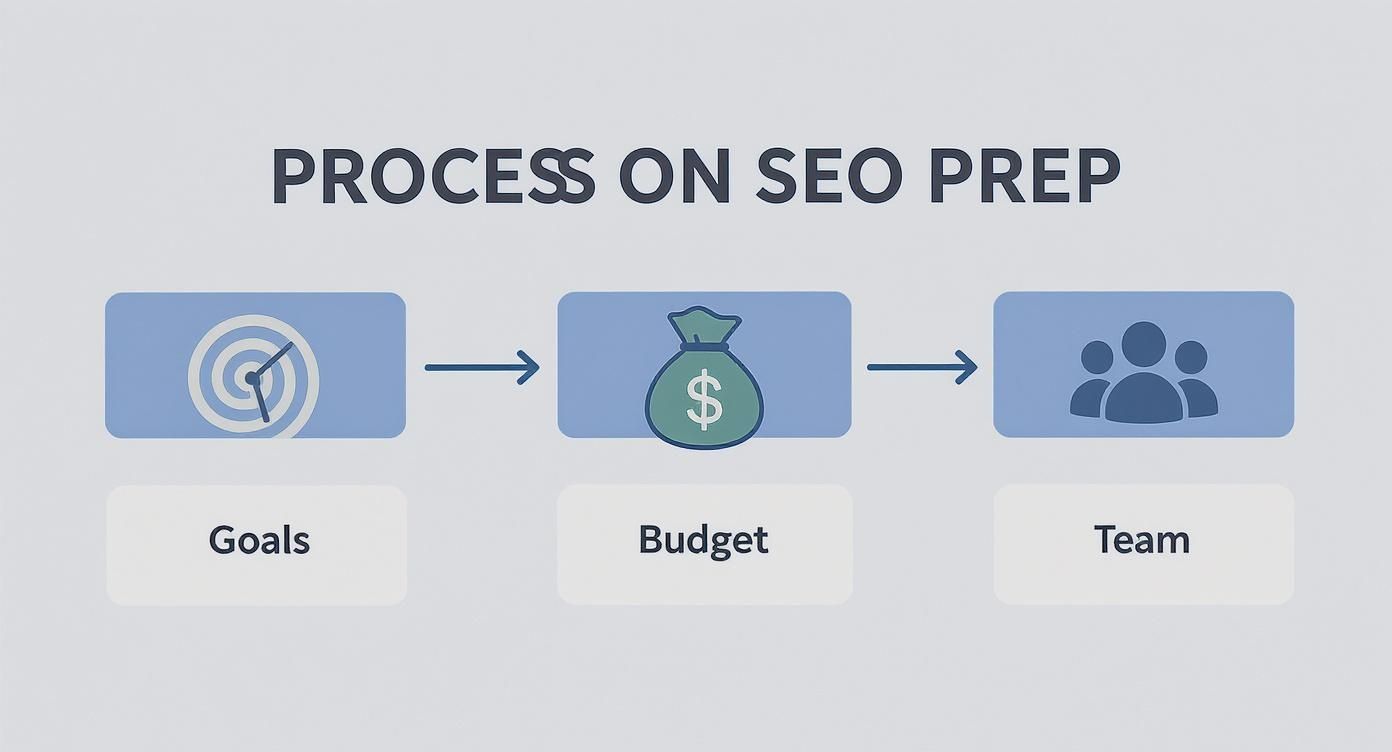
But before you start grilling agencies, you need to have your own house in order. Getting your goals, budget, and internal team aligned is the foundation for making a smart choice.
Go Full Detective on Their Case Studies
Any agency worth considering will have case studies ready to go. Your job is to analyze them like a detective, not just skim them. Don't get star-struck by big-name client logos; the devil is in the details, and you need to find examples relevant to your business.
When you're digging into a case study, ask these questions:
- Is this even relevant? Did they deliver results for a business similar to yours in size, industry, or model (e.g., local service vs. national e-commerce)? Success in one area doesn't always translate to another.
- How did they do it? A good case study breaks down the how. Did they focus on a massive technical SEO overhaul, a content marketing blitz, or a local SEO campaign? This reveals their core strengths.
- What was the timeline? How long did it take to see real movement? This is crucial for setting realistic expectations for your own campaign. SEO is a long game.
- Were the results actually meaningful? A jump in "impressions" is a vanity metric that doesn't pay the bills. Look for outcomes tied to real business goals, like a 50% increase in qualified leads or a 30% lift in organic revenue.
If an agency's case studies are vague, lack specific numbers, or can't explain the strategy behind the win, that’s a huge red flag. Real experts are proud of their work and eager to explain their process.
Talk to Real-Life References
Testimonials on a website are a nice touch, but they're hand-picked and polished. The unvarnished truth comes from speaking directly with current or past clients. A confident agency won't hesitate to connect you with a few references.
Once you get someone on the phone, don’t blow it with generic questions. Get specific:
- Communication: "How would you describe their communication? Were they proactive with updates, or did you have to chase them down?"
- Reporting: "What were their monthly reports like? Did they actually help you connect their SEO activities to your bottom line?"
- Problem-Solving: "Can you tell me about a time a challenge came up? How did the agency handle it?"
The answer to that last question is often the most revealing. How an agency handles bumps in the road says more about them than their highlight reel. For more ideas, our guide on how to choose a digital marketing agency has extra questions that are useful for vetting any marketing partner.
Gauge Their Transparency and Communication Style
An SEO partnership is doomed to fail without clear, consistent communication. As you talk with them, pay close attention to how open they are about their methods and workflow. A great partner should feel like an open book.
You’re looking for clarity on a few key things:
- Project Management: What tools do they use (like Asana, Trello, etc.)? Will you have visibility into tasks and progress, or will you be left in the dark?
- Reporting Cadence: How often will you get reports? Monthly is standard, but what KPIs do they track, and can they explain why those metrics matter to your business?
- Key Contacts: Who is your day-to-day point person? How often can you expect to have actual strategy meetings?
This stuff matters. Data shows that SEO leads have a 14.6% close rate, which blows the 1.7% from outbound leads out of the water. That means leads from search are 8.5 times more likely to convert. You need an agency that can clearly report on these high-value results and demonstrate their impact.
Evaluate Their Technical and Strategic Chops
Finally, you need to feel confident that they actually know what they're doing. Look for proof that they're masters of the three core pillars of SEO: technical, content, and authority (link building).
Here’s a quick checklist to help you probe their expertise:
- Technical SEO: Do they have a clear process for a technical site audit? Ask them to name the top three technical problems they usually find on a new client's site. Their answer will tell you a lot.
- Content Strategy: How do they handle keyword research? Can they explain how they map topics back to your business goals? Find out if they have in-house writers or if they outsource content—and to whom.
- Link Building: What’s their philosophy on earning links? They should be talking about quality, relevance, and outreach, not quantity. If they even hint at "black hat" tactics like buying links, run.
The Only Questions You Need to Ask a Potential SEO Agency
Going into a meeting with a potential SEO agency without a solid list of questions is like showing up to a final exam without studying. You might stumble through it, but you're probably not going to like the results.
The questions you ask are your single best tool for cutting through the sales pitch to see how an agency really operates. This isn't about grilling them; it's about having a real conversation to find out if they have the skills, strategy, and personality to be a true partner.
We're going to break down the essential questions into four critical areas: Strategy & Onboarding, Technical SEO, Content & Links, and finally, Reporting & KPIs. For each one, I'll show you what a great answer sounds like—and what a terrible one does, too.
Questions About Strategy and Onboarding
The first 90 days are everything. This period sets the tone for the entire relationship and shows you whether an agency has a proven process or if they're just winging it. You need to see a clear, methodical plan from day one.
The big question to ask: "What does the first 90 days of working together look like? Walk me through your process."
-
A great answer is a roadmap. They should immediately talk about performing a deep technical audit, digging into keyword research, and running a competitor analysis. They’ll mention setting up baseline reporting in tools like Google Analytics and Google Search Console so you both know the starting line. A smart agency will talk about finding "low-hanging fruit" for quick wins while building the foundation for a long-term strategy. It should feel organized and proactive.
-
A terrible answer is fluffy and vague. If you hear things like, "We'll dive right in and start optimizing your site," without any specifics, that's a huge red flag. Even worse is a promise of instant, unbelievable results in the first month. SEO is a marathon, not a sprint.
Questions About Technical Expertise
Technical SEO is the foundation of your house. If the foundation is cracked, it doesn't matter how great the paint job is—the whole thing will eventually have problems. An agency's handle on the technical side is a direct measure of their competence.
The big question to ask: "Can you walk me through your process for a technical site audit?"
You're not asking for a full audit right there in the meeting. You just want to hear them explain their methodology.
- A great answer will touch on specifics like:
- Crawlability and Indexability: They should mention checking
robots.txtfiles, XML sitemaps, and your site's index status. - Site Speed: You want to hear them talk about Core Web Vitals and the tools they use to measure and improve site performance (like PageSpeed Insights).
- On-Page SEO: This includes the basics like title tags and meta descriptions but also digging into internal linking structure and proper use of header tags.
- Structured Data (Schema): They should be able to explain how they might use schema markup to make your search results stand out.
- Crawlability and Indexability: They should mention checking
If they can't clearly explain their process or just skim the surface with basic on-page factors, their technical skills are probably too shallow. This is one area where you absolutely cannot afford to compromise.
Questions About Content and Link Building
Content and high-quality backlinks are the fuel that makes your SEO engine run. A sharp agency knows these two things have to work in perfect harmony. How they approach creating content and earning links tells you everything about whether they practice sustainable, "white-hat" SEO or take risky shortcuts.
The big question to ask: "What's your philosophy on earning links, and are there any tactics you absolutely refuse to use?"
Every SEO agency builds links. The difference between the pros and the pretenders is how they do it. You're listening for an answer that prioritizes quality and relevance over sheer numbers.
A solid response will be centered on creating genuinely valuable content that earns links naturally through digital PR and targeted outreach. They should sound excited about building your website's authority the right way.
The second half of that question is a gut check. A trustworthy agency will immediately tell you they never buy links, use private blog networks (PBNs), or participate in shady link schemes. Any hesitation or defensive posture here is a massive warning sign.
Questions About Reporting and Success Measurement
How will you know if any of this is actually working? You need an agency that ties its efforts directly to your business goals, not just vanity metrics. A report full of "impressions" and "clicks" is useless if it doesn't tell you if you're making more money.
The big question to ask: "Which KPIs will you focus on to show we're hitting our actual business goals, not just SEO metrics?"
This question reveals if they were actually listening to you earlier. Their answer should connect directly back to the objectives you care about, whether that's generating leads, driving e-commerce sales, or increasing phone calls.
- Good answers will include business-focused metrics like:
- Organic traffic growth to your most important money-making pages.
- The conversion rate of that organic traffic.
- The number of marketing-qualified leads from organic search.
- Ranking improvements for high-intent, bottom-of-the-funnel keywords.
- Share of voice or visibility growth compared to your top competitors.
If their answer is just, "We'll track your rankings and traffic," you need to push them for more. The right partner will be eager to prove how their work is making a real impact on your bottom line.
Agency Evaluation Scorecard
Once you've interviewed a few agencies, it can be tough to keep them all straight. This simple scorecard can help you compare them objectively based on the criteria we've discussed. Just score each agency from 1 (Poor) to 5 (Excellent) for each category.
| Criteria | Agency A (Score 1-5) | Agency B (Score 1-5) | Notes |
|---|---|---|---|
| Industry Experience | Do they get our business? | ||
| Strategy & Onboarding Plan | Was their 90-day plan clear? | ||
| Technical SEO Expertise | Did they explain their audit process? | ||
| Content & Link Strategy | Felt "white-hat" and sustainable? | ||
| Reporting & KPI Alignment | Do they connect SEO to business goals? | ||
| Case Studies & Results | Are their examples relevant and impressive? | ||
| Team & Communication | Did we click with the people? | ||
| Pricing & Value | Is the cost justified by the potential? | ||
| Overall Gut Feeling | Do we trust them to be a partner? | ||
| Total Score |
Using a simple tool like this helps remove some of the emotion and sales-pitch hype from your decision. It forces you to look at each potential partner through the same lens, making it much easier to spot the right fit for your business.
Decoding Proposals, Contracts, and Red Flags

You’ve done the hard work of vetting agencies and asking the tough questions. Now the proposals are hitting your inbox. This is the moment of truth, where conversations turn into commitments, and it's easy to get distracted by slickly designed PDFs.
But this is where you need to be the most critical. A good proposal isn't a sales brochure; it's a blueprint for your success. It should lay out exactly what they'll do, how they'll do it, and when you can expect it. Anything less is a sign you might be dealing with someone who's better at presentation than performance.
Breaking Down the Proposal
It’s tempting to flip straight to the price tag when you open a proposal. Resist that urge. Before you look at the cost, you need to scrutinize the actual plan. A solid proposal will clearly define the "what," "how," and "when."
Here's what to look for:
- Scope of Work: This is the most important part of the whole document. It needs to list exactly what's included—technical audits, keyword research, content creation, link building, reporting, the works. If it's not written here, you have to assume it's not part of the deal.
- Deliverables: What are you actually getting each month? Look for specifics like "one 2,000-word blog post," or "monthly performance report with analysis," or "technical implementation of schema markup." Vague promises like "ongoing optimization" are just not good enough.
- Timelines: A trustworthy agency will give you a high-level roadmap for the first 90 days and beyond. This shows they have a real plan and helps set realistic expectations for when you might start seeing some traction.
As you review, think about how they plan to show a return on your investment. Knowing how to calculate your marketing ROI is a huge advantage here, as it helps you weigh their financial ask against the outcomes they're projecting.
Navigating the SEO Contract
The contract is where promises become legally binding, so don't just skim it and sign. This is where a bad partnership can lock you in, so you need to pay close attention to the clauses that define your relationship.
A contract should protect both you and the agency. If it feels heavily one-sided in their favor, that's a massive red flag. Don't ever be afraid to ask for clarification or request changes to terms that make you uneasy.
These are the clauses you absolutely must review:
- Contract Length: Most good agencies will want an initial 6-12 month commitment. That’s pretty standard, as it takes time for SEO to show results. What you need to watch out for are auto-renewing contracts that trap you for another full year without your explicit go-ahead.
- Termination Policy: What happens if things just aren't working out? The contract should spell out the notice period (e.g., 30 days written notice) and any fees for ending the agreement early.
- Ownership of Assets: This one is huge. The contract must state, without a doubt, that you own all the work product. This includes content, Google Analytics accounts, and anything else created for you. You should never, ever have to fight to get your own property back.
Having a clear contract is just as fundamental to a healthy partnership as having a solid framework for measuring your digital marketing performance is to tracking your success.
Red Flags You Cannot Ignore
Learning to spot the warning signs is a skill that will save you thousands of dollars and months of headaches. Some red flags are subtle, but others are giant, waving banners telling you to run in the other direction.
If you see any of these, hit the brakes immediately:
- Guaranteed #1 Rankings: This is the oldest, most tired trick in the SEO book. No one can guarantee a specific rank on Google because they don't control the algorithm. Reputable pros talk about improving visibility and driving targeted traffic, not making impossible promises.
- "Secret" or "Proprietary" Strategies: A great SEO partner is an open book. If an agency claims they have a "secret sauce" they can't possibly explain, they're either using shady, black-hat tactics or, more likely, they don't have a real strategy at all.
- A Heavy Focus on Vanity Metrics: Be very skeptical of agencies that lead with fluff like "impressions" or rankings for keywords nobody is searching for. Real success is measured in leads, sales, and revenue—the stuff that actually impacts your bottom line.
- High-Pressure Sales Tactics: If you feel like you're being rushed to sign a contract because of a "limited-time offer," it's a classic tactic to stop you from doing your homework. A confident agency knows its value and will give you the time and space you need to make a smart decision.
Answering Your Top Questions About Hiring an SEO Company
Even after you've done all your homework, a few last-minute questions always seem to surface right before you're ready to make a decision. That's completely normal. Choosing an SEO partner is a big commitment, and you deserve total clarity before signing on the dotted line.
Let's run through some of the most common—and important—questions I hear from business owners. Think of this as your final gut check to make sure your expectations are in the right place and you're walking into this partnership with your eyes wide open.
How Much Should I Actually Budget for SEO?
This is the big one, and the honest answer is: it really depends on your goals, your industry, and how tough the competition is. A local bakery trying to show up in neighborhood searches is playing a completely different game than a national e-commerce brand fighting giants like Amazon and Target.
Instead of chasing a magic number, it's better to think in terms of investment and value. Good SEO isn't cheap because you're paying for expertise—strategy, technical skill, and a ton of time.
Here’s a general breakdown of what to expect:
- Entry-Level: For small businesses or purely local campaigns, budgets often start in the $1,500 - $3,000 per month range. This usually covers the foundational work, some content creation, and managing your local listings.
- Mid-Tier/Competitive Markets: If you’re in a more crowded space, expect to invest $3,000 - $7,000+ per month. This opens the door for a more aggressive content strategy, ongoing technical oversight, and serious link-building efforts.
- Enterprise/National Level: Large-scale campaigns can easily run $10,000 - $20,000+ per month, involving bigger teams and complex, multi-channel strategies.
The main takeaway here? Be very skeptical of suspiciously low prices. Bargain-basement SEO is a fast track to cookie-cutter tactics, weak results, or even Google penalties from outdated, risky methods.
Agency vs. Freelancer—Which Is the Right Choice?
This decision really boils down to what you need in terms of structure, resources, and scope. Neither one is automatically better; they just solve different problems.
An agency brings a full team to the table—you get a strategist, a technical SEO expert, a content writer, a link-building specialist, and an account manager. It's an integrated approach that’s perfect for complex projects or for businesses that need a wide range of skills under one roof. They offer established processes, accountability, and more firepower.
A freelancer, on the other hand, can be a fantastic choice if you have a very specific, targeted need, like a deep technical audit or a single content marketing campaign. They often provide more flexibility and can be more affordable. The trade-off is that you're relying entirely on one person's skill set and availability, which can be a gamble for a long-term, comprehensive SEO strategy.
How Long Until I See Real SEO Results?
Patience is probably the most underrated virtue in SEO. While you can sometimes see "quick wins" from fixing major technical errors in just a few weeks, meaningful, lasting results take time. SEO isn't a light switch you can just flip on; it’s more like planting a garden and nurturing it.
Here’s a realistic timeline for a brand-new campaign:
- Months 1-3 (The Foundation): This is all about discovery. The agency is doing audits, keyword research, competitive analysis, and fixing foundational technical problems. You might not see big traffic spikes yet, but this is the critical groundwork.
- Months 4-6 (Gaining Traction): You should start seeing some positive movement. Rankings for your target keywords will begin to climb, and organic traffic should show a steady upward trend as new content gets indexed and early link-building efforts kick in.
- Months 7-12+ (Building Momentum): This is where the real growth curve starts to steepen. Your site's authority is building, compounding the results. You should see significant, measurable increases in traffic, leads, and—most importantly—revenue.
Anyone promising you page-one rankings in 30 days is selling snake oil. Real SEO is about building a valuable, long-term asset for your business.
The digital world is also constantly shifting, especially with the rise of AI. While 86% of SEO professionals now use AI in their work, it's crucial to partner with a company that understands how to adapt. For instance, organic click-through rates for search results with AI overviews have dropped by 61% year-over-year, which means your strategy must evolve. Discover more insights about AI's impact on SEO.
Ready to stop guessing and start growing with a clear, data-driven strategy? The team at Up North Media combines expert SEO, custom web development, and strategic AI consulting to deliver measurable results for businesses in Omaha and beyond. Schedule your free consultation today!