

Your competitor’s trucks are in the same neighborhoods. They buy from the same suppliers. They probably offer similar warranties. Yet their website keeps producing estimate requests while yours mostly produces spam calls and vague “traffic reports.”
That gap usually isn’t about who “does SEO.” It’s about who built a system that turns local search demand into booked roofing jobs.
For seo for roofing companies, rankings matter. They just aren’t the finish line. A roofer doesn’t stay profitable because a page moved from position seven to position four. A roofer stays profitable because the right homeowner found the right service page, trusted the business fast, called from a phone, and booked an inspection before contacting three other contractors.
We use a different playbook for roofing clients because roofing demand isn’t steady. Some leads are planners comparing materials and timelines. Others are urgent storm leads who need help now. Your SEO strategy has to serve both, and it has to be measurable all the way through to revenue.
Why Most Roofing SEO Fails and How Yours Will Succeed
Most roofing SEO fails because it’s built around the wrong promise.
The usual pitch is simple: rank higher, get more traffic, win more business. That sounds fine until you look at what many roofing companies experience. 70% of roofing companies report dissatisfaction with their current SEO performance, often because expectations are unrealistic and providers underdeliver on what they promised (Aginto’s roofing SEO guide).
The pattern is easy to spot. A roofer pays for “SEO.” The agency sends reports about impressions, broad keyword movement, and blog posts nobody reads. Meanwhile, the sales team still depends on referrals, yard signs, and storm season luck.
What works instead: treat SEO like a lead acquisition channel, not a visibility trophy.
That changes how you make decisions.
If a page attracts traffic but doesn’t produce calls, form fills, or estimate requests, it’s not doing its job. If your Google Business Profile gets views but weak reviews and outdated photos, it won’t carry local trust. If your site looks fine on desktop but feels clunky on a phone, emergency leads bounce before they contact you.
The roofing companies that win usually do three things well:
- They target buyer intent: service pages focus on roof repair, replacement, inspections, storm damage, and emergency work instead of generic company messaging.
- They build local proof: reviews, job photos, service area pages, and clear location relevance show both Google and homeowners that the company is active nearby.
- They track business outcomes: they care about qualified leads, booked estimates, close rates, and revenue attribution.
That’s the shift. Stop asking, “Are we ranking?” Start asking, “Which search assets are producing jobs?”
The Unshakeable Foundation Your Website Needs
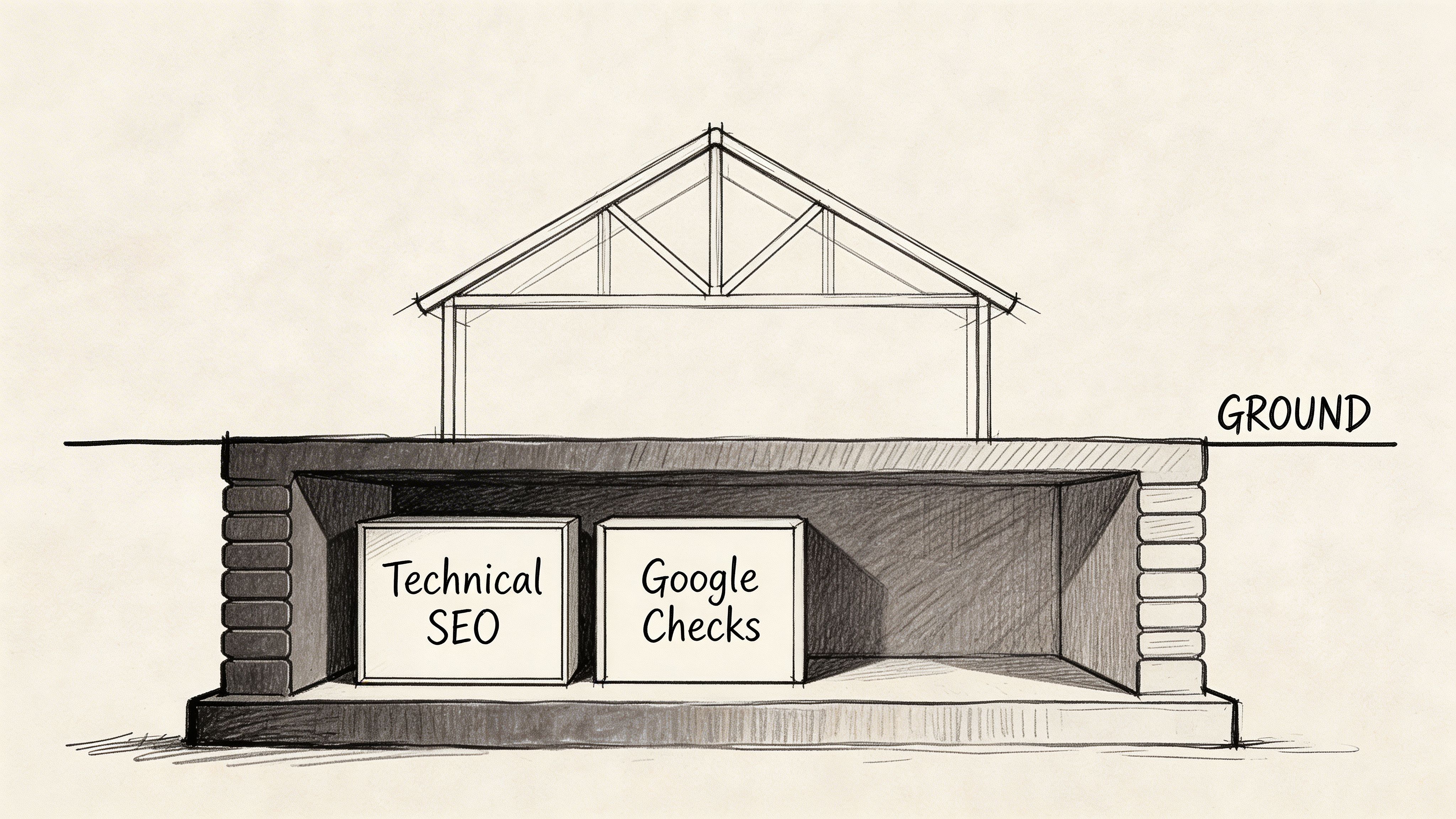
A roofing website has to pass the same test your crews pass on-site. If the structure is weak, nothing on top of it matters.
Right now, homeowners are searching from their phones while standing in their driveway, talking to insurance, or trying to stop an active leak. Over 60% of roofing-related searches now happen on mobile devices, and Google’s 2025 updates made mobile performance and fast INP essential ranking requirements (Ravenized on winning SEO strategy for roofers).
Mobile experience comes first
If your site is hard to use on a phone, your SEO ceiling is low.
The basics sound obvious, but a lot of roofing sites still miss them. Tap targets are too small. Quote forms are too long. Menus hide core services. Before-and-after galleries load like a slideshow from another decade.
We look for a few practical fixes first:
- Clickable contact actions: phone buttons should stay obvious on mobile, especially on emergency service pages.
- Short forms: name, phone, address, service type, message. That’s enough to start the lead.
- Visible service paths: roof repair, replacement, storm damage, inspections, and commercial roofing should be easy to reach without digging.
Speed is a ranking issue and a conversion issue
Google changed the technical benchmark. INP now matters, which means users feel delays even after the page appears loaded.
In roofing, this hits service pages hard because they often carry oversized images, bloated page builders, chat widgets, and unnecessary scripts. We’ve recovered performance by removing unused JavaScript, converting image formats from PNGs to AVIF, and enabling server-side caching, which aligns with the site speed practices described in the Ravenized source.
If you need a plain-English breakdown of the performance benchmarks behind this, this guide on Core Web Vitals is a good starting point.
A slow roofing site doesn’t just lose ranking potential. It loses the homeowner who was ready to call.
Site structure should match how people buy
A clean structure helps both Google and users.
Good roofing architecture usually looks like this:
| Page type | Purpose | Example |
|---|---|---|
| Core service page | Captures main service intent | Roof repair |
| Emergency page | Converts urgent demand | Emergency roof tarping |
| Material page | Matches detailed research intent | Metal roofing |
| Commercial page | Separates buyer type | Commercial flat roofing |
| Location page | Adds local relevance | Roof replacement in Omaha |
Keep the navigation simple. Keep URLs readable. Keep each page focused on one clear intent.
When a website is technically stable, mobile-friendly, and easy to use, every other SEO effort works better.
Dominate the Map Pack Your Google Business Profile Playbook
For many roofing companies, the Google Business Profile drives more real lead activity than the homepage.
That makes sense. A homeowner searches “roof repair near me,” sees the map pack, checks reviews, scans photos, and calls one of the top options. They may never visit your site first.
Fill out the profile like it drives revenue
Too many roofers treat GBP like a citation. It’s closer to a storefront.
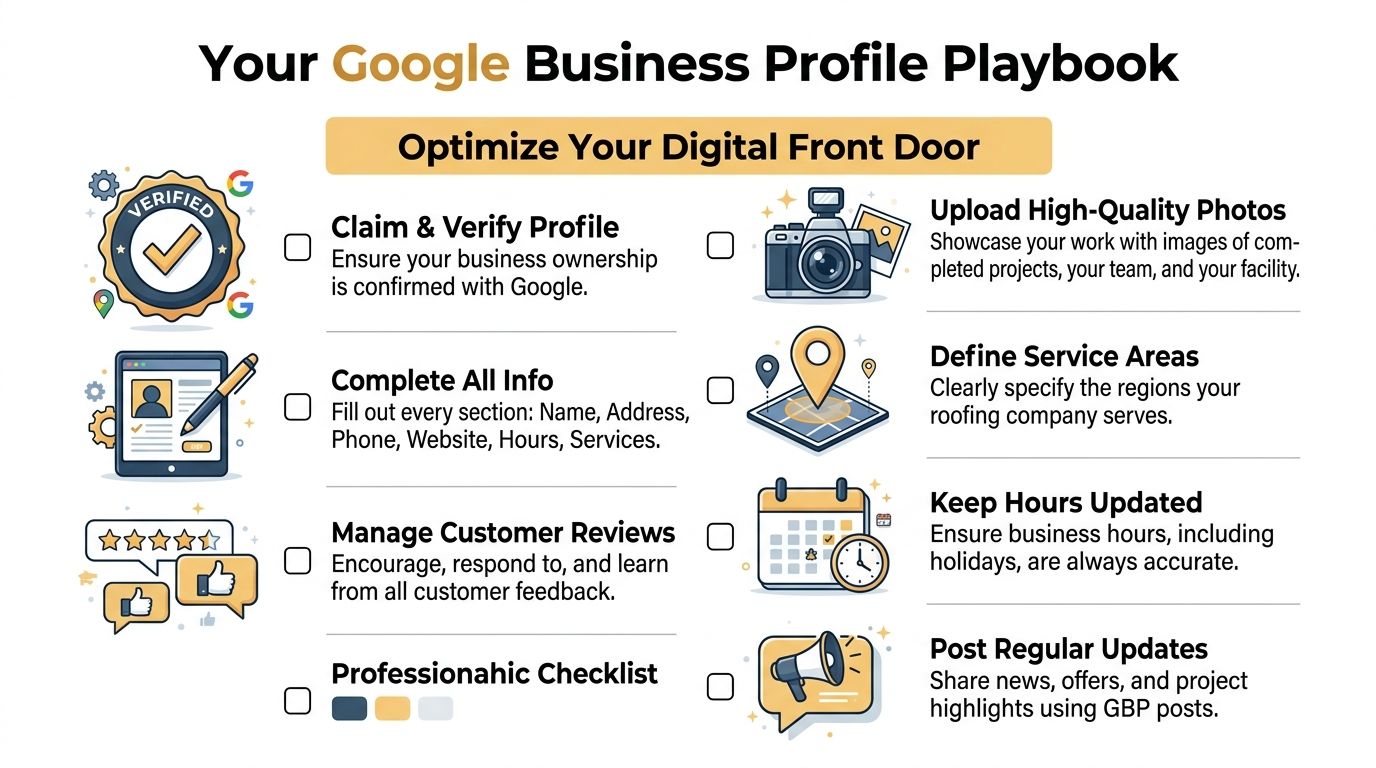
The profile should be complete, current, and active. That includes service categories, hours, service areas, project photos, review responses, and regular posts tied to real work.
The practical checklist is straightforward:
- Claim and verify it: ownership issues delay everything.
- Complete every field: business details, services, hours, and website data need to match your real operations.
- Define service areas carefully: don’t be vague about where you work.
- Show active job history: recent project photos tell both Google and customers that the business operates now.
Google’s local environment also changed. Google Business Profile now uses AI-generated descriptions, sentiment analysis of reviews, and geo-tagged job photos as ranking signals for the map pack, which means profile maintenance isn’t cosmetic anymore. It directly affects visibility.
A helpful companion read if you want a broader local search lens is Rocket Review’s take on how to boost your local visibility.
Reviews are not a side task
Review generation has to be operational, not occasional.
The best time to ask is right after a successful project handoff, while the homeowner still remembers the crew, communication, and result. Don’t wait until a week later when attention has shifted.
Good review workflows usually include:
- A text or email with a direct review link.
- A request from the project manager or office team.
- A follow-up if the customer was clearly happy but didn’t leave feedback.
- A response to every review, including the difficult ones.
Field rule: if your crews deliver a strong customer experience but nobody asks for the review, you’re leaving local authority on the table.
Review responses should sound human. Mention the service and location naturally where relevant. Don’t stuff keywords.
Later, when you want to go deeper into what shapes local visibility beyond the profile itself, these local SEO ranking factors are worth reviewing.
After your profile basics are in place, this walkthrough adds visual context for contractors who want to tighten execution:
Photos and posts separate active companies from stale ones
Most roofing profiles underuse visual proof.
Upload real job photos. Show before-and-after work, crews on-site, close-ups of materials, and finished roofs. Geo-tagged job photos matter in the current local environment, but even beyond rankings, they help homeowners trust that you do this work in their area.
Posts also help when tied to actual services:
- Storm response updates: availability for inspections or tarping
- Seasonal reminders: maintenance and inspection messaging
- Project highlights: short summaries with a location and service type
For seo for roofing companies, GBP isn’t support work. It’s one of the main conversion assets.
Content That Converts Storm-Chasers and Planners
Roofing demand comes from two very different buyers.
One is comparing shingle options, warranties, and financing months before making a decision. The other has water coming in through the ceiling and wants a crew scheduled today. If your content only speaks to one of them, you lose half the market.
Build pages around service intent first
Start with core service pages that match how homeowners search when they’re close to contacting someone.
For roofing, that usually means pages such as roof leak repair, emergency tarping, storm damage inspection, roof replacement, commercial flat roofing, and material-specific services. The page has to answer the immediate question fast: what you do, where you do it, why someone should trust you, and how to contact you.
Weak pages usually open with company history. Strong pages open with the service.
A high-performing service page should include:
- A direct opening: state the service clearly in the first lines.
- Proof: project photos, reviews, process details, certifications, or warranty context.
- Clear CTA: call, request estimate, book inspection.
- Practical detail: timelines, what happens next, insurance support if relevant.
For companies that need content production support, SEO blog content can help fill topic gaps, but only if the content maps to real buyer intent and local service demand.
Fewer location pages, better quality
A lot of roofing sites make the same mistake. They create dozens of near-duplicate city pages with swapped place names and almost no local proof.
That doesn’t hold up well. What works better is a smaller set of strong service area pages for the towns that produce revenue. Use local photos, local review snippets, and service-specific examples from those places.
The right location page feels like a local sales page, not a template with a city name inserted five times.
Useful elements on those pages include:
| Element | Why it matters |
|---|---|
| Local service headline | Matches search intent clearly |
| Area-specific proof | Shows you work there |
| Relevant photos | Supports trust and local relevance |
| Service CTA | Moves the visitor to contact |
| Internal links to service pages | Helps users reach the exact solution |
Storm-driven content is the edge most roofers ignore
Here, roofing SEO gets more interesting than generic local SEO.
Static content works for steady demand. Roofing also has event-driven demand. Searches for terms like “roof damage after hail” can spike over 200% within 48 hours of a storm, which creates a major opportunity for companies that prepared content in advance (SEO Mechanic on roofing SEO strategy).
Most roofers react too late. They wait for the storm, then ask for a new page, a blog post, a post on social, and maybe some ads. By the time those assets are live, the highest-intent search window has already started to close.
The better approach is pre-positioning.
Create storm-ready assets before the season:
- Emergency service pages: hail damage, wind damage, tarping, leak repair
- Town-specific storm pages: especially for priority service areas
- Short FAQ content: insurance process, inspection timing, temporary protection
- GBP post templates: quick updates when weather hits
Then, when a storm passes through, you update and publish immediately. You’re not inventing a response under pressure. You’re deploying one.
Serve planners without slowing down urgent leads
Planners still matter because replacements, material comparisons, and commercial work often involve a longer cycle.
Here, educational pages earn their keep. Build content around roof replacement timelines, material options, inspection checklists, maintenance expectations, and signs a roof should be repaired versus replaced. The mistake is burying emergency leads inside that educational layer.
Keep your content paths separate:
- Planner content should guide visitors toward an estimate and build confidence.
- Urgent content should reduce friction and produce calls fast.
When both paths exist, your content system covers full-roof projects, emergency repairs, and storm demand without forcing every visitor through the same journey.
Build Authority and Trust with Strategic Outreach
Backlinks matter in roofing SEO, but most link building advice for contractors is terrible.
Buying random placements, spraying generic outreach emails, or chasing irrelevant directories won’t build durable authority. Local roofing SEO improves when reputable organizations, suppliers, and community sites can vouch for your business online.
That takes longer, but it works better. Building local authority is a consistent process that often takes 2 to 6 months of content and relevant local backlink acquisition to establish trust with search engines (Portland SEO Growth on SEO for roofing companies).
Start with real business relationships
The easiest outreach opportunities are usually already in your orbit.
Think about the non-competing businesses your team already interacts with. Real estate agents, home inspectors, restoration companies, property managers, insurance-focused service providers, and local builders all have reasons to refer a trustworthy roofer.
Good outreach looks like this:
- Offer reciprocal value: a referral page, co-branded resource, or local homeowner guide
- Keep the ask simple: a link from a partner page, vendor page, or community resources page
- Use actual context: mention the relationship or shared market, not a copy-paste pitch
Supplier and manufacturer mentions are high-value
Roofers often overlook one of the most relevant link sources available to them: suppliers and manufacturer networks.
If your company is certified, preferred, or featured by a brand or distributor, ask whether they maintain contractor listings, installer directories, project spotlights, or partner pages. Those links make sense topically and help reinforce your roofing expertise.
A short email works well:
We’re updating our local digital presence and noticed our contractor profile could use a direct link to our site. If your team maintains installer or certified contractor pages, we’d appreciate being included there.
Simple, specific, and legitimate.
Local PR beats generic outreach
Roofing companies have stories worth publishing, especially after storm events or community projects.
If you complete notable repair work after severe weather, donate labor, help a local nonprofit, or provide expert advice during a major weather event, local publications may want commentary or a feature. That can produce brand visibility, referral traffic, and useful links.
A link is stronger when it comes from a real relationship or a real story.
You don’t need a huge campaign. You need a documented project, a few strong photos, and a short, clear explanation of why the story matters locally.
What not to do
Some tactics create more risk than value.
Avoid these:
- Mass guest post outreach: it rarely produces local relevance.
- Low-quality directories: if the site exists only to sell listings, skip it.
- Fake local partnerships: they’re easy to spot and weak long-term.
- Anchor text obsession: natural links from relevant pages matter more than forcing exact-match phrases.
For seo for roofing companies, authority comes from reputation translated into digital signals. If someone in your market would reasonably recommend you, that’s a link opportunity worth pursuing.
Tracking ROI and Measuring Real Business Growth
A roofing SEO campaign should end in revenue, not a prettier ranking report.
Yes, rankings matter. Top-3 positions drive 64% of clicks, and 64% of consumers only consider roofers with 4+ star ratings, but neither metric matters much if the traffic doesn’t turn into calls, estimate requests, and closed jobs (Triton Commerce on measuring SEO success for roofing contractors).
What to track every week and month
We build reporting around the path from visibility to revenue.
That means tracking search presence, lead capture, and sales outcomes together instead of in separate systems nobody compares. Google Analytics, Google Search Console, your call tracking platform, CRM, and GBP insights should tell one story.
Here’s a simple framework.
| Metric | What it Measures | Tool | Frequency |
|---|---|---|---|
| High-intent keyword rankings | Visibility for buyer-ready searches | Google Search Console, Ahrefs, Semrush | Weekly |
| Google Business Profile impressions and calls | Local map visibility and direct lead activity | Google Business Profile | Weekly |
| Organic landing page traffic | Which service and location pages attract search visitors | Google Analytics | Monthly |
| Form submissions | Lead volume from organic traffic | Google Analytics, CRM, form tool | Monthly |
| Phone calls from organic and GBP | Call-driven lead generation | Call tracking platform, GBP | Monthly |
| Qualified leads | Whether inquiries match your target work | CRM | Monthly |
| Estimate appointments | Sales pipeline impact from SEO | CRM | Monthly |
| Closed jobs attributed to organic search | Revenue outcome | CRM, sales tracking | Monthly and quarterly |
| Review volume and quality | Trust and local conversion support | Google Business Profile | Monthly |
| Page performance by service area | Which towns and services produce results | Analytics, Search Console, CRM | Quarterly |
The metric most roofers skip
Qualified lead tracking is where most roofing SEO reporting falls apart.
A campaign can produce plenty of “leads” that aren’t useful. Wrong service area. Small repair requests you don’t want. Low-intent price shoppers. Spam. If the office team doesn’t label lead quality in the CRM, SEO reporting becomes guesswork.
At minimum, label leads by:
- Service type
- Location
- Lead source
- Qualified or not qualified
- Booked estimate
- Closed won or lost
This is also the right place to document what happened after PR pushes or local announcements. If you use public announcements around major projects or community work, this guide on how to optimize press releases for SEO is useful because it ties visibility efforts back to search performance.
Hold your campaign to business standards
A roofing SEO program should answer questions your sales team cares about.
Which pages generated calls? Which towns are producing the best leads? Which services close fastest? Did storm pages produce booked inspections after weather events? Did review growth improve conversion from profile views to calls?
If your SEO report can’t connect search activity to pipeline movement, it’s incomplete.
One practical note here: if you need agency support, Up North Media offers SEO marketing for local service businesses, including roofing contractors, with a data-driven focus on qualified traffic and measurable outcomes. That only matters if the reporting is tied back to your CRM and lead handling process.
Rankings are the top of the funnel. Revenue is the scoreboard.
Frequently Asked Questions About Roofing SEO
How long does seo for roofing companies take to work
It depends on your market, your site condition, and how aggressive the local competition is.
Google Business Profile improvements can show movement faster than full-site SEO. Broader authority building and organic page growth take longer. If your site has technical problems, weak pages, or poor local proof, fixing those comes before strong results.
The bigger point is this: roofing SEO compounds. It usually starts with foundational fixes, then local visibility, then stronger service and area page performance.
Should roofers focus more on Google Business Profile or the website
Both, but not equally at the same moment.
If your GBP is incomplete, under-reviewed, or inactive, fix that first because it directly affects map pack visibility and lead flow. If your profile is healthy but your site has weak service pages, then your website becomes the limiting factor.
The strongest roofing campaigns use GBP for immediate local presence and the site for depth, conversion, and broader organic coverage.
How many service area pages should a roofer build
Build the pages you can support with real local proof.
A smaller group of strong pages is better than a large batch of thin duplicates. Focus on towns that matter to your business, then make those pages useful with photos, service details, and local trust signals.
Do blog posts still matter for roofing companies
Yes, when they support a real search journey.
Generic blog content about vague home maintenance topics won’t do much. Content works when it helps planners compare options, supports storm response, answers urgent questions, or strengthens nearby service pages.
What’s the biggest mistake roofing companies make with SEO
Treating SEO like a standalone marketing task.
SEO only works well when the website, GBP, reviews, sales process, lead tracking, and content strategy all support each other. If even one part breaks, especially mobile experience or follow-up speed, the whole system underperforms.
Can SEO help during storm season specifically
Yes. Roofing is one of the clearest examples of seasonal and event-driven search demand.
Companies that prepare storm pages, emergency service content, local proof, and rapid update workflows before severe weather hits are in a better position to capture urgent demand when it matters most.
If you want a roofing SEO strategy tied to leads, booked estimates, and measurable growth instead of vanity metrics, Up North Media can help you build the full system. That includes technical fixes, local SEO, service page strategy, storm-driven content planning, and reporting that connects search activity to real business outcomes.