
A page can rank for the target keyword, attract steady impressions, and still produce almost nothing for the business. The title promises a buying guide, but the page reads like a general explainer. A local service page answers broad questions but hides the phone number. A software pricing page ranks for “CRM pricing” while visitors are still comparing features, integrations, and implementation effort.
That gap is where search intent analysis earns its place. The task isn't to assign a neat label to a keyword and move on. It's to understand the searcher's job, the result format Google is rewarding, and the next action a visitor is likely to take. Done well, intent analysis produces sharper briefs, fewer overlapping pages, and calls to action that fit the visitor's stage instead of interrupting it.
Why Search Intent Analysis Changes Everything
I once reviewed an e-commerce category page that ranked for a broad product term. The page had solid technical SEO, relevant copy, and a respectable backlink profile. Yet the SERP was dominated by comparison guides and review pages, while the client's page pushed visitors directly toward a purchase.
The problem wasn't the keyword. The problem was the decision behind the keyword. Searchers wanted help narrowing options, but the page assumed they had already chosen a product. It was trying to close a sale before earning consideration.
Rankings describe visibility, not fit
A keyword spreadsheet usually reduces a query to volume, difficulty, and an intent column. That column is useful only when it changes what you build. “Informational” should lead to a different page experience than “transactional,” but even those labels can hide important distinctions. Someone searching “CRM pricing” may want a price list, a comparison of plans, help calculating total cost, or reassurance that a platform fits a small team.
Broder's foundational taxonomy separated queries into informational, navigational, and transactional goals. In that research, approximately 48% of queries were informational, 30% transactional, and 20% navigational according to the referenced academic discussion of search-intent research. Later work found that the proportions shifted by roughly 15 to 24 percentage points depending on subject category, which is the more useful lesson for practitioners. Intent changes with context.
Practical rule: Treat the keyword as a clue about the task, not a complete description of the person searching.
The diagnostic questions that matter
Before rewriting a page, ask:
- What does the searcher need right now? A fact, recommendation, destination, solution, or purchase path?
- What format does the SERP prefer? A guide, comparison, product listing, local result, video, or branded page?
- What would count as success? A click, a call, a quote request, a product selection, or a return visit?
- What adjacent need follows the first answer? Buyers often need setup guidance, pricing context, delivery information, or proof.
This approach changes content planning upstream. Instead of producing another article because a keyword looks attractive, you decide whether the query deserves a guide, a service page, a comparison, a tool, or no new page at all. It also exposes cannibalization earlier, because two pages targeting similar wording may serve different stages of the same search mission.
The benefit isn't a guaranteed ranking jump. The benefit is better alignment between the query, the page, and the business outcome. That alignment makes every later SEO decision more defensible.
The Intent Families That Actually Matter
The familiar three-way model remains useful, but it's too compressed for everyday content decisions. A practical taxonomy needs to distinguish someone comparing solutions from someone trying to complete a purchase, and someone seeking advice from someone merely collecting facts.
A workable set of intent families looks like this:
Informational intent
The searcher wants to understand something. Queries such as “what is technical SEO” or “how does a heat pump work” usually need a clear explanation, definitions, examples, and links to deeper resources.
Informational intent doesn't always mean a long article. A concise answer, calculator, glossary entry, or video may fit better. The SERP decides the expected format.
Navigational intent
The searcher has a destination in mind. “Acme login,” “HubSpot pricing,” or a branded service query usually calls for the right page, not a broad educational essay.
Your job is to remove friction. Use a clear title, prominent navigation, accurate brand language, strong internal links, and a direct path to the requested destination.
Transactional intent
The searcher is ready to act, although “act” doesn't always mean purchase. They may want to book an appointment, request a quote, subscribe, download a product, or choose a plan.
Product pages, service pages, pricing pages, and booking flows generally fit this family. The page should make the action obvious while answering the objections that could block it.
Commercial investigation
This is the comparison layer. “Best running shoes,” “CRM for small business,” and “MacBook Air vs Pro” indicate that the searcher is evaluating alternatives.
The right page usually includes selection criteria, meaningful differences, limitations, pricing context where available, and a recommendation framework. A generic product description fails because it doesn't help the reader decide.
Guidance-seeking intent
Guidance-seeking searches ask for practical help, troubleshooting, recommendations, or implementation steps. “How do I reset my password,” “which running shoe should I choose,” and “how do I set up a CRM” may contain informational and commercial elements at the same time.
This label matters because the user may not want facts alone. They want a path through a problem. A strong page gives them a sequence, decision points, warnings, and an appropriate next step.
Why fixed percentages don't transfer cleanly
Large-scale log studies demonstrate why universal assumptions break down. One analysis of more than 1.5 million queries found that over 80% were informational, with approximately 10% each navigational and transactional, while about 25% had vague or multifaceted intent as reported in the cited search-intent research. Another analysis of Google Australia logs found a substantially different distribution.
The figures aren't a contradiction to resolve with a new universal benchmark. They show that intent depends on the search engine, audience, topic mix, coding method, and period analyzed. Build labels around your customers and SERPs, then validate them against behavior.
Auditing the SERP Like a Real Practitioner
The SERP is often the freshest evidence available about how a search engine interprets a query. Before writing or rewriting a page, search the phrase in a clean browser context and record what appears above and around the organic listings.
Read the page as a collection of signals
Create a row for each query and capture:
- Top-ranking format: Articles, product pages, category pages, videos, tools, local listings, or brand pages.
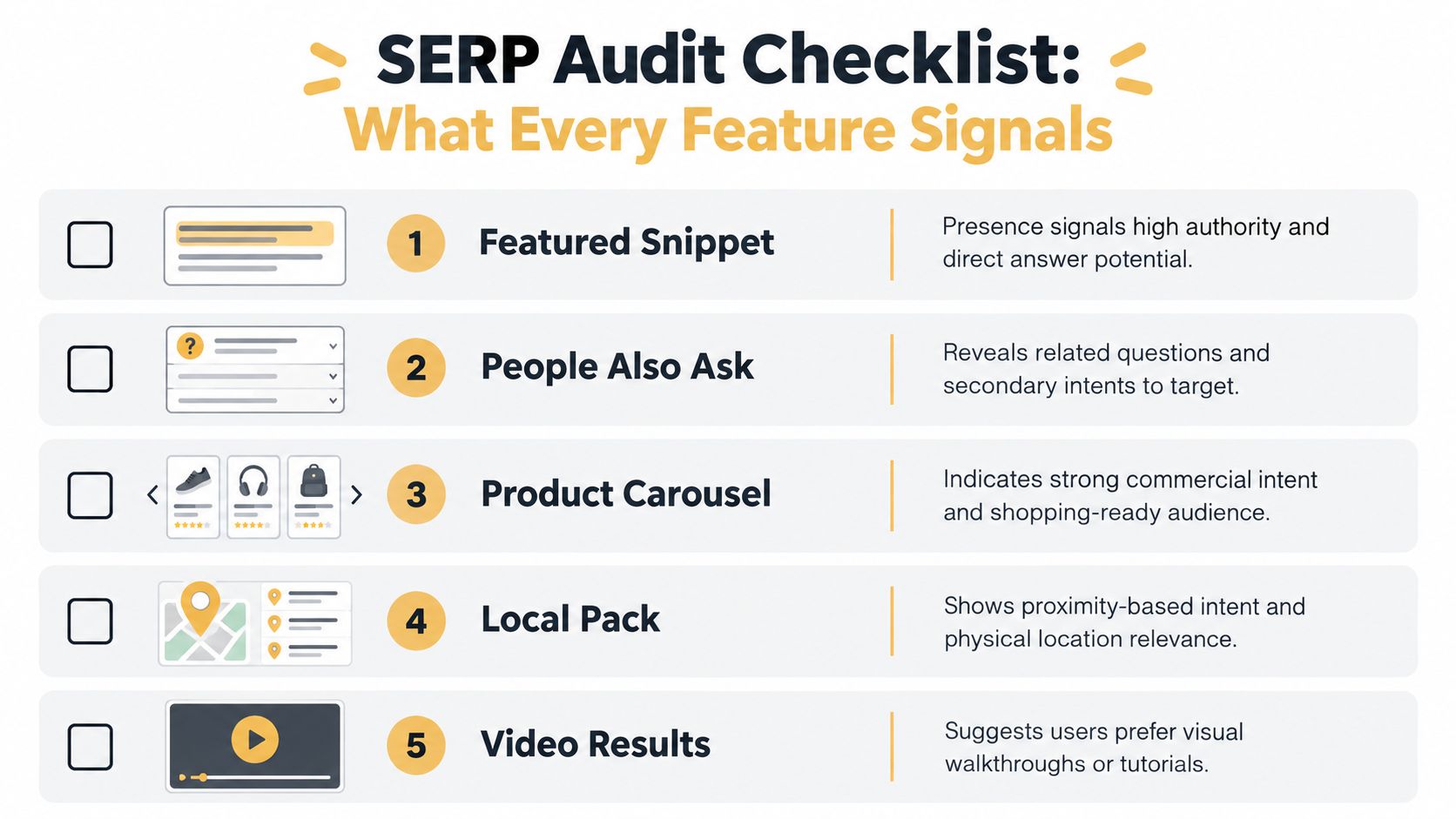
- SERP features: Featured snippets, People Also Ask, product carousels, image results, local packs, sitelinks, and AI Overviews.
- Title language: Words such as “best,” “guide,” “pricing,” “near me,” “login,” or “review” reveal the task being served.
- Content depth: Note whether ranking pages answer one narrow question or support a broader decision.
- Commercial presence: Record shopping modules, paid listings, product details, pricing, and calls to action.
- Geographic emphasis: Check whether the results prioritize maps, addresses, service areas, or local reviews.
A featured snippet suggests that a direct answer may satisfy part of the query. People Also Ask reveals related questions that can become supporting sections. A product carousel points toward shopping behavior, while a local pack signals proximity and location relevance. Sitelinks often indicate that the searcher expects a known brand or destination.
Find the dominant format, then look for exceptions
For a straightforward query, the top organic results often share a format. If the leading pages are comparison tables, publishing another generic explainer is a weak bet. If the results are service pages, an editorial article may struggle even if it contains accurate information.
Don't force certainty when the page is mixed. A SERP can contain guides, product pages, local results, and videos together because different searchers have different jobs. Record the mix instead of assigning a false single label.
For larger audits, collect the top queries from Search Console and group them by topic, landing page, and visible SERP pattern. A keyword gap analysis workflow can help expose topics where competitors serve a format your site doesn't yet provide.
When you need scalable SERP collection for a larger dataset, it helps to compare scraping tools for pipelines before choosing an approach. The goal isn't to automate judgment. It's to make the evidence easier to inspect.
A useful audit doesn't end with “informational” or “commercial.” It records what the searcher sees, what the ranking pages help them do, and where the business can meet that need more completely.
Tools and First-Party Signals Worth Trusting
A query can look informational in Search Console while the session reveals comparison or purchase intent. Tools help collect that evidence, but they do not resolve ambiguity on their own.
Start with Google Search Console. Export queries by page, review the wording that earns impressions, and compare pages attracting similar terms. Look for a mismatch between the query and the landing-page experience. A service page receiving impressions for “how to” searches may need an educational companion, clearer instructions, or a different internal-link route.
Use behavior to test the hypothesis
Server logs show which URLs search visitors request, whether they move between related pages, and where the session continues after the first landing page. Analytics adds engagement patterns. Heatmaps and session recordings can show whether visitors notice pricing, FAQs, calculators, booking controls, or comparison modules.
Read these signals as evidence, not verdicts:
- Short engagement with repeated returns: The visitor may lack enough detail or may be researching across sessions.
- Deep scrolling without conversion: The page may answer the question but present no credible next action.
- Visits to multiple related pages: The session may combine education with comparison or purchase intent.
- Interaction with tools and FAQs: The searcher may need guidance before deciding.
A first-party data process should define what gets collected, why it matters, and which content decision it will inform. A structured first-party data collection approach is more useful than recording every event without a hypothesis. Compare these behaviors with the SERP composition. If guidance pages rank beside service pages and users move from explanations to pricing, classify the query as mixed or guidance-seeking rather than forcing one keyword label.
Know where third-party tools help
Ahrefs can accelerate competitor and keyword discovery. Surfer and MarketMuse can help editors review topical coverage and page structure. These tools support scale, but recommendations still need a SERP review and a check of the page's conversion path.
AI classification can group large query sets for triage. One benchmark using 23,700 short queries across 150 intents reported that BERT reached at least 96% in-scope accuracy, while the best out-of-scope recall was only 66% in the cited benchmark. A production workflow therefore needs a low-confidence or out-of-scope route to manual review. That review should examine result formats and session evidence, not just the assigned category.
The same discipline applies to adjacent marketing data. A practical overview of LinkedIn analytics tools can help teams distinguish useful reporting functions from feature lists when comparing measurement platforms. The tool is secondary. Classification rules, observed behavior, and review quality determine whether the conclusion is useful.
Mapping Intent to Content That Converts
A page earns the visit when its first screen confirms the searcher's task. Match the title, H1, opening copy, page structure, and primary action to the dominant need shown by the SERP. Treat that need as a session signal, not a permanent label attached to one keyword.
| Intent family | Best page format | Primary CTA | Key on-page signals |
|---|---|---|---|
| Informational | Explainer, guide, glossary, or resource | Read a related guide or use a tool | Direct answer, definitions, clear headings, supporting internal links |
| Navigational | Brand, login, location, or service page | Visit, sign in, contact, or find a location | Brand clarity, prominent destination link, sitelink-friendly structure |
| Transactional | Product, category, pricing, booking, or service page | Buy, book, subscribe, or request a quote | Price or offer context, trust signals, availability, frictionless action |
| Commercial investigation | Comparison, review, shortlist, or alternatives page | Compare options or view a recommended solution | Evaluation criteria, honest trade-offs, tables, proof, next-step links |
| Guidance-seeking | Tutorial, troubleshooting guide, checklist, or decision aid | Start the next step or get tailored help | Ordered instructions, warnings, examples, FAQs, contextual tools |
Build the brief around the decision
For “CRM for small business,” give readers a way to compare fit, workflow, pricing structure, integrations, and support. For “how to reset a password,” put the steps near the top and include recovery options when the standard route fails. The format should reflect what ranking pages ask visitors to do, not what the keyword taxonomy predicts.
Write the title and H1 for the dominant task. Use sections and internal links for adjacent needs instead of forcing every modifier into the headline. A buyer should see relevant products before a category history, while a troubleshooting visitor should reach the fix before a sales pitch.
On-page signals reinforce the interpretation. Use descriptive headings, relevant schema where appropriate, concise summaries, comparison tables, accessible product details, and links that represent the next logical step. Internal links should support a progression from education to comparison to action. They should not scatter unrelated destinations across the page.
Paid and organic teams need the same separation between business value and apparent volume. Reviewing keyword research and bidding tactics can help clarify which queries deserve a landing page and which broad research terms should qualify visitors through useful content. A page built for a high-intent session needs a clearer action path than one serving early research.
Before publishing, compare the draft with the live SERP and ask:
- Does the format match the results searchers receive?
- Does the opening answer the primary task?
- Does the page offer a credible next action?
- Can visitors reach an adjacent need without returning to Google?
A content gap analysis can identify missing supporting pages, but a list of gaps is not a publishing queue. Create another page when the user journey, internal-link structure, or SERP composition shows that the existing page cannot serve that need well. Click paths and dwell patterns can confirm whether the proposed content supports the session or merely expands the site.
Handling Mixed Intent Without Breaking the Page
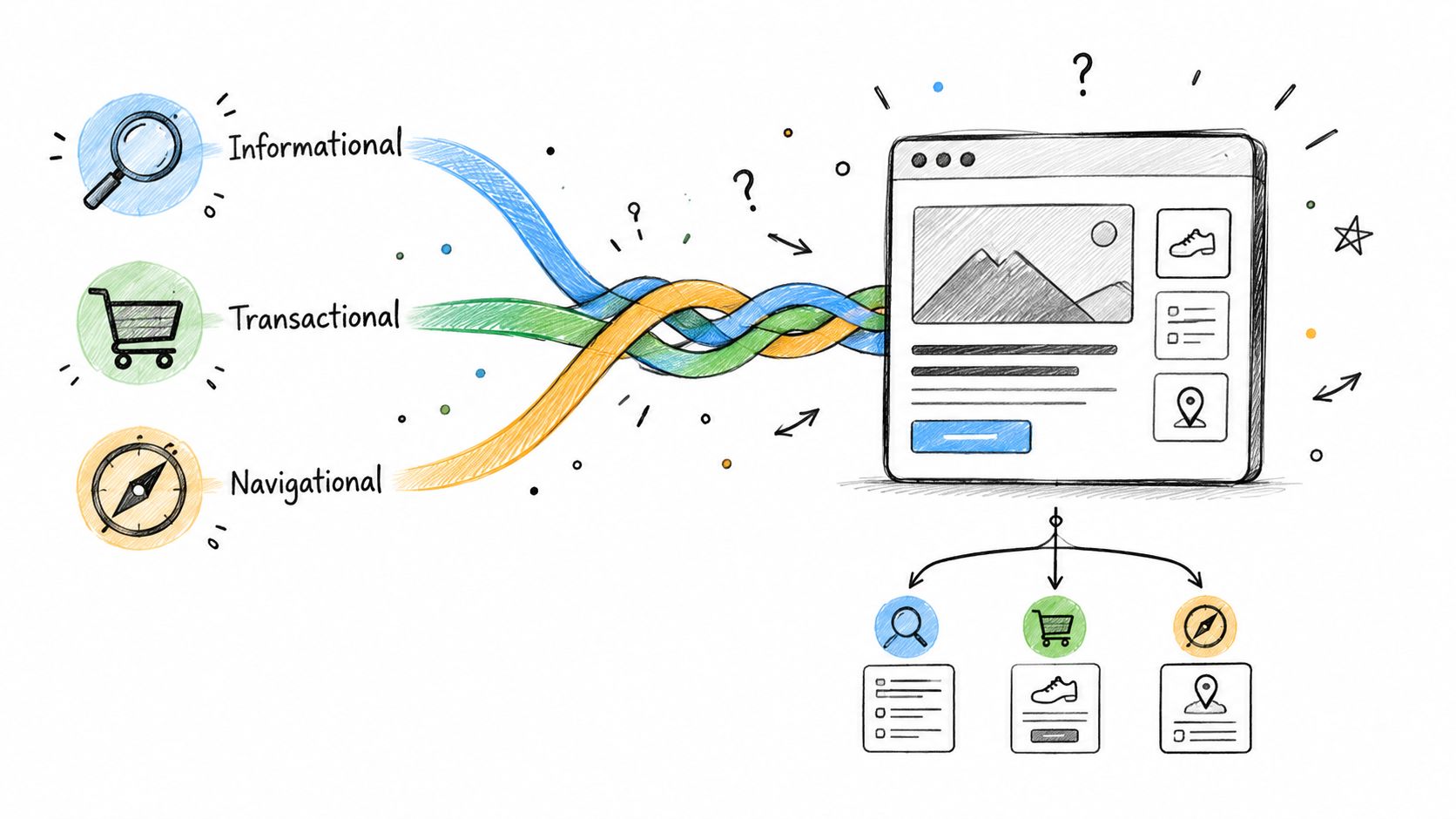
A page can attract visitors at different stages of the same session. Someone may begin with a definition, compare options, and then look for pricing or a booking path. Treating the keyword as a fixed label hides that progression and can lead to the wrong page structure.
Detect the session, not just the entry query
Review behavior across visits and connect the signals:
- Query reformulation: A visitor starts with a broad question, then searches for comparisons, brands, products, or providers.
- Page sequences: A guide leads to a comparison page, pricing page, service page, or booking form.
- Scroll and interaction patterns: The visitor reads explanatory sections, opens FAQs, uses a calculator, and returns later.
- Repeat visits: Buyers evaluating expensive or complex services may need several sessions before taking action.
- Assisted actions: A guide can influence a form submission even when it is not the final landing page.
Mission-level research supports using query sequences and interaction signals alongside the entry term. One study reported 69% overall accuracy and a 63% average F1 score when classifying mission intent, with informational and navigational missions exceeding 75% F1 in the cited research. The practical lesson is simple: isolated keywords discard useful context. You do not need a complex model to apply it. Group searches and page interactions into sessions, then check whether the sequence moves from understanding to evaluation to action.
Layer the experience deliberately
An e-commerce buying guide can explain selection criteria, provide a concise comparison, and link to relevant product categories. A local plumber's service page can describe the problem, confirm service-area relevance, answer urgency questions, and offer a call or quote request. A software implementation guide can solve the setup issue while pointing visitors toward plans, integrations, and support.
Keep one dominant purpose. Mixed intent does not justify adding every possible section. It means serving adjacent needs in an order that matches the session.
A mixed-intent page should have one primary route and several clearly signposted secondary routes.
Build the page from focused modules:
- Answer block: Resolve the immediate question near the top.
- Decision support: Add comparisons, criteria, examples, and limitations.
- Action module: Present the relevant product, service, booking, or contact path.
- Follow-up guidance: Link to setup, troubleshooting, pricing, or deeper education.
A page that tries to satisfy every need becomes unfocused, slow, and difficult to use. A page optimized too narrowly can send visitors back to the SERP just as they are ready to progress. Use the dominant SERP format as the starting point, then test it against query sequences, clicks, return visits, and dwell behavior. That combination shows whether the page supports the whole session or only captures its first question.
Measuring Impact When the SERP Keeps Moving
A click decline does not prove an intent mismatch. A SERP feature may answer the query before a visitor reaches your site, or the query mix may have shifted from action toward research. The useful question is whether the search session still progresses, not whether every impression produces a click.
AI-generated results make that diagnosis harder. In U.S. desktop data covering more than 10 million keywords, AI Overviews appeared for 6.49% of keywords in January 2025, rose to nearly 25% in July, and later fell below 16% by November as reported by Search Engine Land. Informational triggers represented 91.3% in January and 57.1% by October, while commercial and transactional triggers expanded. Pew found that 58% of tracked users encountered at least one Google search with an AI summary in March 2025. Users were less likely to click conventional result links when a summary appeared.
That shift makes click-through rate a partial signal. Compare it with query composition, SERP features, engagement, return behavior, and business outcomes.
Separate visibility, engagement, and revenue
A useful dashboard connects three layers:
| Layer | Questions to answer | Example measures |
|---|---|---|
| Visibility | Are we present for the right missions? | Impressions, rankings, SERP features, branded searches |
| Engagement | Does the page help the visitor progress? | Scroll depth, tool use, repeat visits, engaged sessions |
| Revenue | Does the journey support the business? | Qualified forms, calls, bookings, purchases, assisted conversions |
Segment these measures by intent family, landing page, device, location, and query group. A fall in organic clicks alongside stable branded searches and assisted conversions may indicate answer extraction or SERP cannibalization rather than a broken page. A simultaneous fall in engagement and conversions points more strongly to a content or intent mismatch.
For informational and guidance pages, immediate form fills are only one outcome. Check whether visitors use relevant tools, return to comparison pages, or later arrive through a branded query. Those behaviors can show that the page helped the session even when the first visit did not convert. Transactional pages deserve greater weight on qualified actions, purchase completion, and revenue quality.
A practical rollout
Week one, audit and label. Export priority queries from Search Console, inspect their SERPs, group related terms, and record the dominant format plus secondary needs. Deliver a query-to-page matrix with confidence notes. Every priority query should have observable evidence rather than a guessed label.
Week two, rewrite briefs. Update titles, H1s, openings, page formats, internal links, and calls to action. Add adjacent guidance only when SERP composition or session behavior supports it. Deliver revised briefs and an implementation queue. Each page should have one primary task and a clear secondary path.
Weeks three and four, measure and iterate. Establish a baseline before changes, then segment reporting by intent and page type. Review visibility, engagement, assisted conversions, and direct conversions together. Keep an iteration log recording each change and the evidence behind the next one.
Avoid three common mistakes:
- Static labels: Intent changes as topics, audiences, and SERPs change.
- Click-only reporting: AI summaries and other SERP features can reduce clicks without removing value.
- Single-snapshot decisions: Results vary by location, device, personalization, and time.
The strongest measurement system connects SERP composition with session behavior, then links both to a measurable business action. That approach shows whether a page attracts the right visitor, supports guidance-seeking behavior, and contributes to revenue even as the results page changes.
Up North Media helps businesses connect search intent analysis with data-driven SEO, conversion-focused content, and AI consulting. If your pages attract the wrong visitors or fail to turn qualified search demand into action, visit Up North Media to discuss a practical audit and growth plan.