
Your ads still run. Your analytics dashboard still fills with charts. Orders still come in. But something feels off.
Campaigns that used to be predictable now swing more wildly. Retargeting audiences look thinner. Attribution gets fuzzy. You spend more time second-guessing platform numbers and less time making confident decisions. For a lot of small businesses and e-commerce teams, that's the current reality.
The old model leaned heavily on rented visibility. Ad platforms, third-party cookies, and stitched-together audience data did a lot of work behind the scenes. That model is less dependable now. Privacy rules are tighter, browsers block more tracking, and business owners have to answer a tougher question than before: what customer data do we own and trust?
That's where first party data collection changes the conversation. It gives you a cleaner, more durable picture of who engages with your business, what they care about, and how to market to them without depending so heavily on someone else's system. For a smaller company, that matters even more. You probably don't have a data science team or a big martech budget. You need a practical setup that works with the tools you already use.
The End of an Era for Digital Marketing
A familiar pattern shows up in client conversations. Paid social gets harder to scale. Search costs rise. Email works well for existing customers but not enough new people make it into the list. Reporting platforms disagree with each other. Nobody is fully sure which campaigns deserve credit.
That frustration isn't random. Three changes have pushed digital marketing into a different phase: privacy regulation, browser-level signal loss, and pressure to prove efficiency. Businesses can no longer assume they'll have the same quality of outside data they had years ago. They need a direct relationship with customer information they collect themselves.
Why third-party-heavy marketing feels weaker now
If your strategy depends too much on platform tracking alone, you're building on rented land. The platforms can still help you reach people, but the data they pass back isn't as complete or as stable as many business owners expect.
That creates practical problems:
- Audience quality drops: Retargeting pools may not reflect everyone who engaged.
- Attribution gets messy: A sale happens, but the path to conversion looks incomplete.
- Optimization slows down: Ad systems learn from weaker inputs, so your spend gets less efficient.
- Decision-making suffers: Teams argue over reports instead of fixing the funnel.
Practical rule: If you can't explain where your customer data comes from, how it's captured, and where it lives, you don't control your marketing system.
What changes when you own the signal
First-party data puts control back with the business. Instead of hoping outside systems recognize the right person at the right time, you build your own base of known customer interactions through your website, store, forms, CRM, email list, support conversations, and purchase history.
For a local service company, that might mean quote requests, booked consultations, and email engagement. For an online store, it means product views, cart activity, purchases, reviews, and preference selections. For a publisher, it can include newsletter signups, content consumption, and subscriber behavior.
This isn't just a privacy topic. It's an operating model. The companies that adapt treat customer data like inventory they own, maintain, and use carefully. The ones that don't keep chasing missing signals and wondering why results feel less stable every quarter.
Understanding First Party Data
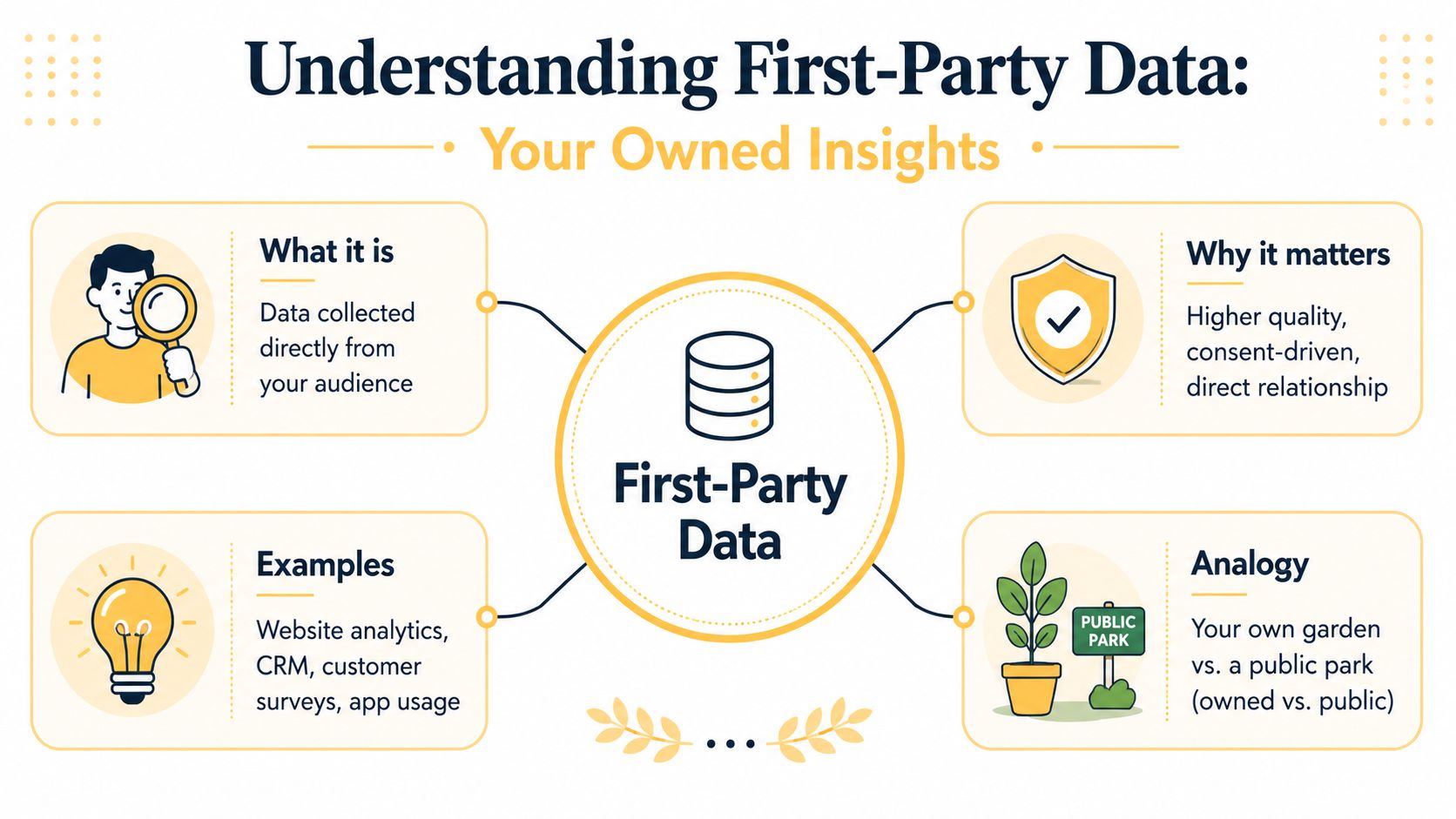
The simplest way to think about first-party data is this: it's information you collect directly from people who interact with your business.
A coffee shop owner doesn't need to buy a list to know that Maria orders an iced latte every Friday and James always asks about new beans. That owner learns through direct interaction. That knowledge is useful because it's current, relevant, and tied to a real relationship.
Online, the same idea applies. If someone visits your website, browses certain products, fills out a contact form, buys from your store, replies to a survey, or joins your email list, that information becomes part of your first-party data.
What counts as first-party data
This category is broader than many owners realize. It usually includes:
- Behavioral data: Pages viewed, products clicked, time on site, repeat visits.
- Transactional data: Purchases, average order patterns, returns, subscription history.
- Declared data: Form submissions, survey answers, preferences, quiz responses.
- Relationship data: Email engagement, CRM notes, support conversations, loyalty activity.
If you want a stronger handle on the behavioral side, this guide to user behavior analytics is a useful companion because it shows how on-site actions become decision-making inputs.
How it differs from second-party and third-party data
A lot of confusion comes from the labels, not the substance. Here's the practical distinction.
| Data type | What it means | Example |
|---|---|---|
| First-party | Data you collect directly | Your Shopify orders, HubSpot contacts, website events |
| Second-party | Another company's first-party data shared with you through a partnership | A co-hosted event partner sharing registrant data under agreed terms |
| Third-party | Data aggregated and sold by outside providers | Purchased audience segments from data brokers |
First-party data is usually the most useful for growing a real business because it comes from actual interactions with your brand. It's not abstract market data. It's evidence of intent.
Your best customer data usually comes from people who already raised their hand in some way.
Why first-party data is worth more
Not all data has equal business value. Owned data tends to outperform borrowed data because it's closer to the moment of customer intent. You're not guessing who might be interested. You're learning from people who already visited, clicked, bought, asked, subscribed, or replied.
That also makes it easier to personalize without being creepy. If a shopper viewed a category three times, sending a relevant follow-up makes sense. If a customer told you their preferences in a quiz, using that information improves the experience. Good first party data collection feels less like surveillance and more like listening.
The Business Value of Owning Your Data
A lot of businesses still treat first-party data like an admin task. Update the privacy policy. Add a cookie banner. Clean up the CRM eventually. That mindset misses the point.
Owning your data improves revenue decisions. It helps you spend less to acquire customers, market more precisely, and build repeatable systems that don't break every time a platform changes the rules.
What the numbers say
The business case is strong. High-performing organizations that have fully transitioned to first-party data strategies report a 37% reduction in customer acquisition costs and a 29% improvement in campaign ROI compared to peers still relying on third-party data, according to a 2026 analysis of over 4,200 B2B and B2C campaigns (first-party data marketing statistics).
For a business owner, the takeaway is simple. Better data doesn't just make reporting nicer. It changes unit economics.
Why ownership creates leverage
When you own the customer signal, you can do work that platforms alone can't do well:
- Segment with context: Separate new prospects from repeat buyers, high-intent visitors from casual browsers, and loyal customers from one-time purchasers.
- Personalize at the right level: Tailor product recommendations, reminder emails, and offers based on what someone did.
- Improve acquisition efficiency: Build better retargeting and suppression logic so you stop paying to message the wrong people.
- Protect future performance: If a platform changes its rules, your core customer data still exists in your own systems.
There's also a technical upside. Businesses investing in stronger storefront and systems integration often find that their website itself becomes a collection engine, not just a brochure. If your site is clunky, disconnected, or hard to customize, it's worth reviewing specialized ecommerce development services that can connect the front end experience with the data your marketing stack needs.
What doesn't work
Some companies collect data aggressively and still get mediocre results. The problem usually isn't volume. It's relevance and activation.
A bloated email list with weak consent is not an asset. A CRM full of duplicate records isn't a strategy. A dozen popups asking for information before a visitor trusts you will often hurt more than help.
Better first-party data starts with cleaner intent signals, not more form fields.
The most useful collection setups are selective. They ask for information at the right moment, tie it to a clear value exchange, and push it into systems where marketing and sales teams can use it.
Strategic Methods for First Party Data Collection
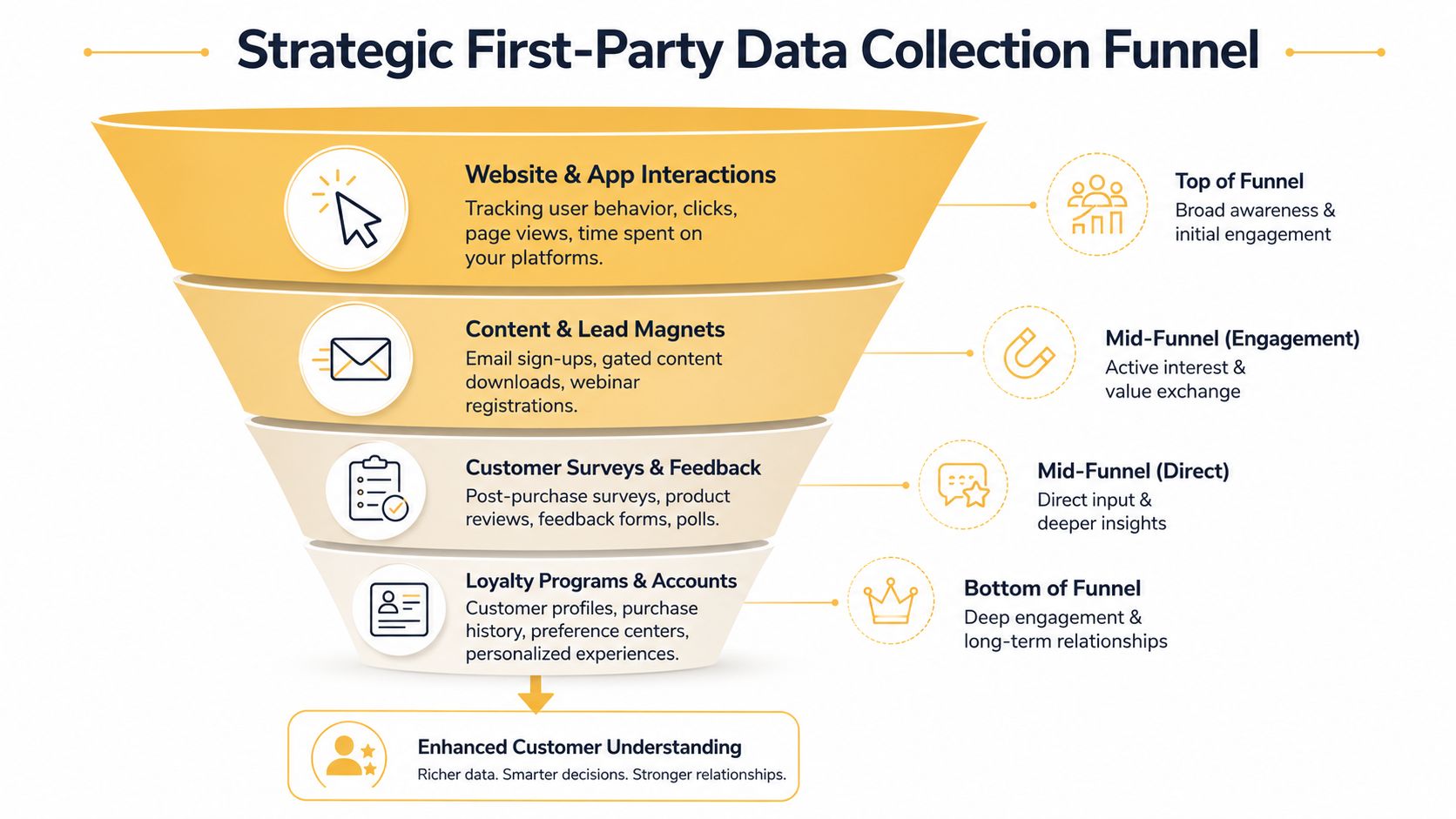
Small businesses don't need a massive architecture project to get started. They need a handful of dependable collection points tied to real customer actions. The smartest approach is to build across the journey, from casual visitor to repeat customer, instead of trying to gather everything at once.
Start with low-friction touchpoints. Then deepen the profile when the customer has a reason to share more.
Collection methods that are practical for SMBs
Here are the methods I'd prioritize first for most e-commerce and service businesses.
- Email signup with a real value exchange: Don't ask people to “join our newsletter” unless the content is truly useful. Offer buying advice, early product access, restock alerts, or a relevant educational series.
- Contact and quote forms: These capture declared intent. The key is to keep them short and route the data into your CRM immediately.
- Customer accounts: Accounts help you tie browsing, purchase, and preference data to an identifiable profile over time.
- On-site quizzes and finders: Product match quizzes, service fit checkers, and recommendation tools can collect preference data without feeling like a form.
- Post-purchase surveys: These reveal why customers chose you, what nearly stopped the purchase, and what they care about most.
- Reviews and feedback requests: These generate both conversion proof and customer language you can use in future messaging.
The collection method should fit the business model. A local med spa doesn't need the same setup as a DTC supplement brand. A B2B software company needs stronger lead qualification than a boutique apparel store.
The best rule is fair exchange
Customers will share information when the benefit is obvious. That exchange can be informational, transactional, or experiential.
| Collection point | What you get | What the customer gets |
|---|---|---|
| Newsletter signup | Email, interest category | Useful tips, offers, updates |
| Quiz or calculator | Preferences, needs, intent | Personalized recommendation |
| Account creation | Identity, order history | Faster checkout, saved info |
| Survey | Feedback, motivations | Better service, voice in product decisions |
That's why broad, generic data grabs usually fail. If your popup asks for an email with no clear reason, people ignore it. If your quiz helps them choose the right product or service, participation goes up because the interaction earns its place.
A stronger acquisition system often combines forms, content, and remarketing logic. If you want more ideas on that front, these lead generation strategies pair well with a first-party data approach.
This video gives a useful visual overview before you decide which collection points to build first.
Why behavior data matters so much
Declared data is useful, but behavioral data often tells you what people do. That's why event tracking on product views, cart actions, repeat visits, and content engagement matters.
Organizations utilizing first-party behavioral data demonstrate an 83% improvement in customer acquisition costs, a 78% increase in customer satisfaction, and a 73% rise in conversions, according to Forrester Consulting's 2024 research (first-party data benchmarks).
That doesn't mean every business needs a complicated setup on day one. It means your website and store should capture meaningful actions, not just pageviews. If a shopper compares three products and abandons the cart, that behavior is often more valuable than a broad demographic label.
Building Your First Party Data Tech Stack
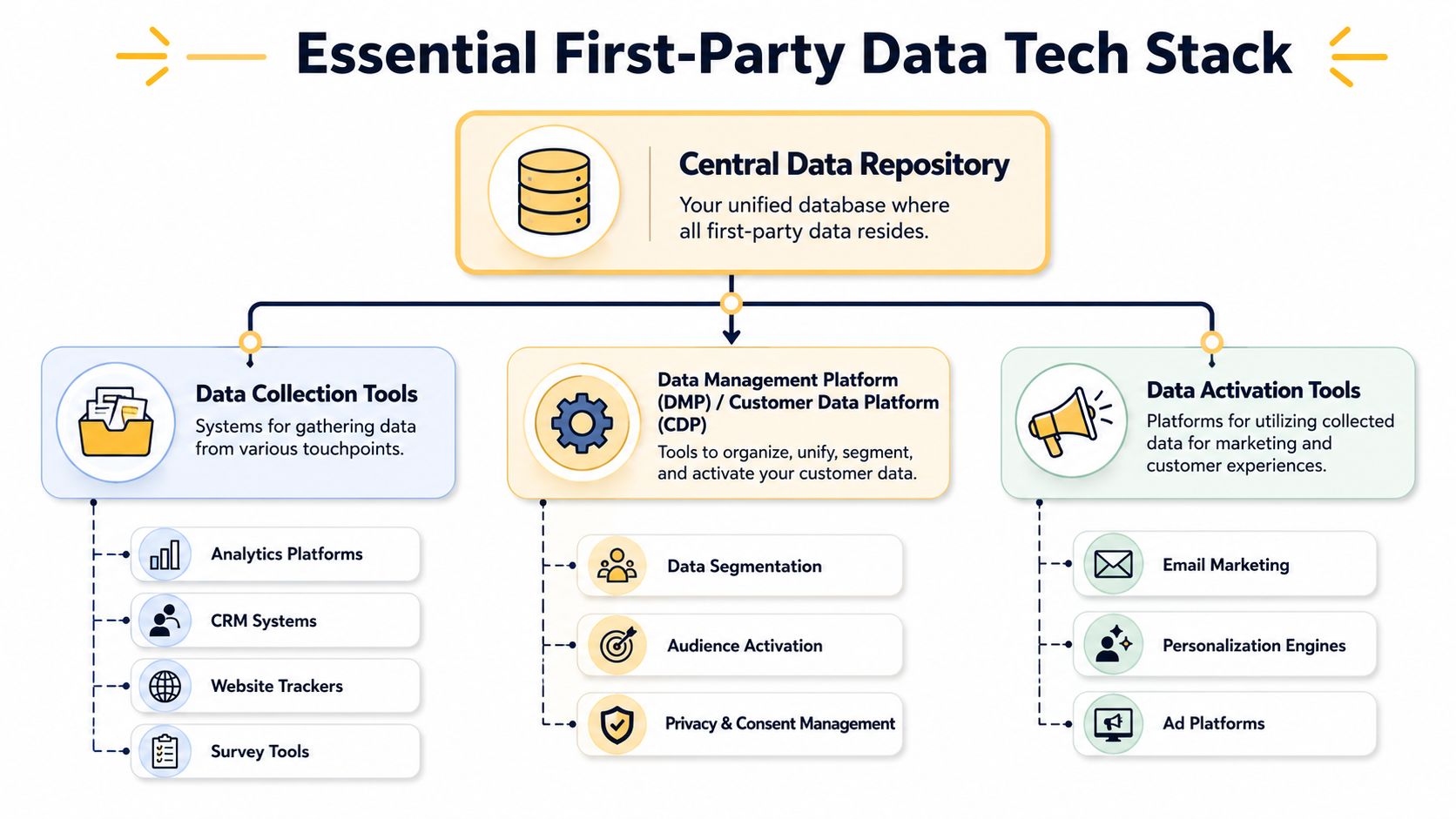
The term “tech stack” scares a lot of business owners because it sounds expensive and overly technical. In practice, your first stack can be simple. You need tools that collect data, store it, organize it, and send it where it can be used.
The easiest mental model is this: one tool remembers the relationship, one tool helps unify the signals, and one layer passes trustworthy events to the platforms you market through.
What each tool actually does
For most SMBs, these are the core categories.
- CRM: This is your relationship record. Tools like HubSpot or Salesforce store contacts, deals, lifecycle stages, and communication history.
- Analytics platform: This captures site and campaign behavior. Google Analytics is the common starting point.
- Email or marketing automation platform: This activates audiences through campaigns, segmentation, and follow-up flows.
- CDP or unification layer: This becomes useful when data lives in too many places and you need a cleaner customer profile across systems.
A CRM answers, “Who is this customer, and what do we know about the relationship?” A CDP answers, “How do we combine all the signals from multiple systems into one usable profile?” Smaller businesses can often delay a full CDP decision and start with strong integrations between ecommerce, CRM, analytics, and email.
If you're still deciding what tools should sit at the center of your operation, this guide on how to choose a tech stack is a practical place to compare trade-offs.
Why server-side tracking matters now
Traditional browser-based tracking misses data more often than many teams realize. Ad blockers, browser restrictions, and cookie expiration all get in the way. That's why more businesses are moving part of their first party data collection setup to the server side.
According to this explanation of a resilient first-party data strategy after cookies, a stronger setup uses CNAME architecture as part of a server-side collection layer, often paired with Server-Side Google Tag Manager, so event payloads are validated before being sent to platforms like Meta CAPI or TikTok Events API. The practical advantage is reduced data loss from ad blockers and cookie expiration.
Client-side tracking is convenient. Server-side tracking is more dependable when accuracy starts to matter.
A sensible starter stack
If you're early in the process, don't overbuild. A lean setup usually works better than a sprawling one.
- Website or store platform such as Shopify, WooCommerce, or a custom site.
- CRM to hold customer and lead records.
- Analytics for behavior tracking.
- Email platform for segmentation and campaigns.
- Server-side event setup when attribution quality becomes a real issue.
The mistake I see most often is buying advanced software before the business has a clear data flow. Tools don't fix strategy. They amplify it. If your form fields are messy, naming conventions are inconsistent, and nobody knows who owns the customer record, adding another platform just creates cleaner chaos.
Data Compliance and Management Best Practices
A good first-party data program is not just about collection. It's about permission, clarity, and maintenance. If customers feel tricked, you lose trust. If your records are stale, your targeting weakens. If your team can't explain how data is used, you create risk and confusion.
For most SMBs, compliance becomes manageable once you focus on a few plain-language principles.
The basics that matter most
Privacy laws like GDPR and CCPA can sound intimidating, but the practical expectations are straightforward:
- Get clear consent: Don't hide data collection behind vague language.
- Explain the purpose: Tell people what you collect and why.
- Give users control: Make it possible to update preferences or opt out.
- Store data responsibly: Limit access and keep records organized.
- Only collect what you can use responsibly: Extra data creates extra liability.
This is also good marketing. Businesses that are transparent about data use often create a better customer experience because people know what they're signing up for.
The cleanest way to build trust is to ask for less, explain more, and use the data well.
Data hygiene is where many teams fall short
Even with consent handled correctly, poor maintenance can undermine your strategy. Duplicate contacts, outdated preferences, disconnected systems, and inconsistent event names make segmentation less reliable.
The benchmark side of data health is useful here. Enterprise benchmarks for first-party data health require a coverage rate of 60–75%, a deterministic match rate of 80–90% to connect anonymous touchpoints to known profiles, and a freshness target of less than 7 days for active customer attributes to maintain profile accuracy (first-party data health benchmarks).
Most small businesses won't manage to those standards immediately, but the direction is clear. You want enough profile coverage to make segmentation useful, enough matching to connect interactions to people, and recent enough data that your campaigns reflect current behavior.
Practical do's and don'ts
| Do | Don't |
|---|---|
| Use consistent field naming across forms and tools | Create multiple versions of the same customer field |
| Review stale records regularly | Keep old preferences forever without validation |
| Sync key systems like CRM, store, and email | Let teams work from isolated spreadsheets |
| Document consent language | Assume one opt-in covers every use case |
Compliance becomes far less painful when it's built into the workflow. The same is true for data quality. Teams that treat cleanup as a recurring operating task do better than teams that save it for a quarterly emergency.
Your First Party Data Implementation Checklist
If you've read this far, the main risk isn't lack of information. It's trying to do too much at once. A working first-party data system usually starts small, gets cleaner, and expands after the basics prove useful.
Use this checklist as your first pass.
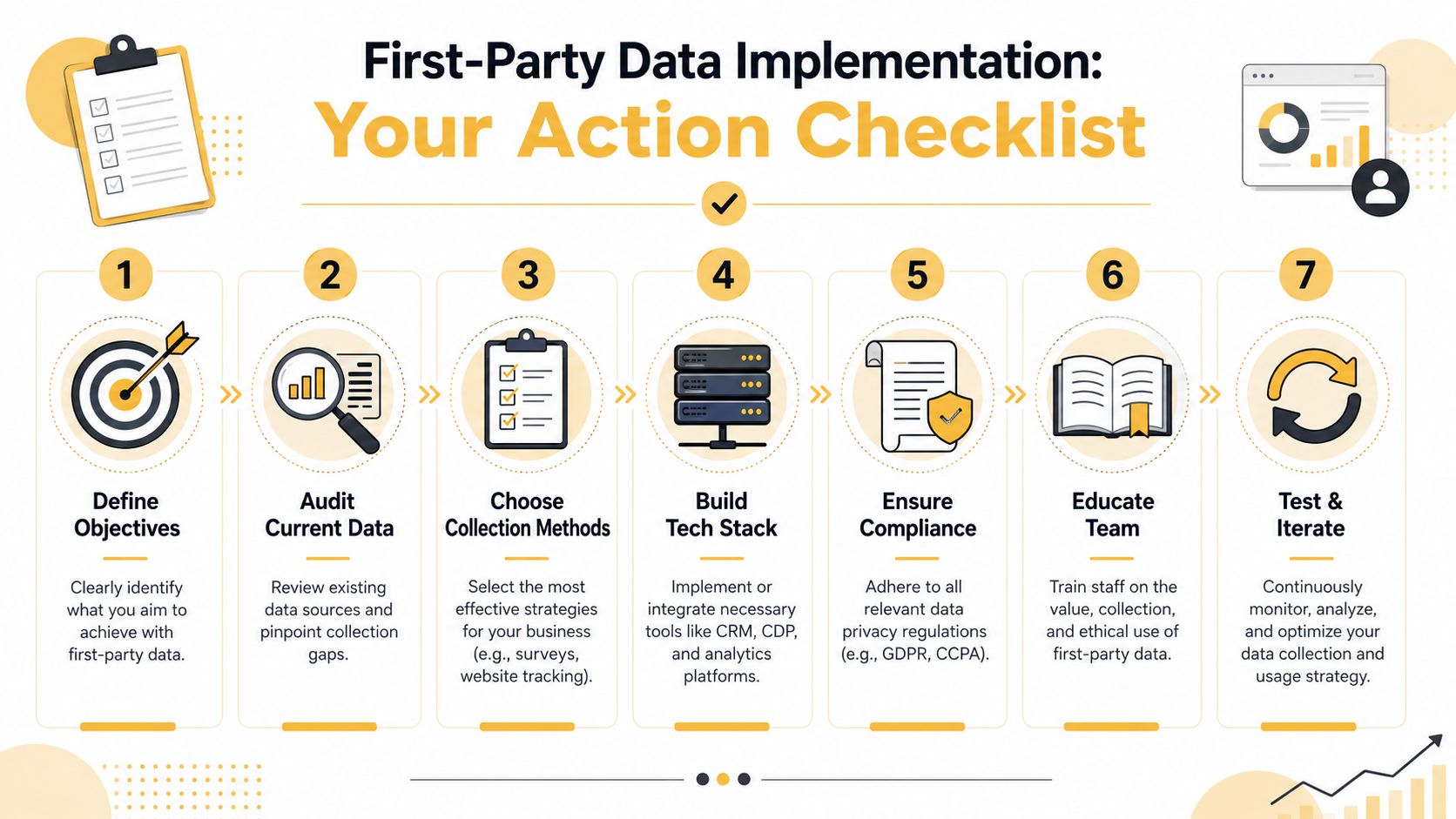
The seven steps that matter
-
Define one business objective first
Pick a clear outcome. Lower wasted ad spend. Improve repeat purchase marketing. Build a better lead follow-up system. Don't start with “collect more data.” -
Audit your current data sources
List what you already have. Website analytics, order history, form submissions, CRM contacts, email engagement, support inboxes, surveys. Most companies already own more useful data than they think. -
Choose two or three collection methods
Start with the touchpoints closest to revenue. For many businesses, that means signup forms, purchase behavior, and post-purchase feedback. -
Clean up consent and privacy language
Make sure forms, banners, and policies are understandable. If your developers need a practical reference, this comprehensive guide to GDPR for dev teams is a helpful technical companion. -
Set up a simple starter stack
Connect your website or store to your CRM, analytics, and email platform. Avoid adding extra software until the flow is stable. -
Create one audience segment you will use Example: repeat buyers, cart abandoners, or quote requests who didn't book. The point is activation, not storage.
-
Review and refine every month
Remove dead weight, standardize fields, and fix broken flows. First party data collection improves through repetition, not one-time setup.
What success looks like early on
Early success rarely looks glamorous. It looks like clearer follow-up, more relevant email messaging, fewer reporting arguments, and a customer record your team trusts.
That's enough.
The businesses that win with owned data usually don't start with a giant transformation. They start with one useful workflow, one clean segment, and one reliable source of truth. Then they expand from there.
If your business needs help turning scattered customer signals into a practical growth system, Up North Media can help you build the site, tracking, and strategy pieces together so your marketing runs on data you own.