
Most advice on keyword gap analysis starts in the wrong place. It tells you to compare against your business rivals, then wonders why the output is full of irrelevant terms, weak opportunities, and content ideas that never fit the SERP.
A better starting point is the search results themselves. Keyword gap analysis is the process of comparing your keyword rankings with the domains outranking you, so you can find terms they rank for and you do not, which exposes missing search queries and growth opportunities as defined in a practical SEO guide. That framing matters because actual competition in search is usually not the company you admire most, but the publisher, aggregator, niche blog, or comparison page taking the click.
Redefining Your Competitive Set
Business competitors and SERP rivals often differ. A direct market competitor may sell the same product, while a publisher can outrank you for the question your buyer asks first. Build the gap list from the wrong domains, and you optimize for a spreadsheet rather than the search result.
Start with the domains that win the query
Your comparison set should reflect the pages ranking for the target query family, not only the companies in your category. Search-focused guidance recommends using ranking domains as the benchmark because they expose missing intent variants, long-tail topics, and cluster opportunities that a business-only list overlooks Search Engine Land's gap analysis guide.
Practical rule: if a domain repeatedly appears for your target topics, include it in the analysis, even when it is not a commercial rival.
The workflow is also more structured than an older side-by-side audit. Keyword gap analysis now supports repeatable discovery across domains, subdomains, subfolders, and exact pages, depending on the tool as described in the Mangools overview. To broaden the tool shortlist before a deeper review, consult these SpyFu alternatives, particularly when comparing platforms built for competitive keyword research.
Treat the analysis as a search visibility exercise
The objective is not to collect terms that competitors rank for. It is to identify where the SERP contains a missing topic, an underperforming page, or a format your site has not addressed. Those are different problems and require different fixes. A missing topic may need new content, while an underperforming page may need stronger alignment, clearer structure, or better internal links.
Choose rivals by query and inspect the pages winning those queries. The result is a cleaner export, fewer false positives, and a more useful brief for content teams.
Teams often select a few familiar brands, export a large keyword list, and treat every difference as an opportunity. In practice, the wrong benchmark inflates easy wins and hides the content architecture work that closes the gap.
Building a Reliable Baseline Dataset
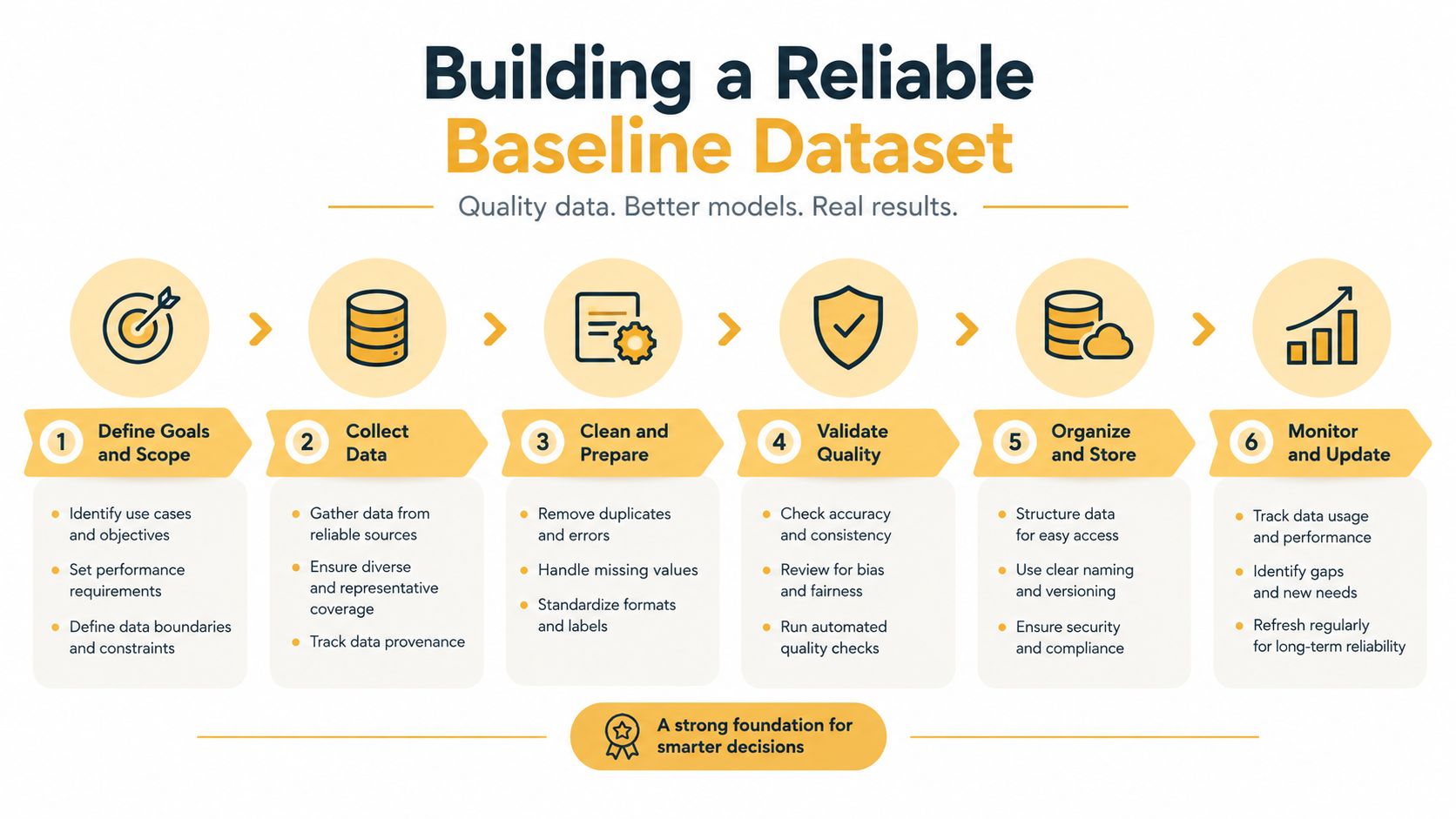
A useful baseline starts with controlled capture, not a giant keyword dump. Collect enough of each SERP rival's footprint to reveal recurring topics, while excluding weak queries, strange modifiers, and unstable fringe rankings. The purpose is to distinguish a missing topic from a page that already targets the topic but performs poorly.
Export for breadth, then cut for realism
Capture at least the top 500 to 1,000 keywords per competitor, then focus on positions 1 through 30. This range, recommended in Hashmeta's step-by-step guide, provides enough coverage to identify repeated themes without directing your team toward terms far beyond the site's current authority.
Configure the export before interpreting it. Tools such as SEMrush let you compare one domain with up to four competitors, then narrow results by location, difficulty, and the dedicated Missing tab as outlined in SEMrush's keyword gap documentation. Similarweb frames competitive data around the last 28 days. Apply the same recency logic here because search behavior shifts fast. A dated export can make an old SERP pattern look like a current opportunity.
Build a dataset your team can use
The baseline should answer three questions before it becomes a content brief.
- Who outranks us? Use the SERP rival set, rather than the competitor list from sales materials.
- Which rankings remain plausible? Keep attention on positions 1 through 30, not terms buried outside the working range.
- What needs human review? Filter by locale, intent, and difficulty before the spreadsheet reaches Slack.
Keep the seed-term process separate from the competitive comparison. A refresher on keyword research fundamentals can align the team before those inputs enter the gap dataset. Then label each result as a missing topic, an underperforming page, or a query that needs no action. Those labels prevent one export from producing identical recommendations for very different problems.
Lock the export format into a shared sheet template so every future gap run produces comparable columns.
A good baseline feels almost boring. That's a feature, not a flaw, because clean inputs make the strategic decisions obvious later.
Filtering for Intent and Attainability
A raw competitor export is not a to-do list. It is a pile of possible directions, and most of them should never become content. The filtering phase is where keyword gap analysis stops being a vanity exercise and starts acting like a prioritization system.
Sort by overlap, then by demand
Established tools now sort opportunities by how many competitors share the gap and by search volume, which makes the process more grounded because it prioritizes keywords with measurable demand and repeatable competitor overlap as documented by SEMrush. That is the right order of operations. If multiple relevant rivals are winning a query, the term is usually more than a one-off fluke.
This also helps separate real opportunities from opportunistic noise. A keyword with a single competitor ranking in an obscure position is much less compelling than a term shared across several relevant domains, especially when the search volume aligns with your commercial priorities. The overlap tells you the topic has survived in the market; the volume tells you it's worth the effort.
Use filters that reflect the site's current authority
A good filter stack is usually built around three gates.
- Intent gate: Keep the terms that match the page type you can realistically create, whether that is informational, commercial, or comparative.
- Difficulty gate: Remove terms that are so competitive they would distract the team for months.
- Volume gate: Drop terms with weak demand unless they clearly support a higher-value topic cluster.
That last point matters more than it seems. A low-volume term can still belong in the plan if it strengthens an important page, but it should not dominate the roadmap just because it looked neat in the export. Good filtering is about fit, not just volume.
Separate commercial queries from broad research terms
Intent discipline pays off. If a keyword screams education but your site only has product pages, the gap is not a keyword problem, it is a content-format problem. Teams that ignore that distinction often create pages that technically target the term but never satisfy the searcher.
Practical takeaway: if the query intent and the page type don't match, don't force the keyword into an existing brief. Reframe the page or exclude the term.
That's also why I prefer to review the surviving terms against the business model before anything gets assigned. A small set of high-fit gaps is more valuable than a large list of theoretically interesting phrases. When the list is filtered properly, the content team can move with confidence instead of debating every line in the export.
Mapping Gaps to Content Architecture
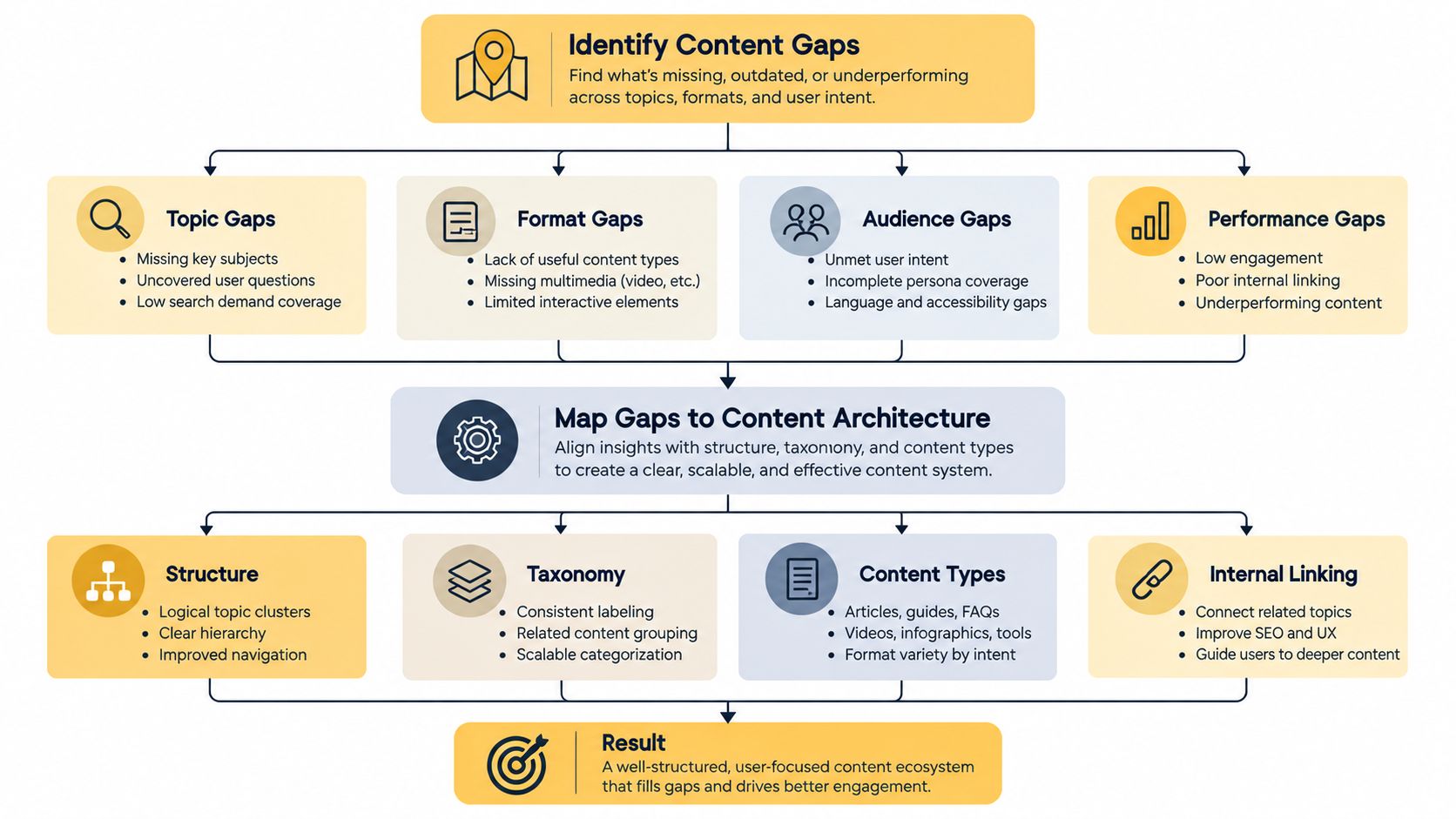
Not every missing keyword deserves a new page. Some gaps point to missing coverage, while others point to pages that already exist but underperform. Mixing those two problems together is how teams end up publishing duplicate content and cannibalizing their own rankings.
Decide whether the gap is missing or underperforming
Independent guidance now makes the distinction clearly. Missing keywords call for one type of action, underperforming keywords another, and the right fix may be to create new pages, refresh existing pages, or consolidate thin content for better topical dominance as explained by Nightwatch. That is the nuance many keyword gap articles skip, and it's the reason so many teams overpublish.
A missing keyword usually means you need new coverage or a new section in the cluster. An underperforming keyword usually means the page exists, but it's not good enough, not focused enough, or not internally supported enough. Those are different jobs for different parts of the team.
Map each surviving gap to a structural action
A practical routing process looks like this:
- Create a new page when the topic deserves standalone treatment and no existing URL can serve the intent cleanly.
- Refresh an existing page when the topic already lives somewhere on the site, but the page needs better depth, clearer intent matching, or stronger internal linking.
- Consolidate overlapping content when several thin URLs are competing for the same topic and confusing the site architecture.
The point is not to publish more. The point is to give each query the right home. That's where topic clusters start to matter in practice, because the cluster structure tells you which page should own the broad idea and which supporting pages should reinforce it. If your team needs a clearer framework for that mapping, topic cluster strategy is the right companion concept.
Thin content rarely deserves its own URL. If two pages answer the same search intent, one of them is probably hurting the other.
Keep the page architecture aligned with intent
This is also where many teams confuse “gap” with “content need.” A gap is only useful if it maps cleanly to a page type and a place in the site hierarchy. If it doesn't, the safer move is usually consolidation or expansion of an existing asset, not another isolated article.
The best architecture decisions are boring on purpose. They reduce duplication, strengthen topical signals, and make internal linking easier to maintain over time.
Prioritizing High-Impact Opportunities
Once the structural action is clear, the next question is what gets done first. That answer should come from opportunity size, implementation effort, and the likelihood that the page can move quickly enough to justify the work.
Use the highest-signal ranking bands first
Experts recommend prioritizing pages where competitors rank in positions 1 through 10 while your site sits outside the top 20, because those are the most actionable opportunities for immediate growth Moz's keyword gap guidance. That rule is useful because it points to terms where the search engine already understands the topic and your site is close enough to be relevant, but not yet visible.
The appeal here is obvious. You are not trying to win an impossible fight or chase a speculative term. You are targeting queries where the ranking gap is large enough to matter, but not so large that the page needs a full-site overhaul.
Compare quick wins with structural plays
A useful prioritization model usually weighs three things side by side.
| Decision factor | What to ask | What usually wins |
|---|---|---|
| Search opportunity | Does the topic have clear overlap with competitors? | Topics with repeatable competitor presence |
| Effort | Can the page be improved without a full rebuild? | Refreshes that unlock existing assets |
| Impact | Does the page support a meaningful business goal? | Pages tied to commercial or cluster growth |
That table helps teams avoid the trap of overvaluing easy work. A quick refresh may produce movement sooner, but a new pillar page may create a better long-term structure. The right choice depends on how much authority the site already has around the topic and how much surrounding support the page can get through internal links.
Score the list against resourcing reality
I like to assign every opportunity a simple label, not a complicated formula. Some items are refresh now, some are build next, and some are park for later. That keeps the backlog readable for content, design, and development teams.
The key is not to confuse urgency with importance. A term with high overlap and high relevance can still wait if the page requires engineering support you don't have this month. Likewise, a smaller page that sits one internal link away from a stronger topic cluster can sometimes move faster than a bigger initiative. The smartest roadmap balances both.
Executing Changes and Tracking Longitudinal Growth
Keyword gap analysis creates value only after the team changes pages and measures what happened. Keep the target keyword set connected to page edits, internal links, and reporting so performance can be judged across the same period.
A realistic implementation loop
A mid-sized ecommerce team I worked with had strong product pages but weak informational coverage. SERP rivals were capturing research traffic with guides and comparison content. We focused on pages that already had topical relevance, refreshed their content, added supporting internal links, and created new guides where no existing page matched the intent.
The measurement setup shaped the decisions. Historical tracking in the keyword-gap workflow can show whether a page keeps improving after an edit or only benefits from a temporary SERP shift. SEMrush documents historical comparisons in its keyword gap workflow. Historical rank tracking shows whether a page is climbing because the content improved, or whether it only received a short-lived bump.
Measure what changed, not just what was published
A useful reporting loop tracks three signals:
- Ranking movement: Did the target page reduce the gap against its SERP rivals?
- Coverage expansion: Did the site gain visibility across the relevant topic cluster?
- Operational follow-through: Did the team use the results to plan and ship the next changes?
Set a fixed review cadence. Review performance monthly during the first quarter after changes ship, then quarterly once the trend is established. This gives the trend line enough length to separate durable movement from isolated SERP noise.
Record the change date, affected URL, target terms, internal links added, and the next review date. Without that change log, teams can see a ranking movement but cannot connect it to a specific edit or distinguish content impact from unrelated market movement.
If analytics needs attention before the next release, analytics implementation can help confirm that the required tracking is configured before new content ships.
The best reports do not celebrate publishing. They show whether the page changed the search outcome.
A working process shifts stakeholder questions from “Which keywords are missing?” to “Which topic clusters and pages should we address next?” That distinction matters. Some gaps require a new page, while others point to an underperforming asset that needs clearer intent alignment, stronger internal links, or better coverage. Keyword gap analysis should guide content operations, not produce a larger spreadsheet.
If you want help turning SERP rival research into a practical content roadmap, Up North Media can map the gaps, review the architecture, and connect the work to measurable SEO outcomes. Visit Up North Media to discuss a keyword gap analysis built around pages with room to improve.