
You're probably in the middle of a familiar SEO headache. The team has published steadily, the editorial calendar looks full, and organic traffic still feels stuck. That's usually the point where content gap analysis stops being a nice-to-have and becomes the fastest way to see what your site is missing, what's underperforming, and why competitors keep showing up where you don't.
At its best, content gap analysis is a practical comparison between your current content and the topics, keywords, and questions your audience already cares about. In SEO terms, it's where you identify shortfalls across content coverage, keywords, links, technical health, and search visibility, while also separating direct competitors, indirect competitors, and SERP competitors so you're not benchmarking against the wrong sites (Brafton). That distinction matters because the page that outranks you might not be a business rival at all, it might be a forum thread, a news result, or a page answering a different intent.
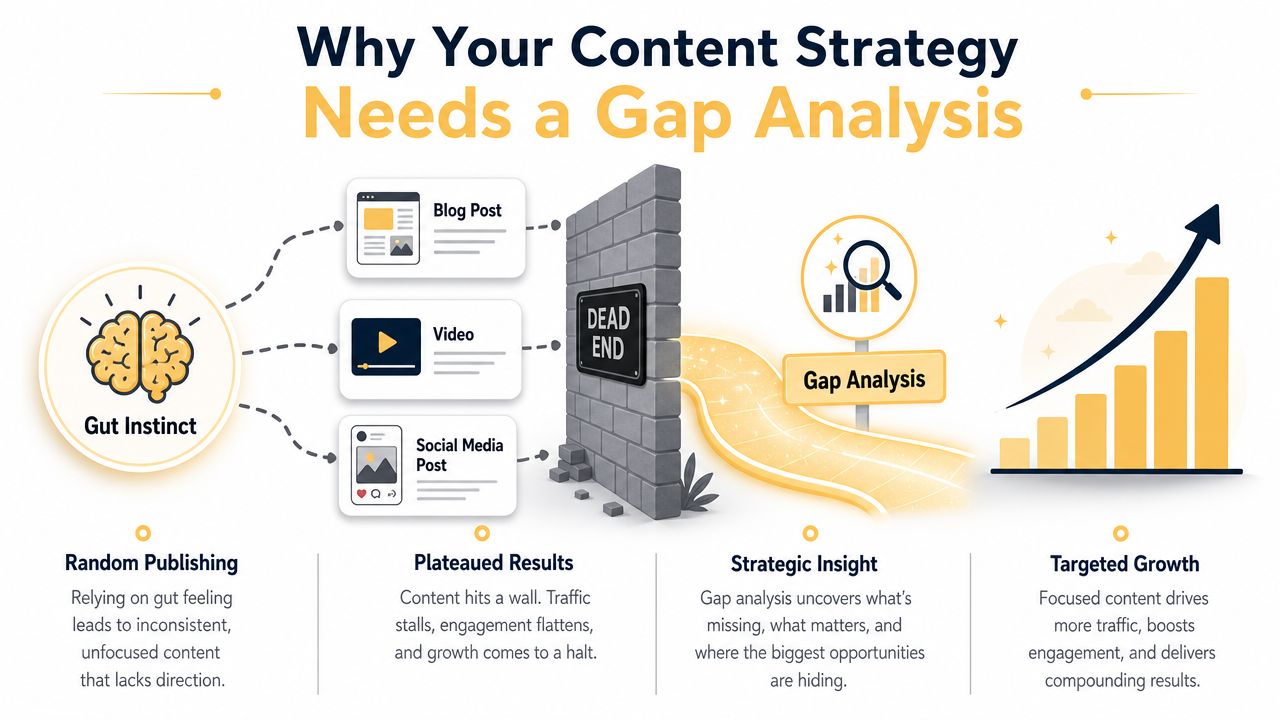
One useful way to think about it is to compare random publishing with targeted growth. A lot of teams create content because a topic is trending or because someone in the room has a hunch. A better approach is to connect the content plan to a structured gap review, then let the gaps tell you what to build, refresh, or consolidate. A good external example of how modern AI systems are framed around structured discovery, rather than guesswork, is how Veo3 AI uses generative AI, which is useful context for anyone trying to understand how machine-assisted workflows are changing content production.
Why Your Content Strategy Needs a Gap Analysis
A lot of content teams reach the same painful moment. The blog has a respectable publishing cadence, social posts are going out, and yet the traffic curve flattens. The problem usually isn't effort, it's coverage. The site is producing content, but not necessarily the content that matches how people search, compare, or decide.
That's where content gap analysis earns its keep. It gives you a diagnostic frame for spotting where your site falls short against other domains and against audience expectations. In practice, that means comparing the topics and questions your site already covers with the topics and questions people are finding elsewhere, including competitors, search results, and adjacent sites that win attention for the same intent.
The real value is coverage, not volume
A content strategy built only on new ideas tends to drift. One month it chases trend-driven topics, the next it reacts to a competitor's launch, then it pivots again when leadership wants more traffic. Gap analysis slows that churn down and replaces it with a clearer standard, what's missing, what's thin, and what needs to be updated.
Practical rule: if you can't explain why a topic belongs in your funnel, it probably shouldn't be the next page you create.
This also changes how you evaluate competition. A direct competitor may tell you which product or service topics you've overlooked. An indirect competitor may show you what buyers care about before they narrow to a vendor. A SERP competitor may reveal that the battle is happening in a featured snippet, a forum answer, or an AI summary, not on a traditional landing page.
A good analysis doesn't treat this as a one-time audit. It becomes a planning discipline, especially in markets where search visibility changes quickly and the same query can surface wildly different result types from week to week (Brafton). That's why teams that keep revisiting gaps tend to make better decisions about refreshes, new pages, and topic clusters than teams that just chase editorial instinct.
Building Your Content Inventory and Competitor Benchmark
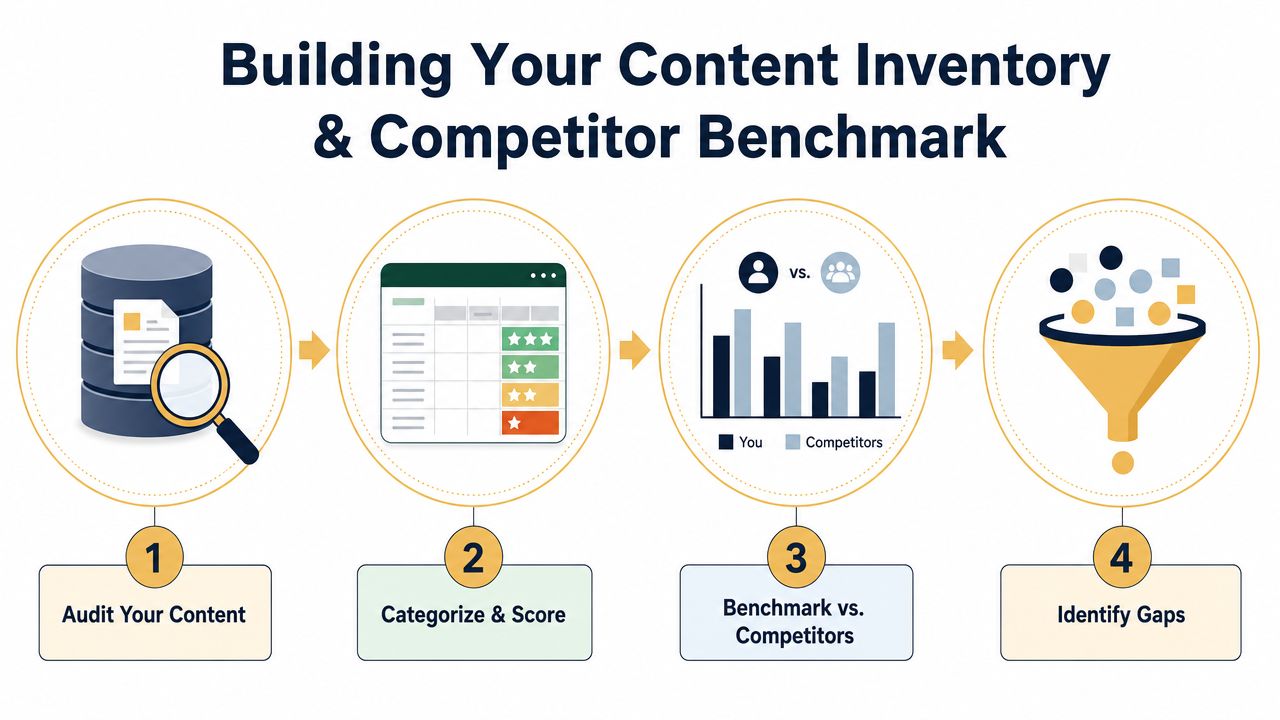
Before anyone can talk about gaps, the site needs a clean inventory. A spreadsheet full of URLs isn't glamorous, but it's the difference between a real analysis and a vague opinion about “what we've covered.” Start with each URL, page title, topic, content type, publish date, and last-updated date, then clean the sheet so every row represents one distinct asset (Moz).
Pick competitors that matter in search, not just in sales
The strongest benchmark set is usually 5 to 10 significant competitors that show up in your target SERPs, not just the names your sales team hears most often (Moz). That matters because search competition and business competition don't always line up. A local niche publisher, an aggregator, or a forum can outrank a better-known brand if it answers the query more directly.
Once the inventory is in place, compare it against those benchmark domains. Semrush's workflow is practical here because it explicitly supports comparing up to four competitor domains, then narrowing the analysis with a Top 20 position filter, a Very easy difficulty filter, and the Missing keyword view to isolate terms competitors rank for that your site doesn't (Semrush). That sequence is useful because it stops the analysis from becoming an endless keyword dump.
Best practice: group exported keywords by parent topic before you make any decisions. It removes duplicates, exposes topic clusters, and keeps the team from creating three pages for the same intent.
Use the benchmark to clean the list, not just enlarge it
The biggest mistake here is hoarding opportunities. A long export isn't a strategy. After you group terms by topic, split them into pages you already have, pages that need a refresh, and missing themes. That's the point where the spreadsheet starts turning into an editorial plan instead of a keyword museum.
For a broader competitor workflow that pairs well with this process, Up North Media's competitor analysis guide is a helpful companion.
If you're mapping the same inventory against a local niche, a service business, or a real estate vertical, the logic still holds. A focused resource like attract home sellers using SEO is a good reminder that the benchmark should always reflect the actual market, not a generic SEO template.
Scoring and Prioritizing Content Gaps by Business Value
Not every missing keyword deserves a page. That's the part a lot of content gap analysis articles gloss over, and it's where many teams waste the most effort. The useful question isn't, “What's missing?” It's, “What missing item is worth building now?”
A strong prioritization model looks at intent alignment, business value, content freshness, and effort required. A weak one overweights search volume and assumes that bigger demand always means better opportunity. In practice, some of the best gaps are small, high-intent pages that sit much closer to a purchase or lead action than a broad informational article ever will.
A simple way to score the list
Start by asking whether the gap is a new page, a refresh, or a cluster expansion. If you already have a page that's close, a refresh may beat a net-new asset. If the topic is adjacent to an existing pillar, a supporting page may do more for the site architecture than a standalone article.
Practical rule: when two opportunities look similar, prioritize the one that is closer to revenue and easier to make current.
| Criteria | High Priority | Medium Priority | Low Priority |
|---|---|---|---|
| Intent match | Directly supports a buying, lead, or comparison intent | Supports evaluation or consideration | Broad awareness only |
| Business value | Clear path to revenue, lead quality, or retention | Indirect business value | Weak or unclear connection to business goals |
| Freshness need | Existing content is outdated, incomplete, or factually weak | Content is accurate but thin | Content is current and competitive |
| Execution fit | Clear owner, clear brief, realistic turnaround | Some ambiguity in scope | High effort with limited payoff |
Quality-of-gap thinking matters. If a page is outdated, inaccurate, or shallow, a refresh may create more value than a brand-new post. If a competitor is covering a new development and your page still reflects older information, that's a content gap even if the keyword is already on your site. Industry guidance increasingly points teams toward relevance, difficulty, funnel stage, and content freshness rather than volume alone (Surfer SEO).
The best teams also validate gaps against actual customer inputs. Support tickets, sales calls, social listening, and recurring objections often reveal questions that keyword tools miss. Those aren't “soft” signals, they're usually the clearest signal that a gap has real commercial value.
Finding Gaps Beyond Traditional Competitor Keywords
A lot of gap analysis still assumes the search results are just a list of business rivals. That assumption is too narrow now. Many queries are answered by forums, Q&A sites, People Also Ask boxes, related searches, and AI-generated summaries, which means the competition for attention isn't always another company's blog post.
Search competitors can be more revealing than business competitors
If a query consistently surfaces Reddit threads, Quora answers, or niche communities, that's not a weird edge case. It's a signal that search intent is being satisfied in a place traditional SEO workflows often ignore. The same logic applies to People Also Ask and related searches, which expose subtopics, phrasing, and objections that your main keyword list might never show.
That's why modern gap analysis needs to include the pages and questions that appear in the SERP, not just the businesses you already know. It also needs to account for zero-click surfaces and AI Overviews, because discovery doesn't stop at the blue links anymore (Nightwatch). If an AI summary answers the query before a user clicks, your gap may be about extractability, completeness, or source trust, not just keyword coverage.
What to look for in the SERP
When a topic matters, scan for three things: who's being cited, which questions are being surfaced, and what format the result takes. Sometimes the winning answer is a short definition. Sometimes it's a comparison table. Sometimes it's a discussion thread because the query is really about nuance, not a clean answer.
For teams trying to expand the topic map without drifting into keyword stuffing, semantic keyword research is a useful companion concept. It helps you think in entities and subtopics instead of repeating the same phrase across multiple pages.
The practical shift here is simple. Don't ask only, “Who ranks?” Ask, “What kinds of pages does the SERP reward, and what questions are still unresolved?” That's where the useful gaps live now.
Turning Gap Findings Into an Actionable Content Plan
A gap list is only useful if it turns into work. Otherwise it becomes another spreadsheet that everyone agrees is important and nobody revisits. The handoff from analysis to execution should be direct, with each opportunity assigned to a page type, an owner, and a deadline.
The cleanest way to do that is to split opportunities into three buckets. New pages cover topics you don't address at all. Refreshes update pages that are outdated, incomplete, or misaligned with intent. Topic cluster expansions support pillar pages with narrower content that closes adjacent gaps and strengthens internal linking.
Sequence the work by impact and feasibility
Editorial calendars work better when they're built from scored gaps instead of brainstorms. The highest-priority items should be the ones with clear business value, a realistic production path, and a specific format the team can execute well. That often means a mix of fast refreshes and slower, more strategic assets.
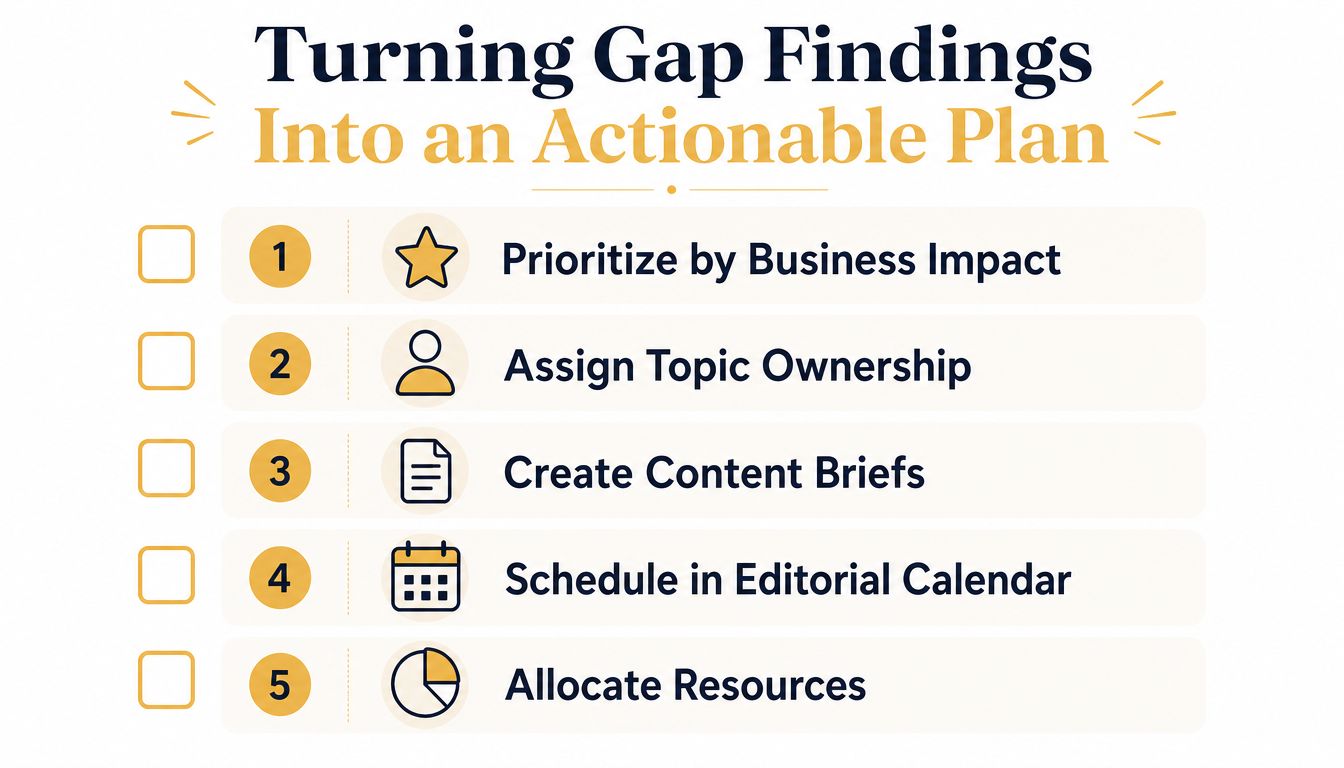
- Prioritize by business impact: Choose the topics that support lead generation, retention, or purchase decisions first.
- Assign topic ownership: Give one person accountability for the brief, draft, and publish date.
- Create content briefs: Include intent, search competitors, subtopics, internal links, and the target CTA.
- Schedule in the editorial calendar: Place refreshes and new pages where the team can ship them.
- Allocate resources: Match the scope of the content to the time, research, design, and SME support it needs.
That structure keeps stakeholders from confusing “interesting” with “important.” It also makes it easier to explain why some gaps get addressed immediately while others wait for the next production cycle.
A good plan doesn't treat every gap the same. Some are quick wins. Others are foundational topic pieces that need more research, more polish, or stronger supporting content. If the calendar reflects that difference, the content team stops reacting and starts building toward a coherent search footprint.
Measuring ROI and Tracking Content Gap Performance
The test of content gap analysis is whether closing gaps changes business outcomes. Rankings matter, but they're not the whole story. If the new or refreshed content doesn't improve qualified traffic, engagement, or conversions, the analysis was diagnostic, not profitable.
Start with the metrics that match the type of gap you filled. New informational pages usually need visibility and engagement tracking. Refreshes need before-and-after comparisons. Bottom-funnel pages need conversion attribution. Leadership usually cares less about the mechanics and more about whether the work contributed to revenue, market share, or pipeline quality.
Track the right metric for the right gap
A practical KPI stack often includes organic traffic, ranking movement, engagement quality, conversions, assisted conversions, and backlinks. The mix matters because different gap types create different outcomes. A content refresh may stabilize traffic on an aging page. A new comparison page may bring in fewer visits but stronger leads. A support-driven FAQ page may reduce friction and help the sales team close faster.
One internal resource that pairs well with this thinking is how to measure SEO ROI, especially if you need to present results to a non-SEO stakeholder. For a deeper look at practical measurement, a real-world local example is helpful. In Omaha, a local business that identifies underserved search topics, publishes focused content, and then tracks the resulting traffic and conversion patterns can see whether the gap work is contributing to lead flow instead of just adding pages to the site. That kind of regional focus works because the content is anchored in actual market demand, not abstract keyword counts.
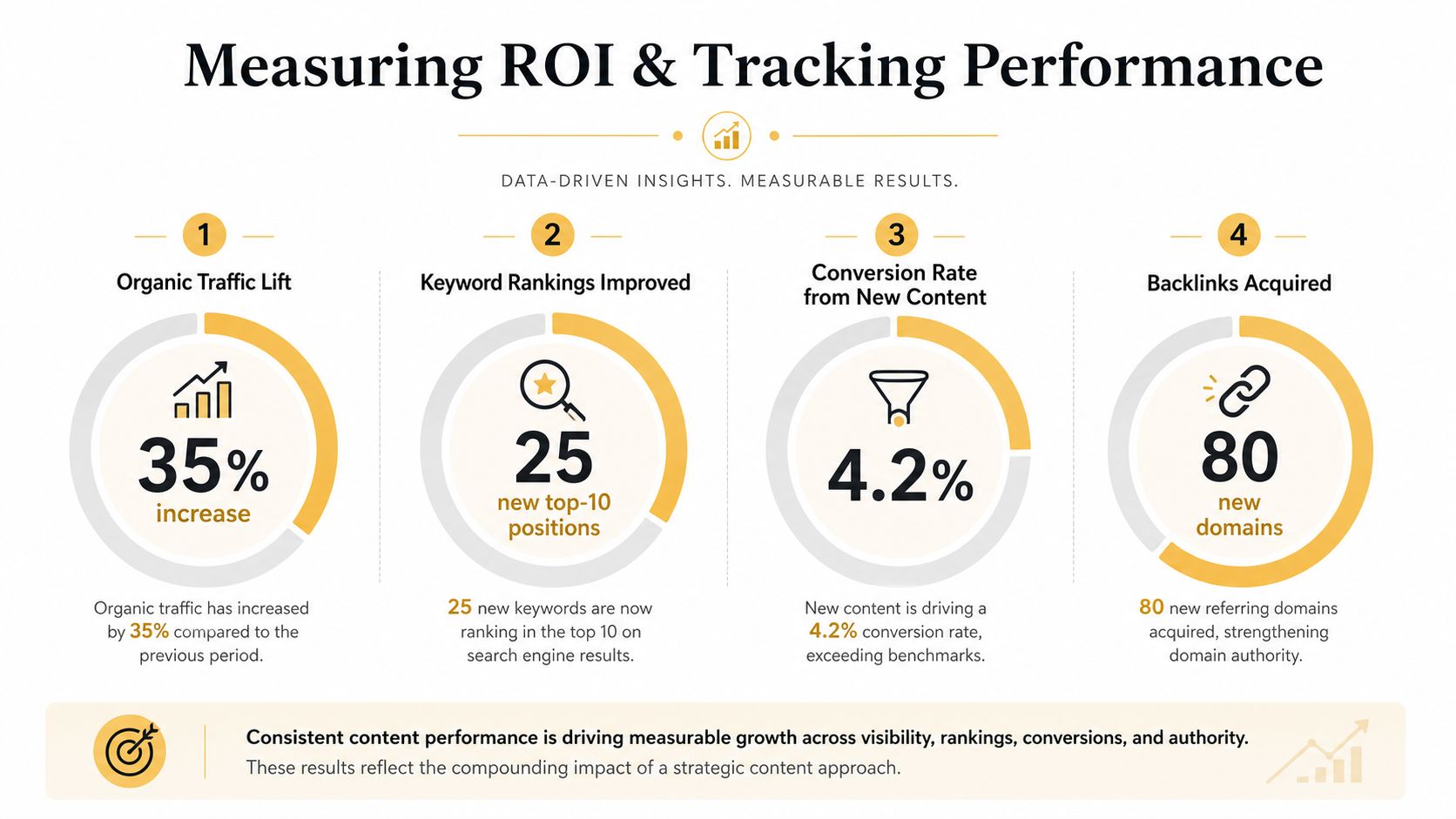
Present results in business language
When you report back, avoid making the meeting about rankings alone. Show which content gaps were closed, which pages were refreshed, what changed in search visibility, and how that affected the outcomes the business cares about. If the site now captures more qualified visits for a specific product line or service area, say that plainly.
Reporting rule: tie each content initiative to the business question it was supposed to answer, then show whether the page actually helped answer it.
The best measurement cadence is recurring, not one-and-done. Revisit the analysis whenever the market shifts, the SERP changes, or the site's own content starts to age out. That's how content gap analysis becomes a living system instead of a quarterly cleanup exercise.
If you want a content gap analysis that leads to more than a keyword list, Up North Media can help you turn the research into a search plan built around revenue, not guesswork. Visit Up North Media to talk through your site, your competitors, and the content opportunities that are worth prioritizing.