

You’ve probably seen some version of this already. A small business owner builds a solid company, invests in a decent website, maybe runs a few ads, and then waits for the phone to ring from organic search. It doesn’t. The site looks fine, but it behaves like a brochure nobody finds.
That’s usually when the search for an seo company for small business starts. And that search gets noisy fast. One agency promises rankings. Another sells “authority.” A third offers a low monthly package that sounds safe until six months pass and nothing meaningful changes.
This guide is about hiring an SEO partner, not buying a bundle of vague deliverables. The difference matters. A good agency helps you build a repeatable source of qualified traffic and leads. A bad one burns budget, muddies reporting, and leaves you with no clean answer to a basic question: did this produce revenue?
Why Choosing an SEO Partner is a Critical Business Decision
A common small business scenario looks like this. The owner signs a 12 month SEO contract, gets monthly ranking screenshots, sees a bump in impressions, and still has the same slow phone weeks three or four months later. By the time they realize the campaign was built around vanity metrics, they have already spent the budget and lost time they cannot get back.
A lot of owners treat SEO like a lighter version of paid ads. It is closer to infrastructure. The work touches your service pages, site architecture, internal links, Google Business Profile, reviews, technical health, and the content that answers buyer questions. If the agency makes smart decisions, those assets keep producing. If they make bad ones, the cleanup can take longer than the original engagement.
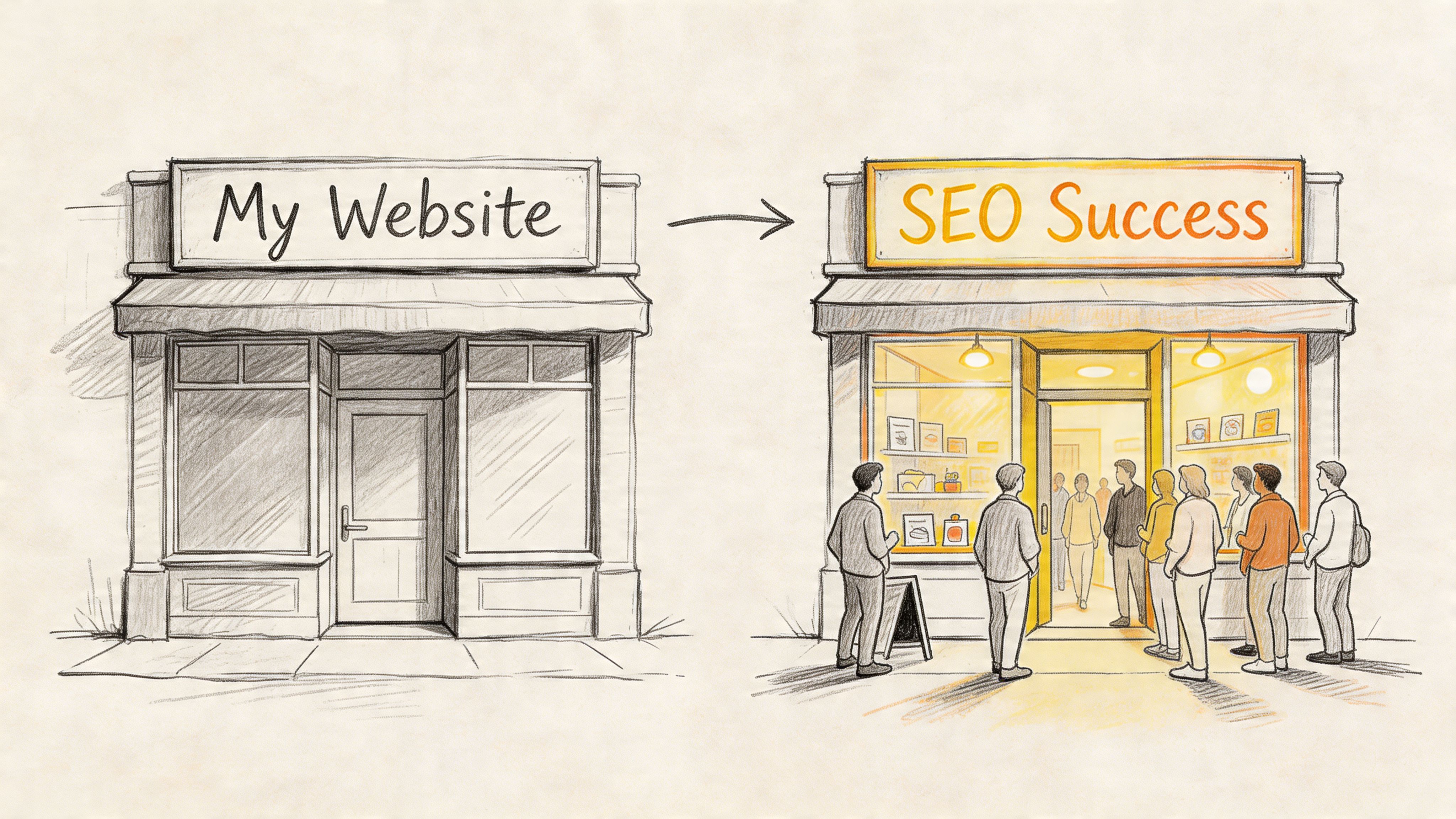
The High Cost of a Bad SEO Partnership for Small Businesses
Large companies can survive a few wasted quarters. A small business usually cannot.
The full cost of hiring the wrong SEO partner is not only the monthly retainer. It is six to twelve months spent publishing pages that never had a chance to rank, chasing broad keywords that do not bring buyers, and letting competitors win the map pack in the neighborhoods you serve. If a local HVAC company misses one summer season because its SEO campaign focused on blog traffic instead of service area visibility, that loss shows up in revenue, not just reports.
This gets more serious when the agency does not understand the difference between local SEO and general SEO. Local search depends on proximity, service area intent, review velocity, Google Business Profile management, and city-specific page quality. A generalist offshore team may be competent at basic on-page work and still miss how people in your market search. I have seen campaigns target terms a local customer would never use, or build location pages for cities the business cannot realistically serve. The work looks busy. It does not produce booked jobs.
That gap matters because local search often captures customers who are already close to taking action. As noted in small business SEO statistics for 2025, a large share of Google searches have local intent, local business discovery happens every week for many consumers, and mobile local searches often turn into offline purchases quickly. For a small business, weak local execution means missing people who were already in the market.
A good agency should know who you want to attract before it writes a page or touches your site structure. If that work has not been done, even a well-written post or a powerful SEO content strategy can drift toward traffic that looks nice in a dashboard and does nothing for sales. That is why clear customer definitions matter early. A simple set of buyer personas for your real service audience helps prevent wasted content, bad keyword targeting, and weak conversion paths.
Practical rule: Evaluate an SEO agency the same way you would evaluate an operations hire. Ask whether their work will improve lead flow, sales quality, and margin, not whether they can produce a busy-looking report.
SEO compounds, for better or worse
SEO results build on previous decisions. Strong keyword selection supports better service pages. Better pages improve conversion rates. Clean technical work helps Google crawl the site properly. Accurate reporting shows which service lines deserve more investment.
Bad decisions stack up too.
- Poor targeting brings visitors who were never going to call.
- Weak technical work limits the reach of otherwise solid pages.
- Generic local tactics ignore the language, neighborhoods, and buying patterns in your market.
- Soft reporting hides whether organic search is producing revenue or just activity.
The Page Optimizer source cited earlier also referenced a Chicago bakery that grew organic traffic and monthly revenue after improving its Google Business Profile and local targeting. The exact lift will vary by market, offer, and competition. The useful takeaway is simpler. Local SEO decisions can change what happens at the register, especially for businesses that depend on nearby, high-intent searches.
Before You Search Aligning SEO with Business Outcomes
Before you talk to agencies, define what a win looks like in your business. If you don’t, the agency will define success for you. That’s where a lot of bad engagements start.
The strongest SEO strategies start with KPIs tied to business outcomes, not raw sessions. Business.com notes in its small business SEO strategy guide that the most effective SEO strategies begin with clear KPIs, focusing on conversion rates from organic search rather than raw traffic. The same source says 70% of small businesses see meaningful ROI such as 20% to 50% conversion uplifts within 6 to 12 months with consistent implementation, while 85% of campaigns underperform due to poor goal alignment.
Pick the outcome before the channel metric
If you run a local service business, your KPI probably isn’t pageviews. It’s booked estimates, qualified calls, or form submissions from the right zip codes.
If you run e-commerce, you care about product page traffic from high-intent searches, conversion rate from organic visitors, and revenue by landing page.
If you run a content-driven business, organic growth matters, but so do subscriber actions, ad-value pages, and whether informational content assists conversion later.
A simple way to frame it:
| Business type | Weak KPI | Better KPI | | | | | | Local service | Total traffic | Qualified calls and quote requests from organic search | | E-commerce | Keyword rankings | Revenue from organic landing pages | | Digital publisher | Sessions only | Engaged visits and subscriber actions from organic content |
Decide your search territory
Some businesses need hyper-local SEO. Others need a mix of local and national visibility. A local clinic, law office, contractor, or restaurant should usually start by owning its service area before trying to rank broadly.
That means defining:
- Primary geography. The city, neighborhoods, or service radius that is most relevant.
- Core commercial intent. Searches tied to services people buy, not just topics they browse.
- Secondary content opportunities. Informational terms that support authority and trust.
This is also where customer definition matters. If you haven’t clarified who you want to attract, build that first. A clear buyer persona process for marketing strategy helps separate the searcher who wants information from the searcher who’s ready to hire.
Don’t ask an agency to “get more traffic” if what you really need is more profitable jobs, better-fit clients, or stronger local visibility.
Know what a workable plan should include
An agency should be able to connect your goals to a practical SEO system. That usually includes keyword research, on-page optimization, technical fixes, content priorities, and reporting tied to business impact.
If you want a strong primer on the content side, this guide to a powerful SEO content strategy is useful because it connects content planning to search intent instead of treating blogging like a volume game.
A good engagement usually starts with a smaller list of meaningful targets, not a giant spreadsheet of keywords nobody will ever monetize. Business.com’s framework specifically points to focusing on 10 to 20 long-tail keywords with buying intent and tracking performance through tools like Google Analytics and Google Search Console in a disciplined way, rather than chasing broad vanity terms in a scattered campaign.
Here’s a useful overview before you start vetting partners:
Finding and Vetting Potential SEO Agencies
Most owners start with Google. That’s fine, but it shouldn’t be your only filter. Search results tell you who ranks. They don’t tell you who communicates well, who understands your market, or who can explain ROI in plain English.
Good agency shortlists usually come from a mix of referrals, local business circles, review platforms, and direct vetting of the agency’s own site. If an agency sells SEO but its own pages are thin, unclear, or obviously templated, pay attention.
Local agency versus offshore provider
This is the part many roundups gloss over. Price matters, but so does fit.
An offshore or large-scale provider can be workable when your needs are standardized, your market is broad, and you mainly want basic execution. But many small businesses don’t need generic execution. They need an agency that understands service areas, seasonal demand, local competition, and how actual buyers in their region search.
Recent data summarized by First Page Sage’s small business SEO agency analysis says U.S. small businesses using local agencies achieve 2.7x higher client retention, and BrightLocal’s 2026 report, cited there, indicates local agencies deliver 35% faster visibility gains for SMBs.
That doesn’t mean every local agency is better. It does mean the cheapest option on paper often becomes more expensive when the strategy misses local nuance.
What local agencies usually do better
- Regional search language. They understand how customers in your market describe services.
- Google Business Profile strategy. They tend to handle map visibility with more specificity.
- Faster collaboration. Calls, approvals, and feedback loops usually move better.
- Business context. They’re more likely to tie SEO to service lines, locations, and sales goals.
A local Omaha company, for example, often benefits from an agency that understands the difference between broad Midwest messaging and the specific intent behind local searches tied to neighborhoods, surrounding suburbs, and service-area behavior. That’s one reason some businesses compare a few different options, including firms with local SEO and reporting capabilities such as digital marketing agency selection criteria for growing businesses.
What to inspect before the first call
Don’t just read the sales copy. Audit the agency the way you’d want them to audit you.
Look at these elements side by side:
| What to review | What to look for | What should concern you | | | | | | Case studies | Clear before-and-after business outcomes | Rankings with no tie to leads or sales | | Testimonials | Specific client context | Generic praise with no detail | | Service pages | Clear process and scope | Buzzwords, vague deliverables | | Reporting language | KPIs, attribution, transparency | Traffic-only reporting |
If a case study can’t tell you what changed in the business, it’s marketing material, not proof.
Read for depth, not polish
A polished deck can hide a thin strategy. During vetting, listen for whether the agency talks about keyword intent, content gaps, technical constraints, local pages, reporting systems, and conversion paths. Those are working details. They reveal whether the team knows how SEO affects a real business.
One practical note. You only need a shortlist of a few strong contenders. More than that usually creates noise. Better to compare a small set carefully than to collect a giant list and make a rushed decision on price alone.
Key Questions to Uncover an Agency's True Value
A discovery call usually sounds good. That is the problem.
A weak agency can talk confidently about rankings, content, and authority for 30 minutes without telling you how any of it turns into calls, booked jobs, or revenue. The right questions force specificity. They also help you spot a common small-business trap: hiring an offshore team for lower fees, then finding out later that nobody understands your service area, your margins, or how local buyers search.
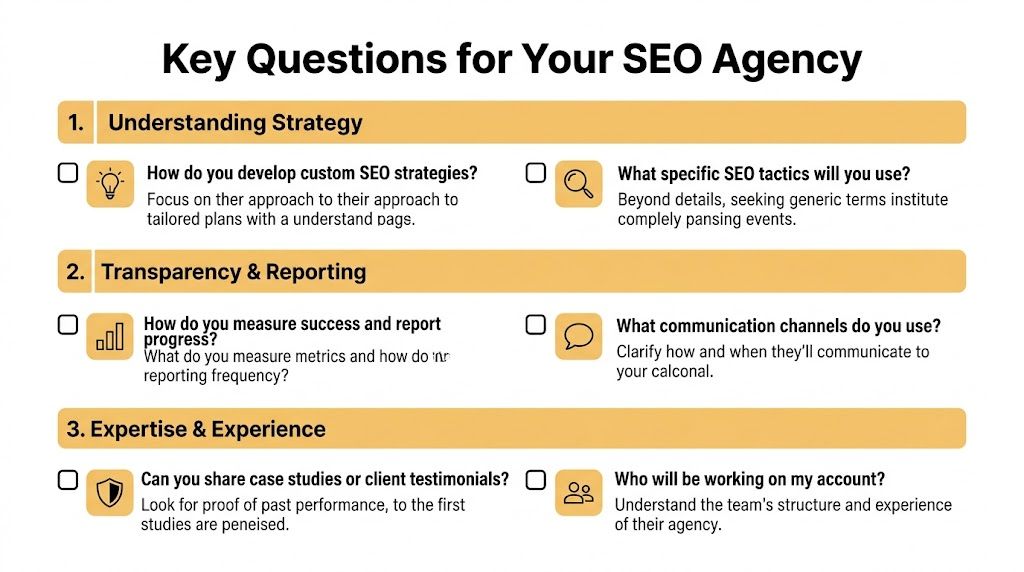
Questions about strategy
Start with the plan, but keep the conversation tied to your market.
Ask:
- How do you decide which keywords are worth pursuing for my business? Look for answers that include intent, service-line value, realistic competition, and whether the term can produce a lead instead of just traffic.
- How would you split effort between service pages, local landing pages, and educational content? The right mix depends on the business. A local roofer, med spa, or law firm should not get the same content plan as an ecommerce brand.
- What would you review first on a site like mine? Strong answers usually mention indexing, internal linking, mobile usability, page templates, location signals, schema, and conversion tracking.
Then ask a local question that exposes whether they understand your market or are recycling a generic playbook:
“How would you help me win searches in my actual service area, including town-level terms, map visibility, and high-intent searches from nearby customers?”
A local agency should be able to talk through neighborhood pages, Google Business Profile work, review signals, and how to avoid cannibalizing one location page with another. An offshore agency can still do good work, but in these aspects, gaps often show up. If they cannot speak clearly about city modifiers, local competition, or how people in your area describe the service, expect a lot of cleanup later.
Questions about reporting and accountability
This part matters more than the pitch.
Many business owners get monthly reports full of impressions, clicks, and ranking screenshots, then still cannot answer a basic question: did SEO produce profitable leads? Ask early how the agency connects work to outcomes.
Use questions like these:
-
Can I see a sample monthly report?
Check whether the report includes qualified leads, calls, forms, booked appointments, or sales influence. Traffic by itself is not enough. -
How do you connect SEO work to revenue?
Good agencies will mention call tracking, form attribution, landing page conversion rates, CRM tagging, and first-touch or assisted-conversion reporting. -
Which metrics do you treat as leading indicators, and which ones do you treat as business outcomes?
This question separates experienced operators from presentation-heavy agencies. Rankings and organic sessions are useful leading indicators. Closed jobs, cost per lead, and revenue from organic search are business outcomes. -
What happens if traffic goes up but lead quality gets worse?
A serious agency has seen this before. They should talk about query quality, page intent, offer alignment, and tightening the content strategy, not celebrating bad-fit traffic.
Ask them to show you how they measure qualified growth, not just visible growth.
Questions about the actual team
A sales call can hide a messy delivery model.
Ask who does the work, who reviews it, and who owns the strategy. If the salesperson disappears after signature and your account gets handed to a junior coordinator with 40 clients, you will feel it fast.
Ask plainly:
- Who will manage my account day to day?
- Who sets strategy, and how often will that person review performance?
- Will content be written in-house, outsourced, or AI-assisted with human review?
- Who handles technical recommendations and QA?
- How many accounts does my strategist manage?
These answers also help you compare local and offshore options fairly. Offshore teams often win on price and production capacity. Local teams often win on market context, communication speed, and better alignment with sales realities. Neither model is automatically better. The issue is whether the delivery setup matches your business. A multi-location home service company may need tight collaboration and local nuance. A simpler site with a capable in-house marketer may do fine with offshore support if strategy and oversight are strong.
Questions about fit and constraints
The best agencies will tell you where results could get stuck.
Ask:
- What type of client is not a fit for your process?
- What would slow progress on my site right now?
- What do you need from my team each month to make this work?
- If we worked together for six months, what would success look like in business terms?
- What would you expect to learn in the first 90 days that might change the plan?
Good answers sound grounded. You want to hear about review bottlenecks, weak offers, poor location signals, limited service-area content, tracking gaps, or a site that cannot convert existing traffic. That kind of honesty saves money.
One simple rule I give small business owners is this: if an agency cannot explain trade-offs, they probably have not done enough real client work. SEO always involves trade-offs between speed and depth, local pages and broader content, quick wins and longer-term authority, lower cost and tighter strategic control. The call should make those trade-offs clearer, not hide them behind polished language.
Bring a written list of questions. Score the call on clarity, specificity, and business relevance. Charisma does not improve lead quality.
Understanding SEO Pricing Models and Spotting Red Flags
Pricing gets attention because it’s visible. Scope problems hide in the contract.
Most SEO engagements fall into three models: monthly retainer, project-based work, or hourly consulting. None is automatically right or wrong. The right fit depends on what you need and how much ongoing work your site requires.
The three common pricing models
Monthly retainer works best when SEO is an ongoing growth channel. It usually covers recurring priorities such as technical fixes, content work, on-page updates, reporting, and strategy. This model makes sense for businesses that need momentum, not just cleanup.
Project-based SEO is better for defined work. Think site migrations, technical audits, local landing page builds, or an initial strategy reset. It’s often useful when a business needs a clear foundation before moving into monthly execution.
Hourly consulting works when your team can implement and only needs expert direction. It can also fit businesses with in-house marketers who want a second set of eyes on strategy and reporting.
If you see this, ask that
Use this framework when reviewing proposals.
| If you see this | Ask this | | | | | | “Guaranteed rankings” | What exactly are you guaranteeing, and for which keywords? | | “Proprietary secret sauce” | What specific activities will be performed each month? | | Very low pricing with broad promises | How much work is actually included, and who does it? | | No mention of analytics access | Who owns the data, logins, and reporting setup? | | Long contract with vague deliverables | What are the exit terms and review checkpoints? |
Red flags that matter more than price
Some warnings are obvious. Others are easy to miss.
- The agency avoids business goals. If they keep steering you back to impressions or generic ranking wins, they may not know how to measure impact.
- They won’t define deliverables. “Ongoing optimization” isn’t enough. You should know what kinds of work they’ll do.
- They control your assets. Your website, analytics, Search Console, and business profiles should stay under your ownership.
- They promise speed without context. Good SEO firms explain dependencies. They don’t sell certainty where none exists.
- They can’t explain prioritization. Every site has more to fix than time to fix it. Strong agencies know what comes first and why.
Contracts deserve the same scrutiny as strategy
Read the agreement like an operator, not a hopeful buyer.
Check for ownership of accounts, access to reporting, cancellation terms, notice periods, and whether the scope changes if your business priorities shift. If the contract makes it hard to leave but easy for the agency to stay vague, that’s the wrong contract.
A fair agreement doesn’t need to be short. It needs to be clear.
How to Measure SEO ROI and Build a Strong Partnership
Six months into an SEO contract, many small business owners are still asking the same question they had on day one. Is this producing revenue, or just reports?
That question gets missed when an agency trains you to watch rankings, traffic, and audit scores without tying them back to calls, form fills, booked jobs, or closed sales. A good SEO partner makes that connection clear, especially for local businesses where a phone call from a nearby customer matters more than a jump in raw sessions.

Read reports like an owner
A useful SEO report connects four things:
- What changed
- Why it changed
- What that means for the business
- What happens next
Anything less leaves too much room for guesswork.
For a local company, that usually means separating vanity metrics from operating metrics. Ranking for a broad keyword can look good in a deck and still do nothing for revenue. More calls from your service area, more quote requests from the right pages, stronger Google Business Profile actions, and better lead quality usually matter more. Offshore agencies often miss this because they report at a distance. A local agency is more likely to understand seasonality, service areas, and which searches turn into jobs. That does not make every local firm better. It means they often start with better context, while offshore teams may look cheaper up front but require tighter oversight to stay aligned with real business goals.
ROI math should include both agency fees and your internal cost to support the work. If your office manager spends hours gathering photos, approvals, and service details each month, that time counts. If organic search drives leads worth more than the combined cost, the channel is working. If reporting cannot get you close to that answer, the problem is not patience. It is measurement. For a plain-English overview of the math, What Is Marketing ROI and How Do You Actually Measure It? is a solid reference.
Set expectations that match reality
SEO needs time to work through technical fixes, indexing, content revisions, and local authority signals. As noted earlier, consistent implementation often shows traction within a few months, with stronger ROI taking longer because traffic quality and conversion rate usually improve in stages.
You should still see early signs that the agency knows what it is doing.
Clear reporting. Better page targeting. Fewer vague promises. Specific recommendations tied to service lines, locations, and lead value.
That is the standard I use when reviewing campaigns. Early wins do not always mean big traffic jumps. Often they show up first as cleaner data, better local page structure, stronger call tracking, or a sharper focus on high-intent searches instead of broad terms that attract the wrong visitor.
Good SEO partnerships produce visibility into performance, decisions, and trade-offs.
Know when to push and when to exit
Small businesses usually do not leave SEO agencies because results take time. They leave because they cannot tell what is happening, what is being prioritized, or whether the work matches the contract.
A healthy partnership usually looks like this:
- The agency answers direct questions with direct answers
- Reports connect work to lead and sales outcomes
- Priorities change when the data or business needs change
- Your team keeps access to accounts, data, and reporting systems
If that is not happening, press for specifics. Ask what changed, what did not, and what gets adjusted next month. Compare current performance against the baseline and the KPIs you agreed to at the start. If the agency still cannot explain progress in business terms, use the exit terms you reviewed earlier and end the contract cleanly.
One practical option for businesses that want local support, custom reporting, and a broader mix of SEO, web, and AI implementation is Up North Media. The firm is Omaha-based and offers data-driven SEO marketing alongside web app development and AI consulting, which can matter when SEO recommendations depend on development resources or operational tooling.
If you’re evaluating an seo company for small business, the right final test is simple. After the first call, you should know how success will be measured, who owns the data, how local intent will be handled, and what would make you leave. If those answers stay fuzzy, keep looking.