
Your website is live. The logo looks good. The service pages are up. You told friends and existing customers about it.
Then nothing happens.
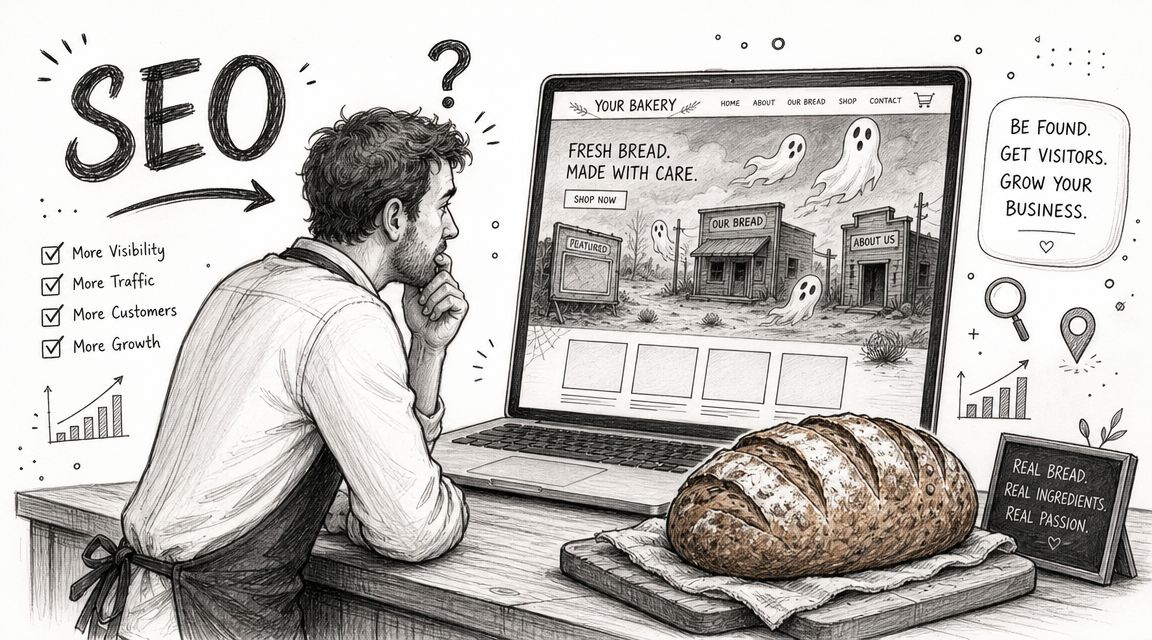
That's where most small business owners get stuck. They assume the website itself should bring traffic, when in reality a site without SEO is like opening a great shop on a road with no signs, no map listing, and no address on the door. People won't find you unless you give search engines clear directions.
The good news is that SEO basics for small business are not mysterious. You don't need an enterprise stack, a giant content team, or a full-time analyst. You need the right order of operations. For a resource-constrained business, that matters more than chasing advanced tactics.
Why Your Small Business Needs SEO Now
A bakery owner in Omaha launches a clean website with online ordering, custom cake pages, and beautiful photos. Weeks later, traffic is flat. The problem usually isn't the product. It's discoverability.
SEO matters because search is still where intent shows up. Someone searching for your service is closer to action than someone casually scrolling a social feed. And because Google remains the main entry point for discovery, small-business SEO still centers on showing up there. In 2024, Google handled about 91.6% of global search engine market share, according to StatCounter, as cited in this small-business SEO guide.
SEO turns a brochure site into a working asset
A lot of small business websites act like brochures. They describe the business, list services, and maybe include a contact form. That's not enough.
A useful SEO setup does three jobs at once:
- Matches intent: Your pages line up with what people type into search.
- Removes friction: Your site loads, works on phones, and makes it easy to act.
- Builds relevance: Search engines can tell which page should appear for which topic.
That's the difference between a site that sits there and a site that brings in calls, quote requests, bookings, or visits.
Practical rule: If a page doesn't target a clear search need and a clear next step, it probably won't help your business much.
Why this matters more than another marketing experiment
Paid ads stop when you stop paying. Referrals are valuable, but they're inconsistent. SEO builds a base layer of discoverability that supports everything else you do.
If you're trying to get your bearings across channels, these digital marketing tips for small businesses help put SEO in the right context. But for most businesses, SEO is where the digital foundation starts because it connects you to people already looking.
The key is not doing everything. The key is doing the most impactful work first.
Your First SEO Decision Local Versus Organic
Before you touch titles, blog posts, or plugins, make one decision. Are you trying to win nearby customers, broader search traffic, or both?
Most wasted SEO work starts here. A plumber, dentist, med spa, or local law office often burns time trying to rank nationally for broad terms when significant revenue comes from local searches. On the other hand, an e-commerce brand or software company can't rely on map results alone.
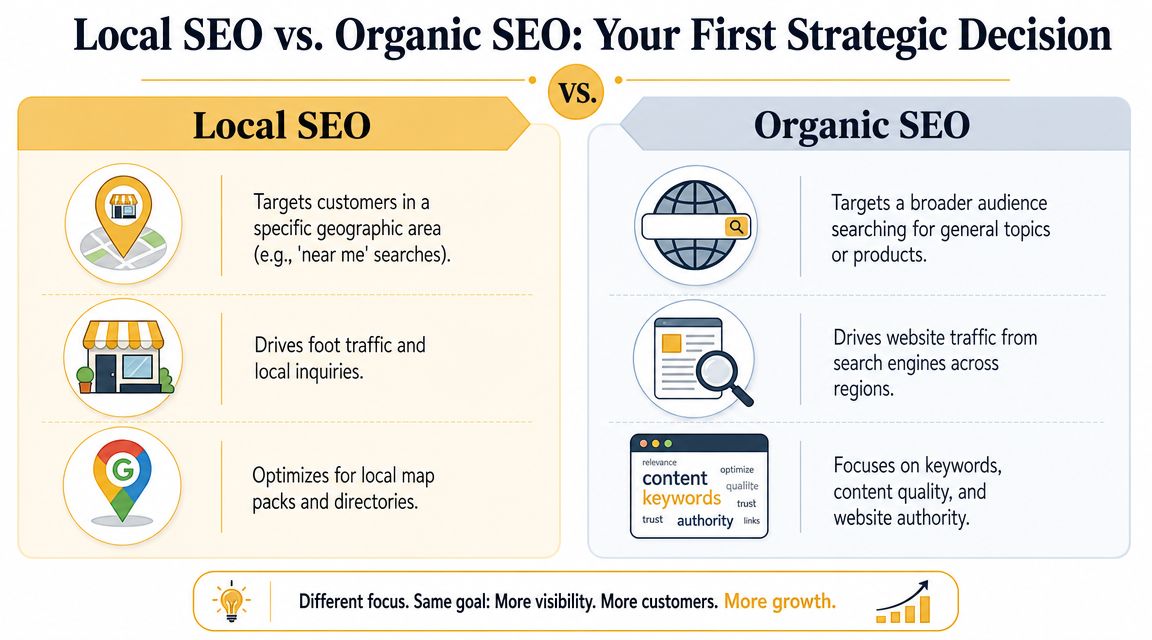
Think billboard versus magazine
Local SEO is like putting up a billboard on Main Street. You want visibility where your buyers already are. That usually means Google Business Profile visibility, map results, service area pages, and consistent business information across the web.
Organic SEO is more like getting featured in a national magazine. You're trying to earn attention from a wider audience through pages that answer broader searches, product terms, or educational topics.
Here's the simplest way to separate them:
| Business type | Priority focus | What usually matters first |
|---|---|---|
| Local service business | Local SEO | Google Business Profile, service area pages, reviews, citations |
| Brick-and-mortar shop | Local SEO | Maps visibility, hours, categories, local landing pages |
| E-commerce store | Organic SEO | Category pages, product pages, technical crawlability, content |
| Multi-region service business | Mixed | Local pages plus broader organic service content |
| Publisher or SaaS company | Organic SEO | Topic clusters, clear architecture, search-intent content |
How to choose without overthinking it
Ask three questions:
-
Does the customer need to be near you?
If yes, local comes first. -
Can you fulfill work outside your immediate area?
If yes, organic may deserve more attention. -
Do most buyers search by service plus city, or by problem/topic?
Service plus city points local. Problem/topic points organic.
If your customers mostly come from a defined geography, local SEO is usually your fastest path to traction.
Many businesses need both, but not equally. A local roofer may eventually want broader educational content. A regional e-commerce company may still need location trust signals. The mistake is treating them as the same playbook.
For a deeper breakdown of proximity-based visibility, Up North Media's overview of local search marketing is useful. But the short version is simple. Pick the lane that matches how people buy from you, then build from there.
Build Your Foundation with a Technical SEO Checklist
Technical SEO sounds intimidating because people describe it with too much jargon. For a small business, it's simpler than that. It is the foundation of a house. If the foundation is cracked, the paint color doesn't matter.
Google's own guidance puts the priority in plain terms. Make pages discoverable and indexable. Use sitemaps and internal links so Google can find important pages, keep key resources accessible, and manage duplicates or low-value URLs with canonical tags or robots.txt, as explained in Google's SEO Starter Guide.
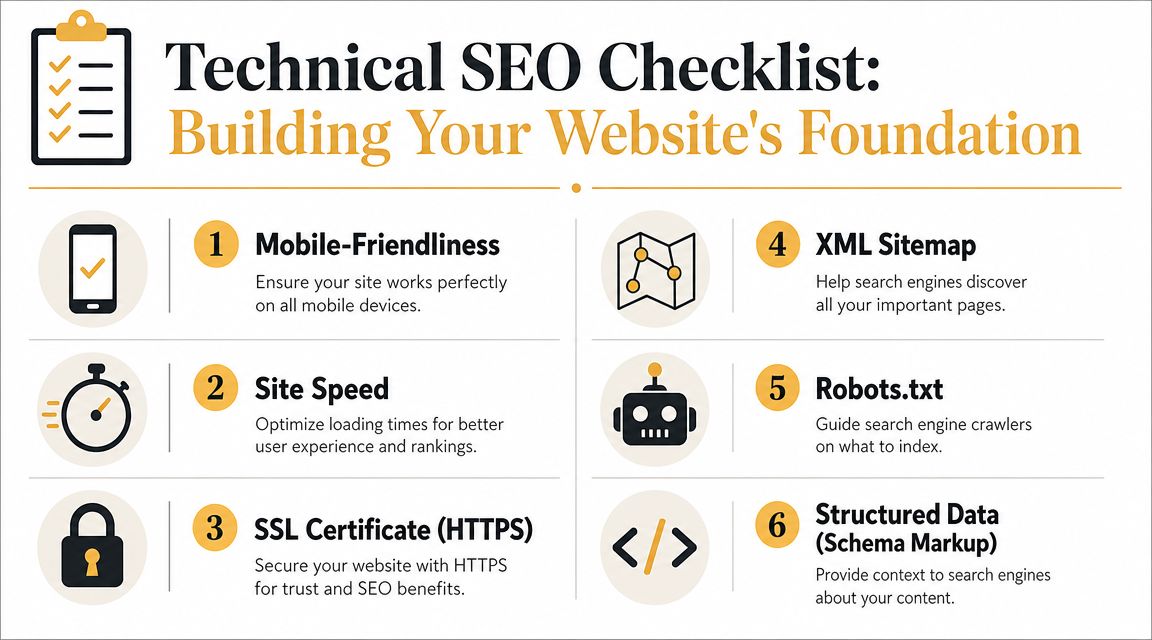
The small-business checklist that actually matters
Don't start with edge cases. Start here.
- Mobile usability: Open your site on an iPhone and an Android phone. If text is tiny, buttons are awkward, or menus break, fix that first.
- Page speed: Slow pages lose people before SEO has a chance to help. Heavy images, clunky themes, and bloated plugins are common culprits.
- HTTPS security: If your site doesn't load securely, fix that immediately. It affects trust before a visitor reads a word.
- Indexation control: Make sure important pages can be crawled, and thin or duplicate pages aren't competing with them.
- Internal links: Your key pages should be reachable through normal site navigation and contextual links.
- Metadata hygiene: Every important page needs a unique title and description. Duplicate metadata creates confusion fast.
What to ask your developer
Most owners don't need to implement every technical fix themselves. They need to ask the right questions.
Use a checklist like this in your next web meeting:
- Can Google reach our important pages? Ask for a review of blocked resources, noindex tags, and crawl issues.
- Do we have an XML sitemap? It should include the pages that matter.
- Are duplicate pages being handled? Canonical tags should point to the preferred version where needed.
- Are titles and meta descriptions unique? Repeated metadata weakens clarity.
- Is the site architecture simple? If core pages are buried, both users and search engines struggle.
A lot of speed-related problems overlap with user experience. If you want a plain-English primer before talking to your developer, this explanation of Core Web Vitals is worth a read.
This video gives a helpful overview before you start making changes:
Technical SEO doesn't need to be fancy. It needs to be clean enough that Google can crawl the site and users can use it without friction.
What doesn't deserve your attention yet
Small businesses often get distracted by advanced schema debates, niche plugin settings, or obscure audit warnings. Those can wait.
If your site is hard to use on mobile, slow to load, missing basic metadata, or confusing to crawl, fix that first. That's where the greatest impact is.
Win Clicks with Smart On-Page and Content Strategy
Once the site is technically sound, the next job is relevance. Here, many owners either freeze up or go too far. They either write nothing, or they jam the same phrase into every paragraph and call it SEO.
Better approach. Treat keyword research like learning your customer's language.
A practical benchmark is to build roughly 20 to 50 target keywords, map them to specific pages, and use synonyms and related questions so the writing sounds natural instead of over-optimized, as outlined in this small-business keyword mapping guide.
Start with page mapping, not blog ideas
Don't open a blank document and ask what to write about. Start with your existing site.
List your core pages:
- Homepage
- Primary service pages
- Location pages if you need them
- About page
- Contact page
- A small FAQ section or resource area
Now assign one main topic to each important page. If two pages target the same thing, combine them or differentiate them. Small business sites often compete with themselves because they've created three weak versions of the same service page.
Where keywords belong
You don't need a complicated formula. You need consistency.
Use your target terms naturally in places that help both the visitor and the search result:
- Title tag: Make the page topic obvious.
- H1 heading: Reinforce the main subject.
- Subheadings: Cover related questions and use cases.
- URL slug: Keep it short and readable.
- Body copy: Answer the searcher's actual question.
- Image alt text and file names: Describe the image accurately when relevant.
- Meta description: Give a clear reason to click.
What doesn't work is stuffing the exact same phrase into every line. Search systems are much better at understanding context now. A strong page usually covers the topic with normal language, related terms, and useful detail.
Focus on money pages first
If you only have a few hours this month, don't spend them writing a trendy blog post. Tighten the pages closest to revenue.
A better order looks like this:
-
Homepage
Clarify who you serve, what you do, and where if geography matters. -
Top service page
Make it specific. Generic pages rarely convert. -
Second and third service pages
Split services clearly instead of lumping everything together. -
FAQ content Add objections and questions buyers ask on calls.
-
Supporting article
Publish one useful piece that answers a common customer question.
What wins: a clear service page that matches buyer intent.
What doesn't: a pile of blog posts with no connection to your offers.
Write for the click, not just the ranking
A page can rank and still underperform if the search result looks weak. Titles and descriptions should earn attention. Headings should help scanning. The page itself should make the next step obvious.
If your team needs a good external reference on structure and readability, this guide to writing content that ranks higher is a useful companion to the basics here.
One more practical note. Content strategy is where businesses often decide whether to handle SEO internally, use a freelancer, or bring in an agency. If you need implementation help, Up North Media offers SEO marketing services alongside web support, which can be relevant when content and technical cleanup need to move together.
Claim Your Territory with Local SEO and Link Basics
For a local business, your website is only part of the picture. Google also looks at the signals around your business across the web. That's why your Google Business Profile often acts like your real digital storefront.
If you haven't claimed and completed it, do that before chasing backlinks.
Your Google Business Profile needs to look alive
An incomplete profile creates doubt. A complete one helps searchers trust you before they ever visit your site.
Here's the minimum standard:
- Correct core details: Business name, address, phone, hours, and website need to be accurate.
- Primary category: Choose the category that best reflects the main service, not the broadest one.
- Services and description: Explain what you do in plain language.
- Photos: Add real images of your team, office, work, products, or trucks. Stock photos weaken trust.
- Review process: Ask happy customers consistently, not randomly.
Reviews matter, but don't script them. Ask customers to describe the service they received in their own words. Natural specificity helps more than generic praise.
Citations are trust signals, not magic
A citation is a mention of your business information on another site, often a directory or local listing. Keep your details consistent across those profiles. If one site lists an old phone number and another uses an old address, you create confusion.
Good starting points include:
- Chamber of Commerce listings
- Industry associations
- Local business directories
- Neighborhood or city directories
- Supplier and partner websites
That's usually enough to get the basics in place. You don't need to submit your business to every directory on the internet.
Backlinks for small businesses should be boring and credible
A backlink is just another site linking to yours. Think of it as an endorsement. For small businesses, the first useful links usually come from relationships you already have.
The most realistic sources are:
- Community partnerships: Sponsor a local event, support a nonprofit, or collaborate on something visible.
- Vendor and supplier pages: Ask if they maintain partner directories.
- Local media and niche blogs: Offer a helpful angle, not a sales pitch.
- Professional organizations: Member listings often include profile links.
If you're planning outreach, a structured guest posting outreach strategy can help you avoid spammy email habits. Just keep expectations grounded. Local SEO rarely needs a flashy link-building campaign. It needs a handful of relevant, believable mentions from places your customers and community already trust.
Your first links should look like relationships, not tricks.
Measure What Matters with Simple SEO Metrics
Most small businesses don't need a dense dashboard. They need a short list of signals that answer one question. Is search visibility turning into business activity?
That means looking past vanity metrics and watching a few practical indicators in Google Analytics and Google Search Console.
The metrics that deserve your attention
Use this as your baseline scorecard:
| Metric | What it tells you | Why it matters |
|---|---|---|
| Organic traffic | How many visits come from unpaid search | Confirms whether visibility is growing |
| Search impressions and clicks | How often you appear and how often people choose you | Shows whether pages are being seen and whether snippets earn attention |
| Top landing pages | Which pages pull in search visitors | Helps you identify what to improve or expand |
| Conversions from organic | Calls, forms, purchases, booked appointments | Connects SEO work to business outcomes |
| Google Business Profile activity | Calls, website visits, direction requests | Especially useful for local businesses |
Zero-click search changed the scoreboard
Many small-business SEO guides still act like the only goal is a website click. That's outdated. Google's AI Overviews can answer some searches directly on the results page, which changes what success looks like. As noted in this US Chamber guide to SEO, the question is no longer just how to rank, but how to earn clicks when the search results page may satisfy part of the query on its own.
That shifts the way you evaluate performance:
- Visibility still matters: If your brand keeps showing up, that can influence later action.
- Snippet quality matters more: Better titles and descriptions can win the click that weaker competitors lose.
- Conversion assets matter more: Strong calls to action, reviews, and trust elements help when a searcher does land.
Don't check rankings in isolation
Rank tracking can be useful, but rankings without context cause bad decisions. If a page moves up and leads don't improve, that page may target the wrong intent. If impressions rise but clicks stall, your snippet probably needs work. If traffic grows but conversions don't, your page may attract researchers instead of buyers.
For owners who want a cleaner way to think about fast-moving signals, this guide to real-time insights offers a useful lens. The core idea applies well to SEO. Data isn't there to impress you. It's there to help you react sooner.
A healthy SEO report should help you decide what to fix next. If it only tells you that numbers moved, it's not doing its job.
Your 30-60-90 Day SEO Action Plan
SEO gets easier when it lives on a calendar. A small business doesn't need a giant roadmap. It needs a sequence that prevents wasted effort.
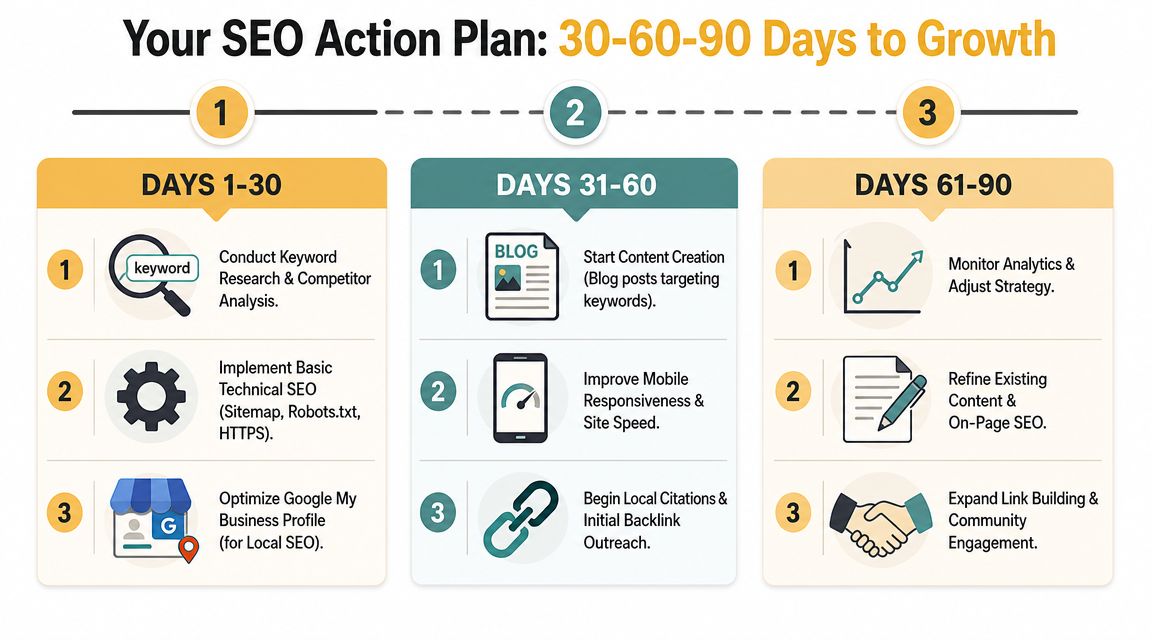
Days 1 through 30
Decide whether your priority is local or organic. Then clean up the technical base.
- Audit your site: Check mobile usability, HTTPS, metadata, crawlability, sitemap status, and internal links.
- Build your keyword map: Pick your core topics and assign them to pages.
- Claim local assets: If local matters, complete your Google Business Profile and correct inconsistent listings.
Days 31 through 60
Start improving pages that can produce leads or sales.
- Rewrite core pages: Tighten the homepage and top service pages around clear intent.
- Add FAQs: Turn sales call questions into content.
- Publish one useful piece: Create one article or guide tied to a real customer need, not a random trend.
Days 61 through 90
Use the third month to strengthen trust and review what the early data says.
- Build local mentions and links: Reach out to partners, associations, or community organizations.
- Check search data: Review impressions, clicks, landing pages, and conversions.
- Refine weak pages: Update titles, headings, and calls to action on pages that get visibility but underperform.
Keep the rhythm simple. Technical first. Core pages second. Trust signals and measurement third. That's the version of SEO basics for small business that usually produces the least waste and the clearest momentum.
If you want help turning this into an actual execution plan, Up North Media works with businesses that need practical SEO support, technical cleanup, and content strategy aligned to real growth goals.