

If your service business does solid work but the phone still goes to competitors, the problem usually isn't the quality of the service. It's visibility at the moment someone needs help.
That's where SEO for service businesses gets misunderstood. Owners often hear broad advice about blogging more, posting on social media, or “building authority,” while the actual issue is simpler. A homeowner needs a plumber tonight. A property manager needs an HVAC company this week. A business owner needs a web consultant in Omaha and wants to compare options before filling out a form. In each case, search is the handoff point between need and action.
The businesses that win online usually aren't doing one magic tactic. They're running a connected system. Their Google Business Profile is complete. Their service pages match what people search for. Their website makes it easy to call, book, or request a quote. Their reviews and local mentions reinforce trust. That's the playbook.
Why SEO for Service Businesses Is a Different Game
A service business doesn't need the internet to admire it. It needs the internet to send qualified leads.
That sounds obvious, but it changes everything. SEO for an online publisher or national e-commerce brand often centers on scale. SEO for service businesses is narrower and more commercial. You're trying to show up for people in a defined geography, with a specific problem, at a time when they're ready to act.
Urgency changes the strategy
Someone searching for “electrician Omaha,” “emergency roof repair,” or “accountant for small business near me” is not in casual browsing mode. They want proof that you do the work, serve the area, and can be reached quickly.
That's why standard SEO advice often fails local service companies. A generic homepage and a few thin pages won't carry much weight when Google is trying to match local intent with a trustworthy provider. Content still matters. Links still matter. Search intent still matters. But they have to work together in a local context.
AIOSEO notes that the global SEO services market is projected to reach $83.98 billion in 2026, that 74% of small businesses invest in SEO, and that Google uses 200+ ranking factors, with the top three remaining high-quality content, backlinks, and search intent alignment in its SEO statistics roundup. The takeaway is straightforward. Your competitors are already treating search like a budgeted acquisition channel.
Practical rule: If your SEO plan doesn't improve calls, quote requests, and booked jobs, it's not a service-business SEO plan. It's just activity.
Local visibility beats broad visibility
A lot of owners still think SEO means “rank the homepage.” That's usually the wrong target.
For service businesses, the better question is whether Google can clearly connect three things:
- What you do by service type
- Where you do it by city, neighborhood, or service area
- Why someone should trust you based on reviews, page quality, and local relevance
That's why your Google Business Profile can matter more than your homepage for some searches, and why dedicated service pages often outperform broad “we do everything” pages.
If you want a concrete example of how this changes by vertical, this breakdown of SEO for roofing companies shows how local demand, urgency, and trust signals intersect in a high-intent service category.
Building Your Local SEO Foundation
The first asset we fix for service businesses is almost never the blog. It's the Google Business Profile.
That profile is your storefront in search. It shapes whether you appear in local results, what people see before they ever visit your site, and whether they decide to call now or keep scrolling.
Complete the profile like it affects revenue
Most profiles are technically “set up” but strategically incomplete. They have a category, a phone number, and maybe a few photos. That's not enough.
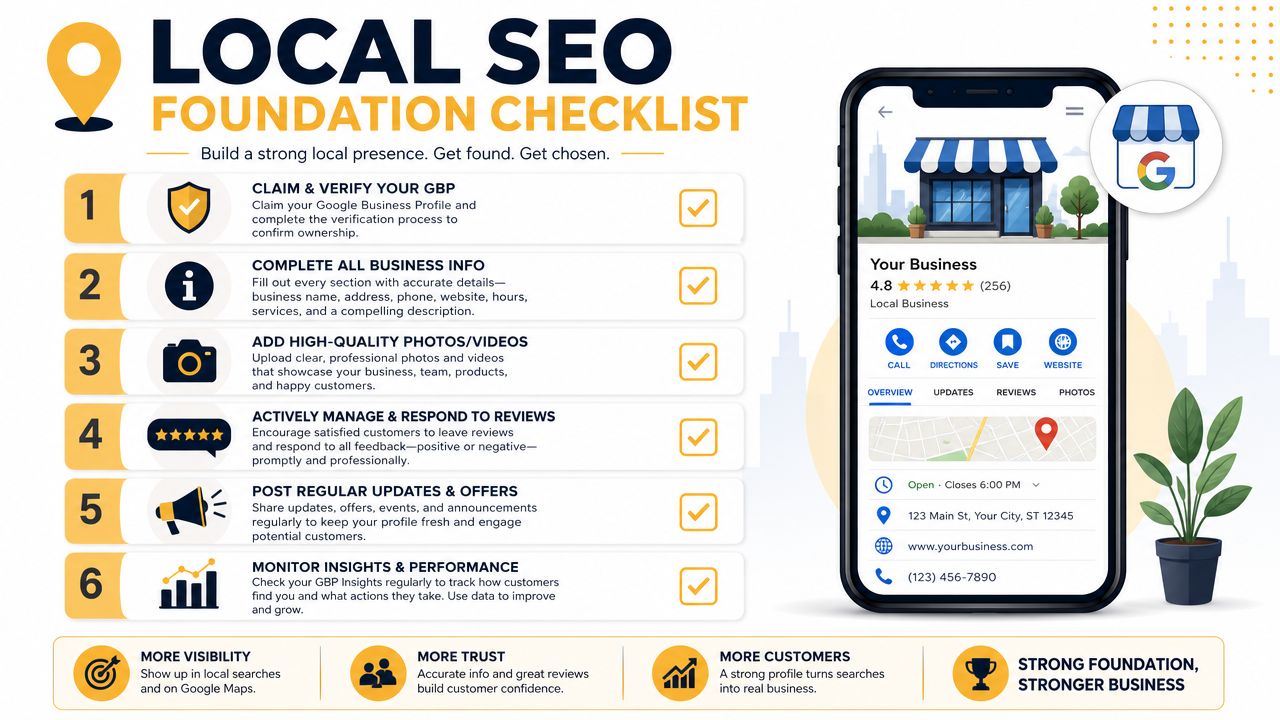
For Google Business Profile work, total completion is the standard. Best practices include choosing the most specific primary category, adding relevant secondary categories, fully listing services with descriptions, uploading 10+ professional photos, and responding to new reviews within 24–48 hours, as outlined in this guide to Google Business Profile optimization for service businesses.
Use this as your baseline checklist:
- Primary category first: Pick the most specific category available. “Plumber” is better than a broad home-services label if plumbing is what you sell most.
- Secondary categories carefully: Add the adjacent categories that reflect real services. Don't stuff every possible option.
- Service list filled out: Each service should have a plain-language description. This helps both relevance and conversion.
- Photos that prove legitimacy: Upload current exterior, interior, team, truck, and jobsite photos. Real images beat stock every time.
- Service areas and contact paths: Add service areas accurately, make the phone number clickable, and ensure the website link goes to the right destination.
A visual checklist helps teams keep the basics from slipping:
What usually goes wrong
The common failures aren't complicated. They're operational.
Some businesses choose a vague primary category. Others leave service descriptions blank, upload low-quality photos, or forget to answer reviews. A lot of teams also create mismatch problems between the business name, phone number, and address information shown on their website and in local directories.
A strong profile isn't “claimed.” It's maintained.
If you want a practical outside reference for the broader discipline of optimising for local search, Bare Digital has a useful checklist that complements the profile work.
This walkthrough is also worth watching if you're updating a profile in-house and want to see the setup flow in action.
The foundation supports everything else
A fully built profile doesn't replace your website. It makes your website more effective by pre-selling the click.
When someone sees complete service listings, fresh photos, active review responses, and accurate service areas, they reach your site with more confidence. That lowers friction. It also gives your service pages a better chance to close the lead instead of spending the first screen trying to establish basic trust.
Architecting Service Pages That Convert
Once someone clicks through from search, your service page has one job. Confirm they're in the right place and make the next step easy.
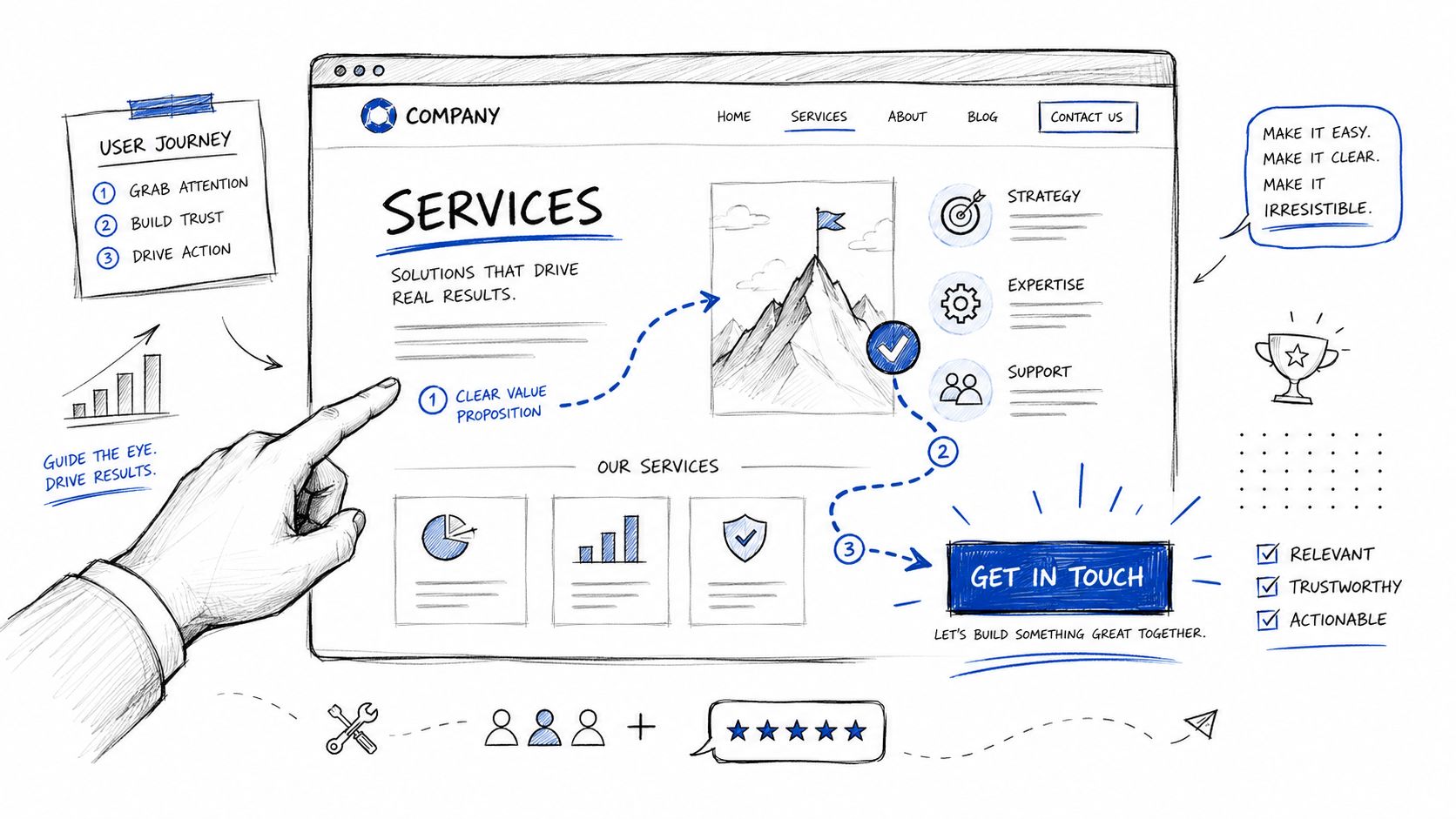
Many local businesses lose leads. They rank for a useful query, but the landing page is vague, cluttered, or too broad. A page called “Services” is rarely enough. A page called “Omaha HVAC Repair” with a clear offer, proof, and a direct call path is much closer to what searchers need.
Build pages around one service and one intent
Google reports that 46% of all searches have local intent, and around 76% of people who search for something nearby visit a business within a day, according to this summary of local SEO statistics. That's why service pages should be designed around immediate relevance, not corporate messaging.
A good service page usually includes:
| Page element | What it should do |
|---|---|
| Headline | Match the service and location naturally |
| Opening copy | State who you help, what you do, and where you work |
| Trust section | Add testimonials, credentials, service guarantees, or recent project proof |
| Service details | Explain scope, common problems solved, and what to expect |
| CTA block | Give a phone option and a form option without making users hunt |
| Supporting FAQs | Answer objections before the user leaves |
For example, if you're targeting “Omaha HVAC Repair,” don't open with a slogan. Open with the service. Say you handle residential and commercial repair, list the systems you work on, and tell people how to request service.
What strong pages include
A service page doesn't need to be clever. It needs to be clear.
Use a structure like this:
-
Lead with the core service Put the service phrase in the H1 and in the opening paragraph in natural language.
-
Show local relevance Mention the city or service area where it fits. Add job examples, neighborhoods served, or local context when you can do it honestly.
-
Reduce hesitation Add trust signals near the top. That can be review snippets, certifications, years in business, financing info, or fast contact options.
-
Answer practical questions Include process details, scheduling expectations, and the kinds of problems you solve most often.
-
Make conversion obvious A visible phone number, a concise form, and repeated calls to action matter more than a long block of copy.
The best-performing service pages read like a conversation with a ready buyer, not like a brochure.
A lot of this depends on design choices too. Layout, mobile readability, form placement, and CTA visibility all affect conversion. If you're evaluating structure and UX together, this overview of service business web design is a useful reference point.
What doesn't work
Thin city-name swap pages are a common mistake. So are giant pages that try to rank for every service at once.
If you offer plumbing, drain cleaning, water heater repair, and emergency service, each needs its own page. Otherwise, Google gets mixed signals and users get weak answers. The page should feel like it was made for that problem, because that's the page most likely to turn search traffic into a call.
Creating Content That Attracts Local Customers
Service pages capture demand that already exists. Content helps create more of it.
Not every future customer is ready to book the first time they find you. Some are comparing options. Some are trying to understand the problem. Some want proof that you know the local conditions, local housing stock, or local business environment. That's where content earns its place.
Local content beats generic publishing
A service business blog doesn't need generic “top tips” posts written for the whole internet. It needs content that sounds like it came from a company working in the places it serves.
A plumbing company in Nebraska has better topics available than “How to Fix a Leaky Faucet.” It can publish content around winter prep, sump pump issues after local storms, basement flooding concerns, or a recent project in a known neighborhood. A remodeling company can showcase before-and-after work with context about budget priorities, layout constraints, and homeowner goals.
Here are the content formats that usually pull their weight:
- Project spotlights: Show the job, the challenge, the work completed, and the area served.
- Local problem guides: Answer questions that come up because of weather, property type, or regional conditions.
- Service decision content: Help buyers compare repair versus replacement, or understand what to ask before hiring.
- FAQ articles: Turn repeated sales questions into pages that rank and support conversion.
A simple example of how this works
Say you run an HVAC company. A generic article about air filter changes may get traffic, but it's weak for local authority.
Now compare that with a post about uneven cooling in older Omaha homes, a write-up on spring AC tune-up issues found during local service calls, or a short case study on replacing a failing unit before peak summer heat. That content does three things at once. It shows experience, reinforces location relevance, and gives your sales team a useful asset to send to prospects.
Good local content should sound like it could only have been written by a business that actually works in that market.
Content should support the core pages
A lot of businesses separate content from conversion. That's a mistake.
Your blog should strengthen your service pages through internal links, supporting topics, and better trust signals. If you have a “Water Heater Repair” page, then publish content around common failure signs, repair timing, and local examples of emergency service. If you offer commercial cleaning, create content around office turnover prep, seasonal maintenance, and specialty cleaning scenarios your target buyers deal with.
That approach also keeps content grounded in revenue. You're not publishing for vanity traffic. You're building a library that helps Google understand your expertise and helps customers feel more certain about choosing you.
Implementing Key Technical SEO for Service Areas
Technical SEO gets overcomplicated fast. Most service businesses don't need an enterprise checklist. They need a few technical decisions made correctly.
The highest-impact work usually comes down to helping Google understand your services, your geography, and your page quality without confusion.
Start with service-area schema
Schema markup is structured data. In plain terms, it's code that gives search engines cleaner context about your business and pages.
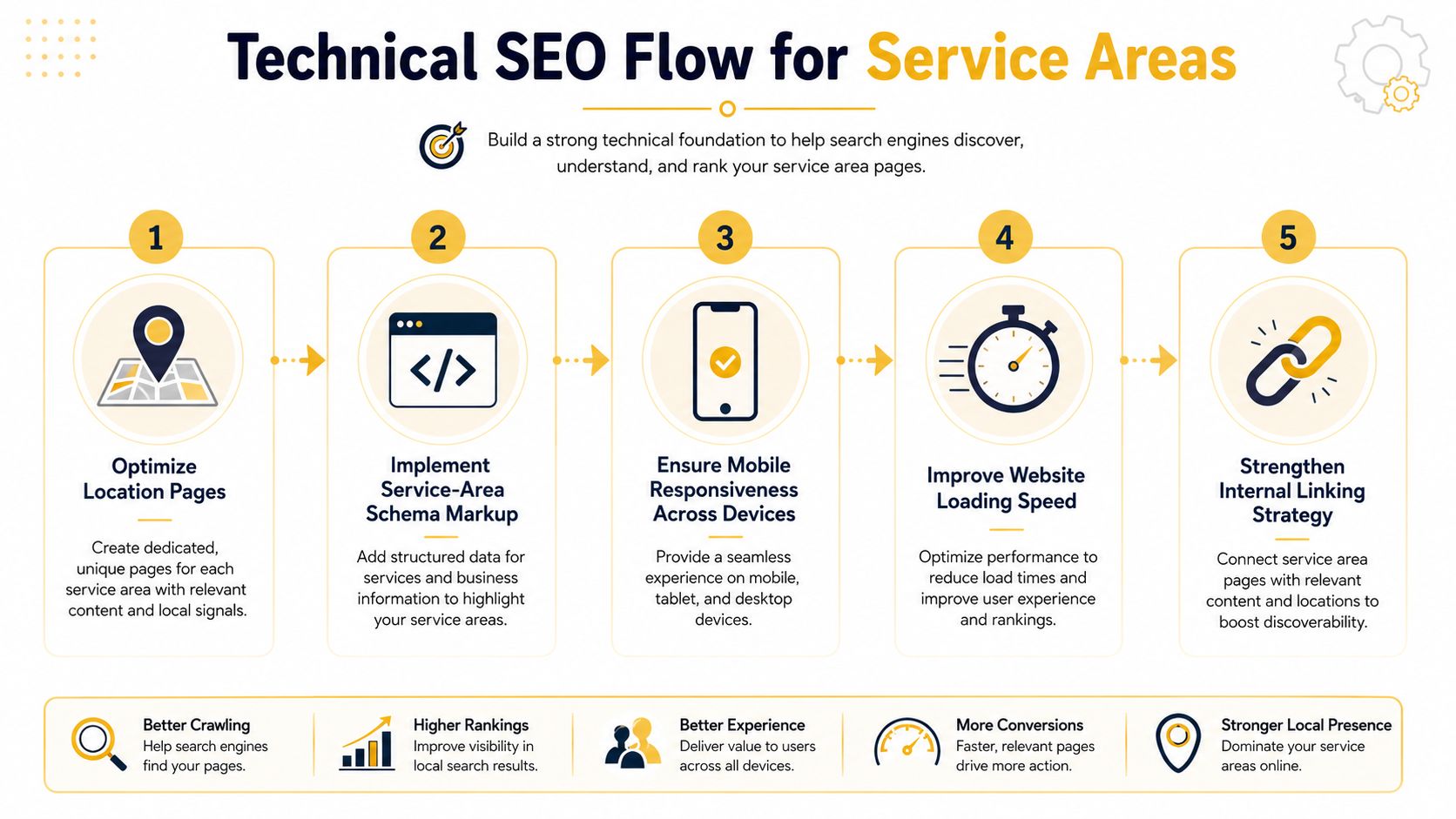
For service-area businesses, this matters because your address, service regions, and offerings don't always map neatly to how users search. Properly implementing service-area schema, then validating it in Google's tools and Search Console, can improve local rankings by 15–25% within 4–8 weeks when paired with location-specific content and citations, according to this guide on technical SEO for service-area businesses.
The same guidance recommends building Tier 1 location pages for your top 3–5 markets, keeping each page 60–70% unique content, and avoiding thin city-name swaps.
Focus on technical work that changes outcomes
For most local companies, this is the order we use:
- Implement service-area schema first: Don't guess. Mark up the business and service context accurately.
- Verify the markup: Use Google's validation and reporting tools so errors don't sit unnoticed.
- Build location pages carefully: Write pages for priority markets with meaningful differences in copy, proof, and examples.
- Strengthen mobile UX: Make buttons thumb-friendly, forms short, and page structure easy to scan.
- Keep load times under control: Slow pages cost leads, especially for urgent searches on mobile.
A lot of technical “SEO improvements” don't affect lead flow. These do.
Speed and mobile experience matter because buyers are impatient
The person looking for a tow company, locksmith, or emergency repair service is often on a phone and under pressure. If the page loads slowly, jumps around visually, or hides the contact path behind a bloated menu, you've already made the sale harder.
That's where Core Web Vitals and page experience become practical, not theoretical. If your team needs a plain-English overview, this article on what Core Web Vitals are is a solid starting point.
Field note: Technical SEO for local businesses works best when it removes ambiguity. Google should be able to identify the service, the area served, and the page purpose without guessing.
Earning Customer Trust with Reviews and Links
Trust is a ranking input and a conversion input. For service businesses, it's hard to separate the two.
A strong review profile helps people feel safe calling you. Relevant local links help search engines see that your business is part of the market it claims to serve. Neither one is optional if you want durable local visibility.
Reviews are sales assets, not cleanup work
Too many businesses treat review collection like an occasional admin task. The businesses that grow through search treat it as part of delivery.
The best time to ask for a review is right after the customer has clearly felt the value of the work. That might be when a repair is finished, a remodel milestone is signed off, or a consulting engagement gets positive feedback. The ask should be simple, direct, and easy to complete.
A practical review system looks like this:
- Ask close to the win: Don't wait weeks. Send the request while the result is still fresh.
- Use one direct link: Remove friction. Don't ask customers to search for your profile.
- Coach the team: Frontline staff should know when and how to ask naturally.
- Respond to every review: Thank positive reviewers and address negative feedback calmly and specifically.
- Look for recurring themes: Reviews often tell you what buyers value most. Use that language on service pages.
A negative review doesn't automatically hurt you most. Silence does. A profile with stale or unanswered feedback creates doubt.
Local links should come from real-world involvement
Link building for local service businesses is less mysterious than people think. You do not need a giant outreach campaign to make progress.
The best local links usually come from things a legitimate business should be doing anyway. Join the chamber. Sponsor a youth team. Support a neighborhood event. Partner with adjacent businesses. Get listed in credible local associations. Offer expert input when local media needs a comment. These links tend to be relevant, geographically aligned, and difficult for weaker competitors to fake.
Here's how the trade-off works:
| Tactic | Why it works | What to avoid |
|---|---|---|
| Community sponsorships | Builds local visibility and can earn mention links | Paying for random low-quality directory placements |
| Industry associations | Reinforces legitimacy in your vertical | Joining irrelevant groups just for a backlink |
| Business partnerships | Creates referral value plus local mentions | Link swaps with unrelated sites |
| Local PR | Earns coverage around real expertise or community activity | Manufactured stories with no local angle |
If a local backlink wouldn't make sense for reputation or referral value, it usually isn't worth chasing for SEO either.
The useful mindset is simple. Build trust in public, and your SEO signals often improve as a byproduct.
Measuring What Matters and Your Quick-Start Checklist
The easiest way to waste money on SEO is to measure the wrong thing.
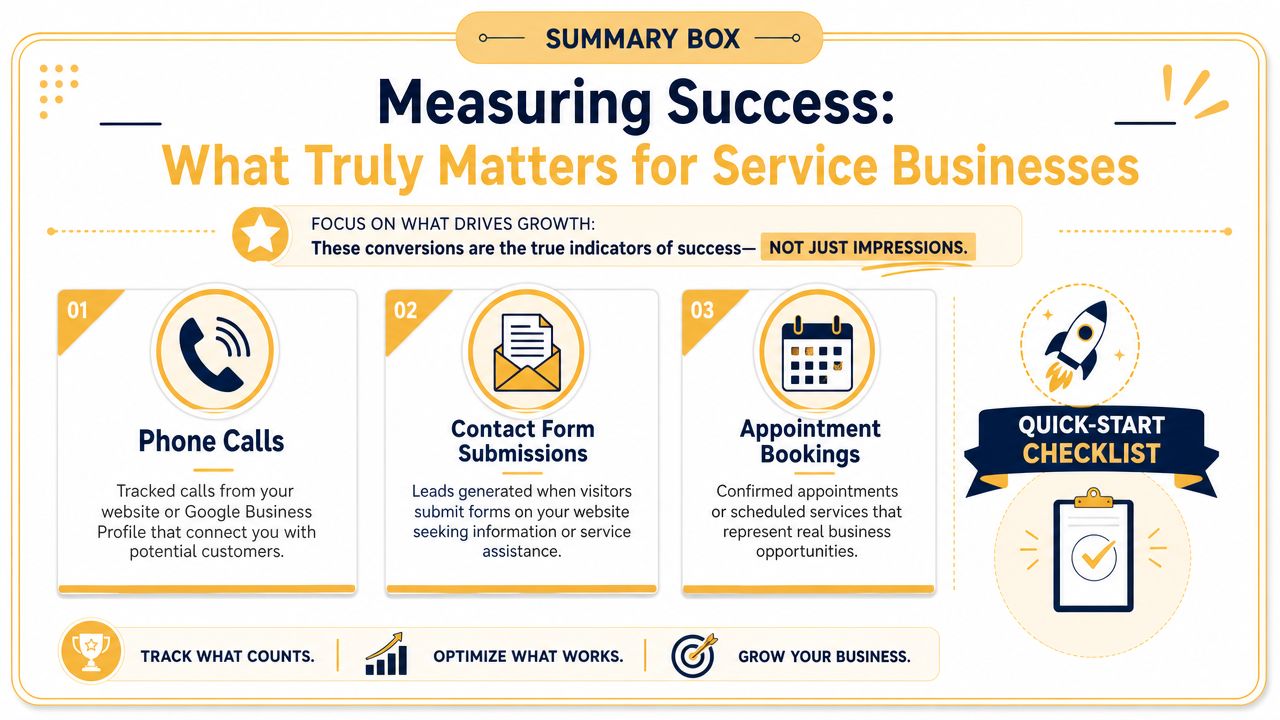
Service businesses don't stay in business on impressions alone. Rankings matter only if they turn into calls, form submissions, and booked appointments. That's the scorecard.
Track conversions before vanity metrics
Start with the places where leads happen:
- Phone calls: From your website and your Google Business Profile
- Contact form submissions: Quote requests, consultation requests, inspection requests
- Appointment bookings: Any confirmed scheduled action tied to revenue
- Direction or click-to-contact behavior: Useful as supporting indicators, not primary success metrics
This summary graphic captures the metrics that deserve most of your attention:
Your Google Business Profile gives useful interaction data directly inside the platform. Google Analytics can track form completions and other key actions on your site. Search Console helps you see which pages are earning visibility and which queries are bringing people in.
If a page ranks but doesn't produce leads, don't celebrate it too early. Check the intent match, the page layout, the CTA placement, and whether the page attracts the right type of visitor in the first place.
A quick-start checklist you can actually use
If you want the shortest path to traction, handle the work in this order:
- Fully complete your Google Business Profile
- Create or improve core service pages
- Add local proof to those pages
- Publish content tied to local problems and real jobs
- Implement schema and clean up location-page structure
- Build a repeatable review request process
- Pursue local links through community and business involvement
- Track calls, forms, and bookings every month
A lot of business owners also need a recovery plan when reputation issues are already affecting lead flow. If that's your situation, this guide from ContentRemoval.com on reputation management is worth reading for the operational side of rebuilding trust after bad reviews.
The bigger point is this. SEO for service businesses works when every part supports the same outcome. Your local profile earns visibility. Your service pages convert intent. Your content builds authority. Your technical setup removes confusion. Your reviews and local links reinforce trust. Then your reporting tells you whether the system is producing real opportunities.
If you want help building that system, Up North Media works with businesses on SEO strategy, web design, and technical implementation that connect local visibility to actual leads.