
When someone pulls out their phone and types "coffee shop near me" or "emergency plumber in Omaha," they aren't just browsing—they're ready to buy. Local search marketing is the art and science of making sure your business is the one they find in that moment of need.
Think of it as the digital version of putting a big, bright, welcoming sign on your storefront. It’s a focused strategy designed to connect your physical store or service-area business with the customers right in your neighborhood who are actively looking for what you offer.
Unpacking Local Search Marketing
At its heart, local search is about tapping into high-intent customers. These aren't people casually scrolling; they have a problem to solve right now.
This is where local marketing splits from general SEO. Instead of trying to rank for a broad term like "best plumber" nationwide, the goal is to dominate a hyper-relevant search like "emergency plumber in Omaha." It’s all about being the most visible and trusted option for the people who can actually walk through your door or book your service.
The Power of Proximity
Don't underestimate the impact of showing up in these local searches. A staggering 88% of consumers who search for a local business on their smartphone will either call or visit that business within 24 hours. That number says it all—local searches lead to immediate, real-world action.
Local search marketing bridges the gap between a customer's digital search and a physical visit. It transforms online visibility into tangible results like phone calls, direction requests, and in-store sales, driving real-world revenue.
Core Components and Strategies
Getting local search right isn't about flipping a single switch. It's a combination of several coordinated efforts working together. For a deeper dive into the overarching strategy, you can explore the broader field of Local SEO.
Here's a quick look at the core components and what they do for your business.
Local Search Marketing At A Glance
This table breaks down the key pillars of a solid local marketing strategy.
| Component | Primary Goal | Key Business Benefit |
|---|---|---|
| Google Business Profile (GBP) | Dominate the Google Maps "Local Pack" and provide crucial business info. | More phone calls, direction requests, and website clicks. |
| On-Page Local SEO | Signal to Google what you do and where you do it, directly on your website. | Higher rankings for location-specific keywords. |
| Local Citations | Build consistent mentions of your business info across the web. | Increased trust and authority with search engines. |
| Customer Reviews | Generate positive social proof and build a strong online reputation. | Higher conversion rates and improved local rankings. |
| Local Link Building | Earn links from other relevant local websites, businesses, and blogs. | Boosted local authority and credibility in your service area. |
| Local Content | Create content that speaks directly to your local audience and their needs. | Stronger community connection and relevance for local queries. |
Each of these pieces plays a vital role in your local visibility.
Think of your Google Business Profile (GBP) as your digital storefront on Google—it's absolutely critical. Then you have local citations, which are just mentions of your business name, address, and phone number (NAP) on sites like Yelp or Apple Maps. Consistency here is key.
You also need to weave location-specific keywords into your website (on-page SEO) and actively encourage customer reviews to build trust. When you get all these elements working in harmony, you create a powerful presence that helps you win the customers closest to you.
Why Local Search Is a Game Changer for Your Business
Think of local search marketing as the great equalizer. It’s how a small, independent Omaha bakery can go head-to-head with a national grocery chain—not by outspending them, but by outsmarting them in the digital neighborhood. The whole thing hinges on one powerful idea: searcher intent.
When someone types "best birthday cake in Omaha" into Google, they aren't just window shopping. They have an immediate need and they’re actively looking for a solution. That high-intent behavior is the magic behind local search. These are customers ready to make a move—visit a store, make a call, or place an order—often within the same day.
Ignoring your local digital footprint today is like having an unlisted phone number back when phone books were a thing. You’re basically invisible to the people who are trying their best to find you.
Turning Clicks Into Customers
The line between showing up online locally and making money is incredibly direct. Unlike those big, broad marketing campaigns that build brand awareness over time, a strong local search presence generates leads right now. It turns a simple Google query into real-world actions that drive revenue.
Just think about these everyday situations:
- A homeowner with a burst pipe searches "emergency plumber near me" and immediately calls the first reputable company they see in the Google Map Pack.
- A family visiting Omaha for the weekend looks for "kid-friendly restaurants downtown" and uses the driving directions from a Google Business Profile to get there.
- A professional needing a last-minute suit for a meeting searches for "same-day suit alterations" and visits the shop with the most positive recent reviews.
In every single case, the business that was most visible and trustworthy at that exact moment of need won the customer.
The beauty of local search marketing is that it targets customers at the exact moment they are looking to buy. It's not about interrupting their day with an ad; it's about providing the perfect solution when they need it most.
Leveling the Playing Field
For small and medium-sized businesses, this is a massive advantage. You don't need a national marketing budget to win over the customer standing two blocks away. You just need to be the best, most visible answer to their local question.
This focused approach lets you compete on things like proximity, reputation, and relevance instead of sheer size. By optimizing for your specific service area, you can capture a loyal customer base that larger, less-focused competitors might completely overlook. The goal isn't to be found by everyone, everywhere; it's to be found by the right people, right here.
Ultimately, a solid local search strategy does more than just boost your rankings. It directly fuels your business growth by:
- Increasing Qualified Foot Traffic: It guides nearby customers straight to your front door.
- Generating High-Intent Phone Calls: It connects you with people who need your services immediately.
- Building Local Trust and Credibility: It uses positive reviews and consistent information to make you the go-to choice in your community.
Investing in what local search marketing is all about means investing directly in your bottom line, ensuring your business is the top choice for the customers who matter most—the ones right around the corner.
The Core Pillars of a Winning Local Search Strategy
A killer local search marketing plan isn't about doing just one thing right. It’s about nailing several interconnected pieces that all work together. Think of it like building a house: you need a solid foundation, sturdy walls, a good roof, and some curb appeal. If you skip one, the whole structure feels a bit wobbly. In the same way, a winning local strategy means methodically shoring up every key area to build a powerful presence that pulls in nearby customers.
This is how all that effort pays off in real, measurable results for your business.
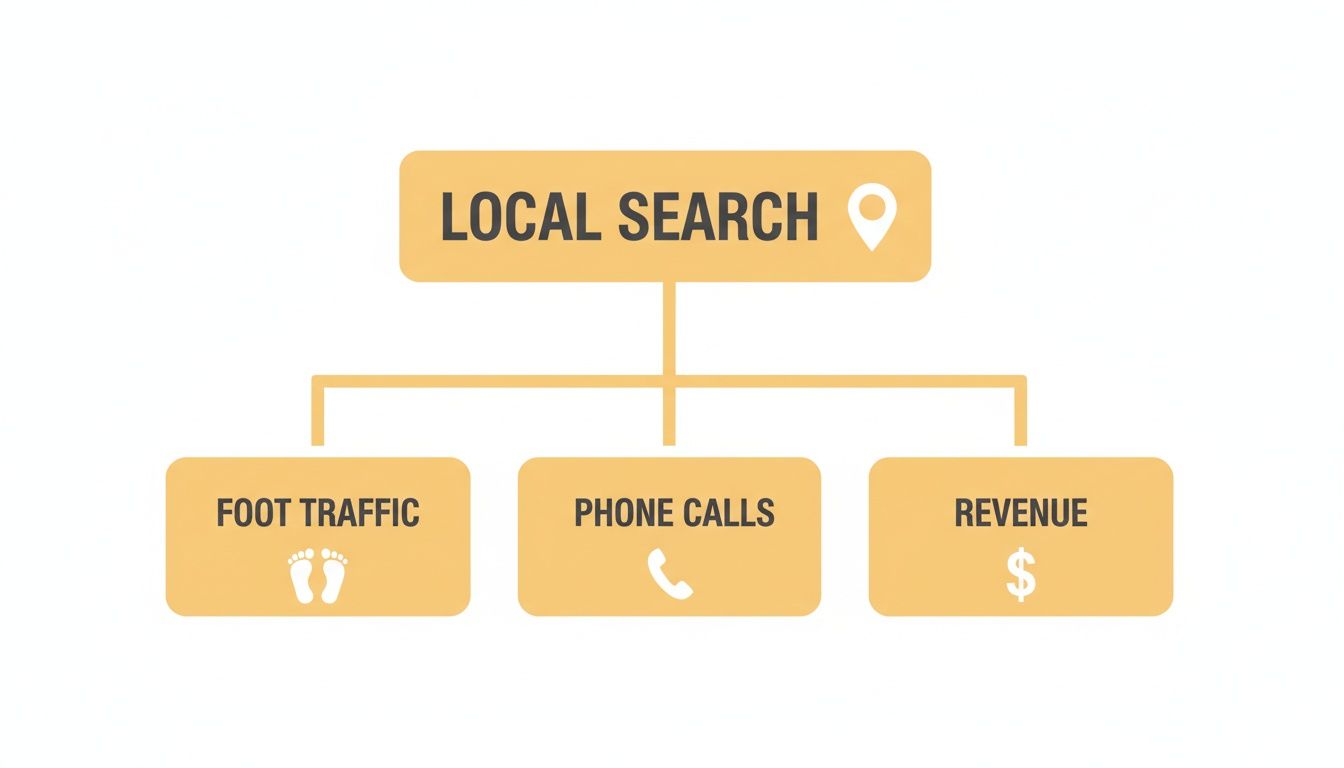
As you can see, a strong local search presence is a direct line to more foot traffic, more phone calls, and ultimately, more revenue. Let's break down the pillars that get you there.
Your Digital Front Door: Google Business Profile
If there's one thing you absolutely can't ignore, it's your Google Business Profile (GBP). This is your digital storefront, and for most people, it's the very first impression they'll have of your business. A well-tended profile puts all the critical info—hours, address, phone number, reviews—right there in the search results and on Google Maps. No extra clicks needed.
A complete and active profile doesn't just help customers; it sends huge trust signals to Google. That seriously boosts your chances of landing in the coveted "Local Pack"—that block of three map results at the top of the page that gets a massive chunk of all the clicks.
Weaving Location Into Your Website: On-Page SEO
While your GBP is the storefront on Google's property, your website is your home base. On-page local SEO is all about tweaking your website's content to scream your geographic relevance to search engines. It’s about telling Google not just what you do, but where you do it.
This means strategically dropping your city, neighborhood, or service area names in key spots:
- Title Tags & Meta Descriptions: These are the headlines and short summaries in search results. They need to clearly state your location.
- Page Headings (H1s, H2s): Work local keywords right into your page titles, like "Expert Plumbing Services in Omaha."
- Body Content: Talk about local landmarks, community events, or neighborhood-specific projects. It shows you’re a genuine local player.
When you embed these location-specific signals throughout your site, you make it obvious to Google that you're the best answer for someone searching nearby. If you want to dive deeper into how this all works, you can learn more about the local search optimization algorithm.
Consistency is Key: Local Citations and NAP
Imagine handing out three different business cards, each with a slightly different phone number or address. It would be confusing and look unprofessional, right? The same thing happens online. Local citations are simply mentions of your business's Name, Address, and Phone number (NAP) across the web on sites like Yelp, Apple Maps, and industry directories.
A consistent NAP profile across the web is a foundational trust signal for search engines. Inaccuracies create doubt, while uniformity builds authority and reinforces your geographic relevance.
Making sure your NAP info is 100% identical everywhere is non-negotiable. Even a tiny difference, like "St." versus "Street," can throw search engines off and weaken your local authority. A clean, consistent citation profile is a quiet but powerful way to prove you are who—and where—you say you are.
The Modern Word-of-Mouth: Reviews and Reputation
In local search, customer reviews are the ultimate social proof. A steady flow of recent, positive reviews does two critical things: it builds trust with potential customers, and it directly bumps up your local search ranking. In fact, a whopping 93% of consumers say online reviews have swayed their buying decisions.
You have to be proactive about managing your reputation. That means:
- Asking for Feedback: Make it dead simple for happy customers to leave you a review.
- Responding to Everyone: Engage with all reviews, good and bad. It shows you're listening.
- Keeping an Eye Out: Monitor your reputation across all the major review platforms, not just Google.
A great online reputation is everything in local search. You can make it easier to collect feedback by leveraging Google Review QR Codes that send customers straight to your review page.
Earning Local Endorsements: Link Building
If citations are like mentions in a phone book, local link building is like getting a referral from a respected neighbor. When another local, relevant, and authoritative website links to yours, it's a massive vote of confidence in Google's eyes. This could be a link from a local news site that featured your business, a community event you sponsored, or a blog run by another local business you partner with.
These local shout-outs signal to search engines that your business is a legitimate, valued part of the community. This is a quality-over-quantity game. A single link from the Omaha Chamber of Commerce website is worth far more than a hundred links from irrelevant, out-of-state sites.
Creating Content for Your Community
Finally, a truly great local search strategy involves creating content that speaks directly to your local audience. This is more than just sticking your city's name on a few pages. It means becoming a real local resource.
Think about writing a blog post about a local festival you're taking part in. Or, if you run a pet supply store, create a guide to the best dog parks in your area. This kind of localized content doesn't just attract local search traffic; it builds a real connection with your community and cements your brand as the go-to expert in your neighborhood.
Not sure where to start? It's easy to feel overwhelmed by all the different pillars. The key is to prioritize what will give you the most bang for your buck.
Local Search Marketing Pillar Checklist
This little checklist can help you decide where to focus your energy first by weighing the effort required against the potential impact on your local visibility.
| Pillar | Effort Level (Low/Med/High) | Impact Level (High/Very High) | Best For... |
|---|---|---|---|
| Google Business Profile | Low to Med | Very High | Every single local business. This is non-negotiable. |
| On-Page Local SEO | Med | Very High | Businesses with a website they want to rank. |
| Local Citations (NAP) | Med | High | Building a foundational layer of local trust. |
| Reviews & Reputation | Med (Ongoing) | Very High | Businesses aiming to build trust and social proof. |
| Local Link Building | High | High | Competitive markets where authority is key. |
| Localized Content | Med to High | High | Becoming a true community resource and authority. |
Start with the low-effort, high-impact tasks like optimizing your Google Business Profile. Once that's in great shape, you can progressively move on to the other pillars. Each one you add strengthens your overall local presence, making it harder for competitors to catch up.
How to Measure Your Local Search Performance
Putting in the work on local search is one thing, but how do you know if it’s actually moving the needle? Measuring performance isn’t about getting lost in spreadsheets full of confusing data. It’s about tracking the specific actions that tell you a customer is getting closer to making a purchase.
You have to connect your online strategy to real-world results.
Think of it this way: a solid local strategy gets customers to your digital doorstep. The right metrics tell you how many of them rang the bell, asked for directions, or called to see if you were open. These are the Key Performance Indicators (KPIs) that prove you’re getting a real return on your investment.
Key Metrics That Truly Matter
Forget about vanity metrics like impressions or overall website traffic for a second. When it comes to local search, you need to zero in on KPIs that show a local customer is ready to engage with your business. These numbers tell the story of how your online presence is driving real-world interactions.
The best place to start is with the powerful—and free—tools Google gives you. They offer a clear window into how customers are finding and interacting with your business.
Your most important data will come from two places:
- Google Business Profile Insights: This is your main dashboard for local engagement. It tracks the direct interactions people have with your profile, which often happen before they even click through to your website.
- Google Analytics: This tool gives you a much deeper look at what people from your local area do once they actually land on your site.
By piecing together the insights from both, you get a complete picture of your local search performance—from the moment someone discovers you on Google Maps to the final action they take on your website.
Tracking Engagement in Google Business Profile
Your Google Business Profile (GBP) is where the most immediate local actions take place. The "Performance" tab in your GBP dashboard is your command center for tracking these make-or-break interactions.
Hone in on these three core metrics:
- Phone Calls: This counts how many people clicked the "call" button right from your profile. It's a high-intent action that often leads directly to an appointment or a sale.
- Website Clicks: This shows you the number of people who clicked the link to your website from your GBP listing. It’s a strong sign of interest and a desire to learn more about what you offer.
- Direction Requests: This tracks how many people tapped for directions to your physical storefront. It's one of the clearest signals that an online search is about to turn into actual foot traffic.
Watching these numbers over time will show you the direct impact of your optimization efforts. For example, if you add new photos and services to your GBP and see a 20% jump in direction requests the next month, you know you’ve got a clear win.
"Measuring local search isn't just about rankings; it's about tracking tangible customer actions. A rise in calls and direction requests is a far more valuable indicator of success than simply being number one for a keyword."
Analyzing Website Behavior with Google Analytics
Once someone clicks from your profile to your website, Google Analytics picks up the story. This is where you can see if your local traffic is actually converting. You can set up specific goals to track the valuable actions local customers take on your site.
Valuable local website actions to track include:
- Contact Form Submissions: When a potential customer fills out a form to request a quote or ask a question.
- Clicks on Your Phone Number: Tracking clicks on a "click-to-call" phone number listed on your site pages.
- Local Landing Page Visits: If you have pages for specific neighborhoods (e.g., "Plumbers in Dundee"), you can see how much traffic those pages are pulling in.
By filtering your audience by geographic location in Google Analytics, you can see exactly how users from Omaha, for instance, behave differently than users from other areas. This lets you fine-tune your website content and calls-to-action to better serve your local customer base, ensuring your digital efforts translate directly into business growth.
Local Search in Action: An Omaha Business Case Study
Theory is one thing, but seeing local search marketing transform a real business is where it all clicks. Let's walk through a tangible example of "Omaha Pipes," a fictional—but totally realistic—local plumbing service that was struggling to connect with customers online.
Their story is a perfect illustration of how a well-executed strategy can make a direct, measurable impact.

Before they got serious about a local search plan, Omaha Pipes was practically invisible online. They were getting by on word-of-mouth and some outdated advertising, getting completely lost in the noise whenever a homeowner had a burst pipe. Their online presence was a ghost town with a bare-bones Google profile and a basic website that wasn't pulling in any local business.
The Transformation Strategy
The team knew they needed to show up when and where it mattered most—right in the middle of a plumbing crisis. They stopped guessing and kicked off a methodical local marketing push, focusing on the core pillars we’ve been talking about. Their game plan was simple but powerful.
First, they treated their Google Business Profile like their single most important digital asset. They claimed it and fully fleshed it out with:
- High-quality photos of their team and equipment on the job.
- A complete list of services, from routine leak repair to emergency water heater installation.
- Accurate business hours and a clearly defined service area covering all of Omaha.
Next, they launched a proactive campaign to get reviews from happy customers, making it dead simple for people to share their positive experiences. This immediately started building the kind of trust and social proof you just can't buy.
The core of their strategy was simple: be the most helpful, visible, and trusted plumber for anyone searching in Omaha. Every single action was designed to reinforce their local expertise and reliability.
Building Local Authority and Connection
With their GBP in solid shape, Omaha Pipes turned its attention to building a wider local footprint. They meticulously audited and updated their business information across dozens of online directories, making sure their name, address, and phone number were identical everywhere. This consistency sent strong trust signals straight to Google.
To connect directly with the community, they started creating genuinely helpful content for their website. They published blog posts like "Common Plumbing Issues in Older Aksarben Homes" and "How to Prep Your Pipes for a Nebraska Winter." This not only attracted organic traffic but also positioned them as the local experts who understood the specific challenges Omaha homeowners face. For a deeper dive into this kind of strategy, check out our complete guide to Local SEO in Omaha.
The Measurable Results
The "after" picture for Omaha Pipes was dramatically different. Within just a few months, the tangible results started rolling in, proving the direct line between their local search efforts and their bottom line.
Here’s a snapshot of their success:
- A 120% increase in qualified phone calls coming directly from their Google Business Profile.
- A 75% jump in online quote requests submitted through their website's contact form.
- They started ranking consistently in the top 3 of the Google Map Pack for high-value keywords like "emergency plumber Omaha."
This transformation wasn't magic. It was the direct result of a focused local search marketing strategy that turned their online invisibility into a powerful lead-generation engine, driving real-world growth for their small business.
Your Next Steps in Local Search Marketing
Alright, so we've covered the pillars of local search marketing. Knowing what they are is one thing, but actually putting that knowledge to work is what gets you customers. The good news is that moving from theory to real-world results doesn't have to be a massive undertaking. You can start making a real dent today with a few smart moves.
The goal here is simple: build momentum. If you tackle a few high-impact tasks first, you create a solid foundation to build the rest of your strategy on. This isn't about trying to boil the ocean; it's about taking deliberate, powerful first steps.
Your Immediate Action Checklist
Ready to jump in? This simple checklist covers the essential first moves any business owner can make to get their local search presence off the ground. These actions hit the most critical ranking factors and set the stage for a more advanced strategy later on.
- Claim and Fully Optimize Your Google Business Profile: This is completely non-negotiable. Fill out every last section, upload high-quality photos, and write a business description that tells people exactly why they should choose you.
- Audit Your NAP Consistency: Do a quick search for your business online. Check the big directories like Yelp and Apple Maps to make sure your Name, Address, and Phone number are 100% identical everywhere. No exceptions.
- Start a Review Generation Process: Figure out a simple way to ask your happiest customers for a Google review. A follow-up email with a direct link or a small handout with a QR code at checkout can work wonders.
Partner with Local Experts for Maximum Impact
Getting these initial steps done is a huge win, but mastering all the pillars—from technical on-page SEO to local link building—takes time and ongoing expertise. That’s where a dedicated partner can make all the difference. For Omaha businesses aiming to really own their local market, Up North Media provides the strategic guidance to turn a good start into a winning game plan.
Here's an example of how we put this into practice on our own website.
We believe in making it clear how our services connect directly to the pillars we’ve discussed in this guide, from optimizing your digital storefront to building a powerful local content engine. Our approach to local search marketing services is built on a deep understanding of what it actually takes to succeed right here in Omaha.
Don't let your competitors scoop up the customers in your own backyard. A proactive, expert-led local search strategy is your key to becoming the go-to choice in your neighborhood.
We help you move beyond the basics to execute a complete strategy that drives real, measurable growth. Ready to find out where your biggest opportunities are? Schedule a personalized local search audit with our team today, and let's build a plan to make your business the top choice for customers in your area.
Your Local Search Questions, Answered
Jumping into local search marketing always kicks up a few questions. That's a good thing. Getting straight answers helps you know what to expect and gives you the confidence to move forward. Here are a few of the most common things business owners ask.
How Long Does This Stuff Actually Take?
This is always the first question, and the honest answer is: it depends. Unlike flicking a switch on a paid ad, local SEO is more like a long-term investment that picks up steam over time. You can definitely see some early wins—like a bump in phone calls from a tuned-up Google Business Profile—within the first 30 to 90 days.
But if you’re trying to lock down top rankings for really competitive local keywords, you're looking at more of a three- to six-month journey of consistent work. Think of it like planting a garden. You have to prep the soil and plant the seeds, and it takes a little while before you see real, solid growth.
Can I Do This Without a Physical Storefront?
Absolutely. In fact, local search marketing is a game-changer for service-area businesses (SABs) like plumbers, electricians, or consultants who go to their customers. Instead of showing a pin on a map at your home address, your Google Business Profile will simply outline the specific area you serve.
The strategy just shifts a little. You'll focus more on:
- Clearly highlighting the neighborhoods or cities you work in.
- Getting great reviews from customers in those specific areas to build trust.
- Creating content on your website that speaks directly to each service zone.
The goal is exactly the same: be the most visible, most trusted option for customers in your service area, even if they never step foot in an office.
What’s the Real Difference Between SEO and Local SEO?
It’s a great question. Think of it this way: general SEO and local SEO are built on the same foundation, but they’re playing a different game. General SEO is all about getting a website seen by a national or even a global audience. A software company, for example, wants to show up for "project management tools" no matter where the searcher is.
Local SEO, on the other hand, throws geography into the mix. It's laser-focused on ranking for searches that have "local intent," like "plumber in Omaha," where how close you are is a massive ranking factor. It’s the difference between casting a giant net across the ocean and using the perfect lure in your favorite local fishing spot.
Ready to stop guessing and start getting found? Up North Media builds local search strategies that connect Omaha businesses with the customers who are literally right around the corner. Let's find your biggest opportunities—schedule a free consultation with us today.