
When a potential customer in Omaha searches for "best coffee near me," Google's algorithm kicks into high gear, sorting through countless businesses to serve up the most relevant results. This isn't a game of chance. It’s a process guided by specific local SEO ranking factors that connect searchers with the best possible local solutions.
Think of local SEO as your digital storefront on the busiest street in town. Getting it right is no longer optional—it's essential for growth. For small and mid-sized businesses, understanding these signals turns a guessing game into a repeatable strategy.
It's the difference between being the first business a customer sees and getting buried on the third page of results, where 75% of users never bother to look. The goal is to send clear, consistent signals to Google that your business is prominent, relevant, and trustworthy right here in your local area.
What Really Drives Local Search Results?
At the end of the day, your local ranking is a reflection of your digital reputation. It’s built on three core pillars that work together to tell Google you're the right answer for a local search.
- Relevance: How well does your business actually match what the searcher is looking for? This comes down to things like your Google Business Profile categories, the content on your website, and even the keywords customers use in their reviews.
- Proximity: How close is your physical location to the person searching? You can't just pick up and move your shop, but you can signal your service area relevance through localized content and a well-defined service area in your profile.
- Prominence: How well-known and respected is your business? Google measures this through your review count and overall rating, the number of quality local backlinks pointing to your site, and how consistently your business information appears across the web.
This diagram breaks down how these core components fit together.
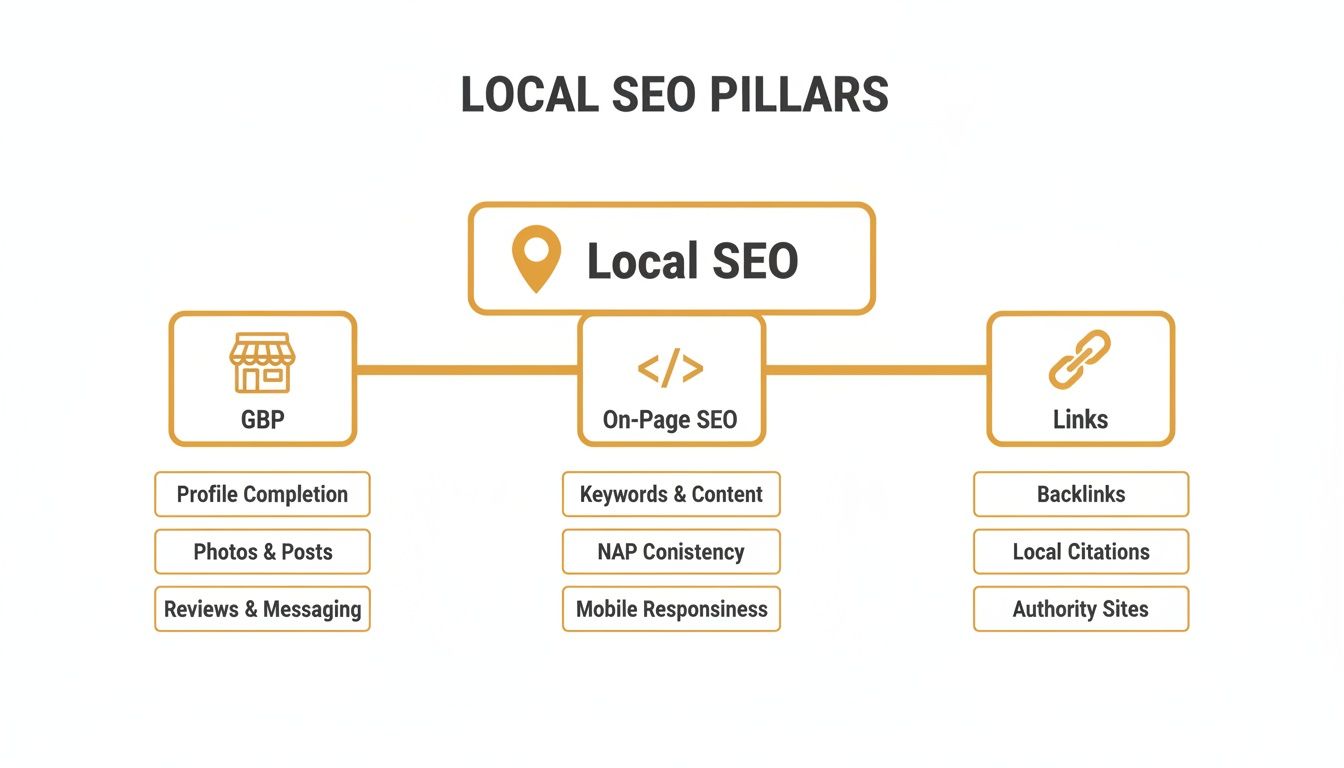
As you can see, a strong Google Business Profile, optimized website signals, and authoritative links form the foundation of any solid local strategy.
To get a better handle on how all these pieces combine, you can check out our guide on what is local search marketing. For a look at how these ideas are put into action, exploring specific local SEO strategies for businesses can offer some great real-world examples.
Now, let's walk through each of these factors, one by one.
The Core Pillars of Local SEO Rankings
To simplify, let's break down the three main categories that Google looks at when deciding who gets to rank in local search. Nailing these three areas will put you ahead of most of your competition.
| Ranking Pillar | Primary Focus | Why It Matters for Your Business |
|---|---|---|
| Relevance | Matching your services and content to a user's search query. | This ensures you show up for the right customers—people actively looking for what you offer. It's about being the best answer to their problem. |
| Proximity | The physical distance between your business and the searcher. | Proximity is a huge factor in "near me" searches. Google prioritizes businesses that are conveniently located for the user. |
| Prominence | How well-known and trusted your business is online and offline. | A strong reputation, shown through reviews, links, and mentions, signals to Google that you're a legitimate and popular choice in the community. |
Think of these pillars as the legs of a stool. If one is weak, the whole thing becomes unstable. A successful local SEO strategy requires a balanced focus on all three to consistently win top spots in the Local Pack.
Optimizing Your Google Business Profile Signals
Think of your Google Business Profile (GBP) as the digital front door for your business. It's often the very first thing a potential customer sees, and let me be clear: this isn't just another online listing. It's the single most powerful tool you have for local SEO. Getting it right is one of the highest-impact things you can control.
Your GBP is the hub. It feeds information directly into the Google Local Pack and Google Maps—the absolute prime real estate for grabbing the attention of nearby customers. A dialed-in profile tells Google you're an active, reputable, and relevant business that deserves to be at the top.
The Unmatched Power of GBP in Local Rankings
When it comes to local search, nothing else carries as much weight. Your GBP is the cornerstone of your visibility. Simple as that.
Time and again, studies show that Google Business Profile signals are the single biggest factor in Local Pack rankings. We're talking about 20–30% of the total ranking mix coming from things like your profile's completeness, the primary category you choose, your photos, and how you handle reviews. Optimizing your GBP is a seriously high-ROI task.
This profile is your control panel for local search performance. Every single detail matters.
Conducting Your Complete GBP Audit
To turn your profile into a machine that attracts customers, you need to make sure every field is filled out completely and strategically. A regular audit is the best way to spot gaps and find opportunities you might be missing.
Here's a quick checklist to get you started:
- Business Name: Is it your exact, real-world business name? Don't stuff it with keywords or city names—that's a fast track to a penalty.
- Categories: Did you pick the most specific primary category possible? For an Omaha law firm, that means choosing "Personal Injury Attorney" instead of just "Law Firm." Then, add any other relevant secondary categories.
- Address and Service Area: Is your address pin dropped correctly on the map? If you're a service-area business, are your neighborhoods (like Aksarben or the Old Market) clearly defined?
- Hours of Operation: Are your regular and holiday hours always up to date? Nothing frustrates a potential customer more than showing up to a closed business.
- Phone Number and Website: Do these go directly to your business? Using a local phone number helps reinforce those local signals.
Running through this list ensures your foundational info is accurate, which is the first step in building trust with both Google and your future customers.
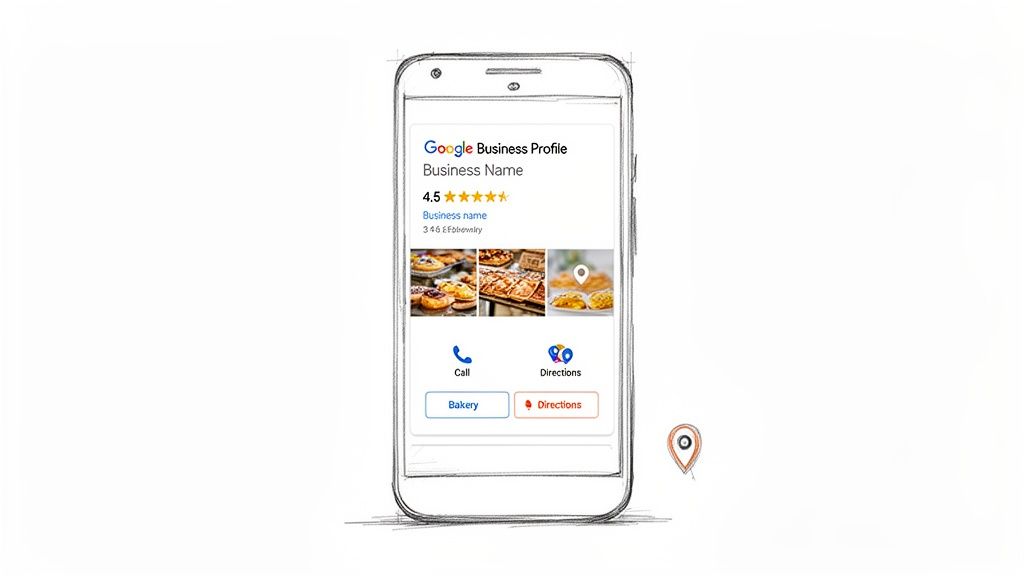
This dashboard is your command center. It’s where you directly influence how people find and perceive your business on Google.
Advanced Optimization Tactics for Maximum Impact
Once you've nailed the basics, it's time to dig into GBP's more dynamic features to really stand out. These are the things that show Google you're actively managing your profile and giving searchers real value.
1. Craft a Compelling Business Description
You get 750 characters for your business description—make them count. This is your elevator pitch. Explain who you are, what you do, and why a customer should choose you over anyone else. Weave in your keywords naturally, but always write for a human first. Talk about what makes you unique and mention your connection to the Omaha community.
2. Leverage High-Quality Photos and Videos
Visuals build instant trust and get people engaged. You need to upload high-resolution photos of your storefront, your team, your products, and your services in action.
Pro Tip: Go beyond the standard shots. Take photos with local Omaha landmarks in the background or show your team participating in a community event. This adds a powerful layer of local context that both search engines and customers will notice.
3. Actively Use Google Posts
Think of Google Posts as free micro-ads that show up right on your profile. They're perfect for announcing:
- Special offers or sales
- New products or services
- Upcoming events
- Company news or recent blog articles
Posts expire every seven days, so you need to be consistent. Every post you make is another signal to Google that your business is active and another chance to grab someone's attention.
4. Engage with the Questions & Answers Feature
The Q&A section is a public forum where anyone can ask and answer questions about your business. Don't wait for others to fill it out—manage it proactively. Seed this section with your own FAQs. Ask and answer common questions about parking, your services, or pricing. This lets you control the narrative and give people helpful information right away.
When you treat your GBP like a dynamic, interactive hub instead of a static listing, you send powerful signals of relevance and authority. For a deeper dive, check out this comprehensive Google Business Profile optimization guide. These advanced tactics are what separate the top-ranking businesses from the rest of the pack.
Proximity Is King, but Reviews Are the Ace Up Your Sleeve
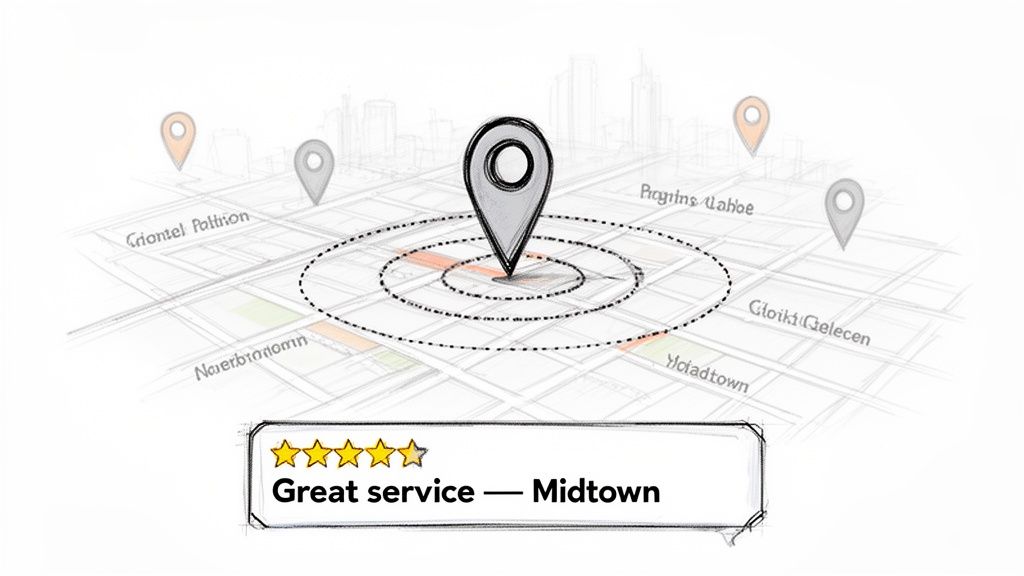
In local search, two things really move the needle: how close you are to the searcher (proximity) and what other customers say about you (reviews). It's a powerful one-two punch that can make or break your visibility.
Think of proximity as the bouncer at the club. When someone in Omaha types in "emergency plumber near me," Google’s first job is to figure out who's actually nearby. It's the initial gatekeeper. While you can't just pick up your shop and move it, you can absolutely influence how Google sees your relevance across your entire service area.
Proximity is the heavyweight champion of local SEO. It’s the non-negotiable ticket you need just to get into the game.
But proximity isn’t the whole story. If it were, the closest business would win every single time, and we know that's not how it works. This is where customer reviews come in. They’re the ultimate tiebreaker, giving Google the social proof it needs to rank you above a competitor who might be a few blocks closer.
Why Proximity Is the Starting Line
Proximity is Google's first filter. It instantly narrows the massive pool of businesses down to a handful of geographically relevant options. Time and time again, research shows that physical distance is the single biggest factor for getting on the local map in the first place.
Studies have measured proximity as contributing anywhere from 36% to 55% of the total ranking signal. It’s what gets you in the conversation. You can see a great breakdown of these factors over at searchatlas.com.
So, if you’re an Omaha business, having a physical address in Dundee gives you a built-in advantage for searches coming from that neighborhood. But once Google has a list of "close enough" businesses, it starts looking for other clues to decide who really deserves that top spot.
Using Reviews to Outrank Closer Competitors
This is where your reputation becomes your most powerful weapon. A killer review profile signals to Google that even if you aren't the absolute closest option, you're clearly the best option. A steady stream of glowing, recent reviews can absolutely leapfrog a competitor’s proximity advantage.
Let's be real: a business with 4.8 stars from 150 reviews just feels more trustworthy than a closer competitor with 3.5 stars from 20 reviews. That social proof is a massive signal of your prominence in the community.
To build a review profile that actually helps you rank, you need to focus on a few key things:
- Review Quantity: You need a healthy number of reviews. It signals that you've been around and have a real customer base.
- Review Velocity: How often are you getting new reviews? A consistent flow tells Google you’re active and popular right now.
- Review Quality: High star ratings are non-negotiable. Google wants to recommend businesses that people genuinely like.
- Review Content: This is a hidden gem. Encourage customers to get specific. A review that mentions "best brunch in Blackstone" or "reliable roof repair in West Omaha" adds powerful, locally-relevant keywords to your profile.
Understanding how all these signals work together is key. We actually have a whole guide that dives into the nuts and bolts of the local search optimization algorithm if you want to go deeper.
Your Action Plan for Generating High-Impact Reviews
Sitting back and hoping for reviews is a losing strategy. You need a simple, proactive system to encourage your happiest customers to share their feedback.
1. Make It Stupidly Easy to Leave a Review Get rid of any and all friction. Create a direct link to your Google review form and put it everywhere.
- Stick the link in your email signature.
- Print a QR code on your receipts or business cards.
- Send a follow-up text or email right after you finish a job.
2. Time Your Request Perfectly The best time to ask is right after a customer has had a great experience and that positive feeling is fresh. This could be immediately after a project is completed, during a positive chat in your store, or the moment they tell you how happy they are.
3. Respond to Every Single Review You have to engage. Thank customers for the good reviews—it shows you’re listening and you appreciate them. More importantly, respond professionally to the bad ones. It shows prospective customers that you care about service and are committed to making things right. Google sees this active management as a huge positive signal.
Aligning Your Website With On-Page SEO Signals
Your Google Business Profile might be the flashy digital billboard that grabs attention, but your website is the bedrock. It’s your home base—the place where you control the narrative, prove your expertise, and turn curious visitors into paying customers. Think of it as the authoritative source that backs up every promise your GBP makes.
A well-optimized website sends powerful trust signals to Google. It proves you’re a legitimate, active business with real roots in the local community. Every single piece, from your page titles to the words you write, works together to hammer home your local relevance.
Why Your Website’s On-Page SEO Is a Big Deal
Don't ever underestimate the weight your website carries in local search. While your GBP profile is king of the Local Pack, your website's overall health is a massive factor for both the map listings and the traditional organic results below them. Things like on-page relevance, how your content is structured, and your site's authority all form a huge piece of the puzzle.
Industry analyses consistently show that on-page signals account for roughly one-third of your local ranking power. Tack on another 15–30% for links and domain authority, and you’re looking at a combined 45–60% of your local ranking influence coming directly from your website and its backlink profile. You can dig into the numbers in this breakdown of local SEO statistics.
The data is clear: skipping out on on-page SEO is like building a house without a solid foundation. Sooner or later, it’s going to crumble.
Auditing Your Core On-Page Local Signals
First things first, you need to make sure your website’s most basic information is perfectly aligned with your local identity. This is all about consistency and clarity.
1. Nail Your NAP Consistency Your Name, Address, and Phone number (NAP) needs to be identical everywhere it shows up online, but it starts with your own website.
- Placement: Get your full NAP somewhere obvious, like your website's footer and on its own contact page.
- Formatting: If your GBP address is "123 N Main St," your website can't say "123 North Main Street." Every comma, every abbreviation—it all has to match perfectly.
- Local Number: Always use a phone number with a local area code (like 402 for Omaha). A generic toll-free number just doesn't send the same local signal.
2. Optimize Title Tags and Meta Descriptions These are the first things people see in the search results. They need to be compelling, and they absolutely need to be local.
- Title Tag Formula: A great starting point is
Primary Service | City, State | Brand Name. For example:Custom Web Design | Omaha, NE | Up North Media. - Meta Description: This is your 155-character ad. Make it actionable and mention your location. Something like: "Up North Media offers expert web design and SEO services in Omaha. Contact us for a free consultation to grow your local business."
A well-crafted title tag and meta description do more than just help you rank. They massively boost your click-through rate from the search results, bringing more qualified, local traffic right to your digital doorstep.
Building High-Value Local Landing Pages
Generic, one-size-fits-all content just won't cut it. If you really want to own your service area, you need to build out dedicated pages that speak directly to your local audience. This is where you prove you're part of the community, not just some faceless national brand.
Service Pages with a Local Twist Instead of one big "Services" page, create individual pages for each of your core offerings. Then, weave in some local flavor.
- Example for an Omaha Plumber: A page on "Emergency Sump Pump Repair" could mention the common flooding issues during spring thunderstorms in the Omaha area. You could even reference specific neighborhoods you serve, like Millard or Elkhorn, to make it even more relevant.
Dedicated Location Pages If you have more than one physical location or serve a few distinct areas, each one deserves its own dedicated page.
- What to Include:
- The unique Name, Address, and Phone number for that spot.
- Unique business hours for that location.
- An embedded Google Map of the address.
- Photos of the local storefront and your team there.
- Testimonials from customers in that specific area.
This strategy sends a crystal-clear signal to Google that you have a real, physical presence in each community, making you a much better result for all those "near me" searches.
Implementing LocalBusiness Schema Markup
Finally, you can give Google a cheat sheet for your business information using LocalBusiness schema markup. It’s a snippet of code you add to your website that explicitly spells out all your key details for search engines.
Think of it like putting a perfectly printed label on a filing cabinet. Instead of making Google guess what’s inside, you’re telling it directly: "This is my business name, this is my address, these are my hours." This technical step removes any guesswork and helps Google trust your data, which is an incredibly powerful signal for local SEO.
Building Authority With Local Links and Citations
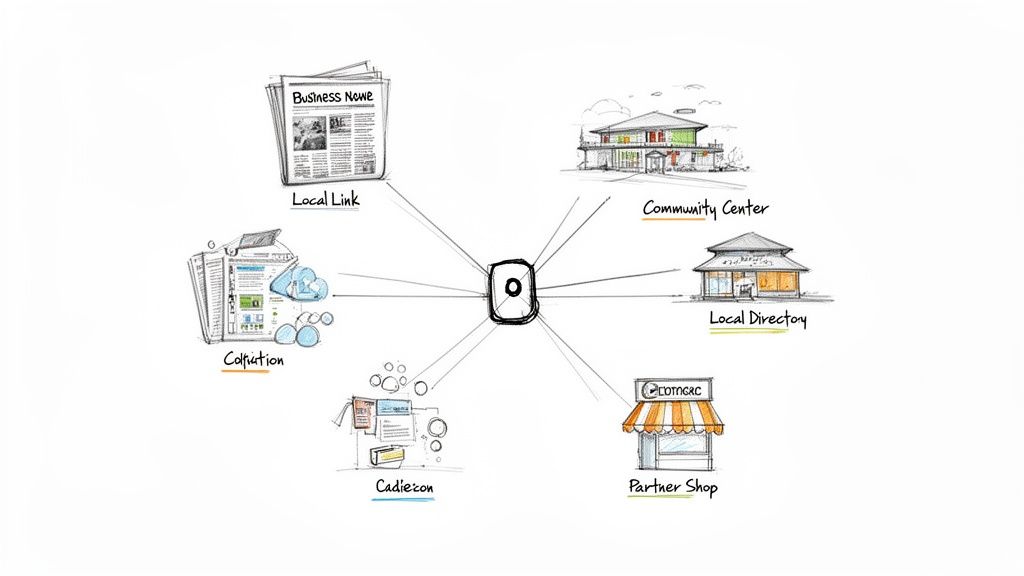
If your website is your digital storefront, think of local links and citations as the roads that guide customers right to your front door. These are powerful off-page signals that act like digital word-of-mouth, telling Google that your business is a legitimate, trusted part of the local community. Getting these two things right is a huge piece of the puzzle for building the authority you need to rank.
Here's a simple way to look at it: a citation is like having your business listed in a trusted local directory—it confirms your basic details are correct. A local link, on the other hand, is like getting a personal recommendation from another respected business or organization in town. You need both to build a web of trust around your business that Google can't ignore.
The Foundation of Trust: Citations and NAP Consistency
A citation is any online mention of your business’s Name, Address, and Phone number (NAP). You'll find them on local business directories like Yelp, industry-specific sites, or even social media pages. But here's the catch: it’s not just about getting listed; it's about being obsessively consistent.
Every single citation must have the exact same NAP information. Even a tiny variation, like "St." versus "Street," can confuse search engines and water down your authority. Inconsistent data sends a signal that you might be unreliable, which can directly tank your local rankings.
Your goal is to create a clean, consistent digital footprint across the web. This reassures Google that the information it has about your business is accurate, making it more confident in showing your listing to searchers.
A great place to start is by making sure your business is listed correctly on the major data aggregators and top-tier directories. These platforms feed information to hundreds of smaller sites, so getting them right has a massive ripple effect.
- Top Data Aggregators: Foursquare, Data Axle
- Essential Local Directories: Yelp, Apple Maps, Better Business Bureau, Nextdoor
Running a regular audit of your citations with a tool like Moz Local can help you spot and fix these inconsistencies before they become a real problem.
Earning Your Reputation With Local Link Building
While citations are about confirming you exist, backlinks are about building your prominence. A backlink is just a link from another website to yours. When a reputable local website links to you, it's a powerful vote of confidence. It’s a signal to Google that other people in your community see you as a valuable resource.
But not all links are created equal. You need to focus on quality and local relevance, not just quantity. A single link from the Omaha Chamber of Commerce website is worth far more than dozens of links from generic, spammy-looking directories.
Good local link building is really about relationships and community engagement, not just SEO tricks.
Practical Strategies for Earning Local Links
Getting high-quality local backlinks is about creative, community-focused thinking. Instead of just asking for links, you want to create opportunities that make other local businesses want to link to you.
- Sponsor a Local Event or Charity: Sponsoring a local 5K, a youth sports team, or a community festival almost always gets you a link from the organization’s website. This not only builds a high-quality backlink but also generates real goodwill and brand visibility right here in the Omaha area.
- Host a Community Workshop or Event: Put on a free workshop related to what you do. For example, a local financial advisor could host a "First-Time Homebuyer" seminar. When you promote it to local news outlets and community calendars, they'll often link back to your event page.
- Create a Hyperlocal Resource: Develop a piece of content that is uniquely valuable to people in Omaha. A local real estate agent could create an interactive map of the best dog parks in the city. This is the kind of resource that naturally attracts links from local bloggers, news sites, and community forums.
- Partner with Neighboring Businesses: Team up on a promotion with a non-competing business nearby. For instance, a local gym and a health food store could offer a joint discount, with both businesses linking to the promotion on their websites.
These strategies build genuine connections within the community, and in the process, they create the kind of authoritative links that search engines see as natural, valuable endorsements.
Measuring Success and Refining Your Strategy
Getting your local SEO dialed in isn't a one-and-done job. You can’t just set it and forget it. To really make it work, you have to keep an eye on your performance, figure out what’s actually moving the needle, and be ready to tweak your approach. This means looking past simple rank tracking and digging into the numbers that actually mean something for your business.
Think of it like the dashboard in your car. You don't just stare at the speedometer. You're also checking the fuel gauge and engine temp to make sure everything's running right. Local SEO is the same—you need to watch a few different Key Performance Indicators (KPIs) to get the full picture.
Key Performance Indicators for Local SEO
Your two best friends for this are your Google Business Profile (GBP) Insights and Google Analytics. Together, they give you a clear view of how real customers are finding you and what they do once they land on your profile or website.
Let's start with your Google Business Profile. The Insights tab is a goldmine. It shows you exactly how the work you're putting in translates into actual customer actions.
GBP Insights is where you see high-intent customer behavior. Metrics like phone calls and direction requests aren't just vanity numbers—they're hard evidence that potential customers are ready to walk through your door or get on the phone.
Here are the key things to watch in GBP Insights:
- How customers search for your business: Are they typing your name in directly? Or are they finding you by searching for a category, product, or service you offer? Those "discovery" searches are a huge win—it means your SEO is bringing in brand-new customers who didn't know you existed.
- Customer actions: This is where you see the real ROI. Keep a close eye on the number of website visits, direction requests, and phone calls coming straight from your profile. If these numbers are climbing, you're on the right track.
Connecting Website Traffic to Business Goals
While you're tracking GBP, you also need to pop over to Google Analytics to see what's happening on your website. Zero in on your organic traffic to understand how local search is driving people to your site and, more importantly, what they do when they get there.
Are local visitors filling out your contact form? Are they booking appointments online? Tracking these specific outcomes helps you connect the dots and actually calculate the return on your investment. It’s how you prove that all this local SEO work is paying off. For a deeper look at what a full strategy involves, check out our guide to local SEO services.
Essential KPIs for Measuring Local SEO Success
Keeping track of the right metrics is the only way to know if your efforts are truly paying off. This table breaks down the most important KPIs from your Google Business Profile and website, showing you what to measure and what each metric actually tells you about your business's performance.
| KPI | Tool to Use | What It Tells You |
|---|---|---|
| GBP Views (Search & Maps) | Google Business Profile Insights | How many people are seeing your business listing. It's your top-of-funnel visibility. |
| GBP Search Queries | Google Business Profile Insights | The actual keywords people use to find you, showing if you're ranking for valuable terms. |
| GBP Customer Actions | Google Business Profile Insights | Direct engagement metrics—website clicks, calls, direction requests. These are strong buying signals. |
| Local Organic Traffic | Google Analytics / Google Search Console | The number of visitors coming to your site from local, non-paid search results. |
| Local Pack Rankings | Third-party rank trackers | Your visibility in the coveted "map pack" for your most important keywords. |
| Local Organic Conversions | Google Analytics | How many local visitors complete a goal (e.g., form fill, purchase) on your website. |
| Phone Call Tracking | Call tracking software (e.g., CallRail) | The volume and quality of phone leads generated specifically from your local SEO efforts. |
| Review Count & Rating | Google Business Profile | Your business's reputation and social proof, which directly impacts clicks and conversions. |
By regularly monitoring these KPIs, you can move from guessing to knowing. You'll be able to spot trends, double down on what works, and make informed decisions to continuously improve your local presence and drive real growth.
Got Questions About Local SEO? Let's Clear Things Up.
Diving into local SEO always brings up a ton of questions. It's totally normal. Knowing what’s what and setting the right expectations from the get-go is the key to building a campaign that actually works. Let’s tackle some of the most common things business owners ask when they start focusing on their local ranking factors.
How Long Does It Take to See Results from Local SEO?
You’ll need some patience, but you won't be waiting around forever. It’s pretty common to see the first signs of movement within 30 to 90 days, especially from the low-hanging fruit on your Google Business Profile. Just filling out your profile, tossing in some good photos, and getting a few reviews can start making the phone ring and bringing people to your door.
But if you’re aiming for those top spots in the Local Pack and trying to outrank your toughest competitors, that’s a longer game. For those kinds of significant gains, you’re looking at a more realistic timeline of 3 to 6 months. Think of local SEO as a marathon, not a sprint. Consistency is what builds the kind of authority that lasts.
What's the Difference Between Local SEO and Traditional SEO?
Think of it like this: traditional SEO is like putting up a national TV ad, while local SEO is like handing out flyers in your neighborhood. One’s trying to reach everyone, everywhere. The other is intensely focused on your own backyard.
Traditional SEO aims to get a website ranking for broad keywords on a national or even global scale. It’s all about casting a wide net. Local SEO, on the other hand, is all about geography. Its whole job is to make sure you show up for searches with local intent, like "plumber near me" or "best coffee shop in Omaha."
The strategies are fundamentally different. Local SEO leans heavily on a unique set of signals that don't matter as much in a big, national campaign—things like your Google Business Profile, consistent NAP citations, and reviews from local customers.
Do I Need a Physical Storefront for Local SEO?
Nope, not at all. While having a storefront that people can walk into is great, service-area businesses (SABs) can crush it with local SEO. I’m talking about plumbers, electricians, landscapers—anyone who goes out to their customers.
When you set up your Google Business Profile, you can simply hide your physical address and tell Google which neighborhoods or cities you serve. The core strategies are exactly the same:
- Build out your local citations.
- Get reviews from customers in your service area.
- Create content on your website that’s relevant to your local area.
These tactics are just as powerful for getting you ranked in the map pack and local search results for the areas you cover.
Ready to stop guessing and start ranking? The team at Up North Media specializes in data-driven local SEO strategies that get Omaha businesses found. Contact us for a free consultation and let's build your local digital presence.