
When you hear "SEO services for startups," what comes to mind? For a lot of founders, it sounds like some complicated digital marketing tactic—a mix of keywords, code, and maybe a little bit of dark magic. But let's cut through the jargon.
At its core, SEO for a startup is about building a permanent digital storefront in the best part of town, instead of just renting temporary ad space. It’s a long-term investment in a compounding asset that fuels consistent, organic growth.
Why SEO Is Your Startup's Ultimate Growth Engine

As a founder, your biggest challenge is getting discovered by the right people. Paid ads can give you a quick hit of visibility, but that traffic vanishes the second you stop paying the bill. SEO is different. It’s the slow-burn strategy that pays off for years.
Think of it like this: paid ads are like renting a flashy billboard on the highway. You'll get noticed for a short while, but once the contract is up, you’re gone. SEO, on the other hand, is like buying the land and building your own flagship store in the city center. It takes more work upfront, but it becomes a valuable asset that pulls in customers day in and day out, long after the construction is finished.
Building A Sustainable Lead Funnel
This long-term mindset is why so many new businesses are all-in on search. In fact, 65% of startups under three years old see SEO as their most cost-effective marketing channel and their top long-term priority. The proof is in the spending, too, with a 42% year-over-year jump in SEO tool adoption among these young companies.
Good SEO isn't just about chasing rankings; it's about building a reliable engine that acquires customers around the clock. It connects your solution with people who are actively looking for it right now.
SEO gives your startup the unique advantage of meeting customers exactly when they are looking for a solution. It's the digital equivalent of being the top-recommended business in town, earning trust and authority organically.
Aligning SEO with Business Goals
A solid SEO strategy should be baked into your business goals from day one. It helps you understand your market, nail down your messaging, and even spot new opportunities based on what real people are searching for. To see how this fits into the bigger picture, check out these essential digital marketing strategies for startups.
And since great SEO runs on great content, understanding smart content marketing strategies for startups is non-negotiable. Investing in SEO isn’t just a marketing line item—it’s a foundational business decision that sets you up for scalable and profitable growth.
To give you a clearer picture, here’s a breakdown of the core SEO services and how they directly map to a startup's growth objectives.
Table: Core Components of a Startup SEO Strategy
| SEO Service Component | Primary Startup Objective | Key Activities |
|---|---|---|
| Technical SEO | Ensure search engines can find and index your site efficiently. | Site speed optimization, mobile-friendliness, schema markup, fixing crawl errors. |
| Content Strategy | Attract and engage your target audience. | Keyword research, blog post creation, creating landing pages, topic clustering. |
| Link Building | Build authority and trust signals for search engines. | Guest posting, digital PR, broken link building, local citations. |
| Analytics & Reporting | Measure performance and identify growth opportunities. | Google Analytics setup, keyword rank tracking, conversion rate monitoring. |
Each of these components works together to create a powerful, self-sustaining growth loop for your business.
What Startups Actually Get with SEO Services
When you sign up for SEO services for startups, you’re not just buying a bunch of keywords or monthly reports. You're bringing in a specialized team to build a growth engine that plugs directly into your business. It's easy to get tangled in the jargon, so let's break down what these services actually mean for your bottom line.
Think of your website as a brand-new shop. It’s got a great sign and beautiful windows, but it's currently on an unmarked road with no directions. SEO is the entire process of paving that road, putting up billboards, and making your shop the go-to destination in town.
Technical SEO: Building a Rock-Solid Foundation
Before you can even think about inviting customers in, you have to make sure your building is up to code. Is it easy for delivery trucks (search engine crawlers) to find the loading dock? Are the doors unlocked? Is it safe and accessible? That's technical SEO in a nutshell.
It's all the crucial, behind-the-scenes work that lets Google and other search engines easily crawl, understand, and index your website without getting stuck in a digital dead end. Get this right, and you’re off to a running start. For instance, a site that loads in under 2.5 seconds sees way better engagement and has a much better shot at ranking well.
Here’s what’s happening under the hood:
- Site Speed Optimization: Making sure your pages load fast, so visitors don't bounce before they see what you have to offer.
- Mobile-Friendliness: Ensuring your site works flawlessly on a smartphone, which is where most people are searching these days.
- XML Sitemap Creation: Handing Google a clean, easy-to-read map of every important page on your site.
- Schema Markup: Adding special tags to your code that help Google understand what your content is about, which can lead to those fancy, eye-catching search results.
Without a strong technical foundation, even the most amazing content will just sit there, undiscovered.
Content Strategy: Filling Your Shelves with Things People Want
Okay, your shop is built and the lights are on. Now you need to stock the shelves with products and information your ideal customers are actively looking for. That’s your content strategy. It's about creating valuable, relevant stuff that attracts and helps your target audience.
This isn’t about just churning out random blog posts and hoping for the best. It’s a calculated game plan, rooted in deep keyword research, to figure out the exact questions your customers are asking Google. A smart content strategy positions you as the expert—the one trusted resource they keep coming back to.
"Relevant, helpful, and trustworthy content is KING. An SEO content strategy helps startups reach target audiences, build brand awareness, and increase organic traffic."
That means creating a mix of content to meet people at every stage of their journey:
- Blog Posts: Answering specific questions to draw people in who are just starting their research.
- Landing Pages: Laser-focused pages designed to turn visitors into leads or customers.
- Case Studies: Building trust by showing real-world proof that you know what you're doing.
- Whitepapers & Guides: Establishing your authority on a topic while capturing valuable leads.
Link Building: Getting a Recommendation from the Cool Kids
Your store is built, stocked, and ready for business. So how do people hear about it? Through word-of-mouth. In the online world, we call this link building. It’s the process of getting other reputable websites to link back to yours.
Every high-quality backlink is like a vote of confidence in Google's eyes. It tells the search engine that other authorities in your space trust you, which is a massive factor in how high you’ll rank.
Here are a few ways agencies earn those powerful "endorsements":
- Digital PR: Creating something genuinely newsworthy—like an original data study or a killer infographic—that journalists and bloggers actually want to talk about and link to.
- Guest Blogging: Writing insightful articles for respected publications in your niche, which gets your name out there and earns a valuable link.
- Resource Link Building: Building the best, most comprehensive guide on a topic so other websites naturally link to it as a helpful resource for their own readers.
Analytics and Reporting: Your In-Store Performance Dashboard
Every good shop owner needs to know which products are flying off the shelves and which ones are collecting dust. Analytics and reporting are your sales reports and security cameras, all rolled into one. It starts with setting up tools like Google Analytics and Google Search Console to track what really matters.
This constant feedback loop is what makes SEO so powerful. You stop guessing and start making strategic, data-driven decisions. It’s how you ensure that your investment in SEO services for startups isn't just a cost, but a compounding return that builds on itself over time.
Setting Realistic Timelines and ROI Expectations
One of the first questions every founder asks is, "So, how long until we see results?" It's a totally fair question. But SEO isn't an overnight fix—it's a long-term investment that builds on itself over time.
Think of it less like flipping a switch for instant traffic and more like planting a tree. You have to prep the soil, plant the seed, and water it consistently before it grows strong enough to actually bear fruit. This whole process is a marathon, not a sprint.
Setting the right expectations from day one helps you stick with the strategy long enough to see it pay off. It prevents that all-too-common startup mistake of quitting right before the real growth kicks in.
The Foundation Phase: Months 1-3
The first three months are all about laying the groundwork. This initial phase is heavy on discovery, fixing technical issues, and mapping out the strategy. You probably won't see a massive spike in traffic right away, but the behind-the-scenes work is absolutely crucial for everything that comes next.
During this period, your SEO agency will be focused on:
- Technical SEO Audit: Hunting down and fixing any underlying problems like slow page speed, broken links, or crawl errors that are holding your site back from being properly indexed by search engines.
- Comprehensive Keyword Research: Pinpointing the exact phrases and questions your ideal customers are typing into Google.
- Competitor Analysis: Figuring out what your competitors are doing well and, more importantly, finding the gaps you can exploit.
- Analytics Setup: Making sure tools like Google Analytics and Search Console are configured perfectly to track every bit of progress.
The main goal here is to get a clean, technically sound website that’s perfectly aligned with your business goals and ready to compete. Early wins often look like better site health scores and maybe some initial rankings for very specific, long-tail keywords.
The diagram below gives you a good visual of how a typical startup SEO campaign progresses, from laying that initial foundation to hitting scalable growth.
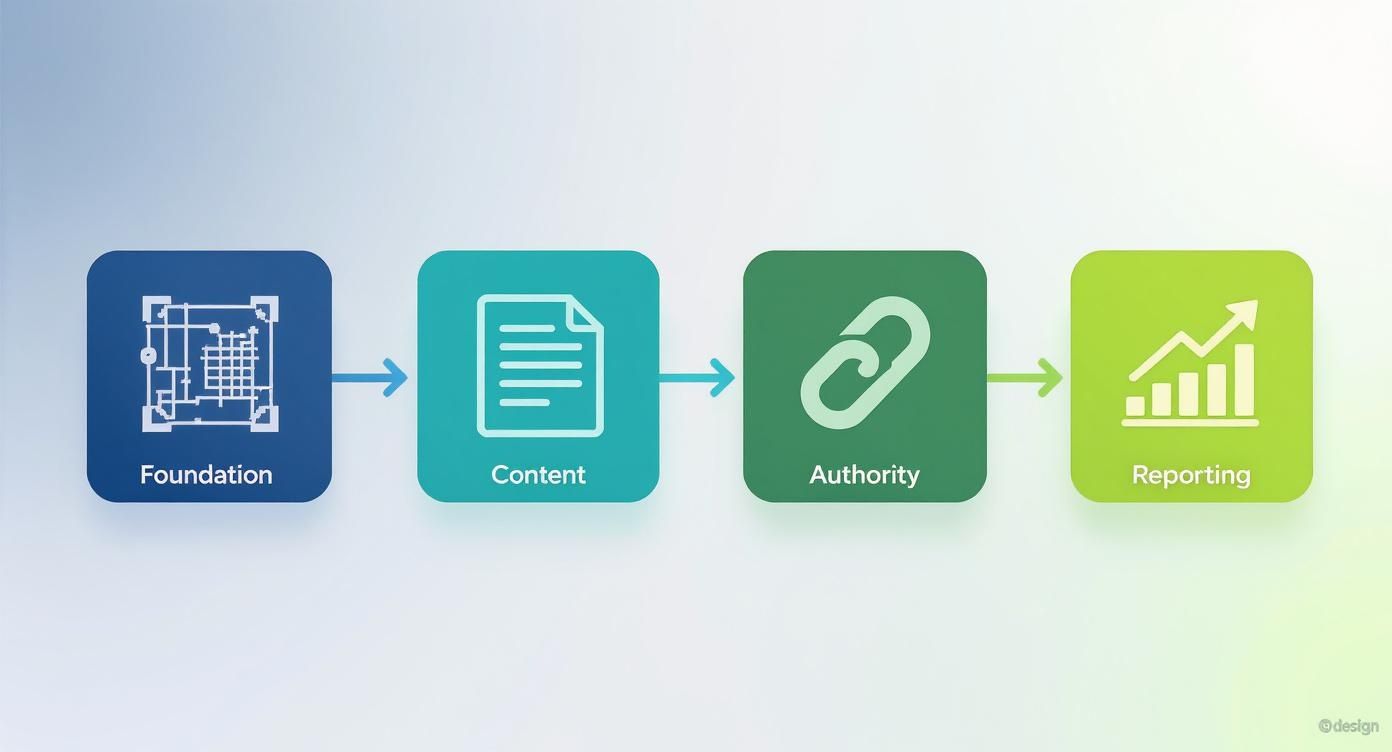
As you can see, SEO success is built in stages. Each phase creates the right conditions for the next one to succeed.
The Momentum Phase: Months 4-6
Once the foundation is solid, the game shifts to building momentum. This is all about creating great content and building your site's authority, and it's usually when you start to see the first real signs of life. Your site will begin to rank for more competitive keywords, and your organic traffic will finally show a noticeable upward trend.
Key activities during this phase usually include:
- Executing the Content Strategy: Consistently publishing high-quality, keyword-optimized blog posts, landing pages, and other resources that your target audience will actually find useful.
- Initial Link Building: Earning the first round of high-quality backlinks from reputable websites. In Google's eyes, these are basically "votes of confidence" for your site.
- Local SEO Optimization: If you have a physical presence, this means optimizing your Google Business Profile and building local citations to show up in local searches.
This period is critical. It’s when all that consistent effort starts to compound, leading to real, measurable gains in keyword rankings and organic traffic. In fact, some startups report an average organic traffic increase of 68% within just six months when they partner with a specialized agency.
The Growth and Scaling Phase: Months 7-12+
After the six-month mark, a well-run SEO strategy starts to enter the growth phase. The momentum you've built begins to snowball, driving significant increases in organic traffic, leads, and, ultimately, customers. All that initial groundwork is now paying dividends, establishing your startup as a genuine authority in your niche.
At this stage, SEO stops feeling like a marketing expense and becomes a predictable, scalable channel for acquiring new customers. The focus shifts from just building to actively optimizing—refining what’s working to squeeze out the maximum return.
Activities now pivot toward scaling what you've built:
- Advanced Content Creation: Developing more in-depth content like whitepapers, case studies, and original research to attract high-authority backlinks.
- Conversion Rate Optimization (CRO): Analyzing user behavior to improve your website's layout, calls-to-action, and landing pages to turn more of those visitors into paying customers.
- Strategic Refinement: Using performance data to double down on what's working and sniff out new keyword opportunities.
Figuring out the return on this long-term investment is key. To get a better handle on the numbers, you can check out our guide on how to calculate marketing ROI. By understanding these timelines, you can manage expectations and truly appreciate the compounding value that SEO services for startups deliver over the long haul.
Understanding Startup SEO Pricing and Packages
Figuring out the cost of SEO services for startups can feel like trying to nail Jell-O to a wall. The prices you see are all over the map, and it’s tough to know what you’re actually getting for your money. But here’s the thing: good SEO pricing isn't random. It’s tied directly to your startup’s stage, your goals, and how fierce the competition is in your market.
Think of it this way: you wouldn’t rent a massive warehouse when all you need is a small office. SEO is the same. An early-stage, bootstrapped startup needs a completely different game plan than a well-funded company looking to dominate its niche. Let’s break down the common pricing models so you can find the right fit.
Common SEO Pricing Models
Most SEO agencies use one of three main pricing structures. Each has its pros and cons, depending on whether you need a quick bit of expert advice or a full-blown, long-term growth campaign.
- Monthly Retainers: This is the most popular option for a reason. You pay a set fee each month for an all-inclusive package—technical fixes, content creation, link building, the works. It’s the best choice for startups that are serious about long-term, sustainable growth.
- Project-Based Fees: Got a specific, one-off job? Maybe you need a full website audit, a targeted campaign to get some quality backlinks, or a deep dive into keyword research. A project-based fee is perfect for this. You pay a flat rate for a clearly defined task. Simple.
- Hourly Consulting: This is your flexible friend. It’s great for startups that need expert guidance but aren’t ready to commit to a monthly retainer. You can use consulting hours for high-level strategy, training your in-house team, or getting help with a tricky SEO problem that just popped up.
The investment can vary quite a bit. Some agencies that specialize in startups offer rates as low as $80 per hour, while monthly retainers can climb past $15,000 for complex services like building market authority and fine-tuning your site for conversions. You can find more details on startup SEO agency pricing on singlegrain.com.
Tailored Packages for Every Startup Stage
As your startup grows, your SEO needs will change. A one-size-fits-all package just doesn't cut it. The smart move is to align your SEO investment with your funding stage and business goals.
The right SEO package isn’t about being cheap; it’s about making the smartest investment for your current growth phase. Your strategy should mature alongside your business, from building a solid foundation to scaling for market leadership.
1. Pre-Seed and Bootstrapped Startups (The Foundation Package)
At this point, the budget is tight. Every single dollar has to work hard. The goal isn't to take over the world just yet; it's about getting the absolute essentials right so you have a solid launchpad for later. You’re just making sure Google can find you and understand what you’re all about.
- Primary Goal: Get your online presence technically sound.
- Key Services: Technical SEO audit, foundational keyword research, Google Analytics setup, and the local SEO basics (like setting up your Google Business Profile).
- Typical Investment: $1,500 - $3,000 per month
2. Seed and Series A Startups (The Momentum Package)
Okay, you’ve got some funding. Now the priority shifts from just existing to actually competing. It’s time to start building authority and carving out your space. That means creating genuinely useful content that pulls in your target audience and earning backlinks that tell search engines you’re a trustworthy source.
- Primary Goal: Build topical authority and start driving real organic traffic.
- Key Services: An ongoing content strategy, consistent content creation, targeted link building, and more advanced on-page optimization.
- Typical Investment: $3,000 - $7,500 per month
3. Growth Stage Startups (The Scaling Package)
You've found product-market fit and you're ready to hit the accelerator. At this stage, SEO becomes a primary engine for acquiring customers. The focus is on expanding your digital footprint everywhere, optimizing every page for conversions, and flat-out dominating the most valuable keywords in your industry.
- Primary Goal: Maximize organic traffic, leads, and revenue.
- Key Services: Large-scale content campaigns, digital PR, conversion rate optimization (CRO), and deep, meaningful analytics.
- Typical Investment: $7,500 - $15,000+ per month
For startups keeping a close eye on their burn rate, exploring cost-effective SEO strategies is a must to get the most bang for your buck. By picking a package that matches where you are right now, you ensure your investment in SEO services for startups pays off when you need it most.
How to Choose the Right SEO Agency for Your Startup
Picking a partner to handle your startup's SEO is one of the biggest marketing calls you'll make. This isn't just about hiring a vendor; you're bringing on a team that will have a direct hand in your growth. The right agency feels like an extension of your own team, but the wrong one can burn through your precious time and cash.
You have to look past the slick sales pitch. You need a partner who gets the unique pressures of the startup world—the tight budgets, the need to pivot quickly, and the relentless focus on results you can actually see.
Look for Startup Experience
An agency that mostly deals with huge, established corporations probably doesn’t have the right mindset for a nimble startup. Their processes are often too rigid, their timelines too slow, and their strategies are built for brands that already have years of authority behind them.
Find an agency with a proven track record working with companies at a similar stage to yours. Someone with real startup experience knows how to build momentum from scratch. They get how to prioritize the foundational wins that set you up for explosive growth later on.
Ask the Right Questions
When you're vetting potential agencies, your goal is to get a feel for their process, how they communicate, and what they consider a "win." A great agency will welcome your questions and give you straight, transparent answers.
Here are a few essential questions to get the conversation started:
- Who will be my day-to-day contact? It's important to know the team structure and who you’ll actually be working with.
- Can you show me a case study from a startup you've helped? Ask for specific examples of how they tackled challenges like the ones you're facing.
- How do you measure and report on success? Look for answers that go beyond vanity metrics like traffic. They should be talking about business goals like leads, sign-ups, or demo requests.
- What’s your process for keyword research and content strategy? Their answer should reveal a strategic, data-driven approach, not just a reliance on automated tools.
For a deeper dive, our article on how to choose a digital marketing agency gives you a full checklist.
A true SEO partner for a startup doesn't just hand you reports; they deliver insights. They connect every action directly to your business goals and proactively suggest changes based on performance data and what's happening in the market.
Startup SEO Agency Vetting Checklist
Choosing an SEO partner can feel overwhelming. This checklist is designed to help you cut through the noise and evaluate potential agencies based on what truly matters for a startup's success. Use it to compare your options and spot the difference between a genuine growth partner and a sales-focused vendor.
| Evaluation Criteria | What to Look For (Green Flags) | What to Avoid (Red Flags) |
|---|---|---|
| Relevant Experience | Proven track record with startups in a similar growth stage or industry. They understand the "build from zero" challenge. | Primarily works with large, established corporations. Their case studies are all household names with massive budgets. |
| Strategy & Process | A clear, customized strategy that focuses on foundational wins and scalable growth. They explain the "why" behind their plan. | A "one-size-fits-all" or "secret sauce" approach. Vague answers about their methods and tactics. |
| Communication Style | Proactive, transparent communication. They set clear expectations for reporting and meetings. You know who your main contact is. | Evasive answers or a communication breakdown after the contract is signed. You have to chase them for updates. |
| Measurement & KPIs | Focus on business-centric metrics like qualified leads, user sign-ups, and customer acquisition cost (CAC). | Obsessed with vanity metrics like "traffic" or "#1 rankings" without connecting them to actual business results. |
| Contracts & Pricing | Clear, flexible contract terms that make sense for a startup. Pricing is transparent and reflects genuine value. | Long, unbreakable contracts. Prices that seem too good to be true, often hiding a low-quality, cookie-cutter service. |
Think of this checklist as your guide during those initial discovery calls. A great agency will tick all the "Green Flag" boxes without you even having to push for it.
Red Flags to Watch Out For
Just as important as knowing what to look for is knowing what to run away from. Certain promises and practices are dead giveaways of an agency that might not have your best interests at heart.
Be careful with any agency that:
- Guarantees #1 Rankings: SEO is influenced by hundreds of factors, and Google’s algorithm is always changing. No reputable agency can ever guarantee a specific ranking. It's just not possible.
- Uses "Secret Sauce" Jargon: A good partner will be open about their methods. Vague talk about proprietary techniques is often a smokescreen for ineffective or even risky "black-hat" tactics that can get you penalized.
- Offers Unbelievably Low Prices: Quality SEO takes expertise, time, and resources. A price that seems too good to be true usually signals a generic, templated approach that won’t move the needle for your business.
- Lacks Transparent Reporting: You should get clear, regular reports that explain what they did, why they did it, and what the impact was. If an agency gets cagey about sharing data, it's time to walk away.
Doing your homework takes time, but finding the right agency is a massive force multiplier for your startup’s growth.
Your First 90 Days with an SEO Agency

You’ve signed the contract and are ready to go. So, what happens now? The first 90 days are less about seeing a tidal wave of traffic and more about building the foundation for all that future growth. Think of it like an architect surveying the land and drawing up detailed blueprints before a single shovel hits the dirt. Every detail matters.
This initial period is all about alignment, deep-dive discovery, and strategic planning. Your new agency partner will be getting under the hood of your business, digging into your market, and auditing your existing digital footprint to build a roadmap that’s actually yours. Knowing what to expect makes for a much smoother partnership from day one.
Month 1: The Kickoff and Discovery Phase
The first 30 days are dedicated to total immersion and sorting out the technical groundwork. It all starts with a kickoff meeting where both teams get on the same page about goals, KPIs, and how you’ll communicate. This isn't just a friendly hello; it’s a strategy session to make sure the SEO plan is directly tied to your real-world business objectives.
After that, the agency rolls up its sleeves and gets into the technical weeds:
- Comprehensive Technical Audit: A deep dive into your website to uncover all the gunk that could be holding you back—slow page speed, crawl errors, indexing problems, you name it.
- Analytics and Tool Setup: Making sure tools like Google Analytics, Google Search Console, and rank tracking software are dialed in to measure what actually matters.
- Initial Keyword Research: This is the first pass at identifying the core set of keywords your customers are searching for, based on your product and what your competitors are up to.
This whole month is about establishing a clean baseline. You can’t know where you’re going if you don’t have an honest map of where you are right now.
Month 2: Strategy and Content Planning
With a pile of audit data in hand, month two is all about building the strategic framework. This is a super collaborative phase. Your agency will present its findings and work with you to hammer out a long-term plan, moving from broad ideas to a concrete, actionable strategy for content and link building.
The second month is where the blueprint becomes reality. It’s the transition from 'what's wrong' to 'here's exactly how we're going to win.' This collaborative planning is vital for ensuring the SEO strategy drives real business outcomes.
Here’s what you can expect during this month:
- Presenting Audit Findings: The agency will walk you through the technical issues they uncovered and lay out a prioritized plan to fix them. No jargon, just a clear "here's the problem, and here's how we solve it."
- Developing the Content Roadmap: Based on all that keyword and competitor research, they'll propose a content calendar targeting high-opportunity topics that will actually attract customers.
- Finalizing KPIs and Dashboards: You’ll work together to lock in the key metrics for success and set up a reporting dashboard so you always have full transparency into the work being done.
Month 3: Implementation and First Wins
In the final month of this initial phase, the strategy finally moves into execution. The agency starts knocking out the technical fixes from the audit and begins creating the first few pieces of content from the roadmap. It's still early, but you should start to see the first signs of life.
This is when you'll start seeing tangible results, like newly optimized landing pages, the first couple of blog posts going live, and a healthier technical score for your site. These early wins, while small, build crucial momentum and prove the partnership is on the right track for long-term success with SEO services for startups.
Frequently Asked Questions About Startup SEO Services
Stepping into the world of SEO can feel a bit like navigating a maze, especially when you’re a startup founder juggling a tight budget and aggressive growth targets. Let's clear up some of the most common questions we hear from founders about putting their money into SEO.
How Much Should a Startup Budget for SEO?
This is the big one, right? While every industry is different, a good starting point for an early-stage startup is usually somewhere between $2,500 and $5,000 per month. That kind of retainer typically gets you a comprehensive game plan covering a technical audit, a solid content strategy, and the first steps toward building your site's authority.
For more established startups trying to muscle their way into a crowded market, that number can climb. It’s not uncommon to see investments from $5,000 to over $15,000 per month for really aggressive campaigns built for speed and scale.
Can SEO Show Results Faster Than Six Months?
Everyone wants to see results yesterday, but real, sustainable organic traffic growth is a long game—it often takes a good 6-12 months. That said, you can and should see important leading indicators much sooner. These are the early wins that tell you the strategy is on the right track.
Within the first 90 days, you should expect to see real progress, like:
- Noticeable improvements in your technical site health scores.
- Your first keyword rankings popping up for less competitive, long-tail terms.
- An increase in brand visibility and impressions showing up in your search console.
SEO is an investment, not an expense. Think of it like this: those initial milestones are the first cracks in the dam. Early progress in technical health and niche keyword visibility might seem small, but they’re the signs that a breakthrough in traffic and leads is coming.
Should My Startup Focus on SEO or Paid Ads First?
It's not really an either/or question. The smartest approach often uses both, but if you're building for the long haul, SEO is your foundation. Paid ads are great for getting immediate traffic and can even feed your SEO strategy with valuable keyword data. They work well together.
But here's the key difference: SEO builds an asset that compounds over time. The authority and content you create will keep bringing in customers long after you’ve turned off your ad spend. That’s why it's a critical investment from day one if you want to build a resilient, cost-effective way to get new customers.
Ready to build a powerful, data-driven growth engine for your startup? The team at Up North Media specializes in creating custom SEO strategies that deliver measurable results. Schedule your free consultation today!