
You're probably in one of two spots right now. Either your business needs a stronger digital presence and you're deciding whether that means a better website or a mobile app, or you've already got a site and someone keeps telling you the next move is “build an app.”
For Omaha business owners, that choice usually isn't about chasing whatever feels more modern. It's about customer behavior, update speed, staffing, budget, and whether the product needs native phone features to work well. A Dundee retailer, a West Omaha home service company, and a startup in Aksarben Village can all ask the same question and still land on different answers.
The biggest mistake I see is treating web vs app development like a branding decision. It's an operating model decision. It affects how people discover you, how often you can update, what you'll spend to maintain it, and how much friction a customer faces before they ever take action.
Web or App The First Big Digital Decision
A local owner usually starts with a simple question. “Should we build an app or just improve the website?” The right answer starts with one issue: how customers get access to the experience.
A website lives in the browser. That means broad accessibility, one shared destination, and fewer barriers between a search result and a conversion. An app lives behind an install. That can create a stronger repeat-use environment, but it also asks more of the customer upfront.
Distribution changes the business case
The primary divide in web vs app development isn't screen size. It's distribution and maintenance.
Industry summaries point to a major shift that began when Apple launched the iPhone in 2007 and opened the App Store in 2008, which created a scalable marketplace for native mobile apps and increased demand for app development. Web development kept its advantage in broad accessibility, simpler updates, and single-codebase maintenance across devices, while app development gained strength in device access and offline functionality, with higher complexity and upkeep attached. That summary is laid out in this comparison of web development and mobile app development.
For a local business, that leads to a practical question. Do you need to be instantly reachable by anyone who can tap a browser link, or do you need a deeper mobile experience that justifies the install?
Practical rule: If customer acquisition depends on search, sharing, and fast updates, start with the web. If customer retention depends on repeat use and phone-specific capability, an app becomes easier to justify.
What this looks like in Omaha
A boutique in the Old Market usually benefits more from discoverability, fast merchandising changes, and low-friction checkout than from asking shoppers to install something first. A startup building a field workflow tool for crews in low-connectivity environments may need the opposite.
That middle ground matters too. A lot of businesses don't need a full native app on day one. They need a strong web experience with app-like behavior, which is why many owners should at least understand Progressive Web App benefits before they commit to a more expensive build path.
Use this quick view as a starting point.
| Business factor | Web development | App development |
|---|---|---|
| Customer access | Open in any browser | Requires install through app store or direct distribution path |
| Updates | Immediate, no user action required | Release cycle is more structured and users may lag on updates |
| Reach | Broad, especially for first-time visitors | Better suited to repeat users with a clear reason to return |
| Device features | More limited for advanced mobile use cases | Stronger access to phone hardware and background behavior |
| Maintenance model | One codebase can serve many devices | Often requires multiple codebases and specialized skills |
Key Differences for Business Owners
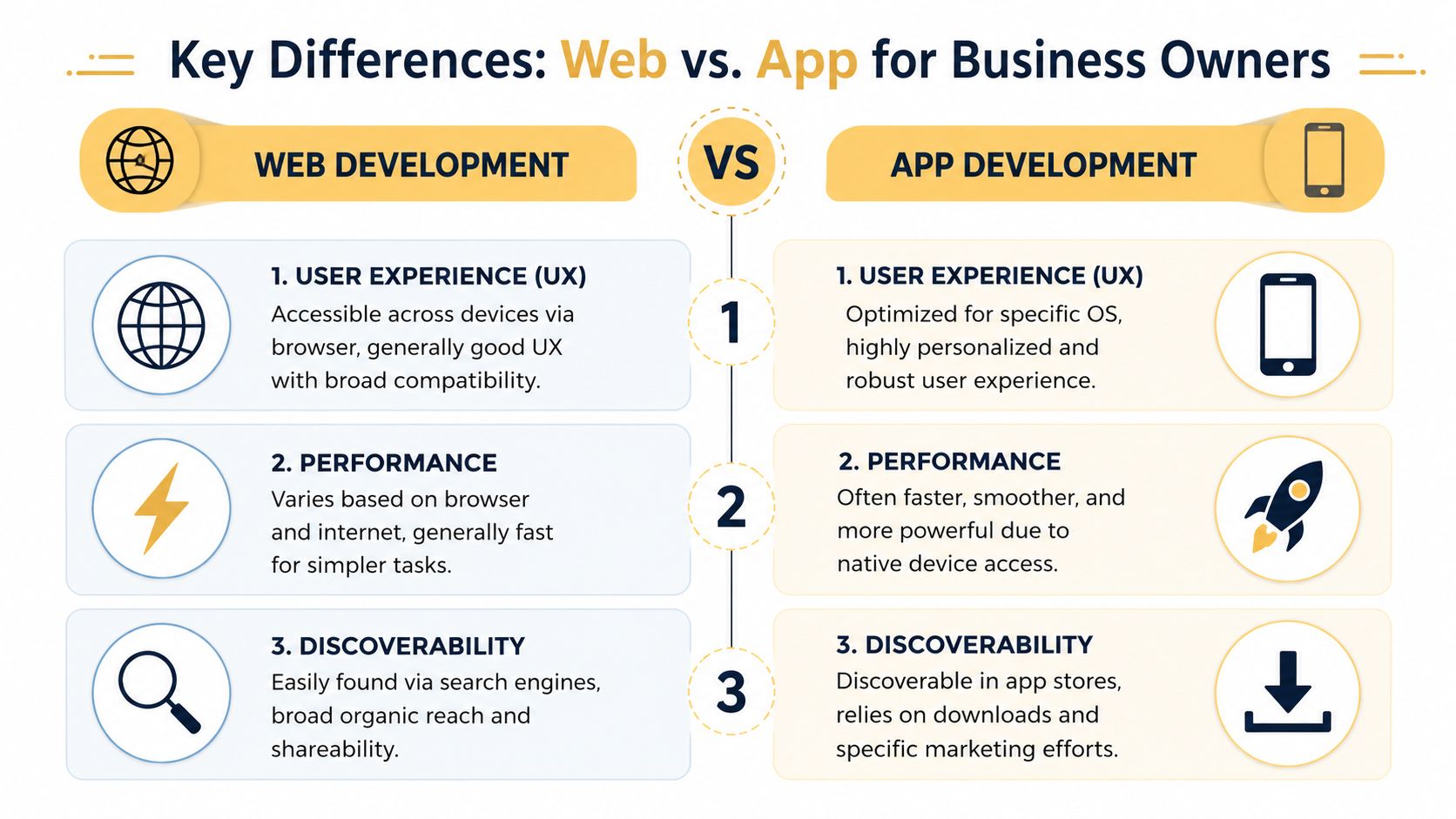
Business owners don't need a developer debate. They need to know what affects revenue, customer acquisition, and operating overhead.
The side by side comparison that matters
| Decision area | Web | App |
|---|---|---|
| User experience | Easy access from any browser. Strong for content, lead gen, and ecommerce flows. | Tighter control over interface and repeat-use journeys. Better when the experience needs to feel like a daily tool. |
| Performance | Works well for many business cases, but resource-heavy interactions can hit browser limits. | Better fit for demanding mobile tasks and persistent use on the device. |
| Discoverability | Stronger fit for search visibility, link sharing, and local marketing campaigns. | Discovery often depends on app store presence plus separate install-focused promotion. |
| Maintenance | Faster updates because users don't need to install a new release. | More moving parts, more release management, and more testing across platforms. |
| Best fit | Broad reach and rapid iteration | Deep engagement and device-level functionality |
Performance isn't just a technical detail
If your product needs to run smoothly over longer sessions, performance has a direct business impact. Battery drain, memory usage, and sluggish behavior can make a product feel unreliable fast.
A 2023 empirical study comparing native mobile apps with their web counterparts found that native apps consumed significantly less energy, while web apps used more CPU and memory, with statistically significant differences and large effect sizes. The authors concluded that native apps generally require fewer hardware resources than web apps. That matters if your product depends on sustained background use or battery efficiency, as shown in the MOBILESoft 2023 study on native versus web app resource usage.
If your product needs long-running mobile sessions, constant sensor access, or reliable background behavior, performance can stop being a nice-to-have and become part of retention.
For a simple scheduling portal or product catalog, that difference may not matter enough to justify native development. For a logistics tool, fitness tracker, or route-based field app, it often does.
SEO and acquisition usually favor the web
Most Omaha SMBs still grow by being found. Search, map visibility, referral links, email campaigns, and social sharing all work more naturally with a web experience than an app-first rollout.
That's why many businesses overbuild too early. They invest in an app before they've built a dependable acquisition engine. Then they discover the harder problem wasn't software delivery. It was getting enough qualified people to the product in the first place.
Consider the difference in customer behavior:
- A first-time prospect usually wants immediate information, not an install request.
- A repeat customer may accept an app if it saves time, gives alerts, or streamlines reorder behavior.
- A service business lead often converts from search, reviews, and a fast mobile site.
- A loyalty-heavy product may gain more from persistent logins and app-based engagement.
UX should follow the job to be done
The strongest digital products match the platform to the task.
A browser is often the best acquisition tool. A native app is often the better habit tool.
If your customer's main job is reading, shopping, booking, comparing, or contacting, web usually carries that well. If the job is scanning, tracking, navigating, recording, or receiving persistent prompts, app development starts pulling ahead.
Analyzing the Investment Cost and Timelines
Budget pressure changes this conversation quickly. Most Omaha SMBs don't have room for a long build, a large maintenance burden, and a platform choice that delays traction.
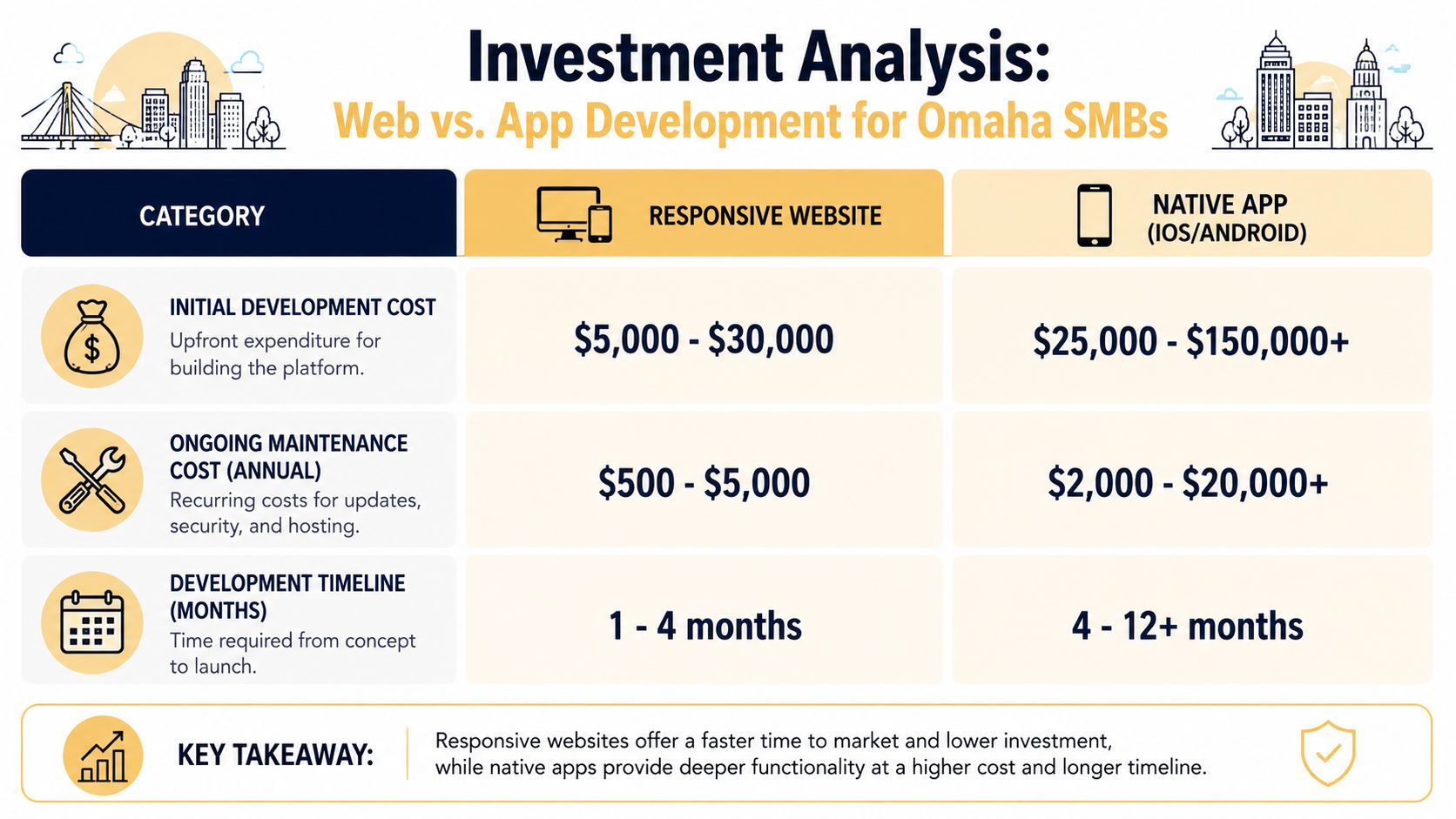
The general pattern is straightforward. Web projects usually launch faster and cost less to maintain because one codebase can serve many devices. Native app projects usually cost more because they often require more specialized skills and platform-specific work.
Why the total cost is usually higher for apps
The initial build is only one line item. Owners also need to think about:
- Release management: App updates move through a more structured publishing process than website changes.
- Testing scope: Native projects often need broader device and operating system coverage.
- Staffing: Mobile work can require more specialized hiring or agency support.
- Feature parity: Keeping iOS and Android experiences aligned adds coordination overhead.
- Maintenance cadence: Every new OS change can create new work.
That's why a single responsive website is usually the safer first investment for early-stage businesses. It gets you to market faster, gives marketing a working destination, and reduces the odds that maintenance starts eating budget before the platform proves itself.
Time to launch affects ROI
A platform that launches sooner can start validating demand sooner. That matters more than many teams admit.
If you're still testing pricing, product-market fit, lead quality, or average order behavior, a web-first release often gives you a cleaner path. You can adjust offers, landing pages, and calls to action without waiting on app-store-driven release cycles.
For a realistic planning lens on budget ranges and build variables, this guide to mobile app development cost is a useful starting point.
What owners often miss
The hidden cost isn't always code. It's delay.
A business that spends months building a native app before proving demand can burn time on design reviews, edge-case testing, and release prep while a competitor is already collecting leads through a simpler web product.
Use this lens when comparing options:
| Cost question | Website or web app | Native app |
|---|---|---|
| Can we launch an MVP quickly? | Usually yes | Often slower |
| Can marketing iterate fast? | Usually yes | More constrained |
| Can one team maintain it? | More often | Less often |
| Do we need separate platform expertise? | Sometimes not | Often yes |
That doesn't mean apps are overpriced. It means they need a clearer business reason. If the app creates a stronger retention loop, supports essential workflows, or enables a feature the web can't deliver well, the extra investment can make sense. If it doesn't, the maintenance burden tends to show up before the payoff does.
When a Web Presence Is Your Best Bet
A lot of Omaha businesses don't need a native app. They need a web presence that loads quickly, works well on phones, and helps people act without friction.
Three local scenarios where web wins
A Dundee coffee shop launching online ordering usually gets more value from a strong mobile website than a standalone app. Customers search, tap, order, and move on. If the menu changes, the site updates instantly. There's no install barrier.
A West Omaha roofing or HVAC company has a similar dynamic. The priority is visibility, trust, and lead flow. People need service pages, reviews, quote forms, and a clean mobile experience. They don't need to download an app just to request an estimate.
An Omaha ecommerce retailer selling specialty products often needs the same thing at the start. Product pages, category structure, search visibility, email landing pages, and checkout flow do more for growth than app installs do.
Why this works economically
The business case is stronger than the technical case in many of these situations.
A web app can outperform a native app economically, even if it's less technically capable, because faster iteration and lower maintenance costs can outweigh the marginal UX advantages of native. That tradeoff is especially relevant for SMBs and ecommerce businesses, as explained in this analysis of web versus mobile development economics.
The cheapest platform isn't always the right one. But the platform with the lowest operational drag often gives small businesses the best chance to learn, adapt, and grow.
Good candidates for web first
These businesses usually benefit from a website or web app before they consider native mobile:
- Local services: Plumbers, clinics, contractors, law firms, and home service providers need calls, forms, and discoverability.
- Content-led brands: Publishers, bloggers, and educational businesses need pages that search engines can crawl and users can share.
- Most small ecommerce stores: Early traction usually comes from product visibility, promotional landing pages, and easy mobile checkout.
- Startups proving demand: A browser-based MVP lets the team test the core offer before funding a more complex mobile build.
If the business also wants app-like convenience, a responsive site or PWA often covers a lot of ground. For Omaha companies evaluating that route, web development services can include custom web apps, ecommerce builds, and browser-based experiences that feel much closer to software than a traditional brochure site.
When You Need a Dedicated Mobile App
Some products do need a true app. Not because apps feel more impressive, but because the business depends on features a browser can't support as cleanly.
Cases where native capability changes the outcome
A field service startup with technicians moving across job sites may need reliable offline workflows, camera input, GPS-based routing, and background syncing. That's not just convenience. It affects whether work gets completed accurately in the field.
A retail concept with barcode scanning, saved customer preferences, and repeat ordering may also justify an app if mobile behavior drives a large share of repeat revenue. The app becomes part of the buying routine, not just another access point.
A fitness or wellness platform is another example. If the product depends on motion data, route tracking, persistent sessions, and quick reopen behavior, the mobile experience is the product.
Engagement is often the deciding factor
Web is strong for reach. Apps are strong when the business needs a tighter retention loop.
That usually shows up in products where customers return often, want personalized flows, or benefit from phone-native interactions. A browser can support a lot. But if the product's value depends on living on the customer's device, app development starts to make strategic sense.
Choose an app when the phone isn't just where the experience appears. It's part of how the experience works.
Hiring and staffing matter too
There's also a talent reality owners shouldn't ignore. A Dev.to analysis cites about 55% of developers doing back-end work, 54% full-stack, 37% front-end, and only 19% mobile, which suggests mobile is a smaller field and can require more specialized hiring decisions, as discussed in this breakdown of web versus mobile development career distribution.
For a business owner, that changes the resourcing plan:
- If speed and staffing flexibility matter most, web talent is often easier to source.
- If the product needs deep mobile specialization, paying for that expertise may be the right move.
- If your roadmap is uncertain, hiring too early for app-only complexity can box you in.
- If mobile is the business model, specialized app talent becomes a strategic asset, not a premium add-on.
That's the dividing line. If native functionality creates the product's value, the investment is easier to defend.
Your Omaha Business Decision Framework
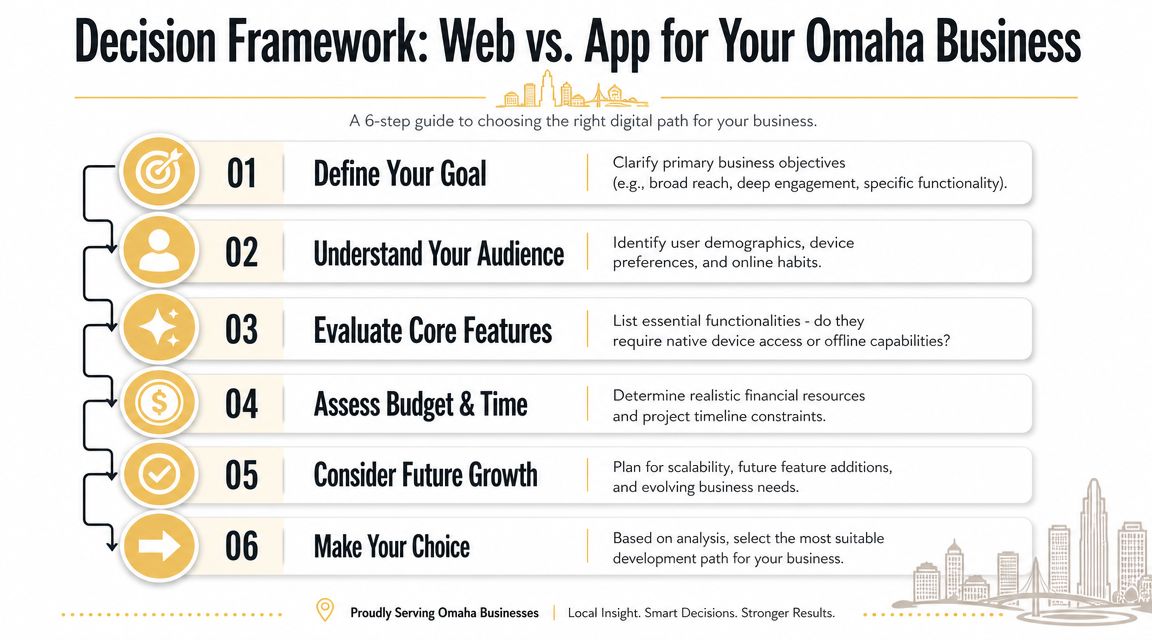
Most owners don't need a long debate. They need a decision process they can use this quarter.
Start with these five questions
-
What is the core job the product must do?
If the main job is informing, selling, booking, or generating leads, web usually has the advantage. If the job requires camera access, GPS, sensor data, or persistent mobile behavior, app moves up the list. -
How do customers find you today?
Search-heavy discovery usually points toward web first. Habit-driven repeat usage makes an app more compelling. -
How much budget and time can you protect over the next year?
Don't just ask what you can build. Ask what you can maintain without slowing the business down. -
What features are essential on day one?
Separate must-haves from nice-to-haves. Many companies overestimate how many native features they really need for version one. -
What happens after launch?
If your team expects constant changes to offers, flows, pages, or messaging, web gives you more room to iterate fast.
A practical way to choose
Use this simple framework:
- Choose web first when reach, speed, discoverability, and lower operating complexity matter most.
- Choose app first when the experience depends on native features, repeat engagement, or high-performance mobile behavior.
- Choose a phased approach when you need both eventually but haven't yet proven the value of app-only functionality.
That phased path is often the smartest move for startups and SMBs. Launch a strong browser-based MVP. Learn what customers use. Then invest in native mobile where the usage pattern justifies it.
The overlooked advantage in modern web work
Web development has changed fast. AI-assisted workflows now have more serious evaluation frameworks behind them. WebCoderBench uses 1,572 authentic user requirements and 24 evaluation metrics to assess web app generation quality, and the paper reports a narrowing effectiveness gap between open-source and closed-source models with no single model dominating all metrics, according to the WebCoderBench paper.
That matters for business owners because it supports a practical point. A modern web-first strategy doesn't have to mean “basic.” It can mean faster prototyping, better iteration, and more advanced builds when the team evaluates quality across multiple dimensions instead of just judging the final screen.
For most Omaha companies, the smartest answer isn't “always build an app” or “never build an app.” It's this: match the platform to the growth model.
If you're weighing web vs app development and want a practical recommendation tied to budget, staffing, customer behavior, and ROI, Up North Media is an Omaha-based option for custom web app development, SEO-focused digital strategy, and app planning. A good next step is a scoped conversation around your actual use case, what needs to launch first, and what can wait until the business proves demand.