
The fitness app category isn't a side market anymore. The global fitness apps market was estimated at USD 12.12 billion in 2025 and is projected to reach USD 33.58 billion by 2033, with a 13.40% CAGR from 2026 to 2033, while North America accounted for 39.82% of revenue in 2025 according to Grand View Research's fitness app market analysis. That changes the conversation for founders and operators. You're not deciding whether an app is a nice add-on. You're deciding how to compete in a category with real money, real expectations, and very little tolerance for weak execution.
Most businesses don't lose because they lacked ideas. They lose because they shipped a generic tracker, overloaded the MVP, or hired a team that could code screens but couldn't shape a product.
Why Invest in a Custom Fitness App
A custom fitness app gives you control over the one thing off-the-shelf platforms can't deliver well: a product built around your business model instead of someone else's template. That matters more in fitness than in many other categories because user motivation is fragile. If onboarding is clumsy, logging workouts takes too many taps, or progress feels invisible, people stop opening the app.
The strongest business case for custom work starts with market size, but it doesn't end there. North America's large share of the category makes competition sharper, not easier. In practice, that means a founder has to think about differentiation from day one. A studio app, coaching brand, supplement company, or wellness startup can't rely on “we also have classes, plans, and progress tracking.” Everyone says that.
Custom beats generic when retention matters
Most off-the-shelf products are fine for proving that software can exist. They're poor at proving that your version deserves repeated use. They usually force compromises in areas that directly affect retention:
- Onboarding logic: You may need different flows for beginners, strength athletes, rehab users, or nutrition-focused members.
- Data model: A HIIT app, a trainer marketplace, and a habit-based wellness app don't store progress the same way.
- Monetization setup: Subscription tiers, coaching upsells, paid programs, and partner offers all need different purchase paths.
- Integration priorities: Some products live or die by Apple Health, wearables, or nutrition sync. Others don't need them at launch.
A good reference point is any serious exercise and workout platform that has to balance guided programming, usability, and repeat engagement. The lesson isn't to copy features. It's to see how much product value comes from the way those features are packaged and sequenced.
A fitness app shouldn't feel like a feature catalog. It should feel like a routine people can stick to.
The business decision is bigger than mobile alone
A lot of founders start by asking whether they need an app at all. That's the right question. In some cases, a web product should come first, especially if content, admin workflows, or onboarding through paid traffic are central to the business. This breakdown of web vs app development is useful if you're deciding where the first version of the product should live.
But once the use case depends on daily habits, sensor data, reminders, or quick logging, mobile becomes the operational center of the experience. That's where professional fitness app development services earn their keep. They don't just produce an app store listing. They shape the product, the architecture, and the release plan so the business has room to grow.
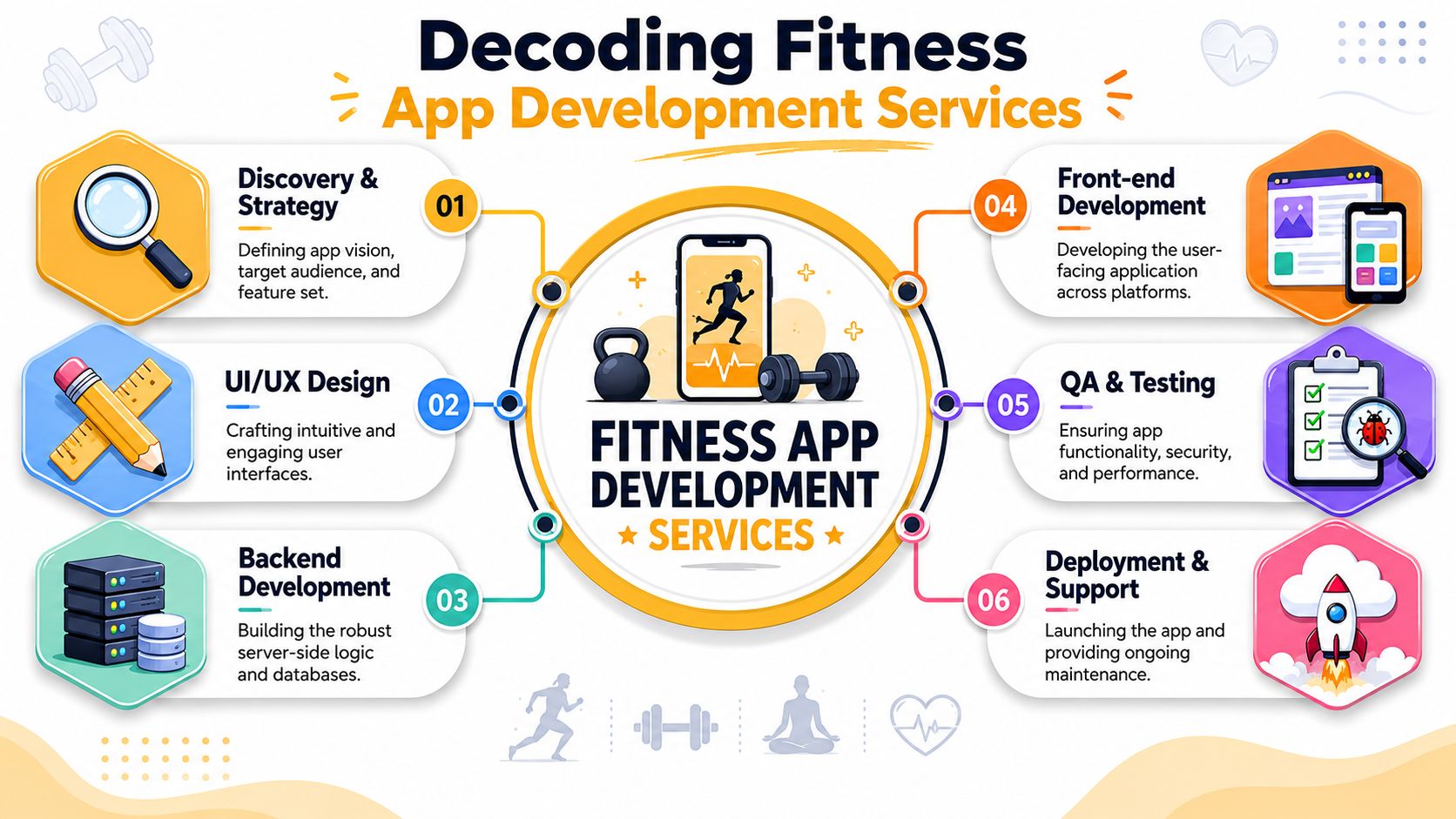
Decoding Fitness App Development Services
Fitness app development services aren't one thing. They're a chain of decisions and deliverables that need to connect cleanly. If one part is weak, the rest gets expensive fast.
The simplest way to think about it is like building a house. Strategy picks the lot and floor plan. Design decides how people move through the space. Front-end builds what users touch. Back-end handles the systems hidden behind the walls. QA checks whether the doors open, the lights work, and the plumbing leaks. Support keeps the place usable after move-in.
Discovery and strategy
A good agency saves the client from building the wrong product well. The team should pressure-test the niche, the user journey, the monetization path, and the first release scope.
Discovery usually answers questions like:
- Who is the primary user? First-time exercisers behave differently than experienced lifters or trainer-led clients.
- What job is the app doing? Logging, coaching, accountability, programming, nutrition, or community.
- What has to be in version one? Not what would be nice. What has to work to prove value.
- How will success be judged? Engagement signals, conversion to paid, program completion, or another measurable business outcome.
UI and UX design
Fitness products are interaction-heavy. People log sets in the middle of a workout, scan progress after a session, and make quick decisions when they're tired. Design has to reduce friction, not add brand polish for its own sake.
Strong UX design in this category usually focuses on:
- Fast input paths: Logging a workout should feel closer to tapping than typing.
- Clear progress visibility: Streaks, milestones, and completed plans need to be obvious.
- Context-aware screens: The app should behave differently before, during, and after activity.
- Motivation without clutter: Too many widgets and prompts create hesitation.
Practical rule: If a user needs to think about how to record a workout, the design is already too slow.
Front-end and back-end development
Non-technical buyers frequently find this aspect perplexing. Front-end is the member-facing app on iPhone or Android. Back-end handles authentication, business logic, workout storage, subscriptions, notifications, analytics events, and integration handoffs.
A complete agency engagement should define both sides clearly. If a proposal overemphasizes screens and barely mentions APIs, databases, or admin workflows, that's a warning sign. Fitness apps often look simple from the outside and get complicated the moment they need syncing, role permissions, or reporting.
QA, deployment, and support
Testing isn't just bug-fixing at the end. In a fitness product, QA should validate log accuracy, offline behavior, sync reliability, notification timing, payment flow behavior, and device-specific edge cases.
After launch, support matters because real users will expose real behavior. That's when teams learn whether reminders help or annoy, where people drop out of onboarding, and which screens deserve iteration first. Good fitness app development services don't disappear after release. They move into maintenance, analytics review, and product refinement.
Essential Features for a Winning Fitness App
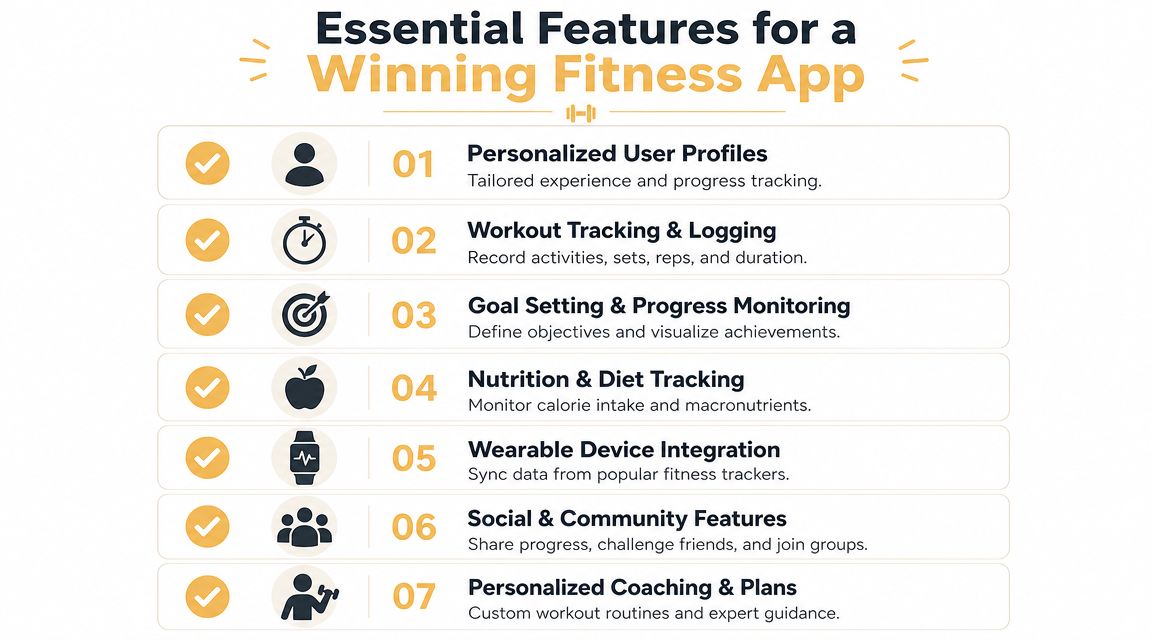
Features matter less than sequence. Teams get into trouble when they treat every useful idea as a launch requirement. A winning app usually starts with a narrow set of functions that support one repeatable habit, then expands once user behavior becomes clear.
This visual is a good shorthand for the feature set most founders have in mind.
MVP must-haves
A strong MVP does four things well. It identifies the user, captures the core behavior, shows progress, and keeps the path simple enough that people will repeat it.
Here's the base set I'd prioritize most often:
- Registration and onboarding: This should collect only what the app needs to personalize the first experience. Long forms kill momentum.
- User profile and goals: The app needs a reason to tailor plans, logs, and milestones to the person using it.
- Workout or activity logging: This is often the core mechanic. If it's hard, the product won't stick.
- Progress tracking: Users need proof that effort is turning into movement, consistency, or results.
- Basic notifications: Reminders can help when they're tied to goals and timing, not generic nagging.
- Admin controls: Founders often forget this. Someone has to manage plans, users, subscriptions, and content.
One practical way to think about the MVP is this: if you removed every flashy extra, would the app still help someone complete the main routine? If the answer is no, the core isn't ready.
Growth-oriented features
After the basic loop works, you can layer on the features that increase stickiness, expand monetization, or make the product harder to replace.
Those usually include:
| Feature | Why it matters | Watch-out |
|---|---|---|
| Wearable sync | Reduces manual entry and improves continuity | Integration complexity rises quickly |
| Nutrition tracking | Extends engagement beyond workouts | Food data quality and UX can get messy |
| Community features | Adds accountability and social return visits | Empty communities feel worse than no community |
| Coaching and plans | Supports premium tiers and personalization | Content operations become a real workload |
| Payments and subscriptions | Turns usage into revenue | Billing logic must be planned early |
Nutrition is a good example of where founders should decide whether to build, partner, or blend both. Some products only need lightweight meal guidance, while others need a much deeper nutrition layer. If that's central to your concept, tools that help users discover your AI nutritionist can be a useful reference for how guided nutrition experiences are being framed today.
A quick walkthrough can help teams visualize how these feature choices come together in real products.
What works and what doesn't
Some patterns consistently work:
- Tight core loop: Open app, know what to do, do it, record it, see progress.
- Visible momentum: History, streaks, completed sessions, or achieved goals.
- Low-friction repeat use: The second workout log should feel faster than the first.
And some patterns usually fail:
- Feature bloat at launch: Users don't reward complexity just because it exists.
- Heavy social before traction: Community only works when enough people have a reason to return.
- AI-first positioning without a solid core: Personalized coaching doesn't fix weak usability.
Tech Stacks and Investment Models
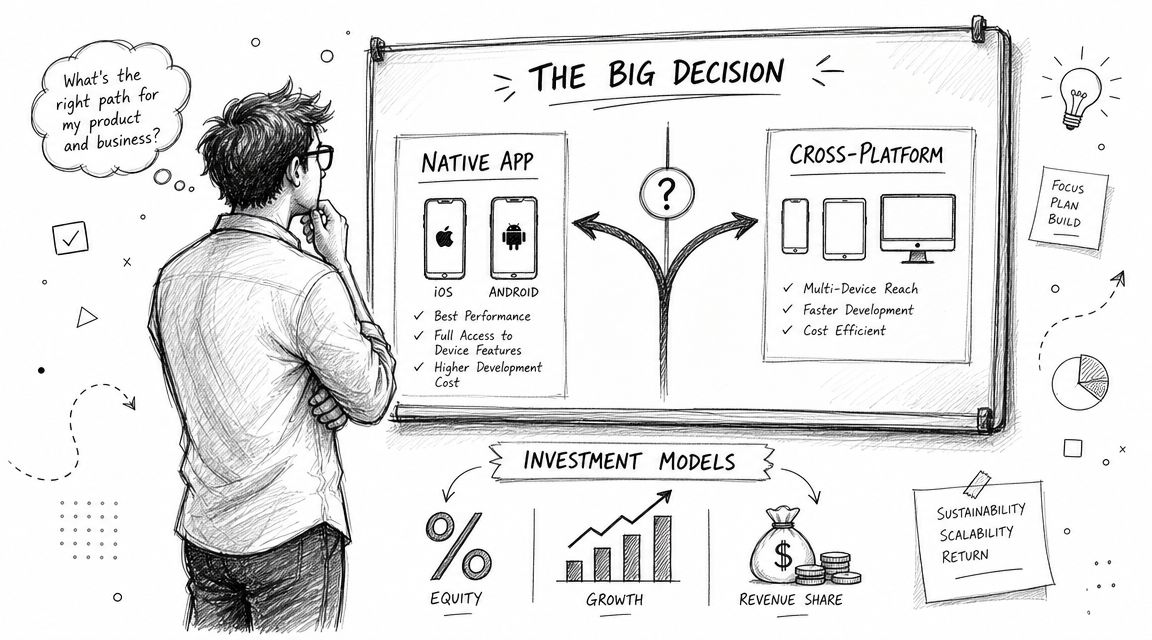
Most founders hear “tech stack” and assume it's mainly an engineering choice. It isn't. It's a business choice with technical consequences. The stack affects speed, hiring flexibility, platform performance, integration work, and maintenance load.
A strong starting principle comes from this fitness app development architecture guide: a technically sound app should separate the mobile client, backend services, and third-party APIs. It also notes that when front-end and back-end are developed in parallel and external APIs are integrated early, teams can validate data flow, reduce rework, and catch latency or schema issues before launch. That's not abstract engineering advice. It's budget protection.
Native versus cross-platform
The stack decision often comes down to two paths.
| Approach | Best for | Trade-off |
|---|---|---|
| Native iOS and Android | Products with demanding device behavior, deep platform-specific UX, or specialized performance needs | More effort across platforms |
| Cross-platform frameworks | Faster shared delivery across iOS and Android, especially for MVPs | Some platform-specific edge cases can take extra care |
For many early-stage products, cross-platform can be the right business call because it compresses the path to launch and keeps the team focused on one shared codebase. For products with heavier sensor usage, more complex motion tracking, or deeper device-specific interactions, native may be worth the added investment.
The best agencies won't sell one answer for every project. They'll explain the operational impact of each choice. If you want a non-technical primer before those conversations, this guide on how to choose a tech stack is a solid place to start.
Architecture decisions that affect ROI
Some choices look small during planning and become expensive later.
- Authentication design: Email, social login, role-based access for members, coaches, or admins.
- Data modeling: Workouts, goals, completions, metrics, and plan versions need to be structured cleanly.
- Third-party API strategy: Apple Health, Google Fit, Stripe, video hosting, messaging tools, and analytics all have different constraints.
- Analytics instrumentation: If event tracking is an afterthought, the post-launch roadmap becomes guesswork.
Teams save money when they validate data flow early. They waste money when integrations are treated like late-stage add-ons.
Fixed price versus time and materials
Pricing models deserve the same scrutiny as the stack.
Fixed price works best when scope is stable, requirements are documented well, and the client wants tighter upfront budget predictability. It's often a reasonable fit for a tightly defined MVP with limited variability.
Time and materials works better when the product still needs discovery, iteration, or scope reshaping based on design and engineering findings. That's common in fitness products because founders often learn mid-project that onboarding, logging flow, or integrations need to change.
Here's the practical distinction:
- Choose fixed price if the problem is known and the feature set is narrow.
- Choose time and materials if the product is still being discovered.
- Avoid fake certainty where the quote looks fixed but every meaningful change becomes a change order.
A cheap quote with a rigid scope often costs more than a transparent engagement with room for iteration.
Your Development Roadmap From Concept to Launch
A fitness app should move through a disciplined sequence. Not because process is sacred, but because each phase answers a different business risk. Skip one, and the next phase gets more expensive.
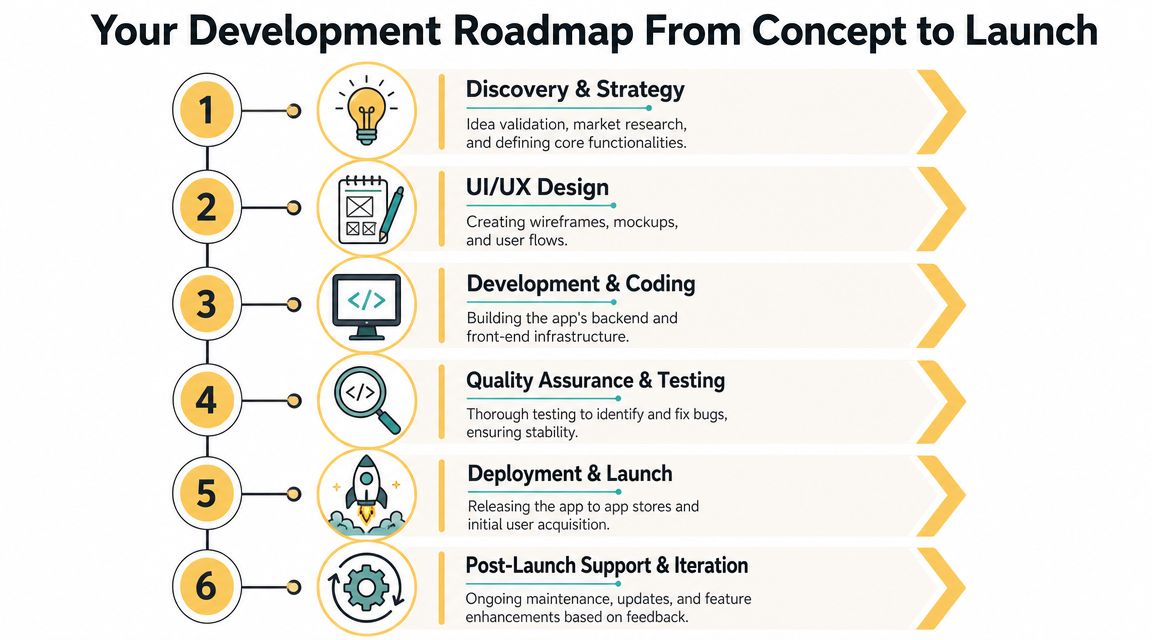
One useful benchmark from Appschopper's fitness app development overview is that an MVP with core features such as registration, activity logs, and goal-setting can be delivered in about 3 to 5 months. That timeline only makes sense when the feature set stays lean.
Phase one through three
The first half of the roadmap determines whether the product can launch with confidence.
-
Discovery and strategy
This phase defines the product thesis. Teams map the audience, narrow the use case, identify success criteria, and lock the MVP boundaries. The key deliverable is usually a requirements set that engineering and design can work from without constant reinterpretation. -
UI and UX design
Wireframes come first, then interactive flows, then polished screens. Good design reviews focus on user effort. How many taps to start a workout? How quickly can someone find today's plan? Where does confusion show up? -
Development and implementation
Front-end and back-end should move in parallel with regular checkpoints. That keeps assumptions visible. If the logging flow requires data the back-end doesn't yet support, the issue surfaces early instead of becoming a costly rewrite near launch.
Phase four through six
The second half is where disciplined teams separate launch readiness from wishful thinking.
Quality assurance
Testing should cover more than “does the screen load.”
A proper QA pass for fitness products checks:
- Core action reliability: Logging, goal updates, plan completion, and account flow
- Integration behavior: Device sync, payment handling, analytics events, and notification triggers
- Edge cases: Weak connectivity, interrupted sessions, app restarts, and stale data states
Deployment and launch
Launch means store preparation, release management, analytics verification, and support readiness. It also means deciding what you'll monitor in the first days and weeks. If no one defines those signals, the team won't know whether onboarding is healthy or where users are dropping off.
Post-launch support and iteration
Product work becomes real here. The first release gives you behavior, not certainty. Teams need a backlog shaped by actual usage, support requests, and conversion friction.
Operator note: The first version should answer whether people want the product. It doesn't need to answer every product question you'll have a year later.
Budget planning matters here. Founders who only fund design and build often get stuck right after launch, which is exactly when the next round of useful decisions starts. This overview of mobile app development cost is helpful if you're mapping the full lifecycle rather than just the build phase.
Evaluating and Choosing the Right Development Partner
The market is large enough that poor partner selection gets expensive quickly. Business of Apps reports that fitness apps saw 850 million downloads in 2024 and generated $3.98 billion in revenue in 2024, according to its fitness app market data. In a category operating at that scale, your development partner has to do more than ship software. They need to help you build a product that can monetize and retain users.
A founder should treat agency selection like hiring a senior product operator, not buying commodity development hours.
What to ask in the first conversation
Good agencies answer direct questions without getting slippery. Ask them:
- How do you define the MVP? If they say “we can build whatever you want,” push harder.
- What happens during discovery? You want a structured process, not vague brainstorming.
- How do you handle product changes during development? This reveals whether they're rigid, adaptive, or chaotic.
- Who owns strategy, design, engineering, and QA? You need clear accountability.
- How do you think about retention after launch? If they only talk about features, they're missing the business.
- What integrations have you handled before? Ask about wearables, subscriptions, analytics, and admin tooling.
- How do you communicate risk? Serious teams surface risks early instead of hiding behind progress updates.
Green flags
A capable partner usually shows a few signs quickly.
First, they challenge assumptions. They don't just nod through your wish list. They question whether social features belong in the MVP, whether nutrition should be custom-built yet, and whether your onboarding asks for too much too early.
Second, they talk about workflows, data, and business rules. Not just colors and screens.
Third, they explain trade-offs in plain language. If they can't translate technical choices into cost, timeline, and maintenance implications, you'll struggle later.
The best agencies don't impress you by sounding complicated. They impress you by making hard decisions understandable.
Red flags that should slow you down
These show up all the time:
- Suspiciously low quotes: Cheap proposals often omit QA, strategy, admin tooling, or post-launch support.
- Instant certainty: If an agency can estimate everything before proper discovery, they're guessing or selling.
- Portfolio without product thinking: Nice visuals don't prove they can structure a retention-driven app.
- No discussion of maintenance: Fitness products don't end at launch.
- No questions about your business model: If they don't ask how you'll acquire, retain, and monetize users, they're treating the project as code production.
Compare proposals like an operator
Don't compare bids line by line on price alone. Compare them on clarity and risk.
Look at:
| Area | Strong proposal | Weak proposal |
|---|---|---|
| Scope | Defined MVP boundaries and assumptions | Broad promises with fuzzy edges |
| Process | Discovery, design, build, QA, launch, support | Build-only mindset |
| Team | Named roles and ownership | Generic “development team” language |
| Change handling | Clear method for revisions and priorities | Scope tension hidden until later |
| Post-launch | Maintenance and analytics plan | Minimal mention or none |
The right development partner gives you informed disagreement, clean process, and product judgment. That's more valuable than speed alone.
Common Pitfalls and Lessons from an Omaha Agency
The most common failure in fitness app projects isn't bad intent. It's bad sequencing.
A local pattern I've seen in Omaha is that founders often arrive with a polished feature list and an underdeveloped retention plan. They know they want workout logging, subscriptions, and wearable sync. They haven't thought through what gets a user to come back on day three, week three, or month three. That gap shows up after launch, when the app technically works but user behavior stalls.
Svitla's guide on fitness products makes an important point in this area. It notes that the main challenge isn't just feature planning. It's engagement and retention, and that post-launch roadmap decisions need to be analytics-driven, as outlined in this fitness app development guide. That matches what experienced agencies see in practice.
Where teams usually go wrong
Three mistakes show up repeatedly.
- They overbuild before validation. Social feeds, challenges, meal planners, coach messaging, video libraries, and deep integrations all sound strategic. Together, they can bury the core use case.
- They underfund post-launch work. The first release creates the feedback loop. It doesn't finish the product.
- They treat compliance and privacy like cleanup work. If the app touches sensitive health-related behavior, those decisions need attention early.
A grounded Omaha example
In agency environments like Omaha's, the strongest projects usually don't begin with “let's build the biggest app we can afford.” They begin with “what is the smallest product that proves people will keep using this?”
That shift changes everything. The team narrows the first use case, limits integrations, and defines the core user action clearly. They also reserve budget for iteration after launch. When that discipline is missing, the project often turns into a patchwork of expensive features with no strong center.
Local founders often benefit from one simple correction: treat launch as the start of product learning, not the finish line.
The Omaha advantage isn't geography by itself. It's proximity, accountability, and the ability to work through strategy in plain language with a team that understands both software delivery and business constraints. That's especially useful for small and mid-sized companies that can't afford a long detour through avoidable product mistakes.
If you're planning a fitness product and want a team that can help shape the strategy, scope the MVP, and build with long-term ROI in mind, Up North Media is worth a conversation. As an Omaha-based digital agency, they work with businesses that need more than code alone. They help turn product ideas into usable, scalable digital experiences with a focus on clarity, measurable outcomes, and practical execution.