

You've been publishing blog posts for months. Maybe longer.
The topics seem right. The writing is solid. Your team shares each piece on social media, and a few articles even get some clicks. But when you look at search performance, it feels random. One post gets traction, three disappear, and the rest sit in your archive like boxes in a garage no one opens.
That usually isn't a quality problem. It's an organization problem.
Most business websites grow content the same way a junk drawer grows. One post about pricing. Another about maintenance tips. Another targeting a keyword your SEO tool suggested. Each article might be useful on its own, but together they don't form a clear signal. Search engines see isolated pages. Readers see disconnected advice. You see a lot of effort without much momentum.
A topic cluster strategy fixes that by turning scattered content into a system. Instead of publishing one-off posts, you build a central resource on a core topic and surround it with focused supporting pages that link together in a deliberate way. That structure helps people find what they need and helps search engines understand what your site should be known for.
Why Your Content Isn't Ranking
A common pattern looks like this. A local service business writes a post called “Signs You Need a New Furnace.” Later, they publish “How Often Should You Service Your HVAC System?” Then they add “Why Is My Energy Bill So High?” Months later, they write “Best Thermostat Settings for Winter.”
Each post is reasonable. None of them are strategically connected.
Content chaos creates weak signals
When content grows without a map, two problems show up fast.
- Pages compete with each other: Several articles may touch the same subject from slightly different angles, so your own pages blur together.
- Important pages stay buried: Your strongest service or category page doesn't get enough internal support from related content.
- Readers hit dead ends: Someone lands on one article, gets a partial answer, then leaves because there's no obvious next step.
- Search engines see fragments: They can crawl the content, but the relationship between pages isn't clear enough to establish subject authority.
Imagine opening a bookstore where every book is stacked on the floor instead of shelved by section. The books exist. Some are excellent. But no one can tell what the store specializes in.
Practical rule: If your blog feels like a timeline of ideas instead of a library of topics, you likely have a structure problem.
Good content can still underperform
Many business owners often find frustration at this point. They assume the answer is to write more, publish faster, or chase new keywords. Sometimes the opposite is true. You don't need more content yet. You need content that works together.
A topic cluster strategy gives each piece a job. One page becomes the broad authority page. Supporting pages answer narrow questions. Internal links create a path between them. That's what turns “a bunch of posts” into a content asset.
Here's the shift that matters most:
| Old approach | Cluster approach |
|---|---|
| Blog posts chosen one by one | Topics planned as a connected system |
| Similar articles overlap | Each page has a distinct role |
| Internal links added casually | Internal links reinforce topic relationships |
| Traffic depends on single posts | Visibility can build across a full topic area |
Once you see the difference, flat performance starts to make sense. Your content may not be failing because it's weak. It may be failing because it's alone.
Understanding the Topic Cluster Model
The easiest way to understand the model is to stop thinking about “blog posts” and start thinking about a book.
Your pillar page is the book. It covers the whole subject at a high level. Your cluster pages are the chapters. Each one goes deeper into a specific part of the subject. The internal links are the table of contents and page references that help readers move naturally from one idea to another.
The pillar page
A pillar page targets a broad topic that matters to your business. It isn't just a long article. It's a structured resource that introduces the full subject clearly and points readers to deeper supporting content.
For a local roofing company, a pillar might be “Residential Roof Repair and Replacement Guide.” For an online store, it might be “The Complete Guide to Espresso Machines.”
A strong pillar page usually does these things:
- Defines the topic clearly: It answers the big question a buyer or researcher has.
- Covers major subtopics briefly: It gives enough context without trying to answer every detail on one page.
- Connects to deeper resources: It links readers to focused pages where they can keep learning.
- Supports business intent: It aligns with services, products, or commercial categories that matter to revenue.
The cluster pages
Cluster content is narrower. Each page focuses on one subtopic, one question, one comparison, or one use case.
For that roofing example, cluster pages could include storm damage signs, insurance claim basics, repair versus replacement, material options, and seasonal maintenance. For the espresso machine store, clusters might cover grinder pairing, milk frothing basics, descaling, machine sizing, and beginner buying advice.
A pillar should introduce the whole neighborhood. A cluster page should walk someone to one specific address.
That distinction matters. If the pillar is too narrow, it can't support a cluster. If the cluster page is too broad, it starts competing with the pillar.
The internal links
Internal linking is what turns separate pages into a real topic cluster strategy.
Every cluster page should link back to the pillar when that helps the reader. The pillar should link down to every relevant cluster. Related cluster pages can also link to one another when the connection is useful and natural.
This structure helps in three practical ways:
- It clarifies site architecture so search engines can interpret the relationship between pages.
- It concentrates relevance around one core topic instead of spreading it thinly across random posts.
- It improves navigation because readers can move from broad guidance to detailed answers without friction.
A category page alone doesn't do this. Categories often collect content by label. A topic cluster is intentionally built to teach, guide, and reinforce authority around a subject.
Designing Your Content Architecture
Before you write anything, decide what your site deserves to be known for. That's the heart of content architecture.
Many businesses skip this step and jump straight into keyword tools. That creates a long spreadsheet, but not a strategy. Start with business relevance first. Then validate with search behavior. Then organize the plan so each page has a clear role.
Choose pillar topics tied to revenue
Your pillar topics should sit close to what you sell, what you service, or what you want to become known for. If a topic attracts the wrong audience, ranking for it won't help much.
Ask these questions:
- Does this topic connect to a service or product line?
- Could a buyer realistically start their research here?
- Can our team speak about this with real expertise?
- Is the topic broad enough to support multiple supporting pages?
A family law firm probably shouldn't build a pillar around “productivity tips.” An HVAC company probably shouldn't build one around “general home ownership.” The subject may get interest, but it won't strengthen the part of the business that matters.
For businesses managing large sets of pages or location-driven content, it also helps to understand how templated content differs from a classic cluster model. This guide on programmatic SEO is useful if you're deciding when to scale pages systematically versus when to build deeper editorial coverage.
Map cluster topics from real questions
Once you have a pillar idea, list the questions people ask before they buy, while they compare options, and after they purchase. Those questions usually make better cluster topics than abstract keywords alone.
Use tools like Google Search Console, Google autocomplete, People Also Ask results, your sales inbox, customer support logs, and SEO platforms such as Ahrefs or Semrush to gather ideas. Then sort them by intent.
A healthy cluster often includes a mix of:
- Educational pages for early research
- Comparison pages for buyers evaluating options
- Problem-solution pages for people with urgent needs
- Process pages that explain what happens next
- Maintenance or usage pages for post-purchase support
Organize the plan before publishing
A simple content map keeps you from creating overlap. It also helps writers, editors, and SEO teams understand how each piece fits into the larger structure.
Here's a sample layout.
| Pillar Topic | Cluster Content Title | Primary Keyword | Content Type |
|---|---|---|---|
| Air Conditioning Services | How to Know if Your AC Needs Repair | AC repair signs | Blog article |
| Air Conditioning Services | AC Installation vs AC Repair | AC repair vs replacement | Comparison page |
| Air Conditioning Services | What Happens During an AC Tune-Up | AC maintenance service | Service explainer |
| Air Conditioning Services | Common Causes of Weak Airflow | weak airflow AC | Troubleshooting guide |
| Backpacking Guide | How to Choose a Backpacking Tent | backpacking tent guide | Buying guide |
| Backpacking Guide | What to Pack for a Weekend Trip | backpacking packing list | Checklist article |
| Backpacking Guide | How to Layer Clothing for the Trail | hiking layering system | Educational guide |
| Backpacking Guide | Backpacking Meals for Beginners | backpacking meal ideas | How-to article |
The point isn't to make a perfect spreadsheet. The point is to avoid publishing content that cannibalizes itself or leaves obvious gaps.
If you can explain, in one sentence, why each cluster page exists and how it supports the pillar, your architecture is probably strong enough to build on.
A Step-by-Step Implementation Framework
Planning gives you the blueprint. Execution is where most topic cluster strategies either become an asset or fade into another half-finished content project.
Start with process. When the workflow is clear, content quality gets more consistent and internal linking stops being an afterthought.
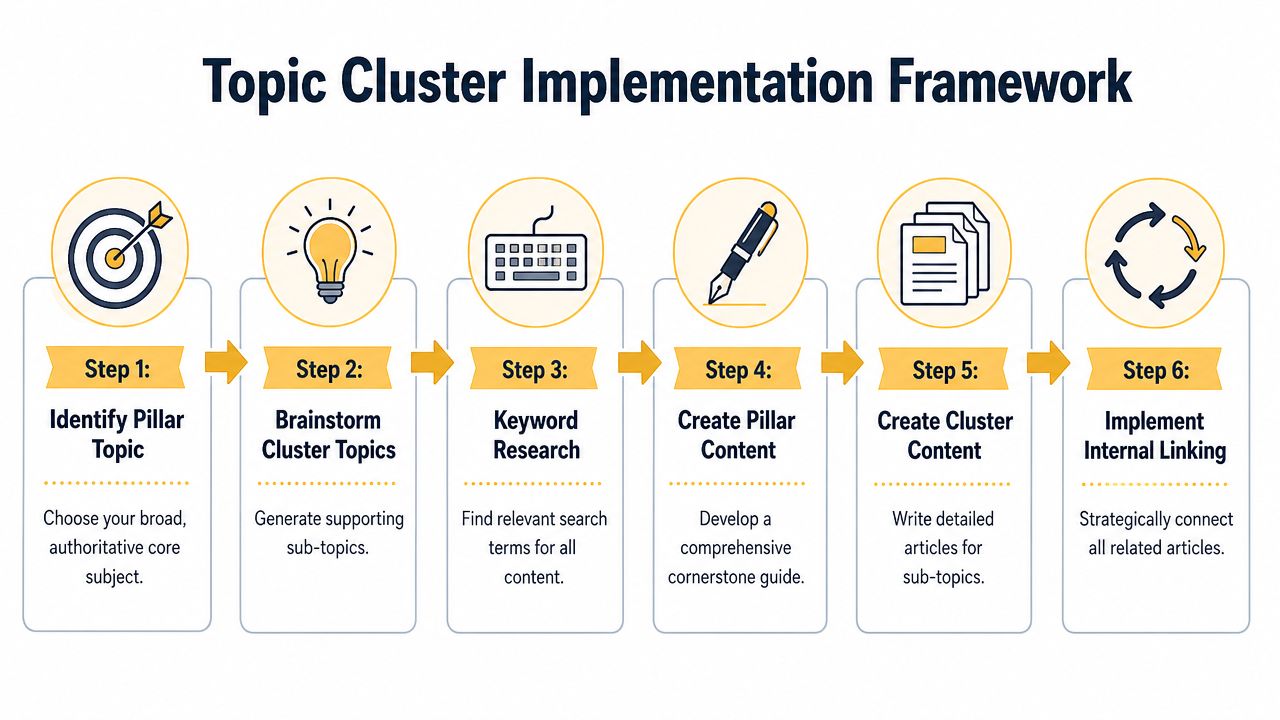
Build the brief before the page
A good content brief keeps writers from drifting into broad, repetitive articles. Your pillar brief and cluster brief should share the same core topic, but they shouldn't ask for the same level of coverage.
For a pillar brief, include:
- Primary topic and search intent: Broad, high-level coverage with clear navigation.
- Core subtopics: The major sections the page must introduce.
- Business goal: Lead generation, product discovery, service education, or category support.
- Required links: Supporting pages the pillar must point to.
For a cluster brief, include:
- Specific user question: One narrow problem or decision.
- Primary keyword and close variants: Used naturally, not stuffed.
- Scope boundaries: What the page should cover and what belongs on the pillar instead.
- Required return link: A contextual link back to the pillar.
Publish in a practical order
Many teams ask whether they should write the pillar first or the cluster pages first. In practice, either can work. What matters is that the full structure is planned before publishing.
A reliable sequence looks like this:
- Finalize the pillar outline so you know the full topic territory.
- Draft a few high-priority cluster pages that answer important subtopics.
- Publish the pillar with working links to live pages and placeholders in your workflow for the rest.
- Expand the cluster steadily until the topic feels well covered.
Here's a walkthrough worth watching if you want a visual explanation of the process in action.
Internal linking is the glue
Many content programs break because teams publish related pages, but they don't link them with enough intention.
Use these linking rules:
- Every cluster links to the pillar: Usually in the introduction, conclusion, or a naturally relevant body section.
- The pillar links to each cluster: Not in a random “related posts” block only. Use contextual links inside the content.
- Clusters link sideways when useful: If two subtopics support each other, connect them.
- Anchor text stays descriptive: Use natural phrasing that tells readers what they'll get by clicking.
Linking check: If a reader lands on any page in the cluster, they should be able to reach the main resource and the next logical subtopic without searching your menu.
Create a publishing rhythm you can sustain
You don't need a frantic cadence. You need a realistic one.
If your team can only produce one strong page at a time, that's fine. Publish deliberately and keep the cluster moving forward. A half-built cluster is still more strategic than ten unrelated blog posts.
Simple distribution helps new pages get indexed and discovered. Share the content through your email list, sales team, customer support team, and social channels. If you want a stronger post-publish system, this guide to a content distribution strategy gives a useful framework for getting more mileage from each piece.
A topic cluster strategy works best when publishing, linking, and promotion happen as one coordinated motion, not as separate tasks owned by different people who never compare notes.
Topic Cluster Examples for Local and E-commerce Businesses
The model gets much easier once you see it applied to real businesses.
A local service company and an e-commerce brand won't build identical clusters, because the customer journey is different. One often serves a specific geography with urgent, trust-heavy decisions. The other usually supports product discovery, comparison, and purchase confidence across a wider set of searches.
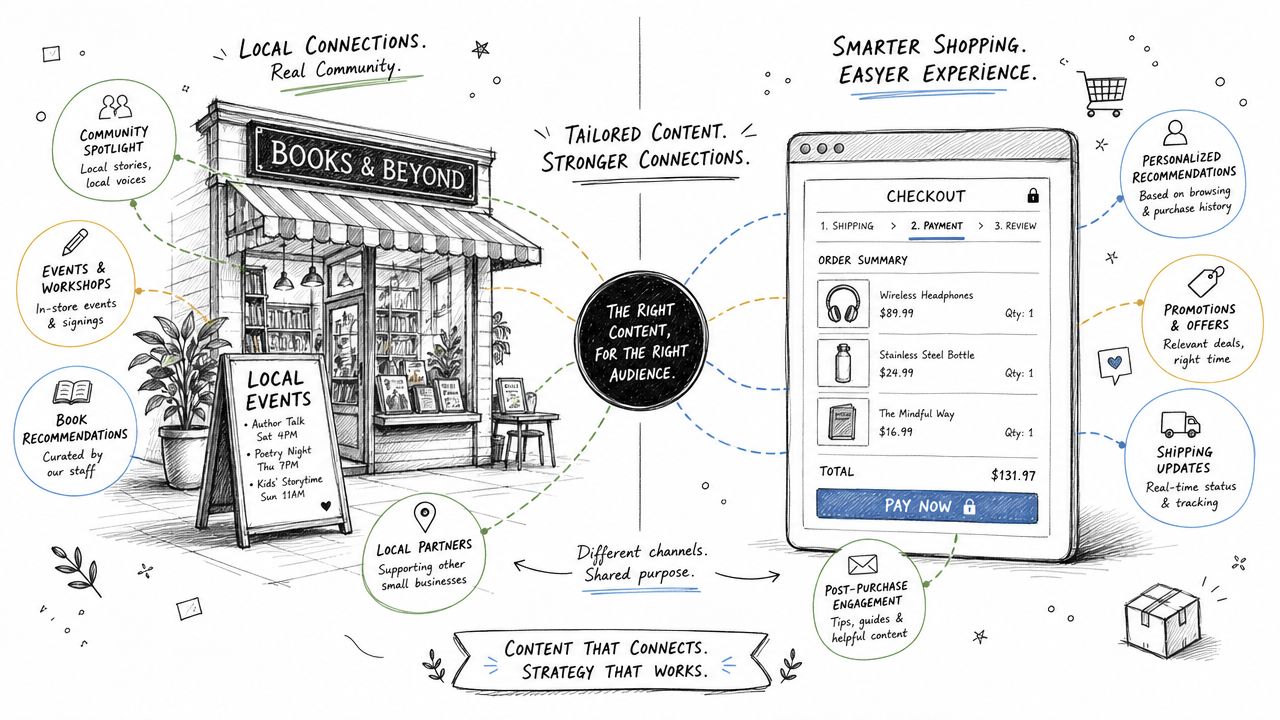
Example for a local HVAC business
Say you run an HVAC company in Omaha. A smart pillar topic might be Air Conditioning Services. That page would explain repair, installation, maintenance, common issues, service areas, and when to call a professional.
The cluster pages around it could include:
- How to Know if Your AC Needs Repair: Covers warning signs like weak airflow, odd noises, or uneven cooling.
- AC Installation vs AC Repair: Helps homeowners decide whether fixing or replacing makes more sense.
- Benefits of Regular AC Maintenance: Explains tune-ups, seasonal care, and breakdown prevention.
- What to Expect During an AC Service Visit: Reduces uncertainty and improves conversion from cautious prospects.
- AC Problems During Omaha Summers: Adds local relevance without turning the article into keyword stuffing.
This works because each page supports a real customer question. Someone may first search for symptoms, then compare solutions, then book service. The cluster mirrors that path.
For businesses that rely on maps, local pack visibility, and city-specific trust signals, this overview of local SEO ranking factors pairs well with cluster planning.
Example for an outdoor e-commerce store
Now switch to an online store that sells backpacking gear. The pillar might be The Ultimate Guide to Backpacking. That page would introduce planning, shelter, clothing, food, footwear, packs, and safety essentials.
Supporting cluster pages could include:
| Cluster page | Why it matters |
|---|---|
| How to Choose a Backpacking Tent | Supports category discovery and product comparison |
| Best Hiking Boots for Rocky Terrain | Matches shoppers with a clear gear problem |
| Lightweight Meal Planning for the Trail | Attracts practical, high-intent research traffic |
| How to Pack a Backpack for Balance | Builds trust through useful expertise |
| Backpacking Checklist for Beginners | Helps early-stage shoppers organize a first purchase |
This kind of content doesn't just support rankings. It also helps shoppers move from “I'm researching” to “I know what I need.”
If your store competes in crowded product categories, it's worth studying how brands win AI-driven e-commerce discovery through stronger product visibility, cleaner site structure, and content that supports buying decisions. That's especially relevant when your educational pages need to feed category and product pages, not just attract top-of-funnel visits.
The best cluster examples don't feel like SEO exercises. They feel like a helpful path a customer would naturally want to follow.
Measuring Your Topic Cluster Success
If you only check whether one article ranks, you'll miss the bigger picture.
A topic cluster strategy is a system, so measure it like a system. Look at the pillar, the supporting pages, the internal pathways between them, and the business actions they influence.
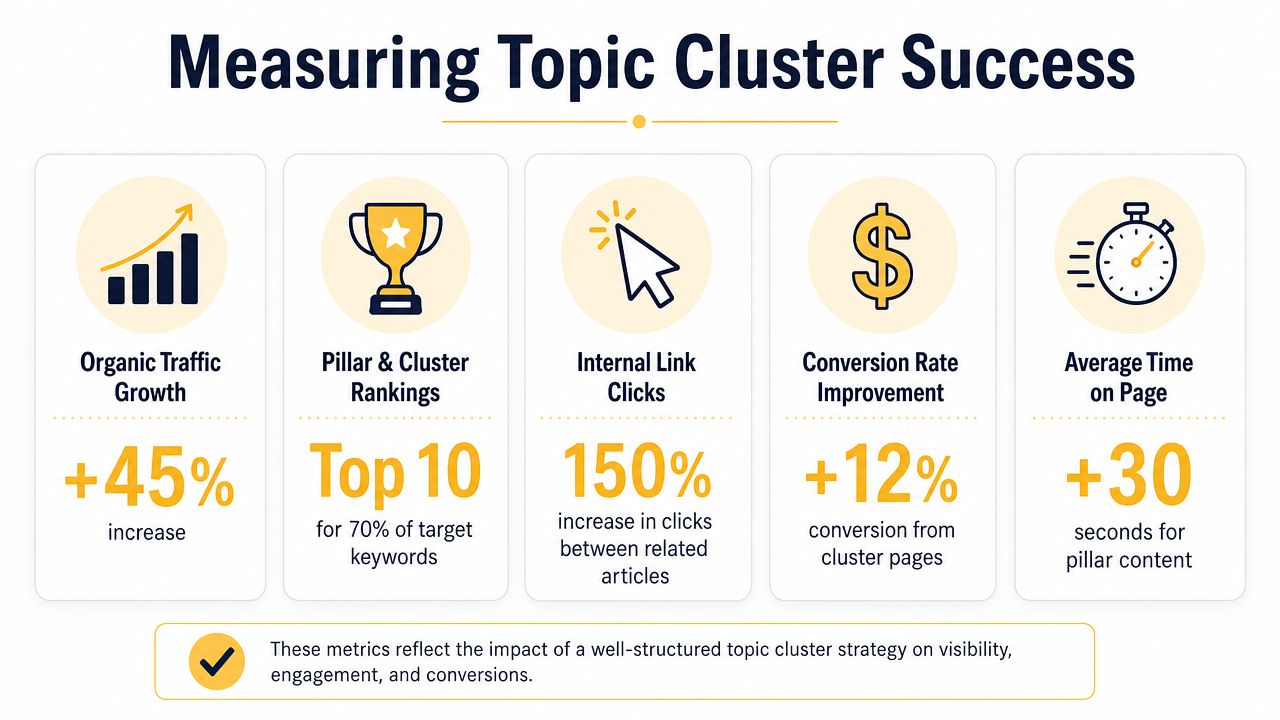
What to watch first
Start with a short list of practical signals:
- Pillar page visibility: Is your main page gaining impressions, clicks, and stronger positioning for the core topic?
- Cluster-wide organic traffic: Are related pages growing together rather than as isolated wins?
- Internal link engagement: Do visitors move from one page to another inside the cluster?
- Lead or sales contribution: Are contact forms, calls, product views, add-to-carts, or purchases influenced by these pages?
- Engagement quality: Do readers stay long enough to consume the content and continue their journey?
Google Search Console helps you see queries, clicks, and indexing behavior. Google Analytics 4 helps you inspect engagement paths and conversions. Used together, they tell a more complete story than rank tracking alone.
Measure by topic, not by post
This is the mindset shift that matters. Don't treat each page like a solo performer. Group related URLs and review them together.
For example, if your air conditioning pillar gains visibility but your repair and maintenance clusters don't, the issue may be thin coverage or weak internal links. If cluster pages get traffic but produce no business action, the content may answer questions well but fail to guide users toward the next step.
What to ask each month: Is this cluster becoming easier to find, easier to navigate, and more useful to the business?
A simple review routine works well:
- Pull Search Console data for the pillar and supporting URLs.
- Check GA4 engagement and conversions for the same set.
- Review internal links manually to confirm nothing broke during edits.
- Refresh weak pages that have impressions but poor click-through or weak user flow.
That process keeps the cluster alive. Without it, even strong content can slowly drift into underperformance.
Common Topic Cluster Strategy Questions
Once you start mapping clusters, a few practical questions come up almost every time.
How many cluster articles does one pillar need
There isn't a magic number. What matters is whether the pillar has solid support from enough focused content to cover the topic in a credible way.
Some businesses can build a strong cluster with a modest set of highly relevant pages. Others need broader coverage because the topic has more product types, service variations, or customer questions. Start with the most important subtopics first, then expand where demand and business value overlap.
Can you turn old blog posts into a cluster
Yes, and that's often the fastest way to improve an underorganized blog.
Run a content audit and sort old posts into three buckets:
- Keep and update: Pages with useful substance and relevant intent
- Merge or redirect: Overlapping pages that cover too much of the same ground
- Retire: Thin or off-topic posts that don't support your authority
Then choose a pillar page, revise the supporting posts so each has a distinct role, and add internal links deliberately. Existing content often becomes much more valuable once it has a home inside a structured topic.
How long does it take to see results
Usually not overnight.
Search engines need time to crawl, interpret, and re-evaluate a content structure, especially if you're improving an existing site rather than launching from scratch. You may notice early indexing and engagement signals first, while stronger ranking movement tends to take more patience. The timeline depends on your site authority, competition, content quality, and how completely the cluster is built.
What's the difference between a topic cluster and a category page
A category page groups content. A cluster organizes intent.
That's the big distinction. Category pages often exist for navigation or CMS structure. A topic cluster strategy is built around one central authority page, focused subtopic pages, and a planned internal linking system that reinforces meaning and guides user flow.
What if one article seems to fit two clusters
Pick the stronger home based on search intent and business context.
If the page adequately supports two areas, you can still link to it from both places. But avoid making one article do too many jobs. When a page tries to serve several clusters at once, it usually becomes vague. Clear ownership makes architecture easier to maintain.
Do product and service pages count as cluster content
They can.
Not every cluster page needs to be a blog post. Service pages, location pages, buying guides, FAQs, comparison pages, and product education pages can all support a cluster if they fit the topic and are linked properly. That's often the most effective approach because it connects SEO work directly to commercial pages instead of isolating it in the blog.
If your site has good content but weak structure, Up North Media can help you turn scattered pages into a focused topic cluster strategy that supports rankings, user experience, and revenue. Whether you're growing a local service brand or an e-commerce store, their team can map the right architecture, improve internal linking, and build a search strategy that fits your business.