
A lot of small businesses think they have a customer experience strategy because they have a website, a Facebook page, an email list, and maybe a phone line that someone answers during business hours. That’s multichannel presence. It isn’t the same as a connected experience.
The gap shows up in ordinary moments. A customer clicks a social post, browses your site on mobile, leaves with questions, then calls your team. Your staff can’t see what they viewed, what they added to cart, or which offer brought them in. The customer repeats themselves, gets a generic answer, and leaves feeling like your business is harder to deal with than it should be.
That’s why what is omnichannel customer experience has become a practical business question, not a buzzword. For an SMB, omnichannel means your channels work together so customers can move between them without friction, confusion, or loss of context. You don’t need an enterprise budget to start doing that well. You do need the right priorities.
Why Disconnected Customer Experiences Are Costing You
The most expensive customer experience problems usually don’t look dramatic. They look ordinary.
A shopper sees a product on Instagram, visits your site later from their laptop, adds it to cart on mobile, then calls with a sizing question. Your phone rep has no record of the cart, no clue which product page they visited, and no visibility into the promotion that started the journey. The customer has to start over.
That disconnect feels small inside the business. To the customer, it signals disorganization.
Where revenue slips away
When channels don't share context, customers run into the same friction again and again:
- They repeat information across chat, phone, email, and in person.
- They receive irrelevant follow-up because your email platform doesn't know what support just handled.
- They abandon purchases when a store visit, call, or chat can't pick up where the website left off.
- They lose trust because pricing, messaging, or service quality changes by channel.
If you want a broader foundation for this topic, it helps to learn about customer experience before narrowing in on omnichannel specifically.
Practical rule: Customers don't care which software owns the interaction. They care whether your business remembers them.
What omnichannel changes
Omnichannel customer experience is the fix for that fragmentation. It means the website, email, social, support, mobile, and physical interactions behave like parts of one system instead of separate departments.
The business impact is not theoretical. Businesses with strong omnichannel strategies retain on average 89% of their customers, compared to only 33% for companies with weak omnichannel engagement. Omnichannel shoppers also have a 30% higher lifetime value than single-channel shoppers, according to omnichannel customer experience research summarized here.
For SMBs, that matters because retention usually beats constant reacquisition. You don't need every possible channel. You need the few channels your customers already use to stop fighting each other.
A good starting point is to audit your biggest handoff failures. If you need a practical checklist, this guide on how to improve customer experience is a useful companion to that process.
Omnichannel vs Multichannel vs Cross-Channel Explained
Most business owners aren’t confused about marketing channels. They’re confused about how connected those channels are.
The easiest way to think about it is this. Multichannel is a building where each department has its own office. Cross-channel is the same building, but departments can pass notes to each other. Omnichannel is the building running from one shared brain, with the same view of the customer every time someone interacts.
The short version
Multichannel means you show up in multiple places.
Cross-channel means some of those places coordinate.
Omnichannel means the customer experiences one continuous relationship, no matter where they move.
That distinction matters because many SMBs say, “We’re omnichannel,” when what they really mean is, “We have a website, email, and social media.”
Omnichannel vs Cross-Channel vs Multichannel
| Attribute | Multichannel | Cross-Channel | Omnichannel |
|---|---|---|---|
| Core idea | Presence on multiple channels | Channels can support one another in parts of the journey | All channels operate as one connected experience |
| Customer experience | Separate interactions | Partial continuity between selected touchpoints | Seamless movement between touchpoints |
| Data flow | Mostly siloed | Shared in limited ways | Unified across the full journey |
| Team coordination | Department-based | Campaign-based | Customer-based |
| Typical example | Website, email, and store all exist, but don’t sync | Email drives users to store pickup or support references a recent order | Cart, support history, preferences, and messaging stay connected across every interaction |
| Main business goal | Reach | Campaign efficiency | Retention, loyalty, and lifetime value |
| Common weakness | Customers start over every time | Handoffs work sometimes, not consistently | Harder to implement without clean systems and process discipline |
Where SMBs usually get stuck
Most local businesses land in the middle. They’ve moved beyond single-channel selling, but they haven’t built the operational habits that make omnichannel work.
A few examples:
-
Retailer with disconnected tools
Shopify handles orders, Klaviyo sends email, Instagram drives traffic, and the POS system sits on its own island. Promotions drift. Support can’t see browsing intent. In-store staff can’t recover digital carts. -
Service business with channel conflict
SEO brings leads to the site, a chatbot answers basic questions, and calls close the job. But the office team has no transcript from the bot, no source data, and no clean intake trail. -
Publisher with fragmented audience data
Newsletter activity, site behavior, and subscription actions all live in different tools. Readers look engaged in one dashboard and invisible in another.
Omnichannel isn't “be everywhere.” It's “work coherently where your customers already are.”
What counts as good enough
For most SMBs, omnichannel doesn't mean building a giant enterprise system. It means a customer can switch channels without losing progress, context, or trust.
If someone starts on mobile and finishes in-store, that should feel normal. If they ask support a question after browsing your site, your team should have enough context to help without making them repeat the story. If they respond to an email campaign after already talking to your staff, they shouldn't get treated like a stranger.
That’s the test. Not how many channels you use, but whether those channels act like one business.
The Tangible Business Benefits of an Omnichannel Strategy
The case for omnichannel gets stronger when you stop talking about “experience” as a soft concept and start looking at what it changes in operations, retention, and revenue.
Better retention and stronger customer value
When businesses connect their channels well, they don't just make customers happier. They make the business more durable.
Forrester reports that companies adopting omnichannel strategies see 35% higher customer retention and a 46% increase in customer lifetime value, along with 31% faster first-resolution times, according to this roundup of omnichannel customer service statistics.
That combination matters because it hits both sides of the ledger:
- Retention improves because customers don't get lost in the gaps.
- Lifetime value rises because repeat purchases are easier to earn when every interaction feels consistent.
- Resolution gets faster because support teams spend less time reconstructing the situation from scratch.
For an SMB owner, that often shows up as fewer dropped leads, fewer frustrated calls, and more value from the traffic you already paid to acquire.
Efficiency is part of the payoff
A lot of businesses assume omnichannel is mainly a marketing initiative. In practice, the strongest gains often come from operational cleanup.
A connected setup reduces duplicated work. Sales can see what marketing promised. Support can see what the customer already did. Store staff or office staff can continue the conversation instead of restarting it. That lowers friction internally before it lowers friction externally.
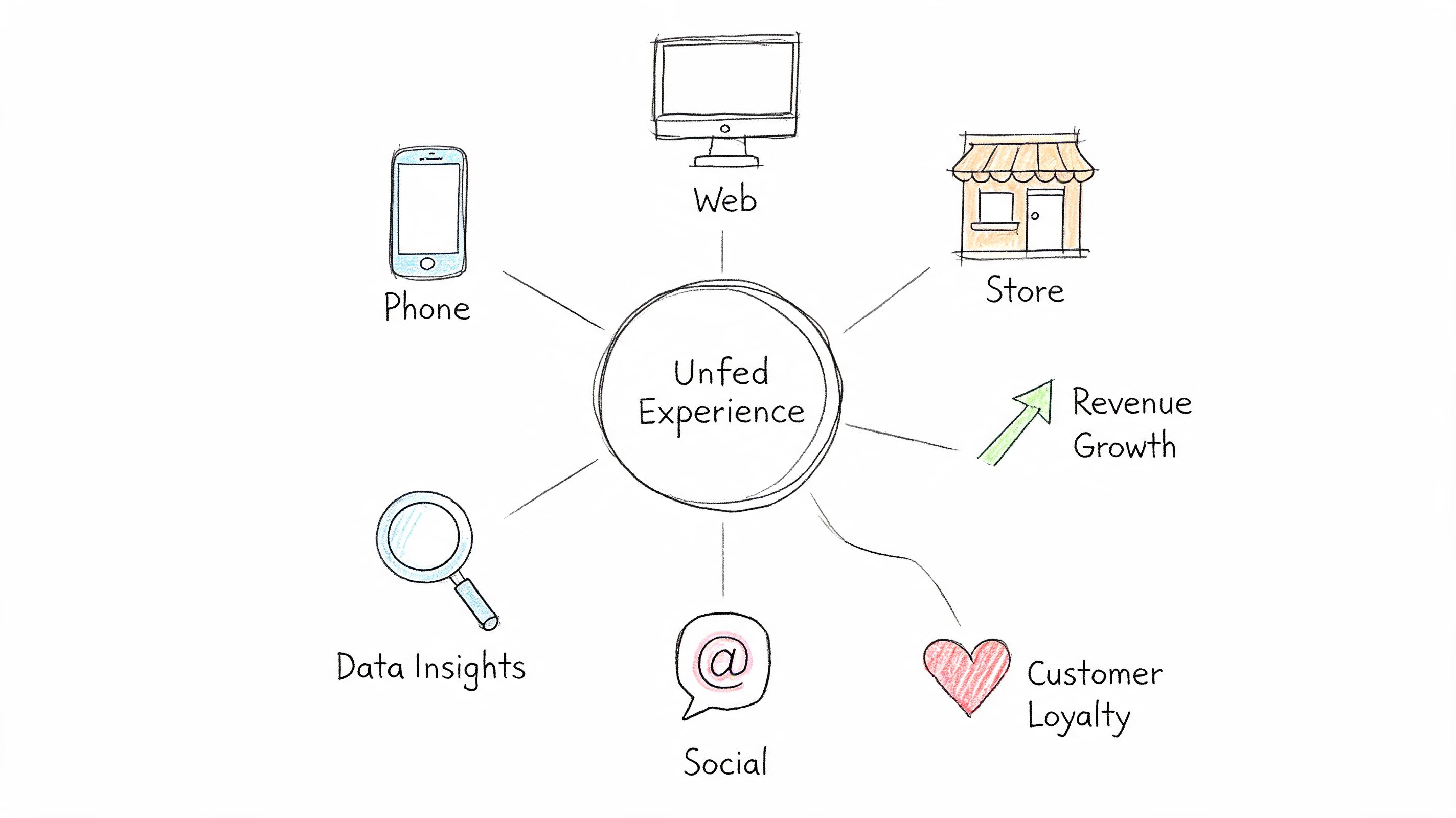
Here’s a quick visual on how the pieces fit together:
What good omnichannel feels like to a customer
It usually comes down to four things:
-
Recognition
The business knows who they are and what they already did. -
Continuity
They can move from one channel to another without losing progress. -
Consistency
Offers, tone, service standards, and information match. -
Low effort
They don't have to repeat themselves or hunt for the next step.
The strongest omnichannel systems don't feel impressive to customers. They feel easy.
That ease is what creates the business upside. Customers buy more readily from companies that remove friction. They come back when the process is reliable. And your team works better when it isn’t patching over disconnected systems all day.
Omnichannel Customer Journeys in Action
Definitions help, but most owners understand omnichannel when they see a real journey play out. Here are two examples that reflect what local retailers and service businesses often need.
A local e-commerce boutique
Sarah discovers a boutique through an Instagram post featuring a new seasonal collection. She taps through to the product page on her phone, looks around, then leaves because she’s between meetings.
That evening, she returns from her laptop. The site remembers the product she viewed and keeps the experience consistent. She adds an item to her cart but doesn’t check out because she wants to see the fabric in person.
The next day, she gets a message that references the item she considered and makes it easy to continue the process. She visits the store, where staff can identify the product and promotion without making her explain the whole path she took to get there.
That’s omnichannel because each touchpoint builds on the last one. Social didn’t just create awareness. The website didn’t just operate as a separate storefront. The store visit didn’t reset the journey.
A local service business
Tom needs a plumber. He searches Google, lands on a well-optimized service page, and uses a website chatbot to ask if the business handles his issue.
The chatbot gathers the basics and hands the conversation into scheduling. Tom picks a time through an integrated calendar. When the office confirms the appointment, the team can see the original site inquiry instead of asking him to repeat the problem.
On service day, Tom receives text updates, and the technician shows up with the right context. After the job, follow-up email asks for feedback and offers the next logical service reminder.
No single step is flashy. The value comes from continuity.
What these journeys have in common
Both examples depend on the same operating principle. Every channel should preserve context instead of discarding it.
That means:
-
Acquisition channels inform follow-up
Social, search, and referrals shouldn't disappear after the first click. -
Sales and service share the same picture
If marketing knows something useful, support should be able to use it. -
The next step is obvious
Customers shouldn't have to guess how to continue the interaction.
If you're trying to align sales and marketing for growth, journey mapping is one of the best ways to expose where handoffs break down.
Where businesses usually break the journey
The failure points are predictable:
-
Different systems own different truths
The website knows behavior, the CRM knows deals, and support knows complaints, but nobody sees the whole picture. -
Teams optimize for their channel, not the customer
Marketing pushes campaigns. Sales pushes calls. Support closes tickets. The customer gets a fragmented experience. -
Follow-up isn't tied to intent
The business sends generic email because it can't act on browsing, chat, or service history.
A practical next step is to map your own customer flows the same way. This overview of omnichannel marketing strategies is useful if you want examples of how different channels can support one another without becoming chaotic.
The Technology Powering a Unified Customer View
Most omnichannel problems are data problems wearing a customer experience disguise.
When a customer has to repeat themselves, the issue usually isn’t that your staff doesn’t care. It’s that your systems don’t share context. The fix starts with a single customer view.
The CDP is the center of the stack
The most important piece in an omnichannel setup is the Customer Data Platform, or CDP. Its job is to create one profile from many signals, including website behavior, CRM records, email engagement, purchases, support history, and sometimes in-store activity.
The core of an omnichannel tech stack is a CDP that creates a single customer profile. Without that data unification, channel handoffs fail, which is a primary reason 70% of customer experience initiatives fall short of their goals, according to this explanation of omnichannel customer experience architecture.
If your website, CRM, support desk, and marketing platform all define the same customer differently, omnichannel won't work no matter how polished the front end looks.
What each system actually does
Here’s the plain-English version of the stack.
-
CDP
This is the unifier. It pulls signals together and helps downstream tools act on the same customer record. -
CRM
This manages sales relationships, account notes, pipelines, and contact history. It tells your team who the customer is in commercial terms. -
Marketing automation platform
This handles triggered email, SMS, audience segmentation, and follow-up logic. It turns customer signals into timely communication. -
Customer service platform
This gives agents ticket history, prior conversations, and relevant context so support can continue the journey instead of restarting it. -
Analytics layer
This helps you see which channels influence outcomes, where handoffs fail, and which paths produce revenue or support load.
What SMBs should prioritize first
You don't need the biggest stack. You need the cleanest one.
Start by asking four questions:
- Where does customer identity live today
- Which system owns purchase or lead history
- Can support see marketing and sales context
- Can marketing suppress or personalize based on service activity
If the answer to most of those is no, you have a unification issue before you have a campaign issue.
For businesses exploring composable commerce or flexible checkout experiences, this guide to Implementing headless payments and subscriptions is a helpful example of how back-end architecture affects customer experience. The same principle applies when evaluating what is headless commerce and whether your current platform can support connected journeys cleanly.
A Practical Omnichannel Roadmap for SMBs and Startups
Many smaller companies make a common mistake. They hear the enterprise version of omnichannel, try to connect everything at once, and create a mess that nobody can maintain.
That pattern is common. A 2025 Gartner report highlights that 67% of SMBs abandon omnichannel initiatives due to integration complexity. The same source notes Forrester data showing that a “lite omnichannel” approach, syncing just 2 to 3 key channels, can yield a 35% higher retention rate for SMBs, as summarized in this Qualtrics article on omnichannel customer experience.
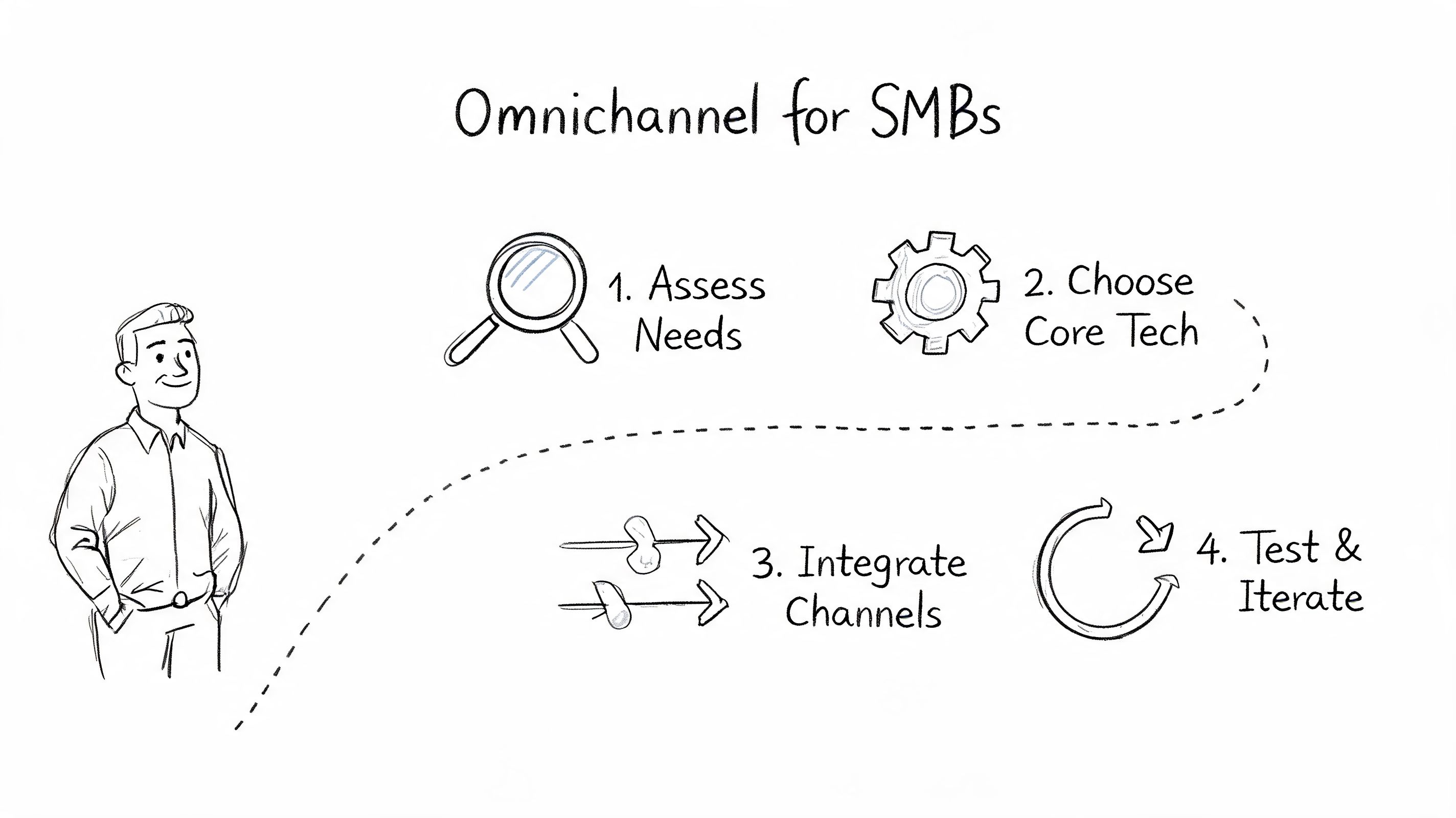
Phase 1 starts with two channels
Pick the two channels that matter most to revenue or service volume. For many SMBs, that’s the website plus email. For a local service company, it might be the website plus phone intake. For a retailer, it could be e-commerce plus in-store service.
Your goal in this phase is simple: preserve context across the handoff.
Focus on:
- Shared customer identity across the two systems
- Consistent offers and messaging so one channel doesn’t contradict the other
- Basic event tracking such as form submissions, product views, cart activity, or booked appointments
- Triggered follow-up based on actual behavior, not batch-and-blast assumptions
This phase should feel boring in the best way. Clean handoffs beat clever campaigns.
Phase 2 adds one more high-impact touchpoint
Once two channels work reliably, add a third that reduces friction.
That might be:
- Live chat or chatbot for pre-sale and support questions
- SMS for reminders, updates, and cart or quote follow-up
- In-store connection through QR codes, POS syncing, or pickup workflows
- Customer portal access for orders, subscriptions, or service history
The rule here is discipline. Don’t add a channel because competitors have it. Add it because customers already expect it and your team can support it consistently.
Start with the handoff that fails most often. That's usually where the first omnichannel win lives.
Phase 3 introduces smarter personalization
After the basics are stable, then bring in AI or deeper automation.
That can include product recommendations, service routing, smarter segmentation, or dynamic content based on behavior. But personalization only works when the underlying data is trustworthy. If your systems are still fragmented, automation just scales the confusion.
A practical roadmap looks like this:
- Unify identity
- Connect the most important handoff
- Add one more channel that reduces effort
- Automate and personalize only after the data is clean
For SMBs and startups, that phased path is usually the difference between a system the team uses and a strategy deck that never leaves the folder.
Measuring Success and Avoiding Common Pitfalls
A lot of businesses measure omnichannel success by asking how many channels they use. That’s the wrong lens. More channels can create more confusion if they aren’t connected.
The better question is whether customers move through those channels with less effort and more continuity. A 2025 McKinsey study found that successful omnichannel adopters achieve 23% higher customer lifetime value, but only when they actively track metrics like Customer Effort Score and cross-channel conversion rates, according to this overview of omnichannel customer experience metrics.
What to track
-
Customer Effort Score
Measure how hard customers feel it is to complete a task, solve a problem, or get help. -
Cross-channel conversion rate
Look at journeys that begin in one channel and complete in another. This tells you whether handoffs are helping or leaking revenue. -
Customer lifetime value
Use CLV to judge whether the connected experience is improving the long-term value of a customer, not just the first conversion.
Pitfalls that derail good strategy
- Inconsistent branding and offers across channels
- Data silos that keep teams from seeing the same customer history
- Overbuilding too early instead of starting with a manageable scope
- Skipping team training so the workflow exists on paper but not in daily use
The businesses that do this well stay focused on continuity, not channel count. They make it easier for customers to buy, ask, switch, and return.
If your business is trying to connect web, search, customer data, and automation without overcomplicating the stack, Up North Media can help you build a practical omnichannel foundation. Their team works with SMBs, retailers, publishers, and startups on custom web apps, SEO, and AI systems that turn disconnected touchpoints into a cleaner customer journey.