

TL;DR: Affordable SEO usually falls into a few realistic lanes: DIY at zero cost, AI-powered tools at about $20 to $50 per month, one-time projects around $500 to $2,000, and recurring local SEO that commonly averages $500 to $650 per location. For broader managed campaigns, legitimate agency work typically starts around $1,500 to $3,000+ monthly, while offers under $300 per month are often high-risk and can create bigger cleanup costs later.
A lot of small business owners are in the same spot right now. The website is live. The service is solid. Customers who do find you tend to buy. But your phone isn't ringing enough, your contact form is quiet, and when you search for what you do in Omaha, your competitors show up first.
That gap is where SEO either becomes a smart investment or an expensive distraction.
The phrase affordable seo services for small business gets thrown around so loosely that it stops meaning anything. Sometimes it means a lean plan with clear priorities. Sometimes it means a low-cost package stuffed with busywork, vague reports, and tactics you'd never approve if someone explained them plainly.
The practical question isn't "What's the cheapest SEO I can buy?" It's this: What can my budget realistically accomplish, and how will I know whether it's working? That's the part many agencies skip.
Is Your Business Invisible Online
You search for your own service in Omaha on a Tuesday afternoon. A competitor with fewer reviews shows up in the map pack. Another has thinner service pages than yours and still outranks you. Your site is live, your work is solid, and yet the leads go elsewhere.
That is what online invisibility looks like for a small business.

A lot of owners assume poor visibility means something is broken on the website. Sometimes it does. More often, the business has never made a deliberate plan for search. Pages were written once and left alone. The Google Business Profile is missing service details, categories, or fresh reviews. Title tags are generic. Location intent is weak. The result is simple. Google has very little reason to put that business in front of ready-to-buy customers.
I see this all the time with Omaha companies that are otherwise well run. A bakery loses cake orders to a national chain because the chain has stronger local signals. A home service company gets fewer calls because its service area pages are thin and its Google Business Profile is incomplete. A B2B firm keeps spending on outbound while a competitor pulls in warmer leads from search because its pages match what buyers type in.
None of that is abstract. It hits revenue.
Good SEO supports demand that already exists. It helps your business appear when someone is looking for the service, comparing providers, or trying to decide who to call first. If those searches never turn into impressions, clicks, calls, or booked jobs, your website acts like a brochure instead of a sales asset.
That is why small business SEO should be judged by business outcomes, not by how many tasks appear on a monthly report. Owners do not need fifty line items. They need to know whether better visibility is producing qualified traffic, phone calls, form fills, direction requests, and closed revenue. That is also where AI can help. Used well, it speeds up keyword clustering, content briefs, review analysis, and reporting. Used poorly, it floods a site with generic pages that never rank.
A lot of providers blur that line. They sell cheap activity and call it strategy. If you are still sorting through what different search engine optimization (SEO) services include, focus on the basics first. Can the provider explain how they will improve visibility for the searches that matter in your market? Can they tie that work back to leads and sales? Can they show what should be done by a person, what can be assisted by AI, and what should never be automated?
Those answers matter more than the sales pitch.
What Affordable SEO Really Means for Your Budget
The biggest mistake I see is treating cheap and affordable as if they mean the same thing. They don't.
If someone offers "full SEO" for less than the cost of a basic utility bill, something has to give. Usually it's strategy, labor quality, transparency, or all three. The economics don't work.
The pricing tiers that actually exist
The market is more straightforward than many sales pages make it seem. Durable's pricing breakdown for affordable SEO services for small business lays out the tiers clearly: services under $300 per month often use risky tactics, local SEO averages $500 to $650 per location, and full-service agency services start around $1,500 to $3,000 monthly. That same analysis makes an important point. Your choice is usually between buying time through agency labor or buying tools through software and DIY effort.
That framing matters because it keeps you from comparing apples to smoke.
If your budget is limited, you still have options:
- DIY path: You spend time instead of cash and use free platforms plus low-cost tools.
- Tool-assisted path: AI and technical SEO tools in the $20 to $50 monthly range can handle parts of the workflow.
- One-time project path: A technical audit or Google Business Profile optimization in the $500 to $2,000 range can fix high-impact issues without committing to a retainer.
- Local recurring path: If your business depends on maps, local intent, and service-area visibility, the $500 to $650 per location range is often where practical monthly work begins.
Why sub-$300 SEO is usually a bad bet
You can't buy meaningful monthly strategy, implementation, reporting, and revision for that price without corners being cut. Those corners often look like low-quality backlinks, thin content, mass directory submissions, or vague reports that never tie work to leads.
Practical rule: If a provider promises full-service monthly SEO for under $300, ask exactly who is doing the work, what tasks happen each month, and how success is measured. The answers usually tell the story fast.
For owners comparing offers, I often suggest reading outside agency sales pages too. This overview of affordable SEO packages for small business is useful because it helps frame packages around what they include, not just what they promise.
Affordable means high-ROI, not low-price
A modest plan that fixes indexing problems, improves local visibility, and tracks form submissions can be affordable. A bargain package that creates a penalty risk isn't.
When you look at budget this way, the question changes from "How little can I spend?" to "Where will the next dollar do the most work?" That's the right question.
Choosing Your Path DIY Freelancer or Agency
You don't need to buy SEO the same way every business does. The right setup depends on your budget, your time, and how much complexity your website has.
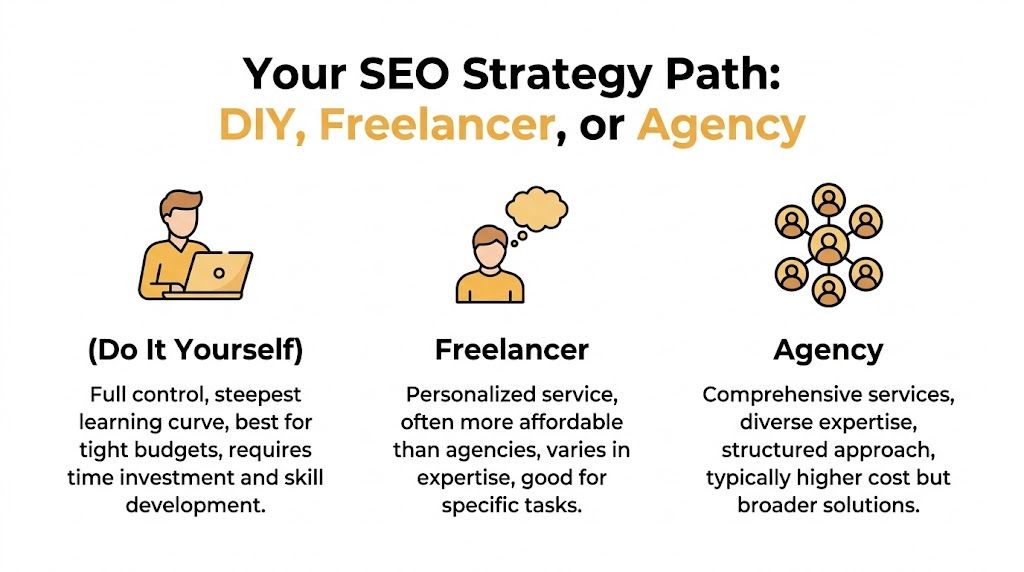
A solo owner with a simple local site can get traction with a different model than a multi-location service company or a growing ecommerce brand. The mistake is assuming one delivery model is always smarter than the others.
SEO Delivery Model Comparison
| Approach | Typical Cost | Time Investment | Best For |
|---|---|---|---|
| DIY | Zero cost, plus optional tools in the $20 to $50 monthly range | High | Owners with more time than budget |
| Freelancer | Varies by scope and specialist | Medium | Businesses needing help with a specific task or channel |
| Agency | Local SEO often averages $500 to $650 per location, while broader managed campaigns commonly start at $1,500 to $3,000+ monthly | Low to medium on the client side | Businesses that need consistency, reporting, and broader support |
DIY works when your business is simple and your time is real
DIY is the cheapest route in cash terms. It can also become the most expensive route in owner time.
If you choose it, keep the scope tight. Claim and complete your Google Business Profile. Fix titles and meta descriptions on core pages. Compress oversized images. Publish a few useful pages tied to clear customer intent. Use Google Search Console and Google Analytics so you're not guessing.
The upside is control. The downside is speed. SEO mistakes made by owners are usually not dramatic. They're just slow, scattered, and hard to prioritize.
Freelancers are strong when the task is narrow
A good freelancer can be a smart middle ground. This is often the best route when you need a technical cleanup, local SEO setup, page optimization, or content support without paying for a full agency stack.
The risk is variance. Some freelancers are excellent. Some are reselling tools. Some are great at one part of SEO and weak at the rest. That isn't a deal-breaker if you hire for a defined job and know what success should look like.
Agencies make sense when coordination matters
An agency becomes useful when SEO touches several moving parts at once. Technical issues, content planning, local visibility, analytics setup, conversion tracking, and ongoing prioritization are hard to keep aligned without a process.
For business owners trying to decide whether they need that level of help, this guide on choosing an SEO company for small business is worth reviewing because it frames the decision around fit rather than hype.
If you're choosing between DIY, freelancer, and agency, don't start with provider preference. Start with how much execution your business can realistically absorb each month.
None of these paths is universally right. A local bakery may do well with one-time outside help and steady in-house updates. A law firm or software company may need a more coordinated approach. Fit matters more than labels.
What You Actually Get with a Good SEO Plan
A good SEO plan shouldn't feel mysterious. You should be able to point to the work and understand why it matters.
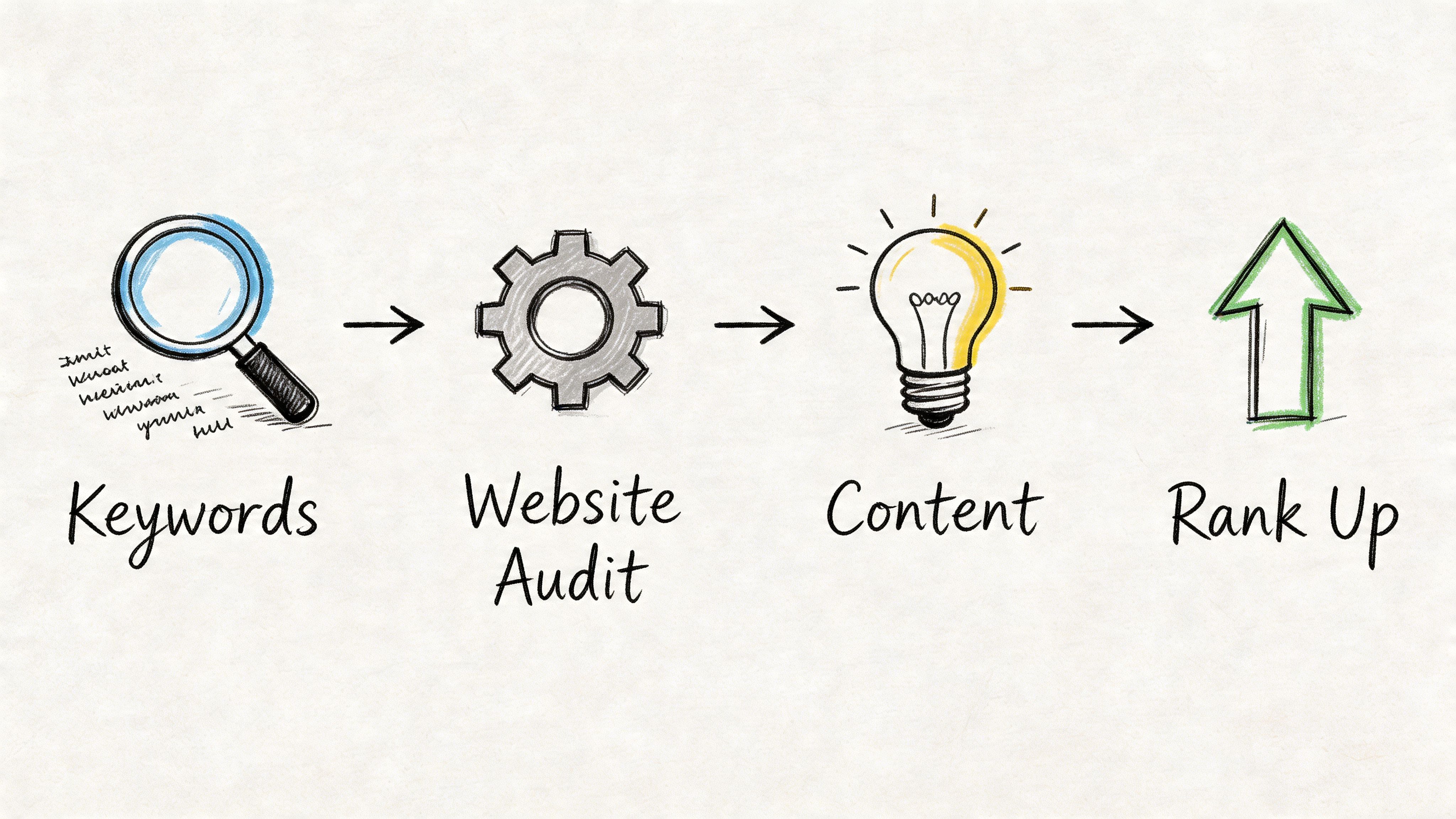
The easiest way to think about it is this. Technical SEO is the foundation of the house. People don't compliment it, but if it's unstable, everything above it performs worse. Content and local signals sit on top of that foundation.
Technical health comes first
For small businesses, the high-impact technical work is usually not glamorous. It's basic, practical, and often overdue. CognitiveSEO's guidance on affordable technical SEO for small businesses highlights three priorities: image compression with a target under 100KB per image, server-level caching, and solid on-page foundations before worrying about advanced schema work.
That advice lines up with what works in practice.
If a site loads slowly because every service page uses oversized photos, rankings won't improve much until that gets fixed. If pages are hard for users to find their way around, internal linking is weak, and titles are generic, adding fancy markup isn't where I would spend first.
Core technical deliverables
- Image compression: Large images are one of the most common performance problems on small business websites.
- Caching setup: Server-level caching usually does more than a stack of random plugins.
- Page basics: Titles, meta descriptions, heading structure, and internal links should be cleaned up before advanced experimentation.
A lot of owners worry they need every advanced feature at once. They usually don't.
Small business SEO often improves fastest when you fix the bottlenecks everybody skipped because they looked boring.
On-page SEO is where intent meets the page
On-page SEO means matching each important page to a real search need. A service page should target the service. A location page should support local intent. A blog post should answer a question your buyer asks before contacting you.
That work includes keyword research, but keyword lists by themselves aren't a strategy. The useful part is mapping a keyword theme to the right page, rewriting weak page copy, improving headings, and tightening internal links so users and search engines can move through the site logically.
A short explainer can help if you want to see the workflow in a more visual format.
Local SEO and off-page support make your business discoverable
For local businesses, this usually includes Google Business Profile work, directory consistency, reputation management, and location-relevant landing pages. For content-driven businesses, off-page support may also include earning relevant mentions and links through useful content, partnerships, or local visibility efforts.
What you should expect from a good provider is clarity. They should tell you what pages are being improved, what technical issues are being fixed, what local assets are being updated, and how each item connects to leads or visibility.
How to Vet an SEO Provider and Measure Real ROI
Most SEO sales conversations spend too much time on rankings and not enough on accountability. That's where small businesses get burned.
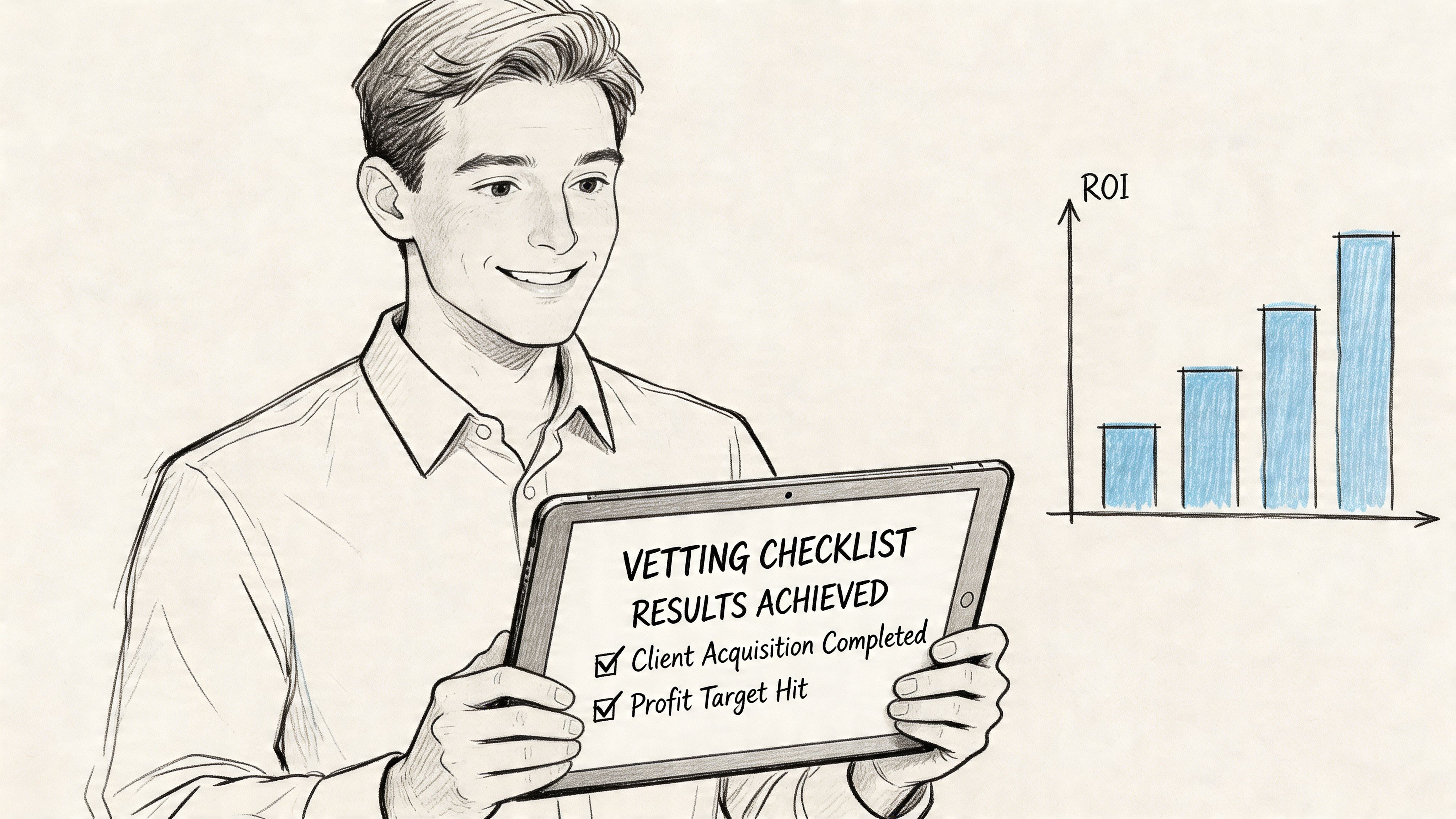
The first thing I want to know from any provider is whether they start with diagnosis or with a package. A provider that jumps straight to "our silver plan" without reviewing your site is selling a template, not solving a business problem.
Start with the audit, not the pitch
B2B Elevation's guidance on evaluating SEO companies for small businesses makes a point I strongly agree with: businesses should prioritize vendors that offer a detailed initial site audit to identify crawl errors and technical debt, and that can tie their work to conversion goals using tools like Google Analytics.
That's the standard.
If an agency can't show you where your current site is leaking opportunity, they can't credibly explain what you're buying. The audit doesn't need to be theatrical. It does need to be specific.
Questions worth asking in the first meeting
- What did you find in the audit: Ask for actual issues, not generic phrases like "your SEO needs improvement."
- What will you measure: Listen for leads, calls, booked appointments, qualified traffic, and form submissions.
- What happens in month one: You want a sequence of actions, not broad promises.
- How do you report results: The report should connect activity to business outcomes.
- What do you need from us: A serious provider usually needs access, business context, and conversion goals.
What real ROI looks like
SEO ROI isn't just higher rankings. Rankings matter only if they lead to the right visitors taking useful actions.
For a service business, I care about things like contact form submissions, tracked phone calls, appointment requests, quote requests, and which pages produced them. For a local retailer, I also care about Google Business Profile engagement and whether search visibility is supporting store visits. For a B2B company, I want to know whether organic traffic is producing qualified inquiries instead of random blog traffic with no buying intent.
A lot of reports avoid this because it's harder than showing keyword charts.
Ask this directly: "How will you connect SEO work to leads or revenue, not just traffic?"
That question changes the conversation fast.
Red flags that should slow you down
Some warning signs are obvious. Others sound polished enough to slip through.
- Guaranteed rankings: No one can ethically guarantee a specific search position.
- No audit-first process: If they sell before they diagnose, expect misaligned work.
- Secret methods: If they won't explain how they build links or optimize pages, assume risk.
- Vanity reporting: Reports full of impressions and no conversion discussion are a problem.
- Tiny monthly fee with broad promises: That's usually a sign of automation or low-quality labor.
If you want a clearer framework for measuring outcomes across channels, this guide on how to calculate marketing ROI is helpful because it puts performance in business terms rather than marketing jargon.
The right provider doesn't just do SEO work. They make it easy for you to tell whether the work is paying off.
Affordable SEO in Action Local Omaha Examples
The theory gets easier when you tie it to businesses people here would recognize.
A bakery with strong products and weak local visibility
A West Omaha bakery can have beautiful cakes, loyal customers, and still miss a lot of nearby demand. The issue usually isn't product quality. It's local discoverability.
In a practical affordable SEO setup, the first wins would come from a stronger Google Business Profile, cleaner service pages for custom cakes and seasonal orders, better photos, and location-aware copy that matches what local customers search. The owner doesn't need a huge content machine. They need accurate local signals, fast pages, and a site that makes ordering easy.
For businesses in that position, local search work tends to outperform broad SEO efforts because the buying intent is immediate. Someone searching locally usually wants a solution soon. Therefore, a focused local SEO strategy in Omaha matters more than publishing generic blog posts every week.
A B2B software firm with traffic but weak lead quality
Now take a small Omaha software company selling into the Midwest. Their problem often looks different. They may already get some website traffic, but not much of it turns into qualified conversations.
Affordable SEO here isn't about chasing every keyword. It's about tightening service pages, building content around real buyer questions, and making sure the site attracts people with commercial intent rather than students, job seekers, or casual readers. A lean plan can work well if each page has a purpose and the analytics are set up to show where qualified leads come from.
In both examples, "affordable" doesn't mean stripped-down fluff. It means choosing the work most likely to move revenue.
Frequently Asked Questions About Small Business SEO
How long does SEO take to show results
A small Omaha business owner usually asks this after paying for a few months of work and seeing rankings move before revenue does. That concern is fair.
SEO timelines depend on your starting point, your market, and the type of work being done first. If the site has technical problems, weak local signals, or poor service pages, early gains can show up within a few months. If the goal is to rank for competitive terms across a wider region, the timeline is longer.
As noted earlier, small businesses often see measurable return within about six months when the work is focused and tracked properly. In practice, I tell owners to watch for leading indicators first: better local visibility, more qualified clicks, stronger call volume, and improved form submissions. Revenue usually follows those signals, not the other way around.
Is SEO a one-time project or ongoing work
Both models can make sense.
A one-time audit, site cleanup, or page rewrite project can fix real problems fast. That works well for a business with a decent foundation that just needs expert correction and a clear plan.
Ongoing SEO makes sense when competitors are active, service lines change, or the site needs regular content and conversion improvements. Search positions shift. Customer questions change. Your best pages can lose ground if nobody updates them.
For a tight budget, I usually recommend a phased approach. Start with an audit and high-impact fixes. Then keep a smaller monthly plan focused on tracking, page updates, local maintenance, and the few actions tied most directly to leads.
Can AI replace an SEO agency
No. It can make a good SEO plan more efficient.
AI is useful for research support, content briefs, schema drafting, page pattern analysis, and spotting gaps faster than a human doing everything by hand. That matters for small businesses because it can cut wasted labor and keep costs under control. Used well, AI helps you get more output from the same budget.
It still needs human judgment. AI does not know which service line has the best margins, which lead source closes, or how Omaha buyers phrase a problem before they call. It also tends to produce generic copy unless someone with search and business experience edits it hard.
The best setup is usually hybrid. Use AI for speed. Use a strategist for priorities, local context, conversion decisions, and quality control. That is how affordable SEO stays affordable without turning into cheap content that never produces leads.
Your Next Steps to Smarter Online Growth
Affordable SEO works when you treat it like an investment decision, not a bargain hunt.
Start with your actual constraints. If you have time but not much budget, DIY plus a targeted audit may be the right move. If local search drives the business, focus there before paying for broader campaigns. If a provider can't explain how they measure leads, move on.
Three practical next steps usually make the process simpler:
- Pick your lane. Decide whether you're buying tools, a one-time project, or recurring help.
- Request an audit-first proposal. Don't accept a package that wasn't shaped around your site.
- Define ROI before the work starts. Know which calls, forms, bookings, or sales count as success.
A good affordable SEO plan doesn't try to do everything. It fixes what matters first, measures the result, and builds from there.
If you'd like a second opinion on your current SEO setup, Up North Media offers a practical starting point for Omaha businesses that want clear priorities, transparent reporting, and a data-driven plan tied to real business outcomes.