

You’re probably here because the pattern is getting old. You have a solid business, a decent website, and real customers who are happy to refer you. But when someone searches for what you sell, your company is buried, a weaker competitor shows up first, and the leads coming through your site aren’t consistent enough to trust.
That’s usually the moment when business owners start searching hire seo company and realize the market is crowded with vague promises, cheap packages, and agencies that all sound the same.
From an Omaha agency perspective, the decision gets easier when you stop treating SEO as a mystery and start treating it like vendor selection. You’re not buying rankings. You’re hiring a partner to improve discoverability, qualified traffic, and revenue from search. That means you need the right fit for your market, your margins, and your internal capacity.
Knowing When Its Time to Hire an SEO Company
The first sign isn’t “my rankings are down.” It’s usually operational. Your team is publishing pages, updating title tags, maybe using a plugin, and still not seeing steady business impact. Or your site gets some traffic, but the leads are weak, local visibility is spotty, and nobody on your team has time to diagnose technical issues, map content to buying intent, or manage Google Business Profile properly.

The business signals are usually clearer than the SEO signals
A lot of owners wait too long because they’re looking for a dramatic drop in traffic. In practice, the more reliable triggers are simpler:
- Your website isn’t producing enough qualified leads. People visit, but they don’t call, submit forms, or buy.
- Your local competitors keep showing up in map results and core service searches. You know the market. You know some of those businesses aren’t stronger than you.
- Your team can execute small tasks but not strategy. Someone can edit a page. Nobody owns technical SEO, content architecture, or reporting.
- You’ve hit a plateau. DIY work got you part of the way, but growth has stalled.
- You need accountability. Without a roadmap, SEO becomes a list of disconnected tasks.
Practical rule: Hire when search has become important enough to matter, but too complex to manage casually.
For small and mid-sized businesses, this often turns into a staffing problem. According to the Previsible State of SEO Jobs Report, 90% of open SEO job positions were at mid-to-enterprise-level firms, with just 10% at smaller companies. That matters because it means most SMBs aren’t competing on a level field for in-house SEO talent. If you’re in Omaha and don’t want to build a full internal search team, hiring an agency is often the more practical move.
Why SMBs usually shouldn’t build this in-house first
An internal hire sounds appealing until you map the full scope. Good SEO usually touches technical cleanup, analytics, keyword research, content planning, internal linking, local optimization, and ongoing reporting. One person rarely does all of that well.
That’s why the trade-off in in-house vs agency marketing is worth studying before you decide. Agencies come with process, tools, and specialized roles. In-house teams bring speed and brand knowledge. For many Omaha businesses, the right answer is agency first, then internal support later once search becomes a larger growth channel.
If your site is invisible, your market is getting more competitive, and your team is guessing more than measuring, it’s time to hire an SEO company.
Defining Your Business Goals and SEO Budget
If you talk to agencies before defining success, you’ll get proposals built around activity instead of outcomes. That’s how businesses end up paying for blog volume, ranking reports, and generic audits that never connect to revenue.
The better starting point is simple. Decide what search needs to do for the business. Not what you want Google to do. What you want the business to gain.
Start with outcomes, not rankings
SEO goals should sound like business goals. More qualified service inquiries. More product sales from non-branded searches. Better visibility for high-intent local terms. Stronger lead quality from people who are ready to buy.
That matters because search already plays a meaningful role in pipeline. Mordor Intelligence reports that 57% of B2B marketers say SEO generates more leads than any other marketing initiative, and 75% of users never scroll past the first page of search results. If you’re going to hire an SEO company, the assignment should be tied to lead generation and sales visibility, not vanity rankings alone.
A useful brief answers four questions:
- What business outcome matters most right now
- Which products, services, or locations matter most
- What kind of lead or sale counts as a win
- What internal constraints exist
Build KPIs your agency can actually work against
You don’t need a huge spreadsheet. You need a short list of metrics that tie back to money.
For a local service business in Omaha, useful KPIs often include:
- Qualified form submissions
- Phone calls from organic search
- Google Business Profile actions
- Organic landing pages that produce leads
- Visibility for core service and location terms
For e-commerce, the KPIs usually shift:
- Revenue from organic search
- Category and product page traffic
- Non-branded click growth
- Conversion rate from organic sessions
- Search visibility for commercial terms
Don’t tell an agency, “We want more traffic.” Tell them which traffic should turn into revenue.
Set a budget that matches the work
Cheap SEO is often expensive later. If a provider is pricing work so low that they can’t audit properly, write properly, or fix technical issues properly, they’ll default to shortcuts, recycled content, or surface-level reporting.
Your budget should reflect three variables:
- Competition level. Ranking a niche B2B service site isn’t the same as competing in retail or healthcare.
- Site condition. A clean site with good structure costs less to improve than a site with crawl issues, duplicate pages, and weak page intent.
- Geographic scope. Local Omaha SEO and multi-state SEO are different jobs.
If you need a practical baseline for small business planning, this guide to affordable SEO services for small business is a useful reference point for understanding what should and shouldn’t be inside a realistic SEO engagement.
Before you reach out to agencies, write a one-page brief with your goals, service priorities, target locations, and budget range. You’ll get better proposals fast.
How to Find and Properly Vet SEO Agencies
A common Omaha scenario looks like this. A business owner gets three referrals, sees a few polished agency websites, books discovery calls, and still has no clear way to tell who can improve qualified traffic. Good vetting fixes that. It gives you a way to separate firms with a real operating process from firms that sell confidence.
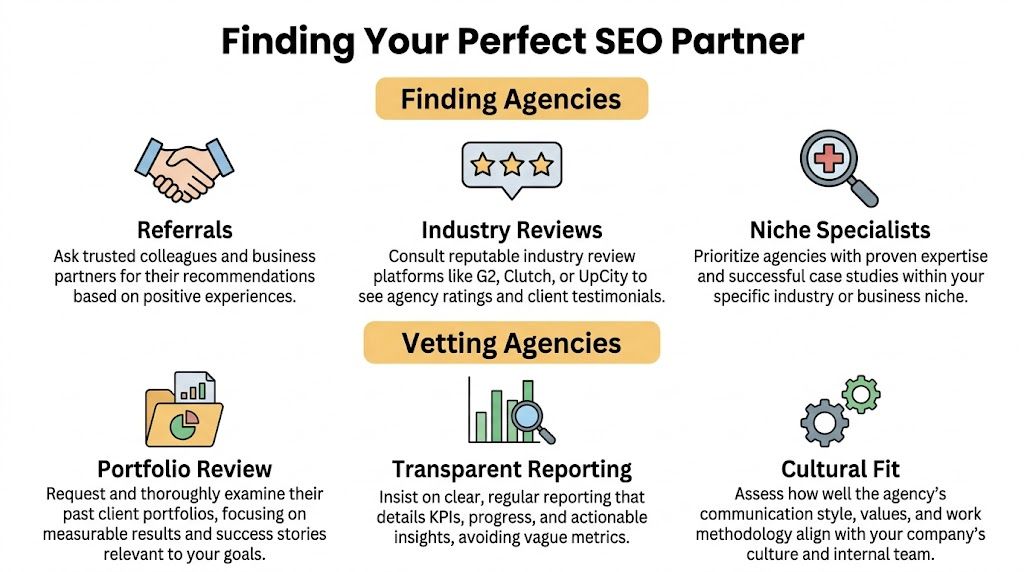
Start by building a shortlist, not picking a winner. For small and mid-sized businesses in markets like Omaha, Lincoln, or Des Moines, local context matters more than many national agencies admit. An agency that knows how service-area pages, local pack visibility, and regional buying behavior work will usually prioritize better than one applying the same playbook it uses for Chicago or Dallas.
Referrals are still useful, especially from business owners with a similar sales cycle. Reviews can help too, but they belong in the first pass only. A smart shortlist usually comes from three places: trusted referrals, agencies that publish work with clear thinking, and firms with relevant examples in your market segment. If you want a broader framework for evaluating vendors, this guide on how to choose a digital marketing agency is a practical place to start.
Another helpful outside reference is this piece on strategies for finding the right agency. The context is broader than SEO, but the screening logic holds up. Process quality, communication habits, and proof of execution tell you more than polished branding.
Once you have a shortlist, review each agency against a few concrete filters:
- Relevant market experience. They should understand how your customers search, compare options, and convert.
- Local and regional judgment. For Omaha-area companies, they should know the difference between ranking in a city core, a suburb, and a multi-location service area.
- Technical fluency. They should be able to explain crawl issues, indexing problems, internal linking, and page intent in plain English.
- Content judgment. They should know when a page needs a rewrite, when it needs consolidation, and when it should be removed.
- Reporting discipline. They should measure leads, revenue signals, and non-branded growth, not just rankings.
One screen matters more now than it did two years ago. Ask how the agency uses AI.
The right answer is not "we use AI for everything." It is usually a controlled workflow. Good agencies use AI to speed up research, pattern analysis, schema drafting, content briefs, and first-pass outlines. They still use experienced people to validate facts, shape local intent, refine messaging, and protect brand quality. For a smaller business in a secondary market, that balance matters. Purely manual work can be slow and expensive. AI-only work often produces generic pages that sound fine and perform poorly.
A credible agency should be able to show you exactly where AI fits into its process, what gets human review, and how it prevents recycled content or factual mistakes. If they cannot explain that clearly, expect the same lack of clarity in strategy and reporting.
Case studies help, but only when you read them skeptically. Look for the starting point, the constraints, the work completed, and the business result. A solid example might show that a local contractor had weak service pages, duplicate location intent, and poor internal linking, then explain how those issues were fixed over several months. If the case study only highlights impressions or a rankings chart with no context, it is not enough to base a decision on.
There are also a few red flags that should shorten the list fast:
- Guaranteed rankings
- Generic packages with no discussion of your site condition
- Vague language about "optimizing your presence"
- No clear explanation of first-phase priorities
- Reports centered on vanity metrics
- Heavy AI claims with no editorial controls
One more practical check. Ask who will do the work. Sales-led agencies often put senior people on the pitch, then hand execution to a junior team you never met. That setup is not always bad, but you should know who owns technical recommendations, who writes or edits content, and who is accountable when progress stalls.
If you want a lower-risk way to evaluate fit, use a paid audit or tightly scoped pilot. That gives you a direct look at how the agency audits, prioritizes, communicates, and handles trade-offs before you sign a larger retainer. In my experience, that tells a local business owner more than any sales deck will.
Key Interview Questions to Ask Before You Hire
A business owner in Omaha gets on three agency calls in the same week. All three promise better rankings, better content, and better leads. The difference shows up when you ask how they make decisions under budget pressure, how they report local results, and where they use AI without lowering quality.

The interview stage is less about broad capability and more about judgment. A good agency should be able to explain why it would fix one issue before another, what it expects from your team, and how it adjusts when a local market does not behave like Chicago, Dallas, or a national e-commerce account.
Questions that show how they prioritize
Start with questions that force the agency to explain its process in plain English.
Ask:
- Walk me through your first 90 days for a business like mine.
- How do you decide what to fix first on a site with limited budget?
- What would you need from us internally to make this work?
- How do you balance technical SEO, content, and local SEO for our model?
Listen for trade-offs. A seasoned strategist should talk about crawl issues, weak service pages, conversion bottlenecks, internal resource limits, and what is likely to affect qualified leads first. If every answer sounds like the same checklist, the work will probably be generic too.
A small or mid-sized business in Omaha usually cannot afford six months of activity that looks busy but does not change revenue. That is why prioritization matters.
Questions that show whether reporting will help you make decisions
Reporting should help you decide what to do next. It should not just prove that someone was active.
Ask:
- What does your monthly reporting include beyond rankings?
- How do you separate branded and non-branded performance?
- How do you handle months when results are mixed or flat?
- Who explains the report, and can we ask direct questions to the strategist?
The best answers include business context. For a local company, that often means leads by service line, organic traffic by location page, Google Business Profile actions, and changes in visibility for terms that drive calls or form fills. If an agency only shows top-line traffic and a handful of ranking wins, it will be hard to tell whether SEO is helping sales.
For a broader agency selection framework, this guide on how to choose a digital marketing agency is useful if SEO needs to work alongside web development, analytics, or paid media.
After you’ve covered the fundamentals, it helps to hear another perspective on evaluating SEO partners. This video gives a useful outside view.
Questions that test local market judgment
This matters more in secondary markets. Omaha search behavior is usually tighter, competition can be uneven by category, and local pack visibility often carries as much weight as traditional organic rankings.
Ask these directly:
- How do you approach Google Business Profile optimization for Omaha businesses?
- How do you decide whether to build city pages, service-area pages, or broader regional pages?
- How do you avoid duplicate local content across nearby markets?
- What local signals would you improve first for a service business in this region?
A strong answer should reflect the economics of your market. For example, a local roofing company may need tighter service-area targeting and stronger review velocity, while a B2B manufacturer may get more value from industry pages, technical content, and better-qualified non-branded traffic. Agencies that mainly work in major metros sometimes miss that distinction and apply an oversized strategy to a smaller market.
Questions about AI that are worth asking now
Any agency you hire should be able to explain how it uses AI in research and production, and where it draws a hard line. The point is not to hear that they use AI. The point is to learn whether they use it responsibly.
Ask:
- Can you show us an AI-assisted audit sample?
- How do you use AI in keyword clustering, content briefs, or SERP analysis?
- Where do you avoid automation because quality drops?
- How do you adjust strategy for AI Overviews or zero-click search behavior?
Search Engine Land’s guide to hiring an SEO agency notes that buyers should ask direct questions about AI use, workflow, and quality control. That is the right takeaway. The useful distinction is simple. AI can speed up research, pattern detection, brief creation, and first-pass analysis. It should not replace editorial review, local market knowledge, technical judgment, or fact checking.
If the answer is vague, keep pushing. Ask who reviews AI-assisted content before it goes live. Ask how they prevent hallucinated claims, copied structure, or thin local pages that all sound the same. Ask whether a strategist is checking SERP intent manually before recommending a page type. Those details tell you more than any polished pitch.
If you want one example of a hybrid model, Up North Media combines SEO with AI consulting and web development, which can matter when the job goes beyond rankings and into conversion paths, automation, or site performance. That blend is not required, but for some businesses it is more practical than hiring a pure-play SEO vendor.
Understanding SEO Proposals Contracts and Pricing
A proposal should answer one question clearly. What exactly are we buying, how will it be delivered, and what happens if the fit isn’t right?
If the document feels vague, padded, or overloaded with jargon, assume the work may be too.
What a solid proposal should include
The strongest proposals are specific about deliverables, ownership, and cadence. They don’t hide behind broad promises like “ongoing optimization” without telling you what gets optimized.
Look for these elements:
- Defined scope of work. Technical SEO, local SEO, content strategy, on-page updates, reporting, and implementation support should be named directly.
- Clear deliverables. Audits, content briefs, page updates, reporting meetings, and roadmap items should be visible.
- Access and ownership terms. You should know who owns content, data, dashboards, and platform accounts.
- Exit language. The contract should explain notice periods, offboarding, and what happens to unfinished work.
What to insist on: If it isn’t written in the scope, don’t assume it’s included.
Comparing common pricing models
Different models fit different situations. A local company trying to fix a visibility problem fast may need one structure. A business with an internal marketing manager may need another.
| Pricing Model | Best For | Pros | Cons |
|---|---|---|---|
| Monthly retainer | Ongoing SEO programs, local businesses, e-commerce, multi-location growth | Predictable workflow, continuous optimization, easier prioritization over time | Can feel vague if deliverables aren’t defined tightly |
| Project-based | Site migrations, audits, technical cleanups, local SEO setup | Clear scope, easier to budget, useful for one-off needs | Often stops before momentum builds |
| Hourly consulting | Internal teams that need senior guidance | Flexible, strategic, useful when your team can execute | Progress can stall if no one owns implementation |
Why local expertise should appear in the contract
For businesses in Omaha and similar markets, a generic national proposal can miss the work that drives leads. Local intent, map visibility, service-area structure, and Google Business Profile often deserve explicit line items.
That isn’t just preference. According to Sarah Moon’s local SEO hiring guide, SMBs in mid-tier cities like Omaha can see 40% higher ROI from agencies with proven local expertise, and 60% of searches in such markets are map-based. If your proposal barely mentions local signals, that’s a gap.
A useful contract for a local business should define how the agency will handle:
- Google Business Profile optimization
- Local landing page strategy
- Review and reputation support
- Service-area targeting
- Map pack visibility tracking
Pricing matters less than alignment
A cheaper proposal isn’t better if it excludes the work that fixes the problem. A more expensive one isn’t better if it bundles activity you don’t need. What matters is fit between goals, scope, and accountability.
Read the proposal like an operator. Ask what gets done monthly, who does it, how success is measured, and what happens if priorities change. If those answers are murky before signing, they’ll be worse after onboarding.
Onboarding and Measuring Long-Term Success
Signing the agreement doesn’t solve the problem. It starts the working relationship. The businesses that get the most from SEO usually treat onboarding as part of strategy, not paperwork.
A healthy start looks organized. The agency gathers access to GA4, Google Search Console, Google Business Profile, your CMS, and any call tracking or CRM systems you use. Then they run an audit, confirm business priorities, and turn that into a roadmap your team can understand.
What your side needs to do
SEO works better when the business participates. You don’t need to become the strategist, but you do need to supply the context an outside partner can’t invent.
That usually means:
- Sharing sales priorities and margin realities
- Explaining which services or products deserve focus
- Flagging seasonality, promotions, and operational constraints
- Reviewing drafts and recommendations on time
When owners stay silent for weeks, approvals stall and momentum drops. Search is not a set-it-and-forget-it channel.
How to measure whether the partnership is healthy
Don’t judge success by rankings alone. A page can rank and still fail. A better lens is contribution to the business.
Track the things that matter most to your model: qualified organic leads, local visibility for buying-intent searches, revenue from organic sessions, and landing pages that drive conversions. Then review those numbers consistently with your agency.
For teams that want a cleaner way to evaluate impact, this guide on how to calculate marketing ROI is a practical place to align marketing performance with business outcomes.
SEO is a long-term operating system. The right agency keeps adapting the plan as your market, site, and search results change.
If monthly calls lead to better decisions, clearer priorities, and stronger lead quality, the relationship is working. If reporting keeps expanding while clarity keeps shrinking, it isn’t.
If you’re evaluating whether to hire an SEO company and want a practical conversation about local search, technical SEO, or AI-supported growth, Up North Media is an Omaha-based option that works with SMBs, e-commerce brands, publishers, and tech companies. A good fit starts with clarity, so the best next step is a direct conversation about your goals, your current bottlenecks, and what kind of search strategy makes sense for your business.