
82.5% of students at a selective U.S. college had used generative AI for academic purposes within two years of ChatGPT's release, according to a 2024 study published by IZA. That's an adoption measure, not a quality score. The same distinction matters when you choose an AI blog post generator: producing text is easy to demonstrate; producing something your business can stand behind takes an editorial process.
For an Omaha service company, online retailer, or digital publisher, the useful question isn't whether AI can fill a content calendar. It's whether your team can turn its drafts into accurate, distinctive posts without spending more on corrections than you save on drafting.
What an AI Blog Post Generator Delivers
An AI blog post generator takes a keyword, topic, or brief and returns a structured draft with headings, body text, and, in more complete platforms, a meta title, meta description, and suggested internal links.
Those outputs aren't equally ready for use. An outline might need only a quick adjustment, while a paragraph about product performance could require approval from the person responsible for that product.
What the generator produces and what a person must add
| Output | What the Generator Typically Produces | What a Person Must Add |
|---|---|---|
| Working draft | Headings and body text from a keyword or brief | Facts checked against sources and original examples |
| Meta title and description | Suggested titles and descriptions within requested length limits | Wording that matches the page's real offer |
| Outline | Section order and subheadings | Check against search intent and reader questions |
| Internal links | Suggested anchor text and target pages | Confirmation that target pages exist and fit |
| Images | Generated illustrations or placeholders | Licensing checks, accuracy review, and descriptive alt text |
| Publishing | Formatting for a CMS in HTML or Markdown | Disclosure, expert approval, and scheduling |
The generator handles structure and first-pass wording; accuracy, original evidence, and approval stay with people.
That division matters more than the difference between a conversational writing assistant and a dedicated blogging platform. A standalone assistant gives you flexibility but leaves you coordinating documents, metadata, and publishing. A connected platform reduces those handoffs, but a direct publishing connection also makes it easier to release an unchecked draft.
In McKinsey's 2024 Global Survey on AI, 65% of organizations regularly used generative AI in at least one business function. For content teams, the practical implication is to design ownership around AI assistance rather than treating it as an occasional experiment.
Check your publishing capacity first
Before comparing tools, answer these questions:
- Planned volume: How many posts do you intend to publish each month?
- Expert availability: Is a subject expert available for every topic you're considering?
- Final authority: Who can approve publication, and who can stop it?
If nobody owns approval, a faster generator won't solve your publishing problem. It'll give your team a larger review queue.
How the Generator Turns a Keyword into a Draft
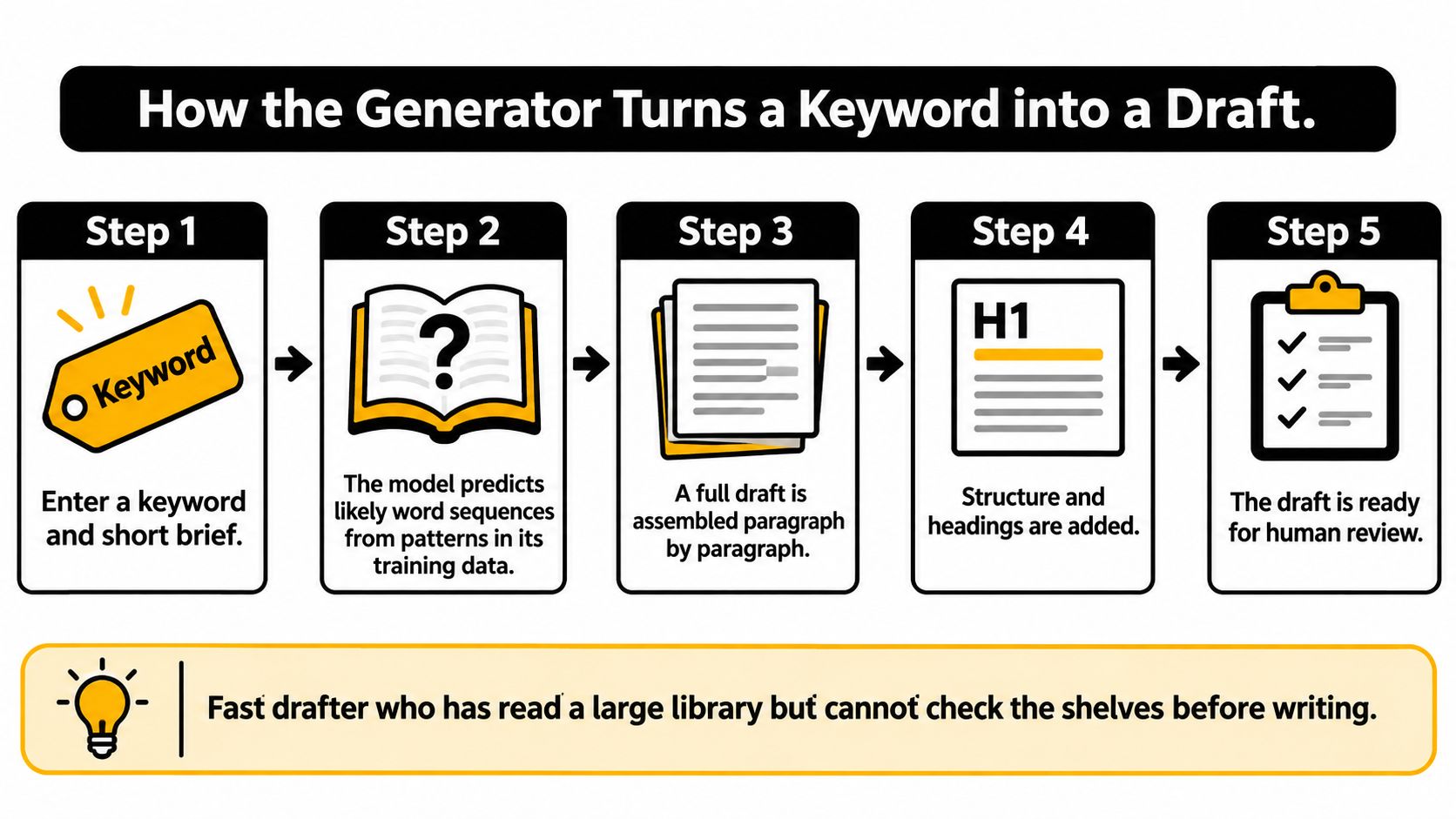
Think of the generator as a fast drafter who has read a very large library but can't check the shelves before writing. The underlying language model predicts likely word sequences from learned patterns. Unless the application supplies documents or retrieves information, fluent wording doesn't mean it has looked anything up.
The workflow below shows the broad movement from input to human review. Individual tools may arrange headings before drafting or assemble them afterward.
Build the input around an actual customer
Say an Omaha plumbing company wants a post about winterizing outdoor taps. A bare keyword leaves the tool guessing about the property, service area, and reader's immediate problem.
A useful brief names homeowners as the audience, supplies approved local weather references, identifies the company's actual service area, and lists customer questions about leaking taps or inaccessible shutoffs. Don't ask the generator to invent local freeze dates.
- Brief input: Enter the keyword, target reader, search intent, length, and tone. For the plumbing example, distinguish a homeowner maintenance guide from an emergency service page.
- Outline: Ask for proposed sections and the order of the argument. Review whether readers get the preparation and safety information they need before attempting the task.
- Section drafting: Generate prose using the approved outline and source documents. Keep manufacturer-specific instructions attached to the equipment they describe rather than turning them into universal advice.
- Metadata: Create a title, meta description, and tags from the finished draft. A maintenance article shouldn't promise emergency repairs unless that's the page's purpose.
- Link suggestions: Supply existing site pages so the tool can propose relevant connections. The winterization article might support an outdoor faucet repair page, but only if that page exists and accurately describes the service.
Why default drafts sound alike
When a prompt contains little business-specific material, the model has little reason to choose distinctive language or examples. It falls back on familiar explanations, broad benefits, and predictable introductions.
Fix the input before repeatedly requesting a more human tone. Supply an approved technician explanation, a customer question, or a real product constraint.
A better prompt doesn't replace expertise. It gives the generator something specific to work with.
The output is still a skeleton and first pass. Every factual claim needs checking before publication.
Benefits and Limits of Machine-Written Posts
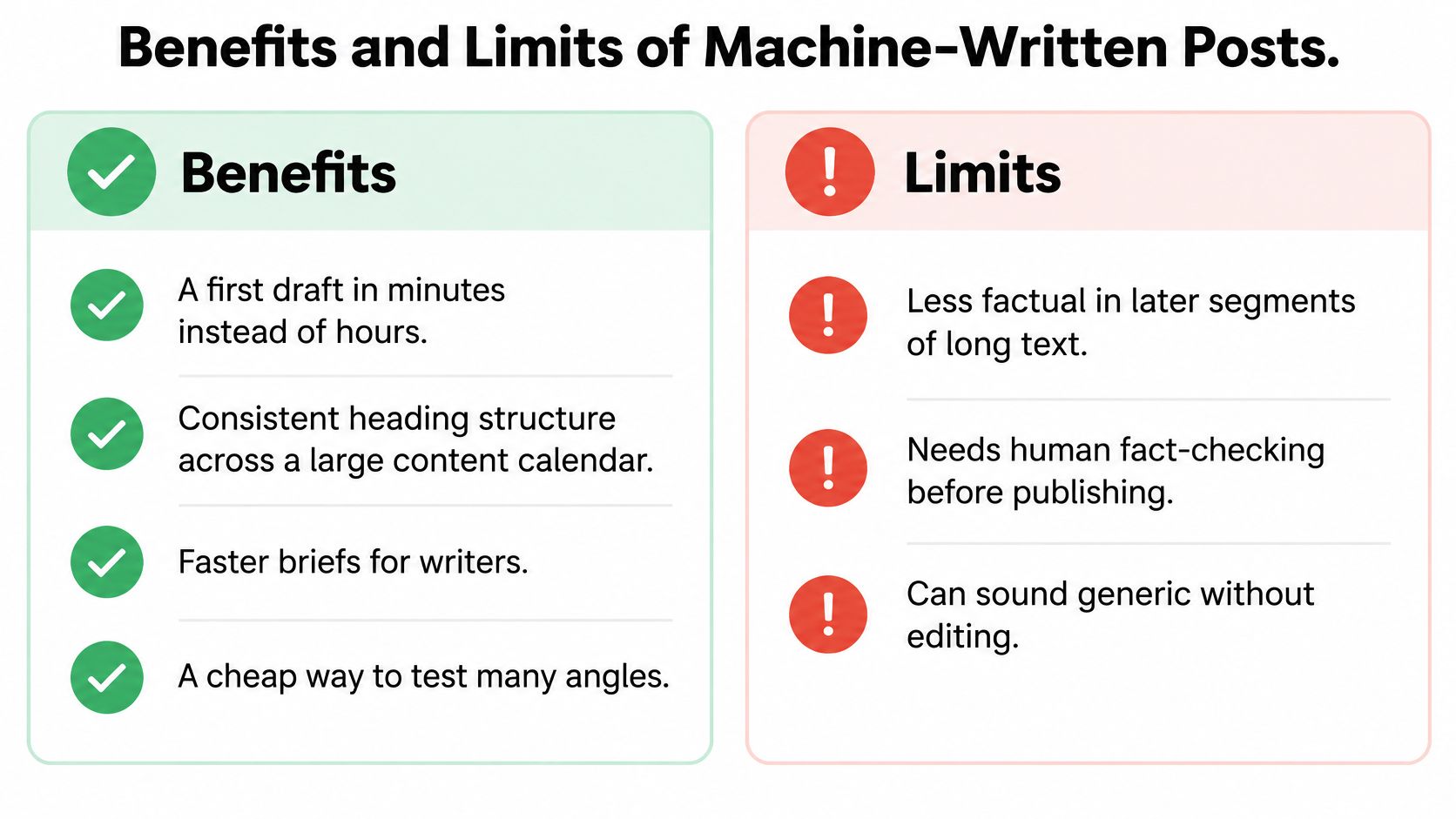
The strongest benefits come from reducing repetitive editorial work:
- Faster starts: Generate a working draft instead of composing every paragraph from a blank page.
- Consistent structure: Apply a shared heading pattern across a content calendar.
- Quicker briefs: Turn a topic and source packet into instructions a writer can refine.
- Lower-cost exploration: Test competing angles before commissioning a full article.
The distinction between useful assistance and unreliable automation is easier to see side by side.
A generated draft is a plausible article, not a checked record of facts. Google's guidance on generative AI content recommends reviewing accuracy, quality, and relevance before publication, and emphasizes useful, original content that demonstrates expertise, experience, authoritativeness, and trustworthiness.
Automation alone isn't a quality signal. A polished paragraph that misstates a service limitation is worse than a plain explanation that helps the customer make the right decision.
Match each failure to a control
Common generator risks and their controls
| Risk | Why It Happens | Control |
|---|---|---|
| Invented statistics | The model predicts plausible numbers rather than retrieving verified figures | Require a source link for every figure |
| Outdated dates or names | Training information can become stale | Run date, name, and quotation checks against current sources |
| Drift in later sections | Longer drafts can move beyond their source material | Score each section separately before approval |
| Generic phrasing | The model favors common language patterns | Add first-hand examples and named expertise |
| Off-brand claims | The tool doesn't know approved positioning | Give the brief an approved claims list |
Supplying documents helps, but it doesn't make the draft self-verifying. A retrieval-enabled system can select the wrong passage, misunderstand a qualification, or stretch a narrow finding into a general recommendation.
Keep evidence attached to the claim it supports. A bibliography at the end won't help an editor identify which source supposedly supports a warranty statement.
For the product-selection side of this workflow, our Outrank overview provides additional context. Evaluate the handoffs it removes, not just how much text it creates.
This video offers another perspective on AI-assisted content creation.
Use the generator for structure, first-pass prose, and variations. Never let it be the only authority for a number, name, date, or recommendation.
Drafting Posts From Keywords in Outrank
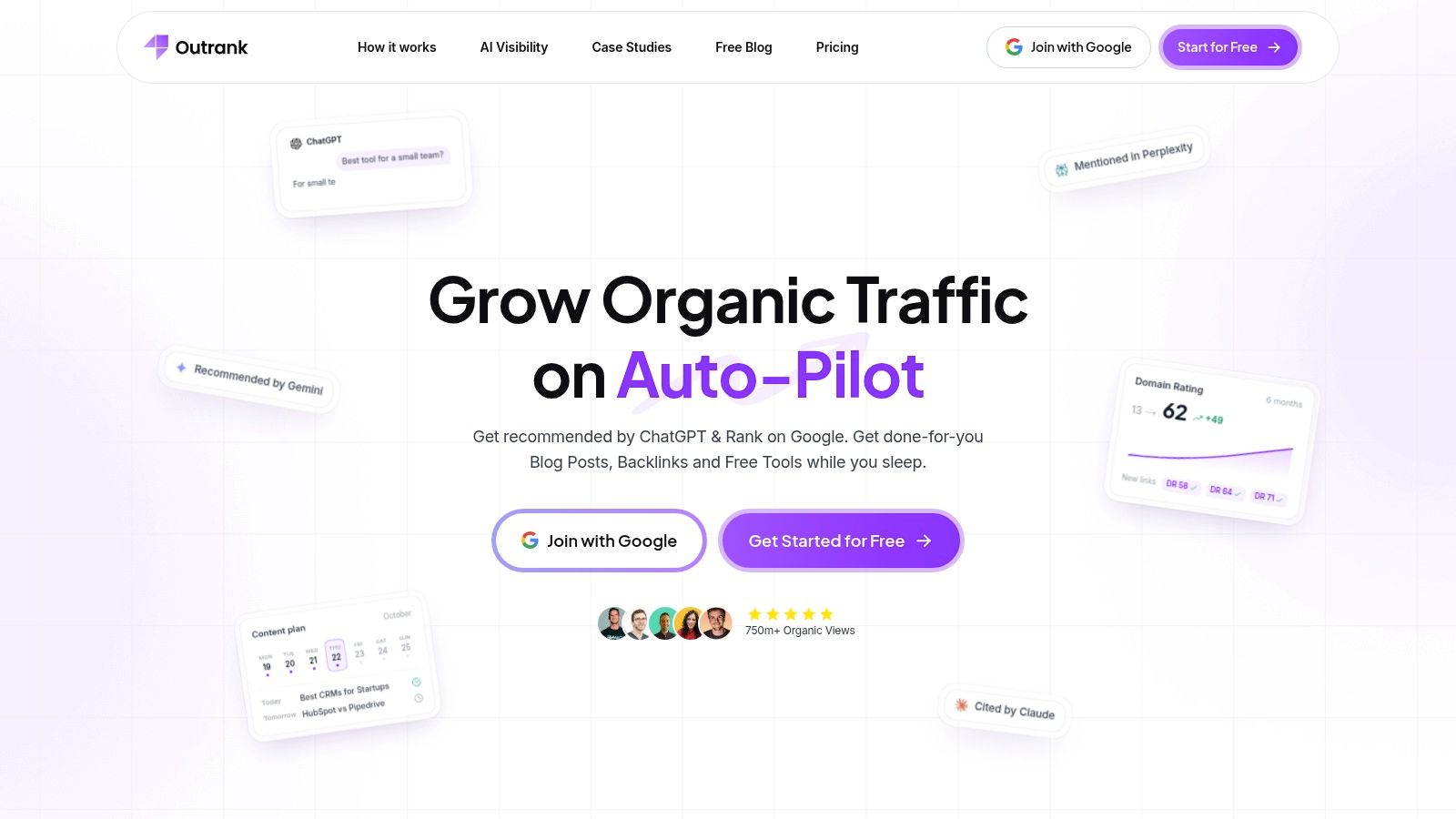
Outrank combines keyword research, AI article generation, brand customization, image creation, and publishing connections. Its practical appeal is reducing the movement between separate research, writing, and website tools.
For a low-commitment workflow test, Outrank's free AI blog post generator lets you start with a topic and inspect the resulting draft before changing your publishing process.
The platform's presentation gives you a starting point for assessing that fit.
Use the integrations without surrendering approval
Outrank supports publishing connections with WordPress, Webflow, and Notion, alongside custom images, rewriting, collaboration, and API integrations. Those features are most useful when formatting and coordination consume time your team could spend improving the content.
Use this operating sequence:
- Select a customer question. Start with a business-relevant need, not a keyword you can't connect to an offer.
- Check existing coverage. Update a suitable page instead of creating a competing article.
- Supply brand context. Include positioning, preferred terminology, and prohibited claims.
- Attach approved evidence. Give the draft a factual foundation.
- Approve the outline. Remove irrelevant sections before generating more prose.
- Generate the article and visuals. Treat images as editorial assets requiring inspection.
- Assign review. Keep source checks and expert approval outside the assumption that generation equals completion.
- Release through the publishing connection. Use the integration after approval, not as a shortcut around it.
Outrank is a reasonable fit for teams that already know their audience and need a connected production workflow. It's less compelling when the bottleneck is missing expertise, unclear positioning, or unavailable source material.
Rewriting can improve expression. It can't supply evidence your business hasn't gathered.
How to Review an AI Draft Before It Publishes
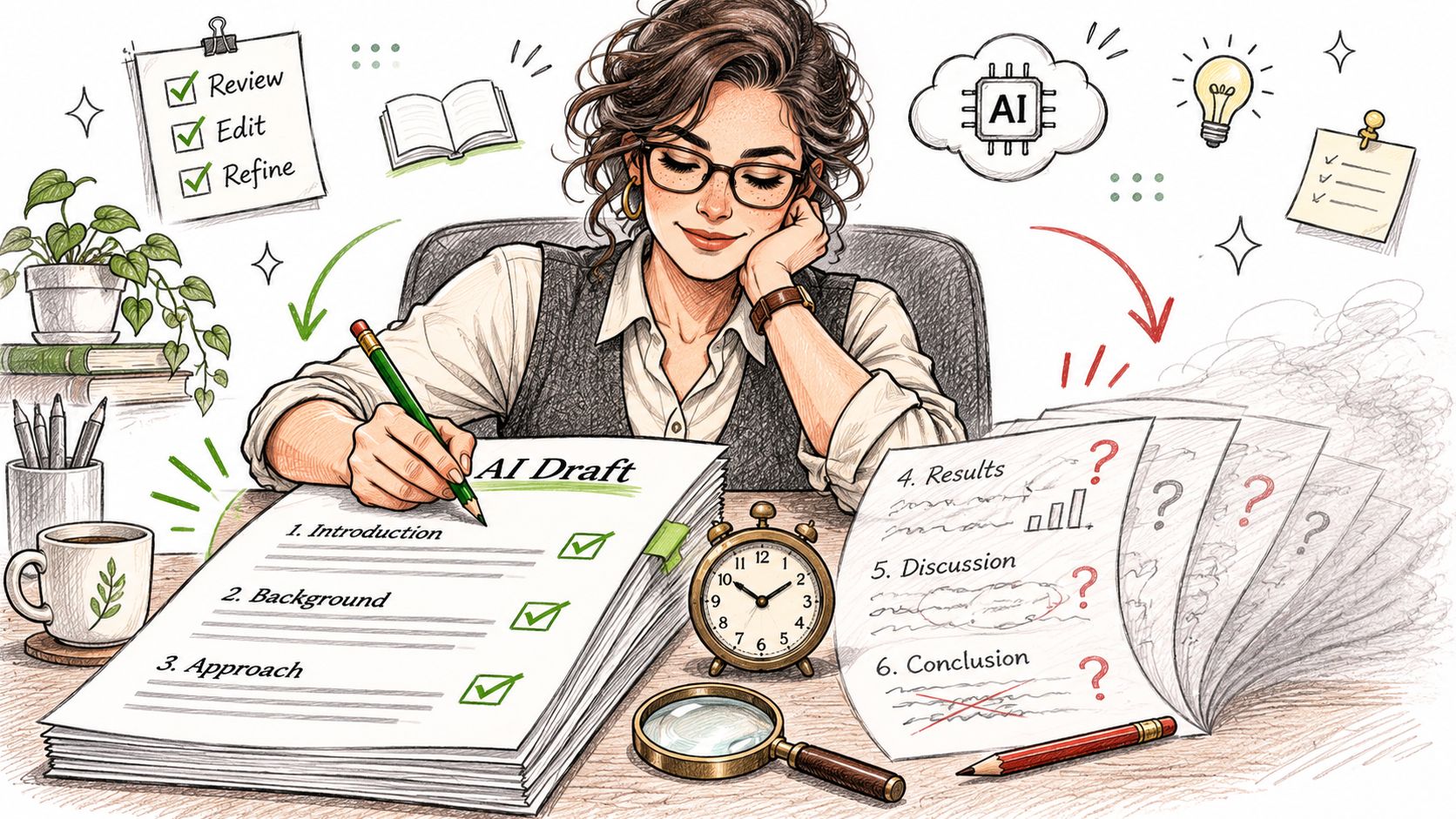
Review the whole draft, not just its strongest opening paragraphs. The LongFact paper and long-form factuality evaluation describe claim-level verification using searches and retrieved evidence, a useful foundation for checking individual statements rather than judging an article by its overall fluency.
Keep the working document visibly separate from the approved version.
Run a claim-level editorial pass
- Separate the sections. Give each section its own review status. Don't let an accurate introduction stand in for checking the conclusion.
- Extract atomic claims. Put each independently testable statement on its own line. A sentence about a product's material, compatibility, and warranty contains separate claims.
- Classify the evidence. Mark each claim as supported, unsupported, contradictory, or unverifiable against an approved source. A citation counts only when its contents support the wording.
- Calculate factual precision by segment. Divide supported claims by all substantive claims in the opening, middle, and closing portions separately. Record the counts so an editor can reproduce the result.
- Escalate consequential statements. Verify specifications, legal requirements, and performance claims against primary documents, not another AI answer.
- Resolve every failure. Rewrite or delete unsupported statements. If a point is necessary, obtain suitable evidence before restoring it.
- Request expert sign-off. Route regulated, safety-related, or commercially sensitive advice to someone qualified to approve it.
- Log corrections after release. Record the claim, cause, replacement wording, and prevention rule for future briefs.
Use a spreadsheet with columns for section, claim, source passage, status, reviewer, and resolution. This is easier to audit than comments scattered across email and chat.
Separate factual approval from copy editing
An article can pass grammar review while failing factual review. Finish claim resolution before polishing transitions, trimming repetition, or strengthening the call to action.
Approval standard: A passing average must never excuse an unresolved safety claim or an inaccurate product promise.
Automated tools can help extract claims, search documents, and flag mismatches. Editors still need to judge whether the source applies to this customer, product, location, and recommendation.
Once factual approval is complete, apply the practical checks in our SEO content writing tips. Preserve the approved meaning when editing for readability or search intent.
Review Levels and Disclosure by Content Type
Review level and approver by content type
| Content Type | Review Level | Approver |
|---|---|---|
| General how-to guide | Editor fact check of all claims | Content editor |
| Statistics or research claims | Source check of every figure, logged | Editor with source log |
| Health, finance, or legal content | Specialist sign-off on the full draft | Qualified subject expert |
| Product specifications or pricing | Check against current product data | Product owner |
| Local service pages | Verify service areas, licensing, and contact details | Local account lead |
| Opinion or case study | Confirmation of quotes and results | Named author or customer |
Assign reviewers according to what could go wrong, not how easy the article was to generate. A short service-area page can create a serious customer problem if it advertises work the business doesn't perform.
For a local Omaha page, the account lead should verify the actual service boundary, contact route, and any licensing statements. For a case study, the named customer must confirm the result and permission to publish it.
Make human responsibility visible
In 2026, 39% of U.S. consumers said heavy AI use would reduce their trust in a brand, up from 20% in 2025, according to the study summarized by Search Engine Land. That makes disclosure a responsibility question, not merely a label-design question.
A notice that says AI assisted with drafting doesn't tell readers whether anyone checked the advice. Pair appropriate disclosure with concrete accountability:
- Name the approving role. Document who can authorize regulated or commercially sensitive claims.
- Define expert-review triggers. Require specialist involvement when a draft gives advice outside an editor's competence.
- Record AI involvement internally. Note whether the tool created an outline, rewrote approved material, generated images, or drafted the article.
- Explain material assistance plainly. Where disclosure is appropriate, describe the assistance and actual human review without overstating either.
- Provide a correction route. Give readers a visible way to report inaccuracies and assign someone to handle them.
Don't invent an author's experience to make generated prose sound credible. If a technician reviewed a maintenance guide, identify that contribution accurately rather than implying the technician wrote every sentence.
When a material error reaches publication, remove the wrong statistic or recommendation, check related passages, and add a dated correction note. A quiet edit may fix the page while leaving readers who relied on the earlier version unaware.
Writing for Search Engines and AI Answers
More posts aren't automatically a visibility strategy. In Adobe's 2026 global survey of 3,000 executives and practitioners, only 54% of organizations were preparing content for AI-powered discovery. A useful response is to improve how clearly your pages answer customer questions, not just increase article output.
Start with a buyer's decision. Someone comparing outdoor faucet repair with replacement needs service-relevant guidance, not a long introduction about the importance of plumbing.
Make the page useful to readers and interpretable to machines
- Answer directly: State the answer near the opening, then explain qualifications. Don't make readers scroll through general background to find it.
- Add first-party evidence: Use approved project examples, original customer questions, product observations, or documented operational details your business can substantiate.
- Use question-led headings: Match the language customers use. Add a short FAQ only when it addresses genuine follow-up questions rather than repeating the body.
- Connect the commercial next step: Link to the relevant service or product page with descriptive anchor text. Avoid sending every article to the homepage.
- Monitor AI descriptions: Establish a recurring check of how AI assistants describe your business, which sources they cite, and where their answers differ from your current offer.
For an online retailer, a useful original contribution might be a compatibility explanation confirmed by the product team. For a local contractor, it might be a clearly bounded description of when a homeowner should stop troubleshooting and request service.
Neither requires padding the article to match a competitor's length.
Improve the underlying source pages
Save the query, answer, cited pages, and relevant context when checking AI-generated descriptions. Results can vary, so don't treat a single response as a permanent ranking.
If an answer repeats an outdated service description, inspect the cited source and your own related pages. Correct inaccurate source material where you control it; don't assume publishing another blog post will displace the error.
Our guide to using AI for SEO addresses the broader workflow. For individual publishing decisions, favor a substantive improvement to an existing relevant page over a new article that answers the same question.
Set Up Your Review Workflow Before You Scale
Run a small pilot before expanding the calendar. Choose posts with available evidence and willing reviewers, then apply the approval requirements appropriate to each topic.
Before drafting, record current organic performance and how AI assistants describe the business. Keep the queries and observation conditions consistent enough to make later comparisons useful.
Measure the finished work
Track these measures against the pilot's starting position:
- Claim support: The share of substantive claims supported by approved sources before release.
- Published corrections: The errors discovered afterward, including severity and cause.
- Discovery outcomes: Changes in qualified organic traffic and observed AI citations over an agreed evaluation period.
Don't attribute every traffic movement to AI drafting. Record major website changes, seasonal demand, and other campaigns alongside the pilot results.
Give every post a named human owner, preserve its source log, and maintain a public correction page. Review time belongs in the production cost, even when the initial text arrives quickly.
Scale only when the team can maintain its approval standard without letting the review queue grow unchecked.
List your highest-value pages, choose one, and run the claim check before commissioning more content. That exercise will expose whether your next investment should be drafting software, better evidence, or additional expert review.
If you need a baseline before committing to an AI publishing program, request an AEO audit from Up North Media. Our audit covers five AI engines end to end and documents how they currently cite your business. Bring your priority pages and customer questions so we can identify what needs correcting, what deserves stronger evidence, and where AI-assisted drafting fits your publishing workflow.