

Search engines and aggregators were the main gateway to online news for 33% of respondents across 47 markets in 2024, according to Reuters Institute findings summarized by Reese News Lab. That's a substantial dependency on platforms publishers don't control. Getting discovered matters, but discovery alone doesn't tell a newsroom whether its reporting supports a sustainable business.
SEO for news websites is an operational and economic discipline. Editors need accurate headlines and recognizable expertise. Developers need reliable publishing templates. Audience teams need to distinguish visibility from valuable readership. The practical question isn't whether Google can find a story. It's whether the publisher can turn that discovery into a relationship worth maintaining.
Technical Requirements Every News Site Must Meet
Google News technical requirements at a glance
| Requirement | Google guidance | Where to check |
|---|---|---|
| News sitemap window | Include only articles published in the previous two days | Sitemap generator in the CMS |
| Expiry | Remove URLs or news metadata once articles are older than 48 hours | Scheduled sitemap job |
| Entries per sitemap | Up to 1,000 news entries; split larger sets of eligible articles | Sitemap index file |
| Canonical URL | Maintain one crawlable canonical URL per article | Page source and URL Inspection |
| Article markup | Recommended NewsArticle JSON-LD carrying headline, author, image, datePublished and dateModified | Rich Results Test |
| Timestamps | Preserve first publication rather than replacing it with a later edit date | CMS publish field |
The sitemap limits and expiry rules above come from Google's news sitemap guidance, which also makes an important distinction: submitting a sitemap doesn't guarantee crawling or indexing. Treat the table as a publishing checklist, not proof that an article has entered search results.
Article markup needs a separate distinction. It's a recommended way to describe reporting, not a universal requirement for Google News eligibility. A technically valid sitemap can still point to a page with conflicting metadata, inaccessible content or an unintended canonical destination.
Check the live article, not just the CMS
A CMS preview isn't the finished product. Caching, rendering and shared templates can change what reaches readers and crawlers after publication.
Give each check an owner:
- Publishing engineering: Verify that publication and expiry events reach the live sitemap.
- Editorial operations: Confirm that first-publication fields survive subsequent edits.
- Technical SEO: Inspect the canonical destination, rendered content and indexing permissions.
- Template developers: Keep visible article fields and structured metadata synchronized.
These responsibilities should overlap at release time. An editor may correctly fill every field while a template outputs the wrong value. Equally, a developer can build a correct template that receives unreliable dates from the publishing workflow.
Establish a reproducible acceptance test
Choose a small sample of live articles covering breaking news, updated coverage and older reporting. Include different article templates rather than sampling only the homepage's newest stories.
Run the Rich Results Test and URL Inspection, then record each failing row against the affected template or publishing event. Fix failures in table order, while treating an inaccessible or incorrectly canonicalized article as an immediate blocker. Keep the results with the release ticket so the next deployment has an explicit acceptance standard.
How to Run a Google News Sitemap That Stays Fresh
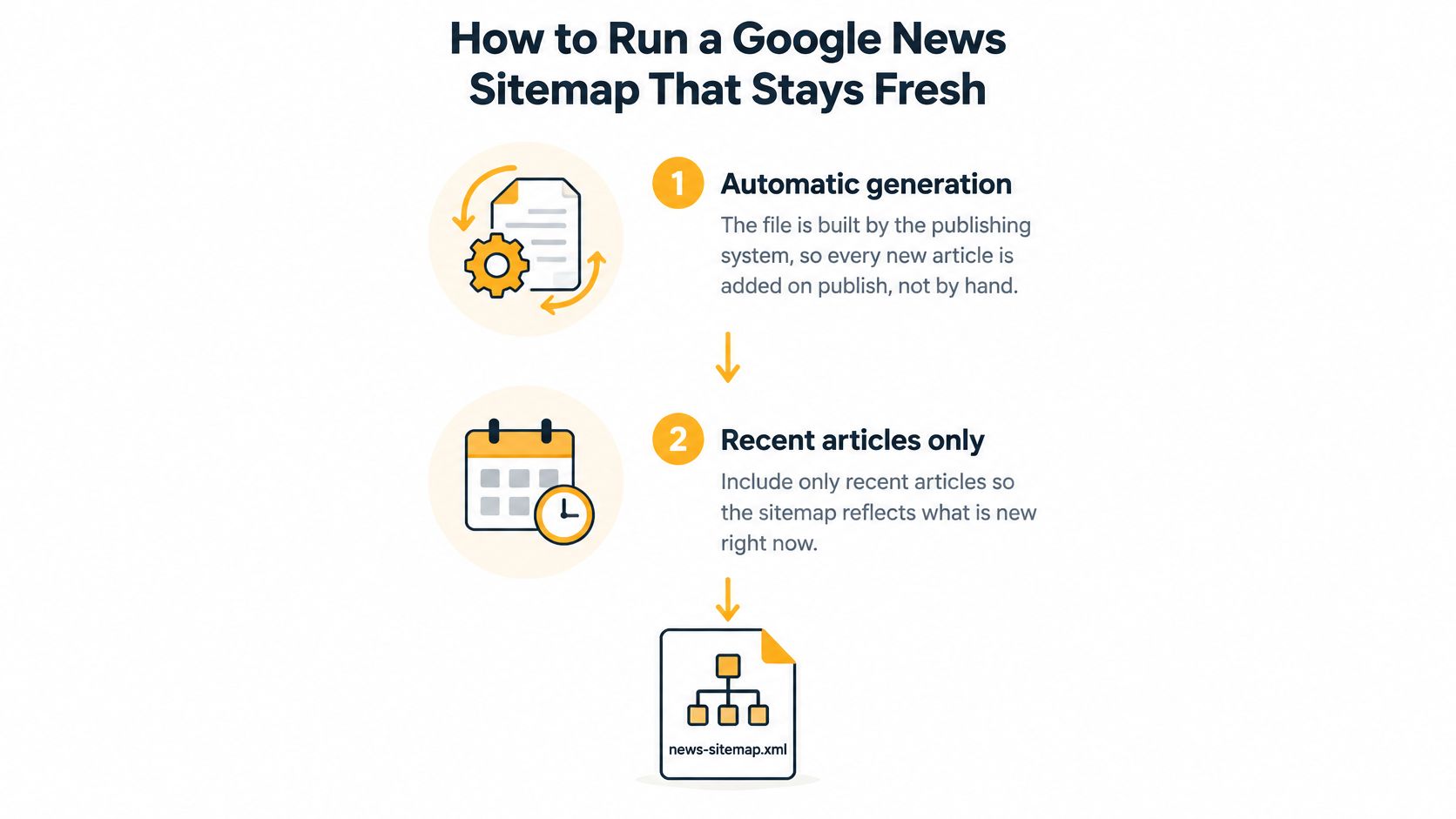
A news sitemap should be an output of publishing, not another editorial task. According to Google's News Sitemap specification, eligible articles come from the previous two days, news entries must expire after 48 hours, and each sitemap can contain up to 1,000 news entries.
Those rules describe a rolling feed of recent reporting, not a historical archive. Google also recommends updating an existing sitemap instead of generating a new file for every publication event.
The diagram summarizes the automation behind that feed.
Build around publishing events
-
Generate entries automatically. Connect sitemap generation to the CMS publish event. Manual submission leaves discovery dependent on someone remembering an administrative step during a busy shift.
-
Filter articles using their original creation or publication record. Don't let an ordinary edit make an older article eligible again.
-
Preserve article identity. Use the intended canonical URL and accurate first-publication timestamp. Check for redirects introduced by slug changes or publishing-system migrations.
-
Update the existing sitemap resource. Creating a new filename for every edit makes the system harder to monitor and troubleshoot.
Each operation needs a failure path. If a publishing event succeeds but sitemap generation fails, the system should retry and notify the responsible team. Otherwise, editors may see a live article while developers assume the discovery feed is current.
Maintain the rolling feed
-
Schedule expiry independently. Remove expired news entries or their news-specific metadata even when nobody publishes another article. A quiet news day shouldn't stop housekeeping.
-
Split eligible entries across files before the documented capacity is exceeded. Base the split on current news output, not the size of the historical archive.
-
Separate tracking where useful. A dedicated news sitemap can make Search Console monitoring easier. Keep the ordinary XML sitemap available for content outside the news window.
-
Validate XML and inspect Search Console reports during a recurring operational review. Check both file accessibility and the URLs inside it, because valid syntax doesn't establish page indexability.
For broader file organization, use our XML sitemap best practices alongside the news-specific routine.
Operational standard: A successful publish event should produce both a readable article and a corresponding discovery entry, without editorial intervention.
Test the workflow with publication, correction, unpublishing and scheduled expiry. A healthy system adds fresh reporting promptly, removes expired news metadata automatically and retains a useful error history. Don't describe stale entries as a proven ranking penalty. The immediate, verifiable problem is that the file no longer follows Google's specification.
Structured Data and Dates That Match the Page
NewsArticle structured data describes the article. It doesn't replace the article. Google's Article structured-data documentation says markup can help it understand headlines, authors, images and dates, but isn't required for Google News or Top Stories eligibility. Google also says there are no universally mandatory Article properties, so provide every applicable recommended property rather than chasing an arbitrary completeness score.
The central requirement is accuracy. A field that passes a syntax test can still describe the wrong headline or publication time.
This illustration shows the template-level work behind article markup.

Resolve conflicting versions of the article
Consider a developing transport story. An editor changes the headline when a road reopens, but the JSON-LD still describes the closure. Readers and search systems now receive different accounts of the article's subject.
A date conflict is less obvious. A typo correction changes dateModified, but the page displays an unlabeled timestamp that looks like a new publication time. The problem isn't that a correction occurred. It's that the page doesn't clearly distinguish first publication from subsequent modification.
Maintain a field map between CMS inputs and outputs:
- Headline: Match the current rendered article headline.
- Author: Identify the credited person or organization consistently.
- Image: Reference an appropriate image associated with the article.
- datePublished: Preserve the original publication value.
- dateModified: Reflect editorial changes accurately, with a compatible visible update label.
Our guide to schema markup for SEO explains the broader implementation approach. For a newsroom, the important engineering decision is to derive these outputs from shared fields rather than maintain separate editable copies.
Run a template-level verification
Start with the Rich Results Test on a representative live article. Then use URL Inspection to check Google's access and rendered view. Finally, compare the news sitemap publication timestamp with datePublished.
Validation should include editorial scenarios, not just untouched articles:
- New publication: Check the initial headline, byline, image and timestamp.
- Developing coverage: Change the headline and verify every output.
- Correction: Confirm that editing doesn't overwrite first publication.
- Template release: Recheck each affected article layout before closing the deployment ticket.
A shared defect can reach every article using that template. Keep the afternoon audit focused on templates and publishing behaviors, then attach screenshots or field comparisons to actionable tickets. A warning without an owner isn't a completed check.
Site Speed, Internal Links and Article Page Rendering
A sitemap tells a search engine where an article is. The article template determines what it can retrieve and what a reader can use. Diagnose those layers separately, rather than treating every indexing problem as a sitemap failure.
Inspect content delivery first
-
Check article HTML. Prefer delivering the main reporting in the initial HTML instead of making it dependent on client-side scripts. Compare page source with the rendered view in URL Inspection, especially when an article looks complete in a browser but appears incomplete to Google.
-
Make new reporting reachable from appropriate section fronts, homepage modules and related coverage. Use links because the stories belong together, not because a fixed link quota supposedly guarantees indexing.
-
Use ordinary anchor links. Related-story modules should expose descriptive links rather than depend entirely on scripted interactions. Test navigation with scripts disabled to reveal avoidable dependencies.
An article can be accessible through its direct URL yet poorly connected to the rest of the publication. That's a navigation problem as well as a discovery problem. Readers following a developing story need a clear path between the latest report and its background.
Evaluate shared templates
-
Measure representative pages. Use Search Console's Core Web Vitals report and PageSpeed Insights to investigate article-template performance. Check mobile layouts directly for obstructive overlays, unstable elements and controls that are difficult to use.
-
Give images descriptive filenames and useful alt text. Serve appropriately sized assets, reserve their display space and avoid making a decorative component compete with the article's lead content.
-
Review duplicate navigation pages. Consolidate near-identical tag pages when they serve the same reader purpose. Retain topic destinations that provide distinct editorial value and a maintained route into coverage.
Fix the shared component before repeatedly repairing individual articles built from it.
Prioritize observable failures. Missing article text is different from a slow advertising component, and neither diagnosis proves why a particular URL hasn't been indexed. Record what you can reproduce, make the change and inspect the result before drawing a wider conclusion.
Earning Visibility in Search and Google Discover
Say a local newsroom publishes a report on a proposed school closure. A parent searches for the proposal directly. Another reader encounters the story in Discover. A previous subscriber searches for the outlet's name because they want its account.
Those are different discovery routes into the same reporting. They shouldn't force editors to produce different versions of the underlying facts.
The Reuters Institute's 2025 technology-trends analysis, using Chartbeat data from hundreds of news sites, reported that Google Discover traffic increased 12% year over year and delivered more combined traffic than organic search. The same analysis reported that Facebook traffic to news and media properties fell 67% over the previous two years, while X traffic declined 50%.
Adapt distribution without distorting the story
The practical response isn't to abandon search for the next referral source. It's to make the reporting understandable wherever readers encounter it.
For the school-closure story, that means:
- Specific headline: Name the school, proposal and decision stage rather than implying a closure has already happened.
- Relevant lead image: Show the school or another meaningful subject, not an unrelated emotional stock photograph.
- Clear attribution: Identify the reporter and distinguish confirmed decisions from proposals.
- Maintained context: Link the report to the relevant education coverage and update it when the facts change.
For editors who need a grounding in basic publishing habits, maxijournal.com's practical SEO advice for new bloggers provides an introductory resource. A newsroom should apply those fundamentals within its own verification and corrections standards.
Invest according to reader behavior
Discover exposure isn't a predictable allocation of traffic that an editor can secure with a headline formula. Treat it as a channel to measure, not a promise to sell internally.
Compare the readers each channel brings. Do they return to the education section? Register for the schools newsletter? Read follow-up reporting? A burst of visits and a developing audience relationship are different outcomes.
Keep search and Discover reporting separate where platform reports allow it. Then evaluate both against the same audience objectives. That prevents a strong referral spike from concealing a decline in the readers who return.
Measuring Success When Clicks Fall
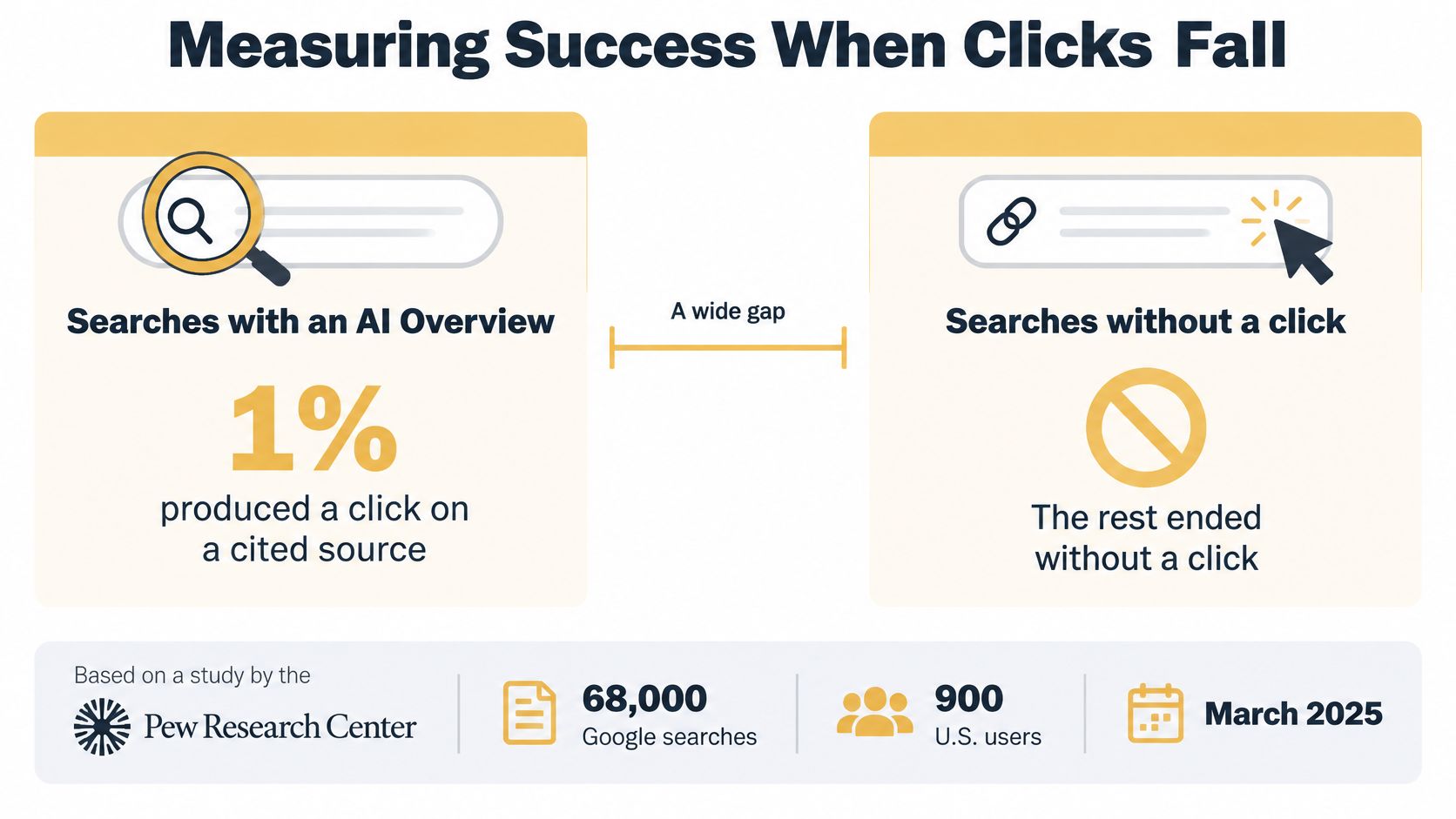
A Pew Research Center study of more than 68,000 Google searches by 900 U.S. users in March 2025 found that only 1% of searches with an AI Overview produced a click on a cited source, as discussed in the Reuters Institute's analysis of life after SEO. The same article cites Chartbeat findings that organic Google traffic to more than 2,500 news sites fell 33% globally and 38% in the United States between November 2024 and November 2025.
The source-click finding needs careful interpretation. It doesn't mean every other search ended without any click. It measures clicks on cited sources, not all possible search interactions.
The visual highlights the cited-source result.
Separate exposure from business results
Rankings and clicks remain useful, but they're incomplete targets. A publisher needs to know whether readers recognize its reporting and whether visits become recurring relationships.
Discovery and conversion metrics for news SEO
| Metric | Stage | What It Tells You | Where to Find It |
|---|---|---|---|
| Search impressions | Discovery | Whether stories appear for target queries | Search Console performance report |
| Branded search lift | Discovery | Whether readers search for the outlet by name | Search Console branded queries |
| Direct traffic | Owned channel | Whether readers arrive without an identified referrer | Web analytics |
| Returning users | Engagement | Whether discovery turns into a habit | Analytics cohort reports |
| Newsletter registrations | Conversion | Whether visits become an owned audience | Email platform |
| Subscription or lead revenue | Conversion | Whether attributed search traffic pays | Billing or CRM system |
Interpret these metrics cautiously. Direct traffic includes visits with missing attribution, not just people typing the outlet's address. Branded-search growth may accompany wider publicity rather than result from SEO alone.
At Up North Media, our SEO reports track organic traffic, keyword rankings, conversion rates and ROI. Those measures provide a baseline, but a publisher should connect them to registrations and revenue rather than stop at an acquisition chart.
Test an editorial decision
Choose a newsletter prompt as a controlled experiment. Assign comparable eligible readers to the existing prompt or a revised version, keeping placement and eligibility consistent.
Record registrations, subsequent visits and subscription outcomes where consent and measurement allow. If individual assignment isn't practical, compare matched article groups over the same period and acknowledge the effects of topic and news demand. Don't change the headline, prompt and page layout together and then credit one component.
Use the accompanying video as an additional discussion resource, while keeping the written metric definitions as the reporting standard.
For a smaller outlet, the strategic implication is concrete: a narrow beat with original reporting can support a recognizable editorial identity. Judge that investment by whether readers seek out the next report, not whether an isolated story wins a broad query.
Deciding Which AI Crawlers Get Access
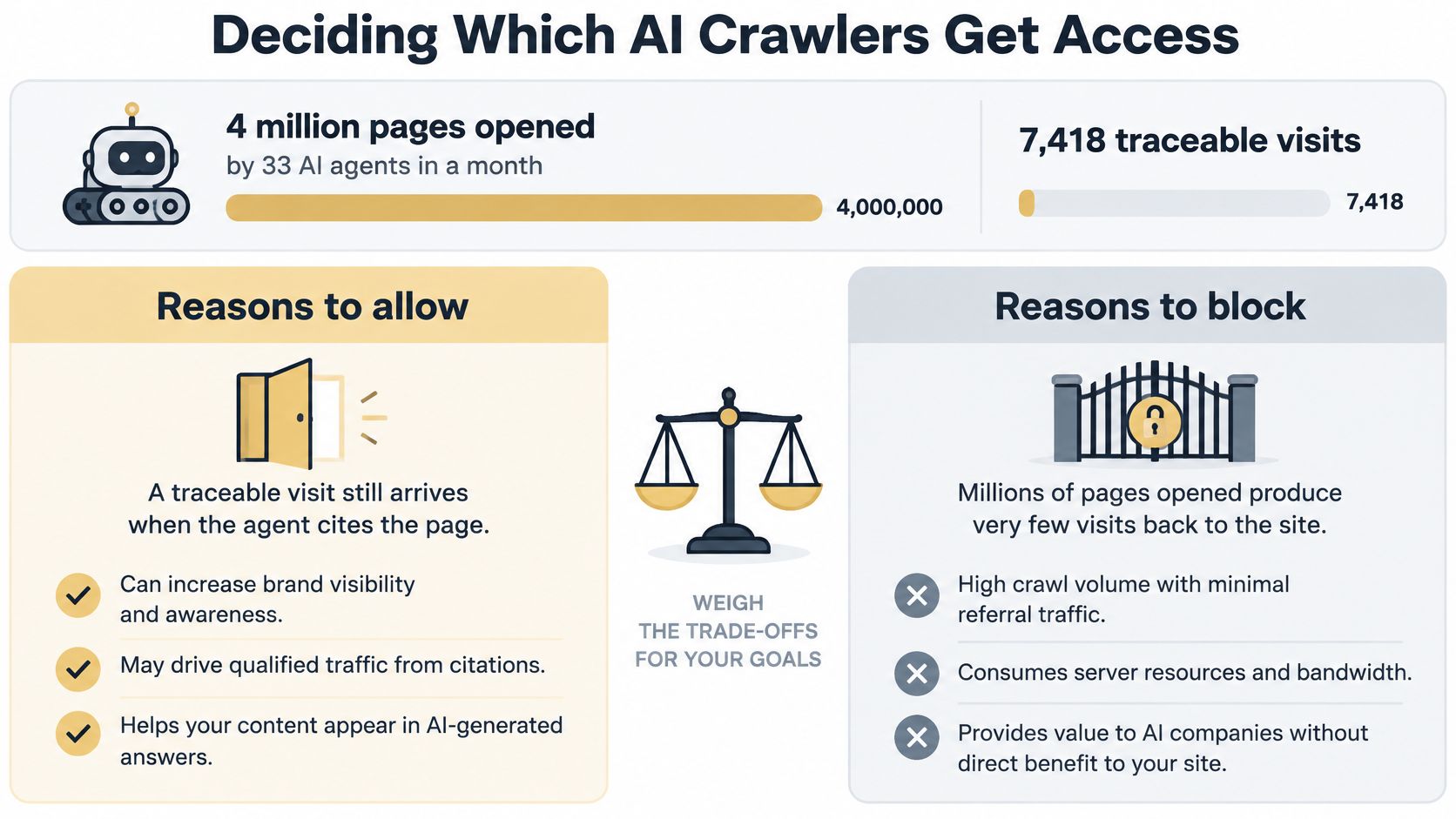
An analysis of one European news publisher in 2026, reported by TechCentral, found that AI systems opened 4 million pages through 33 agents during a month, producing 7,418 traceable visits, roughly a visit for every 540 pages read.
That's a publisher-specific observation, not a universal referral rate. It's still a useful reason to ask whether crawler access produces enough attributable value to justify its costs and commercial consequences.
The comparison below illustrates the access decision, not a guaranteed outcome for another publisher.
Compare the commercial alternatives
| Allow selected access | Restrict selected access |
|---|---|
| Preserve opportunities for citation and referral | Reduce uncompensated retrieval of valuable reporting |
| Support visibility experiments | Protect content subject to licensing or exclusivity decisions |
| Evaluate potential commercial partnerships | Limit avoidable infrastructure demand |
| Require attribution and outcome monitoring | Accept possible discoverability trade-offs |
Crawler access is a policy decision, not an SEO default. A publisher may make different choices for public-service explainers, exclusive investigations and subscriber reporting.
Blocking every agent could limit future discovery opportunities. Unrestricted access could make the publisher pay to serve material that another system uses without generating a meaningful audience relationship. Neither outcome should be assumed without measurement.
Write rules that operations can enforce
Begin with server logs. Group requests by claimed user agent, then verify crawler identity using the operator's documented procedures where available. A user-agent string alone isn't proof of identity.
Build the policy around observable criteria:
- Infrastructure cost: Measure request volume, bandwidth and expensive rendering activity.
- Content rights: Identify material subject to licensing, syndication or contractual restrictions.
- Attribution quality: Check whether citations identify the outlet and lead to the correct article.
- Commercial return: Compare traceable referrals, registrations and revenue with access costs.
- Enforcement: Distinguish voluntary crawler instructions from access controls and contractual terms.
Our explanation of what a robots.txt file does can help the team implement crawler instructions. Don't treat those instructions as a paywall or a substitute for authentication.
Decision rule: Grant access for a documented purpose, then review whether the crawler delivers that purpose.
Before changing production rules, record the market, content exclusivity and monetization logic behind each choice. Name an owner and a review trigger. That turns an emotionally charged allow-or-block debate into a policy the newsroom can defend.
Common News SEO Mistakes and How to Fix Them
When new reporting appears late in search, compare the publication event with the sitemap update log first. A nightly publishing batch is a testable operational explanation. It isn't proof that Google would otherwise have indexed the story immediately.
News SEO symptoms, likely causes and fixes
| Symptom | Likely Cause | Fix |
|---|---|---|
| New stories appear late in search | Sitemap updated in batches or only nightly | Automate sitemap updates on publish |
| Old stories stay in the news sitemap | Missing expiry rule | Remove expired URLs or news metadata automatically |
| Pages crawled but not indexed | Canonical points elsewhere or article text depends on scripts | Confirm canonical URL and indexable HTML with URL Inspection |
| Rich-result warnings | Schema disagrees with visible headline or dates | Synchronize JSON-LD and revalidate |
| Discover traffic drops after a release | Possible defect in a shared template | Test representative templates and compare deployment changes |
| Dates look wrong in results | Edits overwrite first publication | Preserve datePublished and maintain dateModified accurately |
Diagnose without promising a recovery date
Consider an illustrative regional outlet whose sitemap changes only during an overnight job. Moving generation to the publish event removes that particular scheduling delay. It doesn't establish when Google will crawl, index or display each article.
For stale entries, inspect the expiry job's last successful execution. For indexing failures, compare the declared canonical with Google's selected canonical and examine the rendered article. Neither symptom has a single guaranteed cause.
Keep the verification sequence explicit:
- Sitemap repair: Confirm the corrected file immediately, then monitor subsequent processing.
- Canonical or rendering repair: Validate the live output, then allow for recrawling and reassessment.
- Schema repair: Rerun validation, then distinguish a passed test from an appearance in results.
- Post-release traffic decline: Examine template changes alongside topic demand and channel-level variation.
Escalate persistent failures
A Discover decline following a release is a reason to investigate the release, not proof that the release caused it. Compare affected templates with unchanged ones before reverting unrelated components.
Likewise, a corrected timestamp doesn't guarantee that search results will immediately display the preferred date. Separate the change you control from the search presentation you're observing.
Our website optimization service fixes technical issues that prevent search engines from finding and ranking a website properly. Escalate persistent symptoms to a technical crawling and indexing review, with logs, example URLs and deployment history attached.
Build Your News SEO Plan This Quarter
A useful quarterly plan creates evidence of progress, not a checklist of tools someone opened. Assign each action an owner, an acceptance test and a record that the next review can reuse.
Complete the work in dependency order
-
Prove the publishing workflow. Observe sitemap additions and expiry across a representative publishing period. Finish when logs demonstrate successful updates, removal and error handling without manual intervention.
-
Approve every article template. Test representative live pages with the Rich Results Test and URL Inspection. Finish when headline, dates, schema and article access agree, with unresolved defects assigned to owners.
-
Establish the measurement baseline. Record dated values for search impressions, branded queries, direct traffic, returning users and newsletter registrations. Finish when definitions, reporting locations and attribution limitations are documented.
-
Authorize crawler policy. Specify permitted agents, restricted content and attribution checks. Finish when editorial, technical and commercial owners have approved the reasons behind each rule.
-
Run a controlled experiment. Choose a headline approach, newsletter prompt or another isolated change. Finish when the team can compare audience and conversion outcomes against an appropriate control, rather than judging the result from clicks alone.
Keep the strategy open to revision
Don't treat completion as proof that the outlet has solved distribution. The first milestone is a reliable publication workflow. The next is an evidence-based decision about where editorial and development effort produces value.
At the next quarterly review, reuse the same metric definitions and inspect any changes in tracking before interpreting the results. Keep effective experiments, retire unsupported assumptions and record what remains uncertain. That's how news SEO becomes a manageable business process rather than a recurring emergency.
Our SEO process starts with an audit of current performance, competitors and improvement opportunities, then uses reporting to connect traffic with conversions and ROI. Visit Up North Media to discuss a news SEO audit focused on publishing reliability, measurable audience growth and the technical obstacles affecting your reporting.