
For UK publisher news queries measured in April 2025, Google AI Overviews were associated with a 47.5% decline in desktop click-through rate, according to Authoritas findings reported by Press Gazette. That's a reason to question a rankings-only report, not to assume your Omaha service business faces the same decline. You need to know what appeared in search, who visited, and whether those visits became profitable customers.
Effective data driven SEO strategies connect those decisions. Rankings are an input to a visibility-to-revenue scoreboard, not the final result. The practical job is to fund the changes most likely to produce qualified demand, then require evidence before moving budget toward a newer search channel.
Why Position Still Decides Organic Traffic
Position still matters because people don't distribute their attention evenly. An analysis of approximately 4 million Google search results, summarized by Rank.ai, reported an average 27.6% click-through rate for the first organic result, which received roughly 10 times as many clicks as the tenth.
That makes ranking improvements commercially relevant, but it doesn't make every ranking improvement equally valuable. A service page near the top of a busy, purchase-oriented query deserves different treatment from an article already leading a niche informational search. The article might attract readers without ever helping your sales team.
Start with opportunity, not a position target
Data-driven SEO means connecting query demand, position, impressions, CTR, qualified visits, and conversions. Each measure answers a different question, and skipping a stage makes the opportunity estimate less trustworthy.
| Signal | What to investigate | Commercial caution |
|---|---|---|
| Relevant impressions, weak CTR | Result wording and search intent | Search features may reduce clicks |
| Qualified traffic, weak conversion | Offer and landing-page friction | More visits could increase waste |
| Strong conversion, limited visibility | Content coverage and authority | Confirm there's additional demand |
| High rank, little qualified demand | Query relevance | A leading position isn't necessarily valuable |
Use your own query-level CTR history when estimating potential click gains. A broad benchmark is useful context, not a forecast for an individual listing surrounded by ads, maps, shopping results, or AI answers.
Separate demand you created from demand you captured
Split branded and non-branded searches before prioritizing work. Someone searching your business name already knows you; someone searching for an unfamiliar provider represents a different acquisition opportunity. Combining them can make a weak discovery program look healthy.
Then segment by device, country, intent, and landing page. For an Omaha contractor, out-of-area impressions shouldn't carry the same weight as searches from people inside the service territory. An informational query about repairing equipment also shouldn't inherit the expected close rate of an emergency-service query.
Prioritization rule: Favor the opportunity with the strongest plausible incremental profit, not the most impressive rank screenshot.
Build a shortlist of revenue-producing pages sitting outside the top three organic positions. Attach their relevant queries, current visibility, conversion evidence, and likely implementation effort. That becomes a working backlog rather than a list of keywords somebody would like to rank for.
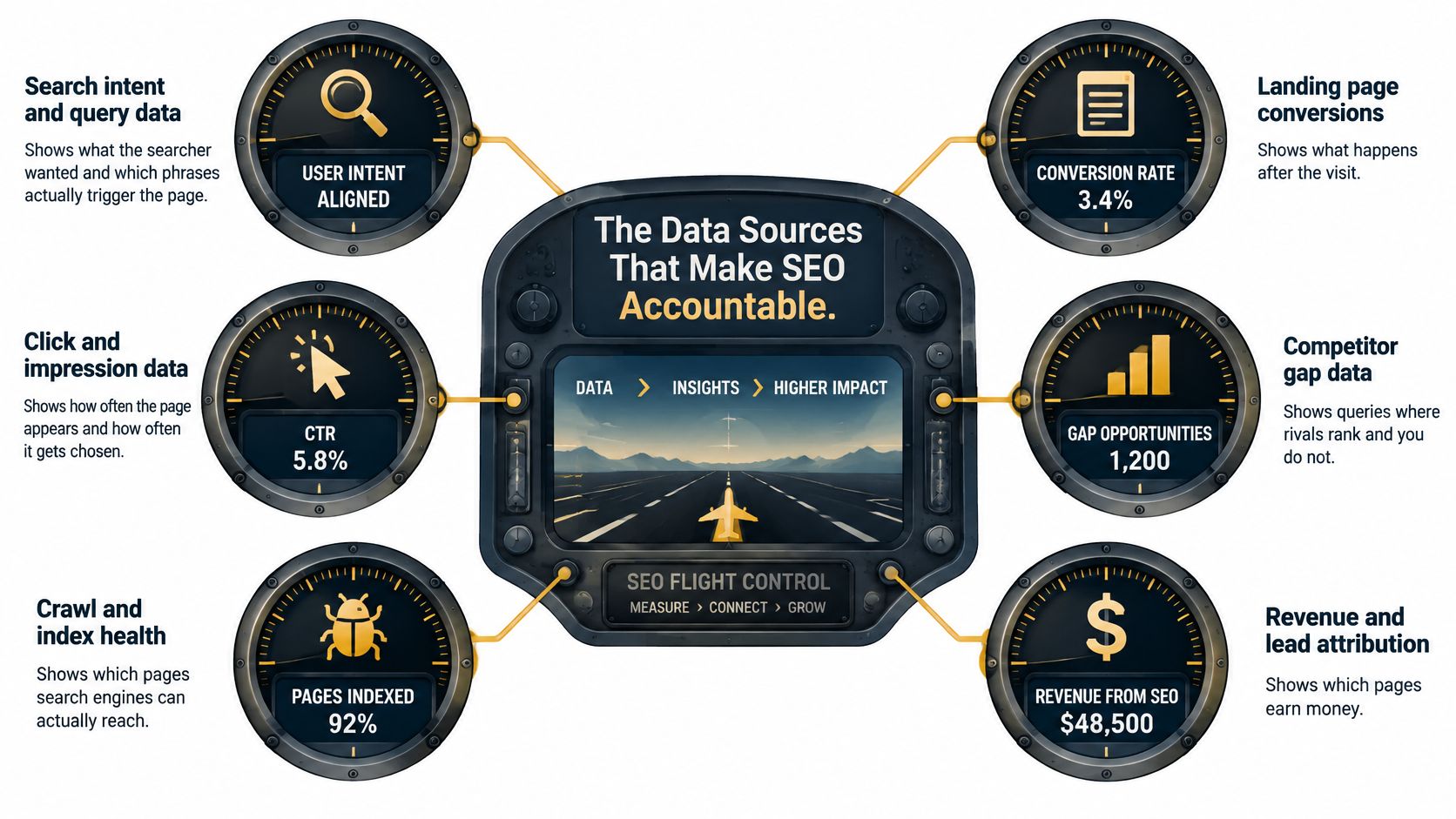
The Data Sources That Make SEO Accountable
Treat your reporting system like an aircraft cockpit, not a trophy case. Every instrument should help someone decide what to change, investigate, or leave alone.
Use this map to assign each source a job.
Give every instrument an owner
- Search intent and query data: The SEO lead reviews Search Console queries and actual result pages. Their decision is whether the landing page answers the searcher's task.
- Click and impression data: The content owner investigates listings that appear frequently but rarely earn a visit. They distinguish weak messaging from a result page that answers the question directly.
- Crawl and index health: The developer owns blocked pages, status codes, mobile rendering, internal-link accessibility, and technical release checks.
- Landing-page conversions: The analytics owner validates completed forms, bookings, purchases, and call events. Scroll depth and return visits support diagnosis but don't replace completed actions.
- Competitor gap data: The SEO strategist compares competing pages, topic coverage, and relevant referring domains. The decision is what evidence or support your page lacks, not which competitor to copy.
- Revenue and lead attribution: The sales or operations owner confirms lead quality, closed business, and disqualified inquiries in the CRM.
A small team can assign several roles to one person. What matters is that each source has a named monthly reviewer and a decision attached.
Follow the customer's actual destination
Say an Omaha home-services page collects impressions for a broad city query. The sales team, however, closes jobs from people searching for emergency help on their phones. A report celebrating the broad term could encourage more general copy while overlooking an inaccessible call button and vague after-hours information.
Trace the narrower journey instead: query intent, landing page, completed call, service-area eligibility, and booked job. That sequence tells you whether to rewrite the page or repair the contact path.
For an app business, the destination might be a store listing rather than a lead form. LetsDeployIt's step-by-step Play Store listing guide is useful when that handoff needs attention; website engagement alone won't tell you whether the listing supports the next action.
Don't collect a dataset just because a subscription includes it. A metric without a decision attached is clutter, and an unreviewed export won't make your SEO accountable.
Metrics That Connect Rankings to Revenue
The useful dashboard isn't the one with the most widgets. It's the one that distinguishes a visibility problem from a conversion problem before your team spends money on the wrong fix.
SEO metrics, where they come from, and the decision they support
| Metric | Primary source | Decision it supports | Threshold or caution |
|---|---|---|---|
| Query position and CTR | Search Console | Whether to test title or content | Use with volume; don't treat every rank equally |
| Impressions without clicks | Search Console | Visibility that never became a visit | Segment by query, device, and result features |
| Qualified visits and conversion rate | Analytics and CRM | Whether traffic is worth more investment | Prefer leads, calls, and revenue over sessions |
| Core Web Vitals field data | CrUX or Search Console | Which template to engineer first | Use field thresholds and device-specific assessment below |
| Device conversion split | Analytics plus crawl | Whether mobile parity is leaking revenue | A good rank with a poor mobile path still loses value |
| Referring domains and link quality | Link index | Where authority is missing versus competitors | Quality and relevance over raw link count |
| Revenue per landing page | Analytics and CRM | Which pages get the next quarter of effort | Connect acquisition opportunities to non-brand demand, not brand traffic alone |
Read a row as a decision rule. If impressions rise but clicks don't, inspect the listing and result-page composition before commissioning more content. If qualified visits rise without additional sales, check lead handling, availability, pricing expectations, and the conversion path.
Revenue attribution needs its own caution. Search Console queries generally can't be joined directly to individual CRM customers, so use landing-page and query-group evidence without pretending you have a perfect customer-level match. Comparing first-touch versus last-touch attribution also helps explain why an educational landing page can assist sales without receiving final-touch credit.
Engineer the template, not the score
Google's Core Web Vitals documentation describes field assessment using the 75th percentile, separately for mobile and desktop, with recommended thresholds of LCP at 2.5 seconds or less, INP below 200 milliseconds, and CLS below 0.1. Passing these measures doesn't guarantee high rankings; relevance, content quality, links, and other ranking systems still matter.
Translate failures into engineering work:
- Slow LCP: Inspect server response, hero-image discovery, and media size. Consider caching, CDN delivery, and earlier loading of the main image.
- Poor INP: Profile long JavaScript tasks and expensive event handlers. Split code and defer work that doesn't need to block interaction.
- High CLS: Reserve dimensions for images, ads, and embeds. Check font changes and dynamically inserted components.
Sort templates by failing-visit volume, then consider their commercial importance. Fixing a shared product template can be more useful than polishing an isolated page with little demand.
Validate the release against subsequent field distributions, not just a Lighthouse screenshot. A better laboratory result is diagnostic progress; a better experience for actual visitors is the outcome.
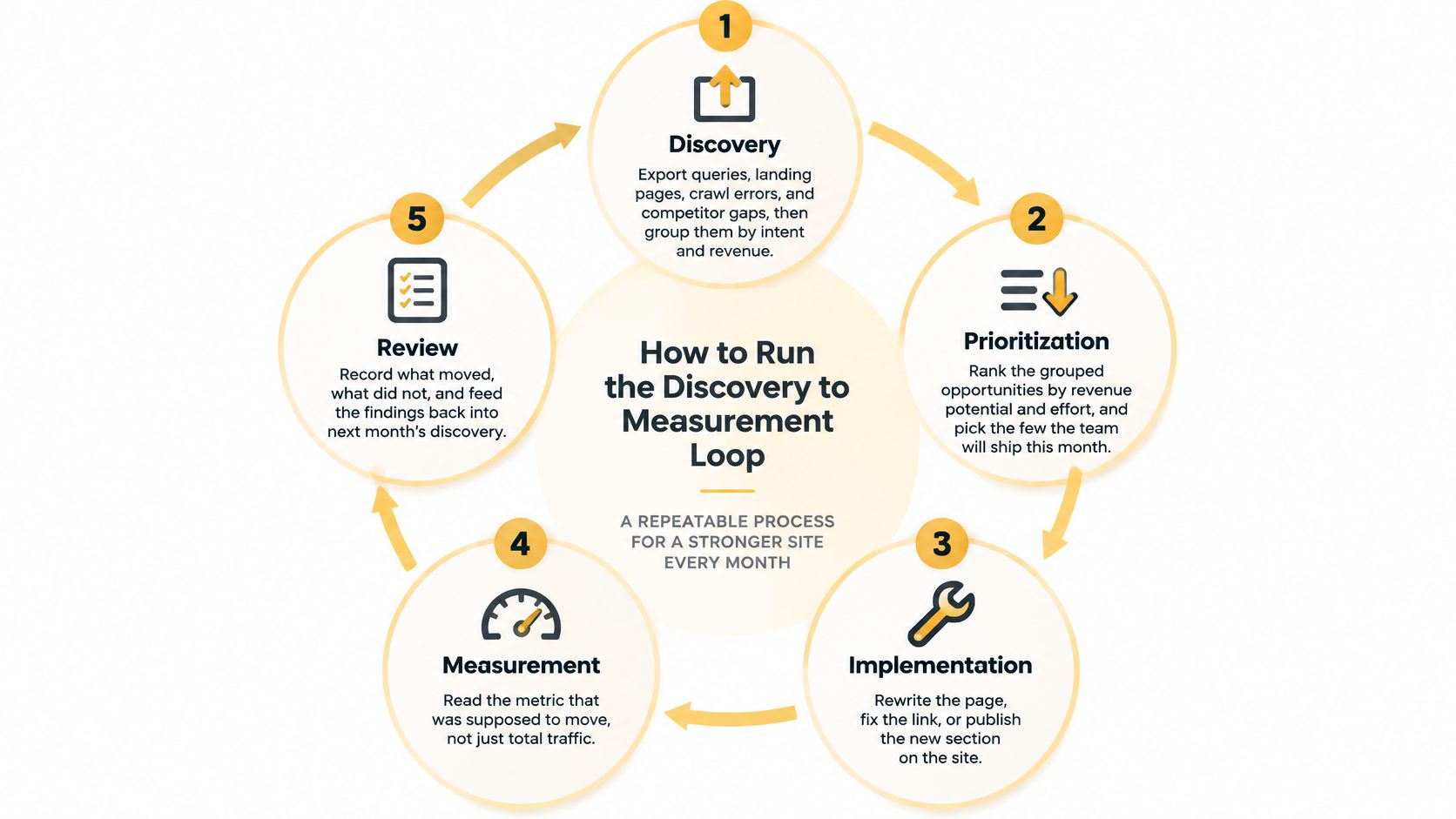
How to Run the Discovery to Measurement Loop
SEO tests need the discipline of a kitchen scale. Change an ingredient, measure the result, and record what happened. If you season everything at once, you won't know which change helped.
The operating loop should make that discipline repeatable.
Write the test before making the edit
-
Discovery begins with grouped evidence. Export queries, landing pages, crawl issues, and competitor gaps. Group opportunities by intent and revenue relevance, using search intent analysis to distinguish a request for instructions from a request for a provider. Don't let a large export substitute for choosing a solvable problem.
-
Form a falsifiable hypothesis. Name the page, proposed change, and metric expected to move. For example: rewriting an emergency-service page's opening around service availability should increase qualified mobile calls from organic entrances. Define no effect as an outcome indistinguishable from the baseline and comparison pages after sufficient exposure, rather than declaring any upward movement a win.
-
Design a comparison you can defend. Select comparable control URLs where the site supports them, and record baseline impressions, clicks, CTR, average position, and conversion rate. Change a single layer, such as title wording or internal links. Running title tests, new schema, and a major rewrite together may improve performance, but it prevents you from assigning the result to an individual tactic.
-
Wait for observable exposure. Confirm that Google has recrawled the changed pages and that enough relevant impressions have accumulated to judge the intended effect. Segment by device, brand, and query type, and annotate promotions, outages, or demand changes. A quieter trading period or a temporary demand spike can distort the comparison.
-
Keep, revise, or roll back. Record the outcome and the reason for the decision, including inconclusive tests. A useful log preserves the hypothesis, release date, affected URLs, comparison group, measured result, and next action. Don't relabel a failed CTR experiment as a branding success after the fact.
Set rules for sparse traffic
A small local site may not have enough comparable pages for a strong controlled experiment. Use a carefully annotated before-and-after comparison, inspect query mix, and be explicit that the result offers weaker causal evidence. Don't manufacture certainty from a handful of visits.
A test can be operationally sensible without proving causation. Report the strength of the evidence alongside the result.
I'd use a primary test per template per month as an operating cadence, not a promise that every test will finish within that period. Give it a named owner and a written kill rule before release. Broken tracking, lost indexability, or a damaged booking path justify intervention immediately; ordinary performance noise doesn't.
Tactics With Omaha Implementation Examples
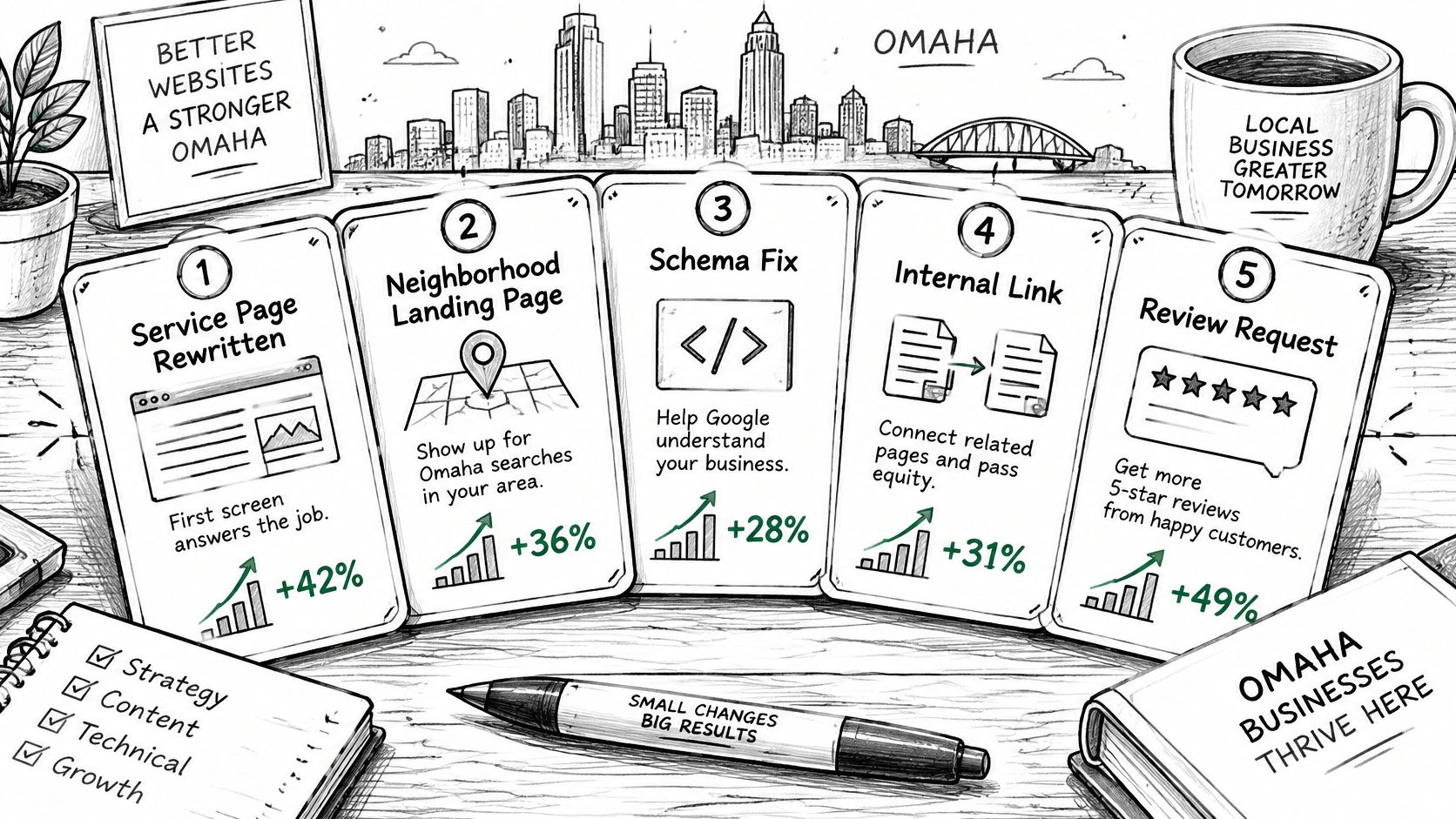
Choose tactics according to the constraint on the page. An Omaha retailer with weak product visibility needs different work from a plumber whose visitors can't complete a mobile call.
This local implementation map keeps the work grounded in pages and customer actions.
Match the intervention to the constraint
Content optimization: Say an Omaha furnace-repair page opens with company history while searchers want help with equipment that won't start. Rewrite the first screen around the repair task, service coverage, availability, and a clear contact action. Measure non-brand CTR and elapsed time from landing to a qualified inquiry, without treating either as a guaranteed improvement.
Keyword prioritization: An emergency plumbing query can deserve priority over a broad home-maintenance topic. Estimate demand multiplied by realistic incremental click share, lead conversion, and close rate, then apply expected job margin and implementation cost. Use local query evidence and sales records rather than assigning the same customer value to every visit.
Internal linking: An Omaha garden retailer might have a useful guide to preparing soil but a poorly discovered raised-bed category. Add a descriptive link where the guide discusses choosing a bed. Watch target-page impressions and relevant query coverage, not just clicks on the internal link.
The following video offers additional context for turning SEO work into implementation.
Make product and mobile improvements measurable
Structured data: For an Omaha shop selling equipment online, mark up product facts that customers can see. Google's Product snippet documentation says valid markup can establish eligibility for search appearances containing details such as price, availability, and ratings; it isn't an independent ranking boost. Apply it to a test group against comparable untreated products, then separate rich-result CTR changes from position changes after recrawling.
Monitor enhancement errors and catalog synchronization. Stale availability or mismatched prices undermine the accuracy required for eligible appearances. A valid schema check isn't a substitute for keeping the underlying product facts current.
UX testing: Say an Omaha booking page uses a sticky banner that covers its appointment button on phones. Repair the shared mobile component and compare completed bookings by device. Keep the metric close to the actual customer task rather than celebrating a higher engagement count.
For a multi-location business, give each location distinct service details, staff information, access instructions, and relevant proof. Swapping neighborhood names in otherwise identical pages doesn't answer different customer needs.
Use a quarterly sequence: select valuable queries, improve the destination page, add relevant links and accurate markup, then address the mobile template. If booking or crawling is broken, fix that blocker before following the sequence.
Measuring SEO When Clicks Are Not the Outcome
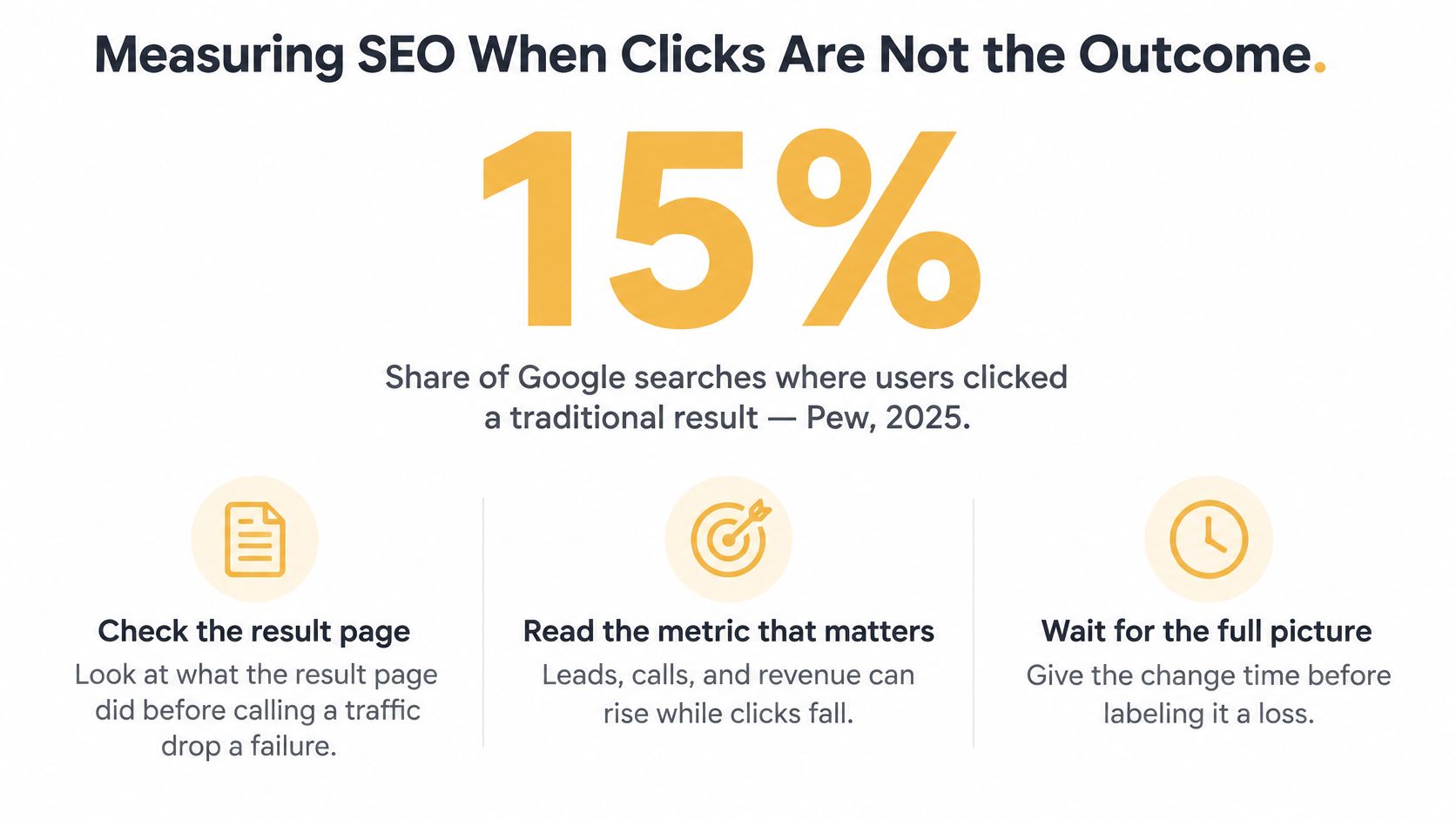
Users clicked a traditional result on 15% of Google searches without an AI summary, compared with 8% when a summary appeared, in a 2025 Pew Research Center analysis discussed by AI Magazine. A traffic decline therefore needs a result-page investigation before it becomes a verdict on content quality.
That finding doesn't prove that a lost visit produced useful brand exposure. It means your reporting must distinguish an acquisition loss from visibility whose commercial effect remains uncertain.
Keep the comparison's scope in mind when reading the visual: the traditional-result click share applies to searches without an AI summary.
Add evidence without inventing attribution
Put these report lines beside organic sessions:
- Priority-query impressions and observed AI summaries: Record impressions for the query group and separately document whether sampled result pages contain summaries. Search Console alone doesn't supply a clean summary-present flag for every impression.
- Branded demand following exposure: Track branded query activity and direct inquiries over the relevant buying period. Annotate other campaigns so you don't credit SEO for demand generated elsewhere.
- Lead quality by landing page: Record service eligibility, sales acceptance, and closed outcomes. A smaller audience can still be commercially useful if more visitors need what you sell.
Also keep a reproducible citation log. Save the query, observation date, cited page, and answer context when your business appears in an AI-generated result. A mention without a useful source reference isn't equivalent to a qualified referral.
Separate a possible assist from a proven return
A lost click isn't automatically a lost strategy. An impression isn't automatically a business result either.
An Omaha publisher's guide might become a cited source while receiving fewer visits. That could help readers recognize the publication later, but the publisher shouldn't book hypothetical assisted revenue to make the report look better. Treat subsequent branded searches and customer-reported discovery as supporting evidence, not a perfect causal chain.
Harmful loss looks different: fewer qualified entrances, declining sales opportunities, and no credible compensating signal. That warrants investigation into content differentiation, the offer, and the acquisition mix.
Don't pause conventional SEO because the scoreboard needs another column. Preserve the distinction between observed visibility, measured visits, and verified commercial outcomes. It's the best defense against both dismissing useful exposure and paying for mentions that never help the business.
Tooling, KPI Dashboard, and the First-Month Audit
Start with a small stack that your team can maintain. Search Console supplies queries and search appearances; analytics supplies landing-page journeys and device splits; the CRM supplies customer quality and sales outcomes. Add CrUX or Search Console experience reporting for template health, plus a rank and link index for competitive investigation.
Keep the combined view in a spreadsheet or business-intelligence dashboard. Normalize landing-page URLs, align reporting periods, and document event definitions before debating small changes. Every tab needs an owner, a current note, and an action.
Keep the executive view compact
Use an SEO reporting template to organize the executive view around these tiles:
| Dashboard tile | Decision attached |
|---|---|
| Non-brand clicks | Which acquisition opportunities deserve investigation? |
| Qualified conversion rate | Are additional visitors becoming viable customers? |
| Revenue from organic landing pages | Which page groups justify continued investment? |
| AI referrals beside Google organic | Does the emerging channel justify additional resources? |
Keep diagnostic detail underneath these tiles. A stakeholder should be able to see the outcome first, then inspect query mix, template changes, or device performance when there's a decision to make.
Require profitability before shifting AI-search budget
A SEOcrawl study of more than 16,000 websites reported AI referral traffic growing about 45% year over year, yet representing only slightly more than a visit for every 100 visits from Google organic search. Growth rate alone is therefore a poor budget-allocation rule.
Create a separate AI-referral channel using identifiable referral sources, and keep unattributed traffic separate. Protect conventional queries that already produce profitable business while testing original evidence, clearly attributed expertise, and accurate product information that can be cited.
Set the profitability rule before expanding that work:
- Include the full cost: Count research, writing, development, measurement, and maintenance, not just software fees.
- Use contribution, not headline revenue: Compare the margin from attributable closed business against acquisition costs.
- Apply the same buying-cycle window: Don't compare fresh AI leads with mature organic customers.
- Require a credible comparison: Shift marginal budget only when AI activity clears your required return and compares favorably with the next available Google-organic investment.
That threshold is business-specific, but it must be written down. Mentions alone don't clear it, and a promising lead isn't a closed sale.
Run a one-week baseline audit
Temporarily pause discretionary new-content and link spending while you reconcile the baseline. Export non-brand queries and positions, identify underexposed revenue pages, compare mobile and desktop conversion, and rank templates by failing visits and commercial importance.
Inspect priority result pages for AI summaries and other features that change the opportunity. Validate forms and calls, exclude spam leads, and reconcile analytics outcomes with CRM records. Finish with a written hypothesis, a selected template, an owner, and a release decision.
Review the dashboard monthly, but allow customer cohorts to mature before judging profitability. Delete charts nobody acts on and scale only changes supported by credible commercial evidence.
At Up North Media, our process starts with an audit of current SEO performance, competitors, and improvement opportunities. Our monthly reporting tracks organic traffic, keyword rankings, conversion rates, and ROI, keeping implementation connected to business outcomes rather than isolated visibility gains.
Up North Media offers data-driven SEO work grounded in an audit, a customized roadmap, and ongoing measurement. Visit Up North Media to discuss your highest-value landing pages, establish a visibility-to-revenue baseline, and identify the next SEO change worth testing.