
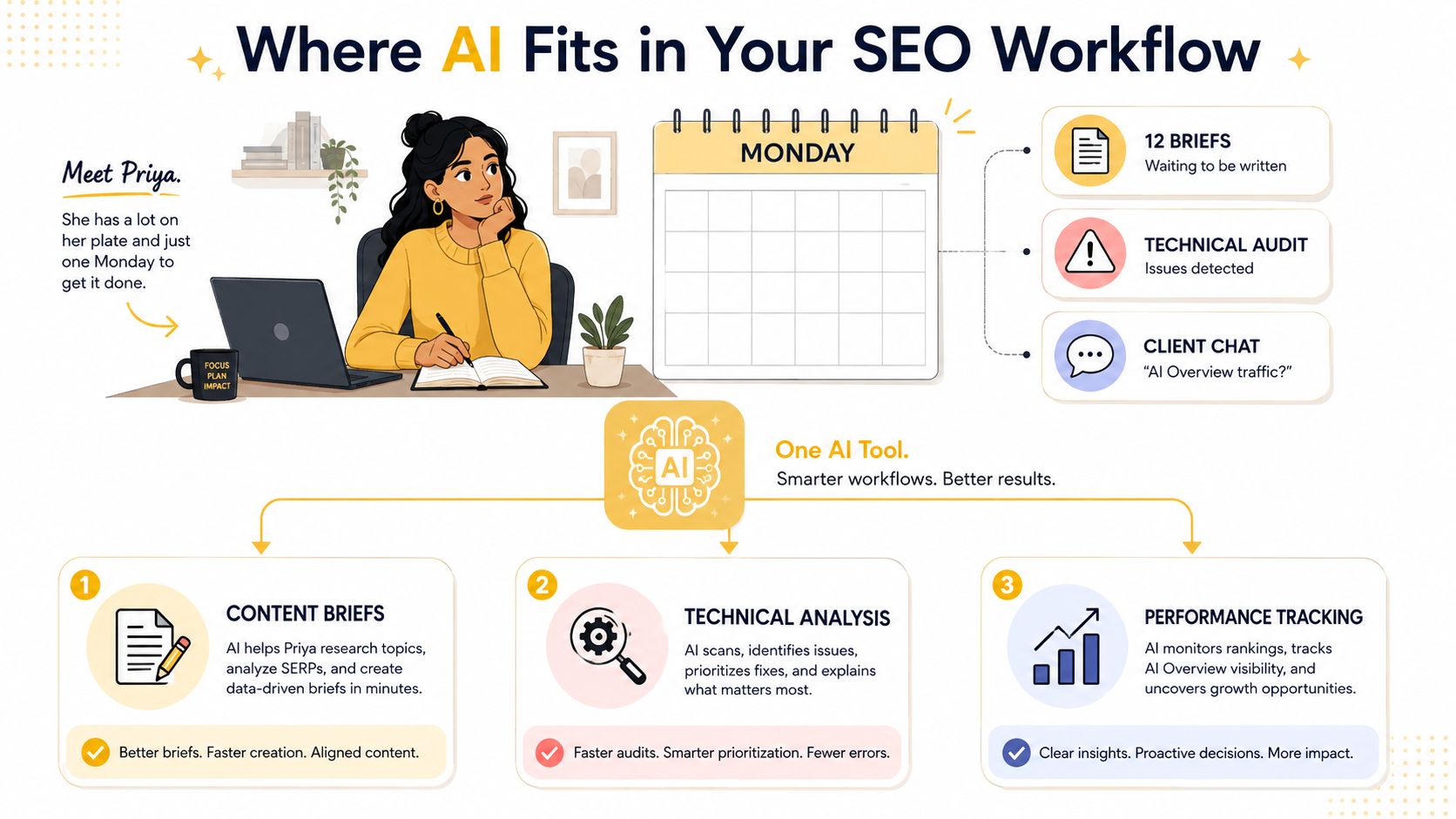
Priya starts Monday with a blank editorial calendar, 12 unfinished briefs, a technical audit full of warnings, and a client asking why AI Overview traffic isn't showing up in the report. By Friday, the calendar hasn't become manageable because an AI tool wrote everything. It has become manageable because repetitive decisions were routed through a controlled workflow, while Priya kept ownership of strategy, accuracy, and client judgment.
That distinction matters. In a 2025 survey cited by G2, over 86% of SEO professionals reported already using AI, and nearly 45% of marketers expected to use generative AI in more than half of their SEO initiatives by 2025–2026 (G2's AI in SEO research). AI is no longer a side experiment for content teams. The useful question is how to use AI for SEO without turning your site into a collection of generic, unverified pages.
Where AI Actually Fits in Your SEO Workflow
Priya doesn't ask an AI model to “do SEO.” She assigns it bounded jobs.
For research, AI groups search queries, summarizes competitor coverage, and turns Search Console exports into possible themes. For content, it acts as a coauthor that converts an approved brief into a structured draft. For technical work, it behaves more like an assistant, identifying patterns in crawls, redirect maps, and schema drafts. For measurement, it serves as an analyst that explains changes across rankings, clicks, conversions, and emerging answer-engine visibility.
The operating loop looks like this:
keyword intake → cluster → brief → draft → optimize → publish → monitor
AI compresses the time between each decision and its output. It doesn't replace the strategist who decides whether a topic deserves a page, whether a recommendation fits the client, or whether an unusual result reflects a real opportunity.
Start with repetitive, low-risk work
Small teams should automate tasks with high volume and clear acceptance criteria first:
- Research compression: Cluster exported queries and label likely intent.
- Brief production: Turn approved topics into outlines, questions, entities, and internal-link targets.
- Content quality checks: Flag missing headings, unsupported claims, weak answers, and unused internal links.
- Reporting preparation: Summarize changes and identify pages that deserve human investigation.
Agencies can go further by building reusable prompt templates for each client, with separate instructions for industry vocabulary, prohibited claims, audience needs, and brand voice. An AI-driven content creation guide can provide useful background for teams designing repeatable content-production systems, but the SEO workflow still needs its own review gates.
Know where AI causes damage
AI is poor at final E-E-A-T judgments because it can't independently validate experience, expertise, or the credibility of a named source. It also shouldn't handle sensitive stakeholder communication, where context and accountability matter more than speed. Link prospecting needs human relevance checks, relationship judgment, and editorial discretion, not a bulk list of vaguely related websites.
The practical split is simple:
Use AI for options, organization, and pattern detection. Keep humans responsible for priorities, evidence, relationships, and publishing decisions.
Google's guidance allows AI-assisted content, but it emphasizes original, high-quality, trustworthy material. Content produced mainly by automation with little added value can receive the lowest quality assessment (Google's guidance on AI-generated content). That gives Priya a workable rule: automate preparation before publication, then make the human contribution visible in the finished page.
Mapping Keywords and Search Intent with AI
Keyword mapping works best when AI receives real search data rather than being asked to invent a market from memory. Export a seed list from Google Search Console, Ahrefs, or Semrush, then preserve the query, landing page, impressions, clicks, and any available intent indicators before sending the data to a model.
Build the cluster in four passes
First, classify the queries. Ask the model to group terms into informational, commercial, transactional, and navigational buckets. Require a confidence score and a short rationale. Navigational searches are frequently misclassified, so a human should review the most important clusters before they become content assignments.
Second, add SERP context. Enrich each cluster with observed result types, featured snippets, People Also Ask questions, forums, product pages, and AI Overview presence where your tools or collection process can support it. AI can summarize that evidence, but it shouldn't pretend that an unverified SERP observation is a fact.
Third, prioritize the clusters. Score each group for topical relevance, business value, competitive difficulty, and likelihood of producing an answer-engine citation. Use a consistent rubric, not the model's instinctive ranking.
Fourth, convert winners into briefs. A good brief should state the intended audience, primary question, page type, supporting questions, evidence requirements, internal links, conversion goal, and what competing pages fail to explain.
Use these prompts as starting points:
SERP-aware intent classification
Classify the following queries by primary intent: informational, commercial, transactional, or navigational. For each query, provide a confidence level, explain the evidence in the wording, identify the likely preferred page type, and flag any term that requires human review. Do not infer search volume or business value without supplied data. Queries: [paste export]
Competitor content-gap analysis
Compare these competitor URLs against our target topic and identify useful gaps, not superficial keyword omissions. Separate missing questions, missing evidence, weak explanations, outdated information, and underserved audiences. Recommend only gaps relevant to our product and audience. URLs: [paste URLs]. Target audience: [describe audience]
Cluster FAQ generation
Using only the questions and SERP observations below, create an FAQ block for the cluster “[cluster name].” Write concise, self-contained answers. Mark any answer that requires a source, subject-matter expert, or product verification. Don't invent statistics, customer examples, or feature claims. Data: [paste questions and notes]
A detailed workflow for grouping related concepts and assigning them to pages is also covered in this guide to semantic keyword research.
| Task | AI Strength | Human Required | Recommended Tool |
|---|---|---|---|
| Query clustering | Groups similar language quickly | Confirm intent and page overlap | ChatGPT or Claude with a Search Console export |
| SERP summarization | Extracts recurring formats and questions | Verify the live results | Semrush, Ahrefs, or a browsing-enabled model |
| Gap discovery | Surfaces missing angles and audiences | Judge relevance and originality | Semrush Keyword Gap plus an LLM |
| Priority scoring | Applies a repeatable rubric | Set commercial and brand priorities | Google Sheets plus an LLM |
| Brief creation | Produces consistent structures | Approve evidence, links, and conversion path | Notion, Airtable, or a content platform |
Review the top 20 priority clusters manually before assigning production work. The model can organize the map, but it can't know whether two pages should be merged, whether a query is strategically important, or whether your business can support the promise implied by the topic.
Drafting Content That Ranks and Reads Like a Human
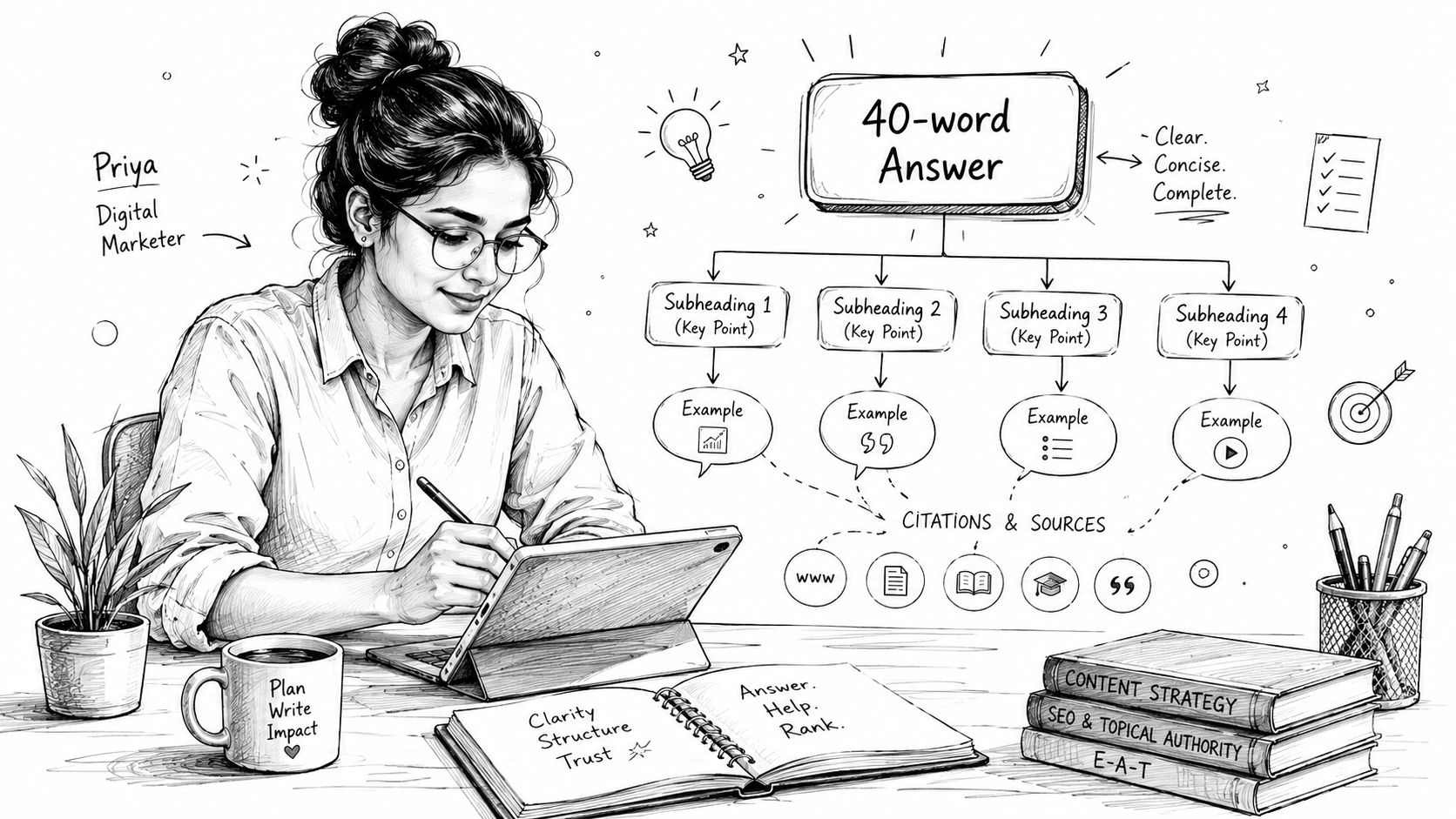
AI drafts become useful when the prompt controls answer order, evidence, audience, and editorial boundaries. Start with the answer, then earn the reader's attention with explanation and examples.
For an informational page, require a direct response in the opening paragraph. A reusable outline prompt looks like this:
Act as an SEO editor for [business and audience]. Build an answer-first outline for “[topic]” targeting “[primary query].” Open with a direct answer of about 40 words, then structure the page around the reader's next questions. Include definitions, practical steps, limitations, examples that can be verified, evidence requirements, internal-link opportunities, and a clear next action. Don't invent facts, customer results, sources, or quotes. Mark every claim that needs human verification.
That prompt produces a scaffold, not publishable authority. The editor still needs to check every claim, replace generic language with firsthand observations, add original comparisons, and make the page sound like the company rather than an averaged internet voice.
Prompts for the finishing layer
Outline refinement
Review this outline for “[topic]” against the supplied search intent and audience. Identify overlapping sections, unanswered questions, unsupported recommendations, and places where a first-hand example would improve the page. Return an editorial checklist, not replacement copy. Brief: [paste brief]
Meta title and description options
Write five title tag options and five meta descriptions for a page about “[topic].” Make each option specific to “[audience],” accurately reflect the page, and avoid unsupported promises. Include the primary query naturally. Explain which option best matches the intent and why.
FAQ block for schema review
Draft concise answers to these verified questions: [questions]. Keep each answer self-contained and accurate to the source material below. Then return a separate list of questions that should not receive FAQ schema because the page doesn't provide a complete answer. Source material: [paste approved content]
Consider the human edit as a production stage, not a quick proofread. In one practical scenario, AI drafted a 1,200-word article about the best CRM for solopreneurs. The editor cut it to 900 words, added a real comparison screenshot, removed repeated feature descriptions, and rewrote the conclusion around the reader's buying decision. The improvement came from selection and evidence, not from asking the model for more adjectives.
A useful reference for teams balancing automation and creative consistency is Kraken Socials' guide to social media design for UK startups. The same principle applies to SEO: AI can accelerate production, but human choices create recognizable, defensible work. Teams building a tool stack can also compare options in this guide to AI content creation tools.
Before publication, run four gates:
- Verify claims: Check names, dates, product details, citations, and recommendations against approved sources.
- Test originality: Remove generic summaries and add firsthand analysis, screenshots, methodology, or proprietary observations.
- Check readability: Simplify dense passages and keep the language appropriate for the intended audience.
- Audit links: Confirm every internal link is live, relevant, naturally placed, and useful at that point in the journey.
Never outsource case studies, personal experience, expert judgment, or opinionated frameworks to an AI model. Those elements are the reason a page deserves attention.
Optimizing for AI Overviews and Answer Engines
A service page can rank traditionally and still lose the visit if an answer engine extracts its response instead. Google AI Overviews reached 2 billion monthly users, while industry analysis found AI Overviews on 13.14% of Google searches in March 2025, compared with 6.49% in January 2025. The same analysis reported external-link clicks of 8% when a summary appeared, versus 15% when no summary appeared (Semrush's AI SEO statistics). These figures support a dual approach: preserve conventional SEO while making important passages easy to retrieve, attribute, and verify.
A page built for answer engines should state the answer, define its context, and show its evidence without forcing a system to reconstruct the author's intent.
Use a clear page anatomy
A practical structure is:
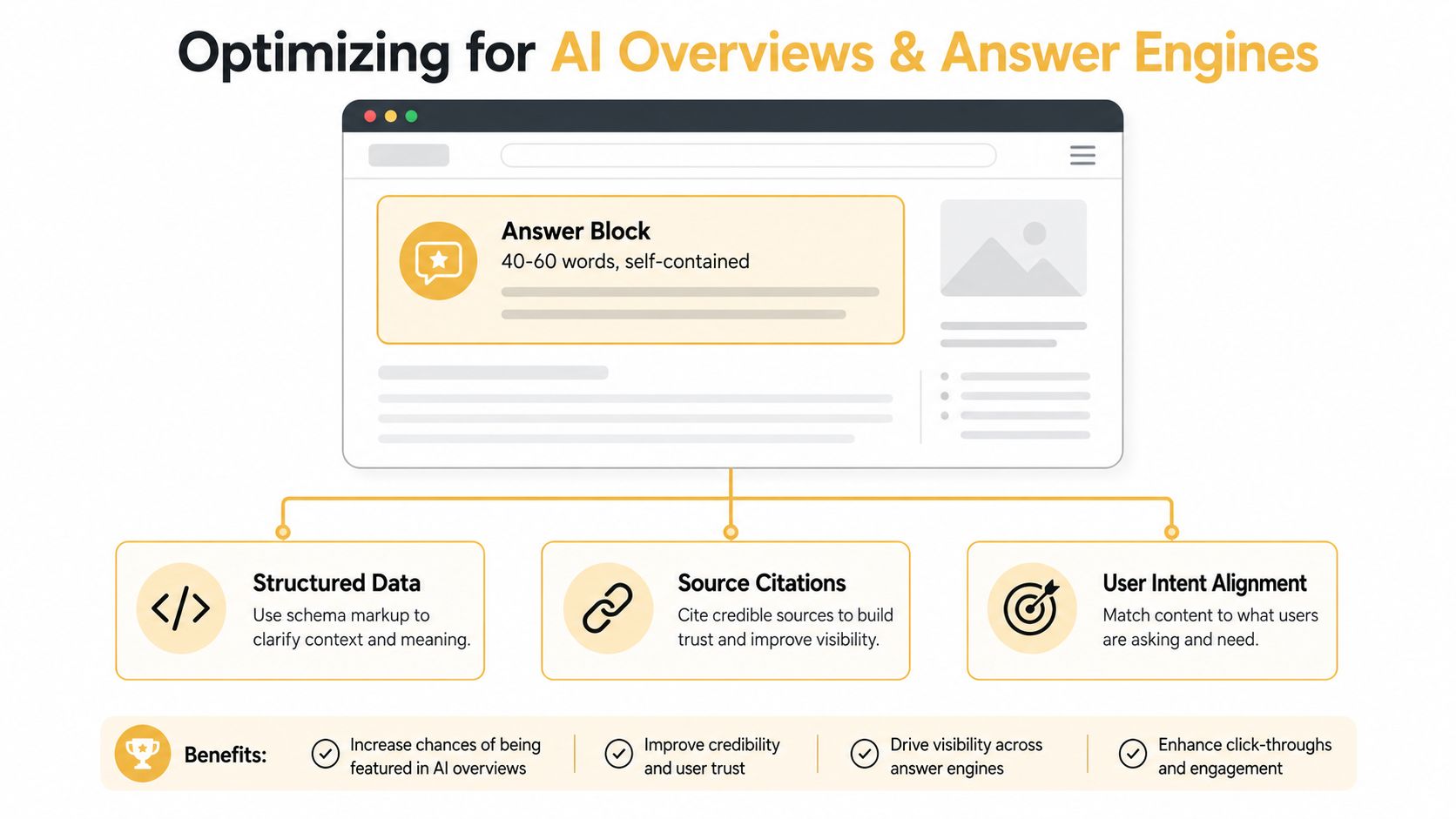
H1 → TL;DR → definitions → modular answer blocks → supporting explanation → evidence and citations → FAQs → conversion path
Put a self-contained answer near the start of each major section. A 40 to 60 word block should answer one question directly, name the subject clearly, and avoid pronouns that lose meaning when extracted. Follow it with nuance, examples, limitations, and source links.
Question-and-answer headings improve scanning, but formatting does not establish authority. Add descriptive author and publisher markup to Article schema. Use relevant FAQPage or HowTo schema only when the visible content supports it, and maintain clear Organization credibility signals. Validate the implementation and remove claims the evidence cannot support.
Use this audit prompt:
Audit the following page for answer-engine readiness. Score citation likelihood from 1 to 5 across seven signals: direct answer clarity, passage self-containment, heading specificity, evidence and citations, author and publisher trust signals, structured data alignment, and user-intent coverage. For each score, cite the exact page passage that supports your judgment. List the five highest-priority changes. Don't claim that any change guarantees inclusion in an AI answer. Page: [paste URL or content]
A 60/40 balance works well in practice, with canonical answers leading and narrative depth following. Formatting every paragraph as a snippet makes a page stiff and repetitive. Readers still need reasoning, examples, and a clear path to act.
For the broader discipline, see this guide to answer engine optimization.
Cited inclusion can increase visibility while reducing the visit that follows. Industry coverage reported organic CTR falling from 1.76% to 0.61% over 15 months for queries where AI Overviews appeared. Measure whether an answer block generates qualified demand, branded searches, assisted conversions, or useful referral traffic, rather than treating appearance alone as success.
Automating Technical SEO Without Breaking Things
Technical automation should produce recommendations and diffs before it produces changes. The safest workflows read large datasets, identify patterns, and hand proposed actions to a person who understands the site's architecture.
Four workflows worth wiring
Log analysis begins with a sampled export from your server logs or crawl platform. A custom GPT can group Googlebot activity, identify URLs receiving little or no crawl attention, and highlight possible orphan pages or inefficient paths. Pair Screaming Frog with a custom GPT when the team needs flexible analysis and clear review notes. Don't let the model decide that a low-crawl URL is disposable without checking its business role.
Internal-link discovery is a strong use case because the output is easy to inspect. Restrict the model to one topical cluster, provide the source and destination URLs, and require anchor-text reasoning. AirOps paired with Sitebulb can support a more repeatable agency workflow, but every suggestion still needs editorial approval.
Deployment rule: AI may suggest a technical change. A human must approve the change, inspect the diff, and own the rollback.
Use this prompt for internal links:
Review the approved page list for the topical cluster “[cluster].” Suggest internal links only between these URLs. For each recommendation, provide source URL, destination URL, exact sentence location, natural anchor text, and a one-sentence rationale tied to user intent. Reject links that are redundant, forced, or unsupported. Do not invent URLs. Page list: [paste URLs and titles]
Schema generation can turn page content into a JSON-LD draft from a controlled template. Ask the model to use only visible claims, then validate the result with Google's Rich Results Test and compare the proposed markup with the previous version before publishing.
Redirect mapping is useful for grouping likely replacements, redirect chains, and 404 clusters. The model can flag patterns in a spreadsheet or crawl export, but it shouldn't auto-deploy redirects. A wrong redirect can damage navigation, relevance, and analytics interpretation.
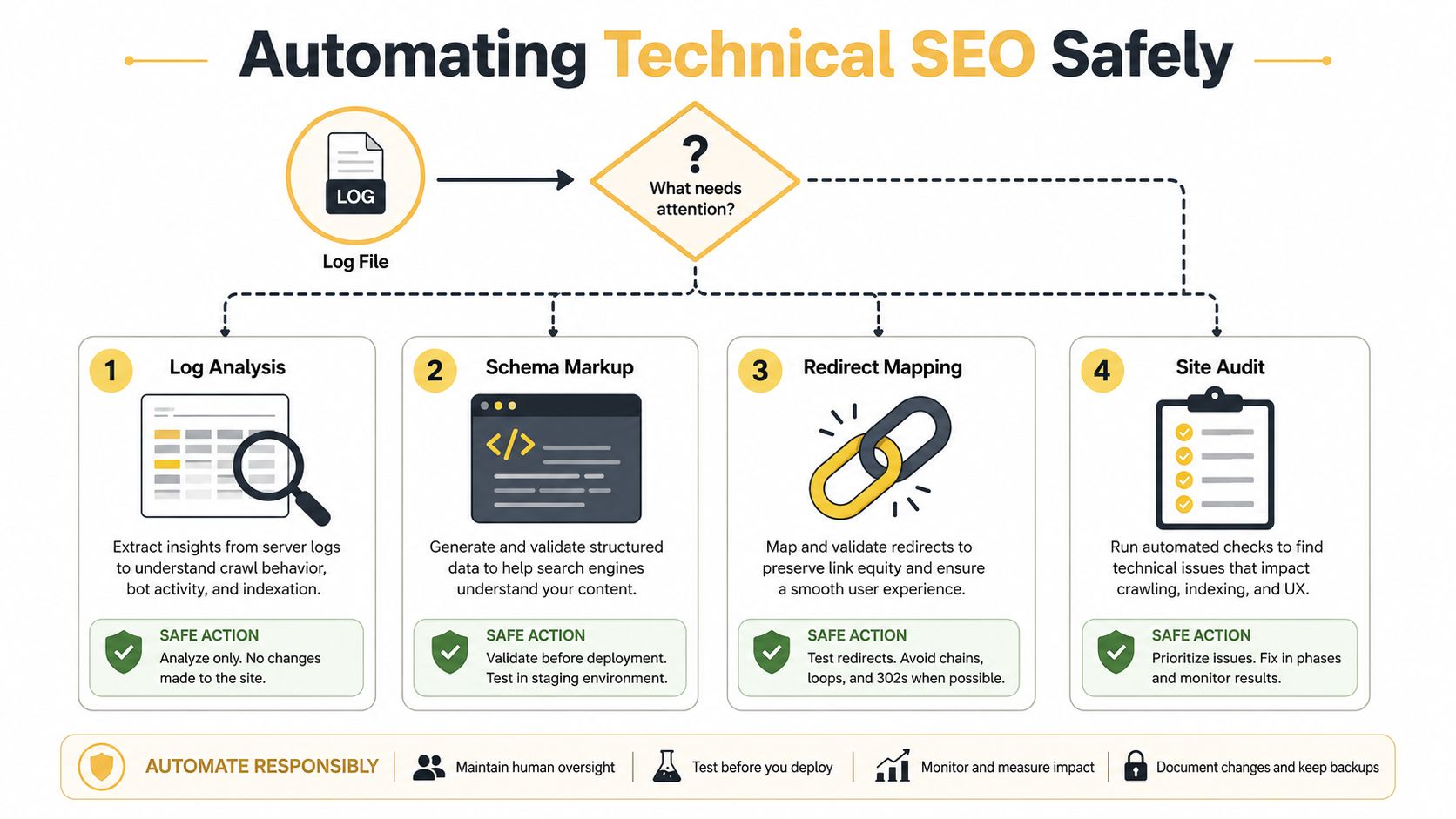
Keep all automated changes in staging first. Diff schema before release, review link placements in context, test redirect proposals against destination intent, and preserve a rollback path. AI is valuable here because it makes inspection faster. It's dangerous when the team treats speed as permission.
Measuring AI SEO Impact Beyond Rankings
A conventional SEO dashboard answers, “Did the page rank and attract visits?” An AI-era dashboard adds, “Was the brand cited, what answer appeared, and did that visibility create demand?”
Keep the two views beside each other rather than replacing one with the other. Search Console and GA4 can cover organic performance, while a manually maintained AI Overview tracker can record query, date checked, answer wording, cited sources, brand mention, and destination URL. A Looker Studio report can combine the first-party data, while the manual tracker supplies context that standard analytics may not capture.
| Metric | Formula | Data Source | 90-Day SMB Benchmark |
|---|---|---|---|
| Organic sessions | Sessions from organic search | GA4 | Establish a baseline and seek a sustained upward trend |
| Keyword rankings | Position by tracked query | Search Console or rank tracker | Improve priority-query coverage without sacrificing relevance |
| Organic conversions | Organic conversions divided by organic sessions | GA4 | Compare against the existing page or query baseline |
| AOI citation rate | Priority queries with a brand or page citation divided by priority queries checked | Manual answer-engine tracker | Set a baseline first, then target a measurable improvement |
| Brand mention frequency | Checks containing the brand divided by total checks | Manual prompt and query log | Track direction by topic and competitor set |
| Citation-link referrals | Sessions from identifiable answer-engine citation links | GA4 referral data | Look for qualified visits, not raw mentions |
| Incremental demand | Conversions or branded-search activity after exposure, compared with a control group or prior baseline | GA4, Search Console, CRM | Confirm that visibility adds value rather than shifting existing traffic |
The table uses directional benchmarks because a universal SMB threshold would create false precision. A local service business, a software company, and an online retailer have different query sets, conversion paths, and reporting quality.
Build a weekly AI-visibility digest
Review this week's priority-query checks and compare them with the previous period. Summarize new citations, lost citations, brand mentions, competitor mentions, answer changes, linked referrals, organic clicks, and conversions. Separate observed facts from hypotheses. Flag any case where AI Overview visibility may be replacing clicks from a page that already performed well organically. Recommend no more than five human investigations.
The key measurement principle is incrementality. Don't celebrate an answer-engine mention if organic traffic or conversions just moved from one existing channel to another. Segment by query type, landing page, brand versus non-brand intent, and whether the page had strong organic visibility before the AI feature appeared.
A practical 2026 study found purely AI-generated content reached the top search position only 9% of the time, reinforcing why output volume shouldn't become the primary success metric (Semrush's AI content ranking study). The dashboard should reward useful visibility and business outcomes, not automated publishing.
Governance, Rollout, and Your Next 90 Days
AI SEO scales only after the team defines what the model may see, suggest, and publish. Without those rules, every prompt becomes a new interpretation of quality, and every client account develops a different risk profile.
Start with a short governance document covering:
- Human review stages: Assign owners for keyword approval, factual review, brand review, technical QA, and final publication.
- Verification checkpoints: Require source links or internal evidence for every statistic, quote, named claim, product capability, and customer result.
- Voice libraries: Store approved examples, banned phrases, audience descriptions, terminology, and positioning notes in the prompt system.
- Prohibited claims: List promises the model must never create, including guaranteed rankings, unsupported performance outcomes, invented credentials, and unverified case studies.
- Disclosure policy: Decide when the business records or discloses AI assistance, especially for regulated or expertise-sensitive content.
- Data handling: Keep confidential client information, unpublished product details, and personal data out of tools that aren't approved for that use.
Google's position is useful here. AI assistance itself isn't the quality standard. Originality, usefulness, and trustworthiness are. Independent coverage has also reported a 0.011 correlation between the percentage of AI-written content and ranking position, which means the amount of AI text alone doesn't explain competitive performance (analysis of AI content and SEO data). Your governance should therefore measure human contribution and page quality, not chase an arbitrary AI-versus-human ratio.
Days 1 through 30
Audit the current workflow from keyword intake to reporting. Choose two repeatable, lower-risk tasks, such as query clustering and content-quality checks. Build a prompt library with inputs, desired outputs, failure examples, reviewer names, and version dates. Establish baseline data in Search Console, GA4, your rank tracker, and an initial answer-engine query log.
Days 31 through 60
Expand into content briefs, draft assistance, internal-link suggestions, and technical analysis. Keep weekly QA meetings short and concrete. Review rejected outputs as training material for the library, then update prompts when the same failure recurs.
For agencies, create a separate workspace or instruction set per client. A regional retailer shouldn't inherit the terminology, prohibited claims, or conversion logic of a SaaS account. Up North Media is one example of an agency that combines AI consulting with data-driven SEO, content optimization, technical SEO, and competitive analysis as part of client delivery (Up North Media).
Days 61 through 90
Add AI Overview and answer-engine checks to reporting. Connect Search Console and GA4 data to a Looker Studio dashboard, maintain the manual citation tracker, and include a short explanation of visibility changes in client reports. Test whether citations create incremental branded demand, qualified referrals, or conversions before expanding the workflow.
Use this decision checklist whenever someone proposes another automation:
- Volume: Does the task repeat often enough to justify setup and maintenance?
- Risk: Could an incorrect output affect trust, compliance, revenue, or crawlability?
- Verification: Can a reviewer check the result quickly against a reliable source?
- Hallucination exposure: Does the task require facts the model can't independently verify?
- Brand sensitivity: Would a generic answer weaken the company's positioning?
- Rollback: Can the change be reversed cleanly?
- Measurement: Do you know which metric should move if the workflow works?
Automate first where volume is high, risk is contained, and review is straightforward. Keep strategy, evidence, relationships, and final judgment human-led. That operating model gives small teams the speed advantage of AI without surrendering the standards that make SEO assets competitive.
If your team needs a controlled AI SEO workflow, Up North Media can help with keyword research, content optimization, technical SEO, AI consulting, and visibility measurement across search and answer engines. Visit Up North Media to discuss a practical rollout built around your business goals, existing data, and review capacity.