

In today's competitive landscape, businesses are no longer asking if they should automate, but what they can automate for maximum impact. While traditional automation handles simple, repetitive tasks, intelligent automation (IA) represents a paradigm shift. By integrating Artificial Intelligence (AI), Machine Learning (ML), and Robotic Process Automation (RPA), IA tackles complex, judgment-based workflows, transforming operations from the back office to the front lines.
The difference is profound: instead of just following rules, IA systems learn, adapt, and make decisions. This capability unlocks a new level of efficiency and strategic advantage that was previously unattainable. For small and mid-sized businesses, this means being able to compete on a larger scale, streamline critical functions, and deliver superior customer experiences without a proportional increase in overhead.
This article breaks down 10 transformative intelligent automation use cases that are driving real-world ROI across diverse industries like e-commerce, digital publishing, and local services. We'll move beyond the buzzwords to provide a strategic blueprint for each application.
You will find a detailed analysis of each use case, including:
- Actionable Benefits: The specific, tangible outcomes you can expect.
- Implementation Roadmaps: Key considerations for getting started.
- Success Metrics: How to measure ROI and operational improvement.
- Starter Tech Stacks: The tools and integrations needed to build your solution.
Whether you're a startup looking to scale or an established enterprise aiming to optimize, these examples will reveal how you can leverage intelligent automation to reduce costs, accelerate growth, and gain a decisive competitive edge. Let's dive into the specific applications.
1. Intelligent Document Processing and Data Extraction
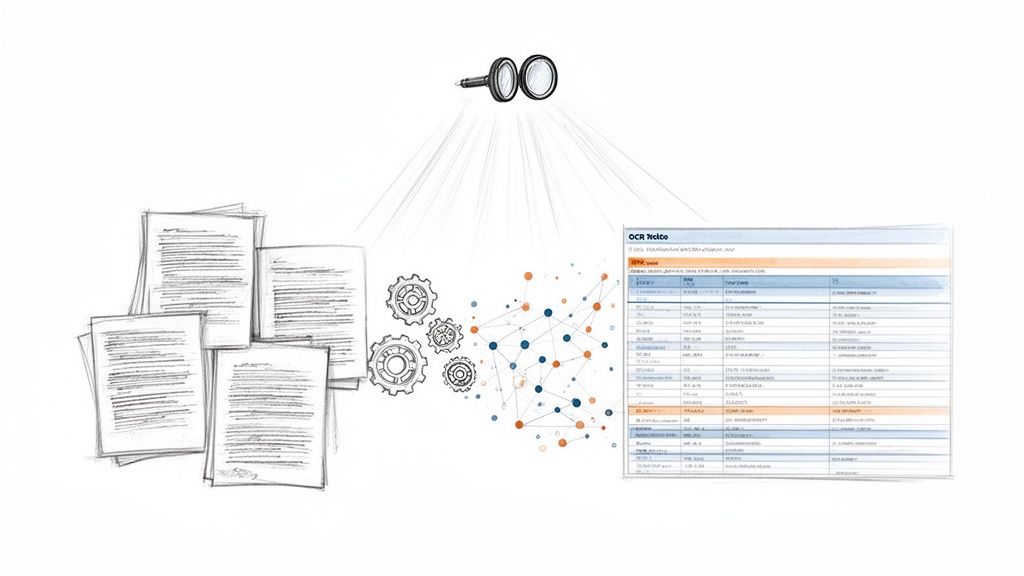
Intelligent Document Processing (IDP) is one of the most impactful intelligent automation use cases, revolutionizing how businesses handle vast amounts of unstructured data. It combines Optical Character Recognition (OCR), Natural Language Processing (NLP), and machine learning to automatically read, classify, and extract relevant information from documents like invoices, contracts, and customer forms. This eliminates the tedious, error-prone task of manual data entry, enabling teams to focus on higher-value work.
For instance, an e-commerce retailer can use IDP to automatically extract purchase order details from supplier invoices, cross-referencing them with their ERP system for instant validation and payment processing. This accelerates the procure-to-pay cycle and reduces operational overhead.
Strategic Analysis
IDP's core value lies in converting unstructured data locked in documents into structured, actionable information. The technology goes beyond simple OCR by understanding context; it can differentiate between a "shipping date" and an "invoice date" regardless of their position on a page. Further advancements in this area are exemplified by dedicated AI-powered data extraction engines, which offer sophisticated models for even greater accuracy and adaptability across diverse document formats. This strategic shift transforms administrative departments from cost centers into data-driven, efficient hubs.
Key Insight: The true power of IDP is not just automation but the creation of a clean, structured data pipeline from previously inaccessible sources, fueling better analytics and decision-making.
Actionable Takeaways
To successfully implement IDP, follow these practical steps:
- Start Small: Begin with a high-volume, standardized document type, like vendor invoices from a top supplier. This provides a clear path to demonstrating ROI.
- Establish Exception Handling: Create a human-in-the-loop workflow. When the system's confidence score for extracted data is low, it should flag the document for manual review.
- Prioritize Integration: Ensure the IDP solution seamlessly connects with your core systems (ERP, CRM, etc.) to create an end-to-end automated process.
- Train and Retrain: Continuously feed the system corrected documents and new templates to improve the machine learning model's accuracy over time.
2. Chatbot and Conversational AI for Customer Support
Implementing AI-powered chatbots is a transformative intelligent automation use case that redefines customer support. These systems use Natural Language Processing (NLP) to understand, interpret, and respond to customer inquiries in real-time, 24/7. Unlike simple scripted bots, modern conversational AI learns from interactions, understands context, and can handle complex queries, from tracking an order to providing initial technical support. This provides instant, scalable support and frees human agents to manage more sensitive or complex issues.
For example, a SaaS company can deploy a chatbot to guide new users through onboarding, answer common feature questions, and create support tickets for tier-1 issues. This improves the customer experience by providing immediate assistance while simultaneously reducing the support team's repetitive workload.

Strategic Analysis
The strategic advantage of conversational AI is its ability to create an efficient, hybrid human-AI support model. By automating high-frequency, low-complexity interactions, businesses can dramatically lower operational costs while improving response times. The technology also serves as a powerful data collection tool, gathering insights into common customer pain points, product feedback, and emerging issues. For businesses looking to enhance their support capabilities, exploring how to automate customer service on upnorthmedia.co provides a deeper dive into crafting an effective strategy.
Key Insight: Conversational AI isn't about replacing human agents but augmenting them. It acts as a frontline filter, ensuring that when customers do need to speak with a person, the agent has the full context of the conversation and can resolve the issue more effectively.
Actionable Takeaways
To successfully deploy conversational AI, consider these practical steps:
- Define a Clear Scope: Start by automating responses to your top 5-10 most frequently asked questions. Don't try to solve every problem at once.
- Design Seamless Escalation: Create a clear and frictionless pathway for the bot to hand off a conversation to a human agent when it cannot resolve an issue or detects customer frustration.
- Train with Real Data: Use actual customer chat logs and support tickets to train the AI model. This ensures it understands your customers' specific language, phrasing, and common problems.
- Measure Performance: Track key metrics like resolution rate, customer satisfaction (CSAT) scores, and escalation frequency to continuously refine the chatbot's effectiveness.
3. Intelligent Lead Scoring and Sales Pipeline Automation
Intelligent Lead Scoring is a game-changing use case that applies machine learning to sales and marketing processes. This technology analyzes historical data, engagement patterns, and demographic information to automatically score leads, predicting their likelihood to convert. It moves beyond simple rule-based scoring by identifying subtle correlations in customer behavior, allowing sales teams to prioritize high-potential prospects and ignore time-wasting ones.
For example, a B2B SaaS company can use an intelligent model to score a lead higher if they visited the pricing page, downloaded a specific case study, and work at a company of a certain size. This automates lead distribution to the most appropriate sales reps, triggers personalized nurturing campaigns, and ensures that the team’s energy is spent on deals that are most likely to close.
Strategic Analysis
The core strategic value of intelligent lead scoring is its ability to create a highly efficient sales funnel. Traditional scoring relies on manual, often arbitrary, point systems. In contrast, intelligent automation builds dynamic models that learn and adapt from actual outcomes. This approach connects marketing efforts directly to revenue by ensuring a seamless handoff of genuinely qualified leads to the sales team. For businesses looking to scale, understanding which a marketing touchpoints generate leads and conversions is fundamental, and intelligent scoring provides that data-driven link.
Key Insight: Intelligent lead scoring transforms sales from a volume-based activity into a precision-based one, directly boosting conversion rates and shortening the sales cycle by focusing effort where it matters most.
Actionable Takeaways
To effectively deploy intelligent lead scoring, follow these steps:
- Define Lead Quality: Before implementation, clearly define what a "sales-qualified lead" (SQL) looks like based on historical conversion data. This becomes the target for your model.
- Ensure CRM and MAP Integration: Your scoring tool must have deep, bi-directional integration with your CRM (e.g., Salesforce) and Marketing Automation Platform (e.g., HubSpot) to automate workflows seamlessly.
- Start with Historical Data: Train your initial machine learning model using at least six to twelve months of historical data on both converted and lost leads to establish a reliable baseline.
- Monitor and Retrain: Regularly monitor the model's performance against actual sales outcomes. Plan to retrain the model quarterly with new data to adapt to changing market dynamics and customer behaviors.
4. Robotic Process Automation (RPA) for Back-Office Operations
Robotic Process Automation (RPA) is a foundational intelligent automation use case where software "bots" are configured to mimic human actions and automate repetitive, rule-based digital tasks. These bots interact with applications and systems just like a human would: logging in, copying and pasting data, filling out forms, and moving files. It is a non-invasive technology that works with existing IT infrastructure, making it ideal for streamlining back-office functions in finance, HR, and operations.
For example, a digital publishing platform can deploy an RPA bot to manage new subscriptions. The bot can automatically process payments, update the CRM with user details, send a welcome email, and grant access to premium content, all without human intervention. This ensures a seamless customer onboarding experience while freeing the operations team to handle more complex subscriber inquiries.
Strategic Analysis
The primary value of RPA is its ability to deliver rapid ROI by tackling high-volume, low-complexity tasks with near-perfect accuracy and 24/7 availability. Unlike more complex AI, RPA automates processes as they are, acting as a digital workforce that executes predefined steps. This approach is highly effective for legacy systems that lack modern APIs for integration. For a deeper dive into process optimization, you can explore strategies on how to streamline business processes. This strategic application scales operational capacity without a linear increase in headcount, directly impacting the bottom line.
Key Insight: RPA serves as a powerful bridge technology, automating interactions between disparate or outdated systems and creating efficiency where deep system integration is not feasible or cost-effective.
Actionable Takeaways
To effectively implement RPA in your back-office, consider these steps:
- Audit and Prioritize: Begin by mapping existing workflows to identify the most suitable candidates for automation: tasks that are repetitive, rule-based, and high-volume.
- Start with a Pilot: Select a single, well-defined process, like accounts payable data entry or employee onboarding paperwork, to prove the concept and measure initial ROI.
- Design for Exceptions: Build clear exception-handling pathways from the start. When a bot encounters an unexpected scenario, it should escalate the task to a human for resolution.
- Establish Governance: Implement a strong governance framework to manage bot deployment, monitor performance, and ensure security and compliance from day one.
5. Predictive Maintenance and Anomaly Detection
Predictive maintenance and anomaly detection leverage machine learning models to forecast equipment failures, identify system irregularities, and surface unusual patterns before they disrupt operations. By ingesting sensor readings, historical logs, and performance metrics, these solutions flag potential issues proactively, reducing downtime and maintenance costs. This intelligent automation use case is vital for businesses that rely on continuous digital services.
For instance, a web hosting provider can employ anomaly detection to monitor CPU usage and network latency across its server fleet. When usage deviates from established baselines, the system generates alerts and triggers automated scaling or failover routines. This preemptive action keeps e-commerce platforms online during traffic spikes and prevents revenue loss from unexpected outages.
Strategic Analysis
At its core, predictive maintenance shifts organizations from reactive firefighting to data-driven foresight. Establishing accurate baseline performance metrics is imperative, as models learn normal operating conditions and distinguish genuine anomalies from benign fluctuations. Integrations with tools like Datadog AI-powered anomaly detection (https://www.datadoghq.com) or New Relic applied intelligence enhance visibility by correlating events across logs, traces, and metrics.
By combining historical incident data with real-time sensor inputs, teams can continuously refine detection thresholds and reduce false positives. This strategic approach not only safeguards platform stability but also optimizes resource allocation, extending hardware life cycles and cutting support overhead.
Key Insight: Proactive anomaly detection transforms maintenance from a cost center into a competitive differentiator, enabling faster incident resolution and improved service reliability.
Actionable Takeaways
- Start with a pilot on critical systems, such as database clusters or load balancers, to validate anomaly thresholds
- Integrate with existing monitoring platforms (Datadog, New Relic, Splunk) to leverage unified dashboards
- Establish tiered alerting levels to prevent alert fatigue and ensure critical events get immediate attention
- Define clear escalation paths, including on-call rotations and automated ticket creation
- Continuously retrain models on updated logs and failure records to improve prediction accuracy
- Review and adjust detection sensitivity quarterly, aligning thresholds with evolving infrastructure demands
6. Intelligent Email Marketing Automation and Personalization
Intelligent email marketing automation transcends traditional batch-and-blast campaigns by leveraging AI to deliver highly personalized, timely messages at scale. It analyzes behavioral data, purchase history, and real-time engagement patterns to segment audiences dynamically. This allows systems to automatically optimize send times, subject lines, and content for each individual, dramatically improving email marketing ROI.
For example, an e-commerce retailer can use this technology to send personalized product recommendations based on a user's recent browsing history, or an abandoned cart reminder with a tailored incentive. Similarly, a digital publisher can send curated content digests based on a subscriber's specific reading preferences, increasing engagement and loyalty.
Strategic Analysis
The core strategic value of this use case is its ability to treat each customer as an individual, moving from mass communication to one-to-one conversations. By using predictive models to anticipate customer needs, businesses can proactively send the right message at the right moment. This shifts email from a simple broadcast channel into a powerful, data-driven revenue engine that nurtures leads, drives conversions, and reduces churn by identifying at-risk customers for re-engagement campaigns.
Key Insight: Intelligent email automation is not just about sending emails more efficiently; it's about making every email more effective by using data to create a genuinely personal and relevant experience for the recipient.
Actionable Takeaways
To effectively implement intelligent email automation, follow these steps:
- Start with Behavioral Segmentation: Begin by creating dynamic segments based on clear actions like purchase history, browsing activity, and email engagement. This is the foundation for personalization.
- Systematically A/B Test: Use AI-powered tools to continuously test variables like subject lines, send times, and content offers to learn what resonates with different audience segments.
- Implement a Preference Center: Empower users by allowing them to choose the type and frequency of communications they receive. This builds trust and improves deliverability.
- Monitor Key Metrics: Track open rates, click-through rates, conversion rates, and unsubscribe rates to measure performance and refine your strategy over time.
7. Intelligent Inventory Management and Demand Forecasting
Intelligent automation transforms inventory management from a reactive, manual process into a predictive, strategic function. This use case leverages machine learning models to analyze historical sales data, seasonality, market trends, and even external factors like weather or competitor pricing. The result is highly accurate demand forecasting at the individual SKU level, enabling businesses to automatically optimize stock levels, prevent costly stockouts, and avoid overstocking.
For an e-commerce retailer, this means predicting which products will be popular during an upcoming holiday season and automatically adjusting reorder points across multiple warehouses. This proactive approach ensures product availability, maximizes sales opportunities, and minimizes capital tied up in slow-moving inventory, making it one of the most vital intelligent automation use cases for the retail sector.

Strategic Analysis
The core strategic value of intelligent inventory management lies in its ability to create a resilient and agile supply chain. Traditional forecasting relies on historical averages, which often fail to account for sudden market shifts. AI-powered systems, however, can perform demand sensing in near real-time, identifying new trends as they emerge and adjusting forecasts dynamically. This capability moves businesses from simply managing stock to strategically shaping supply to meet predicted demand.
Key Insight: Intelligent forecasting isn't just about ordering the right amount of product; it's about optimizing cash flow by reducing holding costs and preventing lost revenue from stockouts, directly impacting profitability.
Actionable Takeaways
To effectively implement intelligent inventory and demand forecasting, consider these steps:
- Prioritize Data Hygiene: Start by cleaning and normalizing historical sales data. Inaccurate or incomplete data is the primary reason forecasting models fail.
- Start with Key SKUs: Focus initial efforts on your highest-volume or most critical products. These items have more data, making it easier to build and validate an accurate model.
- Integrate External Data: Enhance model accuracy by incorporating external data sources. For a local Omaha business, this could include local event calendars or regional weather forecasts.
- Establish a Feedback Loop: Continuously monitor forecast accuracy against actual sales. Use this performance data to retrain and refine your machine learning models monthly or quarterly.
8. Intelligent Content Recommendation and Personalization
Intelligent Content Recommendation and Personalization is a crucial intelligent automation use case for any business aiming to capture and retain audience attention. This technology uses machine learning algorithms to analyze user behavior, historical preferences, and content attributes to deliver highly relevant suggestions in real-time. By moving beyond generic content delivery, businesses can create a unique, one-to-one experience for each user, dramatically boosting engagement.
For example, a digital publishing platform can leverage this automation to recommend articles based on a user's reading history, topics they've lingered on, and authors they follow. This not only keeps the user on the site longer but also exposes them to a wider range of relevant content, increasing their loyalty and the likelihood of them converting into a subscriber.
Strategic Analysis
The core strategic value of intelligent personalization lies in its ability to transform a passive content consumption experience into an active, engaging journey. The system utilizes techniques like collaborative filtering (recommending items that similar users liked) and content-based filtering (recommending items similar to what a user has liked before) to predict user intent. This moves the needle from simply presenting information to actively guiding a user toward what they will find most valuable, thus maximizing the value exchange between the platform and the consumer.
Key Insight: Effective personalization is not just about showing users more of what they already like; it's about intelligently introducing them to new, relevant content, preventing "recommendation fatigue" and building trust.
Actionable Takeaways
To successfully implement intelligent content recommendation, consider these practical steps:
- Implement Hybrid Models: Don't rely on a single algorithm. Combine collaborative filtering, content-based filtering, and even business rules (e.g., promoting new or high-margin content) for more robust and accurate recommendations.
- Solve the "Cold Start" Problem: Have a strategy for new users. Use popularity-based recommendations or ask for initial preferences during onboarding to gather data before the algorithm can take over.
- A/B Test Your Strategies: Continuously test different recommendation placements, algorithms, and layouts. Measure key metrics like click-through rate (CTR), session duration, and conversion rates to identify what works best for your audience.
- Introduce Serendipity: Intentionally inject a small amount of diverse or unexpected content into recommendations. This prevents filter bubbles and can help users discover new interests on your platform.
9. Intelligent Pricing Optimization and Dynamic Pricing
Intelligent pricing optimization is a powerful intelligent automation use case that leverages machine learning to adjust product or service prices in real-time. This approach analyzes vast datasets, including competitor pricing, inventory levels, demand elasticity, and customer behavior, to identify the optimal price point that maximizes revenue and profit margins without sacrificing competitiveness. It allows businesses to move beyond static, cost-plus pricing models into a more agile and responsive strategy.
For example, an e-commerce retailer can automatically increase the price of a high-demand item as inventory dwindles, then lower it during off-peak hours to stimulate sales. Similarly, a SaaS company can use this technology to test different pricing tiers based on feature usage, identifying the most profitable structure for various customer segments.
Strategic Analysis
The core strategic value of intelligent pricing is its ability to treat pricing not as a fixed number but as a dynamic lever for growth. The algorithms can understand complex market relationships, like how a 5% discount from a key competitor impacts your conversion rate, and react instantly. To effectively implement intelligent pricing, understanding key methodologies like various dynamic pricing strategies is crucial, as they provide the foundational models for how to adjust prices based on market signals. This transforms pricing from a quarterly management decision into a continuous, data-driven optimization process.
Key Insight: Intelligent pricing optimization enables a business to capture the maximum perceived value from every customer segment at any given moment, ensuring you are never leaving money on the table or pricing yourself out of the market.
Actionable Takeaways
To successfully implement dynamic pricing, follow these practical steps:
- Start with Controlled Experiments: Begin by testing small price variations on a limited set of products or a specific customer segment to measure elasticity and impact on conversion rates.
- Automate Competitor Monitoring: Use web scraping tools or dedicated pricing platforms like Prisync to automatically track competitor price changes, providing a critical data feed for your algorithm.
- Set Business Rule Guardrails: Implement clear price floors to protect your profit margins and price ceilings to avoid alienating customers. These rules prevent the algorithm from making extreme, brand-damaging adjustments.
- Track Beyond Revenue: Monitor a balanced set of metrics, including conversion rates, customer lifetime value (CLV), and cart abandonment rates, to get a holistic view of the pricing strategy's impact.
10. Intelligent Fraud Detection and Risk Management
Intelligent fraud detection is a critical intelligent automation use case for any business operating online, especially in e-commerce and fintech. It leverages machine learning and AI to analyze vast datasets in real-time, identifying fraudulent transactions, account takeovers, and other malicious behaviors. By recognizing subtle anomalies and complex patterns that rule-based systems miss, it protects revenue and customer trust.
For example, a digital payment platform like Stripe can analyze thousands of signals for each transaction, such as device fingerprint, IP location, and transaction velocity. If a card is suddenly used for multiple small purchases in a different country from its usual location, the ML model flags it as high-risk, declining the charge before it is processed and preventing significant financial loss.
Strategic Analysis
The core value of intelligent fraud detection lies in its ability to adapt to new and evolving threats automatically. Traditional systems rely on static rules that fraudsters quickly learn to circumvent. Machine learning models, however, continuously learn from new data, identifying emerging fraud rings and sophisticated attack vectors without manual intervention. This dynamic defense layer significantly reduces financial losses while minimizing "false positives" that block legitimate customer transactions, thereby protecting the user experience.
Key Insight: Effective fraud management is a balancing act between security and customer friction. Intelligent automation provides the precision needed to block true threats without disrupting the path to purchase for good customers.
Actionable Takeaways
To implement a robust intelligent fraud detection system, focus on these key steps:
- Collect Comprehensive Data: Gather a wide range of data points for each transaction, including user behavior, device information, transaction history, and network data. The more context the model has, the more accurate it will be.
- Implement a Multi-Layered Approach: Combine static rules for obvious fraud with dynamic machine learning models for complex cases. This creates a more resilient defense system.
- Monitor Key Metrics: Continuously track metrics like the false positive rate, precision (the percentage of flagged transactions that are actually fraudulent), and recall (the percentage of total fraud captured).
- Establish a Review Loop: Create a workflow for your team to review and label transactions flagged by the model. This feedback loop is essential for retraining the model and improving its accuracy over time.
Comparison of 10 Intelligent Automation Use Cases
| Use Case | Implementation Complexity (🔄) | Resource Requirements (💡) | Expected Outcomes (📊⭐) | Ideal Use Cases | Key Advantages (⚡) |
|---|---|---|---|---|---|
| Intelligent Document Processing and Data Extraction | Medium 🔄🔄 — template training & integration | OCR/NLP engines, labeled documents, integration work | 📊 Reduce manual entry 80–90%; ⭐ Accuracy up to ~95% | Invoices, contracts, onboarding, claims | ⚡ High throughput; error reduction; better compliance |
| Chatbot and Conversational AI for Customer Support | Medium-High 🔄🔄🔄 — NLU + multi-channel integration | Conversational models, training data, support handoff flows | 📊 Handle 70–80% routine queries; ⭐ Faster responses, ↑ CSAT | 24/7 customer support, lead qualification, FAQs | ⚡ Instant responses; 24/7 availability; automated lead capture |
| Intelligent Lead Scoring and Sales Pipeline Automation | High 🔄🔄🔄 — model training & CRM integration | Historical CRM/engagement data, data science, CRM hooks | 📊 ↑ Sales productivity 20–30%; ⭐ Better conversion rates | B2B SaaS, digital agencies, sales-heavy businesses | ⚡ Prioritize high-conversion leads; predictive pipeline insights |
| Robotic Process Automation (RPA) for Back-Office Operations | Medium 🔄🔄 — process mapping, maintenance | RPA platform, process analysts, monitoring/governance | 📊 60–80% faster execution; ⭐ ~99% accuracy on rule-based tasks | Finance, HR, order processing, billing | ⚡ Automate repetitive tasks; 24/7 operation; cost savings |
| Predictive Maintenance and Anomaly Detection | High 🔄🔄🔄 — sensor integration & modeling | Extensive historical logs/sensor data, data science, monitoring | 📊 ↓ Unplanned maintenance 40–50%; ⭐ Improved reliability | Infrastructure, hosting, CDNs, critical ops | ⚡ Prevent downtime; proactive alerts; extend asset life |
| Intelligent Email Marketing Automation and Personalization | Medium 🔄🔄 — segmentation & testing | Clean customer data, marketing platform, creative resources | 📊 Open rate +20–50%; CTR +15–40%; ⭐ Higher ROI | E‑commerce, publishers, SaaS onboarding | ⚡ Personalized at scale; optimized send/content; improved engagement |
| Intelligent Inventory Management and Demand Forecasting | High 🔄🔄🔄 — time-series + external data | Historical sales, ERP/IMS integration, forecasting models | 📊 ↓ Inventory costs 20–35%; fewer stockouts; ⭐ Better turnover | E‑commerce, retailers, fulfillment centers | ⚡ Optimize stock levels; improve cash flow; reduce lost sales |
| Intelligent Content Recommendation and Personalization | High 🔄🔄🔄 — real-time models & infra | Large behavior/content datasets, hybrid recommenders, compute | 📊 CTR +20–60%; ↑ session time & retention; ⭐ Better discovery | Digital publishers, streaming, content platforms | ⚡ Increase engagement; personalize in real time; scale recommendations |
| Intelligent Pricing Optimization and Dynamic Pricing | High 🔄🔄🔄 — elasticity models & live feeds | Market/competitor data, pricing models, POS/e‑commerce integration | 📊 Revenue +5–25%; margin +2–8%; ⭐ Improved competitiveness | E‑commerce, SaaS, travel, retail | ⚡ Maximize revenue; dynamic competitiveness; reduce markdowns |
| Intelligent Fraud Detection and Risk Management | High 🔄🔄🔄 — real-time scoring & graph models | Large labeled transaction pools, security experts, integrations | 📊 ↓ Fraud losses 50–80%; ⭐ Real-time prevention & lower chargebacks | E‑commerce payments, fintech, digital payments | ⚡ Stop fraud before settlement; adaptive models; compliance support |
From Use Case to Business Case: Implementing Your Automation Strategy
Throughout this guide, we have explored ten potent intelligent automation use cases that are actively reshaping industries, from e-commerce and digital publishing to local services and high-growth startups. We’ve moved beyond surface-level descriptions to dissect the strategic mechanics of each application, whether it’s using intelligent document processing to eliminate manual data entry, deploying conversational AI to enhance customer support, or leveraging predictive analytics for smarter inventory management.
The common thread weaving through these diverse examples is a fundamental shift in operational philosophy. Businesses are transitioning from reactive, labor-intensive workflows to proactive, data-driven systems that anticipate needs, mitigate risks, and personalize experiences at scale. The power of intelligent automation (IA) lies not just in doing tasks faster, but in executing them more intelligently, freeing your team to focus on strategic growth initiatives rather than repetitive operational burdens.
Synthesizing the Strategy: Your Path Forward
The journey from understanding these use cases to implementing a successful automation strategy requires a clear, methodical approach. The most successful implementations, whether for an Omaha-based retailer or a national publisher, are not about adopting technology for its own sake. They are about solving specific, high-value business problems.
To begin building your own business case, consider these core takeaways:
- Start with the Pain Points: Don't chase the most complex AI model first. Identify the most significant bottlenecks in your current operations. Is it the high volume of manual invoice processing? The time spent by your sales team qualifying leads? Or the lost revenue from stockouts and overstock? The most impactful intelligent automation use cases directly address and solve these tangible pain points.
- Measure Everything: A successful pilot project is your greatest asset for gaining internal buy-in. Before you begin, establish clear baseline metrics. Focus on quantifiable KPIs such as cost per transaction, customer satisfaction scores (CSAT), error rates, or employee time saved. A well-documented ROI from a small-scale project provides the undeniable proof needed to justify broader investment.
- Think Integration, Not Isolation: Intelligent automation delivers its greatest value when it's integrated into your existing tech stack. An intelligent lead scoring system is powerful, but it’s exponentially more effective when it seamlessly syncs with your CRM. Likewise, a dynamic pricing engine should pull data from your inventory management and marketing analytics platforms. Your strategy should prioritize tools and platforms that connect and share data fluidly.
The Incremental Revolution
Adopting intelligent automation is not an overnight transformation; it is an incremental revolution. The examples detailed in this article, from fraud detection to content personalization, are building blocks. Your first project might be a simple RPA bot that automates report generation. The success and learnings from that initiative can then fund and inform a more complex conversational AI chatbot for your website.
This phased approach de-risks the investment and allows your organization to build institutional knowledge and confidence. Each successful implementation creates a ripple effect, revealing new opportunities for optimization and efficiency gains across other departments. The ultimate goal is to create a culture of continuous improvement, where automation is a core component of your operational toolkit, driving both cost savings and competitive advantage.
For small and mid-sized businesses, the prospect of implementing these technologies can seem daunting. However, the modern ecosystem of AI-powered tools and expert partners has made these advanced capabilities more accessible than ever. The key is to start now, start small, and build momentum. The future of your industry is being written by the businesses that master these intelligent automation use cases, turning operational efficiency into a strategic weapon for sustainable growth.
Ready to move from theory to implementation? Up North Media specializes in developing custom web applications and integrating AI-powered solutions that solve real-world business challenges. We help businesses in Omaha and beyond build a strategic roadmap for automation, ensuring your technology investment delivers measurable results. Schedule a free consultation with Up North Media to discover how these intelligent automation use cases can be tailored to drive your business forward.