
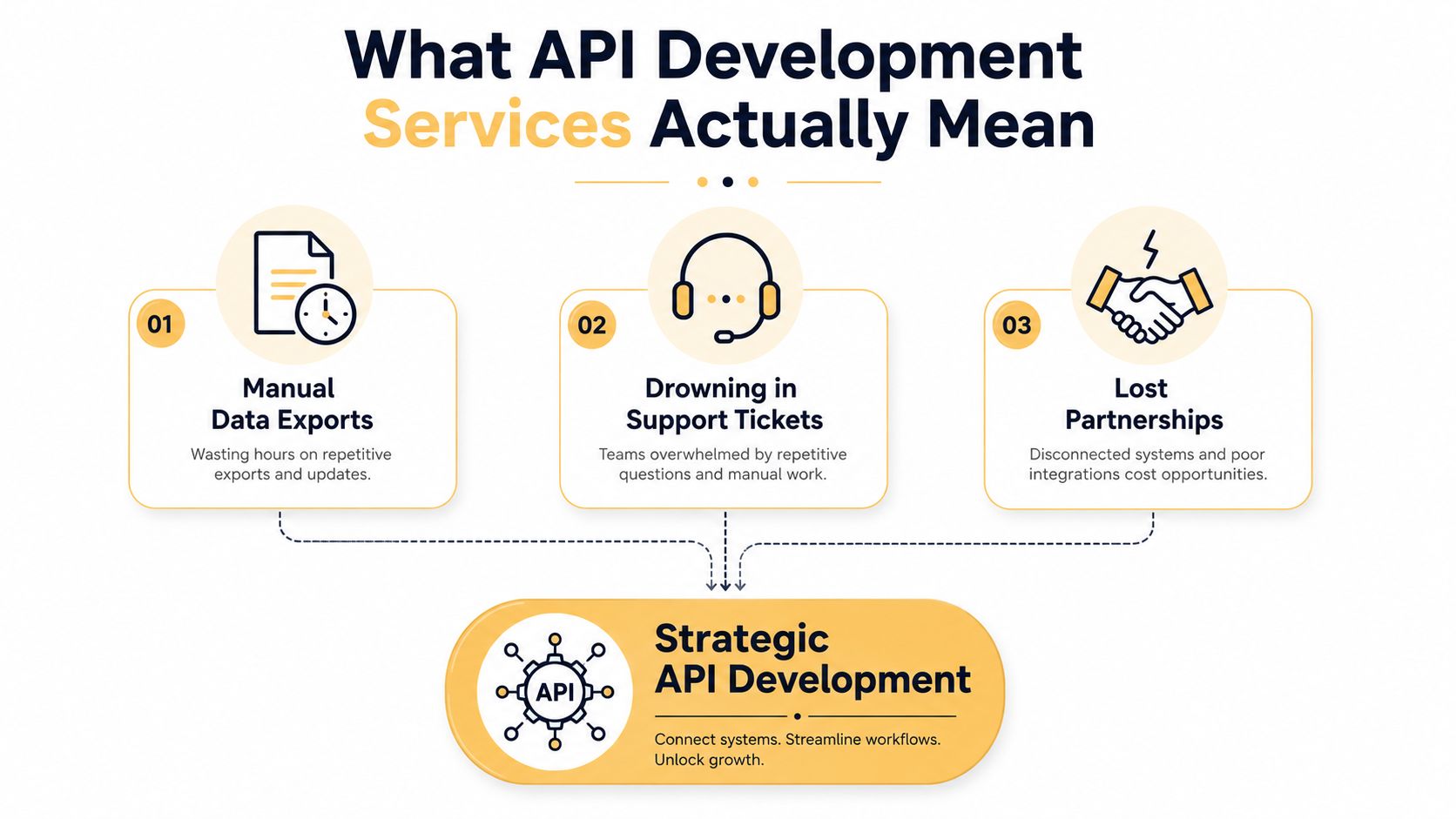
Your product works, but the business around it is starting to strain. Employees export data into spreadsheets, support teams answer questions that software should handle automatically, and prospective partners ask whether your systems can connect before they commit. Each workaround solves one immediate problem while making the next integration slower and more expensive.
That's why API development services should be treated as a business decision, not a coding task. A well-designed API can open a partner channel, automate a revenue-producing workflow, or give an internal team reliable access to information it currently retrieves by hand. A poorly designed one creates another system to document, secure, monitor, and repair.
For Omaha-area companies, the practical question isn't whether APIs matter. Your website, payment provider, warehouse system, CRM, mobile application, and analytics tools already depend on interfaces. The question is whether those interfaces are strategic assets or unmanaged liabilities.
What API Development Services Actually Mean
A founder usually notices the API problem when growth stops being smooth. Orders sit in a manual export queue, customer records must be copied between systems, and a promising partner walks away because integration would take too much custom work. The business has demand, but its software can't exchange information cleanly enough to support it.
The working definition is straightforward: API development services cover the end-to-end work of designing, building, documenting, securing, deploying, and maintaining the interfaces that let software exchange data and actions. That scope extends well beyond writing endpoint code.
The work behind a production API
A capable provider should help with:
- API strategy: Identify which workflows, systems, and partner opportunities deserve an interface first.
- Contract design: Define resources, requests, responses, errors, authentication, and versioning in OpenAPI or Protobuf.
- Implementation: Connect application logic, databases, payment systems, identity providers, warehouses, CRMs, and other dependencies.
- Quality assurance: Test ordinary requests, invalid input, retries, permissions, rate limits, and dependency failures.
- Documentation: Give internal developers and external consumers a usable reference, examples, onboarding path, and changelog.
- Operations: Deploy the service, add observability, configure alerts, and establish a process for changes and deprecation.
- Lifecycle management: Maintain compatibility, review usage, rotate credentials, investigate incidents, and retire old versions safely.
The value appears in the workflow the API changes. A partner can onboard without a custom data exchange. A staff member no longer reconciles the same records every morning. A mobile application can use the same business logic as the web product. An integration becomes a repeatable channel instead of a one-off engineering project.
Why the business interface matters
APIs became strategically important as the broader API economy developed from early web-services foundations in the late 1990s and early 2000s. SOAP emerged in 2000 for structured XML message exchange, while Roy Fielding's 2000 dissertation defined REST, which later became the dominant philosophy for web APIs built around HTTP methods and resource-oriented patterns. In November 2000, eBay launched an API for approved partners to list items and access auction data programmatically, demonstrating that an API could extend a platform beyond internal systems into an external developer ecosystem. API Evangelist's API timeline documents that progression.
The two issues most vendors underplay are AI-agent readiness and post-launch security operations. An API now needs to be clear and constrained enough for autonomous software to consume safely, and it needs continuous inventory, monitoring, and abuse detection after launch. Those are deliverables, not future enhancements.
Comparing REST, GraphQL, and gRPC
The right protocol depends on one question: who's calling the API, and how often? A public partner API has different needs from an internal service that handles latency-sensitive traffic. Choosing GraphQL or gRPC because it sounds modern is a reliable way to buy complexity you don't need.
REST remains the default for most public web, mobile, and partner integrations. It uses familiar HTTP methods, works with widely available tooling, and gives vendors an accessible hiring pool. Pair it with an OpenAPI contract, consistent error responses, authentication, pagination, and clear versioning. Its weaknesses are predictable. Clients may receive more data than they need, or make several calls to assemble one screen.
GraphQL earns its place when multiple consumers need different views of the same connected data. A browser, mobile application, partner portal, and internal dashboard can request different fields without requiring a separate endpoint for every presentation. That flexibility comes with harder caching, query-cost controls, authorization at field or resolver level, and protection against expensive nested queries. Use GraphQL when consumer variation is the problem, not because REST feels ordinary. Teams comparing the trade-offs can also review this detailed GraphQL versus REST API analysis.
gRPC is a strong internal choice for service-to-service communication where low latency, compact payloads, streaming, and generated clients matter. Benchmark research reports gRPC as faster than REST and GraphQL, with one microservices study reporting an average gRPC response time of 3.1 ms in its test setting. The comparative protocol study supports measuring the actual workload rather than selecting a protocol by reputation. gRPC is less convenient for direct browser consumption, so external access commonly needs a gateway or translation layer.
| Criteria | REST | GraphQL | gRPC |
|---|---|---|---|
| Best audience | Public clients, partners, mobile apps | Multiple clients with varied data needs | Internal services |
| Main strength | Compatibility and tooling | Precise, consumer-shaped queries | Low-latency, schema-first calls |
| Main trade-off | Over-fetching and chatty calls | Query complexity and caching | Browser access and learning curve |
| Sensible default | Yes, for most SMB APIs | Only with clear consumer variation | For performance-sensitive internal traffic |
Whatever protocol you choose, test authentication, authorization, malformed input, object access, rate limits, and error handling. A practical resource on automated API security testing can help shape that test plan. My default recommendation for a ten-person company is REST plus OpenAPI, unless a specific workload justifies GraphQL or gRPC.
Tech Stacks and Architecture Patterns That Scale
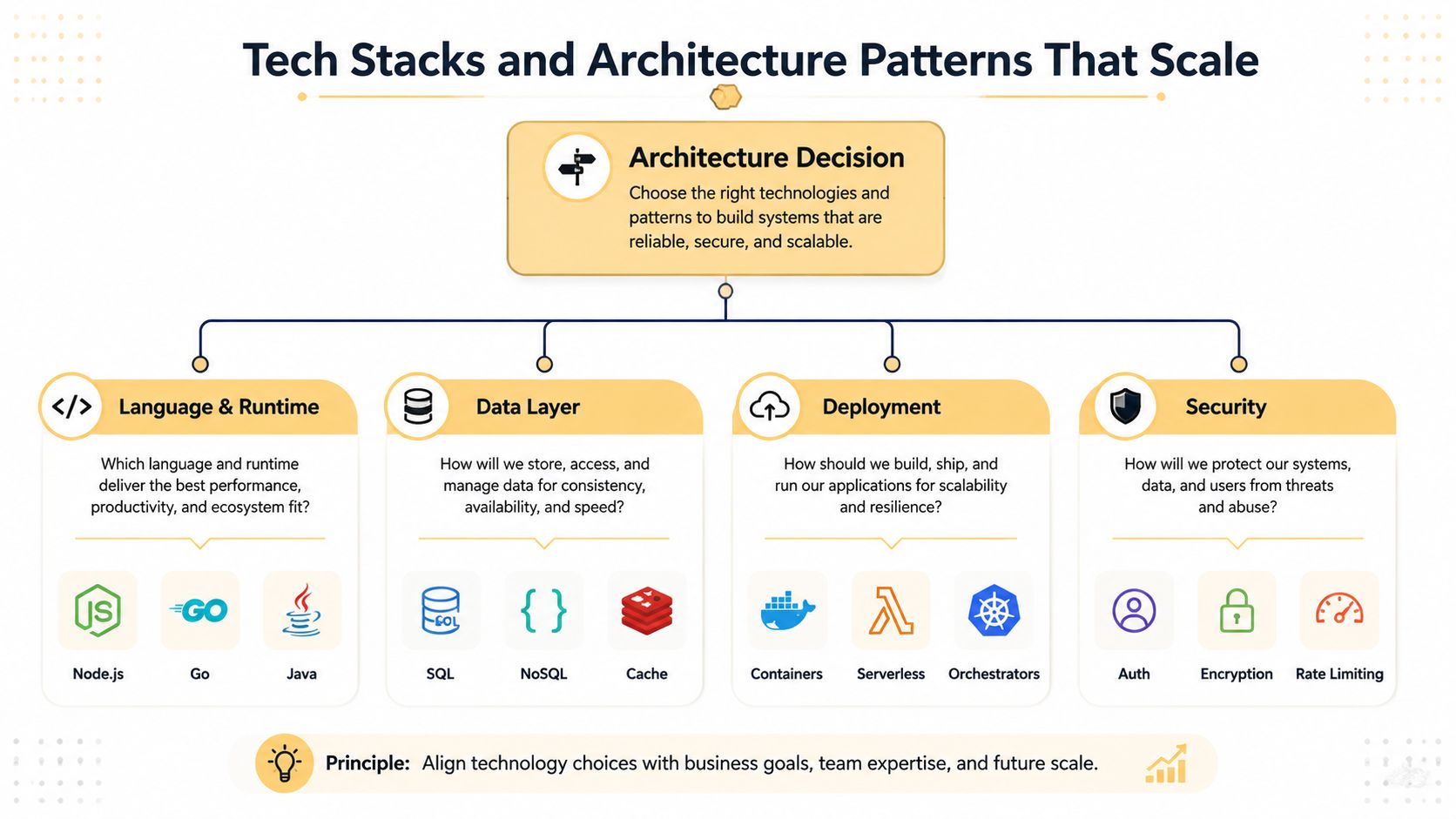
Architecture decisions should follow your team, traffic pattern, data, and operational capacity. A vendor who starts with a framework before asking what the API must accomplish is starting in the wrong place.
Choose the runtime around the team
For many SMBs, Node.js with TypeScript is a practical default because it supports rapid product work and makes it easier to share types across web applications and services. Go fits high-throughput, concurrent services with a small runtime footprint. Java remains a sensible choice where enterprise libraries, established internal expertise, and long-lived systems dominate. Python belongs in data-heavy endpoints, automation, and machine-learning workflows, especially when the API sits close to analytical code.
The language matters less than whether the provider can explain its operational consequences. Ask how the service will handle dependency timeouts, background work, validation, tracing, and upgrades.
Keep the data layer boring
PostgreSQL is the starting point for most business APIs. It handles transactional records, reporting needs, constraints, and mature tooling without forcing a small team to operate several databases. Add Redis when measured read pressure or session and cache requirements justify it. Put slow or retryable work behind a queue such as Amazon SQS or RabbitMQ instead of making a user wait on every downstream operation.
For deployment, use containers on a managed platform for many teams. Kubernetes can be appropriate when traffic, isolation, deployment complexity, or team capacity demands it, but it shouldn't be a status symbol. A modular monolith often gives a small team cleaner boundaries without the distributed-system overhead of many independently operated services. Teams evaluating broader platform choices can use this guide on how to choose a tech stack.
Add the controls that prevent expensive rewrites
Start with an API gateway for authentication, routing, and rate limiting. Define versioning before the first external consumer arrives. Use idempotency keys on payment, order, and other write endpoints so a retry doesn't create a duplicate action. Add structured logs, distributed tracing, dashboards, and alerts before launch, not after the first incident.
A ten-person team should usually begin with one deployable service, PostgreSQL, a managed container platform, a queue for asynchronous tasks, a gateway, OpenAPI in the repository, and automated CI/CD. That stack can grow. The important part is that its boundaries and operating rules are explicit.
Security, Compliance, and AI-Agent Readiness
Security starts before the first endpoint ships and continues through every release. Documentation alone doesn't protect an API. Governance has to enforce naming, versioning, authentication, authorization, schema validation, and version-aware standards across the lifecycle.
A centralized governance model reduces integration errors and security drift by making those decisions consistent. Define OpenAPI or Protobuf constraints early, enforce them in CI/CD, and use a gateway or service mesh to apply routing and security policy uniformly. That approach also standardizes rate limiting, token handling, encryption in transit, and least-privilege access. Redocly's API security guidance provides useful detail on schema and governance controls.
Match controls to exposure
| Control | Public API | B2B Integration | Regulated PCI or HIPAA |
|---|---|---|---|
| Identity | OAuth 2.1, scoped tokens, strong key management | OAuth or mutual TLS with partner-specific scopes | Mutual TLS or tightly managed OAuth, private access where appropriate |
| Schema control | OpenAPI checks in CI | Contract testing and compatibility gates | Versioned schemas with evidence retained for audits |
| Traffic protection | Gateway rate limits and abuse detection | Per-partner quotas, circuit breakers, replay protection | Strict gateway policy, segmentation, and documented exceptions |
| Auditability | Security events and access logs | Partner actions, data access, credential events | Structured audit logs shipped to a SIEM with retention controls |
| Data protection | Encryption in transit and at rest | Minimize shared fields and isolate tenants | Consider private endpoints, dedicated tenants, and customer-managed keys |
Compliance should map evidence to engineering controls rather than run as a disconnected paperwork exercise. PCI DSS, HIPAA, GDPR, and CCPA may change the required boundaries, retention, access model, and residency decisions, but they don't eliminate the need for clear contracts and operational monitoring.
Design for AI agents before they arrive
Postman's 2025 State of the API Report says 89% of developers use AI, while only 24% design APIs for AI agents. That gap is the clearest signal that agent readiness deserves deliberate design. The report is available through Postman's 2025 State of the API Report.
An agent-ready API needs machine-readable discovery, unambiguous schemas, safe response shapes, scoped short-lived tokens, per-agent identity, explicit confirmation for consequential actions, and spend or usage caps. Treat prompt injection as a boundary problem. The API must validate authorization and arguments independently, even when an agent supplies them through a trusted-looking tool call.
Scraping and automated access also make gateway policy important. Security teams should understand abuse paths, including research on how attackers attempt to bypass PerimeterX, while defending their own endpoints rather than relying on obscurity. Use this alongside practical web application security best practices, not as a substitute for authorization and monitoring.
Salt's 2025 API security research reports that 80% of organizations lack continuous, real-time API monitoring, 33% experienced an API security incident in the past year, and 50% delayed a new application rollout because of API security concerns. The same research reports that only 19% are very confident in inventory accuracy, while 54% rely on developer documentation to identify sensitive data exposure. Salt's API security findings make the operational lesson clear: inventory, runtime detection, and launch readiness belong in the delivery plan.
Deliverables, Timelines, and Pricing Models
A proposal for API development services should describe artifacts, decisions, and ownership. “Backend development” isn't a deliverable. You should know what lands in your repository, how you'll operate it, and what happens after the vendor leaves.
Require a complete handoff
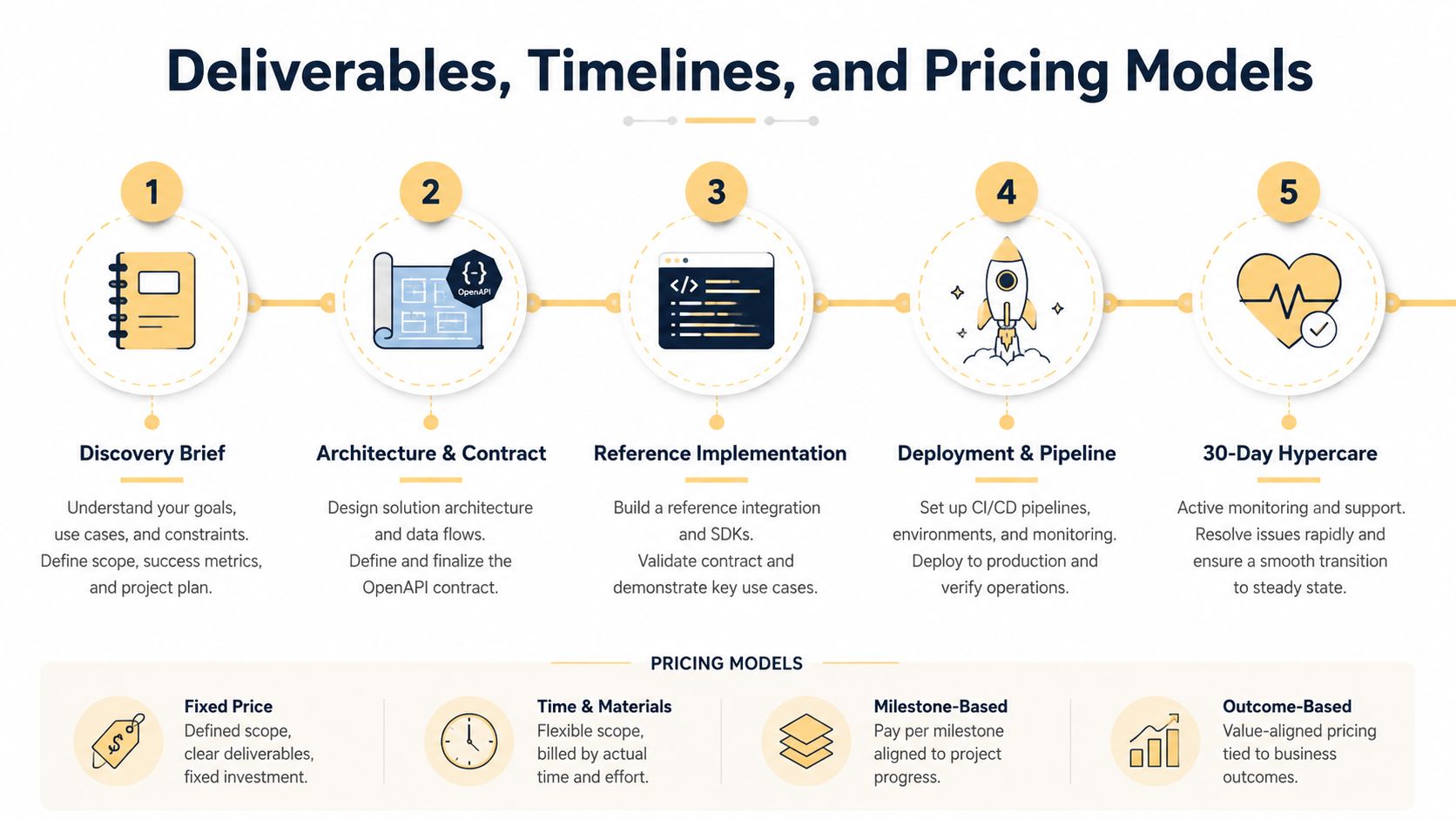
A serious engagement should produce:
- Discovery brief: Business workflows, consumers, dependencies, risks, and success criteria.
- Architecture package: System diagram, data boundaries, deployment model, security decisions, and failure paths.
- API contract: OpenAPI for REST or Protobuf for gRPC, with examples, errors, authentication, and compatibility rules.
- Reference implementation: Working endpoints connected to representative data and integrations.
- Delivery infrastructure: CI/CD pipeline, infrastructure as code, environment configuration, migrations, and rollback procedure.
- Operating documentation: Runbook, dashboards, alerts, escalation path, changelog, and deprecation process.
- Hypercare: A defined 30-day post-launch support window for defects, operational tuning, and handoff questions.
Tie the schedule to scope
A single public CRUD API typically takes 4 to 6 weeks when requirements, systems, and decisions are clear. A multi-tenant B2B platform with authentication, billing webhooks, and a customer portal commonly runs 12 to 20 weeks. An enterprise integration involving legacy adapters and compliance evidence can take 6 to 9 months. These are scope ranges, not promises. A vendor should explain assumptions behind every range.
Three commercial models cover most engagements:
| Model | Protects the buyer when | Main risk |
|---|---|---|
| Fixed fee by milestone | Scope is defined and acceptance criteria are testable | Change requests can become expensive |
| Time and materials with a cap | Discovery may uncover integration uncertainty | The cap needs clear reporting and approval rules |
| Dedicated squad | The API is a continuing product with evolving priorities | You must manage prioritization and capacity |
Price moves with endpoint count, third-party systems, compliance scope, uptime expectations, data complexity, tenant isolation, and AI-agent features. Ask vendors to separate discovery, implementation, infrastructure, security testing, launch support, and ongoing operations. A low initial quote often excludes the work that prevents a costly second project.
Buyer rule: Never approve a fixed price until you know what the vendor considers an endpoint, an integration, a finished test, and a production-ready handoff.
How to Choose the Right API Development Partner
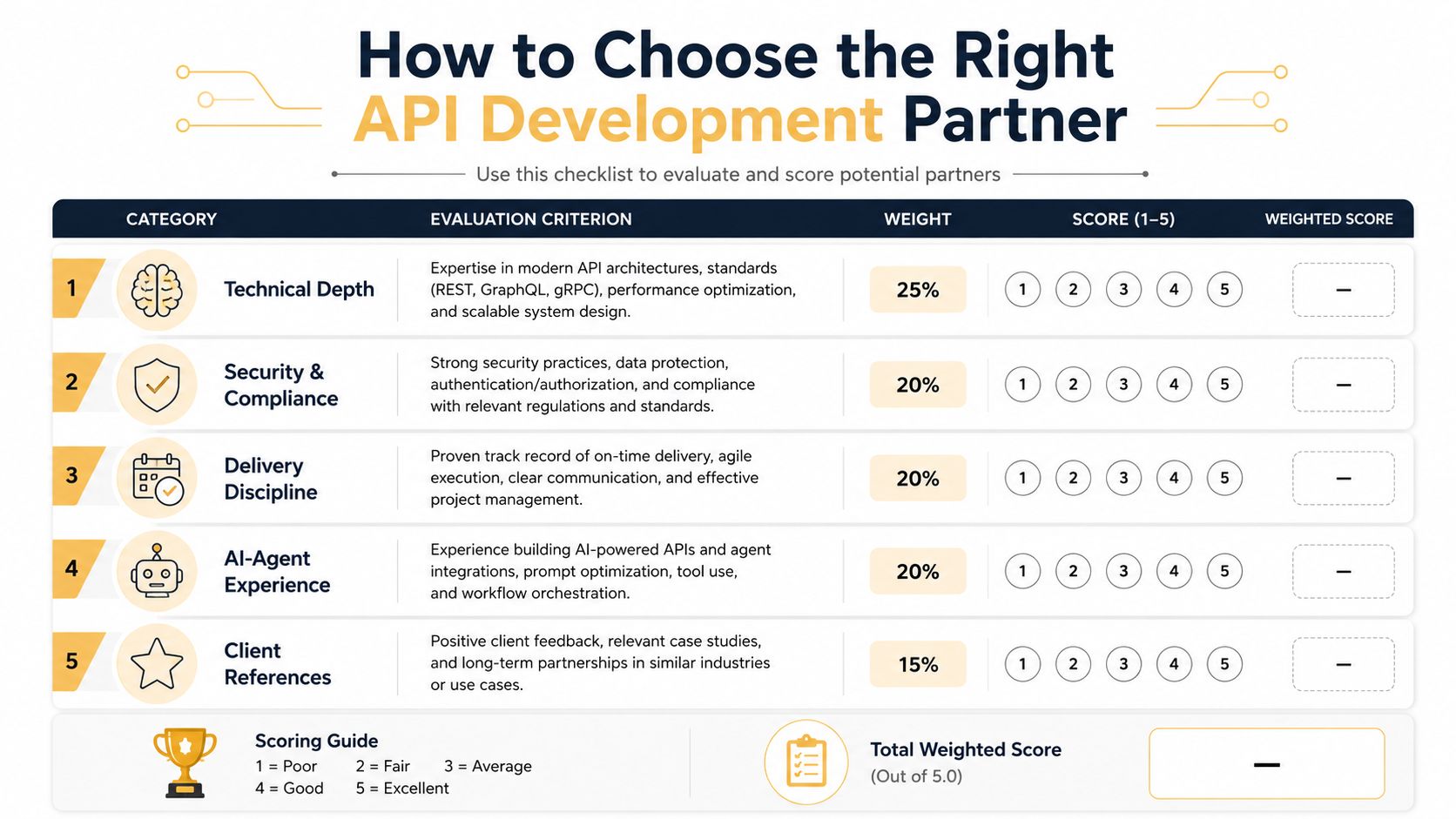
A polished pitch deck tells you very little. Evaluate vendors with a scorecard that forces evidence across technical depth, delivery discipline, security, AI-agent experience, domain fit, communication, and total cost.
Ask each provider to answer the same questions in writing. Weight technical depth and security heavily, then score the evidence rather than the confidence of the salesperson.
Copy this into your RFP
- Discovery process: What happens before implementation, and what decisions must discovery resolve?
- Schema-first workflow: Will you produce OpenAPI or Protobuf before coding, and how will CI enforce it?
- Security baseline: How will you handle identity, authorization, input validation, rate limiting, secrets, and dependency failures?
- Observability stack: Which logs, traces, dashboards, alerts, and incident procedures will ship with the API?
- Uptime expectations: What service-level objectives, escalation rules, and recovery practices support the proposed target?
- Data residency: Where will data be stored, processed, backed up, and accessed by support personnel?
- AI-agent readiness: Can the API support machine-readable discovery, per-agent permissions, safe actions, and spend controls?
- Ownership: Will source code, infrastructure as code, contracts, tests, documentation, and deployment credentials live in our repository?
- Exit clause: Can another team operate the system without proprietary lock-in or withheld documentation?
Disqualify a vendor that won't name the architect who'll lead the work, can't show a relevant production reference, offers a fixed price without a discovery phase, or refuses to put source code and infrastructure in your repository. Those aren't minor preferences. They expose how the provider handles accountability.
Use these interview questions:
- Tell me about an API incident you handled in production. What failed, how did you detect it, and what changed afterward?
- Show me how you'd version a resource when an existing partner needs compatibility but the business needs new behavior.
- How would you protect an agent that can create orders, issue refunds, or modify customer data?
A production team answers with trade-offs, failure modes, and artifacts. A presentation team stays at the framework level.
Real-World Examples From Local and Omaha Projects
A Midwestern e-commerce retailer had outgrown a single-warehouse workflow. Orders, inventory, and logistics data moved through disconnected processes, which made checkout depend on slow coordination between systems and limited the retailer's ability to add a logistics partner.
The recommended architecture used REST for broadly compatible commerce operations and GraphQL for consumer-specific storefront views. A logistics provider exposed a gRPC service, so the integration used an adapter rather than forcing the external system into the retailer's public protocol. The project delivered documented contracts, integration tests, deployment automation, and operational monitoring. The reported result was a 40% reduction in checkout latency, as described in the project brief, but that outcome shouldn't be generalized without the same baseline, workload, and measurement method.
An Omaha-based B2B publisher faced a different problem. Its content data sat behind fragmented APIs, and internal teams and external partners needed consistent access to structured publishing information. The team consolidated those surfaces behind a GraphQL gateway, with explicit schemas and permissions for different consumers. The architecture also exposed structured data to internal AI agents, rather than assuming human developers would remain the only API clients.
The useful patterns are simple:
- Match protocol to workload: External compatibility and internal latency aren't the same requirement.
- Design schemas around consumers: A contract should reflect real actions and data needs, not a database table copied into JSON.
- Treat the API as a product: Give it an owner, roadmap, documentation, security budget, usage visibility, and deprecation policy.
The point of local examples isn't to copy an architecture blindly. It's to connect technical choices to the business constraint that made them necessary.
Your Next Step and What to Bring to a Consultation
You have two choices. Keep extending spreadsheets, manual exports, and Zapier-style glue, or invest in an API boundary that makes each future integration easier to deliver. The first option feels cheaper because its costs hide in staff time, support work, missed partnerships, and fragile workarounds. The second requires deliberate design, but it gives the business a reusable foundation.
A consultation should begin with the workflow, not a preferred framework. Bring the process you wish you could automate, the systems that need to exchange information, the people or partners who will consume the API, and the action that must become faster or more reliable. If you don't have precise traffic figures, bring the best operational estimate you have and identify the busiest workflows.
Bring these details to the first call
- One painful workflow: For example, order reconciliation, inventory synchronization, customer provisioning, or content distribution.
- Two or three systems: Name the applications, databases, vendors, and legacy tools that need to communicate.
- Usage expectations: Share a rough monthly request volume, peak periods, and whether traffic is human, automated, or agent-driven.
- Security obligations: Identify PCI, HIPAA, GDPR, CCPA, contractual controls, residency requirements, or customer-managed key expectations.
- Commercial boundaries: Bring a budget range, target launch window, internal technical capacity, and preferred ownership model.
- Existing material: Include database diagrams, integration documentation, sample payloads, current error logs, and any partner requirements.
Up North Media is an Omaha-based digital agency that offers web application development, custom integrations, automation workflows, and AI consulting. For an API project, the useful discussion is whether its team can connect those capabilities to your specific workflow, systems, security requirements, and operating model.
The first call should be a fit assessment, not a sales pitch. You should leave with a clearer problem statement, the information still missing, the likely architectural decisions, and a sensible next step. If a vendor jumps straight to a framework and a quote without understanding the workflow, keep looking.
Bring the RFP checklist from the previous section, ask every provider for the same evidence, and compare what they'll deliver. Then choose the partner that can own the contract, implementation, security operations, documentation, and handoff, not the partner that promises to write endpoints quickly.
If your Omaha-area business is losing time to manual exports, disconnected systems, or partner integration delays, Up North Media can help evaluate the workflow and plan production API development, custom integrations, and AI-ready automation. Book a free consultation with the team, and bring your systems, constraints, and highest-value workflow so the conversation starts with a real business problem.