
You're probably making this decision earlier than you want to.
A new app is on the roadmap. Maybe it's an e-commerce storefront with custom account features, a client portal, a subscription product, or a mobile experience that has to pull data from inventory, CMS content, pricing, and user accounts all at once. On paper, the question sounds technical. In practice, it affects budget, timeline, user experience, and how often your team gets blocked waiting on backend changes.
That's why the GraphQL vs REST API debate matters. It's not a developer argument about syntax. It's an architectural choice that shapes how quickly your team can ship, how expensive the platform becomes to maintain, and where performance problems show up later.
The API Choice That Defines Your Application's Future
Most businesses don't need the “most modern” API style. They need the one that fits the product they're building.
REST is still the safe default in many projects. It's familiar, well understood, and works especially well when your application deals with straightforward resources like products, orders, blog posts, or customer records. If your team wants predictable behavior and broad tooling support, REST is usually the easiest place to start.
GraphQL solves a different problem. It becomes attractive when the frontend needs flexible access to many related pieces of data, especially if web and mobile teams need different shapes of that data. In those cases, GraphQL can remove a lot of friction between frontend requirements and backend delivery.
Early decisions here tend to stick. Once your API powers customer-facing features, changing direction gets more expensive. The wrong choice doesn't just create technical debt. It creates delivery debt. Developers spend more time building workarounds, project managers juggle dependencies, and product changes move slower than they should.
Here's the short version:
| Business concern | REST | GraphQL |
|---|---|---|
| Best fit | Simple, stable resource access | Complex, changing frontend data needs |
| Learning curve | Lower | Higher |
| Caching | Strong with standard HTTP and CDN patterns | Usually needs more custom strategy |
| Frontend flexibility | Lower, depends on endpoint design | Higher, clients request exact fields |
| Operational complexity | Lower | Higher |
| Good default for SMBs | Often yes | Sometimes, if data relationships are complex |
The mistake is treating this as a winner-take-all decision. In real production systems, teams often use both. The better question is simpler: where does each approach reduce cost, speed delivery, or remove bottlenecks for your business?
Foundational Concepts REST and GraphQL Explained
REST and GraphQL solve the same business problem. They let applications read data and send updates. The difference is how they structure requests, how much coordination they require between teams, and how much complexity they introduce as the product grows.
That design choice affects delivery speed early.
How REST works
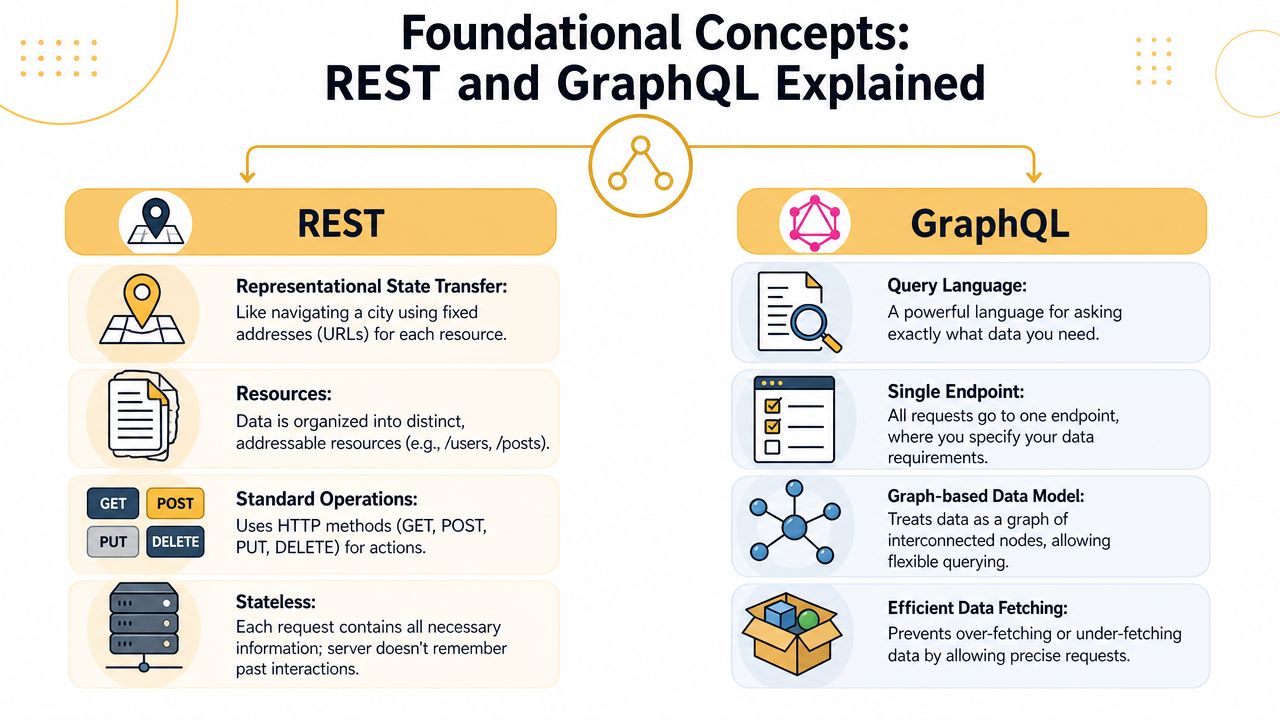
REST organizes data around resources. A product might sit at /products/123. A customer might sit at /customers/456. Teams then use standard HTTP methods such as GET, POST, PUT, and DELETE to read or change those resources.
For a business owner or project manager, the practical benefit is clarity. REST usually mirrors how the business already thinks about its data: products, orders, customers, carts. That makes onboarding easier, speeds up documentation, and reduces ambiguity during development.
Roy Fielding described REST in his 2000 doctoral dissertation at the University of California, Irvine. That history matters less than the reason REST became common. It fits standard web infrastructure well, and teams can usually ship a working version quickly without adding a lot of API-specific tooling.
How GraphQL works
GraphQL uses a different model. It often exposes one endpoint and lets the client send a query for the exact fields it needs, including related records.
That flexibility is attractive on products with complex screens. An ecommerce product detail page may need product data, stock status, pricing rules, reviews, related items, and CMS content. In REST, teams often gather that through several endpoints or build a custom endpoint for that page. In GraphQL, the client can request that shape directly.
GraphQL was created at Facebook and later released as an open specification. The official GraphQL documentation explains the core idea clearly: the schema defines what data is available, and clients query only the fields they need.
What this means in practice
REST usually shifts more response-shaping work to the backend team. If the frontend needs a new combination of fields, developers often add or change an endpoint. That can be perfectly fine on stable applications where screens do not change often.
GraphQL shifts more of that flexibility to the client side, but it does not remove backend work. Someone still has to design the schema, write resolvers, set permissions, control query depth, monitor performance, and manage caching rules. This is one of the hidden costs teams miss when they assume GraphQL is automatically the faster option.
I have seen small teams choose GraphQL too early and spend extra time solving problems they did not have yet. I have also seen content-heavy and multi-device products save real development time with GraphQL because frontend teams stopped waiting for new endpoint variants every sprint.
A simple rule works well here. REST fits best when your data maps cleanly to stable business resources. GraphQL starts to pay off when the same backend data must support many changing views across web, mobile, and content-driven experiences.
For teams comparing real implementations, the Saaspa.ge developer API is a useful example of how an endpoint-first API is presented in production, which helps clarify whether your project needs that simplicity or the extra flexibility of GraphQL.
Core Architectural Comparison A Head to Head Analysis
Choosing between REST and GraphQL is less about feature lists and more about where the cost shows up later. One approach may save frontend time but add backend governance. The other may keep operations simpler but slow down feature delivery once product requirements start branching across web, mobile, and third-party channels.
For business owners, that distinction affects budget as much as code quality. The API style you pick shapes how fast new screens ship, how easy the platform is to cache, and how much specialist effort the team needs to keep performance under control.
Data fetching and payload control
This is the category where GraphQL usually makes the strongest business case.
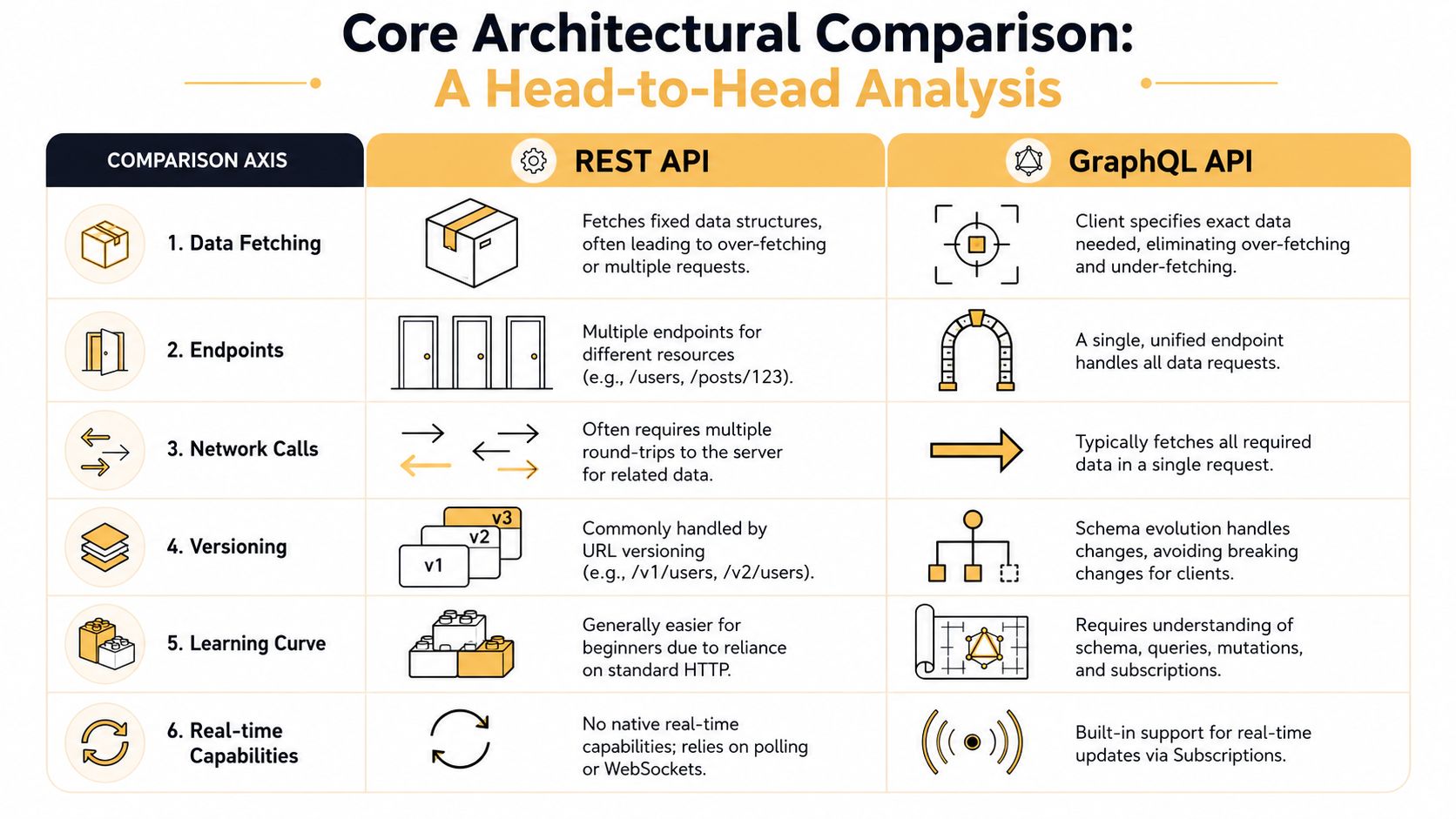
REST endpoints return predefined shapes. That works well if your product has stable views and every client needs roughly the same data. It starts to create waste when a mobile app needs a small subset, a desktop view needs related records, and a partner integration wants something else again. Teams then face a familiar agency problem: accept larger responses than needed, add more endpoints, or keep building special-purpose variants that increase maintenance.
GraphQL gives the client more control over fields and relationships in a single request. In practice, that can reduce unnecessary payloads on mobile apps and content-heavy products. The upside is real, but it depends on the product structure. A simple account dashboard or inventory tool may not gain much. A storefront with personalized blocks, product recommendations, reviews, and availability checks often gains more.
This trade-off usually becomes clearer during planning for a custom web application build process, because data needs look simple early and become more fragmented once the product serves multiple devices and user journeys.
Performance and the myth that GraphQL is always faster
GraphQL is not automatically faster. It is often more efficient for the client.
That difference gets lost in sales pitches and technical debates. GraphQL can reduce round trips and avoid sending unused fields, which can improve the user experience on complex screens. But protocol flexibility does not remove resolver overhead, query parsing, or database fan-out. If the backend is poorly structured, GraphQL can become slower than a plain REST design serving predictable resources.
WunderGraph's review of benchmark data found REST outperforming GraphQL on latency and requests per second in simple, high-concurrency workloads, especially once traffic patterns became repetitive and easy to optimize with standard HTTP behavior: https://wundergraph.com/blog/fact-checking-graphql-vs-rest
That lines up with what teams see in production. For public APIs, admin systems, and flat CRUD patterns, REST often has the cleaner performance profile. For apps that assemble several related objects into one screen, GraphQL can improve perceived speed because the client gets what it needs in fewer calls.
The University of Washington benchmark paper showed a mixed result rather than a simple winner. In some scenarios Apollo GraphQL produced lower round-trip times, while REST performed better under heavier concurrency and more repetitive access patterns: http://faculty.washington.edu/wlloyd/papers/graphql-camera-ready.pdf
The practical takeaway is simple. Measure performance against your own workload. Do not choose GraphQL because it sounds faster in theory.
Caching and infrastructure behavior
REST has the easier operating model here.
It fits naturally with HTTP caching, CDN rules, cache headers, and endpoint-level monitoring. If your catalog pages, product records, blog posts, or account resources are predictable, REST usually costs less to optimize and less to explain to new developers.
GraphQL can still perform well, but teams usually need more planning around persisted queries, field-level caching, resolver batching, and client cache normalization. Apollo's guidance on GraphQL caching makes this clear: strong performance comes from deliberate cache design, not from GraphQL alone: https://www.apollographql.com/docs/react/caching/overview
That extra engineering work is often worth it for products with complex screens. It is harder to justify for a smaller business site, a partner API, or a system where the same requests repeat all day.
A practical comparison:
| Area | REST | GraphQL |
|---|---|---|
| Caching model | Native HTTP and CDN patterns | Usually query-aware or client-side caching |
| Server work per request | More predictable | Can vary widely by query shape |
| Payload efficiency | Often returns fixed data sets | Client can request only needed fields |
| Best performance profile | Repeated, cacheable resource access | Multi-resource views with changing client needs |
Developer workflow and delivery speed
Delivery speed depends on who is waiting on whom.
With GraphQL, frontend teams can move faster if the schema already exposes the right relationships. A new page may only require a new query instead of a backend ticket for another endpoint. That can shorten release cycles on products with frequent UX changes.
REST usually wins on team familiarity and lower coordination cost. Developers, QA, support teams, and outside vendors tend to understand endpoint-based APIs quickly. Documentation is often easier to structure. Debugging is usually more direct because each URL has a narrower purpose.
I would frame it this way for a client. GraphQL can reduce friction in feature delivery once the product gets complex. REST usually reduces staffing risk and operating overhead earlier on.
Error handling and security posture
REST errors are easier for many teams to reason about because HTTP status codes map cleanly to request outcomes. GraphQL can return partial data and errors together, which is useful but requires more discipline in frontend handling, testing, and monitoring.
Security also shifts in emphasis. GraphQL needs clear limits on query depth, complexity, introspection access, and resolver behavior. The official GraphQL security guidance covers common controls such as demand limiting and trusted documents: https://graphql.org/learn/security
REST has its own risks, but they are usually more familiar: endpoint exposure, weak authorization checks, inconsistent versioning, and input validation gaps.
Neither option is safer by default. GraphQL asks for tighter query governance. REST asks for disciplined endpoint management. The better choice is the one your team can operate well six months after launch, not the one that sounds more modern in a kickoff meeting.
Real World Scenarios When to Use GraphQL vs REST
A team usually feels this decision when the first version ships and new requests start piling up. The storefront works, but marketing wants custom landing pages, the mobile app needs lighter payloads, and operations wants partner access without breaking internal workflows. That is the point where API style stops being a technical preference and starts affecting delivery speed, maintenance cost, and how much complexity the team can absorb.
A simple rule helps. Choose the API style that matches the shape of the product you expect to run in 12 to 24 months, not just the MVP you want to launch this quarter.
When REST is the better business decision
REST is often the safer choice when your application centers on stable resources and predictable actions. Product, order, customer, invoice, booking, and account objects map cleanly to endpoints. Teams usually ship these systems faster because the contract is easier to explain, test, and support.
REST tends to work well in cases like:
- Partner and third-party integrations: External developers usually prefer clear URLs, standard HTTP methods, and response behavior that fits common API tooling.
- Internal business systems: Admin panels, inventory tools, CRMs, and scheduling platforms often need reliability and clarity more than query flexibility.
- Catalog or content delivery with heavy caching: If page speed depends on CDN caching and straightforward GET requests, REST keeps the setup simpler.
- Early-stage products with lean teams: A smaller team can usually hire for REST skills faster and spend less time on schema design, resolver tuning, and query governance.
In practice, I recommend REST first for many SMB builds because it limits moving parts. That matters if the budget is fixed, the roadmap is still changing, or outside vendors will touch the system later.
When GraphQL earns its keep
GraphQL starts to make sense when one screen needs data from several places and each client wants a different slice of it. The benefit is not "GraphQL is always faster." A key benefit is control over data shape. Sometimes that reduces payload size and cuts extra requests. Sometimes it does not, especially if the backend work behind one query is expensive or poorly tuned.
That distinction matters for planning.
GraphQL is a strong fit for:
- Mobile apps with mixed connection quality: Fewer round trips and tighter payloads can help, especially on screens that aggregate user, content, and transactional data.
- Content-rich platforms: Homepages, article pages, author pages, recommendations, and personalization blocks often pull from CMS, search, analytics, and user systems at once.
- Complex e-commerce experiences: Modern product pages can require pricing, stock, reviews, related products, promotions, loyalty data, and CMS content in one render path.
- Multi-channel frontends: If web, mobile, kiosk, and internal tools all consume the same domain data differently, GraphQL can reduce frontend-specific endpoint sprawl.
There is a cost, though. GraphQL shifts work from endpoint design to schema management and resolver performance. A poorly designed GraphQL layer can trigger expensive backend fan-out, duplicate database calls, and harder-to-predict infrastructure load. For a business owner, that means the wrong implementation can erase the delivery gains and show up later as cloud cost, debugging time, and slower releases.
The myth to drop early
GraphQL is not automatically faster than REST.
On some pages, it is faster because the client gets exactly the fields it needs in fewer requests. On other pages, REST wins because cached endpoints are cheap to serve and easier to optimize at the edge. Benchmarks and production results vary by query design, caching strategy, resolver quality, and the number of backend systems involved.
The useful question is simpler: where is the bottleneck in your product? Network chatter, frontend coordination, backend compute, CDN caching, or team capacity? Your answer points to the better fit.
The hybrid model is common for a reason
Many growing platforms end up with both. REST handles stable external contracts such as partner access, order submission, or catalog feeds. GraphQL serves the company's own apps where page composition changes often and the frontend needs more control.
That split is practical, not ideological.
A commerce business is a good example. Partners may get REST endpoints for orders and inventory because those flows are stable and easy to document. The company's storefront or app may use GraphQL to assemble promotions, content blocks, customer data, and product details for each view. That keeps external integrations predictable while giving the product team more flexibility where it affects conversion and release speed.
If you are still defining product scope, this guide on building a web application from scratch is a useful planning reference before the API contract gets locked in.
See the Difference Sample Requests and Responses
The cleanest way to understand GraphQL vs REST API behavior is to compare the same job in both styles.
Assume a page needs two things:
- A user's profile information
- The titles of that user's last five blog posts
With REST, you'll usually make separate requests because profile data and posts are different resources.
REST example
Request 1
GET /api/users/123
Response
{
  "id": 123,
  "name": "Ava Carter",
  "email": "ava@example.com",
  "phone": "555-0101",
  "address": {
    "street": "100 Main St",
    "city": "Omaha",
    "state": "NE"
  },
  "createdAt": "2026-01-10T12:00:00Z",
  "updatedAt": "2026-02-01T09:30:00Z"
}
Request 2
GET /api/users/123/posts?limit=5
Response
[
  {
    "id": 9001,
    "title": "Launching a New Storefront",
    "body": "Full post content...",
    "tags": ["ecommerce", "ux"],
    "publishedAt": "2026-02-10T08:00:00Z"
  },
  {
    "id": 9002,
    "title": "Managing Seasonal Inventory",
    "body": "Full post content...",
    "tags": ["operations"],
    "publishedAt": "2026-02-08T08:00:00Z"
  }
]
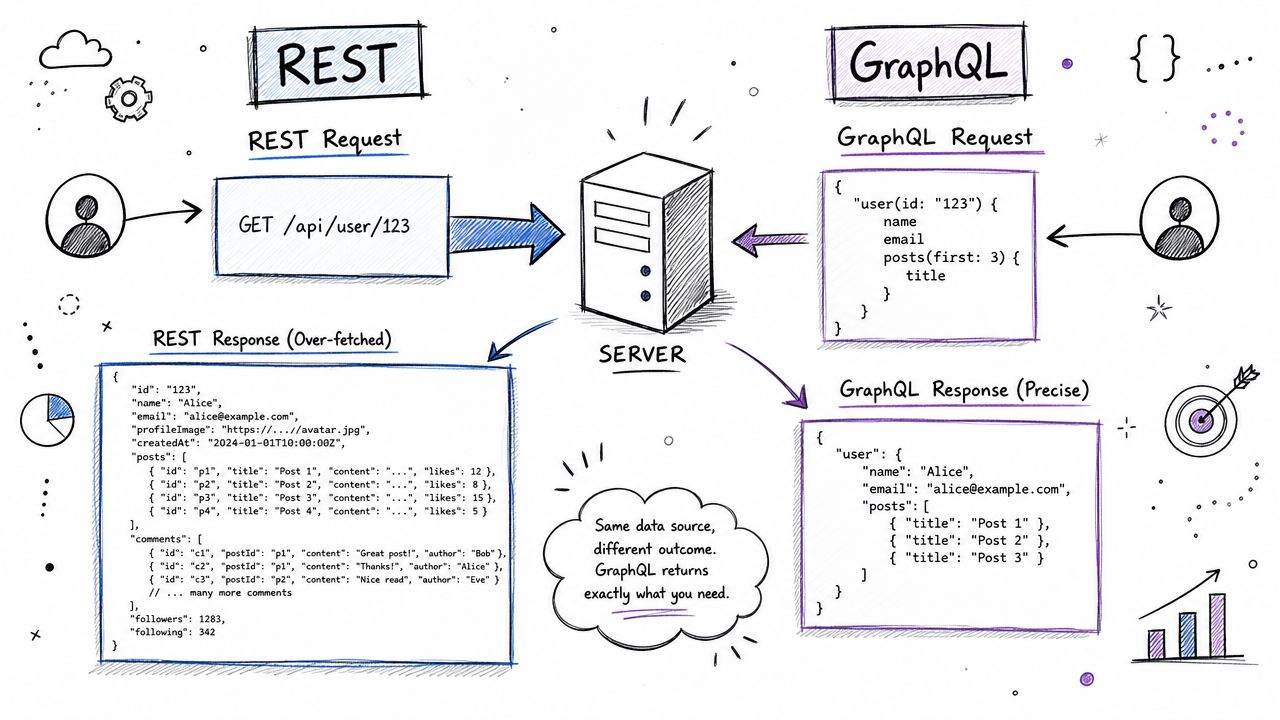
That works, but the client receives fields it may not need, like phone, address, full post body, and tags.
GraphQL example
With GraphQL, the client can request exactly what the screen needs in one call.
Query
query {
  user(id: 123) {
    name
    email
    posts(limit: 5) {
      title
    }
  }
}
Response
{
  "data": {
    "user": {
      "name": "Ava Carter",
      "email": "ava@example.com",
      "posts": [
        { "title": "Launching a New Storefront" },
        { "title": "Managing Seasonal Inventory" }
      ]
    }
  }
}
What this means in practice: REST returns what the endpoint was designed to return. GraphQL returns what the client asked for.
That's the heart of the trade-off. REST is simpler to expose and cache. GraphQL is better at serving custom view-level data needs without multiplying endpoints.
Implementation Costs and Migration Strategies
A lot of teams choose an API style based on a demo. The invoice arrives later.
Implementation cost is not just the first sprint. It shows up in how quickly the team can ship, how easy the stack is to support, and how much extra engineering work appears once traffic grows.
REST usually wins on familiarity. Teams can define endpoints, plug into standard auth and logging patterns, and ship a usable API without introducing many new concepts. That lowers onboarding time and reduces hiring risk, especially for small and mid-sized businesses that do not have specialists focused on API platform work.
GraphQL can reduce frontend friction, but it adds real design and operations overhead. The cost is rarely the query syntax itself. It comes from the systems around it.
Where costs usually show up
The expensive parts of GraphQL tend to appear after the first release:
- Schema design: The schema becomes a contract across products and teams, so mistakes are expensive to undo.
- Resolver performance: A clean query can still trigger inefficient backend calls and unnecessary database work.
- Caching: REST fits standard HTTP and CDN caching more naturally. GraphQL often needs custom cache rules or persisted queries.
- Governance: Teams need query depth limits, rate limits, field-level permissions, and better observability than many REST projects start with.
For simple, cacheable resources, REST often stays cheaper to run and easier to tune. GraphQL can also consume more server time because the platform has to parse queries, validate them, and resolve client-defined field combinations before it returns a response. That does not make GraphQL a bad choice. It means the budget should account for platform work, not just feature work.
I usually frame it this way for clients. REST is often cheaper to launch. GraphQL can pay off later if the product has several frontends, fast-changing interfaces, or screens that combine data from multiple systems.
How to migrate without rewriting everything
A full replacement is rarely the right move.
The lower-risk option is to keep the existing REST services and add GraphQL as a thin composition layer for the parts of the product that need more flexible queries. That lets frontend teams build new experiences without forcing the business to rebuild stable backend systems that already work.
This approach changes the economics in your favor:
- Existing REST endpoints keep serving current apps and partner integrations.
- New web or mobile features can use GraphQL where the UI needs more control over the response shape.
- The team can measure whether GraphQL is reducing frontend effort before expanding it further.
That phased model is often the right fit for growing e-commerce stores, membership platforms, and content products. It is also common in agencies that inherit mixed systems from prior vendors, including projects that already depend on specialist partners such as a blockchain development company for selected backend services.
Questions to ask before greenlighting GraphQL
A short review with engineering and product leads usually surfaces cost drivers:
- Will the frontend benefit enough to offset the added platform work?
- Can the current team design and maintain a schema without slowing delivery?
- Is caching a major part of your performance strategy?
- Do you have a plan for query limits, resolver tracing, and access control?
- Are you solving a real product problem, or following a tooling trend?
If the architecture may also include function-based workloads or usage-based hosting, this guide to what serverless architecture means in practice gives useful context. API style and runtime choices often affect each other more than teams expect.
Making the Right Choice for Your Business
A business owner usually asks a simpler question than the engineering team does. Which option gets the product live faster, keeps future changes affordable, and does not create avoidable scaling problems a year from now?
That is the right lens for GraphQL vs REST. This choice affects delivery speed, frontend effort, caching strategy, hiring risk, and how expensive change requests become after launch.
Start with the cost of change
REST is usually the safer business choice when the product model is clear and the workflows are predictable. If the system revolves around products, orders, bookings, invoices, user accounts, or standard CMS content, endpoint-based APIs are often faster to ship and easier for new developers to maintain.
GraphQL starts to make sense when the interface keeps changing, several clients need different slices of the same data, or the product pulls data from multiple backends into one screen. In those cases, the extra schema and resolver work can reduce repeated backend endpoint changes. It does not remove complexity. It moves it to a different layer.
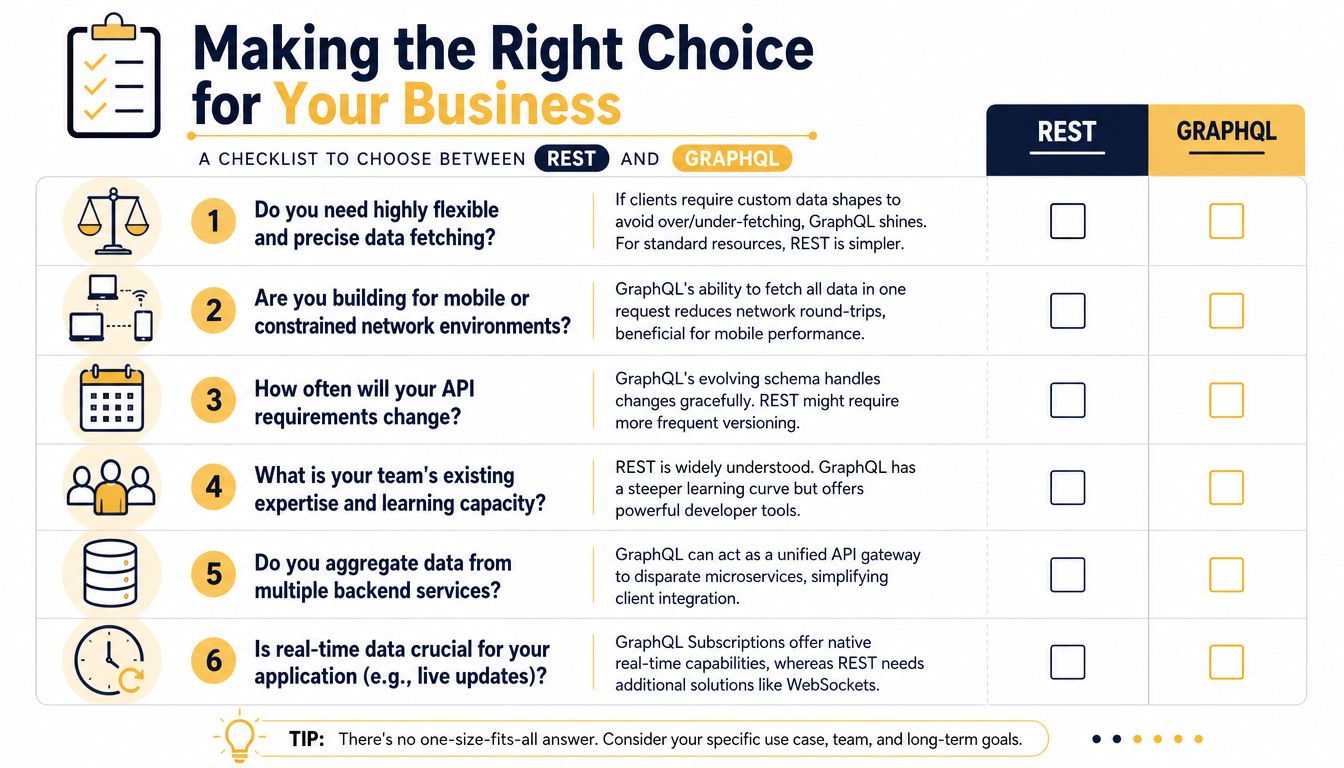
Use this checklist in stakeholder meetings
A short decision review with product, engineering, and operations usually reveals the better fit:
- Are the frontend requirements likely to stay stable for the next 12 to 18 months? If yes, REST often wins on speed and operating cost.
- Will partners, vendors, or external developers consume the API? REST is usually easier to document, test, and support across a broader range of clients.
- Are you trying to reduce client round trips, or are you trying to keep server performance predictable? GraphQL can help the first problem. REST often handles the second more cleanly.
- Can your team manage schema design, query limits, resolver performance, and field-level access rules? If not, GraphQL can slow delivery instead of improving it.
- Will one user-facing experience combine data from several systems? That is a common case where GraphQL can justify the added platform work.
One practical point often gets missed. GraphQL is not automatically faster. On some projects it reduces over-fetching and improves the client experience. On others, resolver chains, permission checks, and weaker cache behavior increase backend work. For SMBs, that difference shows up as budget pressure before it shows up as architecture elegance.
Practical recommendations by business type
For most small and midsize e-commerce businesses, I would still start with REST. Catalog, cart, checkout, account, and admin flows usually benefit more from predictable caching, simpler monitoring, and lower maintenance overhead than from highly flexible queries.
For content platforms, the answer depends on how dynamic the experience really is. A publisher with a few page templates can stay on REST for a long time. A content product with personalized modules, multiple apps, and frequent presentation changes is a stronger GraphQL candidate because frontend teams tend to ask for new data shapes every sprint.
For startups building mobile-first products, GraphQL can be a good early bet if one app view depends on several related entities and rapid UI iteration is part of the business model. If the product is still proving basic workflows, REST often keeps the first release simpler and cheaper.
Teams working in specialized environments should also sanity-check API decisions against the rest of the stack. A partner experienced in distributed systems, such as a blockchain development company, can offer a useful outside view on whether schema coordination and service aggregation are justified or premature.
If this decision is part of a larger platform discussion, review this guide on choosing the right tech stack for a new product. API style affects frontend architecture, hosting, staffing, and the cost of future changes.
Choose REST if the business case depends on simpler delivery, predictable caching, and lower operating overhead. Choose GraphQL if the product needs flexible client queries badly enough to justify stricter governance and added backend complexity.
The best choice is the one your team can ship, support, and afford over time. That is usually more valuable than picking the API style with the most hype.
If you're planning a custom app, e-commerce platform, or content-driven product and want help evaluating the right architecture, Up North Media can help you map API decisions to real business outcomes like delivery speed, scalability, and long-term maintenance.