

You publish a solid article, product guide, webinar recap, or buying guide. The page is well written. The design looks clean. The offer is clear. Then almost nothing happens.
Many teams often get stuck. They assume the problem is the content itself, so they go back and make the next piece longer, sharper, or more polished. In practice, the bigger issue is usually simpler. The team has a publishing habit, not a content distribution strategy.
A one-time promotional burst rarely fixes that. Sustainable results come from a system that decides who should see each asset, where it should appear, how it should be reformatted, when it should be resurfaced, and how the team will know whether distribution produced business value.
When Great Content Gets Zero Attention
A local service business writes a useful FAQ page. An e-commerce brand launches a strong gift guide. A publisher posts an expert interview that deserved far more reach than it got. The pattern is the same. They hit publish, share it once or twice, and move on to the next piece.
That isn't a quality problem. It's an operations problem.

Why the stakes are bigger than one missed post
Content distribution isn't a side task anymore. By 2026, worldwide content marketing revenue is projected to reach $107.5 billion, which puts real pressure on teams to prove that distribution drives visibility, pipeline, and growth, not just activity (WhisperTranscribe).
That matters for small and mid-sized businesses because content costs don't stop at writing. You pay for strategy, design, editing, approvals, landing pages, email, social scheduling, ad spend, and the time your team spends coordinating all of it. If distribution is improvised, the return usually is too.
What a system looks like in real life
The businesses that get traction usually do a few things consistently:
- They plan distribution before publishing: The blog post isn't done when the draft is approved. It's done when the email, social cutdowns, creative assets, and tracking are ready.
- They adapt the message by channel: A good LinkedIn post isn't the same as a good email intro. A paid social ad needs a different hook than a blog excerpt.
- They revisit strong assets: Evergreen content shouldn't disappear after launch week.
Practical rule: If your team can describe its creation workflow in detail but can't describe its distribution workflow, distribution is the bottleneck.
Search visibility is also changing. If your content needs to show up in AI-driven discovery environments as well as traditional search, this Generative Engine Optimization guide is worth reading because it frames visibility as a distribution challenge, not just a ranking exercise.
The fix isn't more frantic posting. It's building a repeatable system that gives every important asset multiple chances to perform.
Start with Who and Why Not Where and How
Most weak distribution plans start with channel selection. The team asks whether it should be on LinkedIn, Instagram, YouTube, or paid search. That's backward. The first job is to decide who you're trying to reach and what business outcome the content should support.
Build a usable audience profile
You don't need a giant persona deck. You need a working document your team can use when writing headlines, choosing channels, and setting calls to action.
For an SMB service business, focus on buying triggers:
- Problem trigger: What happened that made the customer start looking?
- Decision filter: Do they care more about speed, price, trust, or specialization?
- Preferred proof: Reviews, examples, comparisons, or consultations?
For an e-commerce retailer, focus on shopping behavior:
- Discovery context: Are shoppers browsing, comparing, or ready to buy?
- Content preference: Product demos, styling ideas, how-to content, or customer photos?
- Friction points: Shipping questions, fit uncertainty, product quality, or returns anxiety?
For a publisher or content-driven platform, focus on consumption habits:
- Entry point: Search, social, newsletter, referral, or direct visit?
- Loyalty trigger: Timely reporting, niche expertise, community, or convenience?
- Conversion path: Free subscriber, registered user, paid subscriber, or sponsor lead?
If your team needs a cleaner process for documenting this, a practical walkthrough on creating buyer personas can keep the exercise grounded.
Set goals that change decisions
A lot of teams say they want “more reach.” That sounds reasonable, but it doesn't tell anyone what to do next.
Research indicates that 90% of B2B companies use content marketing and 38% plan to increase spending over the next year, which is one reason distribution has become more competitive and more important to define precisely (LinkedIn Marketing Blog).
A useful goal changes the plan. If your goal is qualified leads, you'll prioritize channels that support stronger intent and clearer handoffs. If your goal is online sales, you'll push harder on product-focused creative, retargeting, and landing-page alignment. If your goal is subscriber growth, you'll design content around repeat visits and registration prompts.
Match the goal to the business model
Use simple business-first goals like these:
| Business type | Strong distribution goal | What to watch |
|---|---|---|
| SMB services | Generate qualified inquiries | Form fills, booked calls, lead quality |
| E-commerce | Drive product page visits and sales | Conversion path, assisted purchases, revenue by channel |
| Publishers | Grow subscribers and repeat visits | Newsletter signups, return sessions, engaged readership |
A channel only matters if it reaches the right person at the right moment with the right next step.
Once the audience and goal are clear, channel decisions get easier. You stop asking, “Should we post more?” and start asking, “Where does this buyer pay attention, and what action do we want after the click?”
Design Your Channel Mix with the POEM Framework
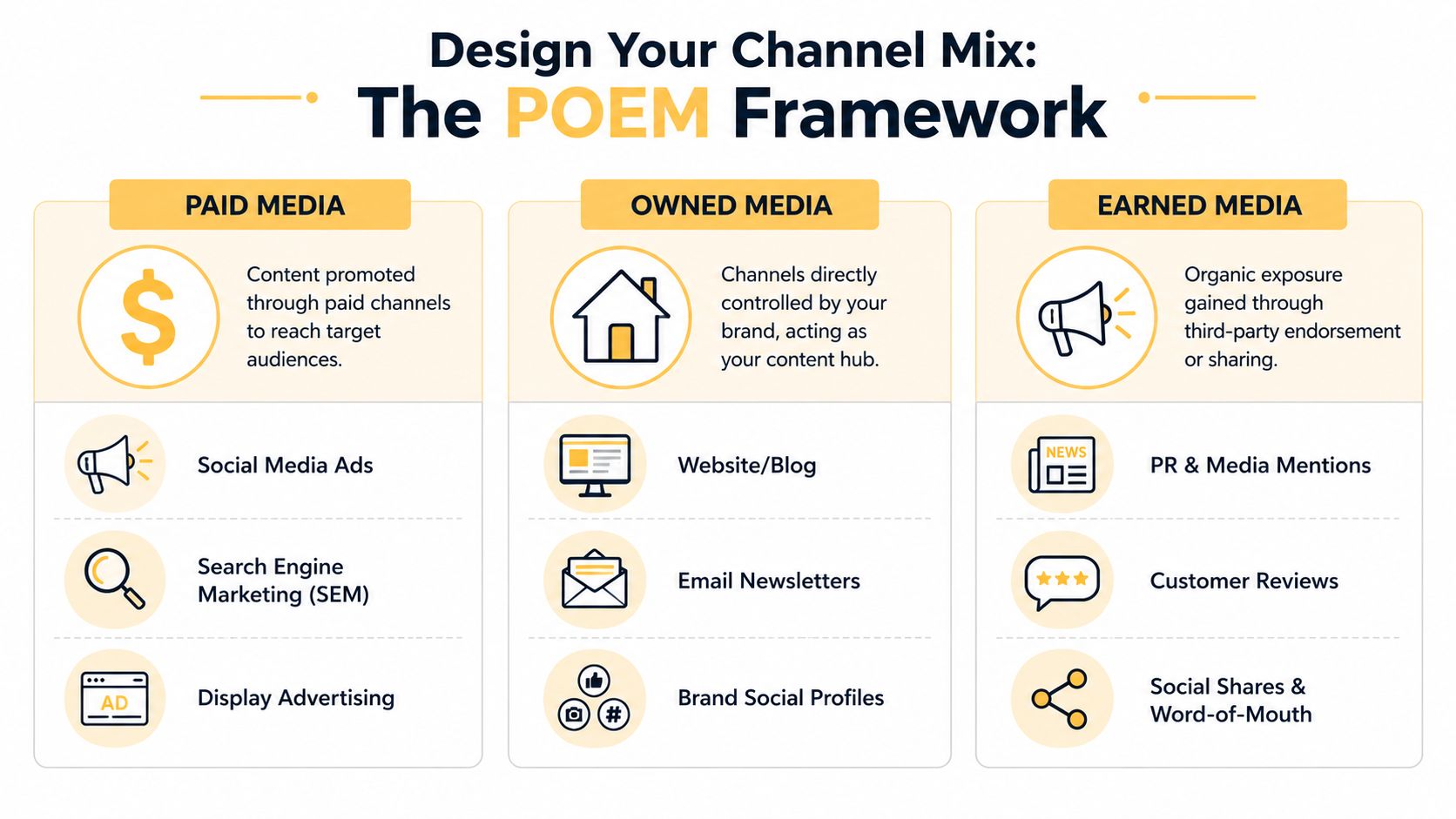
A strong distribution system needs structure. The cleanest framework for that is POEM, short for Paid, Owned, and Earned media. It stops teams from overloading one channel and hoping for the best.
What each channel type actually does
Owned media is what you control. Your website, blog, email list, resource center, and branded social profiles live here. This is the foundation because you own the audience relationship and the destination.
Paid media buys attention. Social ads, search campaigns, sponsored placements, and creator partnerships can put content in front of a targeted audience quickly. Paid is useful, but it goes stale fast if you treat it like a one-click boost button.
Earned media is exposure you don't directly buy or control. Search visibility, media mentions, customer reviews, social sharing, and word-of-mouth belong here. It usually takes longer to build, but it often carries stronger trust.
Sample POEM Channel Mix by Business Type
| Business Type | Primary Owned Channels | Primary Paid Channels | Primary Earned Channels |
|---|---|---|---|
| SMB services | Website, service pages, email newsletter | Search ads, paid social retargeting | Local SEO visibility, reviews, partner mentions |
| E-commerce | Product pages, email flows, SMS, brand social profiles | Shopping ads, paid social, creator whitelisting | UGC, product reviews, organic social shares |
| Publishers | Article hub, newsletter, app, editorial social profiles | Sponsored distribution, subscriber acquisition ads | Search traffic, citations, community sharing |
Where many paid programs break
A lot of SMBs and mid-sized brands rely too heavily on boosted posts. That's usually where the waste starts.
Data from 2025 shows that 68% of B2B content distribution budgets are wasted on boosted posts with no A/B testing or visual iteration, and ROI declines within 3 weeks (Pierre Herubel).
That finding lines up with what happens in day-to-day execution. A team publishes one strong creative, puts budget behind it, sees early traction, and assumes the ad will keep working. It usually won't. Platform fatigue sets in. Audience response drops. The same message gets ignored.
Paid distribution decays faster than the content asset itself. Treat the asset as evergreen, but treat the ad creative as temporary.
A practical anti-decay routine
Instead of building one paid ad per asset, build a rotation set:
- Headline variation: Change the promise, not just the wording. One version can lead with a pain point, another with a use case.
- Visual variation: Swap screenshots, product photos, founder clips, UGC-style creative, or graphic treatments.
- Format variation: Test static image, carousel, short-form video, and text-led creative.
- Audience variation: Separate cold prospecting from warm retargeting so you aren't judging all performance through one blended result.
For e-commerce, that might mean rotating product demo clips and customer proof assets. For publishers, it could mean testing a data-led headline against a curiosity-led one. For a service business, it may be a comparison graphic versus a short founder video.
The point of POEM isn't balance for its own sake. It's deliberate coverage. Owned channels build consistency. Earned channels build trust. Paid channels add speed, but only if you manage decay instead of pretending algorithms have a memory.
Implement a Content Repurposing Workflow
The issue isn't typically a content shortage. It's a packaging shortage.
A solid article can become an email, a short video script, a carousel, several social posts, a sales enablement snippet, and a retargeting angle. But that only happens when repurposing is built into production from the start.
Why one-and-done publishing fails
Most content marketing teams allocate 90% of their effort to creation and only 10% to distribution, which is why so many good assets underperform unless the team defines who distributes what, where, and how fast (Digital Applied).
That imbalance shows up everywhere. The article is polished, but no one has written the email. The webinar is recorded, but no one clipped the strongest moments. The case study is approved, but social has no graphics and paid has no alternate creative.
Turn one pillar asset into a full asset pack
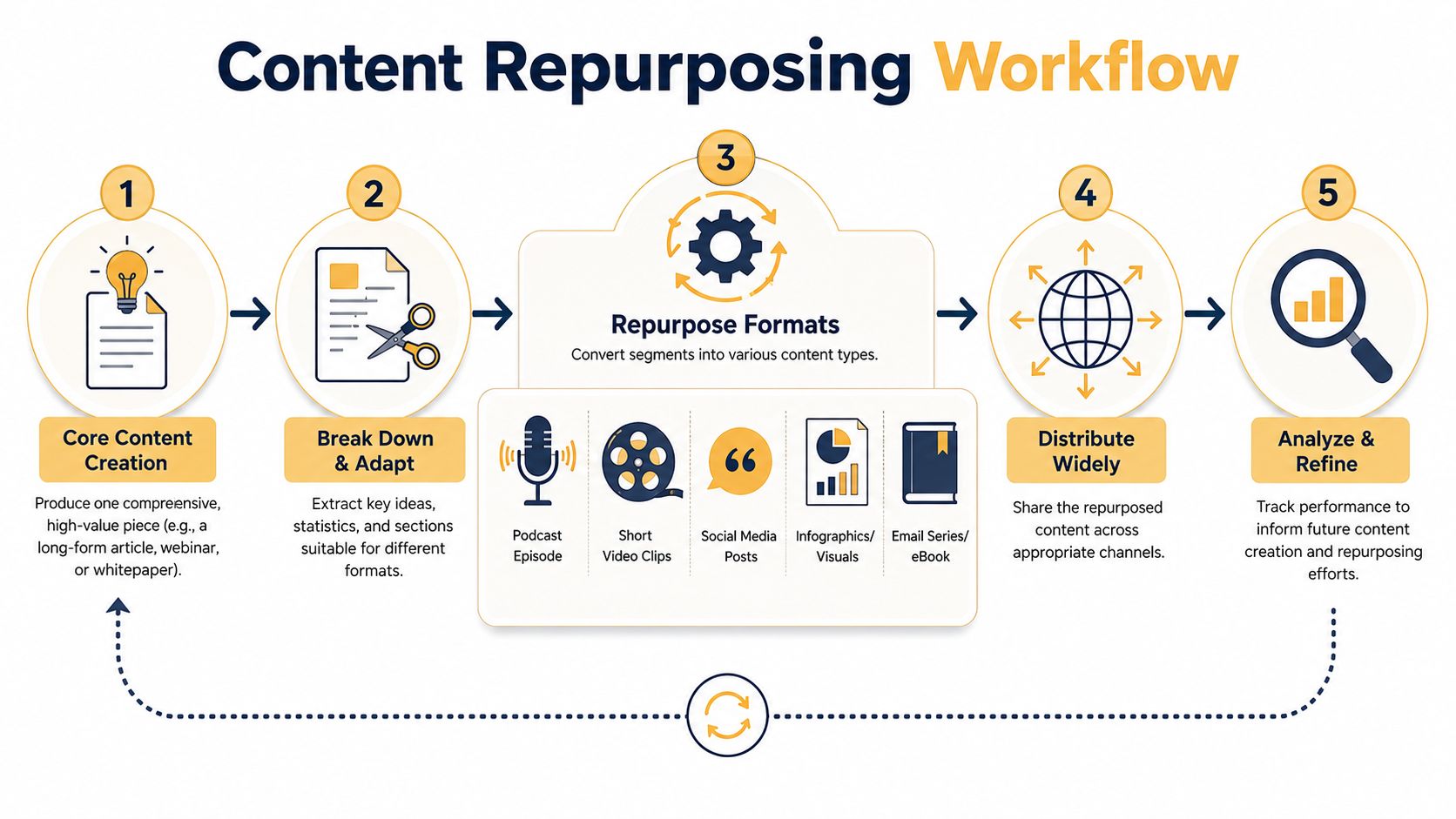
A simple workflow works better than a complicated content factory. Start with one core asset, then break it into channel-ready pieces.
-
Choose a pillar asset
Pick something with depth. A long-form blog post, buying guide, webinar, product comparison, or customer story works well. -
Extract reusable angles
Pull out key claims, customer objections, practical steps, visuals, short quotes, and examples. These become your raw material. -
Map each angle to a channel
Don't force the same asset everywhere. Match the format to the channel's behavior. -
Build once, package many ways
Create a small batch of derivatives at the same time the pillar is finalized.
Here's what that can look like from a single article:
- Email newsletter intro: A short problem-led summary with one clear click path.
- LinkedIn carousel: A sequence built from the article's main steps or mistakes to avoid.
- Instagram graphic: One quote, one stat if available, or one tip turned into a visual card.
- Short video script: A tight explanation for Reels, TikTok, or YouTube Shorts.
- Sales follow-up asset: A repackaged excerpt your team can send after discovery calls.
A quick visual makes the process easier to standardize:
Put ownership on the workflow
Repurposing breaks when it's everyone's job and no one's job. Give each stage a clear owner.
| Workflow stage | Owner | Output |
|---|---|---|
| Pillar content approval | Strategist or editor | Final source asset |
| Asset extraction | Content lead | Pull quotes, hooks, clips, proof points |
| Channel adaptation | Social, email, paid, design | Platform-ready versions |
| Scheduling and launch | Marketing ops or channel owner | Calendar entries and publishing |
| Review and refresh | Strategist and analyst | Notes for reuse, updates, and creative swaps |
Operational advice: If a piece of content can't be repurposed easily, the issue is often the production process, not the topic.
Repurposing isn't about squeezing every drop out of an asset. It's about building a workflow that respects limited time and turns content from a single event into a campaign.
Build Your Distribution Engine with Calendars and Tools
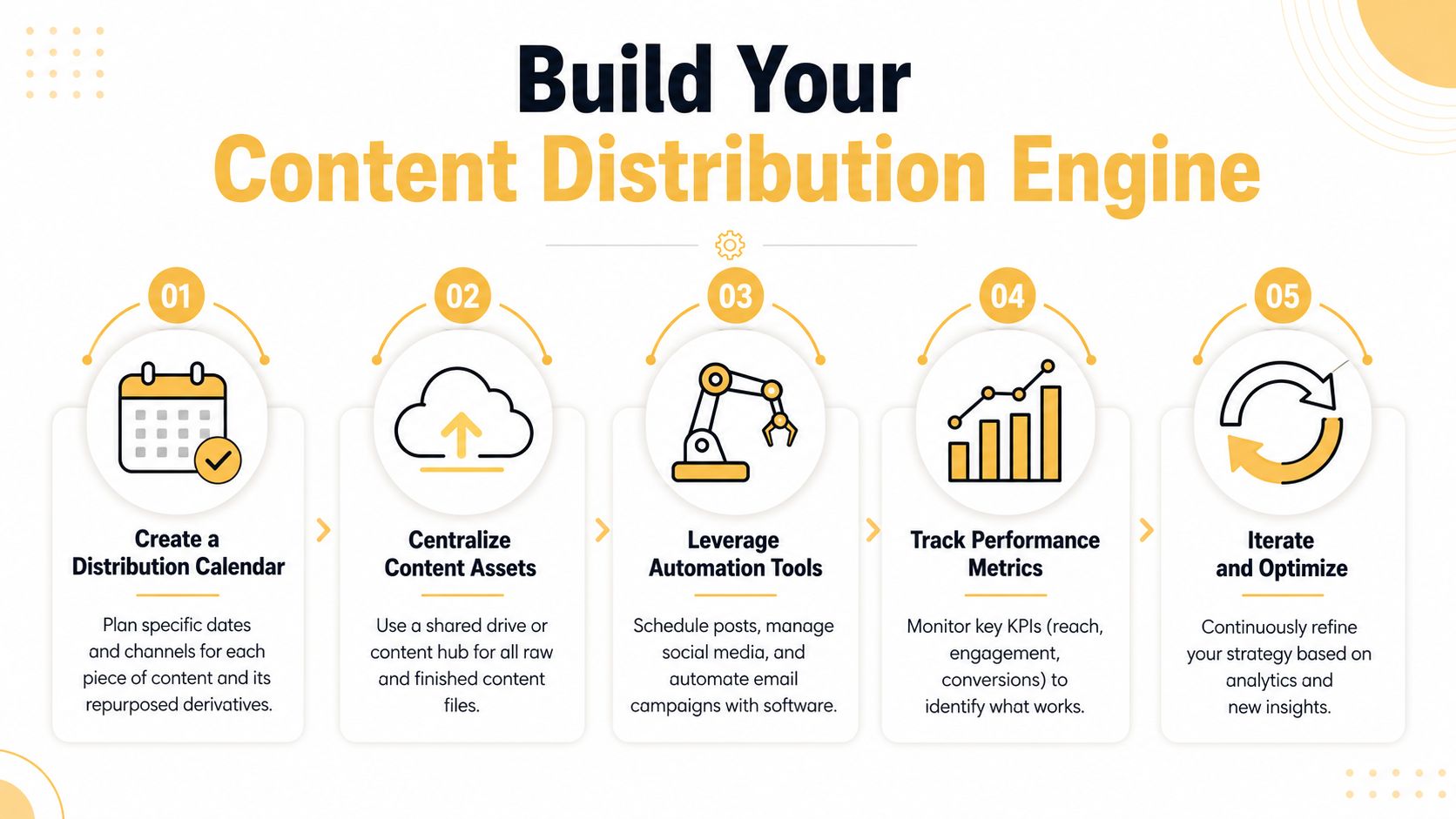
Distribution becomes reliable when the team can see the work, assign the work, and repeat the work. That requires a calendar and a lightweight tool stack, not a giant enterprise platform.
Build a calendar for promotion, not just publishing
A normal editorial calendar tells you when the article goes live. A distribution calendar tells you everything that happens after.
For each asset, include:
- Launch date: When the core asset publishes.
- Owned channel schedule: Email send, homepage feature, internal links, newsletter placement.
- Social rollout: Initial post, alternate-angle repost, clipped video, creator or founder post if relevant.
- Paid support: Prospecting creative, retargeting creative, landing page pairing, and planned refresh dates.
- Review point: A date to assess what gets extended, refreshed, paused, or repurposed again.
If you need a simple template before building your own system, this guide to creating a content calendar is a useful starting point.
Choose tools by function
The right stack is usually boring, and that's a good thing. You want tools your team will use.
Planning
- Notion: Good for campaign briefs, asset checklists, and publishing status.
- Trello: Useful if you want a cleaner board-based workflow with fewer distractions.
Creation
- Canva: Fast for resizing graphics and building repeatable social templates.
- Google Docs: Still one of the easiest places to collaborate on copy and approvals.
Scheduling
- Buffer: Good for straightforward social scheduling.
- Later: Helpful when visual planning matters more, especially for social-heavy brands.
Analytics
- Google Analytics: Essential for understanding content paths, traffic quality, and conversions.
- Native platform analytics: Useful for creative-level feedback, especially for video and paid social.
Don't let email become the weak link
Email is one of the most dependable owned distribution channels, but only if delivery holds up. Good content won't matter if it lands in spam or promotions unpredictably. If email is part of your core distribution engine, these email sender reputation tips are worth reviewing before you scale volume.
The best distribution engine isn't the most advanced one. It's the one your team can run every week without confusion.
A workable engine is visible, repeatable, and boring in the right ways. That's what lets a small team execute like a larger one.
Measure Performance and Calculate ROI
If distribution reporting stops at impressions, likes, or shares, leadership won't trust it for long. Those metrics can be useful signals, but they don't answer the question that matters most. Did this content help the business?
Start with business outcomes, not vanity metrics
A strong measurement approach ties each content asset to a commercial outcome. The exact KPI depends on the model.
For an SMB service firm, useful indicators often include:
- Qualified inquiries: Contact form submissions, booked calls, or request-a-quote completions.
- Sales conversation quality: Whether leads mention the content, arrive better informed, or match target-fit criteria.
- Pipeline support: Whether content-assisted leads progress more smoothly through follow-up.
For e-commerce, the focus shifts:
- Product page sessions from content
- Add-to-cart and checkout behavior after content visits
- Revenue influenced by content-led traffic
For publishers, the center of gravity is different again:
- Subscriber starts
- Registration completions
- Return visitation and deeper on-site engagement
Use simple attribution before fancy attribution
Many teams delay measurement because they think they need a complex attribution model. They don't. Start with clean campaign tagging, channel naming, and destination tracking in Google Analytics.
A simple operating model works:
| Distribution activity | Track this | Business interpretation |
|---|---|---|
| Newsletter send | Clicks to content and next-step actions | Did owned audience traffic move toward conversion? |
| Social promotion | Traffic quality and on-site behavior | Did the post attract the right visitor, not just any visitor? |
| Paid amplification | Landing-page actions and downstream conversion | Did spend create meaningful demand? |
| Earned pickup | Referral quality and assisted outcomes | Did outside visibility produce qualified visits? |
Calculate ROI in a way leadership will accept
You don't need to overcomplicate the math. Compare the cost of creating and distributing the asset against the business value it influenced. Include writing, design, paid spend, production support, and any platform costs tied directly to the campaign.
The more important discipline is consistency. Use the same method each month so your team can compare assets fairly. If you need a cleaner framework for structuring that analysis, this walkthrough on how to calculate marketing ROI is a good reference.
Report what changed because of distribution, not just what was published because of effort.
That mindset changes behavior. Teams stop celebrating a busy calendar and start improving the parts of the system that produce revenue, leads, or subscriber growth.
Putting Your Content Distribution Plan into Action
The best content distribution strategy doesn't look dramatic from the outside. It looks organized.
The audience is clear. The business goal is explicit. The POEM mix is intentional. The asset gets repurposed before launch, not after it's forgotten. The team runs on a calendar. Performance gets reviewed with business metrics in mind. Then the cycle repeats.
Start smaller than you want to
For most businesses, the fastest win isn't building a giant multi-channel machine on day one. It's choosing one content pillar, one audience segment, one owned channel, one paid test, and one earned opportunity. Then tighten the process until the team can repeat it without friction.
That applies across formats too. If audio is part of your plan, a thoughtful guide on optimizing podcast distribution can help you treat podcast promotion as a system instead of a publish-and-pray task.
What usually works
A few habits consistently separate effective teams from frustrated ones:
- Document the workflow: Decide who owns adaptation, approvals, scheduling, and review.
- Refresh paid creative regularly: Good assets last longer than ad creative does.
- Keep owned channels strong: Your email list, site, and content hub should remain the center of gravity.
- Review with discipline: Look at what created action, not just attention.
A content distribution strategy isn't a checklist you complete once. It's an operating system for getting more value from every article, guide, video, email, and campaign your team already works hard to produce.
If you want help turning that system into a working plan, Up North Media can help map your audience, build the right distribution workflow, and connect your content efforts to measurable growth.