
You're probably feeling the same tension most founders hit after the first burst of traction. The business is working, customers are coming in, but the systems behind it are held together with SaaS subscriptions, Zapier flows, spreadsheets, and manual workarounds. One tool handles billing, another stores customer data, a third runs support, and none of them agree on what “current” means.
That setup is fine when you're testing an idea. It becomes a liability when customers expect a smooth product and your team needs clean operations. The hard part is that custom software development for startups isn't automatically the answer. Sometimes it's the smartest move you can make. Sometimes it's an expensive distraction.
The right question isn't “Should we build custom software?” It's “Which part of our business is important enough, unique enough, and painful enough to justify building?”
From Frustration to Foundation Why Startups Need Custom Software
A lot of startups start by renting their operations. They use Shopify, HubSpot, Stripe, Notion, Airtable, QuickBooks, and a few plugins to bridge the gaps. That's rational. You buy speed first, then control later.
The trouble starts when the business stops fitting the tools.
You add a custom onboarding flow, but your CRM can't represent it cleanly. You need pricing logic that your checkout stack can't handle. Your support team copies data between systems because the source of truth changes depending on which tab they're looking at. At that point, you're not saving time with off-the-shelf software. You're working around it.
What custom software actually means
Custom software isn't just “a web app someone coded.” It's software designed around your operating model, your customer journey, and your constraints. Instead of forcing your business to match a vendor's assumptions, you build the workflows that match how your company creates value.
That might mean:
- A founder dashboard that combines payments, usage, and support signals in one place
- A customer portal with flows designed for your service model
- An internal ops tool that removes repetitive handoffs between teams
- A product layer that becomes part of what customers are buying
If you need a broader primer, Up North Media has a useful explanation of what custom software development means in practice.
Custom software becomes strategic when it stops being “just tech” and starts shaping how the business runs.
The market trend reflects that shift. The custom software development market was valued at USD 43.16 billion in 2024 and is projected to reach USD 146.18 billion by 2030, with a 22.6% CAGR, according to Grand View Research's custom software development market analysis. That matters because it shows customized systems aren't a niche purchase anymore. Startups are treating software as infrastructure, not overhead.
Where the moat comes from
A custom build only provides a strategic advantage if it captures something competitors can't copy easily. Usually that's one of three things:
- Workflow advantage because your process is faster or cleaner than the standard playbook
- Customer experience advantage because your product feels simpler and more coherent
- Data advantage because your system collects and uses information in a way generic tools don't
This is also where adjacent technologies matter. Teams exploring blockchain, identity, or tokenized products often need architecture that packaged SaaS can't support well. In those cases, resources on web3 solutions for startups and enterprises can help founders understand where custom infrastructure starts to make sense.
Custom software is the point where a startup stops improvising and starts building its own workshop. Not because custom is fashionable, but because the garage setup can't support the work anymore.
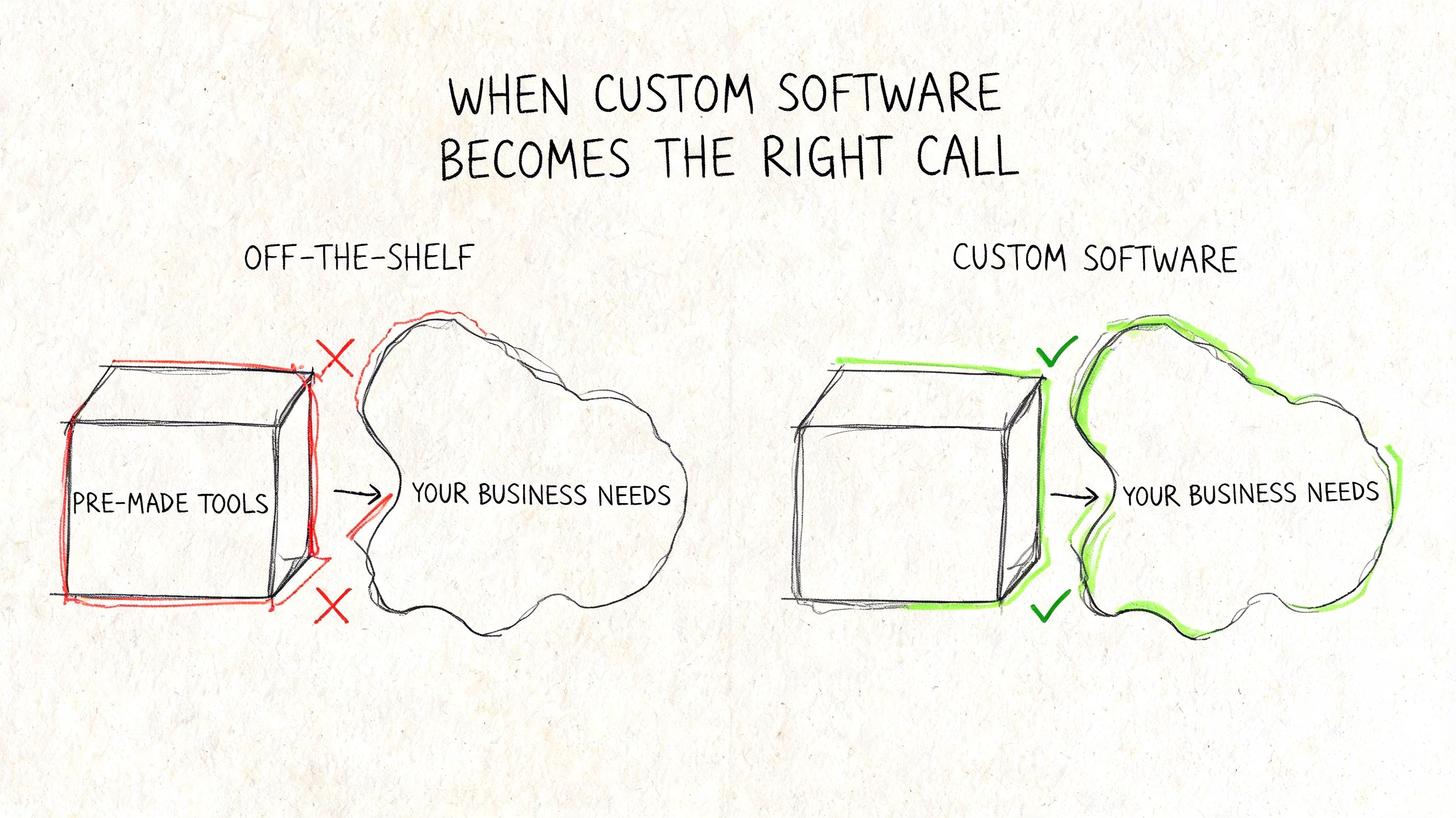
When Custom Software Becomes the Right Call
There's a simple test I use with founders. If your software is just keeping the lights on, buy it. If your software is how you win, build more of it.
That's the difference between an off-the-rack suit and a bespoke one. Everyday use typically doesn't demand tailoring. But if the fit affects how you perform, present, and move, generic stops being good enough.
Signals that usually justify a build
Custom software is technically justified when the core value depends on proprietary workflows or complex integrations. As TecvEq explains in its startup custom software guide, modern stacks often need payments, CRM, and analytics to work together through APIs, and custom architecture can create a single source of truth instead of forcing teams into manual work.
That shows up in practice in a few predictable ways:
- Your team is duplicating work across tools because data lives in separate systems
- Your customer journey breaks when a handoff moves from one platform to another
- Your pricing, rules, or approvals are unique enough that plugins keep falling short
- Your product promise depends on speed or precision that generic tools can't deliver
- Your reporting is unreliable because every system defines the same entity differently
Situations where buying usually beats building
A lot of founders overestimate how much software needs to be custom. If email marketing, invoicing, appointment booking, or basic CRM workflows are standard for your business, buying proven tools is usually the smarter move. You should spend engineering effort where differentiation lives, not where vendors have already solved a common problem.
Practical rule: Build the layer that makes you different. Buy the layer that everyone needs.
Founders benefit from a more structured framework for solving the software build-buy dilemma. The strongest decisions usually split the stack instead of treating everything as all-build or all-buy.
A quick decision filter
Ask these questions before greenlighting development:
| Question | If yes | If no |
|---|---|---|
| Is this workflow central to your customer value? | Consider custom | Buy or adapt tools |
| Do integrations create daily operational friction? | Consider custom | Keep the stack simpler |
| Would the process give you a defensible advantage? | Consider custom | Avoid bespoke work |
| Can you validate demand without building it first? | Wait | Build later if needed |
The key is fit. Not technical ambition. Founders get into trouble when they build because software feels serious, not because the business needs it.
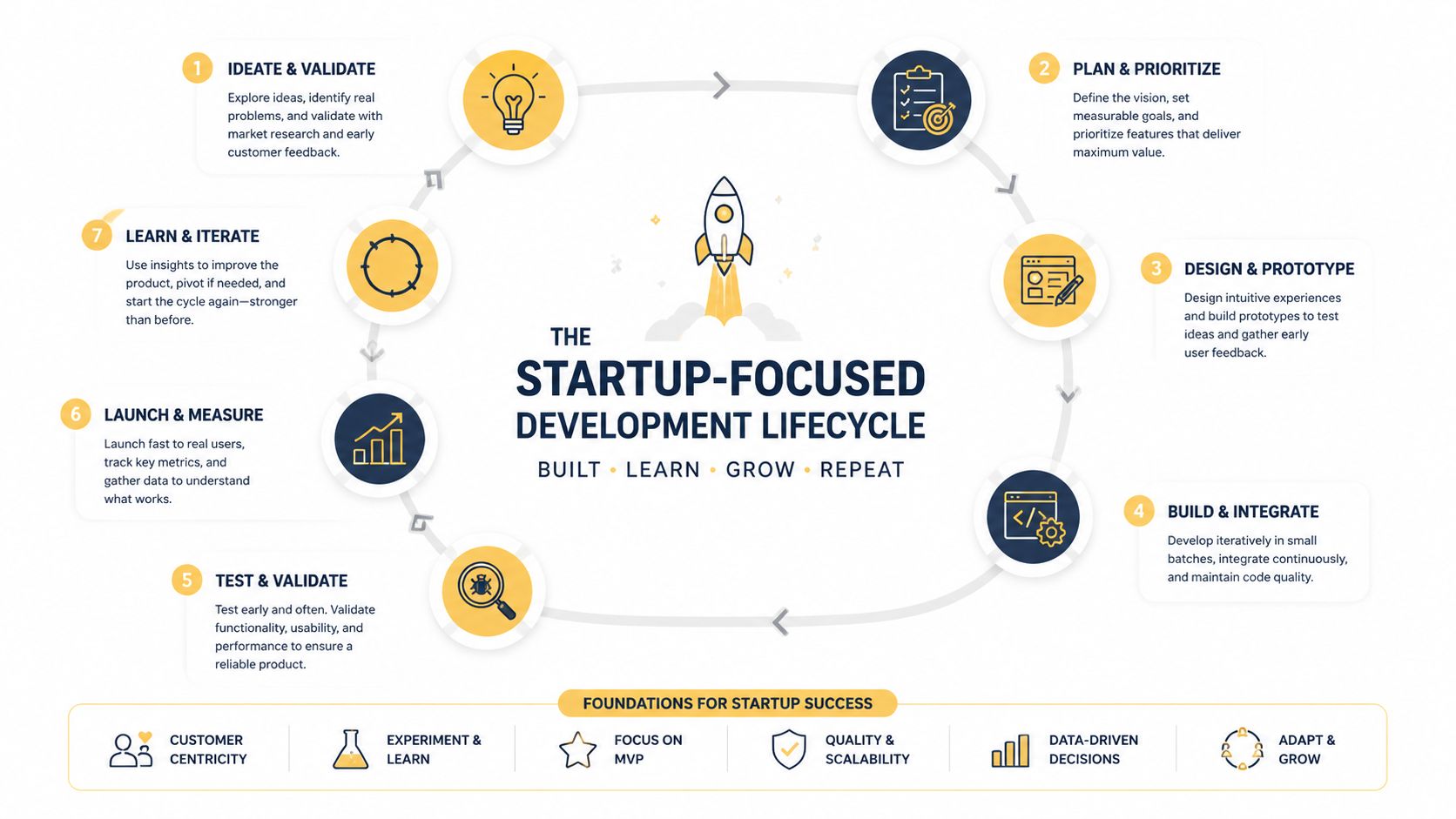
The Startup-Focused Development Lifecycle Explained
A good startup build process should feel less like pouring concrete and more like setting up a test kitchen. You're trying recipes, checking what people want, and only then deciding what belongs on the permanent menu.
Discovery before code
The strongest projects start with business clarity, not a feature list. Founders often arrive with a backlog full of requests, but the early work is really about isolating the smallest valuable workflow.
That means defining:
- Who the first user is
- What painful job the product solves
- Which actions prove adoption
- Which constraints matter early, like compliance, integrations, permissions, or data sensitivity
A disciplined discovery phase saves money because it kills vague requirements before they become expensive tickets.
Design what users will actually do
Wireframes and prototypes are where teams catch bad assumptions cheaply. In Figma or similar tools, you can test the sequence of actions, the number of clicks, the labels, and the moments where users get confused. This matters more than founders expect.
A startup doesn't need a polished design system on day one. It does need flows that make sense.
If users can't tell what to do next in a prototype, code won't fix that confusion.
Build the MVP, not the fantasy roadmap
For startups, the first build should support validation. Not a grand technical vision. That usually means one user type, one core workflow, one clear outcome.
A healthy MVP often includes:
- Authentication and roles only if they're required for the first use case
- A focused dashboard that supports the core action
- Essential integrations such as Stripe, analytics, email, or calendar sync
- Basic admin controls so the team can operate without engineering help
- Instrumentation to see what users do after launch
What it usually doesn't need is a full permissions matrix, advanced automation, white-labeling, or a pile of edge-case features requested by hypothetical future customers.
QA, launch, and iteration
Testing isn't a ceremonial phase at the end. It starts as soon as user flows exist. Founders should expect checks around form handling, payment states, role access, browser behavior, and integration failures. The question isn't whether bugs exist. The question is whether the team can find the dangerous ones before users do.
After launch, the actual work begins:
- Watch usage patterns and support tickets
- Compare actual behavior against the assumptions from discovery
- Refine flows before adding breadth
- Document decisions so future development doesn't become archaeology
One practical note. Up North Media's process for custom web application work follows this same sequence of discovery, planning, UI and UX design, development, and QA. That's not unique to one agency. It's just what sane startup execution looks like when the goal is learning fast without creating chaos.
Budgeting and Timelines for Your First Build
Founders usually ask for a fixed price and a ship date before the product is clearly scoped. That's understandable, but it's backwards. Budget and timeline only become useful when they're tied to a narrow objective.
The better question is, “What's the smallest release that gives us a real answer?”
What an MVP should cost and how long it should take
For pre-seed startups, industry guidance suggests MVP budgets of roughly $10K to $50K with 8 to 12 week timelines, according to Neontri's guide to custom software for startups. That range makes sense when the product is tightly scoped around validation, not around long-term completeness.
If you want more context on how feature count, integrations, and architecture choices affect spend, this breakdown of web application development costs is a useful reference point.
What changes the budget fast
The biggest cost drivers usually aren't the obvious ones. Founders focus on screen count. Engineers worry more about complexity behind the screen.
Common budget multipliers include:
- Third-party integrations because external APIs always add edge cases
- Role-based access when different users need different permissions and views
- Admin tooling because manual operations need a place to live
- Data migration from spreadsheets or old systems
- AI features where model behavior, prompting, fallback logic, and privacy rules add operational work
A simple interface can still hide a complicated backend. A “small” app with billing logic, document generation, and workflow automation may require more effort than a larger-looking but simpler product.
How to keep the first build sane
Use these guardrails:
- Fund a question, not a platform. The first release should answer whether users want the core thing.
- Freeze the must-haves early. New ideas will show up every week. Most should wait.
- Leave room for revision. Early feedback nearly always changes requirements.
- Protect post-launch capacity. If you spend the entire budget on launch, you won't have enough left to respond to what you learn.
A startup MVP should feel slightly incomplete on purpose. That's usually a sign the team cut scope correctly.
The best first builds are modest. They look almost underbuilt from the inside, but they're aimed directly at the business risk that matters most.
Assembling Your Development Team In-House Agency or Freelancers
Once a founder decides to build, the next mistake is assuming there's one correct staffing model. There isn't. Team structure should match the stage of the company, the urgency of the timeline, and the complexity of the product.
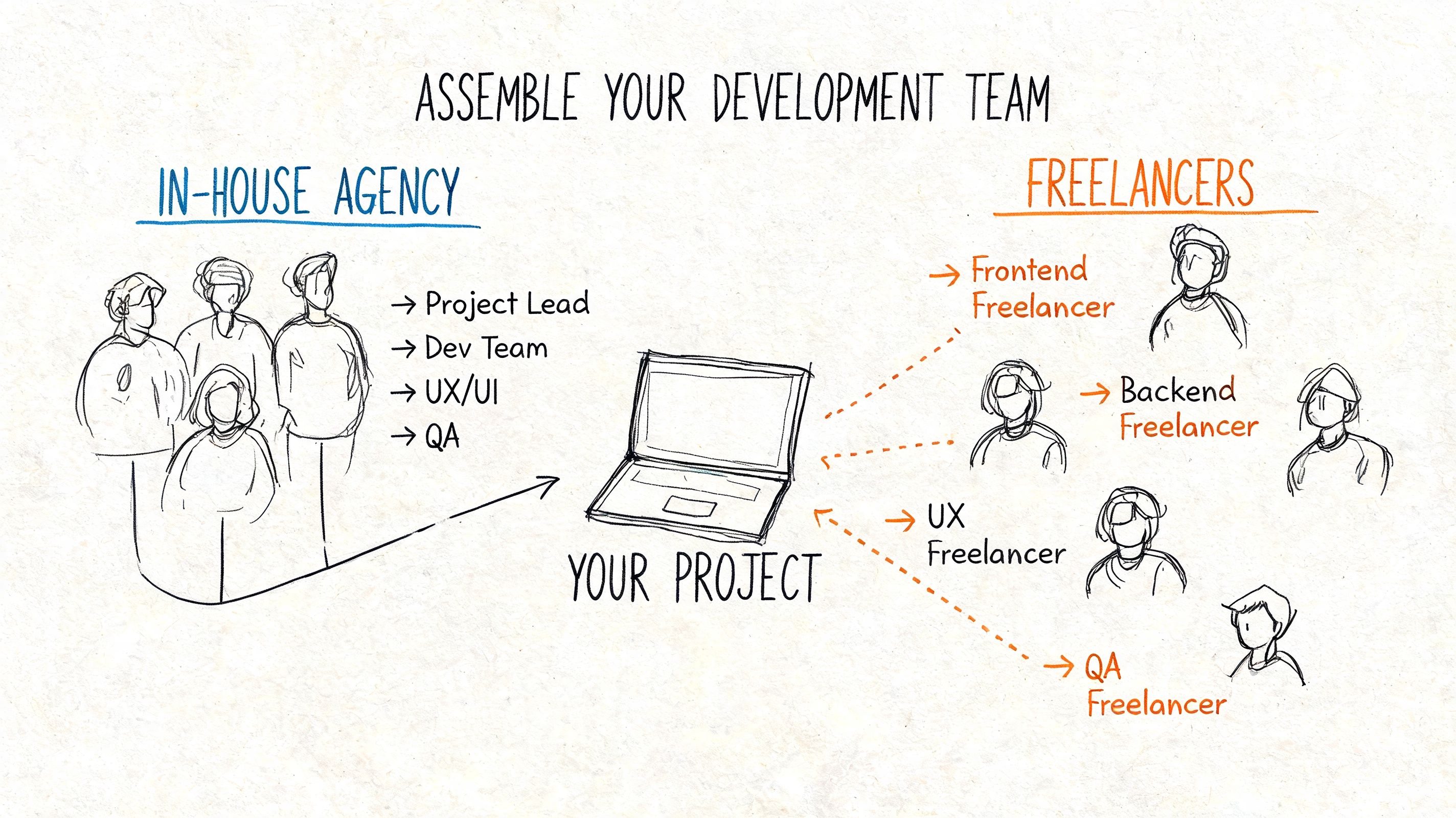
The broader market has already moved in this direction. 72% of organizations outsource software development, and cloud-based solutions accounted for 57% of custom software projects in 2024, according to Appfire's software development statistics roundup. For startups, that matters because external delivery is no longer a fallback option. It's a normal operating model.
In-house team
Hiring internally gives you the most direct control. Product context stays inside the company, communication is tighter, and the team builds deep familiarity with your domain over time.
That said, in-house is slower to assemble. It also puts more burden on the founder to recruit, manage, and sequence roles correctly. If you hire one strong engineer but still need product, design, QA, and DevOps support, you haven't solved delivery. You've just started staffing it.
Best fit for:
- Funded startups with a long product roadmap
- Companies building software as the core business
- Teams that already have technical leadership
Agency partner
A good agency gives you a prebuilt team shape. Strategy, design, engineering, QA, and delivery management come together faster than most early-stage companies can hire. That can be useful when you need momentum without building an internal department first.
The trade-off is that founders need a partner with a process, not just coders for rent. This guide on how to choose a software development company is a practical way to evaluate fit before signing anything.
Freelancers
Freelancers work well for sharply defined tasks. A landing page, a payment integration, a dashboard refactor, a design sprint. They become riskier when the project needs cross-functional coordination and long-term accountability.
That doesn't mean freelancers are a bad option. It means the founder must supply what agencies and internal teams usually provide: clear specs, product direction, QA standards, and continuity.
If you're building internal hiring muscle, this article on how to streamline your tech hiring process can help sharpen the way you screen technical talent.
Side-by-side trade-offs
| Model | Strength | Risk |
|---|---|---|
| In-house | Control and long-term product knowledge | Slow hiring and higher operational overhead |
| Agency | Speed and broad execution support | Quality varies by process and communication |
| Freelancers | Flexibility for targeted work | Fragmentation and weaker ownership |
The right answer is often hybrid. Founders keep product ownership close, use an agency to accelerate the build, and bring selective capabilities in-house later as the roadmap stabilizes.
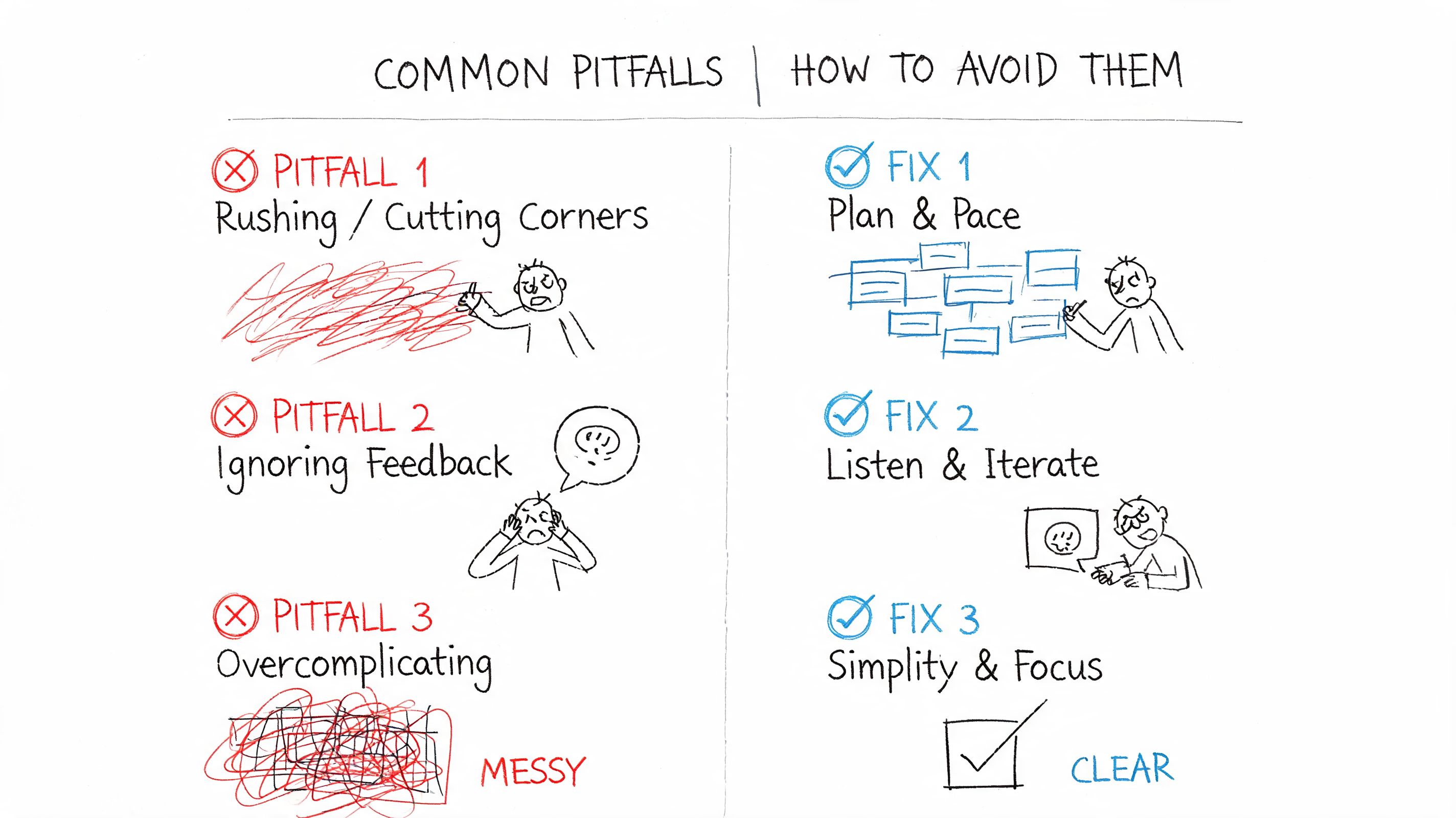
Common Pitfalls and How to Avoid Them
The most expensive mistake in custom software development for startups is building too early. Not building too slowly. Not choosing the wrong framework. Building a polished solution for a problem customers don't care enough about.
The premature build trap
CB Insights data consistently shows “no market need” as the top reason startups fail, and the practical takeaway from M Accelerator's contrarian view on startup software is straightforward: prove demand with lighter, cheaper tools first when you can.
That means founders should seriously consider using no-code tools, spreadsheets, forms, Airtable, or manual service delivery before funding a custom application. If customers won't pay, engage, or return when the workflow is clunky, cleaner engineering won't rescue the model.
Start with the ugliest version of the truth you can test.
Other mistakes that quietly hurt teams
Some traps show up after the build begins:
- Feature fever. Stakeholders keep adding “small” requests until the MVP stops being minimal.
- Bad shortcuts. Teams skip structure, naming, tests, or documentation in the name of speed, then can't change the product safely.
- No owner for maintenance. After launch, bugs, updates, and integration changes still need attention.
- AI as decoration. Founders bolt on chat or automation because it sounds modern, not because it improves the workflow.
How AI changes the decision
AI has changed the custom software conversation in one important way. Founders no longer choose only between “build from scratch” and “buy SaaS.” Now there's a third layer. You can buy core infrastructure, add AI APIs, and build custom logic around them.
That's powerful, but it creates new judgment calls:
- Buy the model capability when the feature is generic, like summarization or classification
- Customize the workflow when your value comes from domain logic, permissions, retrieval, or human review
- Delay advanced AI features if you can't support prompt tuning, monitoring, cost control, or data governance after launch
Most startups don't need a bespoke model. They need a well-designed product flow around existing AI capability. The winning move is often custom orchestration, not custom model research.
Build Your Future with Up North Media
Founders don't need custom software just because it sounds prestigious or advanced. They need it when generic tools start distorting the business, slowing the team down, or weakening the customer experience. That's the dividing line.
The strongest software decisions are usually restrained. Validate demand cheaply. Identify the workflow that truly matters. Build only what creates an outsized advantage. Keep the first release narrow enough that you can still change direction without tearing everything apart.
That mindset also makes AI decisions cleaner. Don't treat AI as a checkbox. Use it where it sharpens the product, reduces manual work, or improves decisions. Ignore it where it only adds noise and operating cost.
For startups in Omaha and beyond, that combination of product judgment and technical execution matters more than flashy roadmaps. A useful development partner should be able to challenge scope, structure an MVP, design around real workflows, and tell you when not to build yet.
Up North Media works with startups that need custom web applications, AI consulting, and a practical path from idea to usable product. If you're sorting through whether to build, what to build first, or how to shape an MVP that won't waste runway, a focused conversation is usually the best next step.
If you're weighing custom software, AI features, or a first MVP, talk with Up North Media about the business case before you commit to the build. A free consultation can help you decide what should be custom now, what should wait, and what you can validate with simpler tools first.