
Building a SaaS application isn't just a coding project; it’s a strategic journey. I’ve seen countless founders succeed by following a clear, four-phase path: validate the idea, plan the technology, build the product, and launch it to customers. This methodical approach is your best defense against wasting time and money, making sure you’re solving a real problem before you write a single line of code.
Your Blueprint for a Successful SaaS Application
Welcome to your no-nonsense roadmap for building a Software as a Service (SaaS) application. Forget the dense technical jargon. This guide is a strategic blueprint for founders, designed to turn your big idea into a product people will actually pay for. We're going to walk through the entire process, stage by stage, so you know exactly what to expect.
And you're right to be excited. The opportunity here is massive. The global SaaS industry is currently valued at around $390.5 billion, a huge leap from just a year ago. It's on track to hit a staggering $793.1 billion by 2029. This isn't just hype; it's a clear signal that businesses are all-in on cloud-based software. In fact, experts predict SaaS will power 85% of all business software by 2025.
The Four Core Phases of SaaS Development
To grab a piece of that market, you need a structured plan. Every successful SaaS product I've ever seen or worked on follows a similar high-level path. It's about moving from a simple hypothesis to a real, revenue-generating business. This isn’t just about the code—it’s about making smart decisions in the right order to build momentum and cut down your risk.
This simple visual breaks down the entire journey into four core phases.
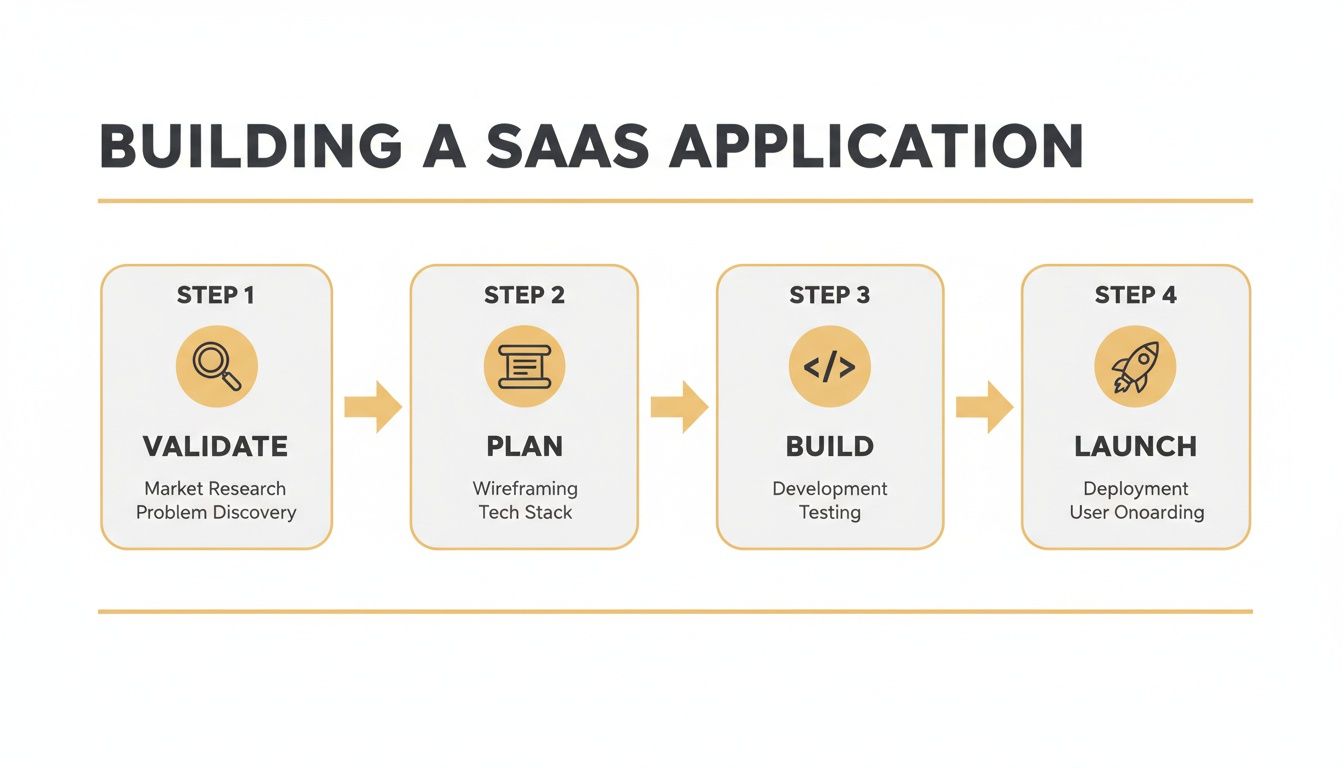
The flow is intentional: learn before you build, and build before you scale. It’s a principle that saves startups from themselves.
This guide will break down each of these phases into actionable steps. While building a SaaS product has its own unique challenges, many of the core development principles are universal. If you're interested in the fundamentals, our guide on how to build a web application from scratch is a great place to start.
Here's a quick look at how these phases typically break down in the real world for a startup or small business building its first product.
SaaS Development Phases At-a-Glance
| Phase | Key Objective | Estimated Timeline (SMB/Startup) |
|---|---|---|
| 1. Discovery & Validation | Confirm there's a real market need for your idea. Define the core problem you're solving. | 2-6 Weeks |
| 2. Planning & Architecture | Choose the right tech stack, design the system architecture, and create a detailed product backlog. | 2-4 Weeks |
| 3. MVP Development | Build, test, and refine the core features of your Minimum Viable Product (MVP). | 3-6 Months |
| 4. Launch & Iterate | Deploy the application, gather user feedback, and begin the cycle of continuous improvement. | Ongoing |
These timelines aren't set in stone, of course, but they give you a realistic picture of what it takes to get an MVP out the door without cutting critical corners.
The goal isn't just to build an application; it's to build a sustainable business. By obsessing over validation first, you ensure there's a hungry market waiting for what you create. That's what sets the foundation for growth and separates the SaaS companies that thrive from the ones that never quite find their footing.
Validating Your Idea Before You Build
It’s the classic founder mistake: you get a brilliant idea, and the first thing you want to do is start coding. I get it. The temptation to just build the thing is huge, but jumping straight into development is the fastest way to burn through your time and money.
The road to a successful SaaS doesn't start with a single line of code. It starts with cold, hard evidence. Your mission, before you write anything, is to prove that you're solving a problem so real, so frustrating, that people will happily open their wallets for your solution.
Think of this validation phase as your insurance policy against building something nobody wants. It's about swapping your gut feelings for actual data and turning a hunch into a legitimate business case. You're not just asking, "Can I build this?" You're asking the much more important question: "Should I?"
Uncovering The Real Problem
Your first move isn't to pitch your amazing solution—it's to become an expert on the problem itself. The only way to do that is to get out and talk to your potential customers. Forget about sending out a SurveyMonkey link for now; you need real, insightful conversations that get past the surface-level complaints.
The goal of these interviews isn't to get people to say, "Wow, that's a great idea!" Instead, you're a detective on a fact-finding mission. You want to uncover their current workflows, their biggest frustrations, and the janky "hacks" they've duct-taped together to get by.
You'll strike gold with questions like these:
- "Can you walk me through how you currently handle [the process your SaaS will improve]?"
- "What's the most infuriating part of that process?"
- "Have you tried to fix this before? What did you try, and why didn't it work out?"
- "If you had a magic wand and could change one thing about this, what would it be?"
Listen for emotion. You want to hear the frustration, annoyance, and resignation in their voice. Those are the signals of a genuine pain point. If people aren't already trying—and failing—to solve this problem, it might not be a big enough deal for them to pay you for a solution.
Define Your Ideal Customer Profile
As you talk to more and more people, a clear picture of your Ideal Customer Profile (ICP) will start to form. This isn’t some vague demographic like "small businesses." It’s a super-detailed sketch of the exact person or company that will get the most value from your product.
A solid ICP should include:
- Demographics: What industry are they in? How big is their company? What’s their annual revenue?
- Psychographics: What are their goals? What motivates them? What are their biggest challenges?
- Watering Holes: Where do they hang out online? Think specific subreddits, LinkedIn groups, or niche industry forums.
- Pain Points: The specific, recurring problems your SaaS is built to solve.
Nailing down your ICP makes every single decision from here on out easier. You’re no longer building for "everyone"; you're building for a specific, well-understood group of people who are desperate for what you have.
Test Demand with Minimal Investment
Once you've got a solid hypothesis about the problem and who has it, it's time to test demand without blowing your budget. You're looking for a tangible action that signals real purchase intent. To make sure you're on the right track before committing serious resources, it’s critical to learn how to validate a startup idea.
Here are two powerful, low-cost ways to do it.
1. The "Smoke Test" Landing Page Throw up a simple one-page website that nails your value proposition. It should speak directly to the pain points you uncovered in your interviews and have a crystal-clear call-to-action, like "Sign Up for Early Access" or "Join the Waitlist." Drive a small amount of targeted traffic—maybe $100 in ads aimed squarely at your ICP—and watch the conversion rate. This number is a fantastic early indicator of genuine interest.
2. The Low-Fidelity Prototype This is just a non-functional mockup of your app. You can build it with a tool like Figma or even just a PowerPoint deck. The goal is to visualize the core workflow. Take this prototype back to the people you interviewed and ask them to "use" it. Watch where they get stuck, see what gets them excited, and just listen. This costs a tiny fraction of actual development but can save you months of building the wrong features.
A huge mistake founders make is confusing politeness for validation. Your friends will always say your idea is "great." Real validation is a stranger signing up for a waitlist or, even better, putting down a deposit. Always chase actions, not opinions.
This groundwork isn't a detour from building your product. It's the most direct route to creating a SaaS application that people will actually use and pay for.
Choosing Your Tech Stack and Architecture
Picking the right technology for your SaaS is a lot like choosing the foundation for a house. It’s a decision that will define how fast you can build, how easily you can scale later, and what your long-term maintenance costs will look like. This isn't about chasing the trendiest new framework; it's a strategic move that needs to align with your actual business goals.
Your goal isn't to build with the most impressive tech—it's to build with the right tech for the job. The stack for a data-heavy analytics app will look completely different from a real-time collaboration tool. This is where you connect your technology choices directly to your product's core purpose.
Core Components of a SaaS Tech Stack
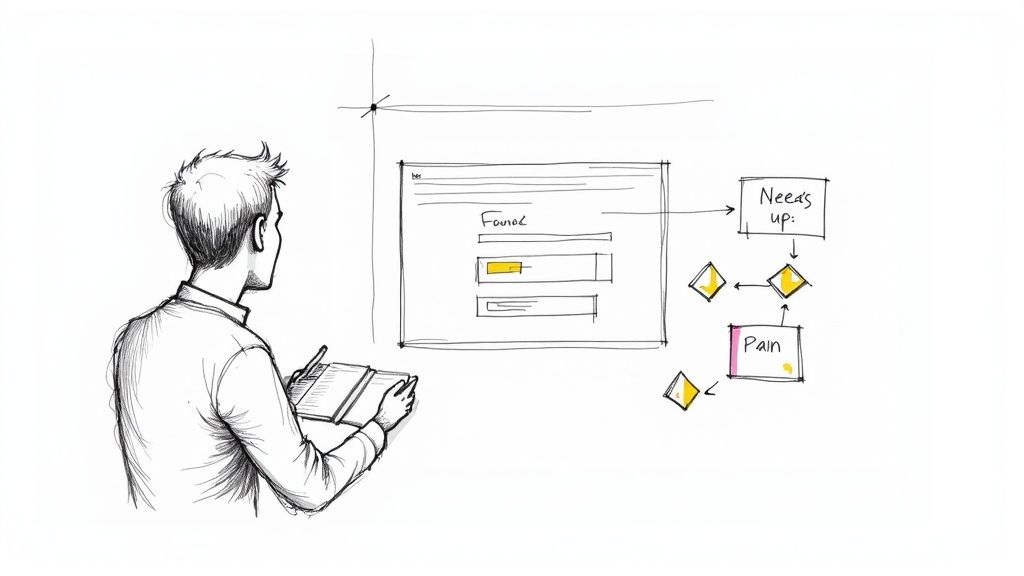
Every SaaS application is built on a few key pillars. Getting a handle on what each one does is the first step toward making a smart choice. For most startups and SMBs, the sweet spot is a blend of performance, strong community support, and a healthy talent pool.
- Frontend (The Client-Side): This is everything your user sees and interacts with—the UI and UX. Popular choices are JavaScript frameworks like React or Vue.js, which are fantastic for creating dynamic, responsive interfaces.
- Backend (The Server-Side): This is the engine under the hood. It manages business logic, database interactions, and user authentication. Common languages here are Python (with frameworks like Django), Node.js (often with Express.js), or Ruby (with Rails).
- Database (Data Storage): This is where all your application and user data lives. The choice is usually between SQL databases like PostgreSQL, which are great for structured data, and NoSQL databases like MongoDB, which offer more flexibility.
Getting this right early on saves a world of headaches. To help you sort through the options, our guide on how to choose a tech stack goes much deeper into evaluating these technologies for your specific project.
Monolith vs. Microservices: An Early Decision
Beyond the individual technologies, you have to think about your application’s architecture. This is really about how all the pieces of your software are organized and how they talk to each other. For a new SaaS product, it usually boils down to two main approaches.
A monolithic architecture is the classic way to build, where your entire application is a single, unified unit. All the code for the frontend, backend, and business logic lives in one codebase. It’s much simpler to develop and deploy at the start, which is a massive advantage when you’re racing to get an MVP to market.
On the other hand, a microservices architecture breaks your application into a collection of smaller, independent services. Each service handles one specific job (like user authentication or payment processing) and can be developed, deployed, and scaled on its own. It offers incredible flexibility and resilience but adds a ton of complexity, especially for a small team.
For 95% of startups, starting with a well-organized monolith is the smarter play. It slashes initial complexity and lets you pour your energy into finding product-market fit. You can always strategically break it apart into microservices later, once you have paying customers and a clear need to scale specific parts of your app.
Matching Your Stack to Your Use Case
To make this concrete, let's look at how these choices play out in the real world. Imagine you're building a project management tool like Trello.
- Frontend: You’d probably lean toward React. Its component-based structure is perfect for building interactive elements like draggable cards and getting real-time updates to feel snappy.
- Backend: Node.js would be a strong contender here. Its event-driven nature is built for handling lots of simultaneous connections and real-time notifications—the heart and soul of a collaborative tool.
- Database: A flexible NoSQL database like MongoDB makes a lot of sense. The structure of boards, lists, and cards can change and evolve without causing database migraines.
Now, let's flip the script to a SaaS for financial analytics. Here, data integrity and the ability to run complex queries are everything. The stack might look more like this:
- Frontend: Angular could be a good fit. Its structured framework is well-suited for building complex, data-dense dashboards where consistency is key.
- Backend: Python with Django is an absolute powerhouse for data analysis and numerical computation, making it a natural choice for the backend logic.
- Database: A relational database like PostgreSQL is non-negotiable. Its strict schema and powerful querying capabilities ensure the data accuracy and consistency that financial apps demand.
To give you a clearer picture, here are a few sample stacks tailored for different kinds of SaaS products.
Sample SaaS Tech Stacks for Different Use Cases
Choosing a tech stack isn't a one-size-fits-all decision. The right combination of technologies depends entirely on what your application needs to do. Below is a table comparing a few popular stacks and where they shine.
| SaaS Use Case | Frontend | Backend | Database | Best For |
|---|---|---|---|---|
| Data-Intensive Analytics | Angular | Python (Django) | PostgreSQL | Complex dashboards, financial apps, and platforms where data integrity is critical. |
| Real-Time Collaboration | React, Vue.js | Node.js (Express) | MongoDB, Redis | Project management tools, chat apps, and any service needing instant updates. |
| Content Management | Next.js (React) | Node.js, PHP | MySQL, PostgreSQL | Blogs, marketing platforms, and websites where content delivery speed matters. |
| E-commerce Platform | Vue.js, React | Ruby (Rails), PHP | MySQL, PostgreSQL | Online stores that require robust inventory management and secure transactions. |
| Social Media App | React Native, Swift/Kotlin | Go, Python (Django) | Cassandra, Redis | High-traffic applications with heavy read/write loads and real-time feeds. |
This table is just a starting point, of course. The key is to analyze your own product’s requirements—scalability needs, real-time features, data complexity—and select the tools that give you the most direct path to building a great product for your users.
Remember, your tech stack is a long-term commitment. Choose wisely by focusing on your product's core needs, your team's existing skills, and a practical path to getting your MVP into the hands of real users.
Building Your Minimum Viable Product
You've got your tech stack picked out and a solid plan. Now for the exciting part: actually building the thing. This is where your idea starts feeling real, but it all hinges on a concept that trips up a lot of founders—the Minimum Viable Product (MVP).
Let's clear something up right away. An MVP is not a buggy, half-baked version of your final product. Think of it as the sharpest, simplest version of your app that solves one core problem for your ideal customer, and does it exceptionally well. It’s a finely tuned spear, not a clunky Swiss Army knife.
The whole point of an MVP is to learn, fast. It’s a tool for testing your biggest, scariest assumption: "Will people actually use this to solve their problem?" Getting it into the hands of real users quickly gives you the feedback you need before you sink months into building features nobody wants.
The Art of Ruthless Prioritization
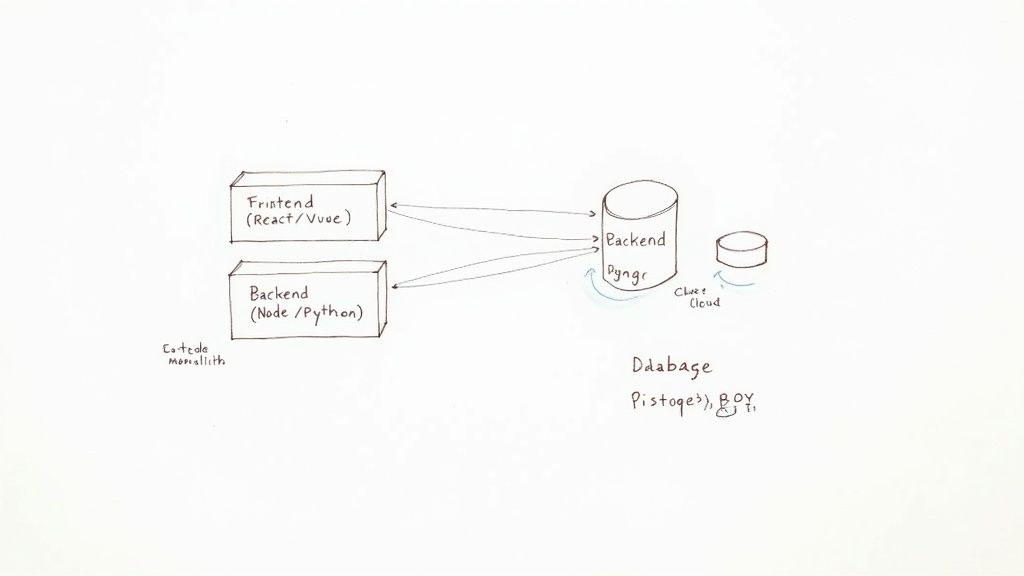
The single most important skill you'll need right now is the ability to say "no." Your initial feature list is probably a mile long, packed with "nice-to-haves" and "what-ifs." To launch an effective MVP, you have to be brutal and cut it down to the absolute bone.
Go back to the customer pain points you found during your research. Which problem was the most urgent? Which solution got people the most excited? That’s where you pour 100% of your energy. Your only goal is to deliver a "wow" moment around that single, core feature.
A great framework for this is the MoSCoW method:
- Must-Have: Features that are completely non-negotiable. Without these, the product is useless and doesn't deliver on its main promise.
- Should-Have: Important features that add a lot of value but aren't critical for the first launch.
- Could-Have: Things that would be nice to include if you have extra time and resources, but can easily be pushed to a later version.
- Won't-Have (This Time): Features that are explicitly out of scope for the MVP. No exceptions.
Your MVP should only contain the "Must-Haves." Everything else gets tossed into the backlog. This level of discipline is what separates a focused, successful MVP from a bloated project that never sees the light of day. For a deeper dive, our complete guide on MVP development for startups offers a framework for making these tough calls.
Don't Skimp on User Experience
Just because your MVP is minimal in features doesn't mean it should be minimal in quality. A clunky, confusing, or just plain ugly interface will kill your product before it has a chance, no matter how clever the core idea is. First impressions matter, especially when you're trying to build trust.
This doesn't mean you need a flashy, award-winning design. It just means you need a clean, professional user interface (UI) and a user experience (UX) that makes sense.
Your first users should be able to:
- Understand what your app does within seconds.
- Find and use the main feature effortlessly.
- Finish their primary task without getting frustrated.
Investing in solid UI/UX from day one is non-negotiable. It shows your early adopters that you respect their time and are serious about solving their problem.
A classic mistake is confusing "minimum" with "mediocre." Your MVP must be viable, and that viability hinges on delivering a polished, reliable experience for its one core function. A single feature that works flawlessly is infinitely better than ten features that are buggy and annoying to use.
Structuring the Development Workflow
Once you've nailed down your feature list, you need a system to manage the build. Agile development methods, especially Scrum, are a perfect fit for building an MVP. This approach breaks the entire project into small, manageable cycles called "sprints."
A typical sprint lasts 2-4 weeks and is laser-focused on delivering a small, functional piece of the product. This iterative cycle lets you build, test, and get feedback in a tight loop, which seriously cuts down the risk of building the wrong thing.
Let’s say you’re building a simple social media scheduling tool. Your sprints might look like this:
- Sprint 1 Goal: A user can sign up, log in securely, and connect one social media account.
- Sprint 2 Goal: The user can write a post with text and upload an image.
- Sprint 3 Goal: The user can schedule that post for a future date and time.
Each sprint delivers a tangible piece of value. This keeps the team focused, creates a predictable rhythm of progress, and lets you pivot quickly as you learn. It's the engine that will turn your feature list into a product you can actually launch.
Planning Your Launch and Go-to-Market Strategy
Okay, your MVP is built, tested, and ready to go. Take a moment to appreciate that—it's a huge milestone. But remember, a great product doesn't just sell itself. The game is shifting now from pure development to creating a solid, repeatable process for getting your app into the hands of real users and, you know, actually turning it into a business.
This phase is all about building the bridge between your code and your market. A successful launch isn't just a single event; it's the payoff from careful planning across three critical areas: deployment, security, and your go-to-market plan. Nailing these ensures your product not only finds its audience but also earns their trust right out of the gate. This is where your SaaS app meets the real world.
Automating Releases with CI/CD
Let's be honest: manually deploying code is slow, risky, and practically invites human error. The modern, professional way to handle releases is to set up a Continuous Integration/Continuous Deployment (CI/CD) pipeline. Think of this automated workflow as your production line for shipping features and bug fixes quickly and reliably.
Here’s a quick rundown of how it works:
- Continuous Integration (CI): Every time a developer pushes new code to a central spot like GitHub, an automated process kicks off. It builds the code and runs a battery of tests to catch bugs before they cause real problems.
- Continuous Deployment (CD): If all the tests pass, the pipeline automatically deploys the new code to your live production environment. No manual intervention needed.
Setting up a basic pipeline with tools like GitHub Actions or GitLab CI/CD is surprisingly straightforward these days. This automation frees up your team to focus on building cool stuff, not wrestling with deployments, and means you can respond to customer feedback with speed and confidence.
Building Trust with Security and Compliance
In the world of SaaS, security isn't just a feature—it's the absolute bedrock of your customer relationships. A single data breach can torpedo your reputation before you even get started. And with over 51% of organizations finding cloud data security harder than on-premise systems, you need a proactive, multi-layered security strategy from day one.
Start with these non-negotiables:
- Data Encryption: All data, whether it's sitting in your database (at rest) or flying across the internet (in transit), must be encrypted. This isn't optional; it's a baseline expectation.
- Robust Authentication: Implement strong password policies, sure, but more importantly, offer multi-factor authentication (MFA). This one feature is among the most effective ways to shut down unauthorized account access.
- Regular Security Audits: Periodically run vulnerability scans on your application and infrastructure. Tools like OWASP ZAP can help you find common security holes before the bad guys do.
Beyond the tech, you have to be aware of data privacy regulations like GDPR in Europe and CCPA in California. Understanding your responsibilities for handling user data isn't just a legal hoop to jump through; it's a critical part of building a trustworthy brand.
Your approach to security and compliance sends a powerful message. It tells customers you value their privacy and are a responsible custodian of their data. Never, ever treat it as an afterthought.
Crafting Your Go-to-Market Plan
With your technical house in order, it's time to plan your market entry. Your go-to-market (GTM) strategy is your playbook for reaching, acquiring, and keeping your ideal customers. It doesn't need to be a 100-page document, either. A lean, focused plan is far more effective.
Choosing a Pricing Model
Pricing is one of the toughest—and most important—decisions you'll make. It directly impacts your revenue, profitability, and how customers perceive your value.
Here are a few common SaaS pricing models to consider:
- Tiered Pricing: You offer several plans (e.g., Basic, Pro, Enterprise) with different features and limits. This is the most common model for a reason; it appeals to a wide range of customers.
- Usage-Based Pricing: You charge customers based on how much they use your product (think per API call or per gigabyte of storage). This model aligns cost directly with the value they get.
- Per-User Pricing: A simple model where you charge a flat fee for each user on an account. It’s easy for customers to understand but can sometimes discourage team adoption.
Start with a simple model based on the value you provide. You can—and should—revisit your pricing as you learn more about your customers and the market.
Finding Your First Customers
Forget trying to be everywhere at once. For your initial launch, pick one or two customer acquisition channels where your Ideal Customer Profile (ICP) actually spends their time.
Consider these options for getting early traction:
- Content Marketing: Write genuinely helpful blog posts or guides that solve a very specific problem for your ICP.
- Community Engagement: Become an active, helpful member of relevant online communities, like niche subreddits or LinkedIn groups. Don't just spam your link; add real value.
- Direct Outreach: If you have a well-defined ICP, a personalized cold email campaign can be incredibly effective for landing your first 10-20 customers.
The goal here isn't massive scale. It's about finding a repeatable channel that brings in your first wave of users. They're the ones who will give you the critical feedback you need to iterate and improve. This focused approach is the first step in building a SaaS application that doesn't just work, but actually thrives.
Scaling and Growing Your SaaS Application
Launch day is a huge milestone, but it's the starting line, not the finish. The real work of building a SaaS business begins the day after you pop the champagne. That early traction feels amazing, but turning that initial spark into a sustainable fire means shifting your focus from building to listening, learning, and iterating.
This is where your MVP starts to grow up and become a mature product. It's all about creating a tight feedback loop with your users, making decisions based on data, and making sure your tech can actually handle the success you're chasing. Welcome to the growth stage.
From Assumptions to Data-Driven Decisions
Your MVP was built on a pile of educated guesses about what your users needed. Now it's time to swap those guesses for hard data. Setting up analytics isn't a "nice-to-have" feature; it's the command center for understanding how people actually use your product.
You don't need to track everything. Start with a few key metrics that tell a clear story:
- User Activation Rate: What percentage of new signups actually complete the one key action that delivers your product's core value? This is a huge indicator of whether people "get it."
- Feature Adoption: Which features are your power users hammering on? And which ones are collecting digital dust?
- User Retention Cohorts: Of the people who signed up in January, how many are still active in February? In March? This tells you if your product has staying power.
Tools like Mixpanel, Amplitude, or even a well-configured Google Analytics can give you these insights. This data is your secret weapon for prioritizing what to build next based on real behavior, not just the loudest feature request.
Prioritizing Your Product Roadmap
Once you have user feedback and analytics data flowing in, you’ll be drowning in ideas, bug reports, and feature requests. The real challenge is deciding what to tackle next. A classic mistake is just building whatever gets requested the most. That's a great way to end up with a bloated product that serves a few niche needs instead of improving the core experience for everyone.
A simple but surprisingly effective way to prioritize is to score every potential feature on two axes:
- Impact: How much will this improve the user experience or help you hit a key business goal (like boosting activation or cutting churn)?
- Effort: How much developer time and how many resources will this thing actually take to build?
Zero in on the high-impact, low-effort items first. These are your quick wins. This approach ensures your precious development time is always spent on the things that will move the needle for the most users.
Growth isn't about adding more features; it's about adding more value. Obsess over solving your customers' core problems better than anyone else, and your product will naturally evolve in the right direction.
Scaling Your Infrastructure Smartly
As your user base grows, so do the demands on your application. The server that handled your first 100 users with ease will probably start to sweat under the load of 10,000. You have to get ahead of this—proactive scaling is key to keeping your app performant and reliable.
It's time to start thinking about the serious tech stuff:
- Database Performance: A slow database is usually the first bottleneck you'll hit. Start optimizing your slow queries and think about upgrading to a more powerful managed database service.
- Horizontal Scaling: Instead of just buying a bigger, more expensive server (vertical scaling), design your app to run across multiple smaller servers. It's more resilient and often more cost-effective.
- Cloud Cost Management: Your cloud bill can get out of control fast as you add more resources. Use the tools your provider gives you, like AWS Cost Explorer or Google Cloud Billing, to keep an eye on spending and find places to optimize.
This isn't just about keeping the lights on. It’s about delivering a snappy, reliable experience that makes people want to stick around. After all, customer churn is the silent killer of many SaaS businesses. For long-term success, you need to focus on improving satisfaction and deploying effective customer retention strategies. This cycle of listening, building, and optimizing is how you build a SaaS application that doesn't just launch—it lasts.
Got Questions About SaaS Development? We've Got Answers
So you're thinking about building a SaaS application. It’s an exciting process, but it also brings up a ton of questions. How long will it take? What’s a realistic budget? Should I hire my own team or find an agency? These are the exact questions we hear from founders all the time.
Let's cut through the noise and give you some straight answers.
How Long Does It Really Take to Build a SaaS MVP?
This is the million-dollar question, and the honest answer is: it depends. But for a focused Minimum Viable Product (MVP) built by a small or medium-sized business, a realistic timeline is typically between 3 to 6 months. This isn't just coding time; it covers everything from planning and UI/UX design to development sprints and proper testing before you go live.
A few things can really move that timeline around:
- Feature Complexity: A simple scheduling tool is a world away from a platform with heavy data analytics and a dozen third-party integrations. The more complex the core features, the longer the build.
- Team Size and Experience: A small, seasoned team that communicates well can often outpace a larger, less coordinated group.
- Your Tech Stack: Some technologies are just faster for rapid development, especially if your team already knows them inside and out.
One of the biggest mistakes we see is rushing the process. A well-planned 4-month build is infinitely more valuable than a chaotic 2-month scramble that leaves you with a buggy product nobody wants to use.
What Is a Realistic Budget for a SaaS MVP?
Just like the timeline, the cost to build a SaaS application can swing pretty widely. But if you’re aiming for a high-quality MVP from a professional agency or a skilled in-house team, you should plan for a budget somewhere between $50,000 and $150,000. That range typically covers the whole process—from strategy and design to development, testing, and getting it launched.
Key Insight: Your budget doesn’t stop at launch. Don't forget to factor in ongoing operational costs, which can easily run $1,000 to $3,000 per month for cloud hosting, third-party APIs, and basic maintenance for a smaller app.
It helps to see where that money actually goes:
- Discovery and Design (15-20%): This is the foundation. Skipping this step is like building a house without a blueprint.
- Development and Engineering (60-70%): The biggest chunk, where the actual code gets written.
- Project Management and QA (10-15%): The essential glue that keeps the project on track and ensures you ship a quality product.
Should I Outsource Development or Hire an In-House Team?
This really comes down to your resources, expertise, and long-term vision.
Outsourcing to a specialized agency is often the fastest and most cost-effective way to get your MVP to market. You get instant access to a full team of experts—designers, developers, project managers—without the headache and overhead of hiring.
Hiring an in-house team gives you more day-to-day control and helps build deep product knowledge within your company over the long haul. But it’s a much slower and more expensive path to start, bogged down by recruiting, salaries, and benefits.
There’s also a hybrid approach that works really well. You can outsource the initial MVP build to launch quickly, then start hiring your own team to take over development once you've found product-market fit. This strategy can give you the best of both worlds: speed to market now, and long-term control later.
Building a great SaaS application is a mix of smart strategy, solid engineering, and a real understanding of your customers. At Up North Media, we specialize in turning ambitious ideas into market-ready web applications that help businesses grow.
If you're ready to build your SaaS platform, let's schedule a free consultation and talk about your vision.