
You're probably closer to your customers than any national brand. You answer the phone. You hear the same questions at the counter. You know which service gets the most referrals and which product people pick up, examine, and then leave behind.
But online, that clarity often disappears.
A customer finds your Omaha business through Google, clicks three pages, stalls on a quote form, and vanishes. Someone visits your store in Dundee, follows you on Instagram later, adds an item to cart that night, then never checks out. A lead from West Omaha calls, asks smart questions, says they're interested, and then goes cold. You know demand exists. What you don't always know is where the experience breaks.
That's where customer journey mapping becomes useful. It gives you a way to see your business from the customer's side instead of from inside your operations. That difference matters. The parts that feel clear to your team often feel confusing, slow, or disconnected to a buyer.
Why Journey Mapping Is a Game Changer for Local Businesses
Most small businesses don't need more marketing theory. They need a way to answer basic questions with confidence.
Why do people visit but not book? Why do quote requests drop off after the first call? Why do shoppers browse a local site and then buy somewhere else? A journey map helps you answer those questions by laying out the actual path customers take, from discovery to purchase and beyond.
For Omaha businesses, this is especially important because local buying behavior rarely follows a clean line. A customer might hear about a contractor from a neighbor, check Google reviews during lunch, visit the website after dinner, and submit a form two days later. Another might stop by a shop in the Old Market, compare prices on their phone while standing in the aisle, then buy later from home. If you only look at one channel at a time, you miss the full story.
A useful benchmark here is adoption. Two in five organizations, or 42%, have developed and actively use a customer journey map, according to Hanover Research on customer journey mapping trends. That also means nearly 58% still don't have a formal approach. For a local business, that creates room to move faster than competitors who are still guessing.
Practical rule: If customers regularly ask the same question, hesitate at the same step, or disappear after the same interaction, you already have enough friction to justify mapping.
Journey mapping also forces a healthy shift in perspective. Instead of asking, “Did our team do the process correctly?” you ask, “Did the customer experience feel easy, clear, and worth continuing?” Those are not the same thing.
For a neighborhood retailer, service business, medical practice, or e-commerce brand based in Omaha, that's often the difference between decent traffic and dependable growth.
Laying the Groundwork for Your First Map
Before you build a map, get your inputs right. A bad journey map usually starts with internal assumptions dressed up as customer insight. If you skip research, the map will look polished and still lead you in the wrong direction.
The prep work is simpler than people think. You need two things. First, direct customer input. Second, behavior data from the systems you already use.
Talk to real customers, not your internal favorites
If you own an Old Market boutique, don't only ask loyal repeat buyers why they love you. Talk to first-time customers, hesitant buyers, and people who asked a question but didn't purchase. Those conversations reveal friction your best customers have already learned to tolerate.
Keep it simple. Short interviews work. So do post-purchase emails, customer service notes, and a quick question at checkout. Ask things like:
- How did you first hear about us? This shows whether discovery starts with search, social, referrals, foot traffic, or local visibility.
- What nearly stopped you from buying? Customers often describe the actual blocker more clearly than analytics can.
- What did you need to know before choosing us? This helps you spot missing content, weak proof, or unclear offers.
- What felt confusing or slow? That language often turns directly into website and messaging improvements.
A lot of Omaha owners already collect pieces of this without formalizing it. Sales calls, front-desk conversations, DMs, and follow-up emails all contain useful journey clues.
Pull patterns from your existing data
You don't need an enterprise tech stack to do this well. Start with what you already have. Google Analytics, Shopify, WooCommerce, a booking platform, call logs, chat transcripts, and CRM notes can tell you where people pause, return, or disappear.
For example, a local retailer may notice that product pages get attention but shipping or return-policy pages get repeat visits before checkout. A home service company may see strong traffic to service pages but weak form completion on mobile. A clinic may find that appointment request pages perform better when insurance information is visible earlier.
If you're trying to turn anonymous visitors into customers, first-party behavior data becomes especially useful because it connects observed actions to actual intent instead of broad assumptions.
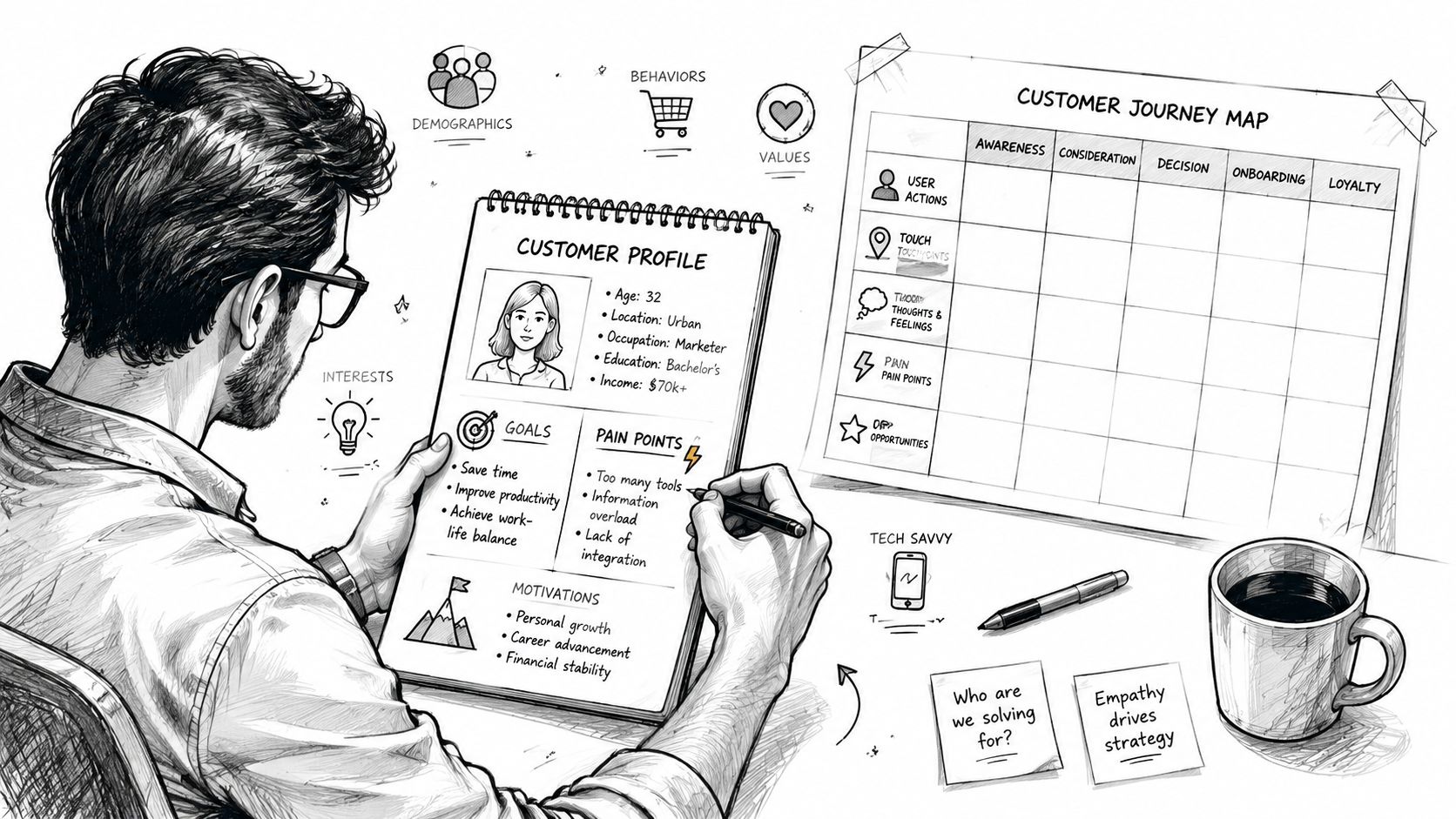
Build lean personas that sound like real people
Personas should help you make decisions, not decorate a slide deck. Keep them grounded in what customers do and what they need in the moment. If you need a framework, this guide on how to create buyer personas is a practical place to start.
A strong persona includes:
- Context: Are they price-sensitive, time-sensitive, or risk-sensitive?
- Trigger: What pushed them to start looking?
- Decision habits: Do they compare options carefully or act fast when trust is established?
- Preferred touchpoints: Do they call, text, browse reviews, or book online?
The best personas are specific enough to guide copy, design, and follow-up. They're not fictional biographies.
For many Omaha SMBs, one or two core personas are enough for a first map. Don't build six if your sales process only clearly supports two. Accuracy beats completeness.
How to Build Your Customer Journey Map
A good journey map doesn't need fancy software. A spreadsheet, whiteboard, FigJam board, or Miro template is enough. What matters is that the map accurately reflects the current state, including customer emotions, frustrations, and points of uncertainty. That approach aligns with the Harvard Business School methodology for customer journey maps.
Start with one customer type and one common journey. Don't begin with every audience, every service line, and every possible path. That's how teams build something so broad that nobody can use it.
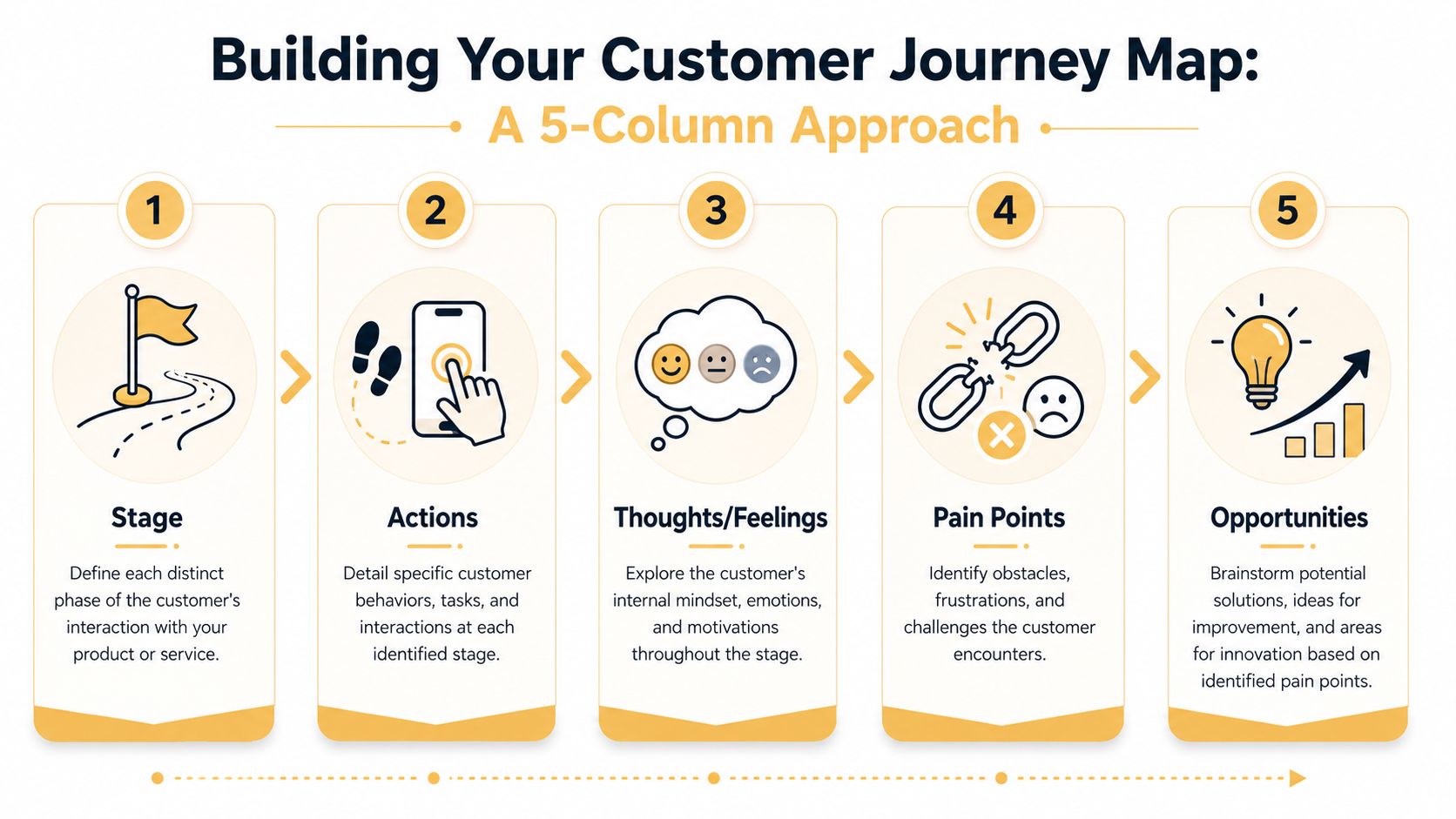
Use a five-column map
A practical map for most Omaha businesses includes five columns:
| Column | What goes in it | Example for a local lawn care company |
|---|---|---|
| Stage | The phase of the journey | Awareness, Consideration, Purchase, Retention, Advocacy |
| Touchpoints | Where the customer interacts with you | Yard sign, Google Business Profile, website, estimate form, invoice email |
| Actions | What the customer actually does | Searches “lawn care near me,” compares services, requests quote |
| Thoughts and feelings | What they may think or feel | “Can I trust these people?” “Why isn't pricing clearer?” |
| Opportunities | Improvements tied to friction | Add service area map, simplify quote form, send faster follow-up |
That structure is enough to create clarity without overcomplicating the exercise.
Define stages from the customer side
If you run a lawn care business in Omaha, a customer journey usually moves through familiar stages. Awareness might begin when they see your truck in the neighborhood or find you in search. Consideration starts when they compare your site against two or three competitors. Purchase happens when they request a quote or approve service. Retention depends on communication, scheduling, billing clarity, and consistency. Advocacy shows up in reviews, referrals, and repeat seasonal work.
The key is to describe each stage from the customer's perspective, not yours. “Lead intake completed” is an internal process label. “Submitted a quote request and waited for a response” is the customer experience.
Here's a useful way to pressure-test your map:
- If the wording sounds like an internal checklist item, rewrite it.
- If the touchpoint isn't customer-visible, move it out of the map or into a service blueprint.
- If the feeling column sounds made up, go back to your research notes.
Inventory every touchpoint you can find
At this point, most maps get better fast. Business owners often underestimate how many touchpoints shape trust before the sale.
For a local service business, touchpoints might include:
- Offline visibility: Wrapped vehicles, signage, community sponsorships, yard signs
- Search presence: Google Business Profile, reviews, local pack listing, service pages
- Direct contact: Calls, texts, quote forms, consultation emails
- Post-sale experience: Scheduling reminders, invoices, follow-up messages, review requests
For a retailer, the list might include product pages, return policies, store visit, cart flow, checkout emails, and customer support replies.
If you need help with identifying customer pain points, reviewing touchpoints one by one is usually where the hidden friction starts to surface.
A strong map also captures transitions. A lot of drop-off doesn't happen at a single page or moment. It happens between moments. A customer moves from Instagram to your site, from a phone call to a quote email, from a product page to checkout. Those handoffs often feel rougher than any single touchpoint.
Record thoughts and feelings with honesty
This part makes some teams uncomfortable because it exposes gaps they've normalized.
A customer may think:
- “I like the company, but I can't tell if they serve my zip code.”
- “The form is too long for a simple quote.”
- “If they take this long to reply now, support will probably be slow later.”
Those reactions matter because they shape behavior. People don't always complain. They often just leave.
This walkthrough helps visualize how the process comes together in practice:
Map what's true, not what you wish were true. If customers feel uncertain, write that down even if your team believes the page is clear.
When the map is complete, don't rush to redesign everything. Look for repeated friction first. Patterns matter more than isolated annoyances.
Bringing Your Map to Life with Data and KPIs
A journey map becomes useful when it changes decisions. That requires metrics.
Without KPIs, teams can agree that a step feels clunky and still argue about what to fix first. With KPIs, you can see whether the problem sits at discovery, response, conversion, onboarding, or support.
The clearest example comes from implementation. Companies that use journey mapping with real-time alerts and cross-team sharing can reduce support ticket volume by up to 25% and increase conversion rates by 15-20%, according to FullStory's analysis of customer journey analytics. That's why a map shouldn't live only in a workshop document. It needs operating metrics attached to each important stage.
Match metrics to the moments customers experience
For an e-commerce business, the purchase stage might center on cart completion and checkout behavior. For a local service provider, it may revolve around form completion, booked calls, and response speed. The metric should match the action customers are trying to take.
A basic rule works well here: measure one behavior, one friction signal, and one outcome for each stage.
A useful KPI doesn't just describe traffic. It helps your team decide what to change next.
Voice-of-customer feedback matters here too. Quantitative data shows where people hesitate. Customer comments help explain why. If you want a practical primer on that side, Formzz VoC insights are worth reviewing.
Key metrics for each customer journey stage
| Journey Stage | Example KPI for E-commerce | Example KPI for Local Service |
|---|---|---|
| Awareness | Branded search activity, landing page engagement | Google Business Profile interactions, service page engagement |
| Consideration | Product page engagement, return to category pages | Time on service pages, FAQ engagement, estimate page visits |
| Purchase | Cart abandonment, checkout completion | Form completion, booked consultation requests |
| Retention | Repeat purchase behavior, support contact patterns | Appointment completion, repeat service bookings, support issues |
| Advocacy | Review activity, referral code use | Review requests completed, referral inquiries, testimonial submissions |
Keep the dashboard small enough to manage
Owners often make one of two mistakes. They either track almost nothing, or they track so much that the metrics become background noise. For most SMBs, a short scorecard is enough.
A clean setup usually includes:
- Leading indicators: Page engagement, quote-start activity, booking intent
- Friction indicators: Drop-off steps, repeated support questions, abandoned forms
- Outcome indicators: Completed purchases, booked jobs, repeat business, reviews
If you need a broader framework for reporting, this guide on measuring digital marketing performance can help connect channel metrics to customer journey stages.
The point isn't to build a complicated dashboard. The point is to make sure every improvement on the map can be validated by behavior, not opinion.
From Map to Actionable Growth Plan
Most customer journey maps fail for one simple reason. They're too big to act on.
A business maps the entire end-to-end experience, identifies twenty issues, assigns none of them clearly, and then moves on. The map becomes a smart-looking document instead of a working growth tool.
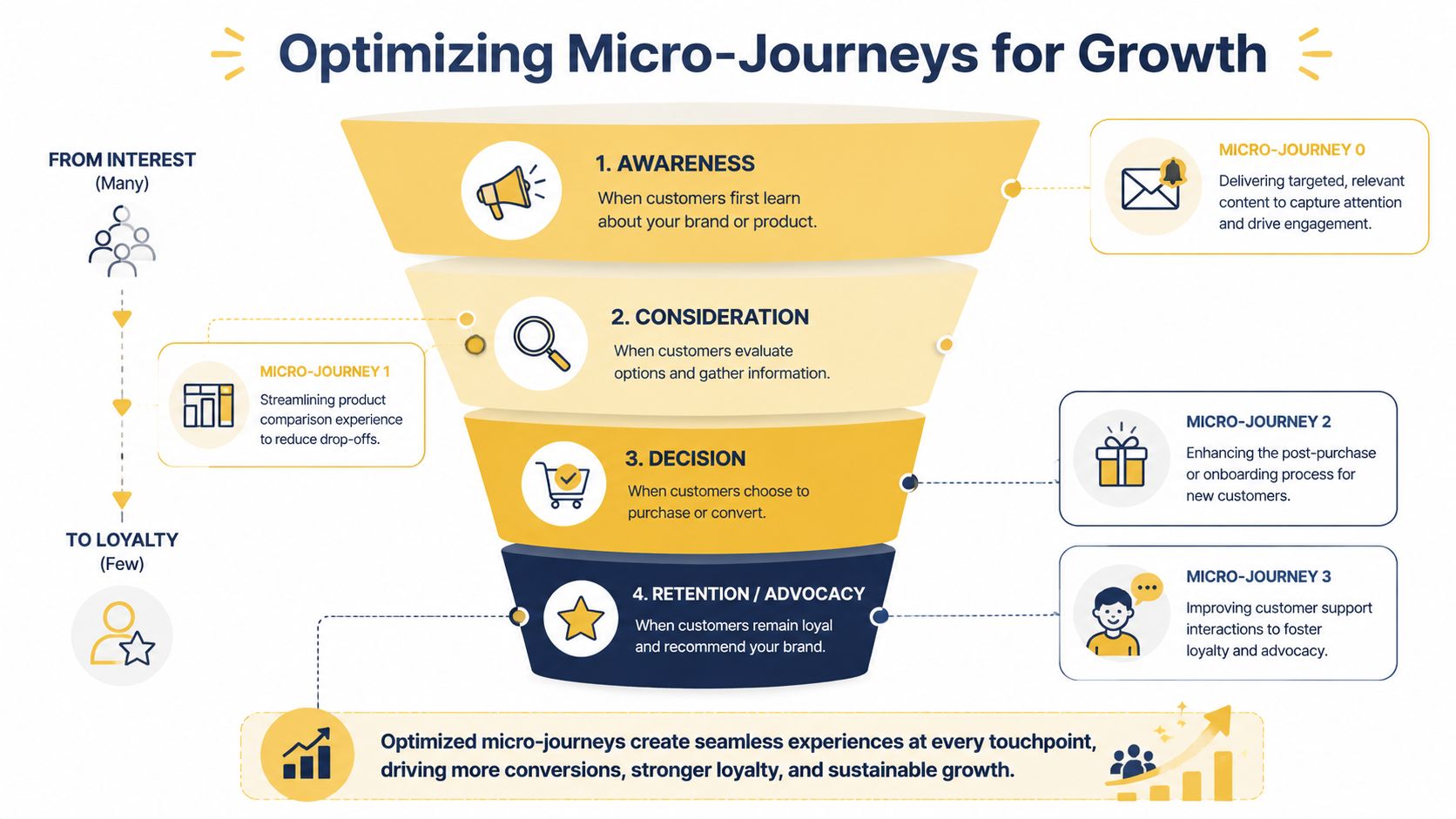
That's why micro-journeys matter.
Instead of trying to fix everything from first impression to long-term loyalty, isolate one narrow journey where customers are most likely to hesitate. Checkout. Quote request. Appointment booking. New customer onboarding. Review request. Support handoff. Those are often the moments that decide whether growth compounds or stalls.
Why micro-journeys deserve your attention
This is the underserved part of customer journey mapping, and it's where many Omaha businesses can get traction quickly. According to Sogolytics on customer journey mapping examples, 68% of customer drop-offs happen at these specific touchpoints, and companies that optimize them see a 23% increase in retention.
That lines up with what many local businesses experience in practice. Customers don't usually vanish because your entire brand story failed. They leave because a small step became harder than it should've been.
A few common micro-journeys for Omaha SMBs:
- Retail checkout: Add to cart, shipping estimate, payment, confirmation
- Service inquiry: Service page, form fill, confirmation, follow-up call
- Onboarding: First purchase, welcome email, setup instructions, first support interaction
- Review generation: Delivery complete, review request, reminder, submission
Pick one micro-journey and tighten it
A focused optimization process is more manageable and usually more productive. Start with the point where sales, service, or retention feels weakest.
For example, take an Omaha med spa that gets strong traffic but uneven booking volume. Don't map the full customer lifecycle first. Map the booking micro-journey:
- Customer lands on a treatment page
- They compare options and pricing
- They click to book
- They see calendar availability
- They submit the appointment
- They receive confirmation and pre-visit instructions
At each step, ask what could break confidence. Missing pricing. Unclear preparation steps. Weak mobile usability. Too many fields. No confirmation. Slow response to questions.
That creates a short, actionable project list instead of a vague CX initiative.
Prioritize the moments of truth
Not every friction point deserves equal effort. Some are annoying but low impact. Others sit right at the point of decision.
Look for moments where the customer is asking one of these questions:
- Can I trust this business?
- Is this worth the cost or effort?
- What happens next?
- Will this be easy if something goes wrong?
Those are decision moments. Fixing them often improves more than polishing top-of-funnel messaging.
For teams working on broader experience improvements, this resource on how to improve customer experience is a useful companion to micro-journey work.
Don't start with the journey that feels most impressive. Start with the journey closest to revenue loss, customer frustration, or repeat support burden.
Turn findings into a short action list
After mapping a micro-journey, convert it into three buckets:
| Priority bucket | What belongs there |
|---|---|
| Fix now | Broken forms, unclear pricing, missing confirmations, obvious mobile friction |
| Test next | CTA wording, checkout field order, follow-up timing, trust elements |
| Monitor | Questions that need more evidence before redesigning |
That format keeps the work grounded. Customer journey mapping should produce decisions, owners, and next actions. If it doesn't, it's still just documentation.
Common Mapping Pitfalls and Your Next Step
The biggest mistake isn't making a bad map. It's making a map once and treating it like finished work.
That's the static map trap, and it's more common than widely acknowledged. Research summarized in this practical guide to data-driven customer journey mapping notes that 67% of journey maps fail to generate actionable insights because they aren't dynamic, data-driven, or validated with clear success metrics.
A few patterns usually cause that failure:
- Internal bias replaces customer evidence. The map reflects what the team thinks should happen.
- No owner is assigned. Friction gets identified, but nobody is responsible for fixing it.
- The map never gets updated. New offers, channels, and customer expectations change the journey.
- Everything gets equal priority. Teams spread effort too thin and improve nothing meaningfully.
The fix is straightforward. Keep the map live. Review it when you change a service, redesign a page, launch a campaign, or notice new questions in sales and support. Treat it like an operating tool, not a workshop artifact.
If you're an Omaha business owner, don't wait until every system is perfect. Start with one persona and one micro-journey. Map what customers do, identify where they hesitate, attach a few useful KPIs, and improve the step that matters most.
If you want a second set of eyes on your first map, or you'd rather build it with a local team that understands Omaha buyers, Up North Media offers free consultations. We can help you map the journey, identify the friction points that matter most, and turn the work into practical next steps your team can execute.