
A founder once told me, “Our brand looks polished, but it still feels like we're pushing uphill.” That's the modern version of standing over a mortar bowl with raw grain in your hands. The material is there. The question is whether you have the right process to turn it into something useful.
What Does Grain and Mortar Mean for Your Business
For most of human history, grain didn't become food on its own. Someone had to grind it, sift it, work it, and repeat that process day after day. That's why Grain and Mortar works so well as a business metaphor. One part is raw potential. The other is the system that shapes it.
A lot of Omaha businesses already have good grain. They have a solid service, a real reputation, and a clear reason customers come back. What they often lack is mortar. Not the visual kind. The strategic kind that binds positioning, messaging, website structure, search visibility, and follow-up into one durable system.
The Raw Material Is Rarely the Problem
Most businesses don't fail because they have nothing valuable to offer. They struggle because the value stays unprocessed. It sits in the owner's head, buried in sales conversations, or scattered across an outdated website and a few social posts.
That's where the metaphor gets practical:
- Grain is your substance: your expertise, offer, reputation, story, and market fit.
- Mortar is your shaping force: the framework that turns that substance into a brand people can understand and act on.
- Growth happens when both work together: a strong offer with weak delivery gets ignored, and polished marketing with weak substance falls apart.
Businesses that get traction usually do one thing well. They stop treating branding as decoration and start treating it as processing. The website isn't just there to look current. The messaging isn't there to sound clever. Every piece should help a buyer move from interest to trust.
Why This Matters Locally
In Omaha, word of mouth still matters. So do relationships. But word of mouth without digital reinforcement has limits. When someone hears your name, they search. They compare. They scan your site, your reviews, your clarity, and your credibility in minutes.
Practical rule: If a customer can't tell what makes you different within a short visit, your grain is still unground.
That's why the old metaphor still holds up. The businesses that win don't just have raw ingredients. They know how to refine them into something consistent, useful, and easy to buy. If you're working on that foundation, this guide on how to build online presence is a helpful next step.
The Original Task A Brief History of Work
The phrase gets stronger when you remember that grain and mortar wasn't poetic language at first. It was daily labor. In ancient Nubia, the mortar and pestle was a core household technology used to grind wheat and barley into flour for over 3,000 years. Historical records also indicate that women and children carried out this work each day, processing about 1 to 2 pounds of grain per person to meet daily caloric needs.
Manual Work Was the Bottleneck
That detail matters because it shows what the tool did. It transformed a raw material into something usable, but it did so slowly and with effort. The process was repetitive, physical, and essential.
Early colonial America looked similar. In Plymouth Colony between 1620 and 1640, colonists had no mechanical mills and relied on large wooden mortars and pestles to grind corn at home for flour and sampe. Historical analysis indicates that women and children often spent 3 to 4 hours per day on this task, processing roughly 0.5 to 1 pound of corn per session, and up to 40% of daily labor time could go to food preparation before water mills changed the equation.
Work becomes strategy the moment someone asks, “How do we produce more with less wasted effort?”
That's the same question every business eventually asks. Not because the work is unimportant, but because manual systems cap growth.
Better Tools Changed Entire Economies
The historical leap came when societies stopped relying only on hand tools. The transition from manual stone methods to the Roman rotary quern increased grain throughput by roughly 300%, which helped support urban populations of over 1 million people in cities like Rome, as noted in this historical summary of milling technology. That same source notes the next major shift came around 1870, when roller mills increased efficiency by another 500%.
A few things stand out in that progression:
- The raw material stayed the same: grain was still grain.
- The method changed everything: throughput, scale, and consistency improved.
- The winning advantage was operational: better processing created larger downstream outcomes.
That's why this old image still lands in business strategy. Companies often obsess over the grain. The offer. The product. The logo. The tagline. Those things matter, but history says the more decisive advantage often comes from the system that processes the raw material efficiently.
The Lesson for Brand Builders
Foundational work is rarely glamorous. It's often repetitive, technical, and invisible from the outside. But invisible systems support visible growth.
If your brand feels stuck, the issue may not be the quality of what you sell. It may be that your current tools still work like a hand mortar in a market that now expects rotary speed.
Defining the Grain and Mortar Business Philosophy
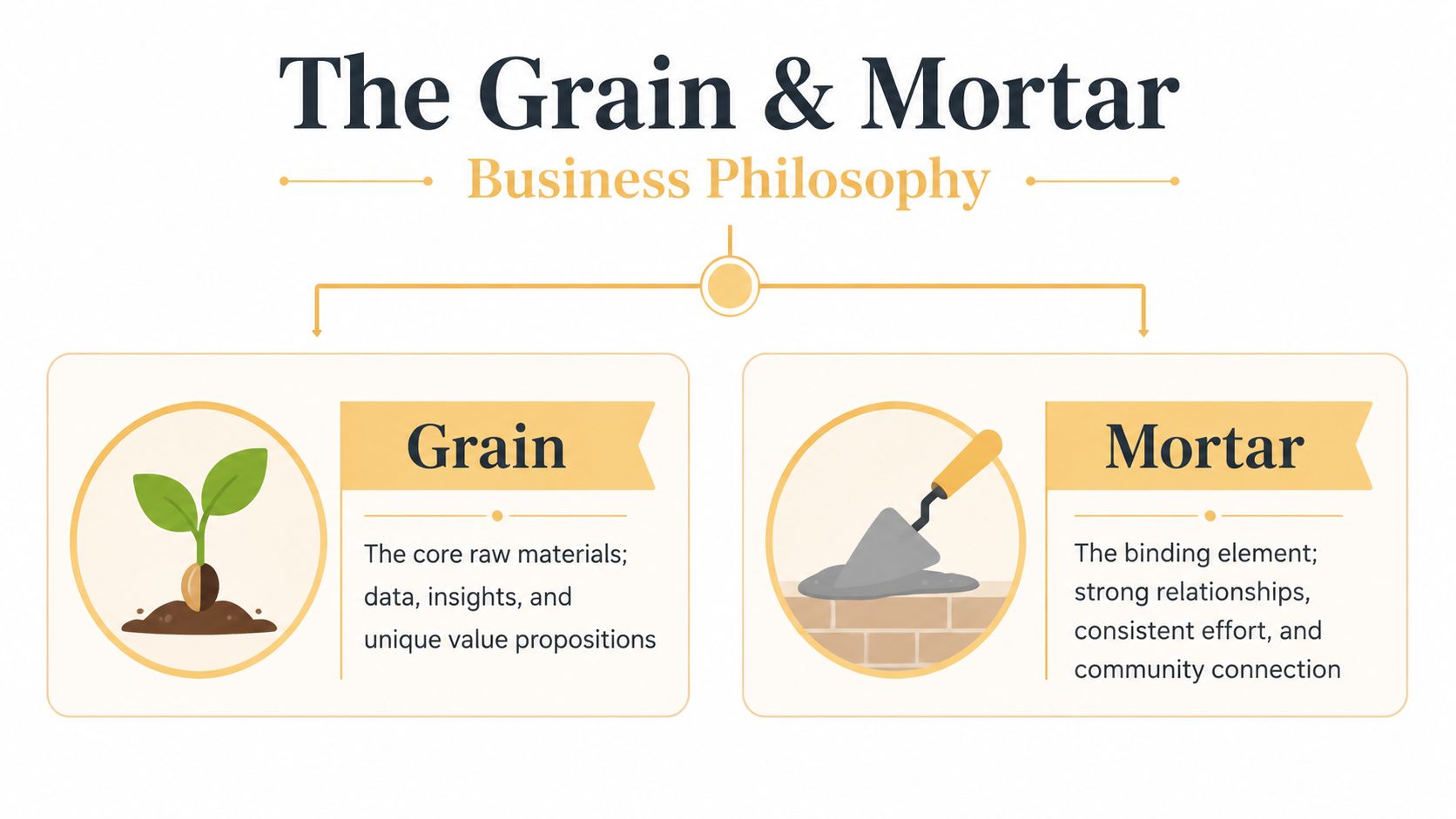
Once you strip the phrase down, the framework is straightforward. Grain is what your business is at its core. Mortar is how that value gets formed, communicated, and held together tangibly.
Grain Means Core Substance
If I'm diagnosing a brand problem, I look at the grain first. Not because it's always broken, but because weak positioning can't be saved by clever execution.
Your grain usually includes:
- Your offer: what you sell and who it helps.
- Your point of view: what you believe that competitors don't say as clearly.
- Your credibility: experience, proof, trust signals, and customer language.
- Your fit: where you belong in the market and where you don't.
A lot of owners think this is “brand story.” Sometimes it is. More often, it's simpler. It's the plain answer to why someone should choose you instead of the other options they found in search.
Mortar Means Binding Force
Mortar is where most strategy lives. It's the set of tools and choices that turn business value into something cohesive. That includes messaging, visual identity, website structure, SEO, campaign planning, content systems, automation, lead handling, and measurement.
Core idea: Grain is potential. Mortar is what makes that potential hold its shape under pressure.
Without mortar, good elements stay loose. You can have a sharp offer, a capable team, and strong service, but if the website confuses buyers and your search visibility is weak, the pieces never join into a dependable brand experience.
How to Tell Which Side Is Weak
Businesses often misdiagnose the problem. They assume they need a rebrand when they need tighter execution. Or they chase tactics when the offer itself isn't differentiated.
Use this quick lens:
| Question | Likely issue |
|---|---|
| Buyers don't understand what you do | Grain problem |
| Buyers understand it but don't trust it | Mortar problem |
| Leads come in, but they're a poor fit | Grain problem |
| Good-fit leads visit but don't convert | Mortar problem |
That isn't perfect, but it's useful. It helps separate identity problems from delivery problems.
A Practical Definition
Your business grows when the raw material is real and the binding system is disciplined.
That's the philosophy in one sentence.
The best brands don't confuse aesthetics with structure. They define their grain clearly, then build mortar that supports every customer interaction. When those two parts align, the brand stops feeling improvised and starts feeling inevitable.
Why Strong Foundations Matter A Local Example
Omaha has a good example of this philosophy in the market already. Grain & Mortar, the agency, built its identity around a name that signals process, craft, and fundamentals. Even before you review the work, the name tells you what they value. Raw material matters. So does the method used to shape it.
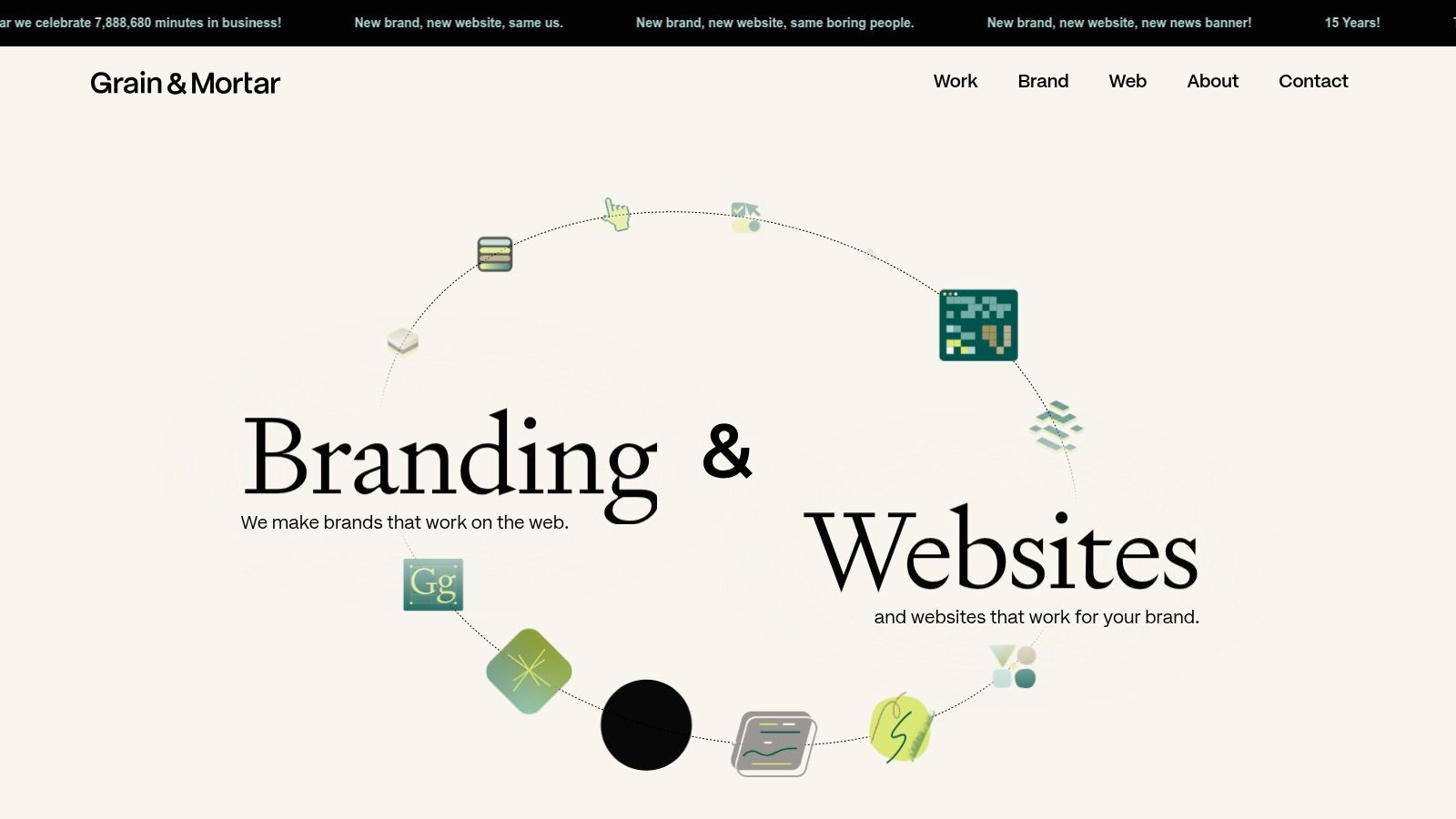
That's smart branding. It communicates seriousness without sounding corporate, and it suggests that brand building starts at the base layer, not at the finish coat.
What the Name Signals
When an agency chooses a name like Grain & Mortar, it's making an argument. It's saying brands aren't assembled from trends. They're built from ingredients and technique.
That shows up in the kind of work they present. Their showcase for Foster describes naming, brand strategy, web redesign, user-flow planning, custom content modules, and experiential marketing. The emphasis is on foundational creative decisions and how separate pieces come together into one stronger brand expression.
A local business owner can read that and immediately understand the value of foundational work:
- Naming creates clarity
- Brand systems create consistency
- Site structure improves usability
- Experiential elements reinforce recognition
Those are real business levers. They matter.
Why Foundation Still Deserves Respect
A weak foundation creates expensive confusion later. I've seen companies spend heavily on ads before fixing basic positioning. The result is predictable. More traffic lands on a message that still doesn't connect.
A polished campaign can amplify a weak foundation just as effectively as it amplifies a strong one.
That's why foundational agencies play an important role. They help businesses define who they are before they try to scale how they're seen.
Later in the process, it helps to see how that kind of work translates into motion and experience:
Where the Case Study Gets Interesting
The local takeaway isn't that every business needs the same style or the same agency model. It's that strong foundations are real assets. A clear name, a coherent visual system, and a better-organized website can change how buyers perceive competence before a sales conversation even starts.
For Omaha businesses, that's not a small thing. Local trust is built fast, and it's lost fast. If your brand foundation feels scattered, buyers notice.
The Limits of Foundation Alone The Need for Data
Foundational branding matters. It just isn't enough by itself anymore.
A business can have a memorable name, thoughtful design, and clean messaging and still miss growth targets. That happens when the brand looks cohesive but the operating system behind it is still vague. You can't improve what you don't measure, and you can't defend marketing spend with adjectives.
Buyers Want Proof, Not Just Presentation
The market has moved in this direction. A 2024 McKinsey study found that 82% of SMBs prioritize agencies with transparent, data-backed outcome reporting, and the same summary notes that many creative showcases remain qualitative, creating a trust gap for businesses that want tangible ROI, according to this McKinsey-based reference on reporting expectations.
That doesn't mean every business owner wants a dashboard full of jargon. It means they want answers to practical questions:
- Which channels are bringing qualified leads
- Which pages are producing action
- Which messages are attracting the wrong audience
- Which efforts should be cut, fixed, or scaled
Without that layer, branding can drift into performance theater. It looks intentional. It sounds strategic. But the owner still can't tell what's working.
Qualitative Work Has a Ceiling
There's nothing wrong with qualitative case studies. They can show thinking, craft, and range. The problem starts when qualitative is all a buyer gets.
A local business choosing a partner usually wants some version of this sentence: show me what changed. Not in abstract terms. In business terms.
What clients need from modern brand work is traceability. They want to connect strategy decisions to outcomes, even when those outcomes take time to compound.
That's why data literacy now belongs inside brand strategy, not outside it. If your agency can define voice but can't explain lead quality, search visibility, user flow, or conversion friction, the work stops short of what modern businesses need.
What Better Looks Like
Useful reporting doesn't have to be bloated. It should be focused, understandable, and tied to business goals. For smaller firms, that often starts with a few core habits:
- Track intent, not just traffic. More visitors only matter if the right people arrive.
- Measure page performance by business role. A service page and a hiring page shouldn't be judged the same way.
- Audit funnel leakage regularly. Search, landing pages, forms, and follow-up all affect results.
- Review strategy against real behavior. If users keep taking a different path than expected, the plan needs revision.
For teams that want a clearer measurement framework, this guide to data analytics for small business is a strong place to start.
The Modern Toolkit Grinding Grain with AI and SEO
If classic mortar was the material that bound stones into a wall, modern business mortar is the mix of digital systems that binds attention, trust, and action into growth. In practice, that means SEO, AI, analytics, content operations, and web development working together instead of in silos.
The construction analogy holds up better than most marketing metaphors because consistency matters. According to Amerimix mortar consistency guidelines, a proper mortar mix should hold at about a 1/2-inch thickness on a trowel for watertight joints. The business equivalent is straightforward. If your tactic mix is off, your funnel leaks.
What the New Mortar Is Made Of
A lot of companies still treat digital channels like separate add-ons. SEO sits with one vendor, content with another, paid media somewhere else, and AI gets discussed as a future experiment. That fragmentation weakens the structure.
A stronger modern mix usually looks like this:
- SEO for discoverability: it aligns your site with the actual language buyers use when they search for solutions.
- AI for processing and speed: it helps teams organize research, identify content gaps, support workflows, and reduce repetitive manual work.
- Web development for conversion: it turns visibility into action through faster pages, cleaner UX, and better lead paths.
- Analytics for correction: it tells you where people drop, hesitate, or choose the wrong action.
Good digital strategy doesn't pile on tactics. It combines them in the right proportions.
If you're exploring where AI fits into search and content operations, this guide on how to transform your rankings with AI offers useful tactical context.
Brand Building Approaches Compared
| Aspect | Classic 'Mortar' (Foundational) | Modern 'Mortar' (Data-Driven) |
|---|---|---|
| Primary goal | Clarify identity | Clarify identity and improve performance |
| Core tools | Naming, visual systems, messaging | SEO, AI workflows, analytics, UX, web builds |
| Success signal | Cohesion and recognition | Cohesion, discoverability, and measurable action |
| Main risk | Looking good without traction | Over-optimizing without clear brand substance |
| Best use | Establishing trust and consistency | Scaling trust into repeatable growth |
What Works and What Doesn't
What works is integration. A service page built for search intent, supported by useful content, improved through user behavior data, and maintained with AI-assisted workflows has a much better chance of compounding value over time.
What doesn't work is superficial adoption. Adding AI-generated copy to a weak website won't fix unclear positioning. Publishing SEO pages without understanding buyer questions won't produce strong-fit leads. Installing analytics and never reviewing it is just expensive decoration.
For teams sorting through tools and workflow changes, these AI content creation tools are a practical reference point. The bigger principle is simpler. In 2026, the best mortar isn't just creative discipline. It's creative discipline reinforced by data and automation.
Building Your Brand From Grain to Growth
Most businesses don't need a louder brand first. They need a clearer one. Then they need the systems that carry that clarity into search results, site experience, lead handling, and ongoing optimization.
That's the full value of the Grain and Mortar idea. Your grain is the part no competitor can fake. It's your expertise, your offer, your market fit, and your reputation. Your mortar is the structure that makes those strengths visible and actionable.
A Useful Brand Audit
Start with a simple review:
- Check your grain: Can a new buyer understand what you do, who it's for, and why it's different?
- Check your mortar: Does your website, SEO, content, and follow-up process support that story consistently?
- Check your durability: Are you making decisions from evidence, or from assumptions and taste alone?
The strongest brands don't choose between foundation and performance. They build foundation for performance.
For Omaha business owners, that matters more now because buyers move fast. They don't separate brand, website, search result, and user experience into different buckets. They experience all of it as one impression.
If the impression is clear, credible, and easy to act on, growth gets simpler. If it's fragmented, every sales effort gets harder than it should be.
If your business has strong raw material but your digital systems aren't turning it into consistent growth, Up North Media can help. The team works with Omaha businesses on SEO, AI consulting, and custom web development that ties brand foundations to measurable performance.