

A lot of dentists are in the same spot right now. The clinical side is solid, patient care is strong, referrals still come in, but growth feels uneven because new patients search on Google before they ever ask a neighbor.
That creates a frustrating gap. You can be the right practice for implants, family dentistry, Invisalign, or emergencies, yet still lose attention to the office that shows up first in local results.
That’s where a dental seo agency becomes practical. Not as a vague marketing vendor, but as the team that connects your expertise to people actively looking for care in your market, including Omaha neighborhoods where local visibility can decide who gets the call and who gets ignored.
Growing Your Practice Beyond Referrals
A busy practice can look healthy from the inside and still have a visibility problem from the outside. The schedule is decent. Existing patients are loyal. Staff stays busy. But there are open chair hours that should’ve been filled by people searching for treatment right now.

That gap usually shows up in familiar ways. A practice gets plenty of word-of-mouth for cleanings and checkups, but higher-value services stay inconsistent. Another office has a good website design, but it doesn’t rank for local treatment searches. A third has strong reviews, yet competitors dominate map results because they’ve built better local search signals.
Referrals still matter. They always will. But referrals alone rarely give a practice control over growth.
For dental owners in Omaha, that’s the key shift. Search visibility isn’t separate from practice growth anymore. It’s part of the front door. If someone searches “dentist near me,” “emergency dentist Omaha,” or “Invisalign consultation,” they’re already raising their hand.
A capable agency closes the distance between that search and your schedule. It helps your practice show up, look credible, and make it easy for the patient to act. That includes your site, your Google Business Profile, your reviews, your service pages, and the technical health of the whole setup.
If your practice needs a marketing partner that understands that healthcare businesses have different needs than a general local company, this overview of digital strategy for dental practices is a useful starting point.
The best dental marketing doesn’t manufacture demand. It captures demand that already exists and routes it to the right practice.
What a Dental SEO Agency Does
Most dentists have heard some version of the same pitch. Better rankings. More traffic. More visibility. That language is too broad to help you make a decision.
A real dental seo agency usually operates in four jobs at once.
Strategic partner
The first job is business alignment. Good agencies don’t start with keywords. They start with your economics.
If implants matter more than hygiene volume, the strategy should reflect that. If you’re a startup office, the early plan will look different from an established practice trying to gain map share in a crowded area. If you want to attract families in West Omaha, the service mix, landing pages, and local targeting should match that goal.
Weak agencies often fail here. They sell a fixed package instead of building around services, geography, competition, and patient intent.
Technical expert
Your website needs to be easy for patients to use and easy for Google to understand. Those are not always the same thing, and both matter.
A technical team handles things like:
- Crawlability: Making sure search engines can access important pages.
- Site structure: Grouping services and locations in a way that makes sense.
- Mobile usability: Preventing booking friction on phones.
- Security and trust signals: Keeping the site reliable and professional.
Think of technical SEO like the plumbing behind your walls. Patients don’t compliment it, but if it’s broken, everything else suffers.
Content engine
Content isn’t “write blog posts and hope.” In dental, it needs to answer real questions and support real services.
That means clear pages for procedures, financing questions, sedation concerns, cosmetic options, and treatment comparisons. It also means writing in a way that earns trust without sounding clinical or robotic.
Some content exists to rank. Some exists to convert. The best agency knows the difference and builds both.
Practical rule: A service page should help a nervous patient understand the procedure and help Google understand what the page is about.
Local champion
Most dental decisions happen locally. Patients usually don’t want the best dentist in a different city. They want a trusted option nearby, with strong reviews, clear availability, and an office they can reach quickly.
That makes local SEO a core agency function, not an add-on.
A local-focused team works on:
- Google Business Profile optimization: Categories, services, photos, updates, and accuracy.
- Map visibility: Strengthening the signals that help your practice appear in the local pack.
- Citation consistency: Keeping name, address, and phone information aligned across directories.
- Review acquisition support: Creating systems that increase review velocity without sounding forced.
When these four roles work together, SEO stops being abstract. It becomes patient acquisition infrastructure.
The SEO Playbook for Modern Dental Practices
A dental practice rarely needs gimmicks. It needs a system. The strongest campaigns usually rest on four pillars, and if one is weak, the others have to work harder than they should.
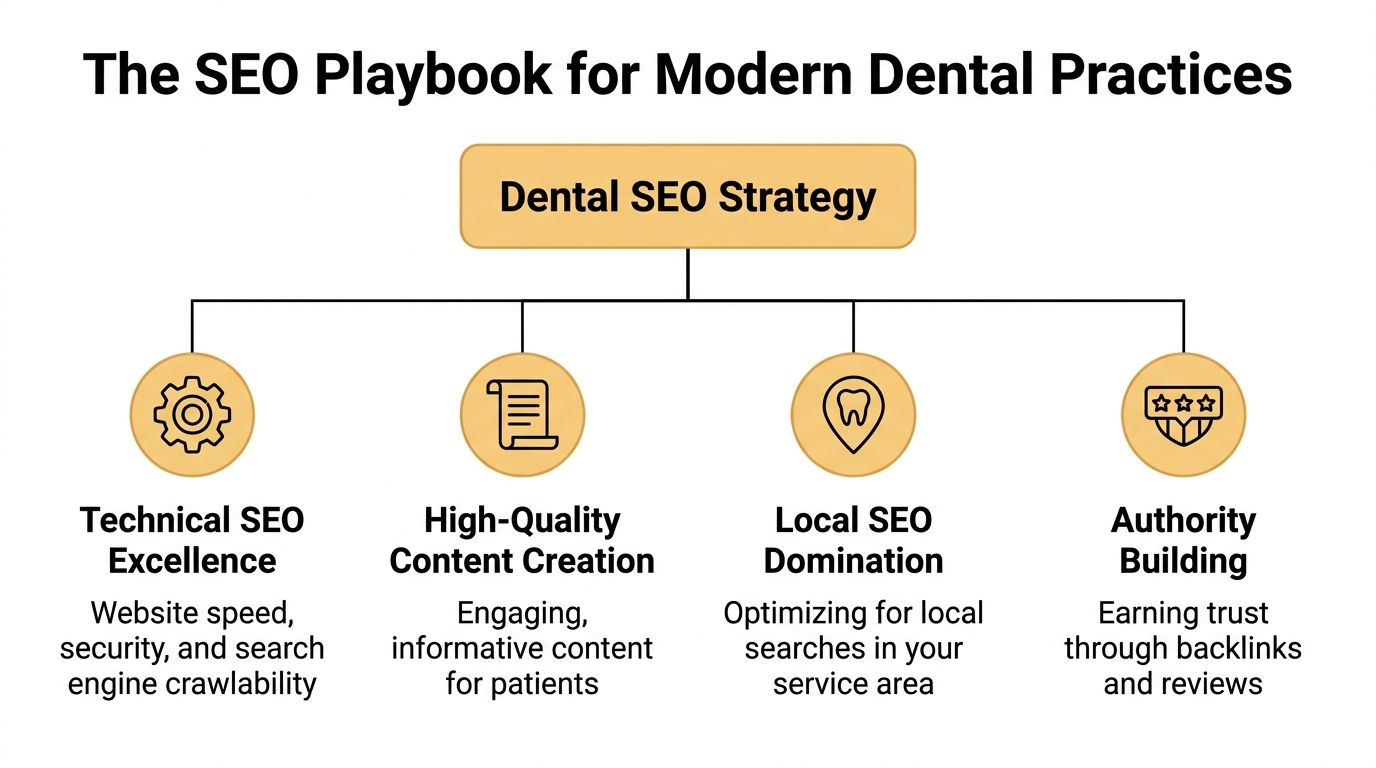
Local SEO dominance
For dentists, local SEO is often the shortest path from search to booked appointment. Many patients aren’t researching the entire field. They’re choosing from the few practices Google places directly in front of them.
The local pack matters because it compresses trust into a small space. Reviews, proximity, categories, and profile quality all influence whether someone clicks or keeps scrolling.
A serious local program usually includes:
- Google Business Profile refinement: Accurate categories, treatment-focused services, updated imagery, and complete business details.
- Location page development: Pages that serve real neighborhoods and service areas without duplicate, thin copy.
- Local citation cleanup: Removing conflicting listings that send mixed signals.
- Review operations: Building a repeatable process for gathering and responding to patient feedback.
For Omaha practices, this work often determines whether you become visible in your immediate service radius or stay buried behind offices with stronger local foundations. This guide to local SEO is relevant if your visibility problem is strongest in map results rather than your main website.
Technical SEO foundation
Technical SEO sounds intimidating because it’s usually explained badly. The simpler analogy is this: your website is a building, and Google is the inspector trying to find every room. If doors are jammed, hallways are confusing, and signs are missing, important pages get missed.
That’s why audits matter.
A concrete example comes from LinkGraph’s dental SEO research. One Denver dental clinic reduced crawl errors by 70% and saw a corresponding 23% increase in organic traffic after those fixes helped Google better find and rank service pages (LinkGraph).
That kind of work usually includes:
- Fixing crawl errors and broken pages
- Improving mobile performance
- Cleaning up duplicate content
- Strengthening internal links
- Adding schema markup, which is structured data that helps search engines interpret treatments, locations, and providers
Technical SEO doesn’t create demand by itself. It removes the friction that blocks your best pages from performing.
Content that converts
Dental content works when it meets the patient at the decision point. Generic blogging about oral health tips has a place, but it won’t carry the whole campaign.
A stronger content mix includes:
- Treatment pages: Veneers, implants, Invisalign, emergency visits, sedation, pediatric care
- Decision-support pages: Cost expectations, candidacy, recovery, comparisons
- Trust-building pages: Meet the doctor, technology, financing, before-and-after context when appropriate
Keyword selection matters here, but not in the old “stuff phrases into headings” way. The goal is matching what patients search for with pages that deserve to rank. If your team needs a clean explanation of search intent and topic planning, this piece on how to perform keyword research is worth reviewing.
Reputation management
Reviews influence both ranking strength and patient confidence. They also shape what happens after the click.
A practice with strong service pages and weak review signals often stalls at the exact moment the patient is deciding whether to call. A practice with a disciplined review process creates a compounding trust asset.
Good review strategy isn’t just “ask for more reviews.” It means asking at the right moment, making it easy, responding professionally, and using feedback to strengthen the patient experience itself.
Patients don’t read reviews like marketers. They scan for consistency, professionalism, bedside manner, and signs that the office runs on time.
The Critical Shift to HIPAA-Compliant ROI Tracking
Traffic reports used to satisfy practice owners. They shouldn’t anymore. If your agency can show visits, impressions, and rankings but can’t safely connect marketing activity to patient outcomes, you’re missing the most important part of the picture.
The issue is bigger now because search behavior is changing. Patients increasingly ask detailed, sensitive questions, including treatment concerns, scheduling constraints, and cosmetic preferences. In an AI search environment, those searches become more specific and more medically adjacent. That raises the stakes for how practices track leads and attribute revenue.
Why standard tracking can become a liability
A lot of marketing stacks were built for retail, not healthcare. They rely on pixels, browser-based attribution, and tools that were never designed with protected health information in mind.
That creates a problem. The same setup that helps a home services company optimize ad spend can expose a medical practice to risk if it captures or transmits the wrong data.
According to Fuel Online’s review of the market, as of 2026, fewer than 10% of dental SEO agencies explicitly detail their HIPAA-compliant tracking methods, leaving practices vulnerable to penalties that can reach up to $50,000 per violation, according to 2025 HHS reports (Fuel Online).
A modern dental seo agency should be able to explain, in plain language, how it handles:
- Lead attribution without exposing protected data
- Call tracking workflows for healthcare settings
- Server-side or privacy-first measurement
- CRM and scheduling integrations
- Reporting that ties marketing to patient value, not just clicks
If an agency gets vague when you ask how SEO performance is measured safely, that’s not a small red flag. It’s a competence issue.
What better measurement looks like
The goal isn’t to know everything about every patient. The goal is to know which channels and pages produce qualified opportunities, then connect those opportunities to business outcomes in a compliant way.
That often means lead-to-patient mapping built with privacy controls from the start. It also means selecting tools carefully. If your team is comparing options for phone attribution and workflow design, this review of call tracking software is a useful reference point before implementation.
One practical benchmark separates advanced agencies from presentation-heavy ones. They can tell you which treatments are generating calls, forms, and booked consultations, and they can explain how they collect that data safely.
This short video is a useful primer on the broader compliance mindset healthcare marketers need now.
For Omaha practices, local agency selection matters here. You want a partner that understands local search and healthcare privacy constraints at the same time. Up North Media is one example of an Omaha agency that offers SEO, web development, and AI consulting relevant to privacy-first measurement for service businesses, including healthcare-focused campaigns.
The right report doesn’t just say “traffic is up.” It shows which search-driven inquiries turned into real patient opportunities without creating compliance exposure.
Decoding Pricing and Measuring Real-World Results
SEO pricing feels confusing because the market mixes serious operators with cheap packages that look similar on paper. They aren’t similar in practice.
For most dental offices, the standard model is a monthly retainer. That structure makes sense because SEO compounds. Technical fixes, content publication, review growth, local signals, and reporting all need ongoing work.
What fair pricing usually looks like
In mid-sized U.S. markets, full-scope dental SEO services typically range from $1,000 to $2,500 per month according to 2740 Consulting’s dental marketing statistics (2740 Consulting).
That range usually covers core items such as:
- On-page optimization: Service pages, metadata, internal linking, and site structure
- Google Business Profile management: Keeping local information complete and active
- Content creation: Adding or improving pages that target real patient demand
- Backlink and authority work: Building relevance and trust over time
- Reporting: Tracking progress in a way ownership can use
In more competitive environments, costs can move higher. That doesn’t automatically mean overpricing. It may reflect a larger content workload, stronger link acquisition needs, more intensive technical remediation, or multi-location complexity.
The red flags are usually easier to spot than the fair deals.
| Warning sign | Why it matters |
|---|---|
| Guaranteed #1 rankings | No agency controls Google’s results with certainty |
| Very low monthly pricing | Cheap plans often skip technical work, content depth, or strategy |
| No discussion of goals | If they don’t ask what services matter most, they can’t build the right campaign |
| Ranking-only reports | Rankings matter, but they don’t pay staff or fill schedules by themselves |
What success should look like in practice
SEO reporting often gets padded with vanity metrics. Impressions can be interesting. Keyword counts can be interesting. Neither is the main thing a practice owner should care about.
The more useful measures are closer to the front desk.
Focus on questions like these:
- Are more new patients calling from organic search?
- Are more appointment forms coming from high-intent service pages?
- Are the inquiries for the procedures you want to grow?
- Is the local visibility improving for the neighborhoods you serve?
The reason this matters is simple. Search has a strong offline effect. 2740 Consulting reports that 78% of local mobile searches result in an offline visit, and patients are 37.7% more likely to click the top organic result than a paid ad in this context, which is why strong organic visibility can influence bookings well beyond the website itself.
A good agency translates SEO performance into business language. Which pages generated calls. Which services drew qualified leads. Which local areas improved. Where drop-off happened. What changed this month and why.
Don’t buy a stack of tasks. Buy a process that can explain how search visibility turns into booked treatment.
Your Vetting Checklist for Hiring a Dental SEO Partner
Most agencies sound competent on a sales call. The difference shows up in the questions they welcome and the clarity of their answers.
A dentist should interview a marketing partner the same way they’d evaluate a major software vendor or equipment purchase. You’re not buying promises. You’re buying judgment, process, and accountability.
Questions that reveal strategy quality
Start with business alignment. If the conversation stays generic, the strategy probably will too.
Ask:
- What would you need to learn about my practice before proposing a plan?
- How would you prioritize implants, family dentistry, cosmetic work, and emergency care if all matter to us?
- How do you adapt strategy for one location versus several locations?
A strong answer sounds specific. They should ask about service mix, geography, competition, existing website condition, review profile, and operational realities like scheduling capacity.
Questions that reveal technical depth
A lot of agencies outsource technical SEO or barely touch it. That can work for some industries. It’s weak for dental.
Ask:
- Do you perform a technical audit before or during onboarding?
- How do you handle crawl issues, duplicate pages, and location page structure?
- Who implements technical fixes?
You want to hear practical language, not jargon for its own sake. Agencies that do this well can explain technical problems in plain English.
Questions that reveal reporting discipline
Many deals go off the rails here. The agency reports on rankings. The practice owner wants to know whether the phone is ringing from the right patients.
Ask:
- What will your monthly report show besides rankings?
- How do you connect SEO work to calls, forms, and booked consultations?
- How do you handle compliance when tracking healthcare leads?
If they can’t answer the last question cleanly, keep looking.
Questions that reveal experience and honesty
Case studies matter, but not in the usual polished-slide-deck way. You want enough detail to understand what kind of problems they’ve solved.
Ask for anonymized examples and ask follow-up questions:
- What was broken when the campaign started?
- What changed first?
- What took longer than expected?
- What didn’t work?
Vendors with real experience rarely pretend every campaign was smooth.
Dental SEO Agency Vetting Checklist
| Category | Question to Ask | What a Good Answer Looks Like |
|---|---|---|
| Strategy | How will you align SEO with our highest-value services? | They ask about treatment mix, margins, seasonality, and growth goals |
| Local SEO | How will you improve map visibility in our service area? | They discuss Google Business Profile, reviews, citations, and location signals |
| Technical SEO | What technical issues do you typically find on dental sites? | They mention crawl errors, duplicate pages, mobile friction, and site structure |
| Content | How do you decide what pages to create first? | They prioritize patient intent, service demand, and conversion value |
| Reporting | What metrics will you report to ownership each month? | They focus on calls, forms, qualified leads, and business impact |
| Compliance | How do you track ROI in a HIPAA-conscious way? | They can explain the process clearly without hand-waving |
| Communication | Who will I speak with after the sale? | They define account ownership, meeting cadence, and escalation path |
| Proof | Can you show examples from healthcare or local service businesses? | They share relevant results and explain context, not just screenshots |
One final test helps a lot. Ask the agency what they would avoid doing in your market. Smart partners know which shortcuts create risk, waste money, or attract the wrong kind of traffic.
Local SEO in Omaha and Real-World Case Studies
Omaha isn’t the largest metro, but it’s competitive enough that local visibility can swing quickly toward the practices with stronger digital foundations. In this kind of market, good SEO isn’t about blanketing the internet. It’s about owning the searches that happen near your office, in the neighborhoods you serve.
That’s why local execution matters more than broad marketing talk. A practice can have a polished site and still lose if nearby competitors have cleaner local signals, stronger treatment pages, and a steadier review profile.
If you want a more city-specific view of what local competition looks like, this overview of local SEO in Omaha gives useful context.
What strong campaigns can produce
The upside of a well-run dental SEO campaign is large enough that it should be evaluated as a growth investment, not a line-item expense.
According to Embarque’s 2025 roundup, results from top agencies ranged from a 270% increase in organic traffic to a 5,191% ROI (Embarque). Those aren’t average outcomes for every practice, but they show what’s possible when strategy, execution, and market fit line up.
A few examples from that same body of case evidence make the point clearly:
- Advice Media: Reported a 5,191% ROI for Hampton Dental Associates through SEO and reputation management.
- WebFX: Reported a 3872% increase in organic sessions for Hurst Pediatric Dentistry using local SEO and custom content.
- Victorious: Reported 270% more organic traffic for Eden Health with technical SEO and content work.
- Thrive Internet Marketing Agency: Reported a 557% increase in monthly leads for a multi-location orthopedic practice, which is relevant because the same local service mechanics apply to larger dental groups.
- Cardinal Digital Marketing: Reported 130% year-over-year growth in organic visits for Made Ya Smile Dental.
The lesson for Omaha dentists is straightforward. The ceiling is high, but only when the agency does more than basic optimization. You need local strategy, technical cleanup, conversion-focused content, and reporting that ties the work back to appointments.
Big SEO wins usually look boring up close. Better pages, stronger local signals, cleaner tracking, and disciplined execution repeated month after month.
Frequently Asked Questions About Dental SEO
Do startup dental practices need a different SEO strategy?
Yes. A startup has to build the whole digital foundation, not just improve rankings. That usually means branding, website development, core service messaging, location setup, and local visibility work happening together.
First Page Sage notes that startups often require integrated creative services and may see 40 to 60% higher initial costs, but can achieve twice as fast patient growth with an integrated launch (First Page Sage).
An established practice usually has a different job. It already has brand recognition, some reviews, and an existing patient base. The challenge is often competitive map visibility, service-line expansion, or fixing years of uneven website decisions.
Can a dentist handle SEO in-house?
A dentist can handle parts of it. Many practice owners can help with review generation, service expertise, FAQs, and content approvals.
Doing all of it well is harder. Technical audits, local optimization, structured content planning, and compliant ROI measurement take time and specialized skill. The common failure mode is partial execution. The office publishes occasional blog posts but never fixes the deeper issues holding the site back.
What happens if we stop SEO later?
SEO doesn’t disappear overnight, but momentum slows when work stops. Rankings can hold for a while if your site is strong and competitors are inactive. They can also erode if others keep improving while your content, technical health, and local profile stand still.
The better way to think about SEO is maintenance plus growth. Once the foundation is built, the work becomes more strategic, but it doesn’t become unnecessary.
If your dental practice wants a clearer view of what’s working online, what isn’t, and how to track growth without creating compliance problems, Up North Media can help evaluate the current setup and map out a practical next step.