

You log into your Google Business Profile, glance at the basics, and everything looks fine. Your hours are there. Your phone number is right. You have reviews. Then you search for the service you want to rank for, and a competitor still shows up above you.
That gap is where most business owners get stuck. The profile doesn’t look broken, but it also isn’t pulling its weight.
That’s why google my business audits matter. A strong audit isn’t just a cleanup exercise. It’s a working diagnosis of how your profile, website, reviews, local landing pages, and competitor activity all connect. When we audit a profile properly, we’re not asking whether the listing exists. We’re asking whether every signal around it supports local visibility or weakens it.
Why Your GBP Audit Needs to Be More Than a Checklist
A lot of audit guides treat your profile like a sealed box. Check the hours. Add photos. Pick categories. Respond to reviews. That’s useful, but it’s incomplete.
Google evaluates your business in context. Your profile doesn’t sit alone. It connects to your website, your service pages, the language customers use in reviews, your category choices, and the consistency of your business information across the web. One source puts it clearly: “Google does not experience your business in isolated parts. It sees a network of signals... If those signals support each other, rankings tend to strengthen. If they conflict, local visibility becomes harder to sustain.” That’s the core problem many businesses run into after “optimizing” their listing, as explained in this discussion of the connected local entity ecosystem.
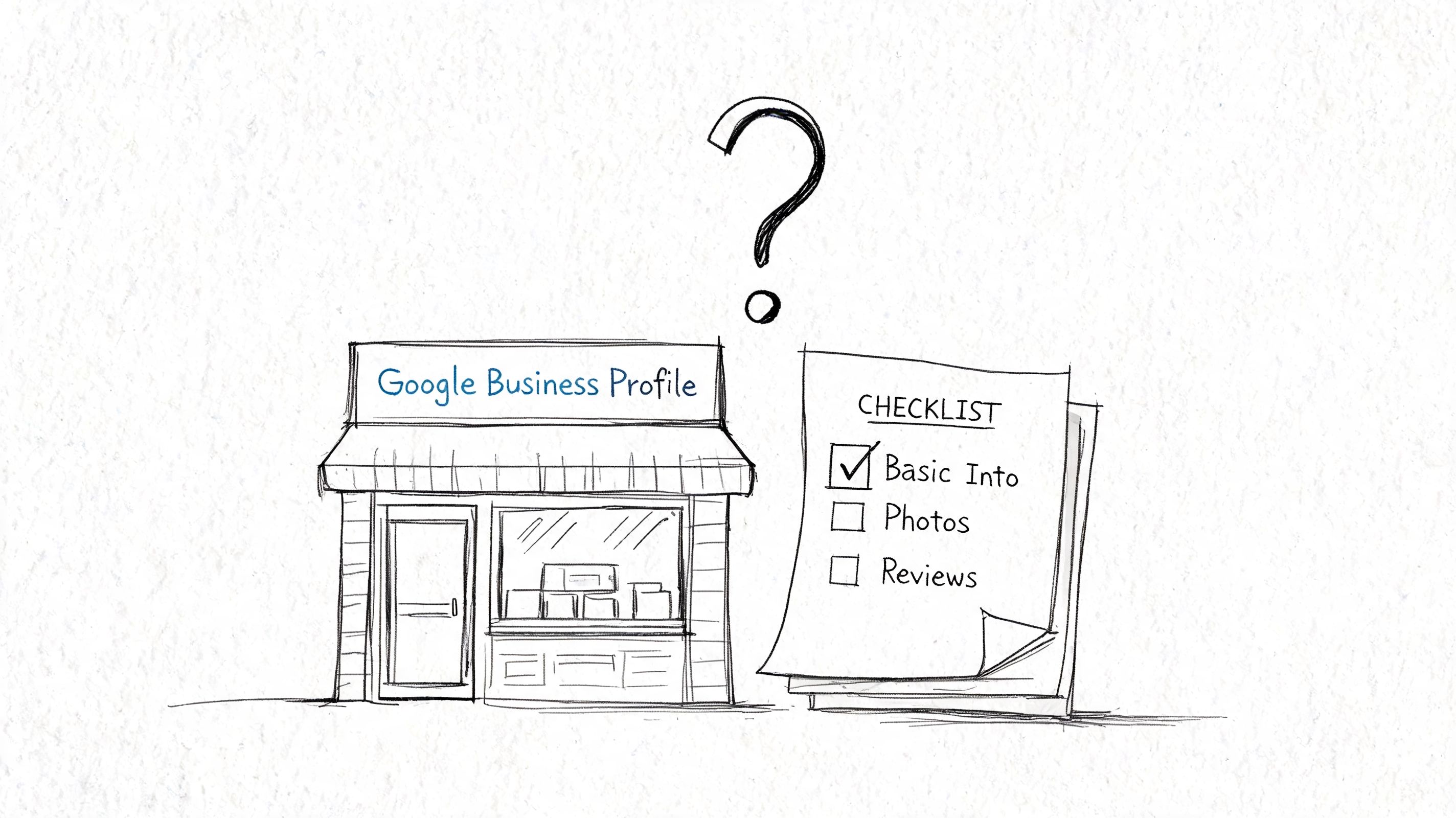
The profile can be right and still underperform
Here’s a common example. A business selects a category that matches its main service, but the website homepage talks mostly about brand story instead of the actual service customers search for. Or the profile highlights one service area while the location pages mention another. Google sees both signals. If they don’t line up, rankings become harder to hold.
That’s why a serious audit asks questions like these:
- Does your primary category match your main revenue-driving service
- Do your landing pages reinforce the same services listed in GBP
- Do customer reviews mention the services you want to be known for
- Do your business details match across your website and listings
- Does your profile send users to the right page, not just the homepage
Practical rule: If your GBP promises one thing and your website supports another, Google has no reason to trust the profile fully.
Think in systems, not fields
The businesses that get the most out of google my business audits stop thinking in terms of isolated fields. They think in systems.
A profile audit should connect directly to your broader local search strategy. If you want a deeper look at how those ranking signals fit together, this breakdown of the local search optimization algorithm is worth reading alongside your audit work.
The takeaway is simple. Don’t treat your profile as a standalone asset. Treat it like the front door to a larger digital presence. If that front door opens into a confusing, inconsistent experience, your rankings and conversions both suffer.
Your Foundational Audit from Top to Bottom
A business owner often opens their profile, sees that every field looks filled out, and assumes the foundation is fine. Then we compare the profile to the website, the map pin, the service pages, and the live customer experience, and the actual problems show up fast.
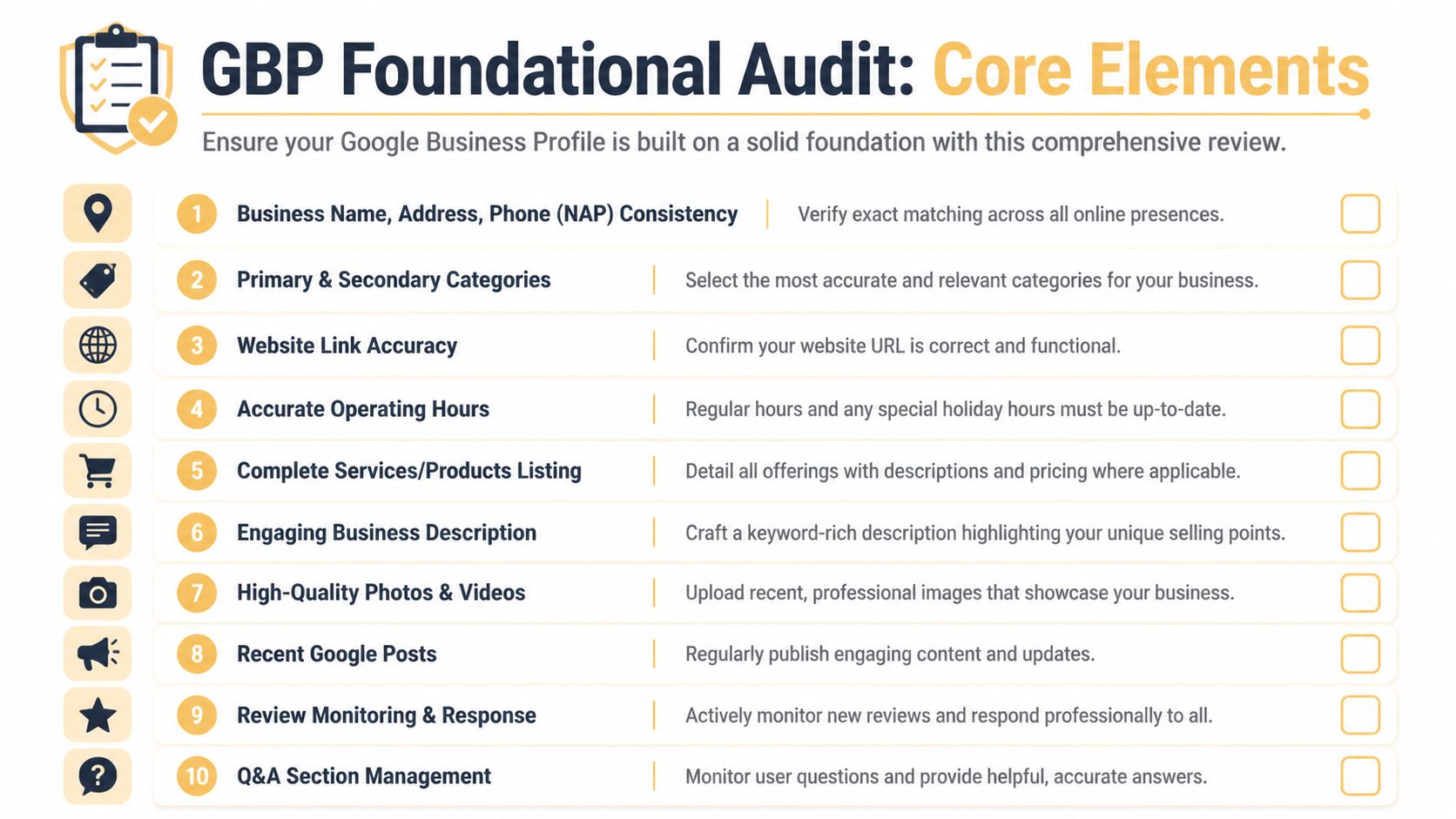
Start with the core details
Start with the fields that affect trust, contact quality, and local relevance right away.
NAP consistency comes first. Your business name, address, and phone number should match your website and major citations exactly. Small differences create confusion for users and make diagnosis harder. If rankings are soft, we need to know whether the issue is competition, weak website support, or inconsistent business data.
Then check the operating details that drive real customer actions:
- Business name should match the actual brand, without added keywords
- Address and map pin should send people to the correct entrance or storefront
- Primary phone number should reach the team that handles new inquiries
- Website URL should load properly and point to the best landing page for the main service
- Hours should reflect normal operations and holiday changes
Wrong hours create more than irritation. They lead to wasted trips, missed calls, and negative reviews from people who were ready to buy.
If you’re repairing an incomplete profile before you audit performance, our guide on how to set up Google Business Profile correctly gives you the right starting structure.
Categories and attributes define what Google should trust you for
Category selection is where many audits get shallow. Owners often choose a broad category that feels safe, then add secondary categories without checking whether the website, reviews, and service pages support those choices.
Your primary category should align with the service that drives the most revenue or the clearest local demand. Secondary categories should extend coverage carefully, not dilute the profile. If you’re a remodeling contractor but most of your qualified leads come from kitchen remodels, that distinction matters. Google uses category signals to decide when your listing is relevant. Customers use them to decide whether they should click at all.
Attributes deserve the same level of scrutiny. Accessibility options, appointment settings, service format, and business identifiers all help clarify what customers can expect. They also help separate your listing from competitors that look generic.
A practical audit question helps here. If a nearby competitor’s profile is more specific than yours, why?
Photos, services, and products need to match the real buying experience
A profile with a logo, one cover photo, and a vague service list usually underperforms because it leaves too much open to interpretation. Google wants confidence that the business is active. Searchers want proof that the business is legitimate and relevant to what they need.
Review this part of the profile with the website open beside it. The goal is alignment, not just completeness.
- Photo coverage: Include storefront, interior, team, equipment, finished work, and customer-facing spaces
- Photo accuracy: Remove images that no longer reflect the location, staff, or service quality
- Service detail: List specific services instead of broad labels like “repair” or “consulting”
- Product information: If products apply, include clear names, images, and short descriptions
- Landing page fit: Make sure the linked page supports the same service language used in the profile
The audit serves as a systems check. If your GBP lists “emergency plumbing,” but the linked page barely mentions it, the profile is sending a stronger signal than the website can support. That disconnect hurts rankings and conversions at the same time.
If you want another outside perspective on how to optimize Google Business Profile, that resource reinforces the same point. A strong profile is specific, current, and easy to verify.
What a solid foundation looks like
A strong foundational audit produces a profile that makes sense within seconds. The contact details are accurate. The categories match the business model. The services reflect what the company wants to sell. The photos support the in-person experience. The linked page continues the story instead of restarting it.
That last piece gets missed in a lot of audits. A Google Business Profile does not perform on its own. It performs as part of a local search system that includes your website, your reviews, your citations, and the way competitors are positioning themselves in the same market.
That is why we treat the foundational audit as the baseline for every later fix. Get this layer right, and the rest of the optimization work has something solid to build on.
Auditing Your Digital Reputation and Social Proof
Your profile tells people what you offer. Your reviews tell them whether they should believe you.
Many businesses misread their own position by focusing on the wrong metrics. They see a strong total review count and assume they’re competitive. In practice, the pattern of those reviews matters more than the trophy number at the top of the profile.
Review count is not the main metric
According to Search Engine Land, review velocity and recency are critical ranking factors, and a business with 100 recent reviews can outrank a competitor with 500 reviews if the latter’s are all from over a year ago. Their guidance also recommends tracking reviews per month against top competitors rather than staring at lifetime totals in isolation, as explained in this piece on GBP audit metrics for local rankings.
That changes how you audit reputation. You’re not just asking, “How many reviews do we have?” You’re asking:
- How many new reviews arrived recently
- How long has it been since the last review
- How does that pace compare with nearby competitors
- Are customers adding photos in reviews
- Are we responding to every review
A stale profile with a high lifetime review count often looks stronger than it is.
Read the review text, not just the stars
The written content of reviews gives you two kinds of insight.
First, it shows what customers value. If people repeatedly mention fast turnaround, friendly staff, or a specific service outcome, that language can sharpen your service pages and on-profile messaging.
Second, it reveals operational friction. If multiple reviews mention confusion about hours, delayed callbacks, or poor location signage, your audit has uncovered a conversion problem, not just a reputation problem.
Use a simple review-content scan:
- Recurring positives: Pull out phrases customers repeat naturally
- Recurring negatives: Group issues by theme, not by one-off complaint
- Service mentions: Check whether your key services appear in review language
- Photo reviews: Note whether customers are reinforcing your visual credibility
Your response habits are visible quality signals
Response coverage matters. The verified guidance in your brief recommends a target of 100% coverage for review responses. That doesn’t mean robotic replies. It means no review should sit unanswered, especially when a prospect is reading the profile and deciding whether you’re attentive.
Response quality matters too. Generic copy-paste responses don’t build trust. Short, specific replies do.
The same goes for the Q&A section. Many businesses ignore it until a bad or inaccurate question appears publicly. During an audit, review every question, answer what’s open, and add your own common questions when useful. This gives customers clarity before they call.
There’s one more operational note worth keeping in mind. Public visibility attracts spam as well as customers. If your team manages calls from the profile, this guide to Stopping Google Business spam calls in 2025 is a practical reference for separating real leads from junk outreach.
Using Diagnostic Tools for Deeper Insights
A manual audit catches obvious gaps. Diagnostic tools show you where the profile is performing well, where it’s underperforming, and where competitors are taking ground.

Start with GBP Insights
Your first stop is the native GBP dashboard. Look at search queries, calls, website clicks, direction requests, and photo performance. Those numbers won’t diagnose everything, but they tell you where customers are already engaging and where the profile may be under-converting.
Review trends over time instead of checking one isolated period. If calls are steady but direction requests are weak, your issue may be different from a business that gets visibility but few actions at all.
Native Insights are useful for self-assessment. They’re weaker for competitor benchmarking.
Move from profile data to market data
Once you’ve looked at your own profile, you need to understand your actual ranking footprint. Geo-grid tools like Local Falcon or Places Scout help by showing how rankings change by location, block by block, around your service area.
That matters because local visibility isn’t uniform. A business may rank well near the office but disappear a few miles away where competitors have stronger review activity, category alignment, or proximity advantages.
A practical workflow looks like this:
- Check GBP Insights for your current action patterns.
- Run a geo-grid scan around your target service area.
- Compare top-ranking competitors at weak grid points.
- Match profile findings to website and review signals.
- Repeat the scan after major changes.
If you’re building out a broader toolkit for this work, this roundup of SEO software options can help you sort through what’s worth using regularly versus what belongs in occasional audits.
Know what the tools can’t do
No tool replaces judgment. A geo-grid report may show a ranking drop in one area, but it won’t tell you whether the cause is weak service-page relevance, stale reviews, category mismatch, or stronger competitor momentum. The audit still requires human interpretation.
That’s why the best google my business audits combine platform data, competitor scans, and plain observation. You’re not collecting reports for their own sake. You’re building a clear diagnosis that tells you what to fix first.
Prioritizing Fixes with an Impact Matrix
A first audit usually leaves owners with an uncomfortable list. Ten fixes look important. Three do change performance this month.
That distinction matters because a GBP audit is not a cleanup exercise inside one profile. It is a systems check. If the profile, website, reviews, and local competitive signals are out of sync, the right order of fixes matters as much as the fixes themselves.
Use effort versus impact
We sort findings with a simple Effort vs. Impact matrix. It keeps teams from spending two weeks polishing low-value details while category problems, broken links, or weak service-page support keep holding the listing back.
| Priority Quadrant | Description | Example Tasks |
|---|---|---|
| Quick Wins | Low effort, high impact | Correct hours, fix website link, respond to unanswered reviews, complete missing attributes |
| Major Projects | High effort, high impact | Rewrite service pages to align with GBP, expand service menus, overhaul photo library, resolve location-level inconsistencies |
| Fill-Ins | Low effort, lower impact | Add a few extra profile details, refresh older post creatives, clean up minor formatting issues |
| Time Sinks | High effort, lower impact | Chasing low-value cosmetic edits before core relevance and trust issues are fixed |
The matrix only works if you judge impact in business terms, not in edit count. Fixes that improve trust, relevance, and conversion behavior belong first. Cosmetic improvements can wait.
What rises to the top first
In local SEO work, the first round of changes usually comes from a short group of issues that affect visibility and lead quality right away:
- Incorrect business details: wrong phone number, URL, hours, or map pin
- Weak category alignment: the primary category does not match the main revenue-driving service
- Thin service coverage: the profile mentions services the listing and website do not explain clearly
- Review response gaps: recent reviews sit unanswered, which weakens trust signals for prospects comparing options
- Profile-to-site mismatch: GBP highlights services or locations that the linked landing pages barely support
A useful action plan is short, ranked, and tied to outcomes.
We often tell clients to ask one question before touching anything: will this fix help Google understand the business better, help a searcher trust the business faster, or help the website convert the click? If the answer is no, it drops down the list.
Prioritize connected fixes, not isolated edits
Small edits often get overrated. Adding a few more photos can help. Updating attributes can help. But if the profile says one thing, the website says another, and reviews keep mentioning services you barely describe online, those lighter edits will not carry much weight.
A stronger sequence looks like this: fix accuracy issues first, tighten category and service alignment second, then improve proof signals such as reviews, photos, and response activity. After that, work on larger website support pieces if the profile is still outrunning the site.
That order keeps the audit tied to the whole local search system instead of treating GBP like a standalone asset.
Build a repeatable review cycle
Prioritization also needs a schedule. Businesses lose ground when they treat the audit as a one-time project, then leave the profile untouched while competitors add fresh reviews, update services, improve landing pages, and sharpen their categories.
A practical operating rhythm looks like this:
- Quarterly audit: review the full profile, website alignment, review themes, and competitor changes
- Monthly check-in: monitor reviews, Q&A, hours, photos, and core action trends
- After major business changes: revisit the profile after a move, rebrand, service expansion, URL change, or staffing shift that affects operations
We see the best results when owners stop asking, “What did we miss in the profile?” and start asking, “What is out of alignment across the profile, website, and market right now?” That question leads to better priorities, fewer wasted edits, and a GBP audit process that stays useful after the first pass.
Frequently Asked Questions About GBP Audits
How long does a thorough audit take
For a single-location business, a real audit usually takes longer than owners expect. If the profile is mostly clean, you can review the essentials in one focused session. If the website, reviews, categories, and competitor benchmarks all need attention, expect a deeper working session plus follow-up time to implement fixes.
The time isn’t just spent inside GBP. A proper audit also includes checking the linked site, reading review themes, and comparing your profile against local competitors.
Can you audit a service-area business without a public address
Yes. You can still audit categories, services, reviews, photos, hours, landing-page alignment, and response habits. The difference is that service-area businesses often run into more verification friction than storefront locations, so documentation and ownership control matter more during setup and maintenance.
You’ll also want to pay close attention to whether your service pages clearly support the areas and services your profile is meant to rank for.
How do you handle audits for multiple locations
Multi-location audits work best when you separate shared brand standards from location-specific performance. Core rules like naming, categories, website structure, and review response standards should be consistent. Photos, local landing pages, hours, and competitive conditions should be reviewed per location.
Don’t assume one strong location means the whole group is healthy. In multi-location environments, small inconsistencies multiply fast.
What if you find incorrect information you can’t change
Start by confirming ownership and user access. Then document the issue carefully, including screenshots and the exact field that needs correction. If the profile pulls in incorrect edits or conflicting public data, check whether your website and major listings are reinforcing the wrong information.
When a correction won’t stick, the issue often sits outside the profile itself. That’s another reason google my business audits need to connect profile review with the rest of your digital presence.
How often should small businesses really do this
If you’re an SMB with limited time, don’t wait until rankings drop. A quarterly deep review and a monthly check-in is a realistic operating rhythm for most local businesses. That schedule catches the issues that hurt visibility before they become expensive to unwind.
If you want a second set of expert eyes on your profile, website alignment, and local search performance, Up North Media can help you turn a one-time GBP review into a repeatable growth system. We work with businesses that need clearer local visibility, stronger SEO execution, and practical next steps they can easily implement.