

Most advice on Yellow Pages SEO is stuck in the wrong decade. It treats Yellow Pages like an old directory you either ignore or keep around out of habit.
That's bad local SEO.
For Omaha businesses, Yellow Pages search engine optimization works best when you stop thinking of it as an ad product and start treating it like a trust signal inside your broader local search ecosystem. Google doesn't evaluate your business in isolation. It looks for consistent business data across the web. A clean, claimed, well-optimized Yellow Pages listing can help confirm who you are, where you are, and what you do.
If your competitors are only polishing their Google Business Profile and ignoring citation quality, they're leaving an opening. This is one of those unglamorous local SEO tasks that still moves the right signals.
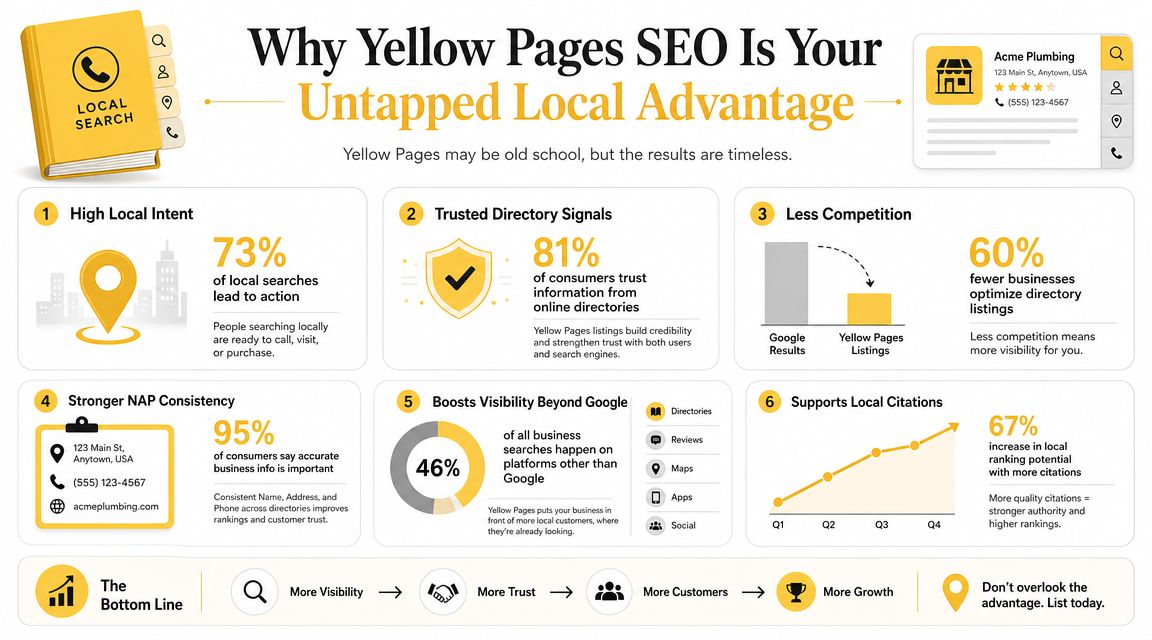
Why Yellow Pages SEO Is Your Untapped Local Advantage
A lot of business owners hear “Yellow Pages” and think “irrelevant.” That would be true if we were only talking about print.
We're not.
According to Jasmine Directory's analysis of Yellow Pages usage, print directory circulation in the United States declined from about 540 million in 2007 to roughly 75 million in 2024, while digital Yellow Pages properties like YP.com and Yellowbook.com collectively attract around 80 million unique visitors per month. That shift is exactly why Yellow Pages still matters. It didn't survive as a print habit. It adapted into a digital citation source that still carries weight in local discovery.
Why this matters to Google, not just YP users
When we work on local visibility, we're not chasing one directory's internal ranking. We're building consistency that search engines can verify. Yellow Pages profiles help reinforce your NAP data, business categories, and service language across the web.
That makes Yellow Pages useful in a way many business owners miss. It's not just a place where someone might find you directly. It's also part of the evidence Google can use to trust your local presence.
Practical rule: If a directory profile strengthens Google's confidence in your business identity, it's worth optimizing even if it isn't your biggest direct traffic source.
That's why Yellow Pages belongs in the same conversation as maps, citations, local landing pages, and your Google Business Profile. If you want a broader view of how these pieces work together, this guide on local search marketing is a useful companion.
Where businesses get this wrong
The common mistake is binary thinking. Some owners overvalue Yellow Pages and expect it to produce leads on its own. Others dismiss it completely because they aren't buying print ads or directory placements.
Both approaches miss the point.
Here's the better lens:
| Old view | Better view |
|---|---|
| Yellow Pages is outdated | Yellow Pages is a current citation source |
| It only matters if people browse the directory | It also matters because search engines validate business data |
| Set it once and forget it | Maintain it like any other local SEO asset |
For a local service company in Omaha, that can mean the difference between a listing that supports rankings and a listing that casts doubt. If your business name varies, your suite number is missing, or your phone number doesn't match other profiles, Yellow Pages stops helping and starts muddying the signal.
The opportunity is simple. Most businesses still don't manage directory data with much discipline. If you do, you gain an edge in the places Google uses to cross-check trust.
The Foundation of Claiming Your Listing and Ensuring NAP Accuracy
Before you optimize anything, claim the listing. If you don't control the profile, you can't correct bad data, remove weak content, or stop duplicates from spreading.
That part sounds basic, but it's where a lot of local SEO problems start. An unclaimed listing often contains an old phone number, an outdated URL, a former suite number, or a shortened business name that doesn't match your other profiles.
Claim first, then audit every field
Start by searching for your business on YP.com. If a profile already exists, claim it through the platform's ownership process. If no listing exists, create one carefully and match your core business data to your primary local records.
Use your official business name, your real-world street address, and your primary local phone number. Don't improvise. Don't “clean it up” differently on each platform. Don't add keyword modifiers to the business name unless they're part of the actual name you use everywhere else.
A practical benchmark comes from Search Engine Land's write-up on local data accuracy testing, which found that YP.com had the fewest duplicate listings among major services tested, and other directories like Superpages often beat Google Maps in overall data quality. That's why third-party directories matter. Google isn't always the cleanest record in the ecosystem.
What NAP consistency actually looks like
NAP stands for Name, Address, Phone number. In practice, consistency means your business appears the same way everywhere that matters.
Here's a simple mini-audit:
-
Name Use one version everywhere. If your business is “Acme Heating & Cooling,” don't alternate between “Acme Heating,” “Acme HVAC,” and “Acme Heating and Cooling Omaha.”
-
Address Match the street format you use on your site and major listings. If you have a suite number, include it consistently.
-
Phone Pick one primary local number for citations. Don't rotate between tracking numbers unless you know exactly how to preserve citation consistency.
-
Website URL Link to the canonical version of your site. Don't let one listing use the homepage, another use a parameter-heavy URL, and another use an old domain.
A citation shouldn't force Google to guess whether two listings represent the same business.
If you haven't locked down your Google listing yet, review this walkthrough on setting up your Google Business Profile. Your Yellow Pages profile should support that record, not conflict with it.
The duplicate listing problem
Duplicate listings are rarely harmless. One may have your old phone number. Another may show the wrong category. A third may exist under an earlier business name variation. Even if customers don't notice, search engines can.
Watch for these common duplicate triggers:
- Old business moves: You relocated, but an earlier address still lives on a forgotten listing.
- Name variations: One platform includes “LLC,” another doesn't, and another inserts a keyword phrase.
- Call tracking mistakes: A sales rep used a different number on one directory and never standardized it later.
- Franchise or multi-location confusion: Service areas and headquarters data get mixed together.
A claimed YP listing should become one of your cleanest, most stable citations. If it's accurate and aligned with your core business records, it helps search engines reconcile your identity. If it's inconsistent, it creates friction you don't need.
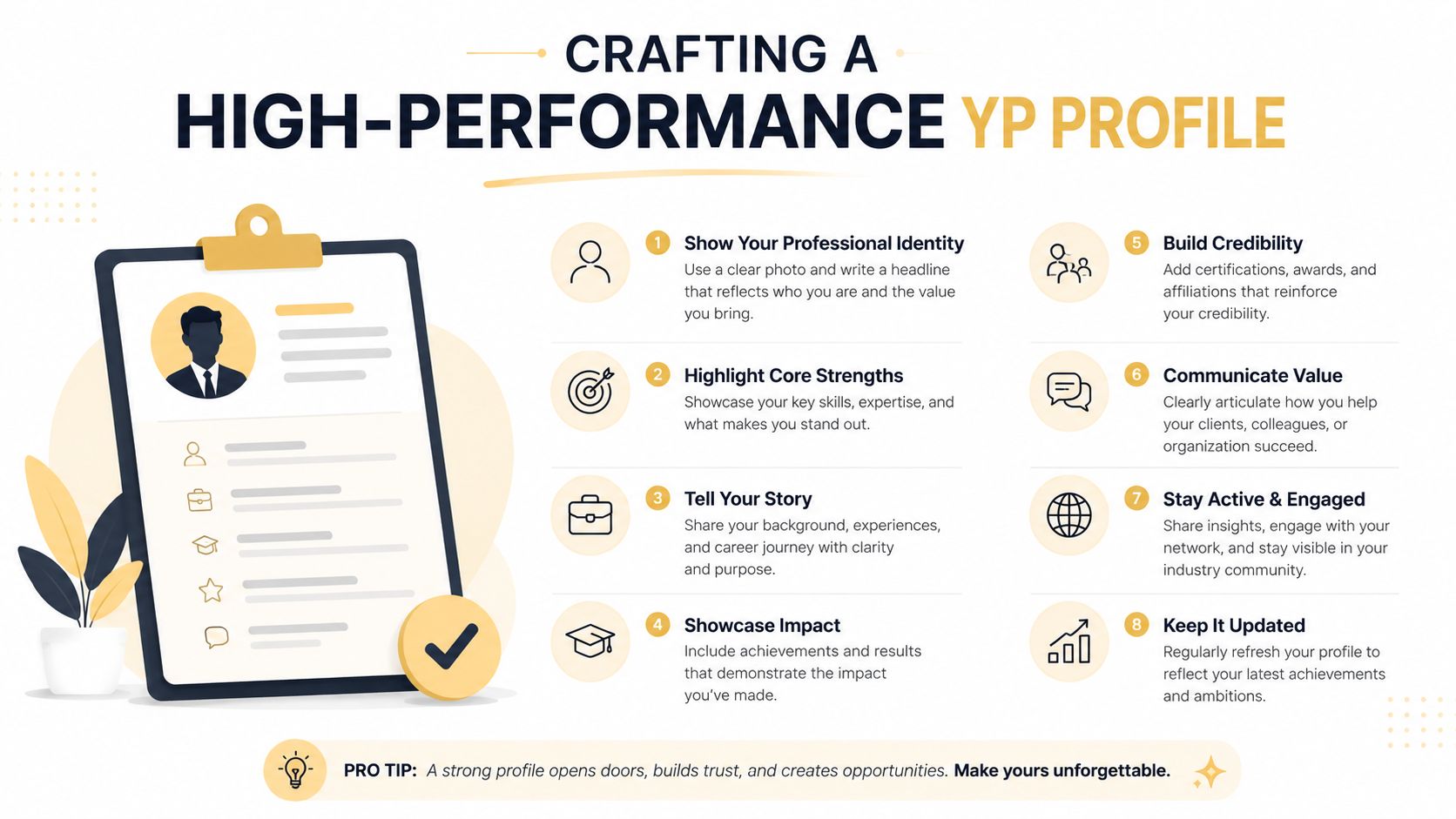
Crafting a High-Performance YP Profile
A claimed listing is just the starting point. The profile has to tell both users and search engines what you do, where you do it, and why your business is relevant for local intent.
The strongest Yellow Pages profiles don't read like placeholder directory text. They read like a controlled local asset built to support discoverability.
Build the profile around search intent
Yellow Pages' own SEO guidance, summarized in its explanation of SEO and optimization workflow, points to a practical process: standardize NAP data, match categories to search intent, rewrite the business description with local keywords, and keep the listing consistent. That's the right framework.
Most weak profiles fail because they're written from the owner's perspective, not the customer's search behavior.
A customer in Omaha won't always search for your exact company name. They're more likely to search by service, urgency, or location. Your profile should reflect that reality through category choices and business description copy.
Write a description that earns trust
Your description shouldn't be stuffed with repeated keywords. It should clearly explain your core services, the area you serve, and the problems you solve.
A strong description usually does three things well:
-
Defines the main service clearly Say what you do first. If you're a roofing contractor, lead with roofing. Don't bury it under generic marketing language.
-
Adds local relevance Mention Omaha or your real service area naturally where it fits.
-
Includes service detail List the types of jobs, specialties, or customer needs you handle.
Here's the difference:
| Weak description | Better description |
|---|---|
| We are a trusted business offering quality solutions for all your needs. | Omaha plumbing company handling drain cleaning, water heater repair, fixture installation, and emergency plumbing service. |
| Family-owned and committed to excellence. | Local HVAC contractor serving residential and light commercial clients with AC repair, furnace replacement, seasonal maintenance, and indoor air quality services. |
The second version gives both users and search engines something useful to work with.
What works: descriptive service language tied to a real place.
What doesn't: generic brand claims, keyword stuffing, or copied website copy pasted into every directory.
Choose categories with discipline
Category selection matters more than many owners realize. If your primary category is too broad or off-target, your profile can show up for the wrong searches or fail to reinforce the terms that matter.
Use this filter when choosing categories:
-
Primary category Pick the closest match to your main revenue-driving service.
-
Secondary categories Add closely related services only if they reflect real offerings.
-
Avoid category inflation Don't add every adjacent service just because the platform allows it.
A dentist shouldn't list unrelated cosmetic services unless they're core. A landscaping company shouldn't drift into home improvement categories just to broaden exposure. Relevance beats volume.
Use visuals like a proof layer
Photos matter because they reduce uncertainty. For local services, uncertainty kills conversion.
Upload images that confirm you're real and established:
- Exterior shots so customers can recognize the location
- Interior or office photos if clients visit in person
- Team photos that show actual staff
- Project photos that document completed work
- Vehicle branding if you're a field service business
Skip stock photography. Stock images make directory profiles look unattended or syndicated.
Link to the right page
Your website link shouldn't always default to the homepage. If Yellow Pages traffic is likely to arrive with a clear service intent, send users to the page that matches that intent.
For example:
| Business type | Better YP destination |
|---|---|
| One-location law firm | Practice area page or local office page |
| HVAC company | Main HVAC service page or Omaha service hub |
| Dental office | New patient page or services overview |
| Contractor with one specialty | Dedicated specialty service page |
That one decision improves user experience and creates a cleaner journey from directory click to conversion.
A high-performance profile is specific, complete, and aligned with the rest of your local presence. It doesn't try to do everything. It reinforces the exact signals you want Google to trust.
Leveraging Reviews for Trust and Visibility
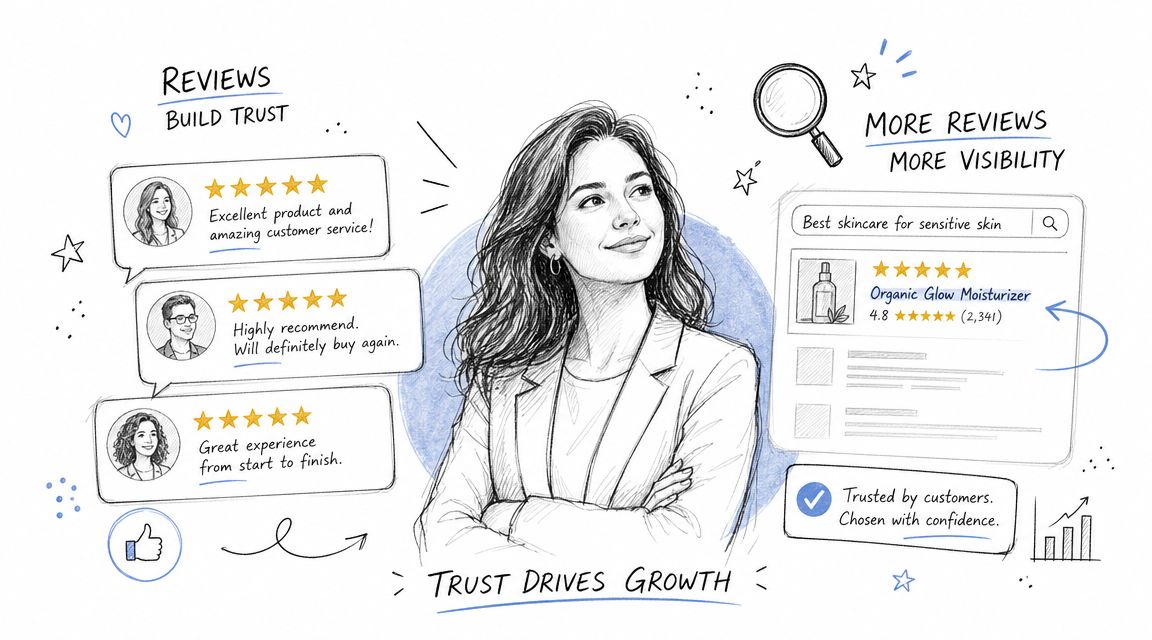
A Yellow Pages profile without reviews looks unfinished. A profile with recent, credible reviews gives people a reason to trust you before they ever reach your website.
Reviews also add something your static listing fields can't. They create fresh, user-generated proof around your services, responsiveness, and customer experience. That helps both conversion and visibility.
Ask for reviews in a way people will actually follow through on
Most businesses either never ask or ask too vaguely. “Leave us a review sometime” doesn't work.
You'll get better response when you ask right after a successful job, make the request personal, and send the customer directly to the review destination. If you want a practical framework for building a review request process, Raven SEO's review guide is worth reading. It focuses on Google reviews, but the principles carry over well to directory reviews too.
Good moments to ask:
- After a completed service call when the customer expresses relief or satisfaction
- After a successful install or project handoff when the result is visible
- After resolving a problem quickly when responsiveness stands out
Respond like a business owner, not a script
Review responses shape trust almost as much as the review itself. People don't just read praise. They look at how you handle feedback.
Here's a simple response framework:
-
For positive reviews Thank them, mention the service briefly, and keep the tone human.
-
For negative reviews Acknowledge the concern, avoid defensiveness, and move the resolution offline when needed.
-
For vague or suspicious reviews Respond professionally without escalating. If the platform offers a dispute process, use it.
A calm, specific response to a negative review often helps your reputation more than five generic replies to positive ones.
What hurts more than it helps
Some review habits create problems fast:
| Bad move | Why it backfires |
|---|---|
| Buying reviews | Patterns look artificial and damage credibility |
| Gating feedback | You lose authenticity and can create platform issues |
| Copy-paste replies | Customers can tell nobody is paying attention |
| Ignoring old reviews | The profile starts to look abandoned |
For local businesses, reviews should be part of operating discipline, not a campaign you run once a year. Ask consistently. Respond consistently. Treat the profile like an active public storefront.
That's what builds trust on the directory itself and supports the credibility of the entire listing.
Connecting YP to Your Broader Web Strategy
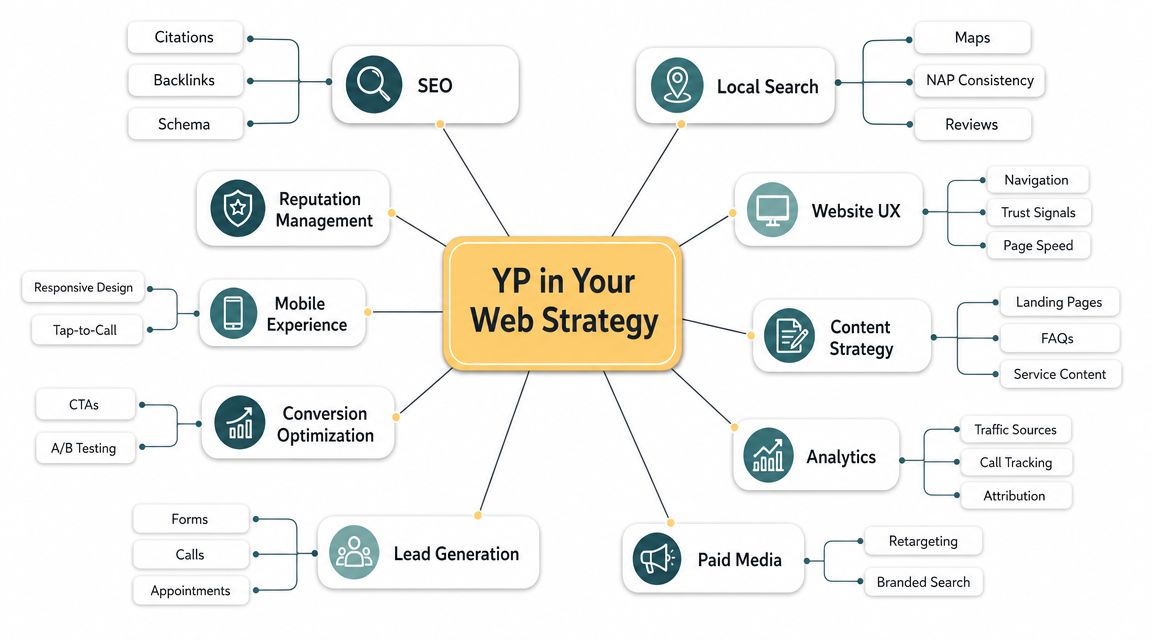
A Yellow Pages listing shouldn't sit off to the side as a disconnected citation. It should reinforce the same business identity your website, maps presence, and core local profiles are already sending.
That's where Yellow Pages search engine optimization gets more valuable. The listing becomes one node in a network of consistent local signals.
Send the listing to the page that matches intent
The website link inside your YP profile is one of the easiest places to tighten alignment. If your directory category and business description emphasize one core service, the destination page should continue that story.
Think in terms of continuity:
- The category defines the service bucket
- The description adds detail and location relevance
- The landing page proves the service, location, and next step
If those three pieces disagree, the signal weakens. If they align, you create a much cleaner path for both users and search engines.
Use structured data on your website
Schema markup helps your site label business details in a machine-readable way. You don't need to turn this into a technical science project, but you do want your site to present clean local business information that matches your citation ecosystem.
That usually means making sure your website clearly reflects:
- Business name
- Address
- Phone number
- Hours
- Relevant local pages
- Service information
If you use local business schema, the underlying business identity should match your authoritative profiles. Don't let your site say one thing while your directory listings say another.
Think in clusters, not listings
This is the shift many businesses need to make. Don't manage Yellow Pages as a standalone directory task. Manage it as part of a local trust cluster.
A healthy local cluster usually includes:
| Asset | Job in the ecosystem |
|---|---|
| Website | Primary conversion and authority asset |
| Google Business Profile | Core local discovery profile |
| Yellow Pages listing | Citation and trust validation source |
| Other major directories | Redundancy and data confirmation |
| Local landing pages | Geographic relevance and service depth |
Your directory listing is strongest when it confirms what your website and primary profiles already say.
What actually works in practice
For most Omaha businesses, the practical play is simple:
- Keep your YP profile fully aligned with your main business records.
- Link to the most relevant page on your site.
- Make sure that destination page reflects the same services and local signals.
- Review your citations when your phone number, address, hours, or branding changes.
What doesn't work is treating directories as isolated submissions you outsource once and never inspect again. Listings drift. Platforms pull data from old sources. Staff make edits without a process.
The businesses that stay visible usually aren't doing magic. They're maintaining consistency better than everyone else.
Measuring Success and Understanding True ROI
If you judge Yellow Pages only by last-click leads, you'll probably undervalue it. If you expect it to function like your primary acquisition channel, you'll probably overvalue it.
The right way to measure it is narrower and smarter.
According to this comparison of Yellow Pages and SEO performance, organic SEO leads are reported to convert at 14.6%, versus 1.7% for Yellow Pages advertising. That doesn't mean Yellow Pages has no value. It means you should treat it as one citation source inside a broader local SEO program, not the centerpiece of lead generation.
Measure direct traffic, but don't stop there
Track direct performance from your YP listing with tools you already use:
- UTM-tagged website links so Google Analytics can isolate visits from the directory
- Call tracking with care so you can measure calls without breaking citation consistency
- Dedicated form thank-you page tracking to see whether YP traffic converts
Then look one layer deeper. Ask whether the listing supports outcomes that don't always show up as obvious last-click conversions:
- Branded search lift
- Local pack stability
- Better citation consistency across the web
- Cleaner business identity signals
Use realistic success criteria
A Yellow Pages listing is doing its job when it contributes to trust, supports discoverability, and sends qualified local traffic to the right page.
Here's a grounded way to evaluate it:
| Metric type | What to look for |
|---|---|
| Direct | Visits, calls, contact actions from the listing |
| Assisted | Better alignment across citations and branded search presence |
| Strategic | Stronger local SEO foundation instead of dependence on one channel |
For a fuller framework on tying marketing activity to business outcomes, this guide on calculating marketing ROI is useful.
Most businesses don't need Yellow Pages to be their best lead source. They need it to be accurate, trusted, and integrated. That's where the ROI usually shows up.
If you want help turning Yellow Pages, your website, and your local search presence into one coordinated system, Up North Media can help. We work with Omaha businesses that need practical SEO strategy, cleaner local signals, and a digital foundation built to produce measurable growth.