
A lot of B2B owners are stuck in the same loop. They spend on ads, publish a few social posts, maybe sponsor an industry email, then review a report full of clicks and impressions that never turns into serious sales conversations.
The problem usually isn't effort. It's that the marketing playbook was built for attention at scale, while B2B buying runs on trust, timing, and relevance.
If you're selling software, professional services, manufacturing capacity, logistics support, or a specialized local service in Omaha, your buyer usually isn't one person. It's a group. One person cares about budget. Another cares about technical fit. Another wants less risk. Broad messaging misses all of them.
Digital marketing for B2B companies works when it stops chasing volume for its own sake and starts engineering the right conversation with the right account at the right time. That's what drives pipeline. That's what closes revenue. And for smaller firms, that's also what keeps marketing affordable instead of bloated.
Your B2B Marketing Is Not a Numbers Game
A familiar scenario plays out every month. A company runs paid campaigns, traffic rises, form fills come in, and sales says the leads are weak. Marketing says the campaigns are working because the dashboard looks active. Sales says none of it is helping close business. Both sides are looking at the same activity and reaching opposite conclusions.
That tension usually comes from using a B2C lens on a B2B problem.
A consumer brand can survive a lot of loose targeting if enough people convert quickly. A B2B company can't. If you sell a service with a longer sales cycle or a product that touches operations, finance, or IT, one unqualified lead isn't just harmless. It wastes follow-up time, burns ad spend, and clutters the pipeline with false positives.
B2B marketing fails when teams confuse attention with buying intent.
In practice, that means fewer things matter more. The right search query matters more than broad reach. One relevant landing page matters more than ten generic blog posts. A conversation with a decision-maker matters more than a spike in traffic from people who were never a fit.
What the wrong approach looks like
You can usually spot it quickly:
- Broad targeting: Campaigns go after an entire industry without separating buyers by role, urgency, or company fit.
- Generic messaging: The same headline tries to speak to the end-user, the operations lead, and the CFO.
- Shallow follow-up: A form fill gets one canned email and one sales call, then dies.
- Vanity reporting: Teams celebrate clicks, impressions, or follower growth while revenue stays flat.
What the right approach looks like
Strong digital marketing for B2B companies looks narrower and more disciplined.
- Accounts first: Start with the companies you want, not the channels you happen to like.
- Buying-group aware: Build messaging for multiple stakeholders, not one abstract “buyer.”
- Content tied to sales: Every page, ad, and email should help move an account toward a real conversation.
- Measurement tied to business outcomes: Marketing should help create pipeline, support close rates, and improve deal quality.
If that sounds less glamorous than “go viral,” good. Most B2B firms don't need viral attention. They need predictable demand from companies that can buy.
The Strategic Blueprint for B2B Marketing Success
Most B2B marketing problems start before anyone launches a campaign. They start when the company hasn't defined who it's really trying to win, how those accounts buy, and what each stakeholder needs to believe before a deal can move forward.
Salesforce puts it plainly in its guide to B2B digital marketing. B2B marketing performs best when teams treat the buying process as a multi-stakeholder system, map each role in the buying group, tailor content to the CFO, IT manager, and end-user, and use intent data to identify accounts already in an active buying window.
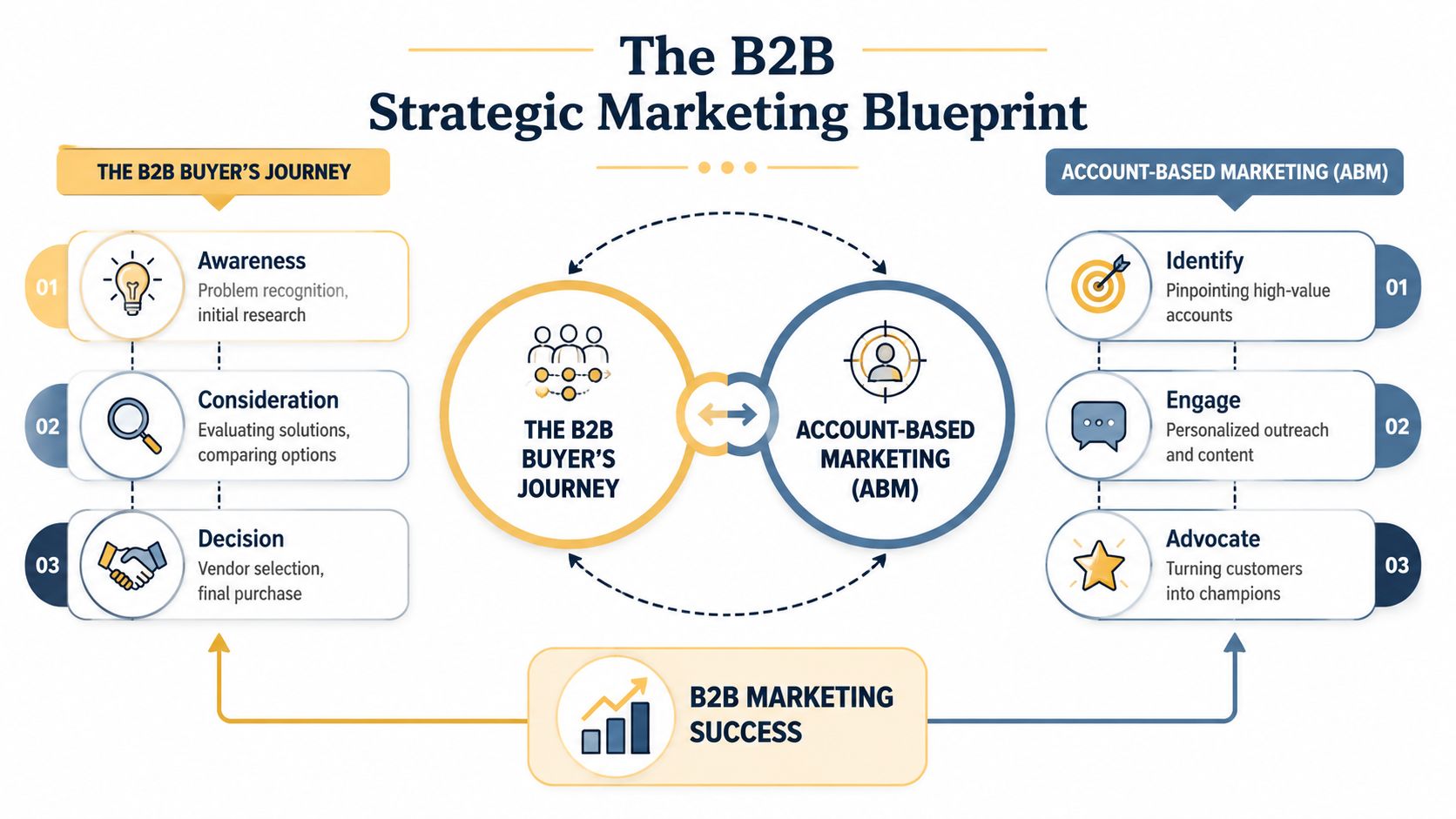
The buying journey is not one lane
A B2B buyer's journey is often described as awareness, consideration, and decision. That's useful, but incomplete. In practice, those stages happen across different people inside the same account.
The end-user may recognize the problem first. The manager compares vendors. Finance asks whether the investment makes sense. IT checks implementation risk. Procurement slows everything down near the finish line.
If your marketing only speaks to one person, you're not supporting the deal. You're supporting one fragment of the deal.
A practical way to map this is to build a simple grid.
| Buying stage | Stakeholder | What they need |
|---|---|---|
| Awareness | End-user or department lead | Clear explanation of the problem and possible approaches |
| Consideration | Manager or evaluator | Proof the solution fits workflow, team needs, and use case |
| Decision | Finance, IT, leadership | Confidence in cost, implementation, risk, and vendor reliability |
That table should drive your content plan, landing pages, outreach, and sales collateral.
ABM keeps focus where it belongs
Account-Based Marketing, or ABM, works because it forces discipline. Instead of asking, “How do we get more leads?” ABM asks, “Which accounts are worth winning, and what has to happen to win them?”
That changes behavior fast.
A broad lead-gen model treats every click as a possible opportunity. ABM treats a shortlist of accounts like strategic targets. Marketing and sales agree on the list. They define what a good-fit account looks like. Then they coordinate outreach, content, ads, and follow-up around those accounts.
Consider it a coordinated field operation. Random motion looks busy. Coordinated motion wins.
A simple blueprint for SMB teams
Small and mid-sized firms don't need a giant enterprise ABM program. They need a working version of one.
Use this sequence:
-
Choose target accounts Focus on fit first. Pick companies that match your strongest use cases, budget range, and service model.
-
Map the buying group List likely roles involved in a decision. For many B2B offers, that's some version of user, manager, technical reviewer, and financial approver.
-
Build role-specific messaging The CFO doesn't care about the same proof the end-user wants. Write for each one.
-
Match channels to account behavior Search captures active research. LinkedIn supports account targeting and visibility. Email keeps deals warm between touchpoints.
-
Set account-level goals Track movement inside named accounts, not just anonymous lead counts.
For teams building outbound around buying signals, this primer on predictable outbound pipeline is useful because it frames outreach around timing and relevance instead of pure volume.
Practical rule: If sales and marketing can't agree on the account list, no channel tactic will save the quarter.
Dominating Search with B2B SEO and Content
Search is where many B2B buying journeys begin, and it stays influential long after that first query. According to a 2024 survey cited by DBS, 57% of B2B marketers say SEO generates more leads than any other marketing initiative, and B2B companies generate twice as much revenue from organic search prospects compared to other channels in the same source summary on B2B marketing statistics and trends.
That matters because SEO in B2B isn't just a traffic channel. It's a trust-building system. It lets you show up when buyers are trying to understand a problem, compare approaches, justify a budget, or evaluate vendors.
A useful visual for that progression is below.
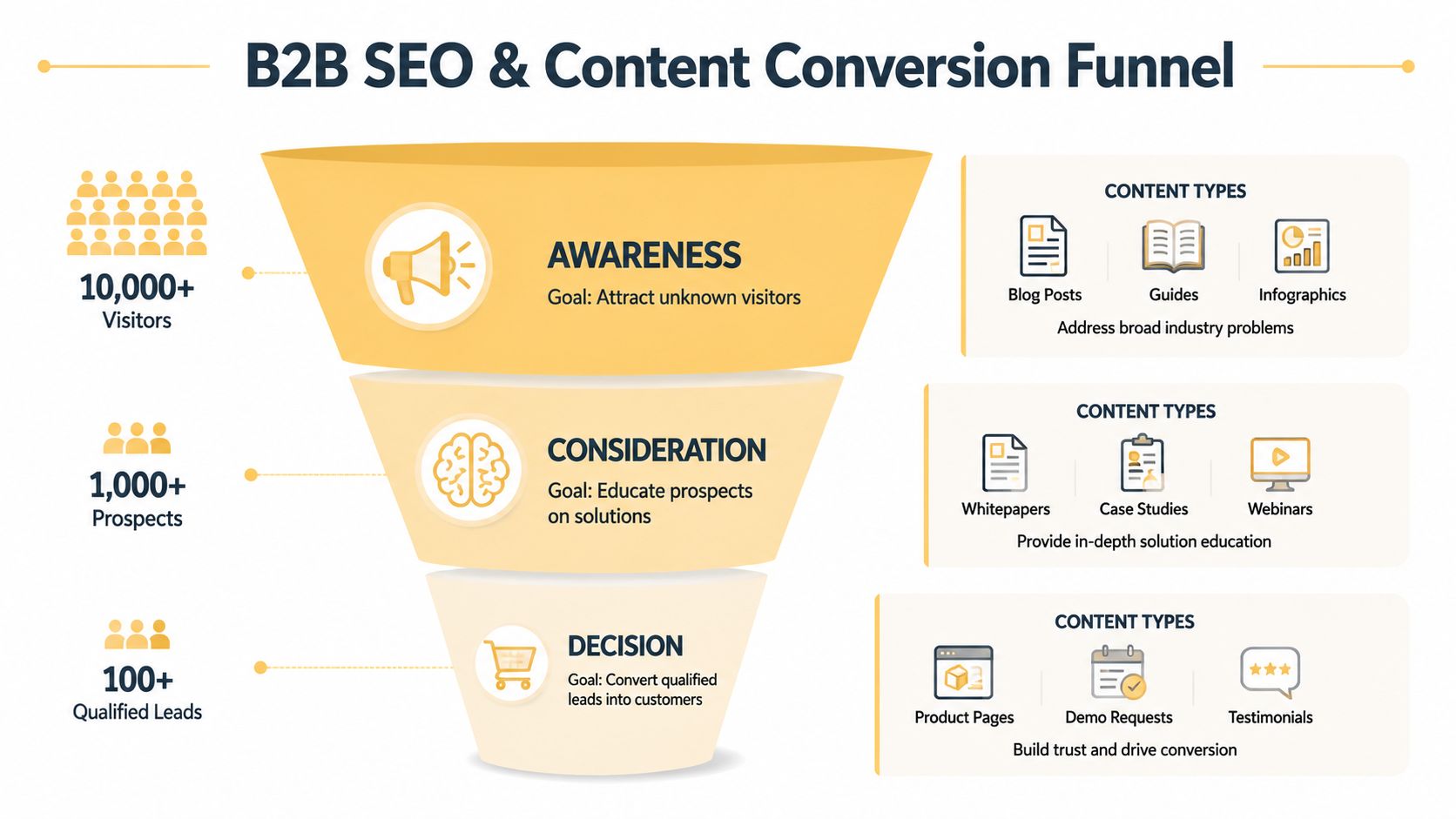
B2B SEO is about intent, not vanity traffic
Many companies sabotage their SEO by chasing the biggest keywords in the market. Those terms look exciting in a report and often produce the least useful visits.
B2B SEO works better when you prioritize search intent:
- Problem-aware searches: Queries from buyers trying to define or diagnose a business issue.
- Solution-aware searches: Queries comparing methods, platforms, or service categories.
- Vendor-aware searches: Queries that include competitor names, alternatives, pricing intent, implementation concerns, or specific service needs.
If your team needs a clean process for building that keyword list, this guide to keyword research basics is a practical place to start.
What strong B2B content actually does
The best B2B content reduces uncertainty. It helps a buyer answer one of four questions:
| Question | Content asset that helps |
|---|---|
| What problem are we solving? | Educational articles, industry explainers, trend analysis |
| What are the options? | Comparison pages, framework content, buyer guides |
| Why your solution? | Service pages, product pages, implementation pages |
| Why trust you? | Case studies, testimonials, process breakdowns, expert content |
That means “content marketing” isn't just publishing blogs on a schedule. It's creating assets that support real buying questions.
For example, a software company usually needs bottom-of-funnel content that handles objections. That might include competitor comparison pages, integration pages, security and onboarding pages, and content that explains how a tool fits into a team's process.
A digital publisher or content-driven platform has a different job. It often needs to build topical authority through deeper editorial coverage, hub pages, supporting articles, and strong internal linking around a core subject area.
Different B2B models need different content architecture
Here are two common patterns.
For software and service firms
The traffic goal isn't “more visits.” It's better-fit visits from people with commercial intent.
Prioritize:
- Core service pages: Each page should target one service or solution clearly.
- Comparison content: Alternatives, versus pages, and migration-related content often attract buyers already evaluating options.
- Objection-handling assets: Security, implementation, support model, pricing approach, and onboarding expectations.
- Sales-enablement content: Pages that reps can send during active deals.
For publishers and expertise-led brands
The goal is broader authority that compounds over time.
Focus on:
- Pillar pages: Broad, authoritative guides around core themes.
- Topic clusters: Supporting articles that answer specific questions and reinforce the pillar.
- Editorial depth: Content written by people who understand the subject, not generic AI filler.
- Conversion paths: Clear next steps from educational content into demos, consultations, or lead magnets.
Publish the page your salesperson wishes existed. That's usually the page your buyer is already trying to find.
A lot of teams also underestimate format variety. Search-driven content doesn't have to be only text. Product walkthroughs, webinar recaps, brief implementation videos, and visual explainers all help buyers absorb complex information.
One useful example is video embedded directly into high-intent content pages.
What doesn't work in B2B SEO
Several habits create activity without commercial return:
- Publishing broad blog content with no sales purpose
- Writing for keyword volume instead of buyer relevance
- Ignoring technical site structure and internal linking
- Letting service pages stay vague
- Creating content that speaks only to marketers, not actual buyers
Good B2B SEO is usually less flashy and more useful. It earns trust one query at a time, then hands sales a warmer conversation.
Targeting Decision Makers with LinkedIn and Paid Media
Search helps buyers find you. LinkedIn and paid media help you reach buyers you already know you want.
That's an important distinction. In B2B, you shouldn't rely only on inbound and hope the right accounts happen to discover you. Some of your best-fit prospects won't search for your service today. They still need to see your expertise, your point of view, and your relevance before an opportunity opens.
According to the verified data provided, 41% of B2B companies prioritize ABM, and the average B2B buyer conducts 12 online searches before interacting. That combination tells you something useful. Personalization matters, and buyers gather information across many touchpoints before they raise their hand.
Use LinkedIn as an account access tool
Most companies underuse LinkedIn because they treat it like a company news feed. That's the least valuable use of the platform.
For B2B firms, LinkedIn should support three jobs:
- Find stakeholders inside target accounts
- Distribute expertise where decision-makers can see it
- Open relevant conversations without sounding like spam
A strong LinkedIn motion usually includes both company activity and personal-brand activity from leadership, sales, or subject-matter experts. Buyers respond better to people with a clear perspective than to faceless promotional posts.
For teams trying to sharpen their execution, LinkedFuse's LinkedIn guide offers useful tactical ideas for profile setup, posting habits, and outreach structure.
What outreach should sound like
Bad B2B outreach sounds like a template. Good outreach sounds like someone did their homework.
That means the message should connect to one of these:
- A business trigger: new hire, expansion, product launch, territory push, or operational change
- A likely pain point: inefficiency, visibility gaps, outdated process, lead quality problem
- A relevant asset: article, checklist, short teardown, or use case page that helps the prospect think
You don't need to say everything in one message. The job of the first touch is usually to earn attention and credibility, not force a meeting.
Paid media should amplify, not replace, strategy
Paid media in B2B works best when it supports an existing account strategy.
That can look like:
| Channel | Best use in B2B |
|---|---|
| LinkedIn Ads | Promote role-specific content to target titles and industries |
| Paid Search | Capture active buying intent around solution and vendor queries |
| Retargeting | Stay visible to engaged prospects during long consideration windows |
This is also where content and targeting need to stay connected. Don't send a CFO to a generic blog post. Don't send an operations lead to a vague homepage. Match the ad to the question that person is already trying to answer.
For a broader playbook on building demand and sales conversations, this article on B2B lead generation strategies is worth reviewing.
If your paid campaign can't name the account, the role, and the next logical action, it's probably too broad.
What smaller firms should avoid
SMBs waste a lot of budget in paid media when they copy enterprise tactics without enterprise resources.
Avoid:
- Launching too many campaigns at once
- Sending all traffic to one generic landing page
- Boosting thought leadership with no follow-up path
- Treating LinkedIn as a pure awareness channel
A smaller Omaha manufacturer, software company, or B2B service provider usually does better with a tight list of target accounts, a narrow set of offers, and clean routing into sales follow-up than with a sprawling omnichannel experiment.
Turning Leads into Revenue with Email Nurturing
Most B2B leads aren't ready when they first convert. They download a guide, attend a webinar, connect on LinkedIn, or visit key pages, then disappear for a while. That's normal. The mistake is assuming silence means lack of interest.
Email nurturing exists for that middle ground.
Done well, email acts like drip irrigation. It keeps delivering useful value over time, without flooding the lead or drying up after one touch. The point isn't to “blast the list.” The point is to stay relevant until the account is ready to move.
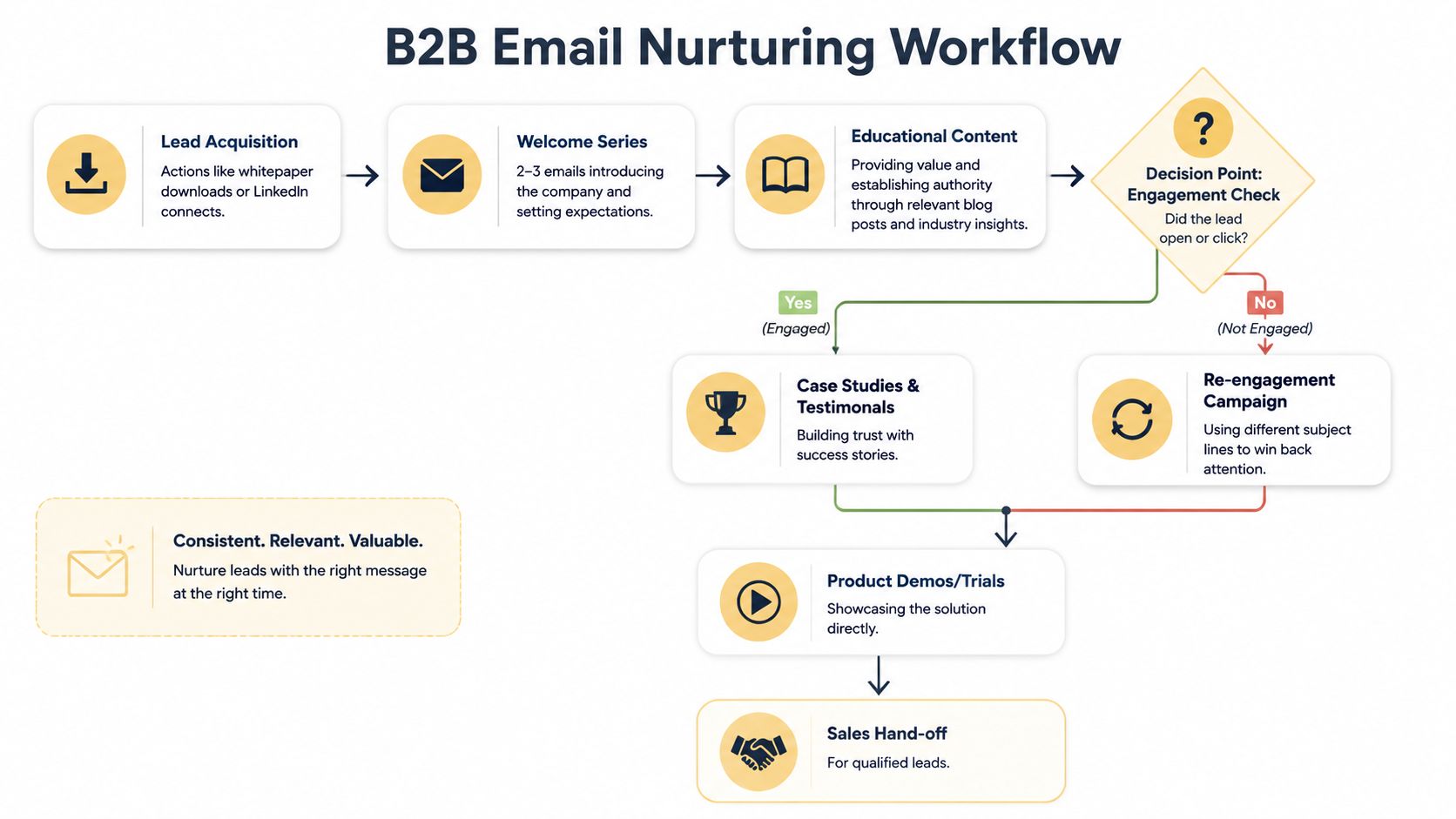
Build the sequence like a guided conversation
A nurturing sequence should feel like a knowledgeable advisor, not an autoresponder with a calendar.
A practical structure looks like this:
- Welcome email: Confirm what they requested, explain what they'll receive, and point them to one related resource.
- Problem-framing email: Help them understand the business issue more clearly.
- Solution education email: Outline approaches, trade-offs, or common mistakes.
- Proof email: Share a case study, process walkthrough, or testimonial-style asset.
- Decision email: Invite a demo, consultation, audit, or conversation tied to their likely use case.
Each message should earn the next one. If the first email is a hard sell, response quality drops fast.
Segment by behavior, not just source
A lead who downloaded a technical guide shouldn't get the same sequence as a lead who viewed your pricing or service page.
Useful segmentation can include:
| Segment type | Example follow-up |
|---|---|
| Content interest | Send related articles or deeper assets on the same topic |
| Funnel stage | Educational emails for early-stage leads, demo-oriented emails for high-intent leads |
| Role | Different proof for operators, technical reviewers, and finance stakeholders |
| Engagement level | Stronger CTAs for active clickers, softer re-engagement for quiet leads |
That keeps your email relevant without overcomplicating the system.
What good nurturing sounds like
The tone matters. B2B buyers don't want a fake “checking in” email every few days. They want help making sense of a purchase.
A few practical rules:
- Lead with usefulness: Give them an insight, framework, checklist, or example.
- Keep CTAs proportional: Early emails should invite learning. Later emails can invite meetings.
- Write like a human: Plain English beats formal brochure copy.
- Use sales handoff carefully: Sales should step in when engagement and fit both make sense.
“Send the next email only if it helps the buyer make a better decision.”
That standard keeps nurture campaigns from becoming noise.
What breaks email nurturing
Most underperforming nurture systems fail for ordinary reasons:
- Every lead enters the same sequence
- The emails talk only about the company
- There is no behavior-based branching
- Marketing never tells sales what the lead engaged with
- No one updates the sequence after launch
Think of the workflow as a living asset. Review where leads stop engaging. Watch which topics get clicks. Check which messages correlate with meetings, replies, or deal movement. Then refine.
For B2B companies with longer sales cycles, email is often where marketing proves it understands patience. Not passive patience. Structured patience.
Measuring Real Business Impact and ROI
A lot of B2B reporting is too shallow to be useful. It tells you what got seen, clicked, or downloaded, but not what changed pipeline.
That creates a dangerous illusion. The team feels informed because the dashboard is full. Leadership still can't tell which activity deserves more budget, which channel is creating sales-ready demand, or whether marketing is improving revenue quality.
Coegi's 2024 guide argues that B2B teams should align sales and marketing around business outcomes such as revenue and customer lifetime value, and use incrementality testing instead of relying on last-click attribution, especially in long B2B sales cycles. That's the key takeaway in its digital-first B2B marketplace guide.
Clicks don't equal commercial impact
Last-click thinking is one of the fastest ways to underinvest in the channels that influence deals.
A prospect may find you through search, read three articles over two months, see your brand on LinkedIn, join an email list, return through a branded query, and only then request a demo. If your reporting gives all credit to the final click, you won't understand what built the opportunity.
That's why B2B teams need a measurement model tied to buying progress, not just lead capture.
What to track instead
A practical B2B scorecard should connect marketing to revenue operations.
Focus on signals like these:
- Lead quality: Which sources create leads that sales accepts and works
- Pipeline contribution: Which channels influence opportunities that enter the pipeline
- Sales velocity: Whether qualified accounts move faster when exposed to the right content and follow-up
- Customer value: Whether acquired customers become durable, profitable accounts
- Incremental lift: Whether a channel changes outcomes compared with doing nothing
For teams working through finance-facing reporting, this guide on how to calculate marketing ROI is a useful reference point.
A simple framework for ROI conversations
When a CEO or CFO asks whether marketing is working, the answer shouldn't start with impressions.
Use a sequence like this:
| Question from leadership | Better B2B answer |
|---|---|
| Are we getting enough leads? | Are we generating the right opportunities from the right accounts? |
| Which channel is best? | Which channels influence qualified pipeline and closed revenue? |
| Should we raise spend? | Which activities show evidence of incremental business impact? |
That shift sounds small, but it changes budget decisions. It pushes teams to protect channels that warm demand, educate buyers, and improve close conditions, even if those channels don't always “win” in a simplistic attribution model.
How to make measurement operational
Good measurement depends on process, not just software.
Sales and marketing need to agree on:
- What counts as a qualified lead
- What account and contact fields must be captured
- How opportunity stages are defined
- How campaign influence gets logged
- How often teams review performance together
If those basics are messy, the dashboard won't fix anything. It will just display cleaner-looking confusion.
For a more SaaS-oriented take on proving commercial impact, this piece on marketing performance for B2B SaaS adds useful perspective around ROI discussions.
The real test of a B2B marketing program isn't whether it creates activity. It's whether sales would miss it if you turned it off.
What Omaha SMBs should keep in mind
Smaller firms don't need enterprise attribution machinery on day one. They do need discipline.
That means a shared CRM, consistent source tracking, defined handoff criteria, and regular review of which campaigns produce real conversations. A lean system that people use is more valuable than a complex system no one trusts.
Your Tech Stack and 90-Day Implementation Roadmap
Most SMBs don't need more tools. They need a smaller stack used well.
Bain notes that the SMB market is a major untapped opportunity and that go-to-market strategies need to be affordable and scalable, with the right blend of digital engagement, inside sales, and support economics, as outlined in its piece on selling to underserved small businesses. That applies directly to digital marketing for B2B companies. The stack has to support execution without creating overhead your team can't maintain.
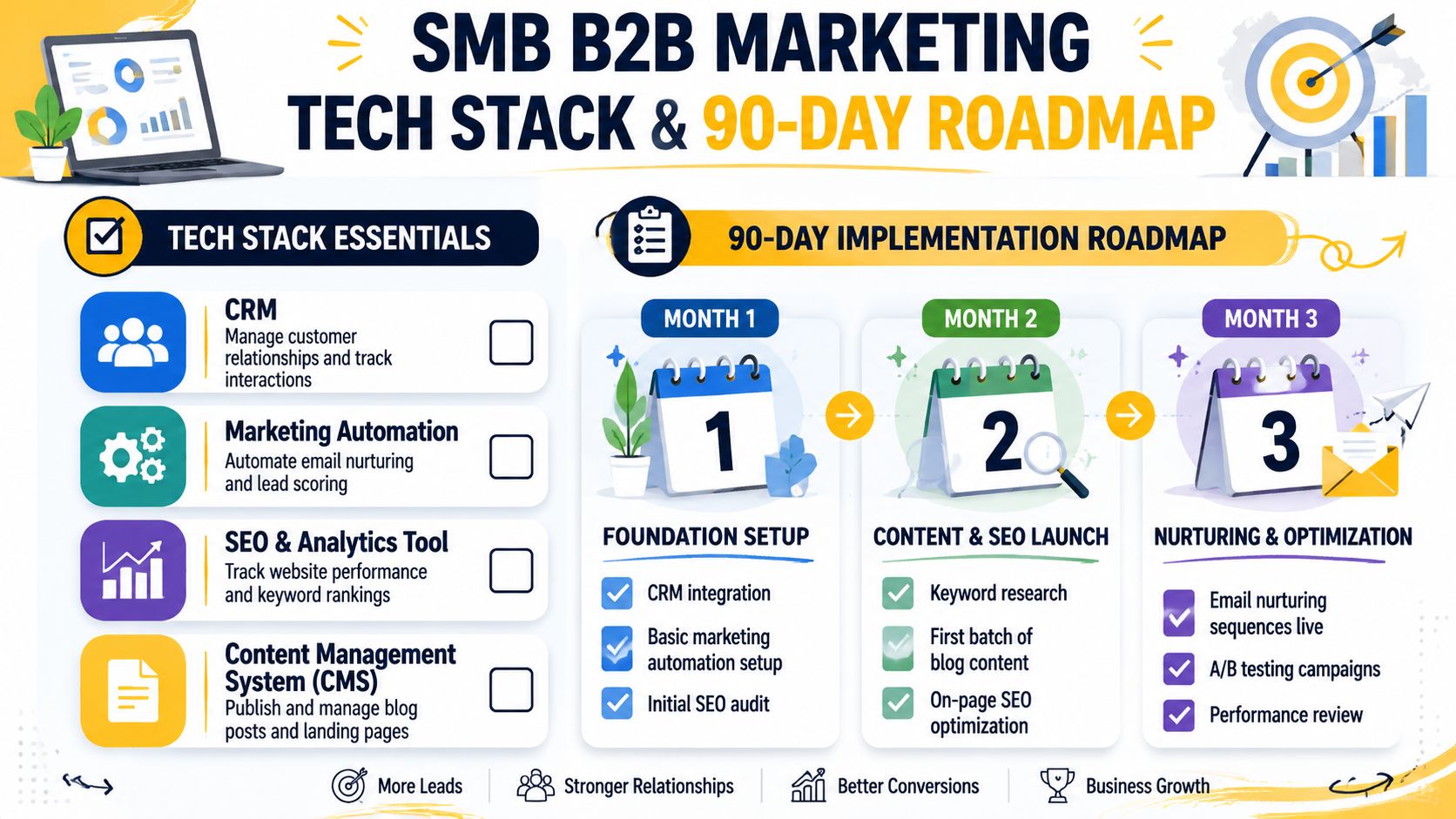
The core stack most SMB B2B teams need
Keep it practical. Four categories cover most of the work.
| Stack layer | What it does | Common options |
|---|---|---|
| CRM | Stores contacts, accounts, deal stages, and activity history | HubSpot, Salesforce |
| Marketing automation | Runs nurture emails, forms, workflows, and lead routing | HubSpot, Mailchimp for simpler setups |
| SEO and analytics | Tracks search performance, engagement, and conversion paths | Google Analytics, Google Search Console, Semrush |
| CMS and landing pages | Publishes service pages, articles, and conversion assets | WordPress, Webflow |
If the company also needs technical execution support, Up North Media is one Omaha-based option that works across SEO, web development, and AI consulting, which is useful when the marketing plan depends on both content strategy and site infrastructure.
A practical 90-day rollout
Don't try to fix everything in one sprint. Sequence matters.
Month one foundation
Start by getting the system ready to support serious marketing.
- Define the target account list: Even a modest, well-qualified list is enough to begin.
- Audit the website: Service pages, forms, analytics, internal linking, and conversion paths need to work.
- Set CRM rules: Standardize lifecycle stages, lead sources, and sales handoff steps.
- Clarify messaging: Write positioning that separates what the buyer cares about from what your company wants to say.
For an Omaha business, this often uncovers a common problem. The site speaks in broad, polished language but doesn't clearly explain who it's for, what problem it solves, or why a local or regional buyer should trust the team.
Month two content and demand creation
At this point, the market starts seeing the strategy.
Build:
- Core landing pages tied to your highest-value services or use cases
- Search-focused content based on high-intent questions and objections
- LinkedIn content from leadership or subject-matter experts
- Targeted paid campaigns only after the landing pages and message are ready
A local B2B software company in Omaha might publish role-specific pages for operations leaders, technical reviewers, and finance stakeholders rather than one generic product page. A manufacturing service provider might create content around turnaround times, quality control concerns, or onboarding logistics if those are the issues buyers care about most.
Month three nurture and measurement
This month turns interest into process.
Launch:
- Email nurture sequences tied to your main conversion points
- Retargeting or account-targeted paid campaigns for engaged prospects
- Regular sales and marketing review meetings to assess lead quality
- A lean reporting dashboard tied to qualified conversations and pipeline movement
By this stage, you should be able to answer simple but important questions. Which pages create meaningful inquiries? Which messages get replies? Which accounts are warming up? Which campaigns produce noise?
An Omaha-specific reality check
Omaha businesses often compete in a practical market. Buyers here tend to respond to clarity, responsiveness, and proof over flashy positioning. If you're serving regional firms, logistics networks, healthcare groups, local service operators, or B2B software buyers in the Midwest, your marketing doesn't need to sound trendy. It needs to sound competent and commercially useful.
That usually means:
- Plain-language messaging
- Fast follow-up
- Industry-specific content
- Pages built for real buyer objections
- A handoff between marketing and sales that doesn't break
The companies that win aren't always the loudest. They're often the ones that make it easiest for a buying group to understand the value, trust the process, and move forward without friction.
If your team needs a clearer system for digital marketing for B2B companies, Up North Media offers Omaha-based support across SEO, web development, and AI-enabled marketing operations. A practical next step is a consultation that maps your target accounts, channel mix, measurement model, and first 90 days of execution around pipeline goals.